




 text in
  English (pdf)
 Article in xml format
 Article references
 Automatic translation
 Send this article by e-mail
 Cited by SciELO
  Cited by Google
  Similars in
SciELO
Similars in
SciELO  Similars in Google
 Permalink

The order Stomiiformes comprises about 444 species in four families: Gonostomatidae, Sternoptychidae, Phosichthyidae, and Stomiidae. The family Gonostomatidae includes 33 described species, commonly known as bristlemouth fishes (Douglas et al., 2023). These are bioluminescent species inhabiting the meso- and bathypelagic zones of all oceans. Their bodies are laterally compressed and elongated, bearing 1 or more rows of photophores (Cervigón, 1996). Gonostomatids differ from other stomiiforms by lacking mental barbels, having well-developed gill rakers, a dorsal fin positioned at or just behind the midbody (anterior in Triplophos), sometimes with an adipose fin, and distinct rows of photophores along the body. They may have photophores on the isthmus but never behind the eyes (Harold, 1999).
In Venezuela, two gonostomatid species have been recorded: Sigmops elongatus (Günther, 1878), formerly Gonostoma elongatum, and Triplophos hemingi (McArdle, 1901). According to Cervigón (1996), “there are no data on their abundance and distribution” in the country; his records were based on four specimens of S. elongatus and one of T. hemingi, captured by the research vessel Dr. Fridtjof Nansen during its 1988 expedition within the UNDP/FAO project GLO/82/001.
The genus Sigmops is distinguished from other gonostomatids by the absence of elongate rays in the dorsal and anal fins; head and trunk of similar length to the caudal region; no photophores on the isthmus; 2 rows of photophores (lateral 11-21, ventral 32-34); and photophores near the symphysis of the lower jaw, the first 4-6 anterior to the pelvic fins forming an arch. Other features include uniserial palatine teeth, with a series of long, thin teeth interspersed with shorter and subequal teeth (Mukhacheva, 1972; Schaefer et al., 1986; Villarins et al., 2022).
Sigmops elongatus differs from congeners by having an adipose fin; anal- and dorsal-fin origins at the same level; small, paired fins; pectoral fin with 10-13 rays; dorsal fin with 12-15 rays; anal fin with 28-32 rays; pelvic fin with 6 rays; and 19-21 gill rakers. Photophores are arranged in two distinct rows (lateral and ventral), with 3 opercular photophores, 13-15 in the lateral series, and 20-24 in the post-anal ventral series, the ventral series has 41-43 photophores, with the first 1-2 of the lateral series elevated and the first 5-6 anterior to the pelvic fins forming an arch. Other diagnostic features include luminous glands: a large gland behind the orbital photophore, two infracaudal glands and 1-2 supracaudal glands. Maximum recorded size is 200 mm SL (Grey, 1964; Mukhacheva, 1972; Kenaley and Stewart, 2015; Villarins et al., 2022).
In the western Atlantic, only S. elongatus and S. bathyphilus (Vaillant, 1884) occur. The latter differs by having small, inconspicuous photophores, fewer anal-fin rays, and more gill rakers (Bigelow et al., 1964; Cervigón, 1976; Froese and Pauly, 2025).
On 19 March 2025, a specimen of S. elongatus was captured in a metal trap (2 × 1.65 × 0.86 m, 1.27 cm mesh, baited with sardines) at a depth of 574 m. The capture site was northeast of Chichiriviche de la Costa, La Guaira, Venezuela (10°35’09” N, 67°12’50” W), 5.2 km from shore.
The specimen (MMVPO-00020, Museo del Mar, Universidad de Oriente, Cumaná, Venezuela) measured 14.6 cm TL. Eye diameter was 17% of upper jaw length. Counts were as follows: dorsal-fin rays 14; anal-fin rays 31; pectoral-fin rays 11; pelvic-fin rays 8; caudal-fin rays 26; adipose fin present (2.1 mm). Photophore counts: ventral 41 (with 5 between pelvic base and anal origin, second and third post-anal elevated); lateral 14; none on the isthmus. Maxilla bore alternating long and short teeth; palatine teeth uniserial; total gill rakers 19 (Fig. 1A-D).
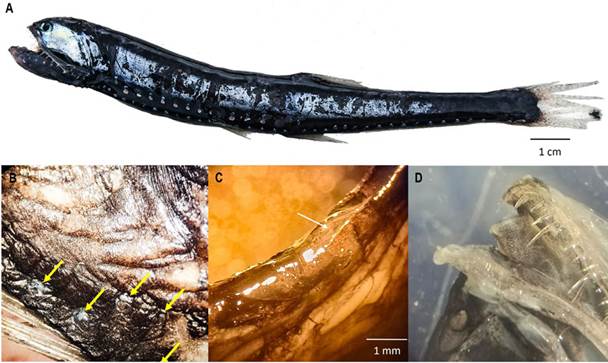
Figure 1 Sigmops elongatus. (A) General view of the specimen; (B) position of the first post-anal photophores; (C) adipose fin; (D) detail of the teeth.
Previous records of S. elongatus in Venezuela are scarce, largely unpublished, and mostly museum-based. The most recent was during the 1988 Nansen expedition, with earlier material from the 1960s-1970s (GBIF, 2025). An updated distribution map was prepared using GBIF data. The present record represents the southernmost locality in Venezuela and the first from the continental shelf. The nearest other coastal record lies 31 km offshore between Curaçao and the Paraguaná Peninsula, while the closest record in central Venezuela is 118 km offshore (Fig. 2).
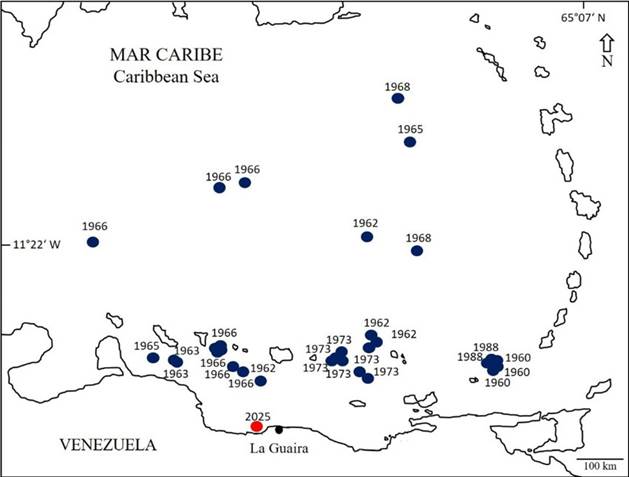
Figure 2 Distribution of Sigmops elongatus in Venezuelan marine waters. Previous records are shown in dark blue, and the new record in red.
The new specimen increases Venezuelan holdings of S. elongatus to nine: eight preserved at the Museo Marino de Margarita “Fernando Cervigón” from the 1988 Nansen expedition, plus the current specimen. Additional historical material (87 specimens, trawl-caught between 1960-1973) is housed in the Museum of Comparative Zoology (Harvard University), Field Museum of Natural History (Chicago), University of Florida, and Smithsonian National Museum of Natural History (GBIF, 2025).
This is the first record of S. elongatus in Venezuela obtained with a trap, using sardines as bait. According to Lancraft et al. (1988), S. elongatus undergoes extensive diel vertical migrations, occurring at 25-325 m at night and 425-725 m during the day, with larger individuals at greater depths. Feeding is cyclic, concentrated between 25 and 250 m at night, with a diet dominated by zooplankton, especially conchoecid ostracods and Pleuromamma copepods. As the trap was set for 24 hours, the specimen likely entered opportunistically during the daytime at 574 m.
Based on ichthyofaunal patterns, Cervigón (2005) defined 4 Venezuelan ecoregions: the Atlantic shelf, the highly productive northeastern shelf, the estuarine-influenced Caribbean zones, and the oceanic-influenced areas lacking strong upwelling or freshwater input. He included the central Venezuelan coast in the latter, noting its narrow shelf and affinities with offshore insular waters. Typical species include Prionace glauca (blue shark), Isurus oxyrinchus (shortfin mako), Isurus paucus (longfin mako), Alopias superciliosus (bigeye thresher), and Manta birostris (giant manta ray). The coastal occurrence of S. elongatus supports this classification and highlights faunal similarities between the central continental coast and oceanic islands.

