




 text in
  English (pdf)
 Article in xml format
 Article references
 Automatic translation
 Send this article by e-mail
 Cited by SciELO
  Cited by Google
  Similars in
SciELO
Similars in
SciELO  Similars in Google
 Permalink

INTRODUCTION
The genus Ophiocamax, originally described by Lyman (1878), is distinguished by the presence of numerous spine-shaped oral papillae arranged in a tuft. The tentacle scales are spine-shaped and blunt, usually occurring in pairs or triplets at each pore. The disc is dorsally covered with rounded, uniform, and thin scales, embedded with minute spines and hooks.
The genus currently comprises 11 described species: Ophiocamax applicatus Koehler, 1922, O. austera Verrill, 1899, O. brevicetra Baker, 1974, O. dominans Koehler, 1906, O. drygalskii Hertz, 1927, O. fasciculata Lyman, 1883, O. gigas Koehler, 1900, O. hystrix Lyman, 1878, O. nominata (Koehler, 1930), O. patersoni Martynov & Litvinova, 2008, and O. vitrea Lyman, 1878. Among them, O. austera, O. fasciculata, and O. hystrix can be found in the Caribbean and Gulf of Mexico (Alvarado, 2011; Stöhr et al., 2025). The type species of the genus is O. vitrea Lyman, 1878.
The fossil record of the genus (O. dorotheae Thuy, 2013) dates back to the Oxfordian stage (France and Switzerland) of the Upper Jurassic, approximately 161.5-154.8 million years ago. Ophiocamax hystrix was described by Lyman (1878) from seven specimens collected off Havana, at 320 m depth.
In Venezuela, studies on echinoderms have been scarce compared to other marine animal taxa (Lodeiros et al., 2013). According to Penchaszadeh (2003), the limited taxonomic and ecological information on echinoderms in Venezuelan waters represents a contradiction, considering their importance within coastal marine ecosystems. This knowledge gap is even more pronounced for deep-water species. Regarding ophiuroids, around 51 species have been recorded in Venezuelan waters, but only one belonging to the family Ophiacanthidae: Ophiocamax fasciculata (PérezRuzafa et al., 2013).
As part of the project “Evaluation of fishery resources captured in demersal zones of the mesopelagic oceanic layer off the central Venezuelan coast,” an outreach campaign was conducted among artisanal fishers of La Zorra fishing port (La Guaira), highlighting the importance of the study and its contribution to the knowledge of the biota of this unexplored area. The specimen examined in this study was collected at El Placer de Los Meros (La Guaira), using a trap net at 280 m depth. The specimen was deposited in the Marine Invertebrate Collection of the Museo del Mar, Universidad de Oriente (MMIEO), Cumaná, Sucre State, Venezuela. The taxonomic identification was carried out using the genus-level taxonomic key of Paterson (1985). In addition, the diagnoses provided by Lyman (1878), Verrill (1899a, 1899b), Paterson (1985), Borrero-Pérez et al. (2008), and Benavides-Serrato et al. (2011) were also employed.
TAXONOMY
Phylum Echinodermata Klein, 1778 (Ex Bruguiere, 1789)
Class Ophiuroidea Gray, 1840
Order Ophiacanthida O’Hara, Hugall, Thuy, Stöhr y Martynov, 2017
Family Ophiocamacidae O’Hara, Stöhr, Hugall, Thuy y Martynov, 2018
Genus Ophiocamax Lyman, 1878
Ophiocamax hystrix Lyman, 1878 (Figs. 1-2)
Ophiocamax histrix Lyman, 1878. Not accepted (orthographic error).
Ophiocamax hystrix Lyman, 1878: 232, pl. 1: figs. 13-15; Verrill, 1899a: 63; Verrill, 1899b: 354, 355; Paterson, 1985: 66, fig. 29; Borrero-Pérez et al., 2008: 177, fig. 5, D-F; Pawson et al., 2009: 1194 (list); Benavides-Serrato et al., 2011: 252-253, 3 figs; Solís-Marín et al., 2013: 627 (list).
Material examined. MMIEO-000032, one specimen, 17 mm disc diameter. Locality: El Placer de Los Meros, La Guaira, Venezuela (10° 48’ 5,30” N, 67° 12’ 8,70” W), February 22 2025, trap net, 280 m, Col. José Sandoval, Juan Rendón, Rhagi Ochoa, Argenis Salas and Yoján Mendoza (Fig. 1).
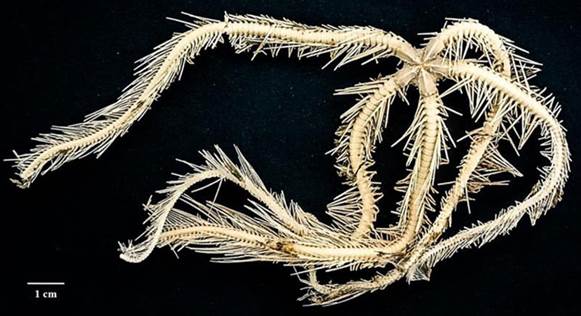
Figure 1 Ophiocamax hystrix Lyman, 1878. MMIEO-000032, dorsal view of the whole specimen (17 mm disc diameter).
Diagnostic characters
Spine-shaped oral papillae, numerous. Disc covered with large, highly irregular plates, bearing short, thick, strong spines surrounding the radial shields (Lyman, 1878).
Description
Disc robust and slightly elevated, with marked constrictions in the interradial areas. Aboral surface covered by well-defined plates with angular and irregular outlines, bearing some short, robust, sharp spines arranged around the large radial shields, with irregular angular shapes, wider distally, and separated by one or more scales acting as wedges. The dorsal region of the disc shows slight damage, possibly attributable to the collection method (trap net) (Fig. 2A). Oral shields small, slightly elevated, with an elongated lobe extending toward the interradial area. Inner angle blunt, lateral corners rounded, with a few granules distributed along the outer portion. Adoral shields large, broadly joined along the midline, connected to the first ventral plate of the arms (Fig. 2B, C).
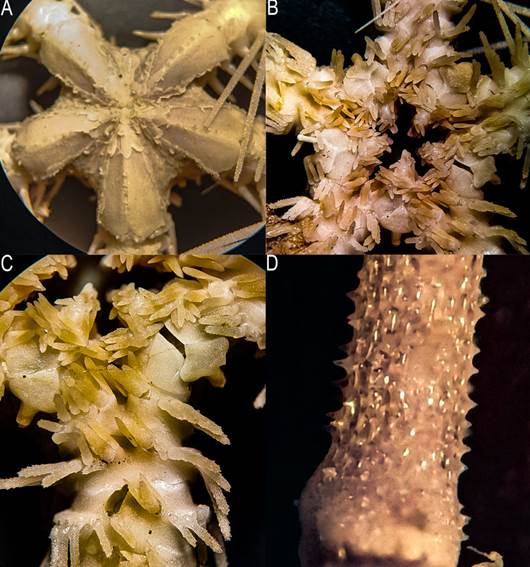
Figure 2. Ophiocamax hystrix Lyman, 1878. MMIEO-000032. A. Dorsal view of the disc showing radial shields and ornamentation. B. Ventral view of the disc showing mouth, oral shields, and adoral shields. C. Detail of oral plates and proximal spines of one arm. D. Detail of arm spine ornamentation, highlighting small glassyspines covering the larger ones.
Ventral arm plates noticeably wider than long, with an obtuse angle at the proximal edge, a slightly curved distal margin, and truncated lateral corners. Lateral arm plates prominent, projecting outward and nearly contacting each other in the ventral region. Dorsal arm plates slightly elevated, with a distal margin much wider than the proximal one and irregularly curved. Each arm with eight elongated, glassy spines, themselves covered with minute spines (Fig. 2D). Three large tentacle scales with a spinous surface.
Dimensions
Disc diameter of the examined specimen: 17 mm. Previously reported diameters range from 5 to 21 mm (Clark, 1941; Borrero-Pérez et al., 2008).
Geographic distribution
This species has been recorded from the Gulf of Mexico, Cuba, Barbados, the Bahamas, Puerto Rico (Lyman, 1882, 1883; Clark, 1915, 1941; Lalana et al., 2004), and Colombia (Borrero-Pérez et al., 2008). This constitutes the first record of the species from Venezuela.
DISCUSSION
This study represents the first report of Ophiocamax hystrix from Venezuela, thereby extending its known geographic distribution in the western Atlantic. The species had previously been recorded in the Gulf of Mexico, Cuba, Barbados, the Bahamas, Puerto Rico (Lyman, 1882, 1883; Clark, 1915, 1941; Lalana et al., 2004), and Colombia (Borrero-Pérez et al., 2008). This new finding is significant as it contributes to the knowledge of ophiuroid biodiversity in the region and provides a better understanding of the distribution of this family in deep waters. The morphological features observed in the collected specimen closely match those described for O. hystrix.
The depth of the present record (280 m) falls within the previously known bathymetric range for the species. Ophiocamax hystrix is closely related to O. fasciculata and O. austera. However, O. austera differs from O. hystrix by possessing rugose spinules on the disc, some short and others longer. Its radial shields are larger, more regular, triangular in shape, and connected without separation by scales. In addition, it bears seven or eight arm spines, specifically on the second and third vertebrae after the disc. Oral papillae, tentacle scales, and oral shields are very similar in both species (Verrill, 1899a; Verrill, 1899b).
On the other hand, O. fasciculata resembles O. vitrea and O. hystrix, but differs from them as it has nine arm spines and dorsal arm plates ornamented with fine granules. In contrast, O. hystrix bears eight arm spines, and its disc scales are thicker, with few short, robust, rugose spinules (Lyman, 1883). It is recommended to continue updating the catalog of echinoderm species in Venezuela, including both deep and shallow waters.

