




 English (pdf)
 Article in xml format
 Article references

 Automatic translation
 Send this article by e-mail
 Cited by SciELO
 Cited by Google
 Similars in
SciELO
 Similars in Google

 Permalink


Introduction
Dielectric oil is classified as a hazardous material according to the definitions EPA 40 CFR 260.10, 40 CFR 260.20-260.24 of the U.S. Environmental Protection Agency 8, Order MAM 304 de 2002 of the European Union 6 and Annex 1 of Decree 4741 de 2005 of Colombian environmental law. The oil is mainly comprised of naphthenic, aromatic and paraffinic hydrocarbons. With the continued use of these oils in power equipment like transformers and cables, a series of chemical reactions is created in which compound acids are formed and deposited into the mud, effecting the heat transfer from the equipment to the environment and diminishing the useful life of the transformer. Dielectric oil should accordingly be changed out to remain effective, but this is an expensive option, or it needs to be regenerated to eliminate impurities. In search for an adequate solution to the problem of waste generated in the regeneration of dielectric oil, the Universidad Nacional de Colombia Sede Medellín (National University of Colombia, Medellín Campus) has put forth various studies (1), (2 which have contributed to the success of the treatment system presented in this paper. An extraction with solvents technique is based on transferring the substance of interest from the solid to the solvent used in the washing as a comparatively affordable treatment 13. Different solvents, including organic solvents and surfactants, were evaluated in the treatment of soils contaminated with hydrocarbons. Vegetable oils were chosen as an environmentally friendly option due to their low cost, non-toxicity and biodegradability, and returned results equally efficient as those achieved with other solvents and surfactants. The fatty acids present in these oils acted similarly to the synthetic surfactants allowing for the strong sorption of hydrophobic compounds like polyaromatic hydrocarbons (PAHs) 7. Surfactants are chemical substances that are used as solvents in different washes. These solvents possess the capacity to modify their physiochemical properties depending on the medium in which they are found as their structures contain a hydrophobic, apolar, part as well as a hydrophilic, polar, part 4), (9. Their structural duality allows these solvents to orient themselves in mediums with different polarities and solubilize hydrophobic compounds. Biosurfactants also make up part of this group of substances. They are produced by different yeasts and bacteria with a variety of chemical structures from simple fatty acids to complex structures like glycolipids, lipopeptides, lipopolysaccharides and phospholipids 3. Low interfacial tension, critical micellar concentration (CMC) and stable temperatures are characteristics of these compounds 16. As well as lowering surface tension, surfactants also serve to increase the bioavailability of the contaminant targeted for extraction and solubilize the remainder left over in the solid. Soil characteristics such as pH, particle size, permeability, and absorbed contaminants are factors that affect the removal of contaminants 9. Choosing an adequate surfactant and applying it in the right concentration is therefore a critical factor in the implementation of remediation techniques and presents a significant effect in the efficiency and cost of treatment 16.
Preliminary study presented the following results: There is not a viable market solution for the treatment of hazardous waste in Colombia. The most commonly used management technique is incineration. Ignorance of the hazardous nature of dielectric waste products persists among certain managers and producers; they consider it harmless and innocuous 1. There is little knowledge of non-contractual civil liability standards, which opens the doors to possible lawsuits by potential victims of poorly managed hazardous waste, even when that management is carried out by a third party endorsed by environmental authorities. The production of this type of waste (Fuller’s earth contaminated with dielectric oil) is growing in Colombia because the energy industry is booming and will continue to do so unless a new technology for cooling and isolating power systems emerges. Businesspeople and entrepreneurs in the energy sector are becoming conscious that they should protect the environment and that their activities can negatively impact it, which is why they are open to the idea of alternative technologies for the treatment of dielectric oils that are both safe and affordable. The hydrocarbons that make up dielectric oil are considered hazardous because they have characteristics adverse to human and ecosystem health. Hexane is an organic solvent that possesses the physical and chemical characteristics suitable for extracting oil present in Fuller’s earth, although in Colombia, the Dirección Nacional de Estupefacientes (DNE; National Narcotics Directorate) restricts its use. Launching a treatment plant based on extraction with solvents requires the acquisition of special permits from the environmental authority in-charge which could be a limiting factor in the application of the proposed technology. The process of extraction with solvents cleans the contaminated Fuller’s earth, but the material is not fully recovered because of the loss of aluminum during ionic exchange.
The previous findings were taken into consideration in order to design a pilot treatment system for Fuller’s earth contaminated with dielectric oil that uses treatment methods alternative to incineration. The design included two sets of objectives. The first was to evaluate which solvent best removed the dialectic oil contaminant from the soil. Results from this part of the study show that extraction with industrial grade Ethanol (96% purity) removed the largest quantity of dielectric oil; the amount in the soil after treatment averaged 0.5ppm, the maximum value permitted by law (Resolution 1170 of 1997 of the Environmental Administration Department). Moreover, it was shown that extraction using Ethanol is economically competitive with incineration. The second objective was to design an economically viable treatment system capable of completing with incineration on the market. To that end, a pilot treatment system was built to test the treatment process 1kg of contaminated Fuller’s earth and evaluate the best alternative found in the reactor. Finally, a possible plan for full-sized treatment plant was proposed which would allow for the management of this type of hazardous waste in an economically competitive and environmentally safe manner.
The objective of this research was to develop a system for treating contaminated Fuller's earth using a dielectric oil extraction technique using solvents, ethanol and TRITON.
Materials and Methods
Materials and Reagents
The research methodology presents the treatment system for Fuller's soil contaminated with dielectric oil using an extraction with a solvent technique, Industrial grade Ethanol reagent and the surfactants TRITON X114 and TRITON X100. Industrial grade Ethanol reagent and the surfactants TRITON X114 and TRITON X100 were acquired at a local chemical product supplier. A KILL A WATT TM energy meter, Velp scientific analytical heating plate and a chronometer were used to build the pilot extraction system for 1kg of contaminated Fuller’s earth.
Analytical conditions
The determining factors that directly influence the physical and chemical properties of the solvent solution in the extraction process are shown. Temperature, this parameter is of utmost importance in the extraction process as it has been shown that the higher the temperature, the better the dielectric oil solubilizes 5), (1. In this experiment, therefore, temperatures were varied between the ambient temperature in the lab (approximately 22°C-24°C) and 70°C.
Surfactants
In previous studies about the cleansing of soils contaminated with hydrocarbons it was found that nonionic surfactants removed the greatest quantity of pollutants. These surfactants do not separate into ions once they are dissolved in water and their detergent action (solubilizing fatty substances) is much greater than cationic or anionic surfactants. The surfactants chosen for this analysis were TRITON X-100 (Phenoleoxylated octyl with a range of 9 to 10 moles of ethylene oxide) and TRITON X-114, both of which have been referenced in previous studies by 11 and 4. Surfactant of concentration is of vital importance as it relates directly to the amount of pollutants that can be removed in treatment. The surfactant removes hydrocarbons from the contaminated soil and has a direct impact on the costs of the process. Therefore, calculating the correct dosage of this compound is necessary to clean the soil efficiently from both a technical and an environmental perspective. Previous studies have found that surfactant concentrations do not need to be much higher than the critical micelle concentration (CMC) value. At this concentration, the surface tension of the water (in the case of water-based solutions) is constant, which indicated that higher values do not affect the surface tension of the solution. The CMC is an experimentally obtained value and varies for each type of surface, for which reason tests were conducted with values 100, 300, and 500 times the CMC value for each surfactant in accordance with previous research 4. The solvent-fuller’s earth ratio is very important in the treatment with surfactants, as seen in previous work by 11 and 4. The significance is due to the almost direct relation between the amount of solvent and the level of decontamination achieved. 4, for example, used ratios of 1:2, 1:5 and 1:8.
Ethanol
In previous works about extraction with ethanol found that ratios of 1:2, 1:4 and 1:8 were the most efficient, both in terms of costs as well as in removing the contaminant 1. Treatment time; 11 ran the process for 30 minutes. The proposed system was analyzed in relation to this time, graded above or below 30 minutes. Volatile Solids:Gravimetric determination of organic matter present before and after treatment was used to quantify the amount of dielectric oil present in the contaminated and decontaminated Fuller’s earth samples. Clean, unused Fuller’s earth was taken for a reference value where it was understood that all organic matter present in the soil was due to contamination with dielectric oil contamination. Methodology is described in regulation NEN 5754 (Determination of organic matter content in soil as loss-on-ignition, 1992) 10 for factorial experimental design and statistical analysis using Design Expert ® Software. Before rejecting (or confirming) one of the options first proposed in the study (decontamination with surfactants or extraction with ethyl alcohol), the treatment technologies were first evaluated at a laboratory scale through an easily implemented processing with a factorial experimental design. Soil samples between 10 and 20 grams were used.
Method with Ethanol and Surfactant
The designed consisted of 216 test runs with two replicas for each wash with a surfactant and 54 test runs for extraction with ethanol, also with two replicas. Finally, the results were analyzed with statistical software to identify a ratio that returns the highest rate of decontamination while considering the analyzed variables. The target removal rate was 5000 mg/kg, the standard rate specified by Resolution 1170 of 1997 the Colombian Department of Environmental Administration.
Washing with surfactants, in the experiments carried out with the surfactants TRITON X-100 and TRITON X-114, a control was needed to adequately establish the removal rate for every condition evaluated. The criteria used to determine if amount of contaminant removed from the Fuller’s earth met environmental norms was the amount of volatile substances remaining after treatment. If the Fuller’s earth after treatment contained the same amount of volatile solids as the clean, unused Fuller’s earth or less, it proved to be free of organic matter resultant of dielectric oil. Resolution 1170 de 1997 of Colombian environmental law requires that the amount of contaminant after treatment be less than 5000 mg/kg (it is worth noting that this norm refers specifically to soil contaminated with hydrocarbons, like Diesel, in service stations and not to Fuller’s earth). The amount of volatile solids remaining after treatment was chosen as the evaluation criterion because in previous experiments using an extraction with agitation methodology - centrifugation for total hydrocarbons in petroleum (THP) 12- it was found that the dichloromethane used to remove the hydrocarbons present in the treated Fuller’s earth also removed the soluble substances that were present in clean, unused Fuller’s earth. When carrying out the THP test as recommended by other authors, it was found that clean, unused Fuller’s earth also showed a THP value measurable by gravimetric methods. Therefore, it was decided that a volatile solids test as referenced in Regulation 10 would be a better choice. The volatile solids present in clean, unused Fuller’s earth with the same characteristics as that used in the experiment (a level of 4.6% p/p, manufacturer’s data) indicate that if the soil after treatment has a 5.1% level of volatile solids, it will meet the cleanliness requirement stipulated by law.
Results and Discussion
The results show that the washes with the surfactant TRITON X-114 were much superior in the removal of dielectric oil compared to the washes that used TRITON X-100. Although TRITON X-100 has a much lower cost than TRITON X-114, the surfactant did not meet the removal rates necessary to fulfill the legal stipulations. Therefore, only the results from the wash with TRITON X-114 are presented. If the amount of volatile substances was greater after treatment, where greater could be as little as 0.5% above the value found in the clean, unused soil, it was considered toxic. If toxic Fuller’s earth were to be dumped into a landfill, it would pollute the ground, making the surrounding soil toxic as well. The Figure 1A shows, the TRITON X-114 surfactant wash with a 1:8 ratio of soil to solution, at a temperature of 70ºC returned amounts of volatile solids under the 5.1% needed to meet the stipulations of Resolution 1170 of 1997. Yet, despite the results of using TRITON X-114, the cost per kilogram is approximately USD $12/kg plus tax, which renders its use cost prohibitive when compared to current incineration methods of disposal. To be clear, the cost of this product was not established until after the extraction tests were carried as the material was donated by a local supplier of TRITON X-114, elsewise the surfactant would have been discarded as a test option from the start. The result is interesting because this surfactant eliminates the need to work with organic solvents, which in and of themselves can present some risk. The only problem with the TRITON X-114 surfactant is its cost. Using TRITON X-114 is a very promising technique because it separates out both the TRITON surfactant and the dielectric oil during treatment and would allow for their reuse after. Treatment with TRITON X-114 is an innovative technology which shows promising results; however, it could not be analyzed in depth as it was outside range of this study. Yet, the subject remains open to future research inquiries.
Extraction with alcohol, despite the excellent results achieved when using TRITON X-114 as an extraction surfactant, the material was dismissed due to cost constraints. Consequently, the biodegradability analysis which is conducted to avoid moving contamination from one place to another was not carried out. Rather, efforts were focused on finding a more cost-effective alternative, which was ethanol (industrial grade, 96% purity). In the results obtained from the tests, high levels of removal were reached with an extraction time of 60 minutes. In Figure 1B, the relation between the response variable (volatile substances) and the independent variables are analyzed. When the experiment was run with the ethanol for 60 minutes at a temperature of 70 ºC with a soil to ethanol content of 1:8, a large part of the dielectric oil was removed from the Fuller’s earth, resulting in a 7.8% remnant of volatile solids. However, contrary to what the simple extraction with the surfactants, this sole wash (extraction) with ethanol did not reach the legally required 5.1% or fewer remnants for volatile solids. The ANOVA analysis for this experimental design is shown in Table 1. According to the table, the value of F in the model (44.45) in an indication that the proposed model is significant and the there is a less than 0.01% possibility that the large value of F in the model doe to noise. Values of Prob F less than 0.050 indicate the terms that are significant for the model; in this case A, B and C are significant terms. Values greater than 0.100 indicate that the terms are not significant in the model. If there are many insignificant terms in the model, it is recommendable to reduce the model to improve it.
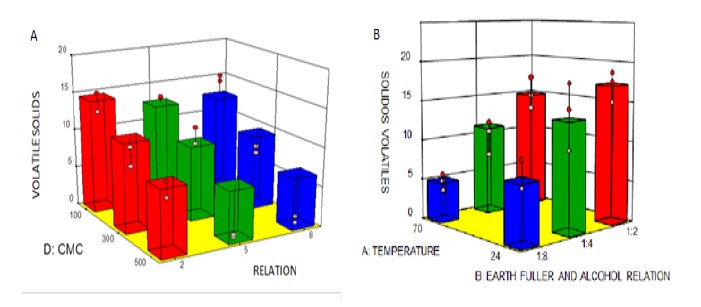
Figure 1 1A: Relation of the evaluated variables in the TRITON X-114 wash. 1B: Simple extraction with ethanol for a 60 minutes time period.
Table 1.Variance Analysis of Variance for Extraction with ethanol
| Source | Sum of the Squares | Grades of Freedom | half square | F Value | p Value Prob ( F |
|---|---|---|---|---|---|
| Model | 1064.07 | 5 | 212.81 | 44.45 | < 0.0001 |
| A - TEMPERATURE | 95.28 | 1 | 95.28 | 19.90 | < 0.0001 |
| B - Ratio of Fuller’s Earth to Alcohol | 903.29 | 2 | 451.65 | 94.33 | < 0.0001 |
| C - Time of Extraction | 65.50 | 2 | 32.75 | 6.84 | 0.0024 |
| Residual | 229.81 | 48 | 4.79 | ||
| Corr. Total | 1293.88 | 53 | |||
| Standard Deviation | 2.19 | R2 | 0.8224 | ||
| Mean | 12.65 | Adjusted R2 | 0.8039 | ||
| C.V % | 17.30 | Predicted R2 | 0.7752 | ||
| Press | 290.85 | Precision | 20.689 | ||
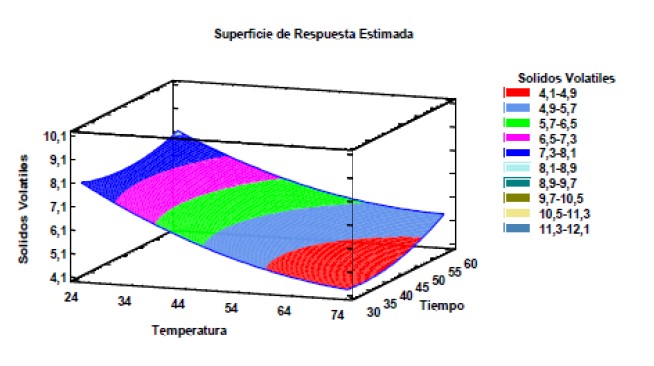
The predicted R2 and the adjusted R2 statistics are the same order of magnitude (0.7752 and 0.8039 respectively) and although they are not the highest values, they are adequate. The precision statistic measures the reaction between the sign and the noise in the model; relations larger than 4 are desirable. In this case, the precision statistic is 20.689 which indicates that the model is adequate for navigating the design space. The next step was to find the combination of variables in the extractions process with ethanol capable of returning an amount of volatile substances lower than the required norm for the treated soil. As seen in the variance analysis, all of the terms are significant, which means that all of the analyzed variables have direct impact on the removal of volatile substances from the treated soil. It was not possible to raise the temperature of the soil:alcohol mixture more than 78 ºC which is the boiling point for ethyl alcohol. Similarity, it was impossible to increase the soil:alcohol ratio, and the measure resulted too big for the pilot system’s equipment. Therefore, it was decided to increase the length of time for the reaction and to indirectly adjust the soil:alcohol ratio by doing a second wash in the best conditions returned from the first. With this technique, we were able to produce a larger ratio in relation to ethanol and treatment time. To do so, another factorial experimental design was proposed. Although the previous designed obtained the highest removal rate of volatile solids, at a temperature of 70ºC, in this new design, temperature as well treatment time again became variable due to their direct impacts on the energy consumption and operation costs of treatment. Figure 2 A shows the new relation obtained between the dependent variable, volatile substances and the independent variables of temperature and treatment time. The soil:ethanol ratio was held constant. With the new design, the average value for volatile solids remaining was 4.43% at an optimal point, a value that is below that required in the environmental regulations, which means that the process meets the objectives planted at the beginning from a technical standpoint. With the values found at the optimal point, a treatment time of 30 minutes, a Fuller earth:ethanol ratio of 1:8 and a temperature of 70ºC with a double wash, a pilot system was built and is pictured in Figures 1. After building the prototype, an experimental design was carried out to corroborate the results found at the laboratory scale. This design varied the agitation velocity between 14 and 24 RPM using Rouston or helical agitators. Response variables included energy consumptions, loss of solvent, net water consumed and volatile substances. These variables were necessary in the calculation of the costs of the treatment system. As seen in Figure 2 B , the new extraction system confirmed the optimal conditions found in the previous experiment. An agitation velocity of 24 RPM returns the levels of cleanliness required by environmental norm, where cleanliness is measured by the amount of volatile solids remaining (should be under 5.1% w/w). The best method is to use a helical agitation because this allows the solid to be stirred in the drying process, reducing the amount of solvent lost. Presents the results of the experiment including loss of solvent (minimal), energy consumption, water consumed in the evaporation and condensation system. Consumption of the new pilot system per kilogram of treated Fuller’s earth: energy consumption: includes stirring, pumping water for heating and cooling, evaporation of solvent and running vacuums 4.7 Kwh; Average value of los of solvent found in the system 0.2% v/v; Water consumption for the condensation of the solvent 10 lts. Table 2 presents the final equation in terms of coded factors, and Table 3 shows the final equation in terms of actual factors. For the alcohol treatment, temperature and the Fuller's earth:alcohol ratio were determined to be the most significant factors. In this case, the conditions under which the required removal levels were achieved were optimized. Based on the new experimental design, 4.34% volatile solids were obtained at the optimum point. This value is below the level required by environmental regulations. Figure 3 presents the response surface.
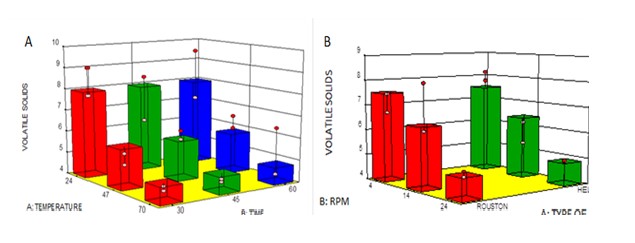
Figure 2A Double extraction using Ethanol. 2B: Relation between volatile solids, type of agitator and agitation velocity in the pilot extraction system.
The loss of solvent obtained in the tested process was within the interval of loss allowable for these types of processes. 14 Treated soil sample using extraction with solvents to recover soils contaminated with hydrocarbons. The authors found the optimal solid:solvent ratio for removing the contaminant and connecting the phases to be 1:3 wight/volume. The effectiveness of distillation as a technique to recuperate the used solvent is clearly seen, with a loss of only 10%. The extraction process is equally effective in removing the organic contaminants for both 14 and the extraction process here tested. In relation to the target criterium (a value of volatile substances equal to 5.1% or less of the treated Fuller’s earth), the process here developed presented a removal efficiency of 98%. To compare, 15 studied the removal of total hydrocarbons from petroleum (THPs) in a sandy soil contaminated with Diesel at a laboratory scale. They carried out the treatment in a continuous bioreactor reaching a removal rate of 91%. 5 Achieved a removal rate of 73% by combining a surfactant wash with bio-landfarming. In this investigation, only extraction with solvents was used and the results nonetheless fell into the range of removal rates reposted in the existent literature about this type of processing and contaminant. Water consumption during cooling should be improved, but the energy consumptions depends in great part on the way the equipment is operated.
Table 2 Final Equation in Terms of Coded Factors
| Coefficient | Standard | 95% CI | 95% CI | High | VIF | |
|---|---|---|---|---|---|---|
| Term | Estimate | df | Error | low | ||
| Intercept | 12.65 | 1 | 0.30 | 12.05 | 13.25 | |
| A-TEMPERATURA | -1.33 | 1 | 0.30 | -1.93 | -0.73 | 1.00 |
| B(1)4.46 | 1 | 0.42 | 3.61 | 5.31 | ||
| B(2)0.96 | 1 | 0.42 | 0.11 | 1.81 | ||
| C(1)-1.03 | 1 | 0.42 | -1.87 | -0.18 | ||
| C(2)1.53 | 1 | 0.42 | 0.68 | 2.37 | ||
Table 3 Final Equation in Terms of Actual Factors
| SOLIDOS VOLATILES | Coefficient | Term |
|---|---|---|
| Intercept | +12.65 | |
| Temperature | -1.33 | A |
| Fuller soil: alcohol relationship | +4.46 | B1 (relation 1:2) |
| Fuller soil: alcohol relationship | +0.96 | B2 (relation 1:8) |
| Extraction time | -1.03 | C1 (15 min) |
| Extraction time | +1.53 | C2 (60 min) |
SOLIDOS VOLATILES = +12.65-1.33A+4.46B(1)+0.96B(2)-1.03C(1)+1.53C(2)
Conclusions
The extraction process using ethanol offers a new solution for the final disposal of Fuller’s earth contaminated with dielectric oil, which until this point has been incineration. The proposed treatment process returns commercializable subprojects and meets the standards put in place for regulating contamination in Regulation 1170 of 1997 of the Colombian Environmental Administration Department. The extraction with a surfactant used as a starting point is another promising solution, however it requires more research to understand the variables that influence in the process in depth. The analyses of technological and economic profitability of the proposed project show good results. The proposed system is proved to economically competitive with current techniques (incineration or safety lining in landfills) and is an environmentally friendly option for managing hazardous waste. Recommendations, the proposed treatment system can be improved to further minimize the loss of solvent and reduce water consumption in cooling to lower costs even more. It is recommended to work with the prototype in the same city where the full-sized treatment system will be installed to evaluate its performance and adjust. Also, the cashflow forecasts should be developed further to consider the effects of working with borrowed capital. Finally, the Fuller soil obtained can be used for another purpose since its market value is high.

