




 English (pdf)
 Article in xml format
 Article references
 Automatic translation
 Send this article by e-mail
 Cited by SciELO
  Cited by Google
  Similars in
SciELO
Similars in
SciELO  Similars in Google
 Permalink

Introduction
Developing cultural awareness and enhancing intercultural communicative competence (ICC) when learning a second language remains a subject of core interest for scholarly research, considering that the lack of exposure to social elements of the target culture is still a reality in many countries (Cong-Lem, 2025; Pemberton, 2024). FL teaching has shifted to a focus in communication in contexts with diverse speakers, where awareness of one’s own culture and understanding of cultures differences is quite relevant (Cong-Lem, 2025, Kramsch, 2014). This allows FL learners to have better communication and interpersonal relationships with speakers of the target culture (Tran & Duong, 2018).
In the Caribbean coast of Colombia, cross-cultural communication in English-as-a-Foreign-Language (EFL) academic programs is generally addressed superficially by introducing and sometimes comparing cultural facts such as celebrations, eating habits, or clothing differences without articulating critical content and activities that encourage global awareness and intercultural understanding (Rodriguez Urbina, 2017). In fact, classroom practices should not focus on binary comparisons that separate “us” versus “them”; instead, they should examine cultural aspects and individual identities as complex contextually-influenced conceptualizations (Fielding, 2022) that also affect language learning beyond superficial observable differences. Therefore, it is important to foster a self-reflective stance in language students and to create opportunities to interact with speakers of their target language so that they can experience the nuanced nature of intercultural communication.
Recent research exploring this issue emphasize on the important role of direct contact with native English speakers and of getting involved in authentic communication for the improvement of EFL university learners in terms of intercultural knowledge, attitudes, awareness and skills (Zhou & Burhanudeen, 2023). One of the best options to facilitate one-on-one interactions, despite constraints for international mobility, is taking advantage of digital options such as virtual mobility (Carr & Beaudry, 2023).
To show the crucial role of ICC in FL learning, this article has a general review of the literature regarding the definition and components of ICC, their link to FL teaching, and recommendations to incorporate this approach in the FL classroom through virtual exchanges. To assess the effectiveness of this approach, this mixed-methods research examines whether and to what extent the participation of low-intermediate English learners in virtual language exchanges contributes to develop intercultural awareness and to improve intercultural competence. This study also examines how different approaches to those language exchanges may influence students’ intercultural awareness and the complexity of the themes addressed in the interactions. Participants’ perceptions before and after the language exchange were elicited through online surveys including closed and open-ended questions. Results are presented using quantitative and qualitative methods and discussed considering theorical references and previous scholarly findings before drawing some concluding remarks.
Theoretical Framework
To show the link between ICC and FL teaching, this section is divided into three subsections, including a general review of the literature regarding the definition and components of ICC, followed by an explanation of the crucial role of this competence in FL teaching and recommendations to incorporate this approach in teaching practices based on previous research, with a focus on virtual exchanges. The last subsection also links virtual exchanges to the development of one ICC component, savoir s’engager.
Intercultural Communicative Competence
Byram and his colleagues (1997) proposed ICC as an encompassing term that emphasizes the ability to look at oneself from an external perspective and to adapt one’s own behavior, values, and beliefs to mediate our interactions with other cultures. The term culture, here, does not refer to the objective or visible part of it, which includes architecture, food, clothing, etc., but to subjective intangible elements, such as beliefs, values, behaviors, and social norms (as cited in Shaules, 2007). Through ICC, people can identify cultural aspects in cross-cultural interactions and manage such interactions in a way that is comfortable for all participants (Crozet et al., 1999).
In recent years, the model has been questioned by alternative perspectives and re-conceptualizations stating that focusing on adapting behaviors and values can sometimes oversimplify cultural interactions, which are characterized by pluralist perspectives and opinions (Hoff, 2020; Tornberg, 2004). This is because no culture is homogeneous in terms of values and beliefs, even within the same nation (Dervin, 2016). Therefore, a variety of identity markers must be considered, beyond nationality, to facilitate understanding in intercultural encounters (Risager, 2018) and to avoid enhancing superficial adjustments rather than deep, transformative learning experiences. Although these alternative perspectives are well-founded and valid, they also entail clear limitations as a guideline for educational practice since they aim at addressing a “non-essentialist view of culture as dynamic and boundless, where learner identities are seen as unstable and co-constructed” (Hoff, 2020, p. 58), leading to ambiguities and contradictions in intercultural communication that are too subtle to be taught in a structured foreign language curriculum.
To address those ambiguities and contradictions, the present study focuses on one of the five knowledge components proposed in Byram’s model (Byram et al., 1997): savoir s’engager, often translated as critical cultural awareness (Agudelo, 2007; Jaramillo Cárdenas, 2023), which tackles the critical analysis of explicit criteria in one’s own’s and other’s culture, and aligns with scholarly demands for more reflective engagement to deepen the learning process beyond surface-level adaptations. However, before describing how the savoir s’engager, component was examined, it is necessary to briefly explain what Byram’s ICC model entails and its stance on foreign language (FL) education.
ICC and FL Learning
Due to its impact on communication and interaction patterns, culture influences language teaching both linguistically and pedagogically, since it affects it on semantic, pragmatic, and discourse levels (McKay, 2003). To incorporate an intercultural approach in foreign language FL teaching, the target language and culture must be taught in contrast to the learners’ first language and culture (Crozet et al., 1999). To develop ICC, Byram and his colleagues (1997) provide a clear-cut list of components:
Attitudes (savoir être): refer to learners’ openness and willingness to evaluate and reconsider their own culture, values, and beliefs as potentially different from those in other cultures.
Knowledge (savoirs): involves learners’ understanding of practices and general processes of societal and individual interaction.
Skills (savoir comprendre): refer to the ability to compare and interpret documents, events, and behaviors from another culture and to relate those discoveries to one’s own.
Critical awareness (savoir s’engager): involves the ability to use new knowledge in interaction (previously called savoir faire); (Byram, 1997; Byram et al., 1997; Council of Europe, 2020).
The first step to incorporate this comparative approach to language education is to foster self-awareness of students’ own cultural identity (Byram et al., 1997; Kramsch, 1993). Initially, this will happen at a superficial level with students understanding basic facts and objective cultural characteristics, but, after exploring their own beliefs, students will be able to engage in analytical and rational evaluations of perspectives, products, and practices related to the target culture (Byram, 1997). In other words, they can grow through different levels of comparative conflict, appreciation of differences, and empathetic attitudes (Gaston, 1984).
To spark students’ interest and willingness to get involved in comparative analyses and the subsequent development of knowledge, teachers can engage in class discussions comparing cultural features and stereotypes from the local and the target culture, role-play performances to act out specific situations, or the projection of films and other media sources reflecting the target culture (Hughes, 1986). In this type of activities, learning is seen a process of discovery where the teacher plays a facilitating role.
Once knowledge (savoirs) and attitudes (savoir être) have been addressed, the second step is to generate real or simulated opportunities for interactions (savoir s’engager) with individuals of diverse cultural backgrounds (Byram, 1997). To do so, teachers can create spaces where students engage with foreign people from different cultures. Having such spaces to promote reciprocal relationships allows the cultural information presented to learners to come from intimate knowledge, which is transferred from one learner to another in a more realistic and meaningful way than information presented in class materials (Freiermuth & Huang, 2021). Some examples include visits from international guests in the classroom, study away programs, or virtual meetings with learners from different cultures.
Certainly, learning strategies, classroom dynamics, activities, and materials vary and should be adapted to the context to enhance students’ reflection on cultural values and their acknowledgement and respect for the identities of others (Byram, 2006). In addition, class activities should be conducted as an ongoing (continuous) formative process of evaluation (Lussier et al., 2007), where students receive recurrent feedback (from teachers, classmates, and/or through self-evaluations) on their cognitive, behavioral, and affective performance (Brindley, 2001).
Virtual Exchanges to Develop Savoir S’Engager
As mentioned in the previous section, to develop intercultural communication, students should engage in tasks along with individuals from different cultures (Byram, 1997). One way to achieve this is through international student mobility. However, this represents a barrier for some students, due to constraints such as lack of opportunities, lack of information, and financial issues. In addition, developing intercultural awareness should not be considered a result of a study abroad experience but as an ongoing process (Deardorff, 2006).
To overcome those limitations, research has shown how online alternatives also enable students’ development of the target language, foster social connections with native speakers abroad, heighten intercultural awareness, and boost second-language communication confidence (Brinckwirth, 2012; O’Dowd, 2021). One of the virtual tools proposed is eTandem Language Exchanges, where learners with different native languages communicate with different native languages and take part in collaborative tasks to practice their target language (Rahimi & Fathi, 2022). During the language exchange, a specific time should be devoted to each target language and each counterpart should have a native role speaker role (Vassallo & Telles, 2006).
eTandems can be incorporated into the curriculum to foster communication, interaction, analysis, and interpretation of behaviors and practices (Zhou, 2023). These exchanges allow learners to communicate with people outside of their peer groups, practice the target language in a real context, and share personal experiences and opinions with others (Freiermuth & Huang, 2021). Therefore, eTandems are based on reciprocity because participants learn from each other, but they are also based on autonomy due to learners’ role in taking ownership of their learning process (Cappellini, 2016; Vassallo & Telles, 2006). Thus, the teacher mainly takes a facilitator role, which entails defining learning goals, coordinating interaction dynamics and spaces, and assessing students’ learning process (Pörn & Hansell, 2020).
In an eTandem Language Exchange project between learners of English and learners of Mandarin, Tian and Wang (2010) evaluated learners’ perspectives regarding language learning and intercultural competence. Their results showed that participants manifested interest in their partner’s culture and perspectives, made an effort to manage cultural differences, and self-reflected about their own culture. Moreover, after the eTandem experience, learners increased their intercultural interactions, manifested more respect, and were more mindful of intercultural differences (Jin & Erben, 2007; Tian & Wang, 2010). Therefore, eTandems were suggested as a sustainable way to practice the target language, in a real context, outside the classroom (Freiermuth & Huang, 2021; Tian & Wang, 2010), while supporting the development of intercultural competence in language learners (Freiermuth & Huang, 2021; Perren, 2018; Ware & Kramsch 2005).
To assess the effectiveness of these online alternatives and the overall impact of including language/cultural exchanges into the curriculum, one path is the implementation of a subjective pre-test before the course starts in order to identify students’ initial intercultural knowledge, skills, and attitudes (Corbett, 2003), and a post-test to determine their progress after the course has ended.
Following a rigorous comparative analysis, this research examines whether and to what extent the participation of low-intermediate English learners in virtual language exchanges contributes to their development of intercultural awareness and intercultural competence. The study also examines how different approaches to those language exchanges may influence students’ intercultural awareness and the complexity of the themes addressed in the interactions.
Method
This article presents a mixed-methods approach to identify the participants’ intercultural awareness and competence before and after experiencing a virtual exchange. The comparison focuses first on assessing how the recognition of cultural differences may have an impact on manifested cultural awareness. Then, it tackles the way in which different approaches to language exchanges may influence the manifested intercultural awareness, during and after online interactions, through the analysis of themes discussed and the complexity of individual reasonings about the experience.
To achieve this, participants filled out a survey before and after participating in the exchange. The survey had the same questions for both moments, which allows for identifying changes in cultural awareness and cultural competence. A quantitative analysis of the survey responses was performed to identify the correlation between the recognition of cultural differences and their manifested cultural awareness. Furthermore, the second survey included a section with open-ended questions, which permitted a qualitative analysis of the responses to identify how the language exchange influences the participants’ manifested intercultural awareness through the interactions with their counterparts.
It is important to state that the final description of our methodology was checked on ChatGPT to help corroborate whether the study was missing any reliability or validity components to ensure a comprehensive data analysis. We also verified that the statistical tests implemented were indeed the most suitable options for the sample size and the type of data collected in case any innovative model became available after the analysis was completed. Based on the suggestions received by the AI tool, we pointed out some ambiguities in the text and rewrote some paragraphs to provide clearer justifications of specific choices and more detailed explanations of contextual factors that could have an impact on our research outcomes. A couple of sentences summarizing the choice of statistical tests were borrowed from the OpenAI source.
Context and Participants
The study was conducted at a university in Colombia, where undergraduate students take English language courses as part of their program requirements. The courses go from English 1 (A1 level of proficiency) to English 5 (B1 level of proficiency). The English 4 course was chosen to be part of the study not only because of the English proficiency level of the students but also because of the cultural topics covered at the beginning of the course, which included several units focused specifically on developing cultural awareness and cultural changes over time. A minimum of low-intermediate language proficiency was also considered a key factor in the selection of participants for this research since the ability to interact with speakers of the target language would be significantly reduced among students with elementary levels of proficiency. Moreover, aiming at data uniformity and since the virtual exchange experience also intended to facilitate language practice and intercultural communication for US students learning Spanish, it was important to select participants with similar levels of proficiency.
The research included 145 participants from a target population of 405 undergraduate students enrolled in English 4 courses (focused on A2+/B1 proficiency levels according to the Common European Framework of Reference for Languages), which constitutes 35.8 percent of the said targeted student population. A total of seven courses took part in the study. A purposive sampling or criterion-based sampling model (Patton, 2002) was followed, where groups that met the criteria-i.e., curriculum, proficiency levels, and a class schedule aligned to the schedule availability of their counterparts at a foreign university-were selected to take part in virtual language exchanges during the first semester of 2023. Since the target population was categorized as small, with a total of 405 students enrolled in the English 4 courses at the moment of data collection, a sample of 35.8 percent would be large enough to capture the diversity of the population. Still, it is important to understand that the findings of this research only intend to assess the outcomes of a specific and contextually adapted cultural and linguistic experience; thus, results are presented with careful consideration in terms of their replicability.
Procedure
This study had institutional endorsement by the Ethics Committee of the higher education institution where the research took place. This process started with the preparation and submission of a detailed description of the research proposal, according to the guidelines of the university’s Office of Research, Innovation, and Entrepreneurship. The description included information about the length of the study, organizations involved, objectives, a detailed account of the data collection tools, and the target population, as well as the information and procedure established to obtain informed consents to collect and analyze data and to ensure data security before, during, and after the study was completed. The proposal was also presented in person before the Ethics Committee, where further inquiries in terms of relevance and research impact were also addressed before approval was granted.
In addition, participation in the study was voluntary after candidates received a detailed explanation of its characteristics, anonymization process, benefits, risks, and the possibility to withdraw at any time without any repercussions. Those willing to participate in the study were required to sign an informed consent before answering the online surveys. All personal information was anonymized during the data collection process and was not included in the analysis of data.
The participants were divided into two groups. Group A (standard) participated in the virtual exchange program following a free-conversational pattern, where students could discuss random topics with their counterparts in the United States. On the other hand, Group B received specially designed intercultural communication training (ICT) in addition to their regular class curriculum, which was later linked to the topics discussed during the language exchange.
Data Collection and Instruments
Data collection took place with the implementation of two online surveys during the first academic semester of 2023, between February and June. The target population was composed of students currently enrolled in level-4 English courses and scheduled to take part in virtual language exchange sessions with Spanish learners from universities in the United States. The discussions took place during the sessions of their English courses.
Pre-Survey
For both groups, the initial survey was conducted at the beginning of the semester before any of the cultural awareness lessons were taught. The goal was to determine the students’ initial understandings, perceptions, and levels of awareness, which could be compared to their responses after taking part in the virtual exchange. On average, the questionnaire required five minutes to be completed. It started with four options where the student had to indicate whether he or she was informed about the purpose, nature, and confidentiality of the study in which he or she was participating voluntarily, and whether he or she authorized the analysis of the information provided for research purposes. After providing consent, participants could proceed with the content-specific questions, which were divided into two parts.
The first part of the survey addressed participants’ perceptions about different aspects of intercultural awareness and socio-cultural knowledge. Therefore, their opinions were categorized according to a Likert scale of agreement. Except by a few statements, items were mostly taken from the cultural awareness survey developed by the language institute at that higher education institution in Colombia (for a version of the questionnaire in its original language, see Appendix B):
I understand the difference between cultural characteristics and stereotypes.
Culture is more about traditions, celebrations, and history than about values.
My cultural identity does not influence how I perceive the world.
Most people have similar ideas about what is good and right.
Acknowledging my own cultural identity is essential for good learning.
I consider that, to avoid cultural misunderstandings, I must treat people the same way I want to be treated.
My cultural identity does not influence the way I communicate with others.
When talking to someone from another culture, I should take his/her background into account.
Punctuality is considered important in every culture.
Women’s conversational style differs from the conversational style of men.
The second section of the survey addressed individual manifestations of cultural awareness according to a Likert scale of frequency where participants could examine their familiarity with cultural differences and their conduct. The statements given were the following:
I recognize many differences when I compare two different cultures.
I recognize many similarities when I compare two different cultures.
I talk about cultural beliefs, values, and traditions referring to my culture.
I am comfortable talking with people from other countries and cultures.
I change the way I talk depending on whom I am talking to.
I have noticed that people from other cultures use different body language when they talk.
Intercultural Communication Training (ICT)
Considering the components of ICC (Byram et al., 1997), a training session was designed and implemented in several groups of students enrolled in level-4 English courses. The training consisted of two sessions where students engaged in role-plays specifically designed to foster the experience and subsequent analysis of different behaviors related to verbal and non-verbal communication from different cultures. Every interaction was represented in pairs with one of the students acting the way he or she would normally behave, and the other one representing some cultural practice assigned after picking up a piece of paper from a box. Nobody else would know what the assigned behavior was until they saw it manifested played out in the conversation.
Some examples of culture-driven behavior include staring at the other person, avoiding eye contact, standing very close to the other person, speaking loudly or very fast, asking personal questions, constantly interrupting the other person, etc. After all the cultural situations already prepared were played out, teachers discussed the difference between stereotypes versus generalizations and guided discussions leading students to evaluate whether those behaviors represented cultural generalizations or stereotypes.
During the second training session, teachers explained key cultural values that would help students reflect on the underlying factors influencing the examples of behaviors previously seen, such as informality, directness, individualism, and privacy, among others. The goal was to enhance an analysis of how cultural differences could lead to miscommunication. The session closed with the collective preparation of different questions that students would like to ask their counterparts in the United States during the virtual exchange, keeping in mind the information previously examined in the ICC training (see Appendix A for more details about the training sessions). Every session lasted 50 minutes, classes were composed of 25 students or less, and resources included printed cards with the description of different behaviors to be represented along with PowerPoint presentations showing the information to be discussed throughout the entire training.
After training, students in Group B took part in a virtual language exchange session with foreign universities with whom they could further discuss cultural matters, guided by some questions they had previously prepared. It is worth noticing that this ICT training complemented the two standard lessons on the development of cultural awareness included in the course syllabus. The standard study plan was the path followed by Group A, which took part in the virtual language exchange experience with a freer exchange discussion format.
Post-Survey Analysis
For Group A, the survey was conducted after reviewing the cultural awareness topics included in the syllabus. For Group B, the survey was conducted after the language exchange. The goal was to identify potential variations in individual knowledge, attitudes, and perceptions between the observed group and the influence of each approach taken (i.e., basic teaching plan vs ICT training) in the outcomes.
The survey included the same two sections of the pre-survey with an additional section, consisting of an open-ended question about similarities and differences between American culture and the participant’s culture. This question was added to collect information about the cultural aspects that participants were able to identify and the complexity of their interactions during the virtual language exchange.
Data Analysis
Since the purpose of our statistical analysis is to identify a correlation between the variables rather than determining causation, a Pearson coefficient test was conducted between the identified rise in participants’ manifested cultural awareness and their behavioral manifestations of that awareness. However, since this correlation coefficient is often simply categorized as a descriptive statistic, the analysis of the responses before and after the virtual language exchange also included a two-sample equal variance t-test to determine whether the data support or reject the null hypothesis: People’s increased recognition of cultural differences has no impact on their manifested cultural awareness.
The combination of the Pearson correlation coefficient and the two-sample equal variance t-test represents an effective data analysis approach because together they offer a comprehensive analysis of both descriptive and inferential statistics. For instance, they can provide valuable information on the degree of association between the variables and determine whether there is a statistically significant difference between those variables before and after the intervention. Many alternative statistical methods, such as ANOVA or regression analysis, require larger sample sizes to achieve reliable results. The t-test is more appropriate when dealing with smaller samples because it can provide valid conclusions about differences in means even when sample sizes are not large.
Overall, the Pearson correlation coefficient and the two-sample equal variance t-test are the best choices for this study because they align well with the research objectives, the nature of the data, and the sample size. Together, these tests provide a balanced approach that combines the strengths of correlation analysis and hypothesis testing to provide an interpretation of the results that goes beyond simple descriptive statistics and ensures both the reliability and validity of the findings.
As previously mentioned, the post-survey included one open-ended question: “Between the United States culture and your culture, what differences and similarities were you able to find?” (For more information about the post-survey, see the Methods section). A thematic analysis was conducted on the answers provided for this question following the guidelines of Jessica Nina Lester and colleagues (2020), which include the following phases: data preparation and organization, data familiarization, addition of notes and comments to the data, coding, and categories development and production of topics names. Survey results showed how participants differ in their comparative perceptions of American and Colombian culture (see Appendix C).
Furthermore, the reliability of qualitative data has been considered in relation to the degree of consistency of the results when the research is performed several times (Kirk & Miller, 1986; Silverman, 2005). However, conducting the research several times to examine participants’ personal perceptions and performing a subjective interpretation of the results is usually not feasible. (Dörnyei, 2007). In such a scenario, reliability checks are performed on sub-processes within the thematic analysis (Dörnyei, 2007). In this study, a double revision of the data analysis took place, with one of the authors performing the qualitative thematic analysis and data codification and the other one revising the process followed and the similarities and differences identified.
Results
This section is divided into three sections. The first subsection is related to the contribution to and the extent of the development of intercultural awareness in low-intermediate English learners after participating in a virtual language exchange. The second subsection focuses on the development of intercultural competence while the third subsection examines the themes addressed in the interactions during the virtual language exchange, and how the complexity of these themes was influenced by having different approaches to the language exchange.
The Impact of Virtual Exchanges on Intercultural Awareness
Based on the level of agreement manifested by the participants, the ten statements proposed in the first section of the questionnaire aimed to determine respondents’ awareness of their own cultural identity and their general perception and awareness of cultural variation around the world.
After comparing the responses from the initial and the final surveys at the end of the semester, the results showed that groups A and B both improved their levels of intercultural awareness. For example, by acknowledging the influencing role of cultural identity on world perception (statements 3 and 5) or the importance of taking into consideration other people’s background when interacting with them (statement 8). Similarly, the small reduction in the rate of agreement with statements 2, 9, and 10 also denotes a slight increase of awareness since those statements expressed superficial definitions and false cultural and social generalizations (the survey results are presented in Figures 1 and 2).
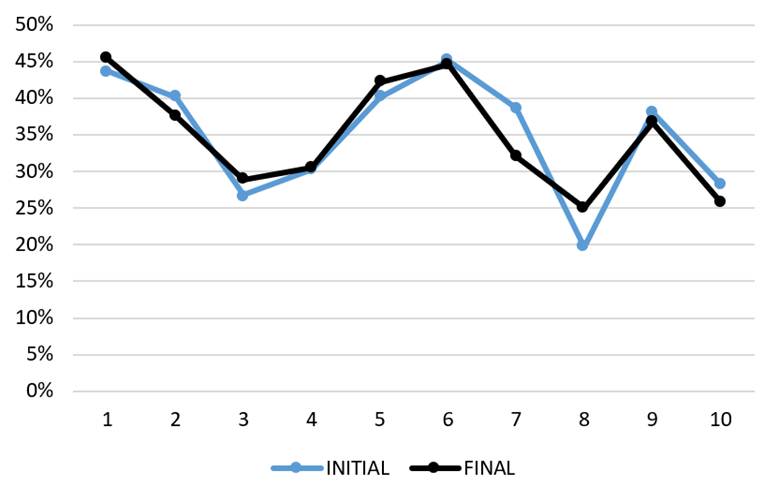
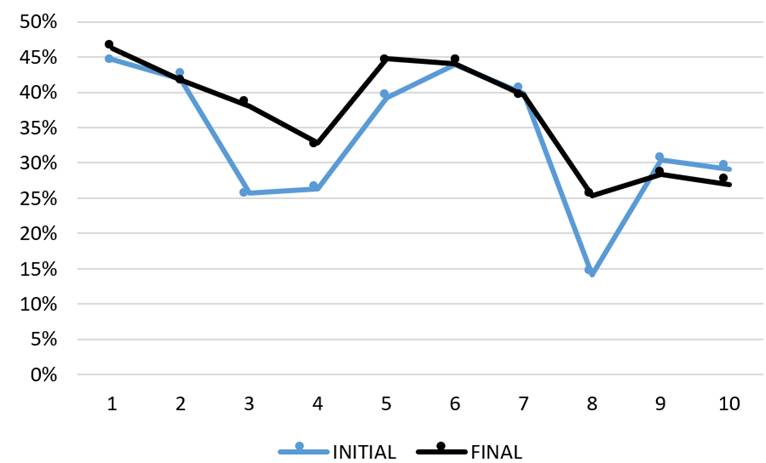
In other statements, there was little to no variation in participant’s’ rate of agreement, but the overall tendency was toward a positive rise in students’ levels of intercultural awareness and socio-cultural knowledge. These results were two times higher among students from Group B, with an increment of 2 and 4 percentage points between the initial and final surveys, as opposed to group A that elucidated exhibited an increment of 1 and 2 percentage points.
The Impact of Virtual Exchanges on Intercultural Competence
As previously mentioned, the second section of the surveys examined individual manifestations of intercultural competence through Likert scales of frequency. Once again, students’ answers from the initial and final surveys were compared to determine the impact of the two approaches taken to prepare them for the virtual language exchange.
Results in this section also indicate that both groups manifested a self-perceived change towards more culturally aware behavior. For instance, the higher percentage of participants rating statements 2, 3, and 5 as something they do always or frequently indicates that they are now able to recognize similarities when comparing cultures, that they acknowledge and talk about their own cultural values and traditions, and that they can consciously adapt to their interlocutors’ conversational style and behavioral patterns (the manifestations of cultural awareness in the initial and final surveys are presented in Figures 3 and 4).
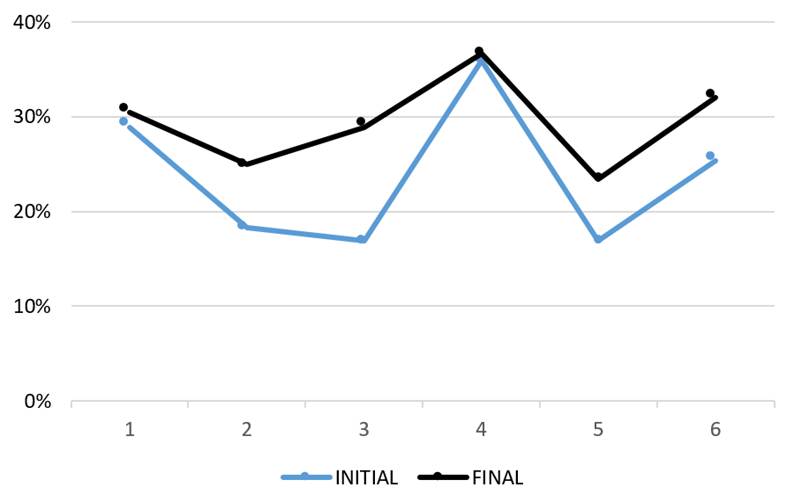
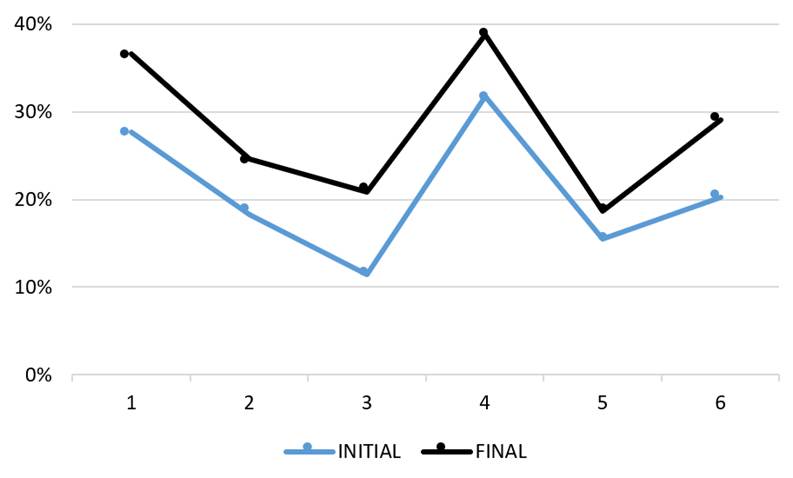
It is important to note that, in this section of the questionnaire, group B also showed a moderately higher overall percentage of improvement (8%) between the initial and final surveys when compared to the responses of the participants in group A (6%). Only in statements 3 and 5 did group A ranked slightly higher than group B.
To further assess these outcomes, a Pearson coefficient test and a two-sample equal variance t-test were conducted during the second section of the questionnaire before and after the virtual language exchange in order to examine the correlation between participants’ recognition of cultural awareness and their behavioral manifestations of that awareness. The main goal was to stablish if the data support or reject the null hypothesis: People’s increased recognition of cultural differences has no impact on their manifested cultural awareness (Table 1).
Table 1 Comparison of Culturally Aware Perceptions and Behaviors
| Group | Pearson R | T-Test |
|---|---|---|
| A - Standard | 0.67 | 0.27 |
| B - CCCT | 0.52 | 0.16 |
The results of the statistical tests illustrate how, in both cases, there is a positive correlation (Pearson R) between increased perceptions of cultural awareness and the behavioral adaptation acknowledged by participants (see Table 1). Yet, being greater than 0.05, the correlation is not strong, which also aligns with the outcomes of the t-test. Hence, the increased percentages identified in participants’ cultural awareness are not statistically significant and fail to reject the null hypothesis. Overall, quantitative analyses produce interesting outcomes whose statistical significance restricts them from conclusions that could be confidently generalized.
Recognition of Cultural Features in Virtual Exchange Interactions
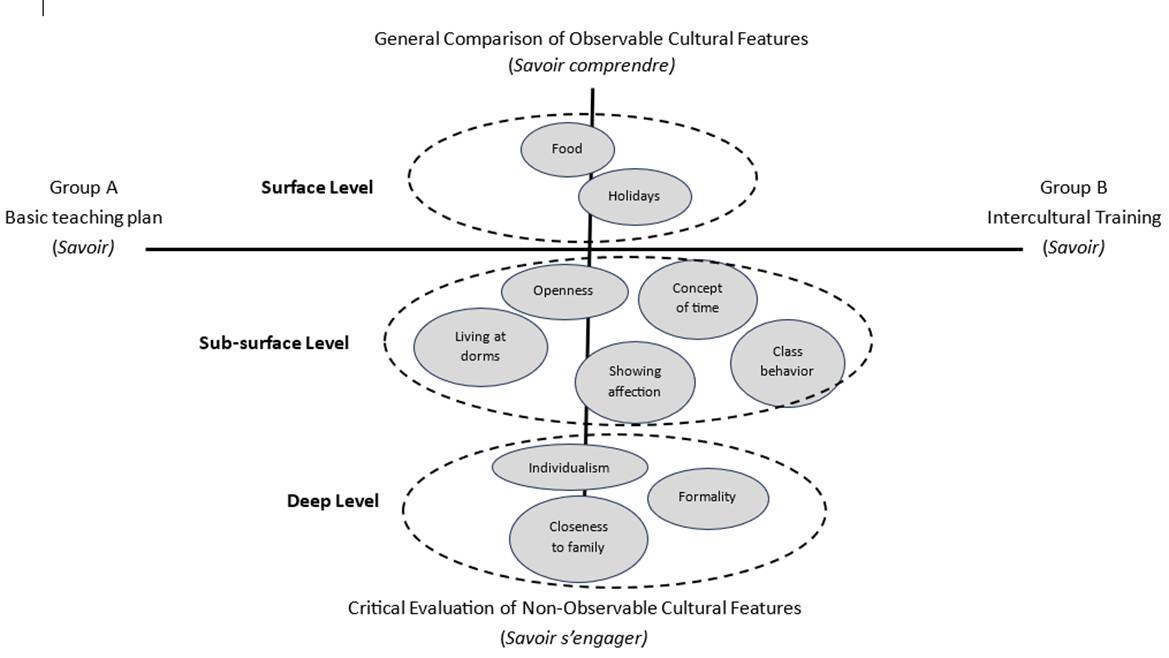
To further assess the influence of virtual exchange on participant’s intercultural awareness and competence, this study examined individual experiences through their perceived differences and similarities in cultural features. The topic names assigned during the thematic analysis were based on Frank’s (2013) analysis of the elements of culture, which also considers Hall’s (1976) cultural iceberg analogy and the products, practices, and perspectives of culture (National Standards in Foreign Language Education Project, 1999). Frank (2013) argues that every culture has easily observable products or features (the tip of the iceberg above the surface), such as food, music, and clothing, practices such as interpersonal relationships, and perspectives, including values and attitudes, as well as non-observable features like cultural practices and social perspectives (the submerged part of the iceberg either at the subsurface or deeply submerged) (Frank, 2013, p. 3). In tandem with this, students’ responses were categorized as part of the surface, sub-surface, or deep level.
The surface level includes the observable features of culture, such as food and holidays. The sub-surface level includes showing affection, non-verbal communication, concept of time, and class behavior. The deep level encloses values, attitudes, and beliefs. Examples of identified values include close or distant interpersonal relationships with family or friends, individualism, and the levels of formality required to communicate in specific social situations and contexts.
As an example, for the response “In our culture I feel we have a closer relationship with our families” (translation), the code assigned was “closeness to family,” then the category assigned was “values,” and the topic assigned was “deep level.” During the thematic analysis, responses that were not specific or difficult to categorize (as similarity or difference), were coded as “Response is not clear” or “Does not specify similarity or difference,” respectively. It is also important to note that, for long answers, two categories and two topics could be assigned according to their content.
Surface Level
In both groups, participants noted similarities in terms of food, such as a shared taste for coffee and seafood: “They eat crab as we do in the Colombian Caribbean Coast” (GB, S35), “...we love coffee...” (GB, S33). Contrasting findings were also expressed by both groups, such as S43’s declaration that “one difference is the scarcity of fruits” (GB) or S35’s surprised realization that “they eat a lot of pizza [compared to Colombia]” (GA).
Only participants in group B commented on holidays, talking about Christmas. S37 mentioned that “It is very similar how they celebrate Christmas with their families,” and S42 manifested, “we like the same holiday which is Christmas” (GB, S42).
Sub-Surface Level
In both groups, people mentioned that “the way they express themselves when they are talking is different to the way we express ourselves” (GA, S8). S36 from group A and S9 from group B expressed similar ideas. These conversational patterns are easily visible in the perceived openness of the American culture and in the social/friendly attitude recognized in both American and Colombian cultures.
“Culture in United States is more open and inclusive” (GA, S11).
“...we [Americans and Colombians] are very friendly when we meet someone for the first time” (GA, S52).
It must be noted that only students’ responses from group B were related to showing affection and the concept of time. Group B students mentioned that Colombians show more affection. S44 manifested that “...Colombians are more open when it comes to show[sic] our feelings while Americans are more reserved,” and S40 claimed that “Americans are a little bit more reserved when it comes to communicating with other people.” Moreover, students referred to the concept of time in their declarations, talking about the priority given to productivity in the American culture. Particularly in relation to the importance of punctuality: “Punctuality” (GB, S66), “They are more productive” (GB, S20).
Other common responses in both groups constituted behaviors related to the university, which was not unexpected considering that all participants were at this stage of their lives. On this subject, participants in group A highlighted the fact that Americans usually live at the university dorms: “the most outstanding difference is that most of the students live on campus and that is weird here” (GA, S43). The finding is rather unusual for Colombians because “in our culture, we don’t do that” (GA, S53). On the other hand, participants from group B highlighted a difference in class behavior. For instance, S45 highlighted that “it is not prohibited to use your phone in class,” which led them to conclude something as “They have more freedom to use their phone during class” (S25).
Deep Level
Responses in both groups mentioned interpersonal relationships, in particular those related to closeness to relatives. S24 from group A, for example, talked about the opposing tendency manifested by the fellow student from the US: “They do not spend a lot of time with their families, and they are not close to them” (GA). S50 and S21 from group B agree with this statement by assuring that “...it is not usual for them to spend time with family members” and that “in our culture I feel that we are closer to our families” (GB). In addition, Colombians build stronger bonds with other people as opposed to “People [in the United States, who] usually do not develop strong bonds” (GB, S60). These attitudes could be categorized as manifestations of individualism, where Americans seem to be less community oriented and more independent than Colombians.
Other manifestations of individualism can also be found in the age at which people move out of their parents’ household and start working, which were found in students’ responses. Both the age to move out and to start working is earlier in Americans than Colombians. Regarding the age to move out, S30 claims that “One difference that I found was that young people are more independent from their parents than in my culture” (GA, 30). About the age to start working, people in the United States “... work from a young age while we live with our parents” (GB, S3). Other respondents went further in their analyses by linking this working age feature to the idea of being more independent. For example, S40 mentioned how “they love working from a young age which I suppose is for being independent” (GB).
It must be noted that references to levels of formality were only found in the responses of students from group B. These responses are related to the way individuals address their professors and peers, which shows variations in the levels of formality depending on context and on a person’s position or role:
“The students [in the United States] usually address their professors by their title and last name” (GB, S17)
“People are addressed with titles, for example, Doctor or Professor, but in some contexts if there is a close relationship, titles are not relevant” (GB, S54)
“... similarities, that we use informal greetings with friends” (GB, S14)
“One similarity is that we use nicknames” (GB, S13)
Discussion
This section includes the data analysis of the results presented in the previous section, focusing first on quantitative data, highlighting an increase in intercultural and social-cultural awareness as outcomes of the virtual exchange. Then, the analysis of qualitative shows how learners’ interactions are linked to observable and non-observable features of culture. This subsection also highlights the recognition of non-observable features by the learners who participated in the intercultural communication training.
Intercultural Awareness and Socio-Cultural Knowledge
Findings from the comparative quantitative analysis of the surveys at the end of the semester showed that groups A and B both increased their levels of intercultural awareness and socio-cultural knowledge. This tendency is visible in the rate of respondents acknowledging the influential role of cultural identity on individual perceptions of the world and in students’ declarations of being more culturally aware. Hence, many of the participants from both observed groups perceive themselves as being able to recognize similarities when comparing cultures, to consider other people’s background, and to consciously adapt to their interlocutors’ conversational style and behavioral patterns during interactions.
Yet, the fact that the results were greater than 0.05 shows a weak correlation between the identified rise in participants’ recognition of cultural awareness and their behavioral manifestations of that awareness, which also aligns with the outcomes of the t-test. Therefore, the increased percentages identified in participants’ cultural awareness are not statistically significant. This could indicate that, in the observed groups, increased awareness does not necessarily lead to the recognition of individual behavioral adaptation. Longitudinal analyses would be required to further explore this claim.
Developing Savoir S'Engager Through Language Exchange
Students’ responses to the survey’s open-ended question were categorized into one or more of the three levels of a given culture, which distribute cultural features according to how easy it is to observe them. Recognizing cultural features of a foreign culture and being able to make comparisons with one’s culture can be linked to cultural awareness. Thus, students’ responses can be related to the ability to compare, interpret, and relate to those features (savoir comprendre) and the skill to use the new knowledge to interact with others (savoir s’engager). Considering the results, it is possible to state that both groups developed an interest in their counterparts’ culture, were able to reflect about their own culture, and became more mindful of the differences between the Colombian culture and American culture. This aligns with the findings of Tian and Wang (2010) in China.
Both groups were able to identify features in the surface, sub-surface, and deep layer of culture. This shows that the qualitative data concurs with the quantitative data previously described. For instance, at the surface level, both groups talked about food; at the sub-surface level, both mentioned non-verbal communication; and, at the deep culture level, both commented on interpersonal relationships. It must be noted that responses in the same categories may be related to different codes. In the category of interpersonal relationships, which is part of the deep culture level, students in Group A mainly referred to both cultures sharing similar open and friendly styles of communications whereas those in Group B were more concerned with the lower importance of bonding with the family and showing affection in American culture.
The students who took part in the intercultural training were able to elaborate further on their individual analysis, by including a higher number of categories related to the sub-surface layer and deep layer of culture. These students talked about showing affection, the concept of time and class behavior, which are related to the sub-surface level. Moreover, they mentioned the age to start working (linked to individualism) and levels of formality (which relate to the deep level of culture). Hence, Group B’s descriptions of behavioral features, formality, and individualism were not only more thorough, but they also tackled many categories of non-observable features that were neglected by those in Group A.
Figure 5 summarizes the topics found in each group’s responses, highlighting the topics in common, the variation among the clusters of students of both groups, and the distribution of the categories according to the three levels of the culture. Figure 5 also shows that students in Group B were able to identify more non-observable features, which reflects a deeper analysis of cultural similarities and differences may be attributed to the IC training received before the language hence contributing to the development of intercultural awareness (savoir s'engager).
To conclude, a comprehensive study of this intercultural knowledge (savoirs) is essential to enhance students’ cultural awareness, allowing them to be better prepared before virtual exchanges, and to have more meaningful experiences oriented to the development of their intercultural competence.
The main study limitation is the sample size, of the sample since it includes a large number of students from the university’s level English 4 courses, but only a fraction of the general student population. Hence, it is advised not only to replicate the research with a larger sample but also in other universities and with language learners of different cultural backgrounds and with different proficiency levels (e.g., beginner and upper-level courses) to compare the outcomes and assess their potential for generalizability potential. Adding other methods, such as in-depth interviews, focus groups, or classroom observations, would also provide rich qualitative data about students’ experiences and perceptions.
Conclusion
Virtual language exchanges can contribute to increasing the intercultural awareness and social-cultural knowledge of language students, but implementing an intercultural communication training prior to the virtual exchange will allow students to be better prepared and will provide a more thorough understanding of cultural similarities and differences. In turn, students may develop intercultural awareness. To support an intercultural approach in language teaching, teachers and policy makers must understand how language and culture are intertwined in language use (Crozet et al., 1999). It is important to highlight that, in the context where the research was conducted, language teachers and the department heads were supportive of the virtual exchanges and intercultural communication training.
Language teachers can include virtual language exchanges into the curriculum to enrich interaction, communication with native speakers, and interpretation of behaviors and beliefs of the target culture (Zhou, 2023). For implementation, before having a virtual exchange focused on cultural topics, it is recommended to have a free conversation virtual exchange; that way, students are aware of the process. In the upper-level courses, to take advantage of the outcomes mentioned, students may have an initial exposure to cultural awareness using teaching materials and/or topics already included in the syllabus, followed by ICT to foster more complex critical analysis and interactions.

