




 English (pdf)
 Article in xml format
 Article references
 Automatic translation
 Send this article by e-mail
 Cited by SciELO
  Cited by Google
  Similars in
SciELO
Similars in
SciELO  Similars in Google
 Permalink

INTRODUCTION
The Jardín Botánico de Bogotá (JBB) is a green space covering approximately 19.5 hectares, located in the borough of Engativá, in Bogotá D.C., Colombia. This place is one of the main centers of research and conservation of biodiversity in the country, with a great variety of trees and plants of different species. The soil cover of the JBB is made up of ligneous species and provides ecosystem services to the overall community.
Natural capital provides humanity with goods and services known as ecosystem services (Li et al. 2023) in combination with the human capacity to associate and cooperate, natural capital enables many beneficial dynamics for humans (Constanza, 2016). Natural assets continuously generate both direct and indirect benefit streams for our well-being (De Groot et al. 2010; Bateman et al. 2011).
Society as a whole benefits from the ecosystem services produced in specific locations (Fisher et al. 2011). When an individual or community in any area of the planet makes decisions for its own benefit, it influences the other communities of the planet (Hagedorn, 2008). By knowing the functions and processes of natural assets, the benefits obtained, and an approximate value of ecosystem services, the decision-making process would be fully informed on the environmental costs of development or the benefits of conservation.
Biophysical valuation is the quantification of the natural goods regarding the supply of ecosystem services provided by a given landscape (Shrestha et al. 2023), which includes the prediction of possible future changes in the supply of ecosystem services over time (Fu et al. 2018; Hu et al. 2021). This type of valuation includes specific assessment of the ecological importance of ecosystem components, e.g., estimation of biodiversity impacts (Saarikoski et al. 2022), or the amount of carbon stored in a forest. Biophysical valuation as a starting point for economic valuation is crucial considering the loss of ecosystems due to different causes and the consequent loss of ecosystem services (Bera et al. 2022; Basu et al. 2023; Bax et al. 2023; Wang et al. 2023; Zrelli et al. 2023).
Therefore, the purpose of this study is to generate an approximation of the monetary value of the ecosystem services provided by the JBB, based on the biophysical value, the economic value of provisioning services, atmospheric regulation services, and cultural recreation services.
MATERIALS AND METHODS
Study area. The study was conducted at the facilities of the Jardín Botánico José Celestino Mutis in Bogotá D.C., Colombia, which has a total area of 19.5 ha. Within the JBB, an area with a size of 0.8 ha was randomly selected for data collection. The area is located at coordinates 74°6'2.95"W and 4°40'6.69"N (Figure 1), with an annual rainfall of 797 mm and temperatures ranging between 8°C to 20°C (IDEAM, 2018).
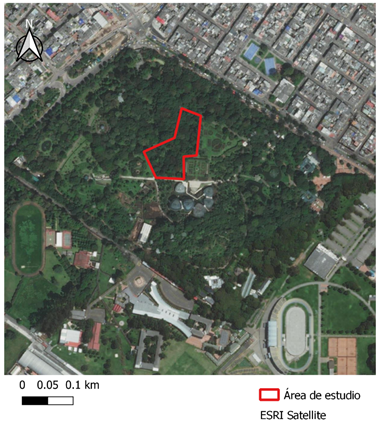
Figure 1 Jardín Botánico José Celestino Mutis, Bogotá D.C. and its surroundings. Map construed in QGIS version 3.28.4-Firenze
Regarding the selection of the study area for the biophysical valuation, the presence of arboreal, shrub or palm species was considered. Additionally, the determination of canopy cover was conducted over 18.7 ha of the JBB using the QGIS 3.30.2 Software; the 0.8 ha of sampled area were excluded from this analysis. Using the canopy cover area, the reference area of the JBB was established to calculate the economic values associated with wood production and aerial carbon storage.
Analysis variables for the valuation of ecosystem services. The variables used for the analysis of ecosystem services and their valuation are described in Table 1.
Table 1 Analysis variables and indicators for the valuation of the ecosystem services provided by the Jardín Botánico de Bogotá José Celestino Mutis (JBB).
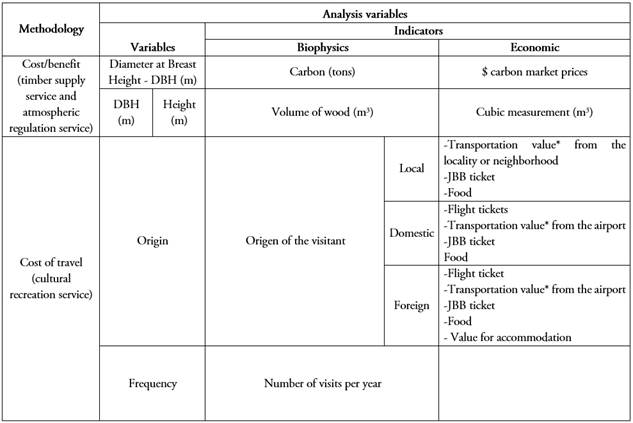
* Digital platform transport service.
Biophysical and economic valuation of ecosystem services.
Biophysical valuation. The biophysical valuation was conducted in the selected area, where an inventory of the timber species (DBH > 10 cm) was registered. The total height of the timber species was determined by an hypsometer and the DBH with dimetric tape. A total of 90 individuals were analyzed.
The data collected in the field were used to determine the volume of wood for each individual and by species. Likewise, to estimate the carbon stored in the aboveground biomass.
Calculation of standing timber volume. The following equation was used to calculate the volume of wood according to Yepes et al. (2011), Gutiérrez et al. (2013):
Volume (living trees)
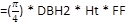
DBH: Diameter at breast height in meters (m)
Ht: Total Height (m)
FF: Form factor (0.65)
Calculation of the volume of harvestable wood. The methodology proposed by Medina Arroyo et al. (2007), where wood waste in the commercial volume of living trees is 39.76%, with a remaining 60.24% of harvestable wood.
Carbon calculation. The equation proposed by Álvarez et al. (2012) was used to calculate carbon and adapted by Phillips et al. (2011) for the estimation of aboveground biomass. It should be noted that this equation is associated with montane rainforest:
BA = Exp (- 2.616382155 + (2.3733 * ln (D))
D: Diameter at breast height in centimeters (cm)
ln: Natural logarithm
From the aboveground biomass (AGB) values, carbon contents are obtained after multiplying the result of the AGB value by 0.5 (Phillips et al. 2011; Yepes et al. 2011), this value corresponds to the carbon content in the plant material (corresponding to 50% of the total biomass).
Given the result of C in kg, the value was divided by 1000 to obtain the data in tons (t).
Economic valuation
Cost-benefit methodology. Using the cost-benefit methodology, the economic valuation of the services of (i) timber provision and (ii) atmospheric regulation was conducted.
In order to obtain a total economic value (TEV), the values found in the volume and carbon calculations were oriented to an economic valuation; the m3 of timber volume and the tons of carbon obtained were monetized, for which a value of 270.9 USD per m3 of timber volume was used (Red Forestal, 2023), and the economic valuation of C per ton was determined taking as reference the values of the European Union carbon credits reported by Carbon Credits for the month of March 2023 (https://carboncredits. com/carbon-prices-today/), which corresponds to a value of 99.65 USD. Using the QGIS software, the canopy area of 18.7 ha (subtracting the 0.8 ha from the forest inventory data collection) of the JBB was estimated in order to obtain the missing canopy area with tree cover, which was 13.4 ha, then the 0.8 ha of the sample was added to the 13.4 ha of defined canopy, to obtain a total reference area of 14.2 ha. With this data it was possible to analyze the total economic value of the service of wood provision and the service of atmospheric regulation by the carbon stored in the aboveground biomass.
Travel cost methodology. The economic valuation of the cultural service of recreation was conducted using the travel cost methodology.
The travel cost valuation methodology involves the implicit price that the tourist pays for accessing a recreational site or for participating in a recreational activity (Juutinen et al. 2022; Xu & He, 2022). For this case, a survey was carried out among different visitors of the JBB between 09:00 a.m. and 05:00 p.m. on February 25, 2023, who were asked about their origin and frequency of their visits. To determine the origin, we gathered information on the country for foreigners, the department for non-local Colombians, and the neighborhood or borough for residents of Bogotá. Using this information, the individual's willingness to pay for the quantity of the good or service associated with an ecosystem in a year was calculated. Transportation costs included the value provided by a digital platform transportation service from the neighborhood or borough and return for local visitors, and from the airport and return for domestic and foreign visitors. Transportation costs for domestic visitors included the value of airfare from the department of origin and return, for foreign visitors from the country of origin and return.
The cost of entrance to the JBB was included, which was 1.05 USD for all visitors. The value of food was included as follows: for local visitors, the value of a single meal per person (2.11 USD); for domestic and foreign visitors, the value of a day's food was included at 12.67 USD and 14.78 USD, respectively. In addition, the average value of overnight expenses for foreign visitors was included.
The information collected was used as a reference to calculate the average monetary expenditure of a day's visit to the JBB by local, national, and foreign beneficiaries. The average value was used to calculate the TEV for all the visits made in 2023 with the use of secondary information on income from that period to the JBB.
Data analysis. The values obtained for wood volume and C capture were extrapolated to the reference area of tree cover (Palacios, 2021) of the JBB, which corresponds to 14.2 ha. Subsequently, it was calculated for 1 ha; the total valuation (biophysical valuation) is the sum of the price obtained from the calculation of the volume of wood and carbon stored in 1 ha.
Regarding the methodology for the valuation of travel costs, once the average cost of a day's visit to the JBB was obtained, this value differentiated between local, national, and foreign visitors was multiplied by the number of visitors to the JBB in 2023. Finally, the values were calculated in units of time (year), in this case for the ecosystem service of timber provision, the value was depreciated to 20 years. In the case of stored C, because the species are limited to conservation use, the estimated value was assumed for one year.
After obtaining the total value of the cost/benefit analysis, the values of the travel cost methodology obtained in the year 2023 were added to obtain a total economic value of TEV including timber provisioning services, atmospheric regulation expressed in the benefit of clean air, and cultural recreation services (Palacios, 2021). For the purposes of comparisons in the report of findings and discussion of results, foreign currency values of March 2023 were used (exchange rate: 4736.03 USD).
RESULTS AND DISCUSSION
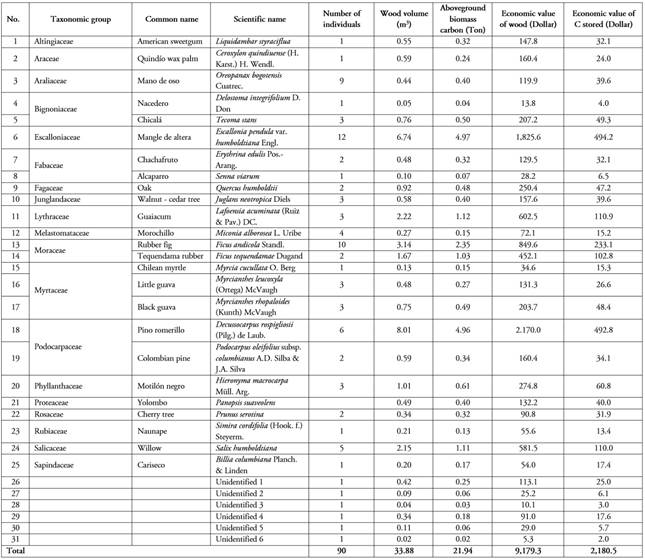
Biophysical valuation. A total of 90 individuals belonging to 31 forest species were found in the 0.8 ha analyzed (Table 2), with the three most abundant being Escallonia pendula, Ficus andicola, and Oreopanax bogotensis. The 90 individuals analyzed have a total volume of 33.88 m3 of wood and store about 21.94 tons of carbon. In terms of volume, the species with the largest volume of wood is Decussocarpus rospigliosii with 8.01 m3, while the species with the largest carbon storage is E. pendula with 4.97 tons.
Table 2 Forest species found in the inventoried area of the Jardín Botánico de Bogotá José Celestino Mutis, the valuation of the volume of wood and carbon stored in the aboveground biomass, and the economic valuation in terms of wood and carbon stored.
The JBB is directly generating clean air for Bogotá, since the final benefit of the carbon uptake service of perennial ligneous species is reflected in the improvement of air quality (Zhang et al. 2023). Despite the fact that the JBB is a transformed ecosystem, it stands out for the provision of atmospheric regulation services, however, natural ecosystems are more efficient in providing the ecosystem service of atmospheric regulation, as in the case of tropical forests, which store between 40% and 55% of the carbon of terrestrial plants, being crucial for the functioning of the carbon cycles of the planet (Flores de Melo et al. 2024).
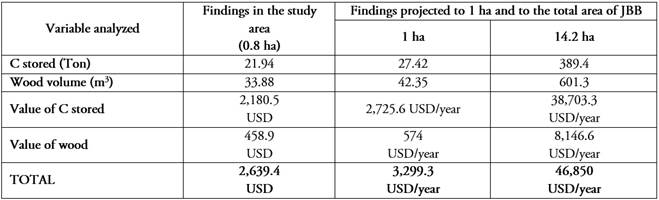
Considering that the JBB has a canopy cover area of 14.2 ha, it can be inferred that in one hectare there are about 27.42 tons of C stored in 42.35 m3 of commercially harvestable wood. In the entire extension of the JBB, about 389.4 tons of carbon are stored in 601.3 m3 of commercially harvestable wood (Table 3). In cities, green spaces are a beneficial wealth for surrounding communities in the form of ecosystem services (Drew-Smythe et al. 2023) and may be fulfilling some functions performed by natural ecosystems. For example, in a study conducted in the mangroves of the Gulf of Urabá in Colombia, it was found that the carbon stored in the aboveground part of the mangroves of the Atrato River delta reached 83 tons/ha, in the Rionegro cove 58 tons/ha, in Puerto César-Punta Coquito 43 tons/ha and in Turbo 38 tons/ha (Blanco-Libreros et al. 2015). Another example is a similar study conducted in the forests in the Jardín Botánico del Pacífico, Chocó, where an average of 48.2 tons/ha of carbon stored is reported (Torres-Torres et al. 2017).
Economic valuation
Cost/benefit. The ecosystem service of JBB wood provision in the analyzed area amounts to 8,146.6 USD. As for the regulating service related to C storage, the economic value amounts to 38,703.3 USD (Table 3). Equating these values to units of space and time, it is concluded that the economic value of JBB in terms of the timber provisioning service reaches 573.7 USD ha/year and the carbon storage regulation service reaches 2,725.6 USD ha/year; the two services together reach an economic value of 3,299.2 USD ha/year. Therefore, the JBB in its entire extension is generating an economic value of around 46,850 USD per year (Table 3).
Table 3 Values found for carbon (C) storage, wood volume, economic value of the C storage regulation service and wood provisioning service in the study area and the total area of the Jardín Botánico de Bogotá José Celestino Mutis (JBB).
A study conducted in the flood lands of Ghodaghodi, Nepal reveals that the approximate ecosystem service value of timber provision exceeds 442,000 USD per year, over an area of 2,563 ha (Aryal et al. 2021), for a value of 172.4 USD ha/year. This shows how JBB has great potential for timber supply, surpassing the economic value of other latitudes such as Nepal. Another example is the research by Hernández-Blanco et al. (2021), where the value of the timber and fuel provision service averages around 2,940 USD ha/year.
The economic value of the ecosystem service of air quality regulation in Iran's forested lands reaches 6 USD ha/year (Badamfirooz et al. 2021); a value much lower than that provided by JBB which corresponds to 2725.6 USD ha/year (Table 3). A similar case is recorded in the study by Aryal et al. (2021), where the carbon uptake service reaches 10 825.8 USD per year, which in terms of unit area is equivalent to 4.2 USD ha/year.
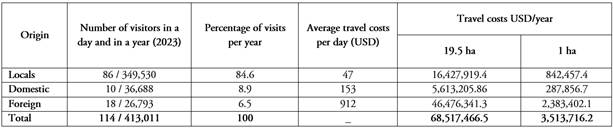
Travel costs. Most of the visitors surveyed are residents of Bogotá, followed by national visitors and finally foreign visitors (Table 4). Foreign visitors are from Germany, Chile, Costa Rica, Ecuador, Finland, Mexico, and the Netherlands. As for Colombian visitors, apart from Bogotá, the predominant cities of origin are Cali and Medellin.
The cultural ecosystem services provided by the JBB have an economic value of 68,517,466.5 USD per year; the value of one hectare amounts to 3,513,716.2 USD ha/year (Table 4). Economic valuation studies using the travel cost methodology have been applied to highlight the importance of cultural services such as landscape beautification and the enjoyment of natural ecosystems. In natural parks in Germany, it was determined that recreation ecosystem services provide an economic value ranging from 1812 to 2949 billion USD (Mayer & Woltering, 2018). In California, recreation ecosystem services from Tahoe's natural areas generate an economic value ranging from 1.35 to 1.84 billion USD/year (Nyelele et al. 2023). The peri-urban areas of Istanbul, specifically the water outfall in the Ömerli Catchment area, generate an economic value of approximately 10.24 billion USD (Cetin et al. 2021).
Table 4 Origin of visitors to the Jardín Botánico de Bogotá José Celestino Mutis in a day and in 2023, percentage of visits per year, average travel costs in a day, and economic value of the cultural ecosystem service of recreation in 19.5 ha and 1 ha in 2023.
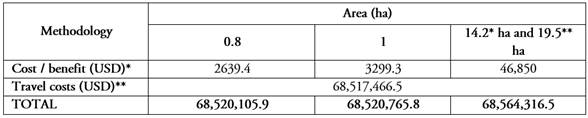
Total Economic Value (TEV). The ecosystem services provided by the JBB generate a total economic value reaching 68,564,316.5 USD on 19.5 ha per year, therefore, the value for one hectare amounts to 68,520,765.8 USD year (Table 5). The resulting values are very relevant in terms of implementing strategies for the conservation of green spaces in Bogotá and the provision of ecosystem services, as they reflect the economic value of the enjoyment that visitors and nearby residents who can perceive the benefits associated with provisioning, regulating, and cultural services. This can be confirmed with similar studies in other regions of the world, for example, the study conducted by Verma et al. (2017), in which, the estimated value for various ecosystem services provided by tiger reserves in India is between 128 million USD and 271 million USD, annually. In terms of unit area, the value fluctuates between 862 USD and 2,923 USD per hectare per year, highlighting the importance of the tiger ecosystem and the need to develop mechanisms for protecting these areas. Economic valuation methods provide evidence that underpins the development of policy instruments to conserve ecosystem services (Azadi et al. 2021).
Table 5 Total economic value TEV of the ecosystem services provided by the Jardín Botánico de Bogotá José Celestino Mutis using cost-benefit and travel cost methodologies.
There are similar studies that seek to highlight the importance of different types of ecosystems in terms of ecosystem services through economic valuation. In Iran, the values in economic terms provided by the offshore and inland flooded areas of the country, is 67,665 USD and 42,171 USD, respectively (Badamfirooz et al. 2021). The economic value of landscape beauty of natural and agricultural ecosystems in Israel is 53,120 USD and 29,077 USD per km2, respectively (Hatan et al. 2021). In Costa Rica, the economic value of ecosystem services provided by mangroves in the Gulf of Nicoya was determined to be 408 million USD/year (Hernández-Blanco et al. 2021). The buffer zone of the Sakabansi dam in northern Benin (Africa) provides ecosystem services estimated at an economic value of approximately 1,751 USD ha/year (Kader Baba & Hack, 2019).
Ecosystems, whether natural or transformed, are crucial for the provision of goods and services to humanity. The JBB offers provisioning, regulating, and cultural services, which provide well-being not only to visitors but also to the surrounding inhabitants of the site in question, and ultimately to the global community. This is because any action taken at one point on the planet affects the rest of the world positively or negatively. Translating the value of ecosystem services into economic terms is an important tool for generating actions that seek the conservation and maintenance of ecosystems. The values derived from the analyses provide a robust foundation for understanding the complexity of the functions ecosystems perform for human well-being. These functions, often intangible to the human senses, ultimately contribute to well-being as reflected in terms of physical and mental health.
Bogotá, with its dense population, should look to expand the supply of such ecosystem services for the enjoyment of its inhabitants. Therefore, it is recommended, on the one hand, to maintain the infrastructure of parks, wetlands, and natural capital in general, and on the other hand, to promote the expansion and creation of additional green spaces that provide provisioning, regulating, and cultural ecosystem services to society as a whole. In this regard, this study is a scientific basis that justifies the need to bring to public policy the conservation of natural ecosystems as transformed in Bogotá.

