




 English (pdf)
 Article in xml format
 Article references
 Automatic translation
 Send this article by e-mail
 Cited by SciELO
  Cited by Google
  Similars in
SciELO
Similars in
SciELO  Similars in Google
 Permalink

1. Introduction
Explaining why some organizations perform better than others dates back to the origins of economic and management thought, as companies share an uncertain and highly competitive environment (Bousinakis & Halkos, 2021; Coelho et al., 2021). Thus, understanding the variables that impact performance is a topic of constant discussion and updates. One contributing factor is creativity, which is considered key in organizational development (Bousinakis & Halkos, 2021; Coelho et al., 2021), as well as in increasing competitiveness and performance.
Individual creativity, the focus of this research, is defined by Oldham and Cummings (1996) as the production of ideas or procedures that meet two conditions: (1) they must be new or original, and (2) they must be potentially relevant or useful to an organization. According to Mitchell and Walinga (2017), individual creativity is linked to original ideas and different ways of thinking. In this sense, Amabile (1996) points out that individual creativity is related to the generation of new and useful ideas, processes, or solutions.
The development of creative ideas can be described as the interaction between divergent and convergent thinking (Guilford, 1967; Speckbacher, 2017). According to Cropley (2006), divergent thinking is associated with solving problems in a non-obvious way, by combining diverse available information and recognizing connections between non-obvious variables to transform data into unexpected insights. Convergent thinking promotes the maintenance of ideas deeply rooted in the organization, seeking to standardize previously implemented actions (Guilford, 1967; Cropley, 2006; Berg, 2016).
Research on the relationship between creativity and management control systems (MCS) is recent and fragmented (Lill et al., 2021) and suggests a potential tension where more control is associated with less creativity. However, a distinct stream of research suggests that MCS can be used not only to restrict but also to enhance creativity (Amabile, 1983; Henri, 2006; Adler & Chen, 2011; Strauß & Zecher, 2013; Moulang, 2015). On one hand, restricting creativity through MCS involves implementing standardization that limits creativity (Moulang, 2015); on the other hand, stimulating creativity through MCS involves altering the patterns of organizational activities, encouraging creativity and the search for new opportunities (Simons, 1995), and promoting new ways of thinking.
Therefore, MCS are believed to be relevant and capable of creating beneficial and necessary tensions for successful creativity, depending on their use. In this context, management control literature (Ahrens & Chapman, 2004; Wouters & Wilderom, 2008; Adler & Chen, 2011; Wouters & Roijmans, 2011; Jordan & Messner, 2012; Sánchez et al., 2012; Englund & Gerdin, 2014; Burney et al., 2017; Souza & Beuren, 2018) has employed the concepts of enabling and coercive formalization by Adler and Borys (1996) to investigate which characteristics of MCS can affect individuals through their attitudes and behaviors toward control and have an impact on creative thinking.
Strategic priorities of an organization, as well as the choice and use of MCS, are influenced by top management and leaders. Therefore, another aspect that can shape the contours of MCS, potentially contributing to either stifling or encouraging individual creativity, is leadership style. According to Abernethy et al. (2010), leadership style is a precursor to the choice of an MCS approach. The authors recognize that it is clearly an important (but often overlooked) variable, considering that MCS choices are the means by which top management communicates, empowers, and executes its vision.
Leadership is also considered one of the significant factors influencing employees' creative behavior (Oldham & Cummings, 1996). Specifically, transformational leadership plays a crucial role in affecting employee creativity (Shin & Zhou, 2003) and is well-suited to identifying new opportunities and developing organizational competencies (Shafi et al., 2020). It helps organizations enhance their creativity while fostering creative work environments (Awang et al., 2020; Shafi et al., 2020). Moreover, transactional leadership is associated with limiting the creativity of subordinates (Suave & Aguiar, 2021).
Given the above, leadership style plays a fundamental role in the use of MCS (Abernethy et al., 2010; Nguyen et al., 2017; Gong & Subramaniam, 2018) and in creativity (Oldham & Cummings, 1996). The literature also indicates that different styles of MCS usage are associated with creativity (Ahrens & Chapman, 2004). However, additional research is needed to understand which uses of MCS prevail according to leadership style and, consequently, the impact of these leadership styles and MCS usage on individual creativity. Therefore, the research question guiding this study is: What are the effects of transformational and transactional leadership and the uses of enabling and coercive MCS on divergent and convergent thinking?
Understanding individual creativity, particularly recognizing the factors that develop or inhibit it, is important. Employees' creativity contributes significantly to organizational effectiveness and survival, as by generating creative ideas, employees provide new solutions and possibilities for change that benefit the organization (Madjar, 2005). This research expands the empirical foundation of studies on MCS and creativity, especially in sectors dependent on the latter such as the textile industry.
Another contribution is addressing gaps related to the implications between creativity and management controls. Some research suggests that control can undermine creativity (Grabner & Speckbacher, 2016; Davila & Ditillo, 2017; Feichter & Grabner, 2020), while other studies affirm that MCS can be used both to enhance or restrict creativity (Davila & Ditillo, 2014; Moulang, 2015). Most of the previous work related to MCS and creativity has only indirectly addressed MCS design (Wynder, 2007; Jordan & Messner, 2012; Davila & Ditillo, 2017) and has not analyzed MCS usage. This research also contributes to the literature on leadership styles by examining whether different styles (transformational and transactional) tend to influence the choice of MCS usage, as well as by enabling an understanding the relationship between different types of leadership styles and their influence on divergent and convergent thinking.
Together, the outlined gaps pose questions that are not yet sufficiently clarified in the literature. Thus, the findings could lead to improvements in Brazilian organizations, particularly in the textile industry. Empirical evidence can support the selection of leaders aligned with the organization's creative strategy by seeking managers inclined toward MCS approaches more suited to the organizational context to promote expected organizational outcomes. Additionally, this research could provide insights into the practical choice of management control in contexts where creativity is important by understanding how to combine both forms of control (enabling and coercive) to reconcile creativity with business needs.
2. Literature review and research hypotheses
Transformational leadership focuses primarily on organizational goals, expanding and elevating employees' self-interest (Bass & Avolio, 1990). Previous studies have asserted that leadership style has a significant correlation with MCS (Abernethy et al., 2010; Hu et al., 2012). In this regard, Abernethy et al. (2010) evaluated the effect of leadership on the use of MCS (interactive and diagnostic), and the results emphasize the importance of leadership in explaining it. The authors found that senior managers use leadership and MCS as a means of communication to reveal preferences and obtain information from subordinates.
According to García-Morales et al. (2012), transformational leadership increases awareness and acceptance of the organization's purpose and mission and promotes a shared vision, reorienting the formation and construction of work teams. This aligns with Adler and Borys' (1996) view of enabling MCS, which, in turn, facilitates interaction between systems and users, stimulating mechanisms for problem-solving, providing feedback, and offering opportunities for improvement (Wouters & Wilderom, 2008). For Hartmann and Maas (2011), these mechanisms encourage interaction among managers at different hierarchical levels and can enhance organizational members' understanding of their individual operational tasks within the context of organizational goals.
Enabling systems are perceived as facilitators of responsibilities (Adler & Borys, 1996; Free, 2007; Chapman & Kihn, 2009). Enabling formalization exerts influence on individual behavior by providing autonomy (Hempel et al., 2012), making employees feel empowered or motivated by the existing rules and systems (Wouters & Wilderom, 2008; Beuren et al., 2020). Delegation is strongly present in transformational leadership, as it represents the real authority given to subordinates to make decisions on a range of matters affecting business operations. Therefore, granting authority to employees is a characteristic of enabling formalization (Wouters & Wilderom, 2008).
However, Nguyen et al. (2017) suggest that transformational leadership does not have a significant effect on reward systems, as these are viewed more coercively. Ahrens and Chapman (2004) argue that coercive systems are designed to enforce compliance with predefined standards, where users are expected to follow rules and instructions. The high pressure and perceived stress associated with expanded goals and goal-based compensation restrict productivity by negatively impacting employees' cognitive capacity to identify new process efficiencies (Pfister & Lukka, 2019). In other words, it leads individuals to the lowest level of transformational leadership.
In this perspective, based on the arguments presented above, the first hypothesis of this research is formulated:
H 1 : Transformational leadership is (a) positively associated with enabling MCS and (b) negatively associated with coercive MCS.
Transactional leadership relies on reward and the fulfillment of a contractual obligation and uses extrinsic rewards that depend on subordinates' performance (Puni et al., 2020). According to Mekpor and Dartey-Baah (2017) , transactional leadership controls and monitors the performance of each individual. In contrast, an enabling MCS encourages dialogue (Wouters & Wilderom, 2008) and advocates for the development of users' skills and intelligence (Henttu-Aho, 2016). Additionally, it allows employees to pursue both efficiency and flexibility in their objectives (Ahrens & Chapman, 2004) and handle inevitable contingencies more effectively (Adler & Borys, 1996). Furthermore, enabling MCS encourage two-way communication, promote information sharing, interactive dialogue, trust, and user involvement in the decision-making process (Hoy & Sweetland, 2001). According to Vieira et al. (2020), a transactional leader acts in a way that establishes adherence to rules, which contradicts the principles advocated by an enabling MCS.
According to Cruz et al. (2015), transactional leadership presents clear expectations and rewards, aligning with coercive formalization. In the study by Yakimova et al. (2018), coercive procedures that promote compliance through sanctions for non-compliance (such as franchise contract termination) enhance franchisees' trust and improve business compliance. They address corrective recommendations by taking actions to increase uniformity in the franchisor's standards across the retail network. Transactional leaders continuously seek to coordinate and adjust behaviors within organizations (Öncer, 2013; Hussain et al., 2017). Thus, they use coercive MCS as they delegate the details regarding their work to employees, specifying how tasks should be performed and in what order (Burney et al., 2017).
Coercive MCS are designed to meet the needs of top managers to maintain control over efficiency (Englund & Gerdin, 2014), imposing a control system logic that requires adherence to pre-planned standards (Ahrens & Chapman, 2004). These standards are established by transactional leaders who offer rewards to subordinates in exchange for completing required tasks and use penalties to ensure task compliance (Vieira et al., 2020). Coercive MCS are robust systems where workers have limited options for action (Ahrens & Chapman, 2004; Coyte, 2019). This limitation arises because transactional leaders hold the information and depend on a well-defined system of contracts and rewards to achieve organizational goals and objectives (Chammas & Hernandez, 2019). Therefore, the following research hypothesis is proposed:
H 2 : Transactional leadership is (a) negatively associated with enabling MCS and (b) positively associated with coercive MCS.
Enabling MCS promote empowerment and provide improvements and opportunities (Adler & Borys, 1996) by encouraging the use of skills and intelligence to promote problem-solving in order to enhance organizational performance. In this way, they foster creative thinking through adaptive and creative actions (Ahrens & Chapman, 2004; Grabner & Speckbacher, 2016). According to Speckbacher (2017), in creative teams working in fashion companies, work processes that require a high degree of variation and divergent thinking make behavioral controls less applicable.
In their study, Kachelmeier et al. (2019) indicates that stimulating a greater number of first-stage ideas leads to gains in creativity, as it generates a larger pool of initial divergent ideas, eventually leading to an advantage in creative ideas. Therefore, thinking differently is a prerequisite for creative thinking. These arguments align with the literature on divergent thinking (Runco & Acar, 2012), in which individuals generate new ideas to solve a problem. Runco and Acar (2012) clarify that divergent thinking is not synonymous with creativity, but it is a precursor to it. Simply put, divergent ideas differ from the norm, but creativity requires ideas that are both different and effective (Runco & Jaeger, 2012).
Thus, regulating creative thinking by restricting behaviors or prescribing outcomes can undermine creative efforts, reduce divergent thinking, and result in less creative solutions. In contrast to this view, other researchers have argued that the very nature of creative work makes control systems valuable and useful (Adler & Chen, 2011; Grabner & Speckbacher, 2016). The results of Hempel et al. (2012) study, for example, demonstrated that enabling formalization plays a significant role in providing predictability, guidance, and clarity to organizations. In turn, it increases team empowerment by reducing uncertainty within the company and providing an understanding of how the rest of the organization operates.
Given that enabling logic stimulates the use of employees' skills and intelligence (Adler & Borys, 1996), which fosters resilience and induces creativity (Beuren & Santos, 2019), it is expected that stimulating employees' intellectual abilities is related to divergent thinking (Speckbacher, 2017) induced by enabling MCS. Based on the above, the following research hypothesis is proposed:
H 3 : Enabling MCS is positively associated with divergent thinking.
Coercive MCS are designed to meet the needs of top managers to maintain control over efficiency (Englund & Gerdin, 2014; Coyte, 2019), imposing a control logic with predetermined standards on employees (Ahrens & Chapman, 2004). Coercive controls aim to create a robust system where workers have limited options for action (Ahrens & Chapman, 2004). These limited options are part of the dimension of convergent thinking, which utilizes predetermined standards and logic, with criteria and benchmarks, for performing activities (Cropley, 2006; Berg, 2016).
According to Kaveski and Beuren (2020), diagnostic control systems and boundary systems limit managers' creativity in developing their activities. Due to the similarities of these systems to coercive formalization, it is argued that the latter also restricts creativity by prioritizing convergent thinking. Cools et al. (2017) highlight that the diagnostic use of MCS transforms the budget into a kind of compass that stimulates responsive creativity to address "closed" problems. In this sense, the budget enhances success in creative tasks by drawing creative employees' attention to the limits that must be respected. This type of budget is considered a closed problem because it is already formulated and has a known method for resolution. This type of closed project focuses on convergent thinking, as it monitors results and corrects potential deviations.
Similarly, coercive MCS can also lead workers to limited options for action (Coyte, 2019). The focus is on the manager, with the goal of controlling the actions to be taken. Due to this centralization, the objective is to seek existing solutions or use traditional methods, aligning with the concept of convergent thinking. Appuhami et al. (2024) concluded that the diagnostic use of budgets, focusing on expenditure restriction, increases the creativity of middle managers in Indonesia. Therefore, the following research hypothesis is proposed:
H4: Coercive MCS is positively associated with convergent thinking.
Organizational leaders need to be creative to foster the creativity of their subordinates in order to generate new ideas and new ways of solving problems (Hussain et al., 2017). Transformational leaders raise their followers' performance expectations (Bass, 1990) and seek to transform their followers' personal values and self-concepts, moving them to a higher level of needs and aspirations (Jung, 2001). Transformational leadership behaviors closely correspond to the determinants of workplace creativity, some of which include vision, support for creativity, autonomy, encouragement, recognition, and challenge (Gumusluoglu & Ilsev, 2009).
Through a sense of self-efficacy, transformational leaders inspire greater creative performance in their subordinates, making employees more likely to be motivated to generate new ideas and solutions (Redmond et al., 1993; Gumusluoglu & Ilsev, 2009). According to Runco and Acar (2012), the generation of new ideas prompted by employees' self-efficacy might be due to divergent thinking, as it seeks innovative solutions to open-ended problems. Shin and Zhou (2003) investigated the effects of transformational leadership on individual-level employee creativity in a business environment, using a sample of 260 R&D employees and their supervisors from 46 companies. They found that Korean employees exhibit more creativity under transformational leadership. The studies by Gumusluoglu and Ilsev (2009) and Yildiz and Özcan (2014) also support Shin and Zhou's (2003) findings by showing a positive relationship between transformational leadership and creativity. According to Jung (2001), transformational leadership promotes higher levels of creativity, as measured by divergent thinking, among group members. Suave and Aguiar (2021) suggest that transformational leadership is positively associated with divergent thinking. Thus, the following research hypothesis is proposed:
H 5 : Transformational leadership is positively associated with divergent thinking.
Transactional leadership is beneficial for the transmission and exchange of information within organizations due to its clarification of roles and task requirements within a defined structure (Ma & Jiang, 2018). Thus, transactional leadership motivates team effectiveness (Öncer, 2013; Hussain et al., 2017) and can promote the team's creative contribution (Taggar, 2002; Rasulzada & Dackert, 2009). However, it is associated with aspects of convergent thinking, as transactional leadership presents clear proposals in terms of expectations and rewards, where everything is set or the guidelines on how to create or solve something are also defined based on previous experiences. Therefore, it is related to convergent thinking.
Transactional leadership is characterized by stimulating extrinsic motivation in followers, which leads to followers developing less creativity (Amabile, 1998). The characteristics of transactional leaders tend to limit the development of creative practices for problemsolving, as followers do not feel motivated to seek creative solutions capable of altering the status quo (Jung, 2001). The relationships between leaders and followers tend to be more restrictive, with greater scrutiny in the execution of processes (Cropley, 2006). Suave and Aguiar (2021) examined the relationship between leadership (transformational versus transactional) and creative thinking style (divergent versus convergent) with startup managers. As a result, the study found that transactional leadership is positively associated with convergent thinking. Therefore, according to the literature, transactional leadership is positively associated with convergent thinking (Anderson et al., 2014; Suave & Aguiar, 2021). Based on this, the following research hypothesis is proposed:
H 6 : Transactional leadership is positively associated with convergent thinking.
Leadership is positioned as a precursor to creativity because leaders shape the work environment to stimulate better performance from their subordinates (Lee et al., 2020). Therefore, they can encourage either divergent or convergent thinking, depending on the organizational strategy adopted. Transformational leaders are seen as more charismatic and inspiring in the eyes of their subordinates (Bass & Avolio, 1990). Such attributes of transformational leaders suggest that they can develop and maintain an efficient MCS (Jung, 2001). Enabling MCS (Mahama & Cheng, 2013) is linked to behavior, that is, to the individual. Spreitzer (1996) argues that, instead of the work environment determining behavior in organizations, it is the individuals' perceptions of the environment that influence behavior. Leadership can develop and maintain an MCS that values and rewards creativity through appropriate performance measures and reward systems (Jung, 2001; Nguyen et al., 2017).
Enabling MCS can provide individuals with a harmonious environment that stimulates the generation of ideas (Chapman & Kihn, 2009). By generating creative ideas, employees provide new solutions and possibilities for change that benefit the organization (Lee et al., 2020). Professionals in leadership positions can play critical roles in enhancing creativity, facilitating individuals' creative performance, and helping organizations leverage original ideas to solve problems (Madjar, 2005). The generation of new ideas occurs through divergent thinking (Acar & Runco, 2012).
Previous research suggests that transformational leadership styles can empower individuals and teams, thus positively influencing individual performance (Jung, 2001; Anderson et al., 2014). In Jung's (2001) study, the effect of transformational and transactional leadership styles on group members' divergent thinking was analyzed. The experimental results support the notion that transformational leadership better supports divergent thinking than transactional leadership. Knowing that leadership is a precursor to MCS choice (Abernethy et al., 2010), enabling MCS aim to help employees deal more effectively with potential problems that may arise in the organization (Ahrens & Chapman, 2004; Hartmann & Maas, 2011). The literature suggests that work conducted creatively makes MCS useful and valuable (Adler & Chen, 2011; Grabner & Speckbacher, 2016). In this study, the following research hypothesis is proposed:
H 7 : Enabling MCS mediates the relationship between transformational leadership and divergent thinking.
Transactional leaders focus solely on the transactional nature of their relationships with their followers (Abbas & Ali, 2023). Previous meta-analyses suggest that this leadership style is effective in increasing followers' satisfaction with the leader, work motivation (Judge & Piccolo, 2004), and creativity (Wang et al., 2011). A transactional leader influences group members' motivation to participate and cooperate by clarifying goals and providing feedback (Bass & Avolio, 1995; Kahai et al., 2003). A transactional leader can build effort-expectation relationships to extrinsically motivate creativity (Eisenberger et al., 1998).
There is no consensus in the literature on which leadership style leads to which MCS, but evidence suggests that transactional leadership influences leaders toward coercive MCS. This is characterized by the implementation of rigidly specified procedures that must be strictly followed (Radtke & Widener, 2016). Employees only know the details of their own work and are specifically told what tasks to perform, how to perform them, and in what order (Burney et al., 2017). According to Silva et al. (2020), the coercive characteristics of budgeting increase the creativity of managers in technology companies.
Existing research on leadership and creativity suggests that transactional leadership is more effective in supporting convergent thinking and the evaluation of ideas (Anderson et al., 2014). Convergent thinking is the ability to solve problems or answer questions without requiring any creative ability (Guilford, 1967). In this study, the following research hypothesis is formulated:
H 8 : Coercive MCS mediates the relationship between transactional leadership and convergent thinking.
Based on these hypotheses, Figure 1 expresses the theoretical model proposed in this research.
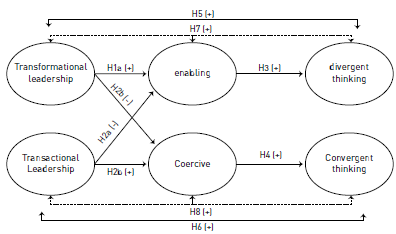
As shown in Figure 1, the proposed relationships are conjectured according to the formulated hypotheses based on the literature.
3. Methodology
3.1 Sample Selection and Data Collection
The study population consists of Brazilian textile industries in the apparel sector. This population was chosen because these organizations are highly dependent on creativity, given the constant innovations in the fashion world that drive the market to seek the latest trends. To access the target population and compose the sample, LinkedIn users holding mid-level management positions in Brazilian apparel industries (women's, men's, and children's clothing) were tracked. This profile was selected because these managers are involved in defining business plans while being influenced in the choice and use of management controls.
To compose the sample, invitations to participate in the research were first sent to Linked In users who met the predetermined criteria. Of the invitations sent, 500 were accepted. After accepting the invitation, the research instrument was sent via a link to the questionnaire hosted on the Google Forms platform. Data collection took place from November 2021 to March 2022.
To estimate the minimum required sample size, the G*Power 3.1.9.2 software (Faul et al., 2009) was used. Following the recommendations of Hair et al. (2014), the power of the test was set at 0.80, with a medium effect size (f2) = 0.15. Considering that the number of predictors is 2 (Figure 1), the minimum sample size for the study is 77 cases. Ringle et al. (2014) suggest that to have a more robust model, it is advisable to use double or triple this number. Therefore, the minimum sample recommended by the literature is between 154 and 231 cases. A total of 254 responses were obtained, of which 39 were excluded because the respondents did not work in the apparel sector. Thus, the non-random sample consisted of 215 responses, a sufficient number to estimate the research hypotheses.
3.2 Research Constructs and Variable Measurement
The questionnaire applied to the sample consisted of 44 assertions. These assertions were adapted from the studies of Cropley (2006), Free (2007), Hartmann and Maas (2011), Mahama and Cheng (2013), Aga (2016), Aga et al. (2016), Berg (2016), Beuren and Santos (2019), and Awang et al. (2020).
Figure 2 Research Instrument.
| 1st Order Construct | 2nd Order Construct | Constitutive Definition | Operational Definition |
|---|---|---|---|
| Leadership Styles | Transformational Leadership | Transformational leaders are proactive, raise followers' awareness of collective interests, and act as mentors for those needing help to grow and develop (Bass, 1990; Antonakis et al., 2003; Hu et al., 2012). | Transformational leadership includes: i) idealized influence; ii) inspirational motivation; iii) intellectual stimulation; and iv) individualized consideration (Bass, 1990; Antonakis et al., 2003; Judge & Piccolo, 2004; Hu et al., 2012). |
| Transactional Leadership | It is a process of exchange based on fulfilling contractual obligations, usually represented by goal-setting and monitoring and controlling results (Bass, 1990; Antonakis et al., 2003; Hu et al., 2012). | Transactional leadership involves: i) contingent reward; ii) active management by exception; and iii) passive management by exception (Bass, 1990; Antonakis et al., 2003; Judge & Piccolo, 2004; Hu et al., 2012). | |
| Management Control Systems | Enabling | Enabling MCS is designed to enhance users' capabilities and leverage their skills and intelligence (Adler & Borys, 1996; Ahrens & Chapman, 2004). | Enabling MCS promotes discussions in meetings among subordinates, superiors, and peers. It involves discussing short- and long-term action plans, aligning goals with organizational objectives, and enabling the organization to reach new horizons. |
| Coercive | Coercive MCS specifies organizational rules with the goal of creating a fail-safe system. The coercive nature of this type of formalization lies in the imposition of its logic on organizational members (Adler & Borys, 1996; Ahrens & Chapman, 2004). | Coercive MCS tracks progress on goals set by managers, monitors and follows up on results, and reviews organizational performance measures. | |
| Creative Thinking | Divergent Thinking | Refers to the "novelty" aspect of creativity and involves seeking new associations, combinations, or perspectives (Guilford, 1967; Cropley, 2006; Berg, 2016). | Divergent thinking seeks to bring new solutions to complex problems and facilitates organizational creativity. |
| Convergent Thinking | It is oriented toward deriving the best (or correct) answer to a clearly defined question, i.e., generating creative ideas (Cropley, 2006; Berg, 2016). | Convergent thinking emphasizes the need to use existing organizational tools to solve problems. |
Source: own elaboration.
To measure the leadership style construct, the Multifactor Leadership Questionnaire (MLQ) developed by Bass and Avolio (1995) was used. However, to increase internal consistency and validity, some studies (Tejeda et al., 2001; Doeleman et al., 2012; Tyssen et al., 2014) recommend an improved version of the MLQ. Therefore, the version of the instrument by Aga et al. (2016) was chosen for transformational leadership, with 13 assertions such as "My superior allows team members to think of different solutions to old problems" and Aga (2016) for transactional leadership, with 7 assertions such as "My superior tells team members what to do if they want to be rewarded for their work."
The enabling approach of MCS was measured using 6 assertions, based on the studies of Hartmann and Maas (2011) and Beuren and Santos (2019), for example, "I perceive that MCS are designed to capitalize on managers' intelligence by giving them the freedom to innovate amid contingencies, unexpected events, and obstacles that may hinder the organization's goals and productivity." Coercive MCS was measured using 6 assertions based on the studies of Free (2007), Hartmann and Maas (2011), and Mahama and Cheg (2013), such as "I perceive that MCS are designed to guide people's actions in the company toward meeting the standards specified by top management."
Individual creativity was assessed with 12 assertions, 6 regarding divergent thinking adapted from the study by Awang et al. (2020), for example, "I have many ideas and always think of ways to improve work" and 6 assertions related to convergent thinking based on the studies of Cropley (2006) and Berg (2016), such as "I apply criteria, standards, and logic based on previous knowledge and experience".
Respondents' perceptions of the assertions were measured using a five-point Likert scale, ranging from (1) strongly disagree to (5) strongly agree. To avoid measurement bias, the assertions derived from foreign instruments underwent a translation and backtranslation process, as recommended by Pedroso et al. (2004). The research instrument was also pre-tested with four professors-researchers in management controls- two PhD candidates, and three master's students to eliminate any comprehension difficulties with the assertions. The instrument was subsequently reviewed and approved by the research ethics committee.
Since this instrument contained not-previously-validated assertions, exploratory factor analysis (EFA) was conducted using Factor Analysis. The analysis was implemented using a polychoric matrix and the Robust Diagonally Weighted Least Squares (RDWLS) extraction method (Asparouhov & Muthen, 2010). The decision on the number of factors to retain was made using the parallel analysis technique with random permutation of the observed data (Timmerman & Lorenzo-Seva, 2011), and the rotation used was Robust Promin (Lorenzo-Seva & Ferrando, 2019c). The results of UniCo 0.89 and ECV 0.76 confirm that the data cannot be treated as unidimensional. However, the EFA retained only 3 factors, but since each construct is supported by the literature, the six constructs in the theoretical model were considered. The results of the Measure of Sampling Adequacy (MSA) and the loading matrix indicated the need to exclude six assertions: four related to transformational leadership (q2, q3, q5, and q6), one from the transactional leadership construct (q14), and one related to convergent thinking (q39).
The estimates of factor score replicability (Ferrando & Lorenzo-Seva, 2018) suggested that the "transformational leadership" factor may not be repli-cable in future studies (H < 0.80). However, it is worth noting that the factor structure presented adequate fit indices (RMSEA = 0.01; CFI = 0.999; TLI = 1.073), and the factor score precision indicators, Orion (>0.80) and FDI (>0.80), are considered good.
3.3 Data Analysis Procedures
Since data collection used only one method, the recommendations of Podsakoff et al. (2003) were followed to avoid common method bias. First, the questionnaire's assertions were randomly organized to prevent associations between constructs by the respondent. Next, the questionnaire was sent directly to respondents who had accepted to join the LinkedIn network. After data collection, Harman's single-factor test was conducted, where a high amount of variance explained by a single factor may indicate common method bias (Podsakoff et al., 2003). The test was performed using exploratory factor analysis, including all variables, both independent and dependent, with the expectation that a single factor would account for no more than 50% of the variance. In this case, a single factor represented 22.01% of the variance, suggesting that common method bias is not an issue.
To analyze the collected data, the structural equation modeling (SEM) using partial least squares (PLS) was employed with the SmartPLS software. SEM combines multivariate techniques, including factor analysis and regression, allowing researchers to simultaneously analyze the relationships between variables (Hair et al., 2014). To evaluate the reflective relationships of the theoretical model, a two-step analytical procedure was adopted.
First, the measurement model was assessed to confirm the validity and reliability of the research instrument, and then the structural relationships were tested using path coefficients (Brei & Neto, 2006; Hair et al., 2014).
4. Data analysis
4.1 Evaluation of the Measurement Model
Evaluating the measurement model is the first step of structural equation modeling and involves the verification of model quality criteria. In this sense, we initially examined the factorial loadings of each assertion of the model. We excluded thirteen assertions that presented cross-loadings lower than 0.708. When removed, they increased the convergent validity and/or the composite reliability of the model, as shown in Table 1.
Composite reliability and convergent validity (AVE) indicators are used to assess the quality of the measurement model. According to Hair Jr. et al. (2021), a composite reliability higher than 0.70 and lower than 0.95 is recommended for the construct to be considered valid. The AVE represents how positively correlated the statements are with their respective constructs, with values greater than 0.50 considered satisfactory (Hair Jr. et al., 2021). Therefore, after the adjustments, we considered that the measurement model had composite reliability and convergent validity.
Subsequently, the discriminant validity of constructs was assessed to gauge the extent to which any given construct was empirically distinct from the others in the model. Discriminant validity was assessed by the Fornell-Lacker and the Heterotrait-Monotrait-HTMT methods (Table 2).
According to Table 2 (shaded values), the discriminant validity of all variables is higher than the correlation matrix coefficients (both vertically and horizontally), suggesting the former is acceptable. Such a conclusion is confirmed by the HTMT ratio of correlations since the obtained values were below those determined in the literature (HTMT < 0.90) (Gold et al. 2001; Teo et al. 2008). These results allowed us to proceed with the analysis of structural relations and hypothesis tests.
4.3 Evaluation of the Structural Model and Discussion of the Hypotheses
To evaluate the structural model, we first assessed the R2 values, indicating the percentage of variance of an endogenous variable explained by the model (Ringle et al., 2014), expressing its quality. The R2 values were considered as average effects, being 14.5% for "Convergent Thinking", 18.4% for "Coercive MCS Use", 18.5% for "Enabling MCS Use", and 19.1% for "Divergent Thinking", as seen in Table 3.
Table 1 Loadings, Composite Reliability, and Convergent Validity of the constructs
| Individual loadings | Composite Reliability | Convergent Validity (CVE) | Individual loadings | Composite Reliability | Convergent Validity (CVE) | |
|---|---|---|---|---|---|---|
| Before | Before | After | After | |||
| Transformational Leadership | q1 - 0.412 | 0.836 | 0.371 | 0.844 | 0.521 | |
| q4 - 0.501 | ||||||
| q7 - 0.710 | q7 - 0.734 | |||||
| q8 - 0.700 | q8 - 0.758 | |||||
| q9 - 0.441 | ||||||
| q10 - 0.674 | q10 - 0.646 | |||||
| q11 - 0.510 | ||||||
| q12 - 0.680 | q12 - 0.687 | |||||
| q13 - 0.741 | q13 - 0.776 | |||||
| q15 - 0.621 | q15 - 0.684 | |||||
| Transactional Leadership | q16 - 0.403 | 0.745 | 0.331 | 0.753 | 0.505 | |
| q17 - 0.609 | q17 - 0.736 | |||||
| q18 - 0.583 | q18 - 0.710 | |||||
| q19 - 0.616 | ||||||
| q20 - 0.591 | ||||||
| Enabling MCS | q21 - 0.677 | 0.836 | 0.460 | q21 - 0.662 | 0.837 | 0.507 |
| q22 - 0.694 | q22 - 0.685 | |||||
| q23 - 0.700 | q23 - 0.745 | |||||
| q24 - 0.670 | q24 - 0.713 | |||||
| q25 - 0.590 | ||||||
| q26 - 0.732 | q26 - 0.750 | |||||
| Coercive MCS | q27 - 0.790 | 0.813 | 0.434 | q27 - 0.797 | 0.832 | 0.500 |
| q28 - 0.665 | q28 - 0.663 | |||||
| q29 - 0.628 | q29 - 0.614 | |||||
| q30 - 0.314 | ||||||
| q31 - 0.712 | q31 - 0.706 | |||||
| q32 - 0.731 | q32 - 0.742 | |||||
| q33 - 0.650 | q33 - 0.643 | |||||
| q34 - 0.643 | 0.865 | 0.519 | q34 - 0.638 | |||
| Divergent Thinking | q35 - 0.793 | q35 - 0.791 | 0.865 | 0.519 | ||
| q36 - 0.779 | q36 - 0.777 | |||||
| q37 - 0.680 | q37 - 0.687 | |||||
| q38 - 0.760 | q38 - 0.770 | |||||
| Convergent Thinking | q40 - 0.620 | 0.814 | 0.472 | q40 - 0.641 | 0.817 | 0.531 |
| q41 - 0.781 | q41 - 0.796 | |||||
| q42 - 0.583 | ||||||
| q43 - 0.614 | q43 - 0.650 | |||||
| q44 - 0.805 | q44 - 0.810 |
Source: own elaboration.
Table 2 Discriminant Validity - Criterion of Fornell & Larcker (1981) and Heterotrait-Monotrait-HTMT method
| 1 | 2 | 3 | 4 | 5 | 6 | ||||||||
|---|---|---|---|---|---|---|---|---|---|---|---|---|---|
| 1. Conv | 0.729* | ||||||||||||
| 2. Div | 0.686 | 0.895** | 0.721* | ||||||||||
| 3. Trans | 0.172 | 0.358 | 0.106 | 0.220** | 0.710* | ||||||||
| 4. Trasf | 0.579 | 0.788 | 0.527 | 0.687 | 0.293 | 0.433** | 0.722* | ||||||
| 5. Coer | 0.381 | 0.502 | 0.335 | 0.419 | 0.386 | 0.593 | 0.293 | 0.359** | 0.707* | ||||
| 6. Enab | 0.400 | 0.530 | 0.437 | 0.513 | 0.348 | 0.518 | 0.343 | 0.430 | 0.648 | 0.856** | 0.712* | ||
Note: *Fornell-Larcker criterion; **heterotrait-monotrait ratio of correlations (HTMT)
Source: own elaboration.
Table 3 Results of the structural model
| Variables | R2 | R2 adjusted | Q2 | f2 | VIF |
|---|---|---|---|---|---|
| Transformational | 0.078 | 1.094 | |||
| Leadership | |||||
| Transactional Leadership | 0.121 | 1.094 | |||
| Enabling MCS | 0.185 | 0.176 | 0.088 | 0.236 | 1.000 |
| Coercive MCS | 0.184 | 0.176 | 0.085 | 0.169 | 1.000 |
| Divergent Thinking | 0.191 | 0.187 | 0.087 | ||
| Convergent Thinking | 0.145 | 0.141 | 0.073 |
Note: Effect size f2: ≥ 0.02 small, ≥ 0.15 medium, and ≥ 0.35 large; recommended value for VIF (variance in action factor) < 5 (Hair Jr et al., 2021). Explained variance R2: R²=2% is considered a small effect, R²=13% a medium effect, and R²=26% a large effect (Cohen, 1988); Q2 > 0 (Peng & Lai, 2012).
Source: own elaboration.
For discussing the hypotheses, we first analyzed the direct relationships between the variables and then the mediation between them, as shown in Table 4.
Table 4 Results of the structural model: hypothesis testing
| Hypotheses | Constructs | Effect | t-value | p-value | Decision |
|---|---|---|---|---|---|
| H1a (+) | Transformational Leadership > Enabling MCS approach | 0.264 | 3.892 | 0.000* | Accepted |
| H1b (-) | Transformational Leadership > Coercive MCS approach | 0.197 | 2.425 | 0.015** | Rejected |
| H2a (-) | Transactional Leadership > Enabling MCS approach | 0.270 | 3.331 | 0.001* | Rejected |
| H2b (+) | Enabling MCS approach > Divergent Thinking | 0.328 | 4.055 | 0.000* | Accepted |
| H3 (+) | Enabling MCS approach > Divergent Thinking | 0.437 | 7.552 | 0.000* | Accepted |
| H4 (+) | Coercive MCS approach > Convergent Thinking | 0.381 | 5.876 | 0.000* | Accepted |
| H5 (+) | Transformational Leadership > Divergent Thinking | 0.115 | 2.733 | 0.006* | Accepted |
| H6 (+) | Transactional Leadership > Convergent Thinking | 0.125 | 4.136 | 0.000* | Accepted |
| H7 (+) | Transformational Leadership > Enabling MCS approach > Divergent Thinking | 0.115 | 2.733 | 0.006* | Accepted |
| H8 (+) | Transactional Leadership > Coercive MCS approach > Convergent Thinking | 0.125 | 4.136 | 0.000* | Accepted |
Note: Significant at the level of *p < 0.01; **p < 0.05; ***p < 0.10.
Source: own elaboration.
Additionally, we evaluated the total effects (f2), which vary according to each construct. In this sense, the "enabling MCS and coercive MCS" constructs have medium effect, and the "transformational leadership and transactional leadership" constructs have small effect. Q2 values indicate whether the model has predictive relevance and should be greater than 0 (Peng & Lai, 2012). The results in Table 3 show that all constructs meet the established criterion. Finally, VIF values < 5 for the independent constructs indicate the absence of collinearity problems (Hair Jr. et al., 2021).
The results of H1a indicate that transformational leadership has a positive and significant effect on enabling MCS (p<0.01), supporting previous assumptions in the literature (Judge & Piccolo, 2004; Abernethy et al., 2010; Van Dierendonck et al., 2013; Asrar-Ul-Haq & Kuchinke, 2016; Nguyen et al., 2017). In other words, transformational leadership inspires followers to achieve higher managerial performance and make informed choices about which MCS to use. As noted in the literature (García-Morales et al., 2012), transformational leadership generates greater purpose and a sense of mission among followers and promotes a shared vision that guides team formation. This is supported by authors (Adler & Borys, 1996; Wouters & Wilderom, 2008), who point out that enabling MCS fosters interaction between users and systems and stimulates cooperation among organizational members to achieve organizational goals (Hartmann & Maas, 2011).
The results of H1b indicate that transformational leadership has a positive effect on coercive MCS (ß 0.197), thus rejecting the hypothesis. The results are significant since there is no clear confirmation of this relationship in the literature. There are only indications (Nguyen et al., 2017) that transformational leadership has no significant effect on reward systems, which tend to have a coercive nature. Authors like (Adler & Borys, 1996; Ahrens & Chapman, 2004) report that coercive systems are designed for adherence to predefined rules and standards. Transformational leadership, however, is based on flexibility and the leader's sensitivity to followers (Hater & Bass, 1988; Jung et al., 1995; Jung & Avolio, 1999). This finding contrasts with the literature by bringing new insights: transformational leadership has a positive effect on coercive MCS.
For H2a, the results indicate a positive association between transactional leadership and enabling MCS (ß 0.270), thus rejecting H2a. This finding reflects the tension in the literature regarding transactional leadership and enabling MCS, given that transactional leadership is based on the exchange between leader and follower, with transactional leaders focused on meeting predefined goals and objectives (MacKenzie et al., 2001) and using penalties for non-compliance (Domingues et al., 2017; Vieira et al., 2020). Moreover, enabling MCS encourages dialogue (Ahrens & Chapman, 2004; Wouters & Wilderom, 2008) and fosters improvements in users' skills and intelligence (Henttu-Aho, 2016). Despite indications in the literature that transactional leadership would not lead to enabling MCS, the results are contradictory, suggesting that in the Brazilian textile industry, transactional managers also opt for enabling MCS.
The results of H2b show that transactional leadership has a positive and significant effect on coercive MCS (p<0.05), supporting the assumptions of (Cruz et al., 2015) that transactional leadership enforces clear rules and predefined expectations, thus aligning with coercive forma-lization. Transactional leaders prefer to use coercive MCS because this system allows leaders to delegate specific tasks to employees with clear instructions (Englund & Gerdin, 2014; Burney et al., 2017), imposing a control logic that requires adherence to pre-planned standards (Ahrens & Chapman, 2004). These standards are established by transactional leaders, who offer rewards to followers in exchange for completing the required tasks (Vieira et al., 2020). This aligns with the coercive MCS framework, where employees have limited action options (Ahrens & Chapman, 2004; Coyte, 2019). Thus, based on the literature, this study's findings confirm the positive association between transactional leadership and coercive MCS.
A direct and positive influence of enabling MCS on divergent thinking was also found, with H3 being accepted (p<0.05). These findings support the assumptions in the literature (Cools et al., 2017; Davila & Ditillo, 2017; Speckbacher, 2017). According to (Hempel et al., 2012; Adler & Chen, 2011; Grabner & Speckbacher, 2016), enabling formalization plays an important role in providing predictability, guidance, and clarity in organizational processes. Speckbacher (2017) argues that stimulating employees' intelligence skills is related to divergent thinking through enabling MCS. These findings align with the literature on divergent thinking (Runco & Acar, 2012), where individuals generate new and creative ideas for problem-solving in organizations. Authors (Guilford, 1967; Cropley, 2006; Praveen, 2017) assert that divergent thinking involves multiple solutions to a problem.
Hypothesis H4, which predicted a positive and significant relationship between coercive MCS and convergent thinking, was accepted. Although the literature is not clear on this topic, the findings are consistent with other studies (Englund & Gerdin, 2014; Coyte, 2019) that highlight that coercive MCS are designed to meet the needs of top managers (Ahrens & Chapman, 2004), imposing predefined standards on employees, where subordinates have limited action options. These limitations are reflected in convergent thinking, as predetermined standards and logic must be followed (Cropley, 2006; Berg, 2016). In the context of diagnostic MCS, studies such as (Cools et al., 2017; Kaveski & Beuren, 2020) note that diagnostic MCS stimulate convergent thinking. While the focus here is not on diagnostic MCS but coercive MCS, the findings advance the literature on this subject.
Hypothesis H5, which predicted a positive and significant relationship between transformational leadership and divergent thinking, was accepted (p<0.01). The results align with those found by Jung (2001), Speckbacher (2017), and Suave & Aguiar (2021), who showed that transformational leadership has a direct impact on divergent thinking. This study provides empirical evidence of the importance of leadership in stimulating creative thinking (Liu et al., 2003; Bono & Judge, 2004). Transformational leaders promote creativity in their followers by generating new ideas for solving problems in different ways (Bass & Avolio, 1995; Yuan & Woodman, 2010; Hu et al., 2012; Hussain et al., 2017) and increasing performance expectations (Bass, 1990). Problem-solving through different methods reflects divergent thinking, as it involves seeking new associations and combinations that may be useful (Guilford, 1967; Berg, 2016). Consistent with previous expectations (Jung, 2001; Speckbacher, 2017; Suave & Aguiar, 2021), the results show that transformational leadership is positively associated with divergent thinking.
The results of H6 indicate that transactional leadership has a positive and significant effect on convergent thinking (p<0.01), corroborating the findings of Speckbacher (2017) and Suave & Aguiar (2021), that transactional leadership has a direct impact on convergent thinking. Transactional leadership benefits organizations by transmitting clear and objective information aimed at motivating team performance and creativity (Taggar, 2002; Rasulzada & Dackert, 2009; Öncer, 2013; Hussain et al., 2017; Ma & Jiang, 2018). Such characteristics are fostered by convergent thinking, as individuals evaluate ideas based on predetermined criteria, standards, and logic from previous knowledge and experiences (Guilford, 1967; Cropley, 2006; Berg, 2016). In this research, the findings suggest that the transactional leadership style of mid-level managers in the Brazilian textile industry contributes to the development of convergent thinking, which aligns with studies conducted in other contexts, such as startups (Suave & Aguiar, 2021).
Hypothesis H7, which predicted the mediating role of enabling MCS in the relationship between transformational leadership and divergent thinking, was accepted (p<0.05). Thus, it can be affirmed that the relationship between transformational leadership and divergent thinking is mediated by enabling MCS. If enabling MCS is necessary to affirm this relationship (Ahrens & Chapman, 2004), transformational leadership is a significant antecedent, as it shapes the environment to provide managers with better choices regarding which MCS to use (Lee et al., 2020). Transformational leadership provides clarity in decision-making, stimulating individuals to generate new ideas (Bass & Avolio, 1990; Anderson et al., 2014; Jung, 2001). By generating creative ideas, employees create new possibilities and changes that benefit the organization (Madjar, 2005; Lee et al., 2020). Transformational leadership is relevant in selecting the appropriate enabling MCS to stimulate divergent thinking, as the literature highlights the importance of choosing the right leadership style for optimal MCS use (Abernethy et al., 2010).
The mediating effect of coercive MCS in the relationship between transactional leadership and convergent thinking was accepted (p<0.05) for H8. Transactional leadership increases followers' satisfaction with the leader and influences cooperation by clarifying goals and providing feedback (Bass & Avolio, 1995; Kahai et al., 2003; Judge & Piccolo, 2004; Abbas & Ali, 2023). Based on the literature, it is believed that transactional leadership leads to coercive MCS use. Both have similar characteristics, such as predefined goals (Ahrens & Chapman, 2004; Judge & Piccolo, 2004), task specifications (Bass & Avolio, 1995; Kahai et al., 2003; Ahrens & Chapman, 2004), predetermined rules (Ahrens & Chapman, 2004; Radtke & Widener, 2016; Burney et al., 2017), and the use of existing knowledge to complete tasks (Burney et al., 2017). These findings reinforce the alignment between transactional leadership and convergent thinking, as the latter focuses on discovering the most effective solution to a problem using tools already employed by the organization (Guilford, 1967; Cropley, 2006).
5. Final considerations
In the context of the apparel sector within the Brazilian textile industry, transformational leadership positively contributes to the stimulation of enabling management control systems and, simultaneously, leads to the positive use of the coercive management control system. Another result is that transactional leadership is associated with both coercive and enabling approaches. Regarding creative thinking, the results indicate that the enabling use has a positive effect on divergent thinking, signaling that the enabling approach is a precursor to achieving objectives and creating value by encouraging individuals to engage more in divergent thinking while performing their tasks in the apparel sector. Likewise, the results show that coercive management control systems positively affects convergent thinking, as convergent thinking demands relevance, utility, and goal orientation, which are supported by the coercive approach.
This study provides empirical evidence reinforcing the role of leadership in stimulating creative processes (Liu et al., 2003; Bono & Judge, 2004). Based on previous studies (Jung, 2001; Speckbacher, 2017; Suave & Aguiar, 2021), the results suggest that different leadership profiles may be more appropriate for different thinking styles, divergent versus convergent. Specifically, transformational leadership has a positive effect on divergent thinking, while transactional leadership has a positive effect on convergent thinking.
Therefore, based on the apparel sector of the Brazilian textile industry, and when extending these findings to other organizations, it is important to highlight that fostering creative thinking (divergent versus convergent) can benefit from the adoption of appropriate leadership styles (transformational versus transactional). In summary, this combination of leadership styles and creative thinking becomes crucial for companies seeking higher levels of creativity. In the Brazilian textile industry, complementary mediation was found; the enabling approach mediates the relationship between transformational leadership and divergent thinking, and the coercive approach mediates the relationship between transactional leadership and convergent thinking.
The study focuses on the perspectives of middle managers; therefore, future research should explore senior managers to expand the generalizability of the findings. It is also suggested to replicate the theoretical model considering the refinement of the transactional leadership and convergent thinking items. Specifically, the transactional leadership items proposed by Aga (2016) to increase the internal consistency and validity of the instrument developed by Bass and Avolio (1995) were not suitable for the Brazilian reality. Therefore, an investigation considering the development/refinement of the items is suggested. In addition, future research can employ qualitative analysis techniques, such as case studies, to clarify aspects that may influence the relationship between leadership styles, management control systems, and creative thinking. Experimental studies may also be important, as they offer opportunities to investigate controlled variables in different perspectives/scenarios.

