




 English (pdf)
 Article in xml format
 Article references
 Automatic translation
 Send this article by e-mail
 Cited by SciELO
  Cited by Google
  Similars in
SciELO
Similars in
SciELO  Similars in Google
 Permalink

Introduction
Popper's theory of falsifiability is widely recognized because it establishes the necessary and sufficient conditions for a theory to be considered empirical. This theory provides both a criterion of scientific validity and a criterion of demarcation, allowing us to distinguish between theories belonging to empirical science and all other types of theories, including those belonging to the formal sciences. The theory of falsifiability satisfactorily explains the process of theory selection and improvement as a result of the continuous interaction between tentative general hypotheses and empirical experience.
According to Popper, the main challenge of a sound epistemology is to establish appropriate criteria for determining whether a theory fulfils the conditions to be part of empirical science. Consequently, it should propose meaningful hypotheses and predictions that can be tested against experience. Moreover, the criteria for this task must fulfil two essential requirements: (a) they must be non-inductive, and (b) they must provide precise guidelines for the functional application of Popper's demarcation principle. The first requirement is met by adopting an approach in which deductive logic alone is sufficient to evaluate a given system of statements and to perform the epistemological and methodological operations necessary to determine whether the system is empirical (i.e., scientific). The second requirement is met by formulating a test principle that is independent of any theory of meaning.
To satisfy the above condition, Popper proposed the principle (or criterion) of falsifiability, which he elaborated in his works The logic of scientific Discovery (Popper, 1959) and Conjectures and refutations (Popper, 1962). In these influential texts, the Viennese philosopher outlines the basic elements for developing an alternative philosophy of science aimed at overcoming Hume's problem of induction. In particular, he seeks to address the looming threat of irrationality that hangs over empirical science if it continues to be viewed as fundamentally inductive -an assumption that many have held since the emergence of modern science (Bacon, 2022; Newton, 1993). As noted above, Popper (1959, 1962) proposed a criterion that distinguishes scientific theories from other types of theories, such as logical-mathematical and metaphysical theories, by applying the principle of falsifiability. This principle serves as a cornerstone for distinguishing empirical sciences from non-empirical frameworks, emphasizing that scientific theories must be inherently testable and falsifiable by empirical evidence.
Falsifiability, more precisely defined as a future ability or potentiality, can be understood as the possibility that the statements or hypotheses proposed by a theory may come into conflict with empirical facts. It is therefore a property whose fulfilment or lack of fulfilment is determined by experience. If such a possibility materializes, it allows for the falsification of certain statements within the empirical world (Karl Popper, 1991b). Popper's epistemology, as summarized by García Duque (2019), revolves around four central components: the deductive approach as a response to Hume's problem, the theory of falsifiability as a demarcation criterion, corroboration as an epistemic virtue of theories, and verisimilitude as a distinguishing feature of promising empirical theories and an overarching goal of science. It has often been emphasized that the theory of falsifiability requires consideration of potential inconsistencies between a theory's claims and empirical facts (Miller, 2007). This notion emphasizes the importance of subjecting scientific hypotheses to rigorous testing to ensure that they can be refuted by empirical observations if they do not correspond to reality. Through this process, falsifiability serves not only as a methodological tool, but also as a safeguard against dogmatism, promoting the continuous refinement and evolution of scientific knowledge.
The condition of falsifiability has significant implications for the development of science and has a clear influence on our conceptions of it. According to Popper, only if we can anticipate or postulate empirical facts that may contradict the claims of a given theory can we conclude that we are dealing with an empirical theory and not a tautological or metaphysical one which claims cannot be tested (Popper 1959, 1962). In this sense, theories with a higher degree of falsifiability are, according to Popper, much more promising and can represent a real advance in knowledge, as their exploration reveals new areas of action and application. The following discussion explores the possibility of applying the concept of falsifiability -one of the central cornerstones of Popper's philosophy of science- to the field of Information and Communication Technologies (ICT), a field often considered to be completely unrelated to the kind of meta-theoretical analysis that can be conducted from this perspective.1 This exploration seeks to demonstrate how falsifiability can serve as a valuable methodological framework for assessing the scientific rigor and empirical validity of ICT theories and innovations.
Venkatesh et al. (2003) introduced the Unified Theory of Acceptance and Use of Technology (UTAUT) as an integration of several complementary models and theories, including the Theory of Reasoned Action, the Technology Acceptance Model, the Motivation Model, the Theory of Planned Behavior, the Combined Technology Acceptance and Behaviour Model, the PC Usage Model, the Diffusion of Innovation Theory, and the Social Cognitive Theory. One of the main motivations behind the proposal of UTAUT by Venkatesh et al. (2003) was its ability to model, using formal sciences such as mathematics, some of the real world implications of the above theories and models, with a particular focus on technology adoption and use. This comprehensive framework provides a structured approach to understanding user acceptance of technology by considering multiple Behavioral and motivational factors within a unified model.
Based on the above, Venkatesh et al (2003), proposed five key hypotheses known as Performance Expectancy (PE), Effort Expectancy (EE), Social Influence (SI), Behavioral Intention (BI) and Use Behaviour (UB).
These hypotheses aim to explain the factors influencing the adoption and intention to use technology in information systems, which are mediated by latent and moderating variables such as age, gender, experience and voluntariness of technology use. It is assumed that these variables have a significant impact on the implementation and adoption of technology across different knowledge domains. The above hypotheses are illustrated in Fig. 1 and provide a conceptual framework to better understand the interplay between user demographics and their interaction with technology adoption processes.
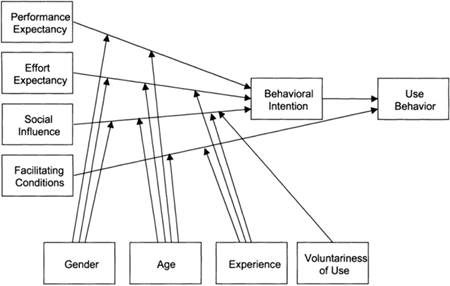
In Fig. 1, it can be seen that the Performance Expectancy (PE), Effort Expectancy (EE), Social Influence (SI), and Facilitating Conditions (FC) hypotheses are related to the Behavioral Intention (BI) hypothesis, which in turn is related to the Usage Behaviour (UB) of the technology. In addition, these hypotheses are influenced by moderating variables such as gender, age, experience, and voluntary use of technology.
Since the introduction of UTAUT hypotheses by Venkatesh et al. (2003), academic communities in different knowledge domains have shown great interest in implementing them to explore specific phenomena and validate the correlation and association results identified in their pioneering work. As noted by Williams et al. (2015), different fields of knowledge have partially applied the UTAUT hypotheses to address various knowledge gaps in the field of technology.
The above observations indicate that the hypotheses and constructs of the UTAUT framework, when applied to real-world scenarios in different domains of knowledge, may encounter inconsistencies with the empirical realities of specific domains. This discrepancy can be attributed to the fact that the UTAUT hypotheses were formulated two decades ago, while technological advances have grown exponentially. Nevertheless, it is essential to conduct a study on the falsifiability of the UTAUT hypotheses in the present context, in order to assess their validity and responsiveness to the adoption of current technologies in different social settings.
To this end, three key hypotheses of the UTAUT framework are highlighted. First, the influence of performance expectancy on technology use intention will be moderated by gender and age, suggesting that the effect will be stronger for males, especially younger males. Second, an individual's behavioral intention has a positive influence on technology use. Third, the effect of social influence on behavior intention is moderated by gender, age, voluntariness and experience, suggesting that the effect will be stronger among women, especially older women, especially in mandatory settings during the early stages of experience.
The above hypotheses were evaluated through the lens of falsifiability in case studies presented in various research papers using the UTAUT framework as their theoretical foundation. To this end, two case studies were examined for each of the three hypotheses, and an analysis was conducted to assess the falsifiability condition stated in the hypothesis against the results obtained from each case study. This process revealed that the hypotheses of the UTAUT framework were ultimately falsified2, demonstrating inconsistencies between the theoretical predictions and the empirical findings in different contexts.
The structure of this document consists of three sections: the first explains the methodology, the second presents the falsifiable hypotheses in various fields of knowledge where the UTAUT theory is applied, and the third presents the conclusions. The analysis of the falsifiability of the UTAUT theory was carried out by identifying falsifying events in the empirical world that challenge the selected hypotheses. The expected results are to demonstrate the applicability of Popper's theses to the field of information and communication technologies, and to provide valuable insights into the relevance and adaptability of the UTAUT framework in contemporary technological contexts.
Methodology
The study begins with a Description of the hypothesis selection process:
a. Selected studies:
In order to explore the applicability of the concept of falsifiability in this area, the selected hypotheses -PE, BI and SI- were defined and their use in the selected studies was analyzed for each hypothesis. The selected studies were selected on the basis of the following criteria: the study must evaluate technology adoption using the UTAUT framework within a case study, the methodology used must be quantitative, confirmatory factor analysis techniques must be applied, and the study must have been published between 2003 and 2023. The falsifiability condition of the PE, BI, and SI hypotheses was then analyzed in the results of the case studies.
Studies that did not meet the above selection criteria were excluded.
b. Definition of the hypotheses of the UTAUT theory:
The definition of the hypotheses in the UTAUT theory was based on the theoretical constructs developed by Venkatesh et al. (2003). Taking into account Fig. 1, the hypotheses that can influence behavioral intention were specifically selected: Performance Expectancy (PE) and Social Influence (SI). These were chosen because the adoption and use of technology can be influenced by an individual's social interactions and the expectation that the technology will meet individual and group needs. In addition, the behavioral Intention (BI) hypothesis was selected based on the premise that behavior is a necessary condition for technology use in different scenarios. BI, together with performance expectancy and social influence, contributes to the adoption and use of different technologies, whether they are technological services or physical devices.
The selected articles corresponding to each hypothesis of the UTAUT theory are presented in Table 1.
Table 1 Articles used for each hypothesis of the UTAUT theory.
| Hypotheses | References |
|---|---|
| PE | Lee et al (2003), King and He (2006) |
| BI | Van Biljon and Renaud (2008), Wang and Shih (2009) |
| SI | Chang et al (2007), Chiu et al (2010) |
Performance Expectancy (PE): This hypothesis in UTAUT theory is defined as: "The influence of performance expectancy on behavioral intention will be moderated by gender and age, such that the effect will be stronger for males and especially for younger males".3 (Venkatesh et al., 2003).
Lee et al. (2003) conducted a quantitative study to measure the adoption of information technologies by citizens requesting digital services such as online documents and permits. This measurement was carried out using a structural equation model, which revealed that the Performance Expectancy (PE) hypothesis was not only potentially falsifiable within the selected object of study, but had already been falsified. The analysis revealed that the PE hypothesis had the lowest R-squared correlation coefficient compared to the other hypotheses. This finding suggests that the PE hypothesis has a minimal impact on the phenomenon under investigation.
Furthermore, the study refutes the claim that behavioral intention to use online services is only influenced by males, especially younger males. Instead, the results suggest that individuals of all genders and ages can effectively use government online services. This interpretation is consistent with an intuitive perspective that discourages gender bias and clearly demonstrates the falsifiability of the original hypothesis.
On the other hand, King and He (2006) focused on TAM-type models to demonstrate their potential application in different fields of knowledge through a meta-analysis that considered 178 observations, each measuring the hypotheses proposed in the UTAUT theory. Their analysis showed that the TAM model presents three related hypotheses that should be evaluated using indicators reflecting the use of different technologies, taking into account access to hardware and software. It becomes clear that the relevant factual evidence shows that the intention to use technology is not adequately described by these hypotheses. It is evident that the intention to use different technologies is not limited to men only, nor specifically to younger men.
For these reasons, when comparing the results of the two studies with the assumptions made in the hypotheses, it must be concluded that they are in conflict with empirical evidence. This conflict satisfies the falsifiability condition of the theory in both selected case studies.
Behavioral intention (BI): This hypothesis in the UTAUT theory is defined as follows: "Behavioral intention will have a significant positive influence on usage" (Venkatesh et al., 2003).
Based on Van Biljon and Renaud (2008), it is assumed that this hypothesis has a strong relationship with the acceptance of different technologies, especially mobile technologies. However, it is observed that the classical model of this hypothesis within the UTAUT framework conflicts with the well-documented fact of the use of mobile technologies, such as mobile phones, by people over 60 years of age. The falsifiability condition of this hypothesis is demonstrated by the aforementioned research and publicly available observations, as the use of mobile devices does not depend solely on behavioral intention among individuals over the age of 60. The intention to use a particular technology can manifest itself in any individual, regardless of their age group.
Similarly, the study conducted by Wang and Shih (2009) evaluates citizens' acceptance of the so-called ‘digital kiosks’ or ‘digital access points’ as a public policy initiative. This phenomenon was investigated through a quantitative study with 244 participants, using partial least squares structural equation modelling techniques, which revealed a low level of partial application for the hypothesis under discussion. This effect provides evidence of a falsifying event, as the acceptance of digital kiosks is also influenced by behavioral intention, which can be an individual or group behavior. To clarify further, the condition of falsifiability of this hypothesis arises because the adoption of digital kiosks is not only a function of behavioral intention, but also depends on other variables and conditions, such as the accessibility policy of digital kiosks.
Social Influence (SI): This hypothesis within the UTAUT theory is defined as follows: “The effect of social influence on behavioral intention will be moderated by gender, age, voluntariness, and experience, such that the effect will be stronger for women, especially older women, especially in mandatory settings during the early stages of experience” (Venkatesh et al., 2003).
To test this hypothesis, the study by Chang et al. (2007) was selected. This study focused on the implementation of a recommendation system for clinical decision making based on pharmacokinetics and artificial intelligence. To this end, the authors applied the hypotheses outlined in the UTAUT theory to the given context, using a sample of 140 physicians who had the opportunity to evaluate the system in practice. The results of the study show that only two of the five hypotheses showed high statistical correlations, while the SI hypothesis showed a very low correlation. This is because the use of a recommendation system in medical practice is not exclusively aimed at women, and especially not at older women. As the study itself shows, both male and female doctors participated in the case studies and used and adopted the recommendation system regardless of gender.
On the other hand, Chiu et al. (2010) proposed an evaluation model focusing on the repeat purchase intention of online shoppers. Specifically, their research focused on perceived trust at the exact moment of an online purchase. However, according to their findings, this hypothesis does not meet the statistical correlation criteria established by Venkatesh et al. (2003), despite having a larger number of respondents in the evaluation instrument. Furthermore, the hypothesis is falsified in the case study, as online shopping users are not exclusively women, nor specifically older women. The study shows that a wide range of people -including young people, children, adults, senior citizens, both men and women- are active in e-commerce.4
As can be seen, this hypothesis contradicts the results of case studies such as those mentioned above. Neither the use of online shopping platforms for goods and services nor the use of specialized medical software is exclusively or particularly targeted at women, nor at older women with a higher level of experience.
Conclusions
The authors of the original article analyzed in this paper published an updated version of their work fifteen years later (Venkatesh et al., 2012). It is surprising, to say the least, that in this new version they remain silent not only about the obvious shortcomings of the core hypotheses of the original theory, but also about the findings of the meta-analytic research conducted on these hypotheses in recent years. This makes it clear that even a minimal familiarity with the principles of the philosophy of science -in particular, Popper's theory of science- would greatly contribute to the revision and improvement of the UTAUT theory.
As discussed earlier, the theory of falsifiability has two main practical applications in science: (1) ensuring the empirical (or scientific) nature of a theory, which includes its hypotheses, explanations and predictions, and (2) facilitating the advancement of theories (and scientific progress) through the use of the method of conjectures and refutations. This method involves subjecting hypotheses to rigorous testing and, in cases where they do not perform satisfactorily (i.e., are falsified), leading to their careful revision and reformulation. As will be examined in detail in the following sections, it is inevitable to conclude that the UTAUT theory is fundamentally flawed, since the hypotheses analyzed have been decisively falsified by relevant empirical evidence. Since the falsified hypotheses are central to the theory, there is no alternative but to proceed with a drastic reformulation or to seek other, more robust alternatives that can better withstand empirical scrutiny. Let us now turn to the specific conclusions for each hypothesis.
When examining the Performance Expectancy (PE) hypothesis, it can be seen that the falsifiability condition of the UTAUT theory is met, as there are numerous potential falsifiers of the hypothesis in the real world. This is evident from the comparison of the selected studies, which show that the hypothesis conflicts with the proposed case studies. The statistical techniques used by the selected authors, including structural equation modelling, confirm that the PE hypothesis does not hold in the case studies analyzed.
This result is significant, as it shows that performance expectancy is not exclusive to young men, but is a phenomenon that occurs regardless of age and gender. These findings challenge the original assumptions of the UTAUT theory and highlight the need to reconsider the hypothesis in order to better align it with the empirical realities of different demographic groups.
For the Effort Expectancy (EE) hypothesis, it is observed that there are falsifying events in the real world that contradict not only this hypothesis, but also all the hypotheses of the UTAUT theory. This was demonstrated by the second related study in this hypothesis, which found that the adoption of digital kiosks by citizens in the empirical world did not conform to the UTAUT hypotheses.
The analysis shows that the expectation of effortful use of digital kiosks and mobile devices is not exclusively observed among young women with little experience, but rather among a diverse population in terms of gender and age. In fact, the studies analyzed indicate that there are no inherent limitations based on gender or age group when it comes to technology adoption, contrary to what the hypothesis suggests. These findings highlight the need for a more inclusive and comprehensive approach to understanding effort expectancies in technology adoption processes.
The Social Influence (SI) hypothesis is closely related to both subjective and objective elements present in the facts or phenomena studied, as it directly influences human perception of a particular event. This has been demonstrated by the studies analyzed, in which various empirical findings clearly and directly refute the hypothesis in question.
Specifically, the research shows that social influence in technology adoption does not occur predominantly among older women in mandatory first-time use settings. Instead, online shopping and the adoption of specialized software are accessible to individuals of all genders and across all age groups. These findings challenge the original premise of the SI hypothesis and highlight the need to reconsider its applicability in contemporary technology adoption contexts.
The position taken in this paper is that various events, with relevant facts corresponding to the case studies analyzed, meet the criteria of potential falsifiers of the hypotheses proposed or stated by the UTAUT theory. This demonstrates that the UTAUT theory satisfies the falsifiability condition required by Popper's philosophy of science for a theory to be considered empirical and therefore scientific.
By subjecting the UTAUT hypotheses to empirical testing, the theory is shown to conform to the principles of scientific rigor. The identification of conflicting empirical evidence highlights the need for continuous evaluation and refinement of the theory to maintain its relevance and applicability in the ever-evolving technological landscape.
This paper demonstrates that Popper's theory of falsifiability is fully applicable in the field of information and communication sciences and that it can be used specifically to evaluate the statements or hypotheses of the UTAUT theory in terms of their empirical nature and informational content, among other aspects. The analysis of the cited studies indicates that there are sufficient potential falsifiers to completely refute the three hypotheses of the UTAUT theory examined in this study.
It is recommended that future research consider all five hypotheses proposed by the UTAUT theory, both in its original and most recent versions. In addition, it is suggested that methodologies such as meta-analysis and systematic literature review protocols be used to address a wider range of research facts or phenomena. This approach will facilitate a more comprehensive evaluation of other hypotheses, explanations, statements or predictions within the UTAUT framework, contributing to its refinement and applicability in contemporary technological contexts.

