




 English (pdf)
 Article in xml format
 Article references

 Automatic translation
 Send this article by e-mail
 Cited by SciELO
 Cited by Google
 Similars in
SciELO
 Similars in Google

 Permalink


Nowadays, drainage problems in rural areas are increasingly common. This is so because of inadequate water management in areas where irrigation systems are implemented or due to extraordinary precipitation events (Llenera and Fernández 2017). According to Ortega and Sagado (2001), in soils with surface and internal drainage problems, farmers tend not to use them or to establish crops with a development period during the summer season when there is no rain or the problem is not evident.
In a soil in which there are water tables in equilibrium conditions, several zones differentiated by moisture content and the energy associated with water are established. It should be noted that changes in the energy content of water in the soil are gradual and continuous as the water passes from the unsaturated to the saturated medium. There is a zone above the water table, known as the capillary fringe, where the moisture content is very close to saturation, but the water pressure is slightly negative (Torres 2014).
In the same context, soil texture is relevant and influences other characteristics or properties, such as poor drainage and soil structure, which regulate water infiltration (Cisneros 2003; Rodríguez 2004). Soil formation influences the optimal progress of plants. In clay soil, the thickness of the capillary fringe can exceed 1 m, whereas in sandy soils, it is typically a few centimeters (Torres 2014). To maintain hydrodynamic equilibrium in the soil-water-plant relationship, it is necessary to design and implement agricultural irrigation and drainage systems. Subsurface drainage systems usually use corrugated plastic pipes, which are in high demand in the market. Previously, to reduce costs, concrete pipes or ceramic pipes were manufactured, which are no longer used due to their mechanical properties (FAO 2009).
One option for the soil conditions of the municipality of Pitalito is topsoil drainage, which is recommended for soils with a high presence of clay. By plowing, this technique seeks to create spaces, like communicating vessels, with a slope like that of the surface. Through the fissures in the soil, the flow of water reaches the subsoil. Due to its geometry, the critical depth must be between five and seven times the width of the implement (Camussi et al. 2022). This technology was tested in Ireland, where two types of drainage were evaluated for a clay-loam textured soil in the south of the country. According to the results, a sand and gravel drain was more costly than a topsoil drains in 12 rainfall events. In the first five events, gravel and sand were more efficient in evacuating water from the soil in the discharge, but from the sixth event onwards, topsoil drainage was the most efficient, a condition it maintained for up to 2 years (Tuohy et al. 2015).
The orifices for the pipe depend on the flow rate to be evacuated. For example, in the United States and Canada, pipes with sand-filled slots are used, where more rows of slots lead to better discharge (Ghane 2022).
Based on the above, the useful life of the topsoil drainage can be extended using a pipe. Taking advantage of the geometric properties of Guadua angustifolia, studies can be carried out to implement a pipe capable of solving problems of poor drainage, given that the south of the department of Huila has a large abundance of plantations. As stated by Sánchez and Cortés (2016), in the southern part of the Huila department, specifically in the municipality of Pitalito, the climatic and geographical conditions are very favorable for the proliferation of Guadua angustifolia. It is currently used as a raw material to develop various economic activities for producers, merchants, builders, artisans, and even industrial participation.
Therefore, the present study aimed to transform and implement Guadua angustifolia Kunth into pipes for the design and construction of agricultural drainage systems.
MATERIALS AND METHODS
Stand inventory
Following the Colombian Technical Standard NTC-5726 (Camargo-García et al. 2008a), a forest inventory was carried out at the Bélgica farm, located in the rural sector of the municipality of Pitalito (Huila), in Cálamo rural settlement. A survey was carried out with a Topcon GTS 235 station to determine the area of the stand (Guadua plantation) in square plots. The variables measured were the number of culms, the state of maturity (regrowth, unripe, mature, over mature, dry), the phytosanitary state, the diameter at breast height (DBH) for mature Guaduas, and mechanical damage (perforations, perpendicular or transversal tears, etc.).
Cutting of the Guadua
The harvested Guaduas were mature and free from mechanical or phytosanitary damage. The optimal harvesting phase is during the waning moon, in the early morning hours, so it was decided to cut between 5:00 and 6:00 a.m., using a chainsaw, the material remained in place for 30 days, undergoing natural acidification (Morales 2002; Perea et al. 2003).
Guadua immunization and drying
The length that presented homogeneity in the external diameter was 3 m. A total of 16 culms, each 3 m, were used as samples. The culms were subjected to natural immersion in fresh water for a period of 180 days, with water changes every 30 days; they were deposited in a 3.2 m³ masonry tank. For the drying process by natural aeration, which lasted 60 days, the culms were stacked horizontally in a well-ventilated and dry place, free from exposure to rain and direct sunlight. During the drying period, the average temperature was 20.7 °C and the average relative humidity was 80%, according to official data from the Pitalito Mayor's Office. As stated by Salazar Contreras and Diaz (1997), in order to reduce the weight of the pieces and make their handling easier, it is necessary to reduce the moisture content of the stems to 10 -15%.
Guadua piping
An artisanal drilling bench was created to use Guadua angustifolia Kunth as a drainage pipe. For this purpose, the perimeter was measured with a tape measure every 0.5 m to obtain the average, and the internal diameter was calculated with a Vernier caliper (measuring range: 150 mm; precision: 0.02 mm), which allowed establishing a perimeter/diameter relationship. Finally, the thickness was calculated at an angle of 45°. The information collected was evaluated and analyzed using descriptive statistics to confirm whether there were significant differences between the data.
The information of Duarte et al. (2016) was considered for pipe storage: in a horizontal position, with protection from soil moisture and solar radiation, and in a ventilated location.
Perforation of internodes
The perforation of the internodes was carried out to ensure longitudinal continuity along the culm. Each guadua piece was placed on a support rack and securely fastened with a strap to maintain stability during the process. A cutting bit supported by a blade with a length of 1.5 m was used to drill through the internal diaphragms. Due to the length of the tool, the culm was rotated and perforated from both ends to achieve complete internal clearance. Special care was taken to perforate the transverse diaphragm that interrupts the cavity of the section in a clean manner, avoiding any damage or wear to the fibers of the guadua. This process enabled the transformation of the culm into a continuous tubular element suitable for fluid conduction.
Design of perimeter perforations
According to NTC-6028, the minimum water inlet area per meter of pipe length should be 8 cm², and the water inlet slots should be uniformly arranged in at least five lines on the circumference of the pipe.
According to Carrillo and Vidal (2021), when calculating the diameter of the orifices, the area of the drainage slots and the number of lines on the circumference of the pipe per linear meter must be considered. In this case, the available plant material may be similar to the four-inch agricultural drainage pipe available from PAVCO (2005), which has a drainage area of 30 cm² per linear meter.
Perimeter perforation
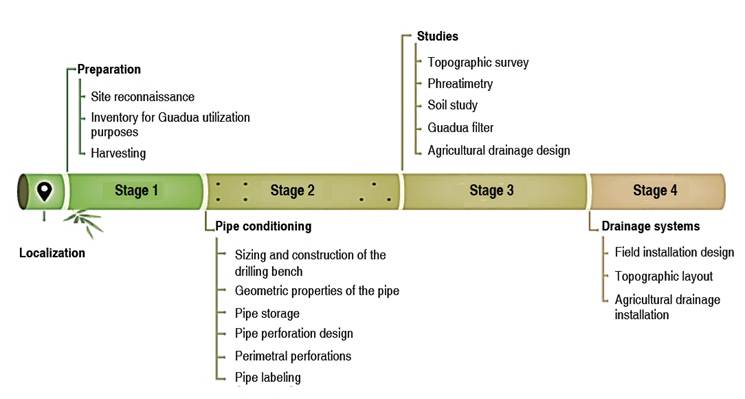
For the perforation process, an elastic fabric band 50 mm wide and 1 mm thick was used, which was adjusted to the outer diameter the culm to mark the angular opening required by the established perforation models (Figure 1). During the longitudinal demarcation on the pipe, the flattest face of the Guadua was identified to establish a centerline. Using a tape measure, marks were made every 10 cm for Model A and every 5 cm for Model B. The elastic band was moved along the pipe to mark the points that were then drilled. Models A and B of perimetral perforations had 60 perforations made with a 5/16" drill bit, equivalent to 0.79 cm in diameter, resulting in a total drainage area of 29.70 cm².
The drilling used a hand drill with a power of 650 W and a capacity of 13 mm, with speeds ranging from 500 to 550 rpm, so as not to deform the plant fibers and hinder the passage of water through the pipe.
RESULTS AND ANALYSIS
Forest inventory and harvesting
A sample size of 11.95 random plots was obtained in the entire stand, with an area of 100 m2 each and a sampling intensity of 71.14%. According to NTC-5726 and Camargo-García et al. (2008a), the standard error of the estimation has a limit of 10%, which indicates that an adequate forest inventory of the stand was carried out. Table 1 presents the values of the population mean and the corresponding confidence intervals.

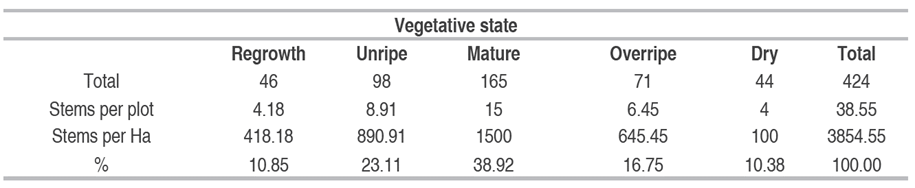
As shown in Table 2, a total of 424 live culms were obtained, of which 236 were adults (mature + over-mature Guaduas). Extrapolating this information, 3854.55 culms per ha were established, according to the forest inventory (Table 2).
The harvest regime was determined according to the arithmetic model proposed by Camargo-García et al. (2008a). This process involves manual processing of the information or the use of Excel, where direct inventory variables such as the number of live culms per hectare interact. The value of the initial density (Di) is obtained from the lower confidence interval (Table 3). The percentages of culms, depending on their state of maturity, are established with the actual values extracted from the forest inventory. Table 3 shows how the intensity changes at different harvest densities.
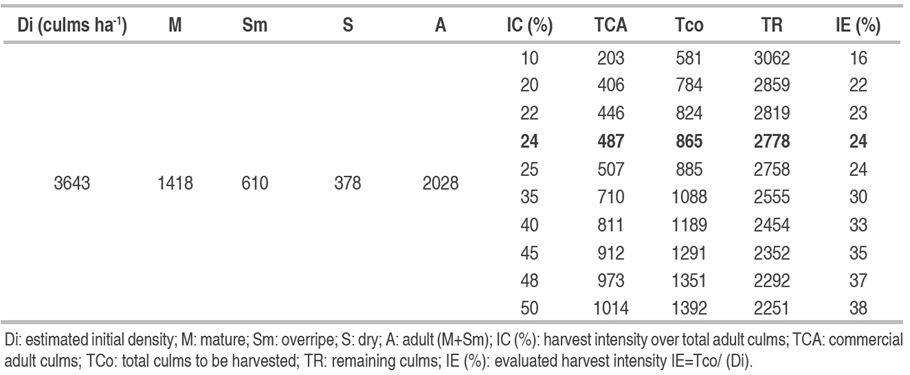
The study by Camargo-García et al. (2008b) indicates that a criterion that can be applied to define the intensity of harvesting corresponds to the ideal conditions of a Guadua forest. Likewise, Tosne (2009) states that a well-managed and productive Guadua forest should be composed of 30-40% of the total population of adult culms. It can be inferred that the stand used in this study is viable for harvesting processes.
There is no significant dispersion between diameters and culm length; the linear regression equation, which is the best fit for these two parameters, produces a value of R2=1, i.e., there is a high correlation. Orjeda (2009) states that, silvicultural processes related to natural regeneration and population density are not evident when data are scattered and R² is far from 1. Another factor may also be the variation in site quality, as there are stands found in good-quality sites.
Adequacy of Guadua as a drainage pipeline
Internode perforation
For a long time, the internodes of the bamboo have been removed mechanically and manually. Hidalgo (1981) indicates that the perforation of Guadua partitions is carried out in a deeply rooted artisanal manner, since no known machine or instrument performs this task simply and effectively. Tearing the transverse zone of the partition with a hand-operated object is a practical and artisanal way of perforating the bamboo internodes.
In this project, Guadua underwent a conditioning process for its transformation into a pipe. This process used the internode drilling bench, which facilitated the work of adapting the pipe. Table 4 below shows the elements used for the development of the drilling bench.
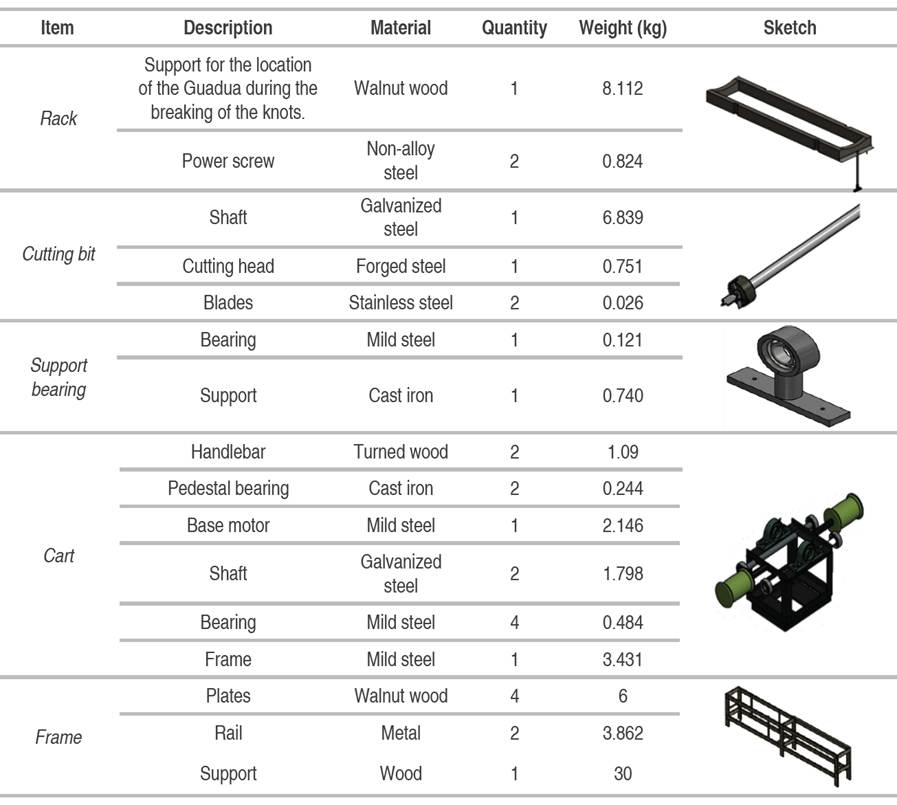
The dimensions of the drilling bench are given in Table 5, as well as the section of the profiles implemented for the frame. Figure 2 shows the final result of the bench construction.

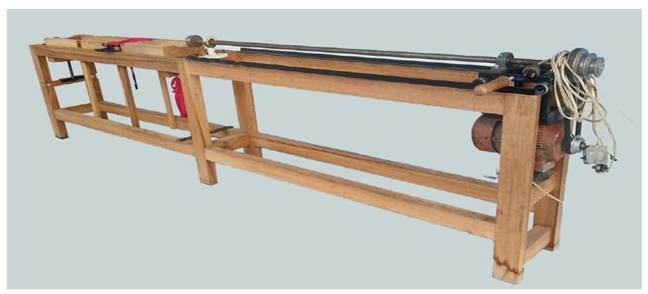
These steps were followed to break the internodes: 1). Taking the middle part of the bamboo (Basa) and cutting it into a length of 3 m. 2). Placing the bamboo on the rack and secure it with a strap to continue with the perforation of the internodes; the cutting bit has a length of 1.5 m, so it was necessary to turn the bamboo at both ends and, in this way, perforate the entire length of the bamboo. 3). After perforating the internode, polishing each one, which was achieved by gradually turning the bamboo on the structure, while the blades shaped their internal edges.
Throughout the breaking process, some particularities were appreciated. When the knot was broken in a concave direction with respect to the cutting edges, the process was easier; breaking in a convex direction required greater effort. In addition, Guaduas with water between the knots or with a high moisture content allowed faster cutting. According to Gutiérrez and Takeuchi (2014), the section of the Guadua where there is a greater presence of parenchymatous tissue (lower part) is the one that presents a greater variation in strength due to moisture content.
Perimeter drilling
Calculating the diameter of the holes, the area of the drainage slots, and the number of lines on the circumference of the pipe per linear meter were considered. In this case, the plant material could be considered equivalent to the 4-inch drainage pipe for agricultural use available from PAVCO (2005). This pipe has a drainage area of 30 cm² per linear meter (Table 6 and Figure 3).
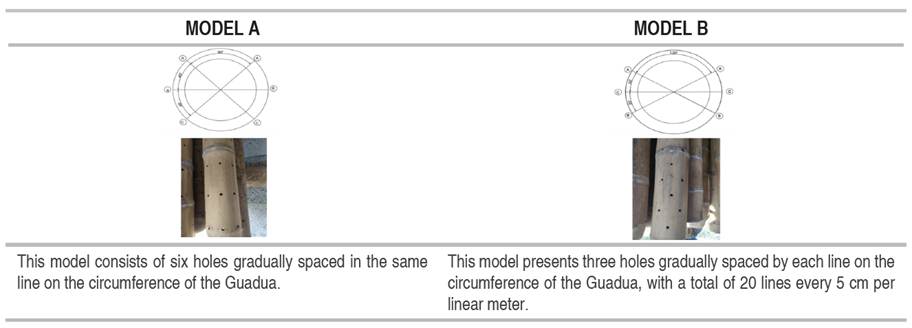
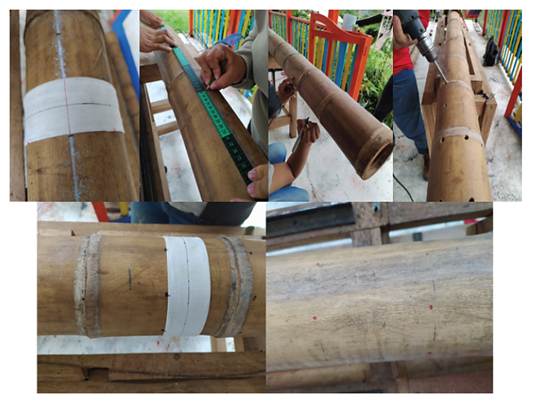
The drainage area of 30 cm² per linear meter from a 4-inch diameter corrugated and perforated PVC agricultural drainage pipe was used as a reference. The perforations made with a 5/16″ drill bit were designed to maintain this same drainage area in both perforation models A and B.
The grooves that PAVCO has in its pipe are oval. To facilitate the work of drilling the Guadua pipe, conventional wood drill bits were used, which were adjusted to the required diameter.
It is important to point out that, using the internodes bench drilling, it was possible to adapt the Guadua to be used as a pipe. In addition, with perimeter holes like the commercial ones, it was possible to obtain 3 m long pipes that could serve as agricultural drainage in places with conditions like those of the experimental area of the Pitalito headquarters of the Universidad Surcolombiana.
Carrillo and Vidal (2021) carried out a hydraulic evaluation of this plant material as an agricultural drainage pipe by calculating Manning's n, confirming its usefulness in the laboratory phase. Duarte and Silva (2021) used a drilling bench to adapt different Guaduas and carry out repetitions of the hydraulic evaluation with emphasis on this same parameter. Burbano and Claros (2021) conducted a mechanical evaluation of a Guadua agricultural drainage pipe. This examination focused on compression, a factor like the crushing that the pipe can suffer. The viability of Guadua in drainage pipes was demonstrated, but more studies are needed to determine the durability of this material and the variability of its resistance over time.
As a recommendation, it is necessary to use the method indicated in NTC 5301 for the preservation of Guadua, in order to extend the service life of the pipe and prevent the excavation work from being lost. Another method that could be tested is the immersion of the culms in a solution of borax and boric acid to prevent their degradation in the soil.
Geometric dimensions of the Guadua agricultural drainage pipeline
Descriptive statistics (Table 7) were used to analyze the average thickness and internal diameters of each bamboo.
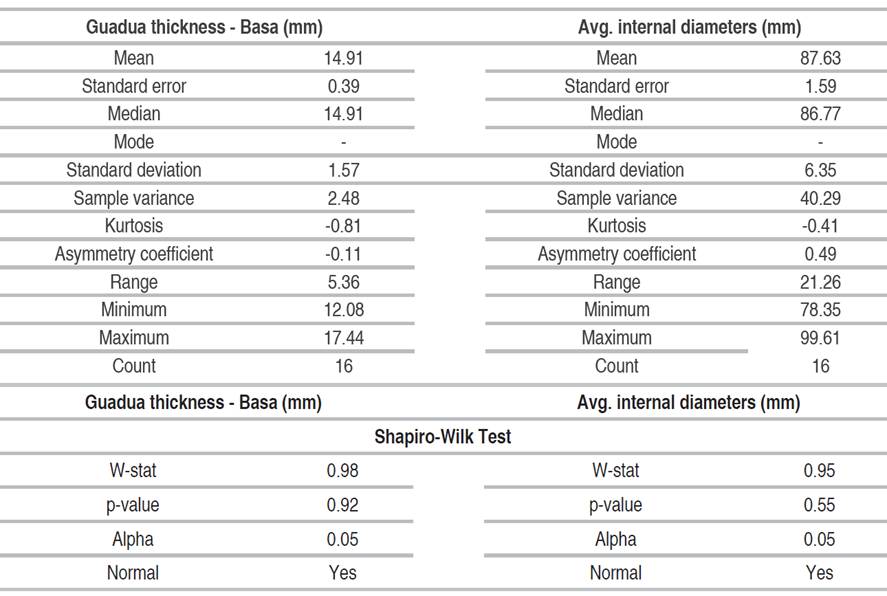
According to this evaluation, the variables of central tendency do not show significant variation. The Shapiro-Wilk test indicates that there is normality in the samples, since the p-value (P>0.05). The standard deviation and variance of the thickness of the Guadua indicate that the data collected are not as dispersed compared to the internal diameters. There is a platykurtic distribution, i.e., a lower concentration of data in relation to the mean.
The basic geometric properties, evaluated by statistical analysis, such as external diameter, thickness, internodal length, and number of knots, show that, in general, the maximum and minimum values do not present a major dispersion, with ranges of 3.3 mm for thicknesses and 21.26 mm for internal diameters. The most common internal diameters for the pipe are between 78.35 and 99.61 mm, with an average of 87.63 mm, which corresponds to the most common and probable size of a Guadua culm.
Concerning the internodal distance (distance between nodes) on the ordinate axis, the proportion of the external diameter does not present proportionality, since, as the external diameter increases, the distance decreases. The latter varies depending on the bamboo species (Sajjala and Kala 2017), as confirmed by Cifuentes et al. (2013) when measuring the negative regression between these variables, obtaining very similar results.
Drainage area and flow characteristics
The drainage area per linear meter of the Guadua pipe is approximately 30 cm², similar to that of a 4-inch PAVCO pipe. According to NTC 6028, the minimum drainage area per linear meter is 8 cm². The PAVCO drainage pipe has an approximate flow rate of 1.6 L s-1 or 25 GPM.
For the installed pipe, Carrillo and Vidal (2021) determined the Manning's n under laboratory conditions and found the following values: for a 1% slope, n=0.02, and for a 2% slope, n=0.03, on average. In comparison, the Manning's n value reported for PAVCO pipes is n=0.02.
Limitations of the proposed technology
The main limitations identified so far with this new technology, compared to commercial piping, are related to transportation and available accessories. Since the Guadua pipes are 3 m long, they must be transported in rigid sections and cannot be rolled, which may complicate handling and logistics. In addition, this system currently lacks standardized accessories, such as connectors, junctions, and other fittings commonly available for commercial pipes. However, the maintenance requirements are expected to be similar to those of PVC drainage pipes.
CONCLUSION
With internal diameters ranging from 7.8 to 10 cm, Guadua has geometric properties suitable for use as a pipe, as demonstrated by this and three other studies conducted at the Universidad Surcolombiana, Pitalito Headquarters, allowing for its implementation in the field. The implementation of drainage systems with Guadua pipes is an option that contributes to the introduction of new renewable resources in the agricultural sector.
The viability of this project in terms of the material's durability requires additional studies and field performance tests. Furthermore, it is considered important to conduct a technical, environmental, and economic study to evaluate the efficiency and suitability of a Guadua agricultural drainage system.
The study achieved the fabrication and geometric/statistical validation for its implementation; however, field performance is still pending evaluation.
It was established that, although there is little bibliographic information on the subject studied, this project opens new research opportunities in the field, seeking to strengthen research in the agricultural sector and the use of Guadua, since it is a renewable and abundant resource in the region, as confirmed by the inventories conducted.
It is recommended that the internode drilling machine be evaluated to address situations that arose during drilling, such as high vibration of the structure. However, for this project, the bench met the established objectives.

