




 English (pdf)
 Article in xml format
 Article references
 Automatic translation
 Send this article by e-mail
 Cited by SciELO
  Cited by Google
  Similars in
SciELO
Similars in
SciELO  Similars in Google
 Permalink

INTRODUCTION
Natural history collections contain scientific material, that allows improve our understanding of the biological diversity of the planet (Sánchez-Almazán 2017). The specimens harbored in collections with their associated data constitute valuable records that help us to document changes (e.g., natural and anthropogenic) across different scales (Mesa and Bernal 2006, Ossa et al. 2012). The traditional use of collections is primarily in the field of taxonomy and serving as depositories of specimens that can be taxonomical references; thus collections are analogous to reference libraries for elaborating biodiversity inventories, ecological evaluations, and support studies in areas such as anatomy, evolution, ecology and, genetics (Mesa and Bernal 2006, Mora-Ambriz and Fuentes-Moreno 2006, Vélez et al. 2012, García and Morffe 2020).
The scientific value of a collection is related to its curation, quality of the associated information, number of type specimens, diversity of groups represented, rarity, and exclusivity of specimens (Sánchez-Almazán 2017). Properly preserved specimens provide invaluable data for the study and conservation of biodiversity (Suarez and Tsutsui 2004, Omedes 2005, Mesa and Bernal 2006, García and Morffe 2020); on the other hand, poorly managed collections diminish the original value of their holdings by not preventing specimen decay nor properly curating their associated data.
Management of biological collections demands a constant effort in the preservation of their holdings, and constantly improving methods to make the collections accessible and useful to the scientific community (García and Morffe 2017). Lack of economic resources, personnel, and operational protocols can be detrimental to the normal functioning of a collection, and it is usually evidenced in the accumulation and decay of specimens generating further issues in the management of the collection (Danks 1991, Arbeláez-Cortés et al. 2015, Martínez and Medina 2017).
The Invertebrate Collection of the Charles Darwin Research Station (ICCDRS), located in Puerto Ayora (Santa Cruz), contains more than 42000 cataloged specimens belonging to the Phylum Annelida, Arthropoda, Mollusca, and Onychophora. Since 1980, we have had data on Lepidoptera and Coleoptera species collected and donated by researchers as reference collections (Keating 1980). ICCDRS is the largest reference collection of terrestrial invertebrates of the Galápagos Islands, and its mission is to provide data for research that would benefit the proper management and conservation of the islands (Jaramillo et al. 2013, FCD c2016). Because of its global and regional importance as the largest and most active repository of Galápagos biodiversity, it is necessary to determine how well preserved is the ICCDRS collection. Our main objective was to conduct an evaluation of the curation status of the Coleoptera collection deposited at the ICCDRS using standardized techniques that may allow the replicability of this evaluation. Having an assessment of the conditions of the collection will help to improve the processes for managing the collection with the goal to increase the lifetime of the specimens and make the associated data available to the scientific community.
MATERIAL AND METHODS
We evaluated the pinned specimens of the order Coleoptera of the ICCDRS collection. These specimens are stored in two large cabinets, that contain a total of 33 drawers- standard entomological boxes made with wood and covered with a glass lid-which contain a total of 495 trays. For the evaluation of the smaller specimens (< 10 mm) we used a stereo microscope Leica EZ4E.
Traditionally, the evaluation of collections has been performed with metrics such as the collection profiling system and the collection health index (McGinley 1993). These well know metrics are ideal for large collections because the units that are measured are specimen containers such as drawers of pinned insects. Although, these metrics were designed for large collections, there are proposals of modifications of these metrics to be used to quantify attributes of individual specimens if required (e.g., Fernández et al. 2005, Cárdenas and Delgadillo 2019). In this study for the evaluation of the collection-here referred as curation status-we used ten metrics retrieved directly from specimens of the beetle collection at the ICCDRS:
1) Curation level: We ranked each specimen in one out of seven categories of curation level; each of these levels has a value from zero to ten. The values were assigned following the criteria evaluated in Table 1. In the hypothetical case that all specimens are in excellent condition, we would have a total value of ten, and if all specimens were in very poor condition, we would obtain values close to 0.2) Status of specimens: we calculated a modified version of the metric 'state of the specimen' (Cárdenas and Delgadillo 2019) for the entire collection. We added all the values of curation level and divided that value for the total number of examined specimens. 3) Status of trays: The curation level of all individuals in a tray was averaged, then the values were added and divided for the total number of examined trays. 4) Status of drawers: The curation level of all individuals in a drawer was averaged, then the values were added and divided for the total number of examined drawers. 5) Taxonomic representativeness: we calculated the percentage of beetle species in the ICCDRS out of all the beetle species reported for the Galápagos in Peck (c2017). 6) Status of taxonomic identification at the species level: the percentage of specimens with taxonomical identification to the species level. 7) Status of taxonomic identification at the genus level: percentage of specimens whose lower taxonomic identification is at the genus level. 8) Status of missing catalog numbers: the percentage of specimens that lack museum catalog number. 9) Information status of complete specimens: the percentage of specimens with curation level equal to ten without identification labels and locality data. 10) Type specimen holdings: number of type specimens.
Results and discussion
Curation level: A total of 9402 dry-pinned specimens were reviewed. Most of the specimens-8612-belong to the category ten. The remaining of individuals are in the levels: zero (82 specimens), one (198 specimens), two (180 specimens), four (89 specimens), six (eleven specimens) and seven (29 specimens) (Fig. 1a). The distribution of the curation level of specimens shows that most of the values are high at ten, with small peaks at values of one and two (Figs. 1a-b).
Status of specimens: We obtained a value of 9.49 out of ten for status of specimen (Fig. 1b), a result that indicates that the preservation of beetle specimens in the collection is high. In a study that analyzed the status of specimens in a Colombian collection of dung beetles, the results were excellent: all the specimens where in perfect condition (Martínez and Medina 2017). One reason why the preservation in both collections is quite high could be related to the presence of a robust exoskeleton in the specimens of Coleoptera that brings protection and support in their handling in collections (Lease and Wolf 2010, Reeves et al. 2021).
Status of trays: The average curation level of specimens per tray was 9.41 out of 10 (Fig. 1c). There is a clear difference between the distribution of curation level values at the specimen and tray levels. At the tray level, the distribution thickens at the higher level, with most of the average values ranging from eight to ten, and the peaks at lower values reduced got fewer observations (Fig. 1c). This pattern suggests that there are few trays that include mostly damaged specimens, and the trays with mostly well-preserved specimens buffer the low values of damaged specimens.
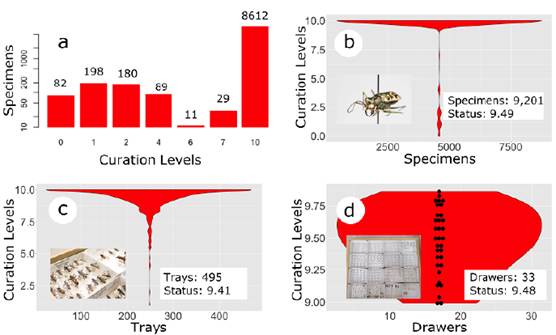
Figure 1 Curation levels and status of specimens of the order Coleóptera at the ICCDRS. a) Number of specimens assigned to each curation level; Y axis and size of bars were ln transformed to control the high values that affect the visualization of the data in the graphic. b) Violin plot of the distribution of curation levels of specimens, in the box are the sample size and the metric status of specimen. c) Violin plot of the distribution of average curation levels of specimens by trays, in the box are the sample size and metric status of trays. d) Violin plot of the distribution of average curation levels of specimens by drawers, in the box are the sample size and metric status of drawers.
Status of drawers: The obtained value is also very high, 9.48 out of ten (Fig. 1d), and the pattern of the distribution of values of curation levels is quite different to the distribution of the statuses of specimens and trays. All the values at the drawers' level range only between nine and almost ten, which indicates that all drawers mostly contain well preserved specimens. The buffer effect that produces these high curation level values is most striking in this case. From a collection management perspective, this pattern is a good indication that the presence of specimens in poor conditions is restricted to random places in different trays and drawers. This indicates that the management of storage units (i.e., trays and drawers) is adequate and is not promoting further damage of the specimens. If the curation level values at the level of several trays and drawers would be low, it may indicate that the poor management of these containers is happening.
Taxonomic representativeness: The ICCDRS contains 9201 pinned specimens of beetles grouped in 273 species, which is more than half (64.69%) of the 422 species reported for Galápagos (Peck c2017). There are 248 genera reported for the Galápagos, the ICCDRS harbors 184 (74%); the most represented genera in the collection are: Blapstinus Sturm, 1826, Ammophorus Guérin, 1831, Hypothenemus Westwood, 1836 of the family Tenebrionidae, GalapaganusLanteri, 1992 and, StomionWaterhouse, 1845 of the family Curculionidae.
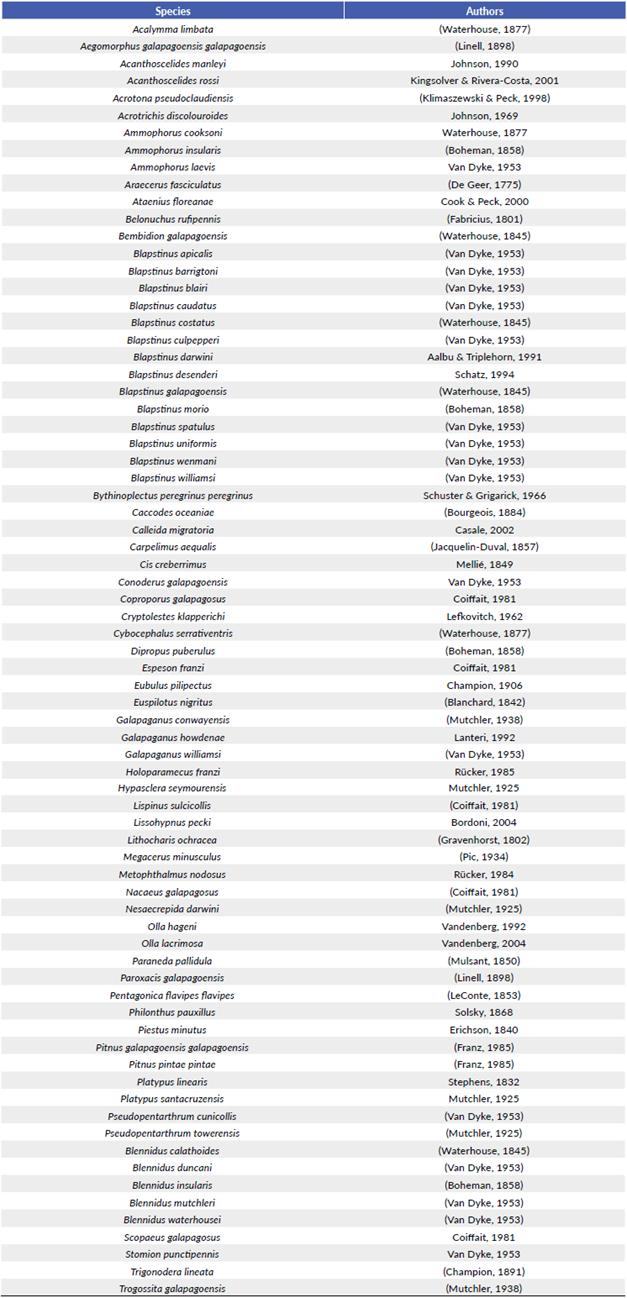
The California Academy of Sciences (CAS) is an appropriate collection to compare with the ICCDRS holdings because of the large expeditions that were conducted during the XX century, including the Galápagos International Scientific Project of 1964, which served to enormously increase our understanding of the insect diversity of the islands (Linsley and Usinger 1966, Peck 2006). The CAS has representatives of 57% of the beetle species reported for the Galápagos and contains the following six species that are not represented in the ICCDRS holdings: Chrysobothris williamsiVan Dyke, 1953, Cryptorama joannae Español, 1976, Endeius multipunctatusCoiffait, 1981, Minthea rugicollis (Walker, 1858), Nesoeme kuscheli Linsley and Chemsak, 1966, Rhantus galapagoensis Peck and Balke, 1993 (Monarch c2022). In contrast, the ICCDRS has 74 species that are not represented in the CAS, belonging to 48 genera (Table 2).
Table 1 Curation levels, and their respective values, used to calculate the status of specimens of the order Coleoptera in the ICCDRS.
| Value | Curation Levels |
|---|---|
| 0 | Absence or destruction of specimen: Lacking two or more structures that are important for taxonomical identification (e.g., head and thorax) |
| 1 | Mutilation: absence of one structure that is important for its taxonomical identification (e.g., head, thorax, or abdomen) |
| 2 | Mutilation with preservation of mutilated structures in plastic capsule or point mounted |
| 4 | Damage: absence of structures that do not hamper taxonomic identification; usually missing duplicated structures such as legs, wings, and antennas |
| 6 | Poorly mounted: specimens with structures that are not properly mounted |
| 7 | Fungus: fungus that does not damage the specimen, usually only forms a small and thin hypha layer on the specimens; and rusting pins: rust produced by pins, may be corrosive to the specimen |
| 10 | Specimen in excellent condition |
Several of the species represented in the ICCDRS collection are rare, for example, the 31% of the species is represented by less than ten individuals. Furthermore, the species Blennidus insularis (Boheman, 1858), Blennidus blairi (Van Dyke, 1953), Blennidus waterhousei (Van Dyke, 1953), Laemophloeus suturalisReitter, 1876, Scopaeus galapagosusCoiffait, 1981, Ablechrus flavipes Wa-terhouse, 1877 and Placonotus politissimus (Wollaston, 1867) are represented by only one specimen each. These species represented by singletons were collected mostly in the 80's: B. insularis collected in 1986 at Volcán Sierra Negra in Isabela Island, B. blairi in 1987 in Santiago Island, B. waterhousei in 1987 in Isla Gardner, L. suturalis with no collection date in Santa Cruz Island, S. galapagosus in 1992 in Pinta Island, A. flavipes in 2001 at Volcán Alcedo in Isabela Island, and P. politissimus in 2006 in Santa Cruz Island
Status of taxonomic identification at the species level: The ICCDRS shows a high level of identification of its material. 83% of its specimens are identified to species, 10.35% are identified only to genus, and the remaining 6.65% are considered indetermined. The species with the higher abundances are Blapstinus pubescens (Waterhouse, 1845) with 335 individuals, Stomion linelli Blair, 1933 with 241, Oosternum costatum (LeConte, 1853) with 237, Hypasclera collenetti Blair, 1928 with 168 yAmmophorus obscurus (Waterhouse, 1845) with 164.
Status of taxonomic identification at the genus level: The specimens identified only to genus were grouped in 37 genera, being the most represented: Ataenius with 212, Mordellistena Costa, 1854 with 109, Hypothenemus Westwood, 1834 with 89 and Stelidota Erichson, 1843 with 41. Two entomological collections in Colombia have reported that only 40.6% of their analyzed specimens have been identified to the species level (Martínez and Medina 2017, Forero et al. 2019). This contrast greatly with the 83% of the ICCDRS; it seems that the focus in taxonomic research and the low diversity, albeit the high endemism, of the Galápagos Islands may have helped to reach this high percentage of identified specimens.
Status of missing catalog numbers: 1388 specimens (15.09%) do not have catalog numbers. This value is lower that the reported for a Colombian collection where 30.6% of the individuals did not have catalog numbers (Martínez and Medina 2017). The families at the ICCDRS with greater number of specimens with missing catalog numbers were: Staphylinidae with 230 individuals, Scarabaeidae with 197 and Hydrophilidae with 137.
Information status of complete specimens: Among the specimens of curatorial level ten, only 125 specimens (1.45%) do not have labels of geographic location. This low number of missing geographic data facilitates an exercise to pinpoint the missing information in labels cross-referencing different data sources such as field notes, personal communications, and data of other specimens collected by the same collectors.
Type specimen holdings: While conducting this evaluation of the curation status of the ICCDRS, we located 17 type specimens, holotypes and paratypes, of Coleoptera: five Ataenius cristobalensisCook & Peck, 2000 and three Ataenius floreanaeCook & Peck, 2000, both species belonging to the family Scarabaeidae; the remaining nine specimens are Acrotona pseudoclaudiensis (Klimaszewski & Peck, 1998) of the family Staphylinidae. These specimens after been located were transferred to a designated type of cabinet. These type specimens were collected between 1989 and 1996 in the islands San Cristóbal, Floreana, Santa Cruz and Isabela (Klimaszewski and Peck 1998, Cook and Peck 2000).
Table 2 Species of Galápagos that are present in the ICCDRS collection but not reported at the CAS collection.
Implications of the collection status measurements in the management of the collection: The metrics reported above indicate that the ICCDRS beetle collection has been properly managed. This work is comparable to the study published by Milán et al. (2010) in a Cuban collection. Both beetle collections have important holdings starting in the XX century, 1963 and 1928 respectively, both have been kept well preserved with adequate curatorial techniques, and the accessibility to the collection by specialist and researchers has ensured high levels of identification. The favorable curatorial results in the collection are related to following good standard practices such as: using high quality pins, the labels printed in acid-free paper, trays with pads of reticulated polyethylene, controls of humidity, temperature, and permanent plague monitoring (Simmons and Muñoz-Saba 2005, Nishida 2009).
Collection evaluations are useful to amend mistakes and improve methodologies that will allow a better management of the collection ( McGinley 1993, Favret et al. 2007, Cárdenas and Delgadillo 2019, Castaño and Ramírez-Chaves 2018).
After this evaluation of the ICCDRS, the following areas of improvement become evident: 1) Increase in the taxonomic representation, assignment of catalog numbers to all specimens, and improve labelling of specimens. 2) To conduct these improvements the ICCDRS requires more economic and human resources. 3) Establish collaboration networks with both collection managers and scientists. 4) To process stored mixed material. 5) To implement efficient protocols to catalog specimens allowing efficient crosscheck between the information in the database and labels. 6) To improve the data collection and data entry to avoid missing data from the field (Serna-Botero and Ramírez-Castaño 2017). All these proposed measures are needed to improve the management of the ICCDRS collection given its importance as a source of information that can be used to the advancement of science and the preservation of ecosystems of the Galápagos.

