
SciELO - Scientific Electronic Library Online

 
vol.45 issue2A wild-blue mutant of the Orange-chinned Parakeet (Brotogeris jugularis) from ColombiaChanos chanos (Gonorhynchiformes, Chanidae) also got to the Caribbean: first report from Colombian waters author indexsubject indexarticles search
Home Pagealphabetic serial listing  

Services on Demand

Journal

Article

Indicators

Related links

  • On index processCited by Google
  • Have no similar articlesSimilars in SciELO
  • On index processSimilars in Google

Share


Caldasia

Print version ISSN 0366-5232On-line version ISSN 2357-3759

Caldasia vol.45 no.2 Bogotá May/Aug. 2023  Epub July 11, 2023

https://doi.org/10.15446/caldasia.v45n2.98993 

Nota Breve

Range extensions for Alopoglossus vallensis (Squamata: Alopoglossidae) in the Central Andes of Colombia

Extensiones de distribución de Alopoglossus vallensis (Squamata: Alopoglossidae) en los Andes Centrales de Colombia

Erika Lorena Benítez-Cubillos1 
http://orcid.org/0000-0003-1507-0223

María F. Diago-Toro1 
http://orcid.org/0000-0003-3314-4425

Yelenny López-Aguirre1 
http://orcid.org/0000-0001-5326-4331

Fernando Vargas-Salinas1  * 
http://orcid.org/0000-0003-1251-647X

1Grupo de Investigación en Evolución, Ecología y Conservación (EECO), Programa de Biología, Universidad del Quindío, Armenia, Colombia, lorena.benitez-cubillos@hotmail.com, mfdiagotoro@gmail.com, yelennylopez19@gmail.com, fvargas@uniquindio.edu.co


ABSTRACT

The lizard Alopoglossus vallensis (family Alopoglossidae) has been historically recorded in the Cauca River Valley and the western Andes (departments of Cauca and Valle del Cauca) of Colombia. Based on a review of specimens in biological collections, we report northern and southern range extensions for the species, including the first records from the departments of Antioquia, Caldas, Quindío, and Risar-alda in the Central Andes of Colombia. These new records also expand the known elevational range and climatic tolerances of A. vallensis.

Keywords: Distribution; Gymnophthalmoidea; Ptychoglossus; shade lizards

RESUMEN

El lagarto Alopoglossus vallensis (familia Alopoglossidae) ha sido históricamente registrado en el Valle del Río Cauca y la Cordillera Occidental de los Andes (departamentos de Cauca y Valle del Cauca) de Colombia. Con base en una revisión de especímenes en colecciones biológicas, reportamos una extensión de rango al Norte y Sur, incluyendo los primeros registros de los departamentos de Antioquia, Caldas, Quindío y Risaralda en la Cordillera Central de Colombia. Estos nuevos registros también amplían el rango altitudinal y las tolerancias climáticas conocidas de A. vallensis.

Palabras clave: Distribución; Gymnophthalmoidea; lagartijas de sombra; Ptychoglossus

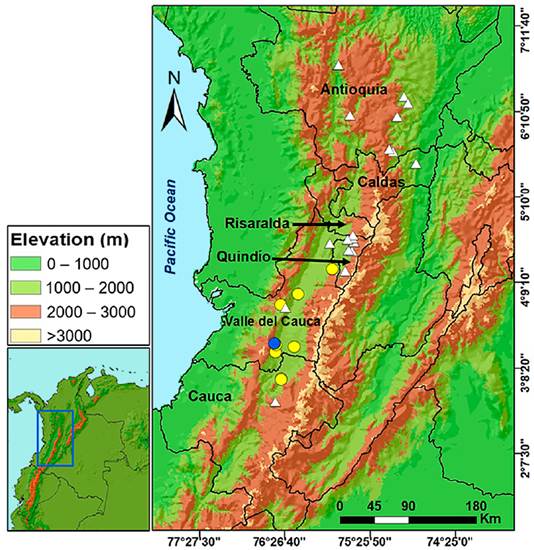
Figure 1 Geographic distribution of Alopoglossus vallensis in Colombia. The blue dot indicates the type locality (Río Pance, 2,5 km vía la Vorágine, Valle del Cauca, Colombia), the yellow dots indicate previously published localities in the departments of Cauca and Valle del Cauca (Harris 1994; Hernández et al. 2019, 2020), and the white triangles indicate localities in the departments of Antioquia, Caldas, Cauca, Quindío, Risaralda and Valle del Cauca based on previously unpublished museum specimens (see Appendix 1). 

The Alopoglossidae is a Neotropical lizard family composed of 32 recognized species that are generally diurnal and cryptic inhabitants of leaflitter (Hernández-Morales et al. 2020; Ribeiro-Junior et al. 2021; Uetz et al. 2021). Many alopoglossid species were traditionally in the genus Ptychoglossus (e.g., Harris, 1994; Bolívar-G and Hernández-Morales 2013). However, a recent analysis of morphological and multilocus genetic data by Hernández-Morales et al. (2020) recommended that Ptychoglossus be synonymized with Alopoglossus due to paraphyly. We follow this taxonomic position herein while recognizing that it remains contested by some authors (e.g., Ribeiro-Junior et al. 2021). Alopoglossus vallensis is one of these former Ptychoglossus species, and it is one of 21 alopoglossid species distributed in Colombia (Harris, 1994; Uetz et al. 2021). It has been recorded in the Cauca River Valley and the western Andes of Colombia (departments of Cauca and Valle del Cauca), in tropical dry forest and premontane humid forest from 1 000-1 700 m elevation (Harris, 1994; Castro-Herrera and Vargas-Salinas, 2008; Hernández-Morales et al. 2019). Alopoglossus vallensis differs from all Colombian congeners except A. stenolepis in having 36-45 scale rows around the midbody, widely separated prefrontal scales, a comparatively elongated body, and narrow dorsal scales (Harris, 1994). It differs from A. stenolepis in several features including hexagonal dorsal scales (vs. quadrangular scales in A. stenolepis), posterior chin shields that are similar in size to the second pair (vs. distinctly smaller than the second pair), a snout that slopes straight in lateral profile (vs. rounded), and hemipenes with 17 flounces (vs. eight) (Harris, 1994; Bolívar-G and Hernández-Morales, 2013).
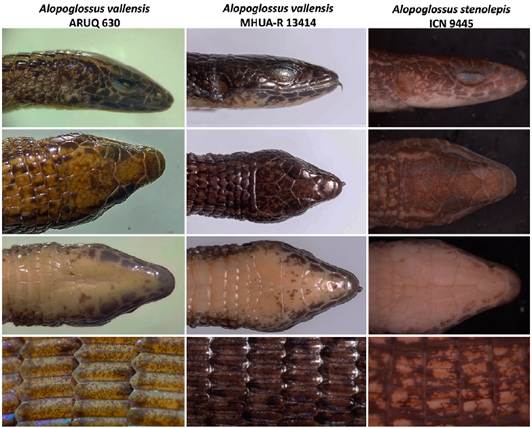
Figure 2 Morphological comparison of Alopoglossus vallensis and A. stenolepis. First row: lateral view of head (note straight vs. curved snout profile); second row: dorsal view of head (note separated prefrontal scales); third row: ventral view of head (note posterior chinshields similar in size to second pair vs. distinctly smaller than second pair); fourth row: dorsal scales of body (note hexagonal vs. quadrangular shape). See Appendix 1 for specimen locality data. 

In this note, we report both northern and southern range extensions for A. vallensis in Colombia, and we also expand its known elevational range and climatic tolerances. We assembled pre-existing records for the species by referencing relevant primary literature (Harris, 1994; Castro-Herrera and Vargas-Salinas, 2008; Hernández-Morales et al. 2019), and we assembled new records through our own fieldwork and by examining previously unpublished specimens deposited in several Colombian collections (Appendix 1). In total, we identified 18 novel A. vallensis specimens collected from 18 localities across the departments of Antioquia (seven localities), Caldas (one locality), Cauca (one), Quindío (six), Risaralda (one), and Valle del Cauca (two) (Fig. 1, Appendix 1). Certain diagnostic features of two of the new A. vallensis specimens are shown in Fig. 2. Cumulatively, the new specimens are the first from the departments of Antioquia, Caldas, Quindío, and Risaralda, and extend the species' known elevational range from 1 000 - 1 700 m to 730 - 1 925 m (Fig. 1). Geographically, the new records extend the distribution of A. vallensis over 282 km northward (straight line measured in Google Earth) into the Central Andes of Colombia, and 29.8 km southward. The previous northernmost published record was from Parque Las Heliconias, Caicedonia, Valle del Cauca (CZPD-UV 3070, 3071, 3073, 3074, 3077, 3080; Hernández-Morales et al. 2019), while the new northernmost record is MHUA-R-10212 from Vereda Guacabe, Yolombó, Antioquia (Appendix 1). The previous southernmost published record was from Santander de Quilichao, Cauca (CZPD-UV 2034, 2051, 2269, 2274), while the new southernmost record is from Finca La Albania, Vereda Camilo Torres, Piendamó, Cauca (MHUA-R 13093). The annual mean range of temperature and precipitation for the 16 new localities (16.5 - 24.5 °C, 1758 - 3 922 mm/year; data downloaded from www.worldclim.org) also expands the range of environmental conditions from those of the nine localities where A. vallensis was previously reported (19.0-24.0 °C, 1 160 -1 925 mm/year). Thus, our new records further broaden scientific understanding of the ecological tolerances of this species.

ACKNOWLEDGEMENTS

We thank Juan D. Vásquez-Restrepo, Martha Lucía Calderón Espinosa, Juan Manuel Daza, Wilmar Bolívar-García, and Cristian Hernández-Morales for sharing voucher information, and Cristian González-Acosta for elaborating the distribution map. We thank Andrea Lorena García-Hernández, Rodrigo Romero, Germán Dario Gómez-Marín, and the Centro de Estudios e Investigaciones en Biodiversidad y Biotecnología (CIBUQ) for financial and logistic support for fieldwork (project 657) in the department of Quindío (under permit: Resolution 374 by the Corporación Autónoma del Quindío CRQ, 7 March 2014). Cristian Hernández-Morales, Marco Antonio Ribeiro-Júnior, and the editorial team of Caldasia provided reviews that improved previous versions of this manuscript.

LITERATURE CITED

Bolívar-G W, Hernández-Morales C. 2013. Ptychoglossus stenolepis (Boulenger 1908). Catálogo de Anfibios y Reptiles de Colombia, Asociación Colombiana de Herpetología. 1(1):26-30. [ Links ]

Castro-Herrera F, Vargas-Salinas F. 2008. Anfibios y reptiles en el departamento del Valle del Cauca, Colombia. Biota Colombiana. 9(2):251-277. [ Links ]

Harris DM. 1994. Review of the teiid lizard genus Ptychoglossus. Herpetol. Monogr. 8:226-275. doi: https://doi.org/10.2307/1467082Links ]

Hernández-Morales C, Peloso PPL, Bolívar W, Daza JD. 2019. Skull morphology of the lizard Ptychoglossus vallensis (Squamata: Alopoglossidae) with comments on the variation within Gymnophthalmoidea. Anat. Rec. 302(7):1074-1092. doi: https://doi.org/10.1002/ar.24038Links ]

Hernández-Morales C, Sturaro MJ, Nunes PMS, Lotzkat S, Peloso PLV. 2020. A species-level total evidence phylogeny of the microteiid lizard family Alopoglossidae (Squamata: Gymnophthalmoidea). Cladistics. 36(3):301-321. doi: https://doi.org/10.1111/cla.12407Links ]

Ribeiro-Júnior MA, Sánchez-Martínez PM, Moraes LJCL, Oliveira USC, Carvalho VT, Pavan D, Choueri ECHL, Wemeck F, Meiri S. 2021. Uncovering hidden species diversity of alopoglossid lizards in Amazonia, with the description of three new species of Alopoglossus (Squamata: Gymnophthalmoidae). J. Zool. Syst. Evol. 59(6):1322-1356. doi: https://doi.org/10.11111/jzs.12481Links ]

Uetz P, Freed P, Hošek J. Editors. 2021. The Reptile Database. Available at: Available at: http://www.reptile-database.org . [Accessed on 20 Sep 2021]. [ Links ]

Citation: Benítez-Cubillos EL, Diago-Toro MF, López-Aguirre Y, Vargas-Salinas F. 2023. Range extensions for Alopoglossus vallensis (Squamata: Alopoglossidae) in the Central Andes of Colombia. Caldasia 45(2):387-391. doi: https://doi.org/10.15446/caldasia.v45n2.98993

AUTHOR'S CONTRIBUTION ELBC and FVS conceived the study; ELBC, MFDT, and YLA collected data; all authors contributed to the writing of the manuscript.

APPENDIX 1

Museum data for Colombian Alopoglossus specimens used in this study. Museum abbreviations are as follows: American Museum of Natural History (AMNH), Colección de Anfibios y Reptiles de la Universidad del Quindío (ARUQ), Colección Zoológica de Prácticas de Docencia de la Universidad del Valle (CZPD-UV), Colección de Herpetología del Instituto de Ciencias Naturales (ICN), Museo de Herpetología de la Universidad de Antioquia (MHUA-R), and University of Michigan Museum of Zoology (UMMZ).

Alopoglossus vallensis. Antioquia: Yolombó, Vereda Guacabe, Finca Normandía, Bosque Normandía, Porce II, 6°44'06.0'' N, 75°04'50.9'' W, 1150 m, MHUA-R 10212; Alejandría, Vereda San Antonio, El Edén, 6°21'59.9'' N, 75°01'40.9'' W, 1308 m, MHUA-R 12602; Granada, Bosque aledaño al Embalse Tafetanes, Central Hidroeléctrica Calderas, 6°07'34.8'' N, 75°06'31.8'' W, 1794 m, MHUA-R 13295; San Carlos, Embalse Calderas, 6°08'23.5'' N, 75°04'00.5'' W 1344 m, MHUA-R 13333; San Rafael, Vereda San Agustín, 6°19'51.2'' N, 74°59'37.9'' W, 1155 m, MHUA-R 13410; Argelia de María, Vereda San Luis, 5°41'41.8'' N, 75°09'45.8'' W, 1300 m, MHUA-R 13414; Argelia de María, Vereda San Pablo, 5°41'59.1'' N, 75°10'35.7'' W, 1700 m, MHUA-R 13415. Caldas: Norcasia, Hidroeléctrica La Miel I, Campamento Los Campos, 5°34'18.7'' N, 74°53'22.3'' W, 732 m, MHUA-R 12473. Cauca: Piendamó, Vereda Camilo Torres, Finca La Albania, 2°44'48.4'' N, 76°33'08.3'' W, 1534 m, MHUA-R 13093; Santander de Quilichao, 3°00'30"N 76°29'02"W, 1067 m, CZPD-UV 2034, 2051; Santander de Quilichao, Vereda Carbonero 3°1'0" N, 76° 29' 0" W, 1134 m, CZPD-UV 2269, 2274, 3069, 3072. Quindío: Calarcá, Carrera 25 Calle 27, 4°31'26.8'' N, 75°38'36.1'' W, 1531 m, ARUQ 516; Calarcá, Finca La Carmelita, Vereda La Bella, 4°17'39.0'' N, 75°43'26.0'' W, 1315 m, ARUQ 630; Armenia, Estadio San José, 4°32'21.9'' N, 75°41'04.7'' W, 1471 m, ARUQ 528; Circasia, Conjunto Residencial de Casas Campestres

La Aldea, 4°38'01.7'' N, 75°37'19.2'' W, ARUQ 659; Filandia, Finca El Placer, 4°39'43.2'' N, 75°41'52.8'' W, ARUQ 742; Filandia, Mirador, 4°40'45.3'' N, 45°38'22.9'' W, ARUQ 823. Risaralda: Pereira, Vereda El Manzano, Finca familia Hurtado Gómez, 4°42'49.4'' N, 75°38'11.9'' W, 1927 m, MHUA-R 13143. Valle del Cauca: Lago Calima, 3°53'30.0'' N, 76°29'30.0'' W, AMNH 119239; Candelaria Ingenio Mayagüez, 3°23'51.4'' N, 76°19'41.0'' W, UMMZ 171671; Bancos del Río Pance, 3°19'59.5'' N, 76°33'04.4'' W, UMMZ 171672; Cali, Barrio el Lido, estación Texaco, 3°25'10.9'' N, 76°32'55.4'' W, 1000 m, ICN 4204; Río Pance, 2.5 km vía la Vorágine, 3°26'0'' N, 66°34'0'' W, 1400 m, ICN 5649, ICN 5652 (holotype); Yotoco, km 18, Carretera Buga-Buenaventura, Reserva Forestal Yotoco, 3°51'27.9'' N, 76°25'53.1'' W, 1650 m, ICN 8266; Obando, Finca La Esmeralda, Inspección de Policía San José, 4°36'55.1'' N, 75°54'31.0'' W, 1530 m, MHUA-R 10284; Río Frío, Reserva Natural Liverpool, 4°01'14.0'' N, 76°17'15.0'' W , 947 m CZPD-UV 2143; Caicedonia, Parque de las Heliconias, 4°18'50.3'' N, 75°52'44.0'' W, 1201 m CZPD-UV 3070, 3071, 3073, 3074, 3077, 3080, 3081.

Alopoglossus stenolepis. Quindío: Filandia, Vereda El Roble, Bosque Bremen-La Popa, 2040 m, ICN 9445.

Received: February 11, 2022; Accepted: July 29, 2022; Published: May 02, 2023

*Corresponding author

CONFLICT OF INTEREST

The authors declare that there is no conflict of interest.

Creative Commons License This is an open-access article distributed under the terms of the Creative Commons Attribution License