




 English (pdf)
 Article in xml format
 Article references
 Automatic translation
 Send this article by e-mail
 Cited by SciELO
  Cited by Google
  Similars in
SciELO
Similars in
SciELO  Similars in Google
 Permalink

The lizard family Leiosauridae contains 34 species that occur in open and forested areas throughout South America, and three genera are represented in Brazil: Anisolepis, Urostrophus and Enyalius (Costa and Bérnils 2018). This last genus is endemic to Brazil with eleven recognized species (Breitman et al. 2018, Costa and Bérnils 2018). Enyalius are diurnal, semi-arboreal, insectivorous lizards that reach a maximum snout-to-vent length of 140 mm (Etheridge 1969, Rodrigues et al. 2014). The taxonomic history of the genus has been relatively stable (see Rodrigues et al. 2014 and Breitman et al. 2018 for recent reviews). Among the most understudied species is E. capetinga, which is endemic to the Cerrado biome and until recently was confused with its more widespread close relative, E. bilineatus (Breitman et al. 2018). Herein, we present a new record for Enyalius capetinga that markedly expands its known geographic distribution.
On 11 December 2014, a juvenile Enyalius capetinga was captured by pitfall trap in an area of Cerrado in the Municipality of Estrela do Sul, Minas Gerais, Brazil (18°45'26" South 47°54'24" West, 950 m elevation). The site is a humid, shaded gallery forest along the Piçarrão stream, with nearby non-native eucalyptus plantations. The lizard was collected under SISBIO permit #46085-1, and the specimen was cataloged in the reptile collection of the Museu de Zoologia da Universidade Estadual de Campinas "Adão José Cardoso," Campinas (ZUEC-REP 4424).
Diagnostic characters possessed by the specimen that support its identification as E. capetinga are as follows, with character states in parentheses representing variation in the E. capetinga type series as published by Breitman et al. (2018): 33 ventral scales (mean = 34.45 ± 2.25 standard deviation [range = 29-40]), 13 dorsolateral tibial scales (10.38 ± 1.29 [8-13]), 66 vertebral scales (68.8 ± 4.94 [55-82]), 6 supraciliary scales (6.59 ± 1.64 [4-14]), 7 supralabial scales (7.86 ± 1.03 [6-12]), and 51-53 paravertebral scales (63.84 ± 5.96 [51-77]). Additionally, the lateral scales are granular, most dorsal scales are keeled, and the nasal and postrostral scales lack contact in our specimen. The specimen was 37 mm in snout-to-vent length, with a tail length of 94 mm. The specimen's overall coloration was generally consistent with male E. capetinga (Fig 1), although we did not examine the specimen for presence of hemipenes and color pattern is minimally useful in differentiating between the sexes in E. capetinga and other congeners (Jackson 1978, Bretman et al. 2018).
Enyalius capetinga was previously known only from seven localities, all in the Brazilian Cerrado: three in Brasília, Distrito Federal; one in Catalão, Goiás; and one each in Unaí, Paracatu, and Nova Ponte, Minas Gerais (Breitman et al. 2018). The Catalão and Nova Ponte records were inadvertendly excluded from the range map and supplemental list of localities by Breitman et al. (2018), but were included in their published phylogeny and its associated supplemental file. Oliveira and Costa (2022) recently published an additional record that they claimed to represent E. capetinga, but this record is based only on iNaturalist photos that show none of the diagnostic features of the species as given in the original description. This proposed record for E. capetinga is thus unverifiable, and we do not consider it further. Therefore, our new record fills a 110-km gap between the Catalão and Nova Ponte records, being 48 km to the northwest of the latter (Fig 2).
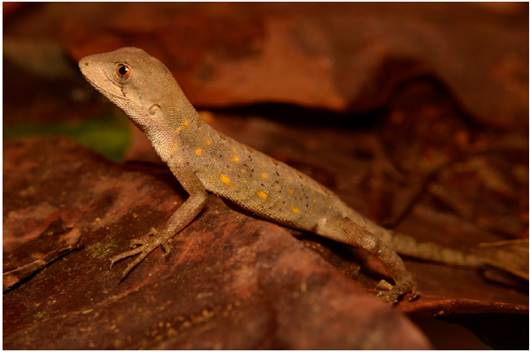
Figure 1 Juvenile Enyalius capetinga (ZUEC-REP 4424) in life, from the Municipality of Estrela do Sul, Minas Gerais State, Brazil.
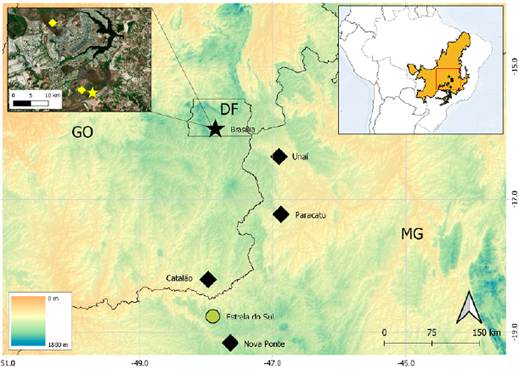
Figure 2 Distribution of Enyalius capetinga in the Cerrado biome (orange polygon of inset map) of central Brazil. Black star = type locality, black and yellow diamonds = other records (Breitman et al. 2018), and green dot = new record. DF = Distrito Federal, GO = Goiás State, MG = Minas Gerais State.
The Enyalius species present in the Cerrado (E. bilineatus, E. capetinga and E. perditus) suffer from ongoing destruction of the biome (Zaher et al. 2011, Breitman et al. 2018). This conversion of natural habitats, the increasing isolation of protected areas, and changes in the Brazilian Forest Code pose serious threats to these lizards (Marques et al. 2010, Ledo and Colli 2016). The new record for E. capetinga that we announce herein is thus of potential importance for the long-term conservation of the species.

