



Services on Demand
Journal
Article
 English (pdf)
 Article in xml format
 Article references
 Automatic translation
 Send this article by e-mail
Indicators
-
 Cited by SciELO
 -
 Access statistics
Related links
-
 Cited by Google
 -
 Similars in
SciELO
Similars in
SciELO -
 Similars in Google
Share

 Permalink
Revista de la Academia Colombiana de Ciencias Exactas, Físicas y Naturales
Print version ISSN 0370-3908
Rev. acad. colomb. cienc. exact. fis. nat. vol.36 no.139 Bogotá Apr./June 2012
MATEMÁTICAS

* Departamento de Matemáticas, Universidad del Valle, Apartado Aéreo 25360, Cali, Colombia E-mail: alvarogr@univalle.edu.co
Universidad Industrial de Santander. Bucaramanga, Colombia. E-mail: ateheran@gmail.com
AMS Classification 2000: 14G05.
Abstract
In this paper we give a generalization of two results obtained by Garcia and Stichtenoth  and use them to exhibit a method to construct curves over finite fields whose number of rational points is large compared to their genus. Such curves are induced by algebraic functions fields obtained from elementary abelian
  -extensions of the rational function field
  using the trace operator
Key words: Finite Fields, Algebraic Curves, Algebraic Function Fields, Elementary Abelian -Extensions, Rational Points.
Resumen
En este articulo generalizamos dos resultados obtenidos por García & Stictenoth en ([G-S]) y usamos estas generalizaciones para construir curvas sobre cuerpos finitos cuyo número de puntos racionales es grande en comparación con su género. Tales curvas son obtenidas considerando -extensiones abelianas elementales del cuerpo de funciones racionales usando el operador traza .
Palabras clave: Cuerpos finitos, curvas algebraicas, cuerpos algebraicos de funciones, âextensions abelianas elementales, puntos racionales
1. 1. Elementary Abelian -Extensions
 a perfect field of characteristic
  , by
, by  an algebraic function field with constant field and by

the Artin-Schreier operator.
Definition 1.1. For a subset  we denote by
  , the splitting field of all polynomials
  , with
  . For
. For  such that
  the extension
  is called an Artin-schreier extension of
  .
.
The following theorem provides a complete description of the Artin-schreier extensions. Its proof depends essentially on the following lemma.
Lemma 1.2. (Hilbert's Theorem 90) Let  be a finite extension of whose Galois group G is cyclic generated by
  . Then
  has the form
  for some
  , if and only if
  .
.
Prooƒ: see [L-N] Theorem 2.25.
Theorem 1.3. Let be a field of characteristic . The polynomial

either splits completely over or else,  is irreducible over . Moreover the following assertions are equivalent:
Prooƒ: Suppose that(1)
is a cyclic extension of degree
(2)
, whose minimal polynomial over
(3)
 , then for
  we have
  and since is a separable polynomial of degree , it follows that
  are all its roots.
 Now, its is clear that, if  , then is the splitting field of .
It remains to consider the case  . Let
. Let  . To prove that is irreducible over it is enough to prove that
  , that is to say, that is the minimal polynomial of
  over (which, from now on, we will denote by min
  ).
).
Since is the splitting field of the polynomial we have that is a Galois extension, therefore, it is sufficient to show that  .
.
For this end, observe that since each  is completely determined by its action on and permutes all the roots of , then
  for some
  , hence, .
Now we will to prove the equivalences:
 suppose that is a cyclic extension of degree and let be such that
  . Since
  , then by Lemma 1.2, there exist
  such that
  . Moreover, since
  and
and  .
.
On the other hand, observe that  . That is to say,
 , then
  therefore, there exist such that
  and consequently satisfies the polynomial
  .
.
Now, since

and
then  . Thus
  and (2) ensures that
  , which is the same as,
  .
.  If , with
  we have that is the splitting field of min
  .
.
 Assume that is the splitting field of an irreducible polynomial of the form
  for some . Again by similar arguments as above we obtain that , which means that is cyclic of degree .
Definition 1.4. An extension  is said to be an Elementary Ableian -Extension of exponent and degree
  if is Galois with
The following Theorem states a relationship between the additive subgroups of and the elementary abelian -extensions. To this end, we first need to establish a result.
Theorem 1.5. Let be a field of characteristic >0. There exist a one to one correspondence between the additive subgroups U of containing  F which have finite index (U:F), and the elementary abelian -extensions. This correspondence is given by

In such case

The inverse map of  is given by

Prooƒ: see {16} page 263
Remark 1.6. observe that, regarding abelian P-torsion group as vector spaces over  we can as well define
  as the map (induced by
  ) that takes finite-dimensional vector subspaces
  (over ) of the quotient space
  to finite dimensional subspaces
  of the vector space
  (where F is the inverse image under in some fixed separable closure
  ). That is to say

Finally if instead of we consider the map
 ,
,one can see that, one such n-dimensional subspace  corresponds, in the notation of Theorem 1.5 to a subgroup
  with
with  that is a "section" of in the sense that
  . Therefore, if
  and
and  are subgroups of such that:

then, the following sentences are equivalent.
(Observe that
exactly when
( more accurately, when
and
are the same subspace of
.)) Moreover, if
, then
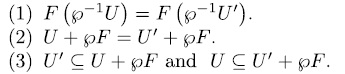
 such that

Then, the extension  is an elementary abelian -extension of of exponent .
Prooƒ: first observe that since E is the splitting field of the set of polynomials  then the extensions
  is a Galois extensions. On the other hand, since U is an additive subgroup of and char(F) = , then there exists
  nonzero elements such that

We can find  , such that
  . Now, by Theorem 1.3 we have that

 for each
  (Remark 1.6) we obtain

 is a root of
  , then the extension is finite. In order to prove that
  , first observe that,

 , by Theorem 1.5 we obtain

But

So, for  , since
  then
then

consequently, . Next we prove that  For
For  we define
  as follows,

Observe that  is the identity on

Therefore by Theorem 1.3, the polynomial  is irreducible over
  (otherwise
  and
and  which is a contradiction) hence the are actually well defined. Now it clear that each
  and
and  , also

In fact, if  then,
then,

it follows that i = j and  (mod ). Therefore
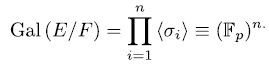
The converse of the Theorem 1.7 also holds. To prove it, we need the following lemma.
Lemma 1.8. Suppose that L/M is finite Galois extension with Galois Group of the form
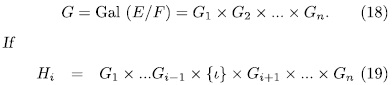
where
 is the
  coordinate and
then

Prooƒ: see {Ro} Corollary 5.5.4.
Theorem 1.9. If
 is an elementary abelian -extension of of degree , then

for some additive subgroup U of which satisfies (3).
Prooƒ: since is an elementary abelian extension of degree , then

thus,  , where each
  has order . Let us define for
  and
and  , be as in the Lemma 1.8 (a)

consequently, by Theorem 1.3. there exist  such that
  for some
  with
with  , which amounts to,
  . Observe that
  and since
  , from Lemma 1.8 (b),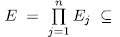
 , and therefore

We now claim that  are linearly independent over . In fact suppose there is a non-trivial linear combination
  ,with
,with  , then
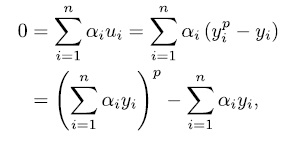
hence  . Now if we assume that
  then
then  and since, for
  , we have that
  , then
  . On the other hand by Lemma 1.8,
  , consequently
  which is a contradiction since
  . Therefore
  . Similar arguments will lead us to prove that
  . Let U be the subgroup generated by
  . Then by (23),
  therefore only remains to prove that
  . In fact, if
  , then
  with
with  and each
  . Therefore it is enough to prove that
  . For this end, observe that
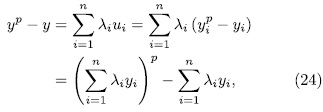
 , we have that

which is a contradiction.
Theorem 1.10. Let U be an additive subgroup of such that

If  , then there exit
  - intermediate fields
  such that
  , where
  with
with  .
.
Prooƒ: if , then  with
with  and by Theorem 1.3,
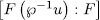 is either 1 or . but if
  , then
  therefore
  which is a contradiction with the choice of u, hence
  . On the other hand, if
  is a subfields such that
  and
and  then by Theorem 1.3, is the splitting field of one irreducible polynomial of the form
  - for some
  . Now, since
  then by Remark 1.6 we have that
  hence
hence  , for some
  and
and  , from which
  ,for some
  for some
  . In sum each subfield
  such that
  and has the form
  for some
  . Finally by Remark 1.6 we obtain the number of these subfields.
Theorem 1.11. Let K be a field of characteristic p > 0 an F/K an algebraic function field of transcendence degree one over K, with constant field K and genus g(F). Consider an elementary abelian extension E/F of degree pn such that K is also the constant field of E. denote by  the intermediate fields
  and by g(E) (resp
  ) the genus of (resp
  ). Then

Prooƒ: Let
 . For a subgroup
  consider the fixed field
  whose genus
  is denoted by
  and the trace idempotent
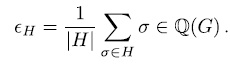
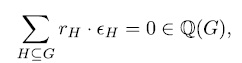
 , because in this case genera would satisfy the same relation (see[Ka])
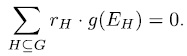
 . In fact, by one side, for
  the Galois group
  of the extension
  is one of such subgroups. On the other hand, if
  is subgroup such that
  then since
  is a Galois extension with
  , we have
  from which we get
  and
and  for some
  consequently,

Now we shall show that any  is contained in precisely t subgroup
  . In fact, each has the form

where each  has order and the set
  is a basis of over . Now, if
  , then
  if and only if
  for
for  . That is to say, there exist
  subgroups Hj such that
  . In other words σ is contained in precisely
  subgroup of G, therefore
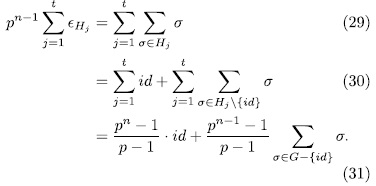
But from  and
and

It follows that,  . Thus
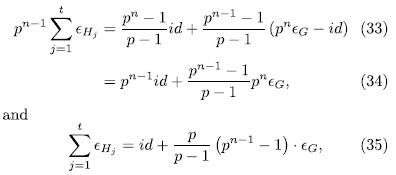
Which amounts to, we have the following relation in 

The theorem now follows from Kani's result.
Observe that the intermediate extension  mentioned in Theorem 1.10 is an Artin-Schreier extension, whose genus,
  can be computed by [[ST], III.7.8]. This takes us to determine explicitly such intermediate field, which we will call Artin-Schreier intermediate subfields, for which we give the following results generalizing Propositions 1.1 and 1.2 in ([G-S]).
Before that, we should give a definition. We call a polynomial of the specific form

 = char (K)) an additive polynomial over K. observe that
  is separable if and only if
  .
. Theorem 1.12. Let
 be a separable, monic, additive polynomial of degree
  , with its roots in F. If E/F is an elementary abelian -extension of degree , then there exists an element
  such that
  whose minimal polynomial over has the form
Prooƒ: Let us consider the set
 , it is clear that W is a vectorial space over , moreover W is an additive finite subgroup of F. Now, since each cyclic subgroup of W is order 1 or , then there exist nonzero elements
  such that
and, the set
 is a basis of W over . Now from Lemma 1.8 we can choose
  such that
  , with
  . If we define the for
  as in (16), it is clear that each is an element of order of Gal (E/F) and therefore
On the other hand, since
 , then σ has a unique representation
With
 , then the action of σ over the element
  is given by

where 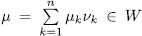 . It follows from (40) that
  if and only if
  for k = 1,2,â¦,n, that is, if and only if
  , and therefore
  . On the other hand, if
  and
and  then, since
  , for some
  , we have
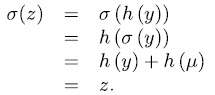
 and therefore
  , consequently y is a root of the monic polynomial whose degree is
  . This implies
  .
. Reciprocally we have:
Theorem 1.3. Let  be a separable, monic, additive polynomial of degree n, with its roots in and
  such that the polynomial
  is irreducible over , then the extension
  where
where  is an elementary abelian -extension of degree n. The intermediate subfield
  with
with  , have the form
  where,
  with
with  and each
  satisfies the equation
  therefore
  , with
Prooƒ: It is clear that
 is the minimal polynomial for y over . Now, for each
  then all roots of the polynomial have the form
  with
with  , and therefore (y) is the splitting field of the polynomial . On the other hand since
  permutes the roots of then
  for some
  , therefore, the application
  , into group
  is an isomorphism, that is to say,
  is an elementary abelian -extension of degree .
 Now, if 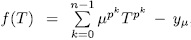 , then
  and
and  it follow that
  . On the other hand, since
  then
then  and therefore
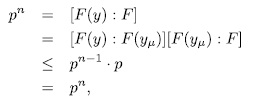
consequently  It is say,
  Now, by Remark 1.6 there exist
  such subextensions
  and therefore
  where
where  . Finally by Theorem 1.10 there exist exactly
  intermediate fields
  with
with  therefore such
  must be one of the
  .
.
2. An application to the construction of curves over finite fields
It is well known that algebraic function fields over finite fields have many applications in coding theory, and the latter is closely related to cryptography, see for example [N-Ch]. In this section we exhibit a method to construct algebraic function fields over finite fields (algebraic curves) with many rational places (rational points).
Let be a prime number,  the finite field with
  elements and
  the rational function field over the finite field
  . By E/K we mean a function field of transcendence degree one over K , with constant field K. We denote by
  the maximum number of rational places of the function field E/K of genus g(E/K) = g. The Hasse-Weil bound implies
 remained untouched for many years. In 1980 Goppa came up with the beautiful idea to associate an error-correcting code to a linear system on a curve over a finite field, see [Go]. In order to construct good codes one needs function fields with many places and thus Goppa's work led to a revival of interest in rational points on function fields (algebraic curves) over finite fields. Applications in cryptography and recent constructions of quasi-random points sets also require curves with many points and added further impetus to work in the field.
 In 1981 Ihara showed in [1] that

 this bound is better that Weil`s bound and gives the asymptotic bound


 times the asymptotic Ihara bond (44) we think that it is reasonable to put this qualification as requirement to filter out curves which should be considered 'poor'.
 To begin our construction, let us benote by  the additive polynomial

 of the kind
  where
where  is defined by the equation:

 denote the remainder of the Euclidean division of the polynomial
  . That is to say extensions of the kind,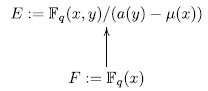
 . More precisely we have.
 Theorem 2.1. The polynomial  defined as (47)has the following property:

Proof. It is enough to prove that

Since

for some polynomial  , then

 and
and  is additive, the result follows.
 Remark 2.2. Observe that in accordance with Theorem 2.1, we have that, for  , the equation

 solutions in
  , therefore the induced curve by the function field E/K has at least
  places of degree one. This leads us to expect to get good curves.
 The following result provides us a relationship among the genus of the function field E/K and the genus of the Artin-Schreier intermediate subfields 
 .
.
Theorem 2.3. With the previous notations, the genus of E/K is given by

 is defined as follows:
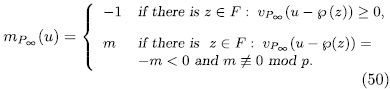
 with
with 
Remark 2.4. Lemma III.7.7 in [ST], guarantees that we can exclude the case
 for an integer
  in the above definition for
Indeed, first observe that from ([ST], i.4.18) together with Theorem 1.11 we have that:

 has the form

 and
and  . Now, since
  , then each of different from
  is unramified in
  , in this way, from ([ST], III.7.8) the genus of
  is given by

 different subfields of the Artin-Schreier, then there are
  in W such that, each one those the Artin-Schreier subfields have the form
  . Finally, from (53) and (51) we have the result.
 Next, we exhibit a technique that allow us to count the rational places of E/K. for this, we will denote by
 , the induced curve by the function field E/K.
 Lemma 2.5. Let us consider the polynomial

 and
and  are defined as in (47). Then, for
  , there exist
  such that
  - belongs to , if and only if
  , for some .
 Prooƒ: Let us suppose that exists
such that (x, y) belongs to , it is to say  . Since
  , then by taking
  we obtain the desired result. Reciprocally, if
  for some
  and since the function a is surjective ([L-N], 2.23), then
  for some , it is to say,
  .
. Lemma 2.6. With the above notations,
 for all
  .
. Prooƒ: By the division algorithm, there exists  such that

 degree
  . Then

 for all
  , we have
As consequence of all the above mentioned we have,
Theorem 2.7. The number of rational places of the elementary abelian p-extension defined by (47) is given by

Prooƒ: For fixed  , we have that (x, y) is a rational point of the curve
  if and only if
  where
where  . In fact, if (x, y) is a rational point of then

 where , then


Now, for each
such that  , we have
  places of degree one of E. Additionally, since for all place of different of
  , P is unramified in E, then
  or 0. Therefore,
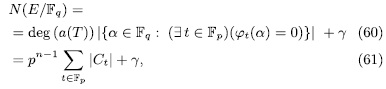
 y
y  . On the other hand, if
  , then
  if and only if
  and
and  and since
  is separable, then
  .
. 3. Examples
In this section we give examples of elementary the Abelian p-extensions of the kind given by (47). We will to consider the particular case when n is odd and  and we will determine the genus and the number of rational places of these extensions using the formulas (49) and (57).
Example 3.1 It p = 2 and n =3, then k =1, q =8. Also,
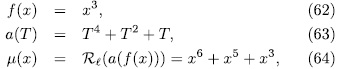
 we have
  and since
  then, from ([ST], III.7.8), we obtain
  . Observe that this value is independ of the root λ, therefore there exist exactly 3 different the Artin-Schreier extensions generated by such roots, and in accordance with (49) we have


 of F is the only place that ramifies in the extension E/F then by (57) we have

Example 3.2. Taking p = n = 3, then q = 27 and k = 1. Also,
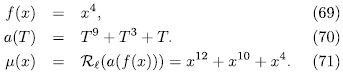
 we have,
  . Therefore

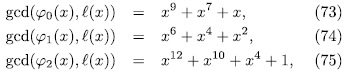 is totally ramified and rational in
  then we have

 of genus 36 having more that 244 rational places (see [VV]).
 The following table contains the values obtained for the genus and the number of rational points by taking different values for p and n, also we compare this values obtained with the Ihara's bound
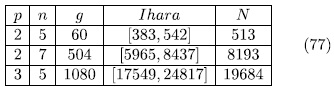
Acknowledgements. The authors deeply appreciate the helpful comments suggestions made by the referees.
References [ Links ] 1991.
[L-N] Lidl Rudolf and Niederreiter Harald. Introduction to finite fields and their applications. Cambridge university press, [ Links ] 1994.
[Go] V.D. Goppa, Codes on algebraic curves. Sov Math.Dokl 24 (1981), 170-172. [ Links ]
[La] Lang Serge, Algebra, Adisson Wesley Publishing Company, [ Links ] 1970.
[Ka] Kani Ernest, Relations between the genera and between the Hasse-Witt invariants of Galois covering of curves, Canad. Math. Bull, Vol 28, pag 321-327, [ Links ]1985.
[N-Ch] Harald Niederreiter, huaxiong Wang and Chaoping Xing, Function Fields over Finite Fields and their applications to Cryptography, Springer- verlag. [ Links ] 2007
[I] Ihara Y. Some remarks on number of rational points of algebraic curves over finite fields. J Fac Sci Tokyo 28 (1981), p.721-724. [ Links ] [Ro] Roman Steve. Field Theory. Springer-Verlag, [ Links ] 1991
[ST] Stichtenoth Hennig. Algebraic functions fields and codes. Springer- verlag, [ Links ] 1993.
[VV] Van Der Geer Gerard and Van Der Vlugt Marcel. Tables of curves with many points. [Online], http://www.science.uva.nl/ geer. [ Links ]
Recibido el 4 de noviembre de 2009
Aceptado para su publicación el 21 de junio de 2010
Versión revisada recibida el 5 de marzo de 2012
