




 English (pdf)
 Article in xml format
 Article references
 Automatic translation
 Send this article by e-mail
 Cited by SciELO
  Cited by Google
  Similars in
SciELO
Similars in
SciELO  Similars in Google
 Permalink

Introduction
The Andean region of Colombia is part of one of the world's biodiversity hotspots, which is partly influenced by the high topographic complexity and the biogeographic history of multiple groups of species (Gentry, 1995; Lynch et al., 1997; Myers et al., 2000; Hazzi et aL, 2018). Besides this high biodiversity, there are several settlements and agricultural areas in the Colombian Andean cordilleras that have triggered transformation processes in their forests, which currently occupy less than 50% of their potential coverage (Armenteras & Rodríguez-Eraso, 2014; Llambí et al, 2019). The repercussions of such transformations are well documented and frequently regarded as significant contributors to the ongoing loss of biodiversity and the fragmentation of these ecosystems (Newbold et al., 2015).
The studies on non-avian reptiles in the Colombian Andean region are rich and varied, including comprehensive checklists and field guides (Rueda, 2000; Castro-Herrera & Vargas-Salinas, 2008; Rojas-Morales, 2012; Restrepo et al., 2017; Román-Palacios et aL, 2017), taxonomic descriptions (Passos & Lynch, 2008), analyses of highway-related mortality (López-Herrera et al., 2016; Zúñiga-Baos, 2023), studies on embryology and development (Hernández-Jaimes et al., 2012), population ecology (Anaya-Rojas et al., 2010), and distribution in urban areas (Rojas-Morales, 2012; Vanegas-Guerrero et al., 2016), among others.
The central-western segment of this region stands out for its remarkable biodiversity, influenced by the transition between the ecosystems of the inter-Andean valleys and two of the three Andean cordilleras (Occidental and Central) that traverse the country (Kattan et al., 2004). The Central Cordillera is considered the oldest and concentrates a high diversity of zoological groups such as amphibians (Lynch et al., 1997; Kattan et al., 2004) and endemic taxa of non-avian reptiles, including the genus Magdalenasaura Fang et al., 2020.
On the other hand, regional checklists have been compiled for the Valle del Cauca department encompassing a substantial section of the Pacific region and the upper Cauca River basin between the Occidental and Central Cordilleras. In the Andean and inter-Andean zones of this department, more than 70 non-avian reptile species have been documented (Castro-Herrera & Vargas-Salinas, 2008; Cardona-Botero et aL, 2013). However, despite the evident richness of these vertebrates, historical and biological information about non-avian reptile species remains relatively limited in this part of the country (Arbeláez-Cortés, 2013).
There have been several endeavors to document the diversity of non-avian reptiles in Caldas (eastern flank of the Occidental Cordillera) and in both flanks of the Central Cordillera and the inter-Andean valleys formed by the Cauca and Magdalena rivers (Acosta-Galvis, 2009; Ramírez-Chaves et al., 2022), but the focus has concentrated on the middle valley of the Magdalena River (Flórez-Jaramillo & Barona-Cortés, 2016; Rojas-Morales et al., 2018), with relatively few contributions centered on localities of the Cauca River basin (Rojas-Morales, 2012; Rojas-Morales et al., 2014), which is also the case with the northern and western portions in Caldas, particularly along the borders of the departments of Antioquia and Risaralda (Ramírez-Chaves et al., 2022). While in recent years, the cords of non-avian reptiles of Caldas have increased, encompassing up to 112 species (Ramírez-Chaves et al., 2021; 2022), there is still a need for updated and historical information on the local non-avian reptile fauna, which is relevant as a baseline for forthcoming diversity assessments and conservation plans. To contribute to the study
of non-avian reptiles in Caldas, we present a historical synopsis of the research on its local species, providing an updated checklist, highlighting noteworthy records, and identifying geographical areas with information gaps.
Methodology
Area description
The Department of Caldas (4°48' - 5°46' N and 74°39' - 75° 55' W) (Figure 1) has an area of 7888 km2 corresponding to a relatively narrow segment of the Colombian Central and Occidental Cordilleras, which significantly influences the distribution of the streams and rivers that flow into its two primary basins: the Magdalena River in the east and the Cauca River in the west. The Magdalena River basin captures the waters from the Central Cordillera that flow along the eastern slope, while the Cauca River basin receives the rivers that drain the western slope of the Central Cordillera and the eastern slope of the Occidental Cordillera. The elevation gradient varies across the region, reaching a minimum of 170 meters a.s.l on the eastern slope in La Dorada municipality, which stretches towards the Magdalena River basin. On the western slope, in the Cauca River basin, the minimum elevation stands at 580 m a.s.l at the confluence of the Arma and Cauca rivers in Aguadas. The Department's highest point is the Nevado del Ruiz, which reaches 5,321 m a.s.l (INGEOMINAS, 1993; Rueda-Almonacid, 2000; Acosta-Galvis, 2009; Ordoñez et al., 2022). According to Morrone et al. (2022), Caldas has three distinct biogeographic provinces: the Cauca, Magdalena, and Paramo Provinces (Figure 1).
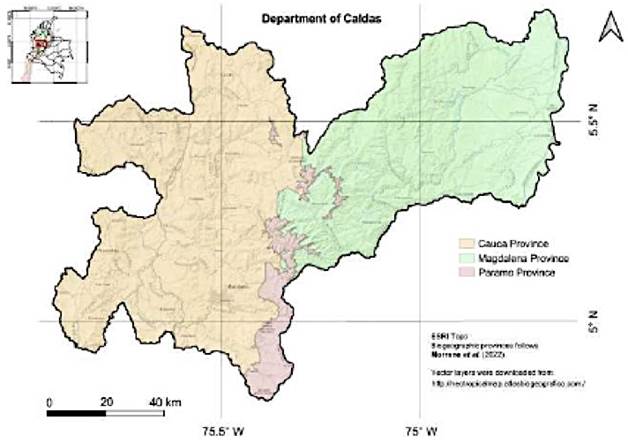
Figure 1 The Department of Caldas in the central part of Colombia. Biogeographic provinces (Cauca, Magdalena, and Páramo) sensu Morrone et al. (2022).
Historical synopsis and checklist of species
For a comprehensive historical synopsis of the documentation of non-avian reptile diversity, we highlight milestones in their study and observations in Caldas. The pre-Columbian depictions of non-avian reptiles are evident in the gold artifacts created by local cultures, and the chronicles of the Spanish conquest offer anecdotal observations of non-avian reptiles in Caldas. On the other hand, we acknowledged the efforts of museum and natural history collections in documenting this group from the beginning of the 20th century. Finally, we summarized the contributions made by national institutions to this endeavor and describe the processes underpinning the establishment of the different studies.
To up date the checklist of non-avian reptiles in Caldas, we compiled the records from various data sources (Table 1), including all the specimens deposited in the reptile collection at the Museo de Historia Natural, Universidad de Caldas (MHN-UCa-R) and the Corporación Universitaria de Santa Rosa de Cabal (CUS-R), which we revised. We also checked directly and from photographs sent by curators the specimens deposited in the reptile collection at the Instituto de Investigación en Recursos Biológicos Alexander von Humboldt (IAvH-R) and herpetological collection at the Instituto de Ciencias Naturales de la Universidad Nacional de Colombia (ICN-HER-R). Finally, additional records were compiled from scientific papers published in indexed journals. Our literature search encompassed Scopus and Web of Science using a combination of keywords: "Squamata* and Caldas", "herpetofauna* and Caldas", "snake* and Caldas", and "lizard* and Caldas" with no temporal constraints. We also searched for information produced by the Corporación Autónoma Regional de Caldas (CORPOCALDAS) not found in conventional search engines corresponding to field observations supported with evidence, including photographs or voucher specimens. We included two records of uncollected specimens reported in iNaturalist platform for taxonomic validation (Chelydra acutirostris and Tupinambis sp.). Species lacking confirmation through either voucher specimens or published reports were excluded from the list.
Table 1 Genera and species of non-avian reptiles from the Department of Caldas, Colombia, by taxonomic families
| Order/Family | Number of genera | Number of species | Number of species restricted to Colombia |
|---|---|---|---|
| Amphisbaenia | |||
| Amphisbaenidae | 1 | 1 | |
| Crocodylia | |||
| Alligatoridae | 1 | 1 | |
| Crocodylidae | 1 | 1 | |
| Squamata-Lacertilia | |||
| Anolidae | 1 | 13 | 7 |
| Alopoglossidae | 1 | 2 | 2 |
| Corytophanidae | 2 | 3 | |
| Diploglossidae | 1 | 1 | |
| Gekkonidae | 1 | 3 | |
| Gymnophthalmidae | 10 | 11 | 5 |
| Iguanidae | 1 | 1 | |
| Phyllodactylidae | 1 | 1 | |
| Sphaerodactylidae | 3 | 5 | 2 |
| Teiidae | 5 | 5 | |
| Tropiduridae | 1 | 1 | 1 |
| Squamata-Serpentes | |||
| Anomalepididae | 2 | 21 | 2 |
| Boidae | 3 | 5 | |
| Colubridae | 24 | 54 | 10 |
| Elapidae | 1 | 2 | |
| Leptotyphlopidae | 1 | 2 | 1 |
| Viperidae | 4 | 5 | |
| Testudines | |||
| Chelydridae | 1 | 1 | |
| Emydidae | 1 | 1 | |
| Kinosternidae | 1 | 2 | |
| Podocnemididae | 1 | 1 | |
| Testudinidae | 1 | 1 | |
| Total | 69 | 126 | 30 |
We followed current taxonomic treatments for the taxonomic update (Uetz et al., 2023). Specimens were identified with the assistance of specialized taxonomic keys and local field guides, including those of Rueda (2000), Acosta-Galvis (2009), and Rojas-Morales et al. (2016). We also consulted reviews of the genera Alopoglossus (Harris, 1994), Atractus (Passos et al., 2009; Passos & Lynch, 2011), Cnemidophorus (Harvey et al., 2012; McCranie & Hedges, 2013), Liotyphlops (Linares-Vargas et al., 2021), Pholidobolus (Hurtado-Gómez et al., 2018; Amézquita et al., 2023); Dipsas (Harvey, 2008); Echinosaura (Vásquez-Restrepo et al., 2020); Erythrolamprus (Hurtado-Gómez, 2016; Curcio et al., 2009); Magdalenasaura (Fang et al., 2022). To validate or correct the identification of some species, we sent photographs and meristic data of specimens of the genera Alopoglossus, Dipsas, and Magdalenasaura to expert researchers.
We confirmed that the taxonomy and systematics of some groups of non-avian reptiles from northern South America (e.g., Cnemidophorus and Sibon) have not been sufficiently evaluated and that trans-Andean specimens of these taxa lack published phylogenies, which limits their identification at the species level (Arteaga & Batista, 2023; McCranie & Hedges, 2013; Vásquez-Restrepo et al., 2020; Amézquita et al., 2023). We, therefore, assigned the populations from Caldas as Cnemidophorus lemniscatus (Linnaeus, 1758) sensu lato, Sibon annulatus (Günther, 1852) sensu lato, and Sibon nebulatus (Linnaeus, 1758) sensu lato.
Noteworthy records and information gaps
We included records obtained during field trips by some of the authors of this study of species not previously documented in Caldas, thereby extending their known distribution ranges. To identify areas with limited information, we generated a heatmap using Kernel density estimation (kernel estimator) and the QGIS (2023) software.
Results
Historical synopsis
We propose five historical moments in the knowledge of non-avian reptiles from Caldas (Figure 2):
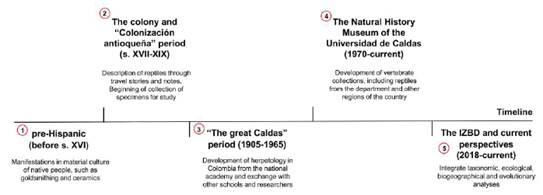
Figure 2 Temporal scheme highlighting key moments in the knowledge of the non-avian reptiles of the Department of Caldas, Colombia
1.Pre-Hispanic manifestations. The earliest recorded instances of non-avian reptiles in Caldas iconography or writings date back to the pre-Columbian representations of the Quimbaya cultures (between AD 850 and the 16th century). These cultures from the middle Cauca basin depicted zoomorphic figures associated with frogs and lizards (Friede, 1978; Osorio, 1990). The Quimbaya's northern boundary lay in the Guacaica and Chinchiná rivers intersection in Caldas south-central region, probably richer in non-avian reptiles then than today.
2.The Spanish colony and Antioquia's colonization period. Between the 16th and 19th centuries, during the colonial and post-colonial eras, several records of non-avian reptiles were documented by chroniclers and travelers, particularly within the Magdalena River basin, which served as a primary entryway into the country. Crocodiles, snakes, and certain lizards were often imbued with a magical-religious significance influenced by a medieval animalistic perception of nature (SantaGertrudis, 1956; Cabarcas-Antequera, 1994). In the late colonial period, the sociodemographic phenomenon of the so-called Antioquia's colonization period substantially altered the landscapes and fauna of present-day Caldas (Parsons, 1961). During this period, primary bibliographic sources consisted of accounts from travelers and settlers, often mentioning snakes, alligators, and turtles, noting, for example, the presence of snakes inside the woodpiles along the banks of the Magdalena River (Röthlisberger, 1963). Between 1825 and 1830, the Boussingault expedition conducted activities in what is now Caldas, particularly in the western gold-rich regions of Marmato, Supía, and Riosucio (Espinosa, 1991), including the collection of zoological specimens by J. M. Goudot, who was affiliated with the Museum of Paris. In this context, non-avian reptiles were collected for study and eventual transport to Europe, but their precise location (Caldas or a nearby Department) is unknown (Medem, 1968).
3. The Great Caldas 1905-1965. Scientific exploration of Caldas non-avian reptiles began in the early 20th century. In the 1920s-1940s, specimens were collected from the Central Cordillera by the Lasallista brothers Nicéforo María and Daniel. These specimens were key in the descriptions of certain snake species by Dr. Afranio do Amaral and Dr. Alcides Prado, affiliated with the Butantan Institute. Notable species named during this period included Helminthophis praeocularis (Amaral, 1924), Atractus manizalesensis (Prado, 1940), and A. biseriatus (Prado, 1941). North American herpetologist Dr. Emmett Reid Dunn contributed to understanding Colombian non-avian reptiles by reviewing extensively specimens from the Magdalena River Valley and the Central Cordillera (Dunn, 1944). From 1941 to 1961, the Colegio Pío XII in Salamina and the Colegio Nacional in Pensilvania housed biological specimens (Martínez et al., 2011), but the current localization of those historical collections is unknown.
4. The Museo de Historia Natural at Universidad de Caldas. In 1975, the naturalist Jesús H. Vélez Estrada established the Museo de Historia Natural of the Universidad de Caldas (MHN-UCa) to house and exhibit collections of both vertebrates and invertebrates to the public. Initially, most of the collection comprised taxidermized specimens of vertebrates, including non-avian reptiles (Salazar, 2004), but in the 1980s, the museum organized field expeditions to different localities in the Amazon, Chocó, and the Magdalena River valley humid forest, where some non-avian reptiles were collected (Salazar pers. comm.). The museum also includes material from Selva de Florencia, studied by Rueda-Almonacid (2000), who conducted the first study focused on the herpetofauna of a protected area in Caldas. The oldest non-avian reptile specimens from Caldas in the collection date back to 1985 and consist of three snakes: Atractus sp. (MHN-UCa-R-332), Bothriechis schlegelii (MHN-UCa-R-015), and Erythrolamprus epinephelus (MHN-UCa-R-334), all from Manizales. Today, the collection houses 806 specimens from Caldas and has grown continuously since 2001, with a notable increase in specimens from 2012 to 2023, reaching 117 species (Figure 3).
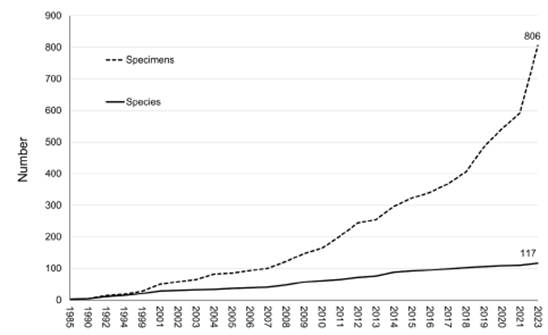
Figure 3 Growth trend of the non-avian reptile collection of specimens from the Department of Caldas deposited in the Natural History Museum at the University of Caldas (MHN-UCa-R), Manizales, Colombia
5. The Integrative Zoological Biodiversity Discovery lab (the IZBD). The IZBD at the Universidad de Caldas was established to contribute to the zoological knowledge of Caldas and Colombia. Its mission was to systematize and organize new and historical biological specimens deposited in the University's Museo de Historia Natural. Over the last five years, data on the non-avian reptiles in the MHN-UCa-R collection have been compiled and subsequently incorporated into the updated checklist of Caldas non-avian reptiles, and is now available to the general public (Ramírez-Chaves et al., 2021, 2022).
Updated checklist of non-avian reptiles from Caldas. Through extensive data compilation, we found that the taxonomic diversity of the non-avian reptiles in Caldas encompasses 126 species belonging to 69 genera, 25 families, and three orders (Table 1,1S,https://www.raccefyn.co/index.php/raccefyn/article/view/2007/3491). Crocodylia is the least represented order, with two species, while Testudines includes six species. In contrast, the order Squamata concentrates the highest richness (61 genera, 115 species) (Table 1). Colubridae has the most species with 54, followed by Anolidae and Gymnophthalmidae with 13 and 12, respectively. Thirty of these species have a restricted distribution in Colombia (Table 1,1S,https://www.raccefyn.co/index.php/raccefyn/ article/view/2007/3491). According to the IUCN (2023) classifications, Stenocercus bolivarensis is listed as Data Deficient (DD), while seven species are listed as threatened with extinction: two in the Critically Endangered (CR) category (Dendrophidion boshelli, Podocnemis leuwyana), two in the Endangered (EN) category (Crocodylus acutus, Riama columbiana), and three in the Vulnerable (VU) category (Riama antioquensis, Chelonoidis carbonarius, and Trachemys callirostris) (Table 1S,https://www.raccefyn.co/index.php/ raccefyn/article/view/2007/3491). All members of the Gekkonidae family in the region are introduced species (Henao-Osorio et al., 2021).
Noteworthy records and information gaps. We present noteworthy records of 15 non-avian reptile species that represent extensions of their known ranges, filling distribution gaps in the country (Figure 4) (Table 2S,https://www.raccefyn.co/index.php/raccefyn/ article/view/2007/3491).
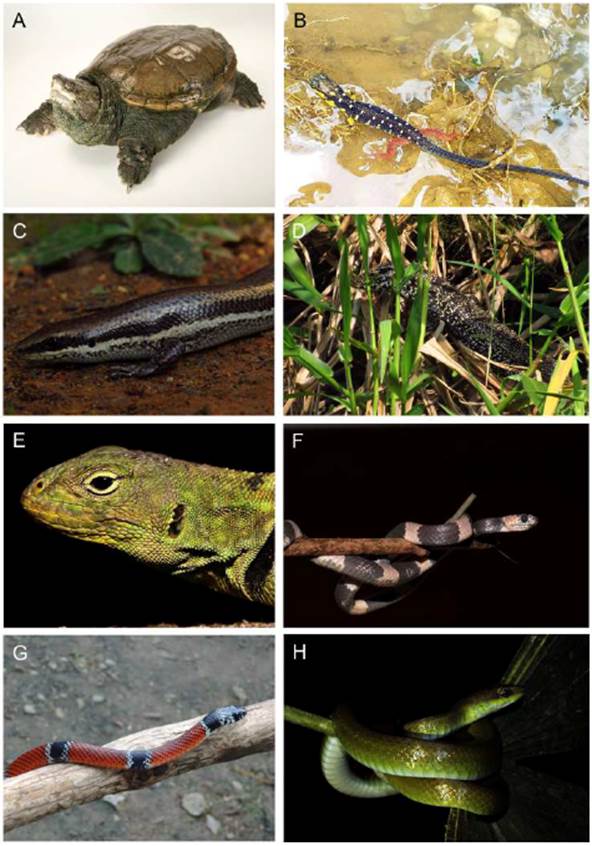
Figure 4 New records of non-avian reptile species in the Department of Caldas. (A) Chelydra acutirostris; (B) Anadia antioquensis; (C) Marisora gr. unimarginata; (D) Tupinambis sp.; (E) Stenocercus bolivarensis; (F) Dipsas gracilis; (G) Erythrolampruspseudocorallus; (H) Mastigodryas danieli. Photographs: Esteban Giraldo (A), Juan Camilo Gallego (B, G), Héctor F. Árias (F), Julián A. Rojas (C, D, E, H)
New record for Colombia: Alopoglossus kugleri (Roux, 1927): Norcasia (MHN-UCa-R-510), Samaná (MHN-UCa-R-608). Identification confirmed by Luis F. Esqueda.
New records for the Department of Caldas: Alopoglossus vallensis (Harris, 1994): Anserma (CUS-R-0116). Atractus lasallei (Amaral, 1935): Aguadas (MHN-UCa-R-647). Chelydra acutirostris (Peters, 1862): Palestina (https://www.inaturalist. org/observations/169608634). Dipsas gracilis (Boulenger, 1902): Chinchiná (MHN-UCa-R-500, 927; identification confirmed by Michael. B. Harvey). Erythrolamprus pseudocorallus (Roze, 1959): Norcasia (IAvH-R-6423), Victoria (IAvH-R-4158). Hemidactylus angulatus (Hallowell, 1854): Risaralda (MHN-UCa-R-935). Liotyphlops bondensis (Griffin, 1916): Samaná (MHN-UCa-R-359). Magdalenasaura adercum Fang, Vásquez-Restrepo & Daza, 2022: Samaná (MHN-UCa-R-331; Identification confirmed by José M. Fang). Marisora gr. unimarginata: Anserma (CUS-R-0112). Mastigodryas danieli (Amaral, 1935): Anserma (CUS-R-0049). Pholidobolus odinsae (Amézquita et al., 2023): Manizales (MHN-UCa-R-851-857). Riama antioquensis (Arredondo, 2013): Samaná (MHN-UCa-R-330). Stenocercus bolivarensis (Ayala & Castro, 1982): Manizales (Figure 4E). Tupinambis sp.: La Dorada (https://www.inaturalist.org/observations/172778884).
Records by municipality. We found no records of non-avian reptiles for La Merced, Marquetalia, and Marulanda. The majority of records supported by specimens are concentrated in the south-central and northeastern regions of the department (Figure 5) in areas corresponding to Manizales, Norcasia, and Samaná municipalities, respectively.
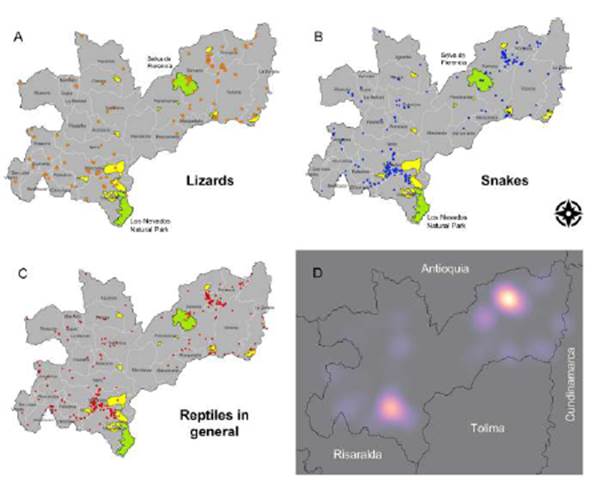
Figure 5 Distribution of records of non-avian reptiles in the Department of Caldas based on voucher specimens (Table 2S, https://www.raccefyn.co/index.php/raccefyn/article/view/2007/3491). National natural parks are highlighted in green and other protected forest reserves and private areas in yellow.
Protected areas in Caldas: The two national protected areas in Caldas are the Selva de Florencia Natural Park, with the highest number of records of non-avian reptiles and specimens (nine and seven, respectively), and Los Nevados Natural Park, with only one record of a species found outside its typical distribution range (Henao-Osorio et al., 2021).
Discussion
The richness of non-avian reptiles in Caldas is considerable (126 species), constituting 19% of the total species reported in Colombia, according to Uetz et al. (2023). A more in-depth analysis revealed significant disparities in species diversity across taxonomic groups, with Crocodylia exhibiting the lowest diversity, with two species (C. crocodilus and C. acutus), which are the only two inhabiting the inter-Andean valleys of Colombia (Morales-Betancourt et al., 2015; Carvajal-Cogollo et al., 2020). The six species of tortoises and turtles (order Testudines) represent 15.7% of the group in Colombia. Lizards and snakes (order Squamata) are the most diverse, with 17.1% and 20.9% of the specimens in Colombia, respectively (Uetz et al., 2023). In terms of species richness, in its 7888 km2, Caldas harbors a similar number of non-avian reptile species from that of the entire Colombian Orinoco region (128 species) (Trujillo, 2015) and is not far from the high diversity in the Caribbean region (171 species) (Carvajal-Cogollo et al., 2020). The richness of non-avian reptiles in Caldas compared with other Andean areas, such as the Mérida Cordillera in Venezuela (108 species) (La Marca & Soriano, 2004; Rivas et al., 2012) is higher, notwithstanding that Caldas represents 25% of the Mérida Cordillera area (La Marca & Soriano, 2004). This highlights the exceptional richness and biodiversity of non-avian reptiles in Caldas.
Our exhaustive examination of collected specimens from different collections and digital sources has yielded valuable findings: the first record of Alopoglossus kugleri in Colombia; the extension of the distribution range of endemic species such as A. vallensis, Atractus lasallei, Mastigodryas danieli, and Magdalenasaura adercum, and a better understanding of the distribution of the threatened and endemic Riama antioquensis (previously listed as Anadia antioquensis in the Vulnerable category on the IUCN Red List) (Arredondo & Bolivar, 2017).
The new record of A. kugleri extends over 600 linear km from the nearest locality in the Cordillera de la Costa, Venezuela (Esqueda et al., 2001). Furthermore, the record of D. gracilis in the Cauca River basin is equally noteworthy, as this snake species was previously recorded only in the humid forests of the biogeographic Chocó in Colombia and Ecuador (Harvey, 2008; Uetz et al., 2023). Published records supported by voucher specimens in Colombia were from the departments of Chocó (Castaño-Mora et al., 2004), Cesar (Moreno-Arias, 2010), and Boyacá (Carvajal-Cogollo et al., 2022). The new record in Caldas is the first known occurrence in the Cauca River basin, extending its distribution by nearly 200 km to the nearest locality in La Cristalina, Puerto Boyacá, Department of Boyacá.
Magdalenasaura adercum was recently described for the northeastern Cordillera Central in Antioquia and placed in the Magdalenasaura genus, which is considered endemic to the Magdalena River basin (Fang et al., 2022). The record in the Selva de Florencia Natural Park extends its distribution approximately 55 kilometers to the south of the nearest locality in the Cocorná River, Department of Antioquia (Fang et al., 2022).
A considerable number of non-avian reptile records from Manizales, Norcasia, and Samaná resulted from the monitoring and characterization conducted in the framework of the La Miel I hydroelectric and the Manizales + Biodiversa projects (Toro-Restrepo & Ramírez-Castaño, 2016; Ramírez-Chaves et al., 2022). These initiatives, involving monitoring programs at different time scales, have enhanced our knowledge at local and regional levels (Rojas-Morales et al., 2016; Stephenson et al., 2022). Future research should focus on understanding the diversity patterns of non-avian reptiles in municipalities with low or no recorded findings, particularly within reserves and protected areas like Los Nevados National Park and Selva de Florencia National Park. There is an urgent need to intensify sampling efforts in these protected areas and pristine zones, as they likely host poorly known and potentially undescribed species. For example, the record of Drepanoides sp. by Rueda-Almonacid (2000) in Selva de Florencia is noteworthy. This snake specimen (VR 4736) is believed to represent an undescribed taxon, but further research and the collection of more specimens are required to clarify its taxonomic status. The only recognized species of the genus Drepanoides is D. anomalus (Jan, 1863), which has distinct characteristics compared to the VR 4736 specimen: the absence of loreal scales, fewer ventral and subcaudal scales, and the absence of maxillary teeth (Guedes et al., 2020). We have included this record with caution to emphasize the importance of sampling in pristine areas with high conservation value, like the mentioned parks, the Arma and Samaná rivers basins bordering Antioquia, and the forests at the Occidental Cordillera in limits with the Department of Risaralda.
Supplementary information
View the supplementary information in https://www.raccefyn.co/index.php/raccefyn/ article/view/2007/3491

