




 English (pdf)
 Article in xml format
 Article references
 Automatic translation
 Send this article by e-mail
 Cited by SciELO
  Cited by Google
  Similars in
SciELO
Similars in
SciELO  Similars in Google
 Permalink

Introduction
During the Cenozoic, regional geological events occurred in the northwestern region of Colombia, such as the uplift of the Central and Western cordilleras and the collision of the Panama-Chocó Block against the Southamerican Plate (Restrepo & Toussaint, 1990; Duque-Caro, 1990; Coates et al., 1992; Montes et aL, 2012). To understand these events, it is fundamental to study the sedimentary deposits from adjacent basins, such as the northern region of the Cauca River Valley and the Colombian Caribbean (Figure 1) (Gómez et al., 2007). Studying changes within the sedimentary record and its fossils can provide valuable insights into establishing a chronological framework for identifying tectonic and climatic variations over time. In these deposits, pollen, spores, and, occasionally, marine microfossils are the most common fossils present and have been studied in recent years (Dueñas, 1980; Ramírez-Pinilla, 2015; Celis et al., 2023). Regional studies have shown that during the Oligocene-Early Miocene, the Amagá Basin was dominated by fluvial environments (Silva-Tamayo et al., 2008), with the coastline located in the southern sector where what is now the Caribbean (Celis et al., 2023) and nearshore settings transitioned to open marine environments in further north areas. Here we present a synthesis of stratigraphic and palynological studies done in the Amagá Basin and the San Jacinto Fold Belt, where the University of Caldas-Minciencias and the National Hydrocarbons Agency (ANH, after its Spanish acronym) have conducted borehole and outcrop studies covering the Eocene-Miocene interval. This allowed us to make a regional comparison of palynological associations among these basins to recognize taxa useful for biostratigraphy. In the Caribbean sections, the presence of calcareous microfossils (foraminifers and calcareous nannofossils), with better-calibrated bioevents, helped us to build an independent chronostratigraphic framework, which was used to tie up the palynological record. Additionally, we assessed the suitability and effectiveness of the palynological zonation of eastern Colombia (Jaramillo et aL, 2011) in the northwestern region.
The Amagá Basin is located between the Central and Western cordilleras (Figure 1), and it is bounded to the east and west by the Romeral and Cauca fault systems, respectively. It consists of a siliciclastic sedimentary fill that rests on an igneous-metamorphic basement (Barrero et al., 2007) and is unconformably overlain by volcanic-sedimentary deposits of the Combia Formation (Bernet et al, 2020). The siliciclastic unit was named the Carboniferous Tertiary of Antioquia by Grosse (1926), the Antioquia Formation by Van der Hammen (1958), and the Amagá Formation by González (1980). Grosse (1926) divided it into three intervals. The lower interval corresponds to a 200 m thick sequence of conglomerates and sandstones interbedded with some claystones. The middle interval, 200-250 m thick, consists mainly of sandstones and mudstones with some coal beds. In the upper interval, a sequence of ~1000 m of sandstones alternates with claystones (De Porta, 1974). The unit is named after the city of Amagá, where the type locality was defined (González, 2001). Based on palynological evidence, different ages have been proposed for this unit: late Oligocene-Early Miocene (Zegarra, 1993; Van der Hammen, 1958), late Eocene-Oligocene (Schuler & Doubinger, 1970), and late Paleocene-Eocene (Escobar, 1990). However, no microfossil distribution diagrams have been published to justify the proposed ages. In addition, sedimentological and paleontological evidence has led some authors to suggest that the unit accumulated in fluvial environments (Guzmán & Sierra, 1984; Guzmán, 1991), while others have suggested a local marine influence (Escobar, 1983; Escobar, 1990; Blandón, 2007).
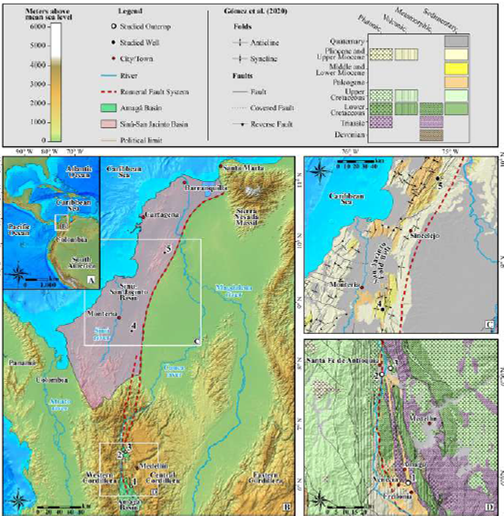
Figure 1 A. Map of northern South America, Central America, and the Caribbean indicating the study area. B. Map of northwest Colombia showing the locations of the Amagá and Sinú-San Jacinto basins and the outcrops and wells studied. C. Geology of the San Jacinto Fold Belt and location of the studied wells. D. Geology of the Amagá area and its surroundings.1. La Sucia Creek; 2. Puente Santa Fé; 3. La Nuarque Creek; 4. ANH-SSJ-Nueva Esperanza-1X well; 5. ANH-San Jacinto-1 well
In the Caribbean, ANH has conducted several stratigraphic drillings in the Sinú-San Jacinto Basin, particularly in the San Jacinto Fold Belt (SJFB). The Universidad de Caldas has studied the stratigraphical and micropaleontological records from these wells to understand the origin and age of the deposits. The SJFB is currently a low-lying mountain range oriented N20°E. It has been affected by subduction, collision, and transpression of the Caribbean oceanic plate and associated oceanic arcs, including the Panamá-Chocó Block, against the South American continental Plate (Pindell & Kennan, 2009; Farris et al., 2011; Montes et al., 2015; Vallejo-Hicapié et al., 2023). It is composed of terrigenous and calcareous sedimentary rocks that span the Late Cretaceous to the Pliocene, although they exhibit regional unconformities (Flinch, 2003; Guzmán et al., 2004; Cardona et al., 2012; Gómez et al., 2015). From the Oligocene to the Recent, they were formed in a forearc basin controlled by a low-angle subduction of the Caribbean plate beneath the South American Plate (Mantilla-Pimiento et al., 2009; Bernal-Olaya et al., 2015; Mora et al., 2018; Osorio-Granada et al., 2020). Two drill holes were analyzed, the ANH-SSJ-Nueva Esperanza-1X and the ANH-San Jacinto-1X, which span the Eocene-Miocene and Eocene-Oligocene intervals, respectively.
The ANH-SSJ-Nueva Esperanza-1X well has a depth of 2265 ft (690 m) and can be divided into three intervals. Interval 1 (2265-1980 ft; 690-604 m) consists mainly of coarse to very coarse beds of poorly to moderately sorted, laminated, or massive sandstones ranging from fine to very coarse-grained and occasionally conglomeratic. Dark gray mudstones with parallel lamination and polymictic conglomerates are less common. Interval 2 (1980-575 ft; 604-175 m) consists mainly of beds of laminated sandstones and mudstones forming coarsening-upward sequences up to 30 meters thick, locally with coal beds. Mollusks and charred logs are present in some beds and pollen, and spores have been recovered from mudstones. To a lesser extent, dinoflagellates, foraminifers, and calcareous nannofossils have also been found. Bioturbation is very common. Interval 3 (575-0 ft; 175-0 m) consists of medium to very thick beds of fine- to coarse-grained sandstones, occasionally conglomeratic, massive, or laminated, locally bioturbated and/or fossiliferous (mollusks and charred logs), interbedded with medium to thick beds of massive or laminated mudstones, locally bioturbated (rhizolites, Thalassinoides) or with mollusk shells. Coal beds are less common. The mudstone beds yielded mainly terrestrial palynomorphs and, to a lesser extent, dinoflagellates. Foraminifers (planktonic and benthic) and calcareous nannofossils are present in some beds (UCaldas - ANH, 2020).
The ANH-San Jacinto-1 well drilled 1725 ft (~526 m) of fine-grained sedimentary rocks in the SJFB (Figure 1) that can be divided into three intervals (UCaldas - ANH, 2020). Interval 1 (1725-1500 ft; 526-457 m) consists of up to 30 cm thick beds of sandy and glauconitic packstones-grainstones that grade to mudstones or marls. Muddy intraclasts and erosion marks are common. Interval 2 (1500-400 ft; 457-122 m) consists of black to gray bioturbated mudrocks parallel laminated or massive, rich in calcareous microfossils, mollusks, charred wood, and fish remains. Occasionally they are interbedded with mudstones and marls. Interval 3 (400-0 ft; 122-0 m) consists mainly of black and yellowish-brown marls, structureless or with parallel lamination, locally bioturbated (UCaldas - ANH, 2020).
Materials and methods
We studied two stratigraphic sections located between the towns of Santa Fé de Antioquia and San Jerónimo in the northern part of the Amagá Basin, which correspond to the Amagá Formation (Figure 1D). From base to top, they correspond to Puente Santa Fé (coordinates: initial point 6.511607, -75.817259; final point 6.511303, -75.814422), and Quebrada La Nuarque (initial point 6.540519, -75.777726; final point ~6.541149, -75.772351). The sections were surveyed using an open polygonal method with a tape measure, a compass, and Jacob's staff. Geometry, lithology (texture and composition), sedimentary structures, and fossils were systematically described in the outcrops (Selley, 1985). Fifty samples were collected for the palynological study. In addition, the palynological record of La Sucia Creek, near the Palomos Mine (Sánchez, 2005), was integrated to build an extended composite section (Figure 1), and the palynological data were compared with those from the ANH-SSJ-Nueva Esperanza-1X and ANH-San Jacinto-1 stratigraphic wells drilled in the Colombian Caribbean (Figure 1).
Sample preparation was carried out at the Instituto de Investigaciones en Estratigrafía (IIES) at Universidad de Caldas using a standard procedure for paleopalynological samples (Traverse, 2007). Approximately 10 to 20 g of rock were collected, cleaned, and crushed until 1-2 mm fragments were obtained. Carbonates were then removed with 50 ml of 37% hydrochloric acid (HCl) and silicates with 70% hydrofluoric acid (HF), followed by washing and filtration through 100 urn and 10 urn mesh. The samples were placed in an ultrasonic bath for about 1 minute to remove any remaining minerals. Then, 10% KOH was added to remove humic acids; the mixture was then centrifuged to concentrate the organic residue, and the non-oxidized organic matter was spread on a coverslip with polyvinyl alcohol. Some of the recovered organic matter was removed and oxidized with 65% nitric acid (HNO3), and humic acids were removed with 5% ammonium hydroxide (NH40H). The mixture was then filtered through a 10 um mesh, and the oxidized film was mounted on a coverslip and fixed to a slide with Canada balsam.
A Nikon 80i transmitted light microscope with 40x and 100x objectives was used to identify, count, and, in some cases, describe the palynomorphs. The identified morphospecies were photographed using a Nikon digital camera and the NIS-Elements F software. Identification of the palynomorphs followed several regional publications (Regali et al., 1974; Germeraad et al, 1968; Lorente, 1986; Muller et al, 1987; Hoorn, 1993; Jaramillo & Dilcher, 2001; Plata-Torres et al, 2023), as well as the morphological database of Jaramillo & Rueda (2023), which contains the description of all the palynomorphs published for northern South America.
For the biostratigraphic analysis, all palynomorphs on the oxidized slab were systematically counted up to 300 palynomorphs per sample, when possible. The abundance and stratigraphic distribution of the biostratigraphic markers were then analyzed and compared with the associations described in the palynological zonation proposed by Jaramillo et al. (2011) for eastern Colombia (Llanos Basin, Eastern Cordillera, and Magdalena Valley). This zonation has the advantage that some stratigraphic levels have been independently calibrated to the international stratigraphic time scale using carbon isotopes, magneto-stratigraphy, and foraminifera. Other regional zonations were also reviewed (e.g., Gonzalez-Guzmán, 1967; Dueñas-Jiménez, 1986).
For the paleovegetation analysis, the palynomorphs were grouped into five categories: Angiosperms (excluding palms), Palms, Ferns (including pteridophytes and bryophytes), Algae, and Fungi. The relative proportions of these palynomorphs along the stratigraphic sequence are presented in pollen diagrams generated by the Tilia 2.0 software. Information on the ecological preferences and paleoenvironmental significance was obtained from the existing literature (e.g., Marchant et al., 2002). The abundance of palynomorphs in the slides was defined as follows: 1) Low: < 100 palynomorphs per slide; 2) moderate: between 100 and 200; 3) high: greater than 200. The terms poorly, moderately, and well-preserved were used to indicate the preservation of the microfossils. The abbreviations FAD (First Appearance Datum) and LAD (Last Appearance Datum) are commonly used to refer to the first or last appearance of a species in the stratigraphic record.
Results
Description of the sampled sections of the Amagá Basin
In the northernmost part of the Amagá Basin, the Amagá Formation is faulted and folded, requiring the study of discrete segments to construct a composite section of the entire unit. The lower part of the unit can be observed near the town of San Nicolás, where it rests on a Paleozoic-Mesozoic igneous and metamorphic basement. It comprises thick amalgamated lenticular beds of lithic sandstones and conglomerates, with crossbedding, shale intraclasts, and calcareous concretions. There are also some thin lenticular beds of siltstones and mudstones with poorly preserved plant remains. Unfortunately, some palynological samples analyzed in this interval are sterile in palynomorphs. The Puente Santa Fé section overlays the previous sequence. Nowadays, the described outcrops have been practically destroyed due to the construction of a highway. It is a succession of 240 m thick composed of fining-upward sequences of conglomeratic sandstones, coarse to fine-grained sandstones, and siltstones. Some coal seams (< 1 m) can be seen in the upper part of some of these sequences. Planar and trough cross-bedding are common in the sandstones (Figure 2A). The organic shales and coal beds contain pollen, spores, and well-preserved plant remains, locally rizoliths. Fine-grained sandstones and organic-rich mudstones are also common in this part. A sequence of lithic conglomerates and sandstones is seen in the upper part of this interval, followed by a fining upward sequence (2-3 m thick) of trough crossbedded coarse quartz sandstones, fine sandstones, and variegated sandy siltstones. The sequences become thicker and coarser in the upper part of this interval (Figure 2A).
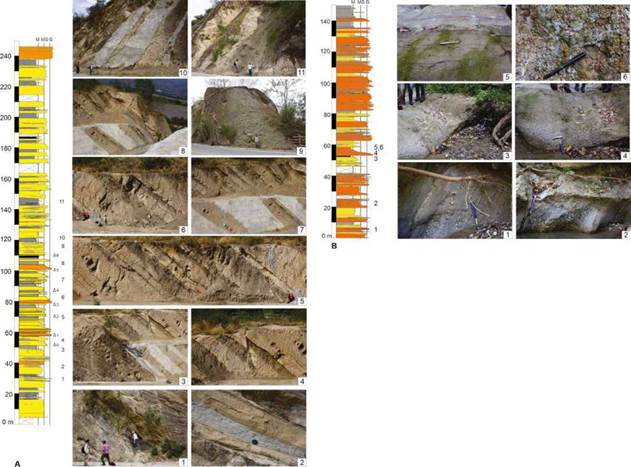
Figure 2 A. Sedimentological characteristics of the Puente Santa Fé section (The numbers indicated in the stratigraphic column correspond to the numbers of the photos).1. Laminated sandstone and conglomeratic sandstone beds that gradually change to carbonaceous gray siltstones and coal, followed by a succession of crossbedded coarse sandstones and conglomeratic sandstones. 2. Detail of fine-grained sandstone beds with low angle cross-bedding. 3. Left, coarse to very coarse sandstones with crossbedded conglomeratic beds and calcareous concretions grading to gray sandy mudstones. From delta 0 there are increasing sequences of coarse sandstones with crossbedding (sets of 10 cm thick), grading to greenish-gray and black mudstones with plant remains. 4. Detail of two fining upward sequences affected by a normal fault. 5. Succession of sandstones and mudstones forming fining upward sequences. Note the irregular surfaces and lenticular geometry of some beds. Some of the mudstones contain rizoliths, well-preserved plant remains, and thin coal beds at the top. 6, 7, and 8. Succession of coarse to finegrained sandstones with crossbedding at different scales, green and gray mudstones, and coal with plant remains. 9. Coarse-grained sandstone beds with cross bedding and calcareous concretions gradually changing towards the top to gray mudstones whose upper part is coal. 10. Fine to coarse-grained sandstones interbedded with coal-bearing mudstones (partly covered by industrial cement). 11. Right: Layers of greenish-gray siltstones with plant debris overlain by thick, lenticular, coarse- to medium-grained sandstone beds. B. Sedimentological characteristics of the La Nuarque Creek section. 1. Medium to very coarse-grained sandstones interbedded with conglomerates of granules and pebbles with cross bedding. 2. Granule conglomerates interbedded with sandstones. Note the orientation of the fragments parallel to the stratification. 3. A layer of carbonaceous mudstone and coal overlain by a layer of pebble conglomerate. 4. Pebble conglomerate gradually changing to very coarse to fine-grained sandstones. 5. Medium- to fine-grained sandstone with discontinuous wavy lamination, marked by carbonized plant debris. 6. Variegated mudstones. M: mud; MS: medium sand; G: gravel (granule)
The La Sucia Creek section consists of thin to very thick beds of mudstones rich in organic matter and plant remains interbedded with some coal beds. There are also medium to thick beds of sandstones with planar lamination and crossbedding at various scales. Sandstones and mudstones often form fining upward sequences. The La Nuarque Creek section has ~150 m in thickness; it is located in the northeastern part of the basin (Figures 1 and 2B). The base of the section is covered by Quaternary sediments and the top is in faulted contact with the Cretaceous volcanic rocks of the Quebradagrande Complex (Gómez et al., 2020) (Figure 1). It is composed of fining upward sequences (~ 6 m thick) of conglomerates, crossbedded sandstones, and green, mostly variegated, siltstones (Figure 2B). Calcareous concretions and thin coal beds are also observed. The upper part of the succession is mainly coarse-grained, consisting of amalgamated lenticular beds of clast-supported conglomerates and sandstones (Figure 2B). Thin beds of gray and black siltstones and claystones are locally present and large charred woody debris and poorly preserved leaves are common.
Palynology
In the three sections studied in the Amagá Basin, a total of 6861 palynomorphs were recorded, distributed in 127 morphotypes, of which 84 correspond to angiosperms, including palms, two gymnosperms (e.g., Podocarpidites), 40 fern morphotypes, one alga (Chomotriletes minor), and one fungus (Table 1s,https://www.raccefyn.co/index. php/raccefyn/article/view/1921/3402). Most samples in the Puente Santa Fé section have moderate to high recovery and good preservation of palynomorphs. Within the palynological assemblage, we recognized Corsinipollenites sp., Foveotriporites hammeni, Gemmamonocolpites perfectus, Mauritiidites franciscoi, Perisyncolporites pokornyi, Psilastephanocoporites fissilis, Retistephanoporites crassiannulatus, Spirosyncolpites spiralis, Striatopollis catatumbus, and Tetracolporopollenites transversalis, and the spores Foveotriletes concavoides, Polypodiisporites sp., Psilatriletes sp., and Verrutriletes sp. Freshwater algae of the Concentricystes type (Chomotriletes minor) and fungi were abundant in some samples (Table 1s,https://www.raccefyn.co/index.php/raccefyn/article/ view/1921/3402).
In the Quebrada La Sucia section, of the 25 samples processed, 11 showed good recovery of palynomorphs. As for pollen, Cyclusphaera scabrata, Mauritidites franciscoi, Perisyncolporites pokornyi, Ranunculacidites operculatus, Striatopollis catatumbus, Tetracolpopollenites transversalis, among others, were recognized. We highlight the presence of spores of Magnastriatites grandiosus, Foveotriletes ornatus, and abundant Psilatriletes sp., as well as fungal remains (Table 1s,https://www.raccefyn.co/index.php/ raccefyn/article/view/1921/3402).
In the Quebrada La Nuarque section, the palynomorph content is low towards the base and ~110 m. High recoveries are found between 50 to 60 m and 80 to 130 m. Among the pollen, Clavainaperturites microclavatus, Crassiectoapertites columbianus, Mauritiiditres franciscoi, Perisyncolporites pokornyi, Retistephanoporites crassiannulatus, Striatopollis catatumbus, Tetracolporopollenites maculosus, Tetracolporopollenites transversalis were identified. This section presents the greatest diversity of pteridophyte spores, including, among others, Concavissimisporites fossulatus, Kuylisporites waterbolkii, Foveotriletes ornatus, Polypodiisporites usmensis, Polypodiaceiosporites pseudopsilatus, Psilatriletes peruanus, Retitrilete sommeri, and Verrucatotriletes aff. bullatus, which are associated with abundant freshwater algae (Chomotriletes minor) and fungal remains (Table 1s,https://www.raccefyn.co/index.php/raccefyn/article/view/1921/3402).
For the ANH-SSJ-Nueva Esperanza-1X well, 72 palynological samples were prepared and distributed between ~17' and 2265 ft (5-690 m). A total of 9557 palynomorphs were examined distributed in 309 morphotypes, 236 angiosperm morphotypes (of which 10 correspond to palms and 3 to mangroves), 55 spores (including ferns and bryophytes), three fungi, and 17 marines (dinoflagellate cysts, marine algae, organic foraminiferal linings, and scolecodonts). Preservation is good and abundance ranges from poor to very abundant. Among the spores, we found Cicatricosisporites dorogensis, Echinatisporis brevispinosus, Echinatisporis muelleri, Foveotriletes ornatus, Magnastriatites grandiosus, Nijssenosporites fossulatus, Polypodiaceoisporites? fossulatus, Polypodiaceoisporites usmenis, and Verrucatotriletes etayoi. As for pollen, we found different species of Bombacacidites (e.g., B. echinatus), Clavatricolpites densiclavatus, Crassiectoapertites columbianus, Cyclusphaera scabrata, Echimorphomonocolpites solitarius/gracilis complex, Echiperiporites estelae, Echitriporites nuriae, Foveotricolporites crassiexinus, Grimsdalea minor, Horniella lunarensis, Lanagiopollis crassa, Magnaperiporites spinosus, Mauritiidites franciscoi, Perfotricolpites digitatus, Perisyncolporites pokornyi, Proteacidites triangulatus, Psilabrevitricolporites triangularis, Psilastephanocolporites fissilis, Psilatricolporites atalayensis, Psilatricolporites costatus, Psilatricolporites pachydermatus, Ranunculacidites operculatus, Retibrevitricolporites grandis, Retistephanocolpites tropicalis, Retistephanoporites crassiannulatus, Retistephanoporites minutiporus, Retitrescolpites magnus, Retitrescolpites? irregularis, Retitricolpites simplex, Rhoipites guianensis, Rhoipites hispidus, Rhoipites planipolaris, Scabraperiporites asymmetricus, Scabratricolporites planetensis, Spinizonocolpites echinatus, Spirosyncolpites spiralis, Striatopollis catatumbus, Tetracolporopollenites maculosus, Tetracolporopollenites transversalis, Verruperiporites denseverrucatus, Verruperiporites paucumverrucatus, Ulmoideipites krempii, Zonocostites ramonae, among others. A progressive increase of marine palynomorphs (e.g., Tuberculodinium vancampoae) can be seen towards the top of the sequence.
In the ANH-San Jacinto-1 well, 36 samples were prepared for palynology. A total of 5125 palynomorphs were counted, distributed in 206 morphotypes, 121 angiosperm morphotypes (of which 12 correspond to palms and two to mangroves), 41 spores (including ferns and bryophytes), four fungi, one alga (Botryococcus sp.), and 39 marines (dinoflagellate cysts, marine algae, organic foraminiferal linings, and scolecodonts). The preservation is good and the abundance ranges from poor to high. Spores include the presence of Cicatricosisporites dorogensis, Echinatisporis brevispinosus, Foveotriletes concavoides, Kuylisporites waterbolkii, Laevigatosporites spp., Nijssenosporites sp., Polypodiaceoisporites fossulatus?, Polypodiisporites planus, Polypodiisporites usmensis, Polypodiisporites spp., Chomotriletes minor (freshwater algae), among many others. Within the pollen, we recognized several species of Bombacacidites, Clavatricolpites cf. densiclavatus, Crassiectoapertites columbianus, Crototricolpites aff. densus, Cyclusphaera euribei, Cyclusphaera scabrata, Echitriporites aff. nuriae, Foveotriporites hammenii, Gemmamonocolpites dispersus, Grimsdalea minor, Jandufouria seamrogiformis, Lakiapollis costatus, Lanagiopollis crassa, Magnaperiporites spinosus, Mauritiidites franciscoi, Monoporopollenites annulatus, Perisyncolporites pokornyi, Psilabrevitricolporites triangularis, Psilamonocolpites medius, Psilaperiporites minimus, Psilatricolporites pachydermatus, Ranunculacidites operculatus, Retistephanoporites crassianulatus,Retistephanoporitesminutiporus, Retitrescolpites? irregularis, Retitriporites dubiosus, Rhoipites hispidus, Scabraperiporites asymmetricus, Spirosyncolpites spiralis, Verruperiporites denseverrucatus, Verruperiporites paucumverrucatus, and Zonocostites sp. The recovery of marine palynomorphs along the borehole was high. We recognized Alisocysta sp., Cordosphaeridium sp., Dinopteridium sp., Batiacasphaera spp., Bitectatodinium spp., Cleistosphaeridium? sp., Heterosphaeridium? spp., Homotryblium sp., Hystrichokolpoma spp., Impagidinium spp., Lejeunecysta aff. fallax, Lingulodinium aff. machaerophorum, Oligosphaeridium sp., Operculodinuium sp., Pentadinium sp., Polysphaeridium spp., Selenopemphix nephroides, Spiniferites spp., and Tectatodinium spp./Filisphaera spp.
Palynostratigraphy and age of the studied sections
In the Puente Santa Fé section, the presence of Perisyncolporites pokornyi (FAD at ~45 Ma) at 18 m indicates that this part of the section is not older than the Middle Eocene (Lutetian). It co-occurs with Foveotriporites hammeni up to 148 m, which has its LAD at ~33 Ma (lower Rupelian). According to the above, the age of this succession is between the Middle Eocene-Early Oligocene (45-33 Ma; T07 zone). On the other hand, Retibrevitricolporites speciosus (LAD 40 Ma, B) accompanies this association up to 129 m and Retistephanoporites crassiannulatus (FAD ~41 Ma, B) is recorded at 148 m. Thus, the sequence between 18-129 m would have a Middle to Late Eocene (Lutetian-Bartonian) age (Figures 3andfigure 1s,https://www.raccefyn.co/index.php/raccefyn/article/ view/1921/3403). Toward the top of the section, there are no biostratigraphic markers to determine age. However, there are no changes in sedimentary facies that would allow us to interpret a stratigraphic discontinuity. Therefore, the sequence is probably Early Oligocene.
In the Quebrada La Sucia section, the presence of Concavissimisporites fossulatus between ~8-85 m and of Magnastriatites grandiosus at the 14 m level, whose FADs were estimated at ~34 Ma, indicates that this interval is not older than the Oligocene. However, no stratigraphic markers constrain the age at the top of the section (Figures 3andfigure 1s,https://www.raccefyn.co/index.php/raccefyn/article/view/1921/3403).
In the Quebrada La Nuarque section, Clavainaperturites microclavatus and Poly-podiaceoisporites pseudopsilatus are recorded at ~55m and ~14 m, respectively (Figures 3andfigure 1s,https://www.raccefyn.co/index.php/raccefyn/article/view/1921/3403). These species have their FAD at ~20 and 23 Ma, respectively, suggesting that the deposits of this section cannot be older than the Aquitanian-Burdigalian. This association is also accompanied by Concavissimisporites fossulatus, Retitriletes sommeri, Foveotriletes ornatus, and Crassiectoapertites columbianus, whose FADs occurred during the Late Eocene-Early Oligocene (~34-31 Ma). According to Jaramillo et al. (2011), C. fossulatus has its LAD in the Serravallian (~12 Ma), suggesting that the age of the section could range between ~20-12 Ma (Burdigalian-Serravallian). However, this event was not considered as will be further discussed below. Thus, based on the palynological information, the age of the Amagá Formation is estimated to be Middle to Late Eocene-Miocene.
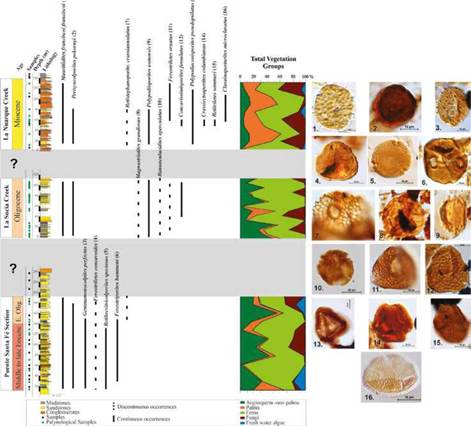
Figure 3 Palynostratigraphy and stratigraphic distribution of vegetation groups of the Amagá Formation based on the sections studied in this work. Information on the Quebrada La Sucia section is taken from Sánchez (2005). The numbers at the end of each palynological name correspond to the photos located to the right. The samples represented by black dots were prepared for palynology.However, they are barren or contain very few palynomorphs.
The age model of the ANH-SSJ-Nueva Esperanza-1X well, including palynology and calcareous microfossils, was published by Celis et al. (2023). The age ranges from Middle Eocene to the Early Miocene. At the base of the core, between 2265-2051 ft (690-625 m), an age no older than Middle to Late Eocene (T06-T07 zones) is assigned by the presence of Perisyncolporitespokornyi (FAD 45 Ma) and Polypodiisporites usmensis (FAD 36 Ma). Between 1962 and 525 ft (598-162 m), an Oligocene age (T08-T11 zones) is interpreted based on the occurrence of Cicatricosisporites dorogensis (LAD 23 Ma), Magnastriatites grandiosus (FAD 33 Ma), Bombacacidites echinatus (LAD 32Ma), Crassiectoapertites columbianus (FAD 33 Ma), Magnaperiporites spinosus (FAD 32 Ma), Psilatricolporites pachydermatus (FAD 30 Ma), and Rhoipites planipolaris (FAD 31 Ma). At the top of the core, between 525-17ft (160-5m), an Early Miocene age was assigned due to the occurrence of Bombacacidites muinaneorum (FAD 23 Ma), Cyclusphaera scabrata (LAD 17 Ma), Nijssenosporites fossulatus (FAD 19 Ma), and Proteacidites triangulatus (FAD 24 Ma). It is also important to note that Middle Miocene biostratigraphic markers, such as Grimsdalea magnaclavata and Crassoretitriletes vanraadshoveni, were not observed.
The ANH-San Jacinto-1X hole is Middle Eocene to Oligocene in age. The continuous presence of Cicatricosisporites dorogensis, along with Perisyncolporites pokornyi, is highlighted. From 1729 to 1548 ft (527 to 472 m), the presence of Perisyncolporites pokornyi suggests an age no older than the Middle Eocene (T06 zone). From sample 1526 to 1126 ft (465 to 343 m), Polypodiisporites usmensis suggests a Late Eocene age (T07 zone). Between the 1076 to 676 ft (328 to 206 m) interval, Psilatricolporites pachydermatus, Crassiectoapertites columbianus, and Foveotriporites hammenii co-occur in the Early Oligocene (T08-T09 zones). Finally, between the 625 and 50 ft (191 to 15 m), the occurrence of Magnaperiporites spinosus, the continuous record of Cicatricosisporites dorogensis, and the absence of Miocene palynomorphs suggest an Oligocene age (T09-T11 zones).
Discussion
Biostratigraphy and chronostratigraphy of the studied sections
The Cenozoic deposits of western Colombia along the Cauca-Patía and Amagá basins are poorly controlled chronologically. The Amagá Basin predominantly contains pollen, spores, plant remains (leaves, stems), mollusks, and crocodile teeth (e.g., Grosse, 1926; Huertas, 1977; Sucerquia, 2004). Among these fossils, pollen can potentially constrain the age of sedimentation. However, there is currently no published information on the stratigraphic distribution of palynomorphs with biostratigraphic value.
Jaramillo et al. (2011) zonation divides the Middle-Late Eocene into two palynological zones (T06 and T07). Very few species used in this zonation were found in the studied sections. In the Amagá Basin, one of the most common species is Perisyncolporites pokornyi, which has biostratigraphic value. Its FAD in the eastern part of the country is ~45 Ma (Jaramillo et al., 2011), and it is relatively abundant along the studied sections. P. pokornyi corresponds to the pollen of the Malphigiaceae, a family of trees, herbs, and lianas with diverse ecological preferences. They are widespread in swamps and mangrove scrub, tropical humid forests, and sub-Andean forests (Marchant et al., 2002). Due to its abundance and wide distribution, its FAD has been used to constrain the age of the Middle Eocene strata. In the Caribbean, P. pokornyi has been recorded in several sections and its FAD could be calibrated with marine calcareous microfossils. Another species of biostratigraphic value that allows constraining the age of the lower part of the Amagá Formation and the Caribbean deposits is Foveotriporites hammeni, whose natural affinity remains unknown. It was first identified in the Catatumbo Basin by González-Guzmán (1967) and has been described, albeit in low abundance, in numerous sections and drill holes from eastern Colombia, the Caribbean, and the Cauca Valley (Pardo-Trujillo et al., 2003; Jaramillo et al., 2011; Plata-Torres et al., 2023a; observations of the authors). In the Jaramillo zonation, it has a LAD at ~33 Ma, which is consistent with its distribution in the ANH-San Jacinto-1X well, where an independent age model was built based on calcareous nannofossils (Arias-Villegas et al., 2023). Other palynomorphs useful for biostratigraphy are Retistephanoporites crassiannulatus (FAD ~41; Lutetian) and Retibrevitricolporites speciosus (LAD ~40 Ma; Bartonian), which help to constrain the age of the lower part of the Amagá Formation. Foveotriletes concavoides was defined by Jaramillo et al. (2007) in the Middle Eocene of the Llanos foothills and the Upper Paleocene of the Cerrejón Formation, which is very similar to Concavissimisporites fossulatus described in Oligocene deposits from the southwestern Caribbean region (Dueñas, 1980). These two spores were recovered in the Amagá Basin. On the other hand, Gemmamonocolpites perfectus belongs to a diverse group of monocolpate-gemmate pollen grains recorded in the Eocene of the Catatumbo region and the Caribbean (González-Guzmán, 1967; Jaramillo & Dilcher, 2001; Plata-Torres et al., 2023a). We believe that these species may have biostratigraphic potential in western Colombia basins.
Jaramillo et al. (2011) divided the Oligocene into four palynological zones (T08 to T11). However, in the studied beds of the Amagá Formation, included in the Oligocene (La Sucia Creek section), these biozones cannot be identified due to the scarcity of biostratigraphic markers for this zonation (Figures 3andfigure 1s,https://www.raccefyn.co/index.php/raccefyn/article/view/1921/3403). Among them are the spores Magnastriatites grandiosus, Concavissimisporites fossulatus, and Foveotriletes ornatus whose FADs are estimated at ~34, 34, and ~31 Ma (Eocene-Oligocene boundary and early Rupelian). M. grandiosus is very similar to Ceratopteris sp., an aquatic fern currently found in the tropics in coastal marshes and alluvial plains adjacent to lakes and rivers (Germeraad et al., 1968). In the case of C. fossulatus and F. ornatus, they have a natural affinity with Huperzia (Lycopodiaceae), which is currently widespread in the humid mountain ecosystems of Colombia (Solé de Porta & Murillo-Pulido, 2005). In this section, R. operculatus is also recorded, co-occurring with Polypodiisporites usmensis, whose FADs are estimated at ~40 Ma and ~37 Ma (Late Eocene), respectively. The natural affinity of R. operculatus corresponds to Alchornea (Euphorbiaceae), mostly trees common in tropical lowland and sub-Andean forests (Marchant et al., 2002). On the other hand, P. usmensis is a fern spore related to Polypodium (Jaramillo & Rueda, 2023), which usually lives epiphytically on lowland rainforest trees, extending to secondary dry forests, gallery forests, shrub savannas, and mountain forests (Marchant et al., 2002). It is also important to note that some of the key species used in the palynological zonation of Jaramillo (e.g., Cicatricosisporites dorogensis, Retibrevitricolporites triangulatus) were not found in the studied material. This, together with the presence of species not described in the literature, suggests that the vegetation in this region had unique characteristics. Therefore, these new morphospecies must be studied to ascertain their biostratigraphic value.
On the other hand, EAFIT University (Medellín) conducted a study to assess the potential for coal bed methane exploration in the Amagá Basin (EAFIT-ANH, 2011). Seven core holes ranging in depth from 80 to 530 meters were drilled near the towns of Venecia and La Pintada, located in the "middle" part of the Amagá Formation, which has economically exploitable coal seams. A palynological study of 92 samples was conducted in five holes (Bioss-Universidad EAFIT, 2011). Palynomorphs found included Magnastriatites grandiosus, Retitricolporites simplex, P. usmensis, Laevigatosporites catanejensis, Retitricolporites irregularis, Mauritiidites minor, Perisyncolporites pokornyi, and Echiperiporites cf. stellae (sic.). The author concluded that this association is characteristic of the Early Miocene. However, according to the available palynological zonations, none of these palynomorphs allows to constrain this age. Instead, most of these species have their FAD in the Eocene, and the association can only be considered not older than the Oligocene since the FAD of M. grandiosus is ~34 Ma. The author also notes that some samples have an older palynological species and interprets them as reworked, such as Foveotriporites hammenii, Bombacacidites gonzalezii, Cricotriporites cf. guianenisis, Verruperiporites densiverrucato (sic.), Foveotricolpites cf. fossulatus, and Psilatricolporites crassus. Although not mentioned in the report, the photographic plates include Cicatricosisporites dorogensis. It is also worth noting that the occurrence of igneous dikes in the area had thermal effects on the organic matter in certain instances. In any case, this material has great potential for further study.
In the Caribbean ANH-SSJ-Nueva Esperanza-1X well, different palynological events were used to establish the age of the Oligocene strata, including the FADs ofMagnastriatites grandiosus (~34 Ma), Crassiectoapertites columbianus (~33 Ma), Magnaperiporites spinosus (~32 Ma), Psilatricolporites pachydermatus (~30 Ma), and Proteacidites triangulatus (~24 Ma), as well as the LAD of Bombacacidites echinatus (~32 Ma) and Cicatricosisporites dorogensis (~ 23 Ma) (Figure 4). Similarly, events such as the FAD of Psilatricolporites pachydermatus, Crassiectoapertites colombianus, Magnaperiporites spinosus, and the LAD of Foveotriporites hammeni and Cicatricosisporites dorogensis were recorded in the ANH-San Jacinto-1X well (Figure 4).
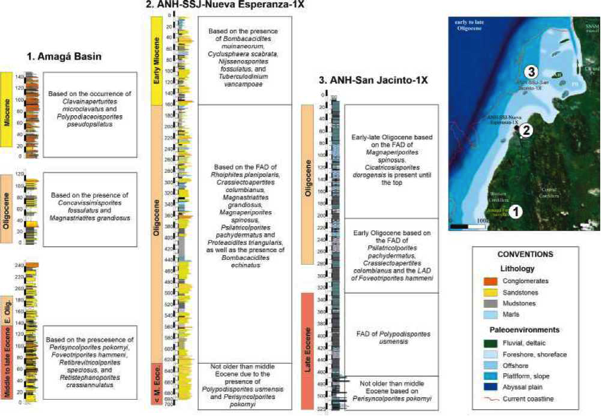
Figure 4 Comparison of the studied sites and summary of the palynological criteria used to determine the age. On the upper right is a paleogeographic map of the Oligocene for northwestern Colombia (modified from Celis et al., 2023) showing the location of the studied sections.
In the La Nuarque Creek section, Polypodiaceoisporites pseudopsilatus and Clavaina-perturites microclavatus were recovered with Early Miocene FADs of ~23 and 20 Ma (Aquitanian and Burdigalian), respectively. P. pseudopsilatus has been associated with Pteris (D'Apolito et al., 2019), which has a diverse ecology in lower and upper montane rainforests. C. microclavatus has been associated with Hedyosmum. Today, this genus is mainly distributed in wet habitats of montane cloud forests, but in the Miocene, its ancestor was distributed in the lowlands (Martínez et al., 2013). On the other hand, the spore Concavissimisporites fossulatus is present in the La Nuarque Creek section. According to Jaramillo et al. (2011), this species has its LAD at ~12 Ma (Serravalian) and could therefore constrain the minimum age of sedimentation. However, this criterion should not be used because, as mentioned above, C. fossulatus can be related to recent spores of Huperzia hippuridea (SoléDe Porta & Murillo-Pulido, 2005), a fern that is currently abundant in Central and South America (Lellinger, 1989). In contrast, species common in eastern Colombia and part of the Jaramillo zonation, such as Nijssenosporites fossulatus and Rugutricolporites intensus, were not found in the Amagá Formation.
In addition to micropaleontological data, radiometric methods such as zircon U/Pb detrital geochronology and thermochronology (zircon fission tracks-ZFT) have been applied to the Cenozoic sediments of the Amagá Formation (Montes et al., 2015; Piedrahíta et al., 2017; Lara et al., 2018). These methods have allowed the determination of maximum depositional ages for different stratigraphic levels. In the central part of the Amagá basin, Piedrahíta et al. (2017) indicated a ZFT maximum depositional age of 28.1 ± 5.8 for the Lower Member of the Amagá Formation and a range of 17.6 ± 1.6 to 10.6 ± 2.5 Ma in the Upper Member. These data are complemented by U/Pb maximum depositional ages from Lara et al. (2018) in the northern part of the basin, which yielded ages ranging from 72.9 to 58.8 for the lower section (Puente Santa Fé section of this work) and 21 to 18.8 for the upper section (La Nuarque Creek section). On the other hand, in a sandstone of the upper part of the Amagá Formation, near the La Nuarque Creek section, Montes et al. (2015) found a U/Pb age of 13.3 Ma for the youngest single-detrital zircon, which was used to establish a maximum depositional age of 13 Ma for this part of the unit. These results demonstrate the importance of using both radiometric and micropaleontological methods in the determination of the age of the continental deposits of western Colombia.
Finally, according to the palynostratigraphic information presented here and the available geochronology, the age of the Amagá Formation ranges from ~40-13 Ma (~27 Myr). Given this wide time interval, we question whether it is correct to include all these deposits in a single lithostratigraphic unit under the rank of a formation. The thermochronological data show that during the Eocene-Miocene, this region was influenced by uplift pulses of the Western and Central cordilleras associated with a general transpressive structural setting causing syn- and post-depositional deformation of the Amagá Basin (Restrepo-Moreno et al., 2009; Sierra & Marín-Cerón, 2011; Piedrahíta et al., 2017). Therefore, it is possible that the so-called Amagá Formation considered as a single unit represents several units separated by stratigraphic discontinuities that have not yet been differentiated due to the lack of detailed cartographic and chronostratigraphic framework.
Vegetation patterns in the Amagá Formation
The distribution patterns of the angiosperm groups (excluding palms), pteridophytes, ferns, algae, and fungi (Figures 3 and1s) show that the Puente Santa Fé section has the highest abundance of freshwater algae at both the base and the top of the section. Pteridophyte spores and fungi are common throughout the section. Similar trends occur in the Quebrada La Sucia section, although there is also a decrease in the abundance of angiosperms (excluding palms), from the base to the top. In contrast, the Quebrada La Nuarque section shows the lowest abundance of angiosperms (excluding palms) among the three sections studied, while palms are the most abundant group. The detailed stratigraphic distribution of palynomorphs in the studied sections is shown in figure 1S (Supplementary Material).
According to this and the sedimentological data, the Amagá Formation accumulated in fluvial environments where humid tropical lowland forests dominated. During the Middle-Late Eocene to Early Oligocene (Puente Santa Fé section), these environments were characterized by freshwater lakes or floodplain swamps, as indicated by the abundance of Concentricystes (Quin et al., 2008; Tang et al., 2013). During the Oligocene (Quebrada La Sucia section), the dominance of ferns, angiosperms, and fungi, suggest tropical rainforests that changed during the Miocene (Quebrada La Nuarque section) to gallery forests near water sources or floodplain forests indicated by the marked increase of Mauritia and the abundance of freshwater algae (Bogota et al., 2021; Trujillo-Gonzalez et al., 2011).
Conclusions
The palynostratigraphic analyses of three stratigraphic sections of the Amagá Formation allowed us to establish a Middle-Late Eocene to Miocene age. Some of the stratigraphic markers used in the eastern Colombian zonations (e.g., Jaramillo et al., 2011) have been identified, including Perisyncolporites pokornyi, Foveotriporites hammeni, Retibrevitricolporites speciosus, Magnastriatites grandiosus, Concavissimisporites fossulatus, Clavainaperturites microclavatus, and Polypodiaceoisporites pseudopsilatus. Nevertheless, some common key species from these palynological zonations (e.g., Cicatricosisporites dorogensis) were not found. Additionally, the presence of previously undescribed pollen and spore species becomes crucial to establish their biostratigraphic potential and understand the evolution of the flora from western Colombia.
The comparison of this information with the Caribbean wells shows that the Middle Eocene-Lower Miocene strata have more key taxa from the eastern zonation of Jaramillo et al. (2010), which, together with the presence of calcareous microfossils, allowed us to further constrain the age of sedimentation. Moreover, these findings can potentially contribute to the calibration of palynological events to the time scale in the continental basins of western Colombia.
According to sedimentological and palynological data, the Amagá Formation accumulated in fluvial environments with freshwater lakes, floodplain swamps dominated by humid tropical lowland forests, and gallery forests near water sources. In contrast, the marine influence increases in the Caribbean from coastal sedimentation in the ANH-SSJ-Nueva Esperanza-1X to open marine in the ANH-San Jacinto-1 (Figure 4).
Supplementary material
See table 1S in https://www.raccefyn.co/index.php/raccefyn/article/view/1921/3402 See figure 1S in https://www.raccefyn.co/index.php/raccefyn/article/view/1921/3403

