




 English (pdf)
 Article in xml format
 Article references
 Automatic translation
 Send this article by e-mail
 Cited by SciELO
  Cited by Google
  Similars in
SciELO
Similars in
SciELO  Similars in Google
 Permalink

Introduction
Located between the Central and the Western cordilleras in the northernmost part of the Colombian Andes (Figure 1), the Amagá Formation is a late Oligocene to middle Miocene Neotropical fluvial siliciclastic succession deposited in a strike-slip intermontane basin associated with the obliquity interaction between the Farallon and the South American plates (Figure 1) (Lara et al, 2018; Silva-Tamayo et al, 2020). Stratigraphically, the base of the Amagá Formation is marked by an unconformity atop Pre-Cenozoic continental and oceanic basement, while the upper Miocene Combia Formation rests in unconformity atop the strata of the Amagá Formation (Lara et al., 2018; Silva-Tamayo et al., 2020). Moreover, the Amagá Formation has been divided into two members. The Lower Member (~294 m) is characterized by a succession of poorly sorted quartzose conglomerates, well-sorted sublitharenites, massive grayish siltstones, and coal seams (Sierra & Marín-Cerón, 2011). On the other hand, the Upper Member (~228 m) is determined by a succession of lithic wackes, feldspathic litharenites, and greenish-to-reddish siltstones (Sierra & Marín- Cerón, 2011).
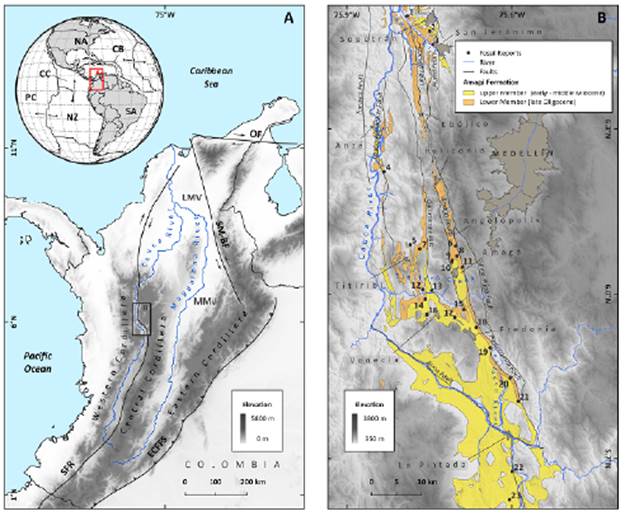
Figure 1 Location of the fossil localities in the Amagá Formation. A. General location map of the studied area in America and its major tectonic features (red rectangle in the upper right corner) and in the Colombian Andes and their major structural components (black rectangle in the center of the panel). B. Specific location of each fossil locality found in the Amagá Formation. Each number represents a fossil locality (e.g., 1 is fossil locality Schönfeld X1). For all the names of the localities and their respective numbers, please read table 1. The ochre color represents the Lower Member of the Amagá Formation and the yellow color represents the Upper Member of the Amagá Formation. The geological distribution of the Amagá Formation is based on Grosse’s geological map (1926).
In his extensive geological work, Grosse (1926) pointed out that the Amagá Formation could potentially have terrestrial macrofossils (i.e., wood, gastropods, and vertebrates). Later, Schönfeld (1947) showed that the fossil wood specimens collected by Grosse (1926) were critical to understanding the Colombian Neogene floristic biomes. However, after Schönfeld's (1947) work, there are no paleontological studies based on the macrofossils of the Amagá Formation. However, under the current global warming scenario, it is worth displaying all possible efforts to find and study fossils in the Amagá Formation, given the geological time interval recorded in its rocks and its ancient Neotropical location.
The Lower and the Upper Members are dated between the Late Oligocene (~28 to ~23 Ma) and the Early-Middle Miocene (~23 to ~11 Ma) (Lara et aL, 2018), so the possible fossils recorded in the Amagá Formation could inform us about the late Oligocene Warming (~26.5 to 24 Ma) (Pekar et al., 2006), followed by the Middle Miocene climatic optimum (~17 to 14 Ma) (Ji et al., 2018), and finally, the Middle Miocene climate transition (~14 Ma) (Sosdian & Lear, 2020) in the Neotropic. Besides, given the location in northern South America, these fossils would also allow us to decipher the paleoenvironments of this basin and how they were related to the formation of the Isthmus of Panama (Montes et al., 2015). In this context, we have compiled all the possible fossil localities and fossil beds reported in the Amagá Formation to develop a spatial framework for paleontologists who want to find and study macrofossils in this sedimentary succession.
Methods
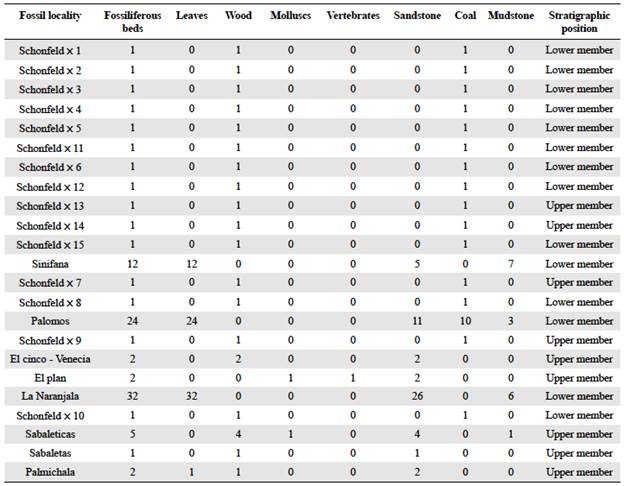
We searched for all written sources, including peer-reviewed papers and undergraduate theses mentioning macrofossils in the Amagá Formation. With this information, we generated a map that includes all the macrofossil sites in the formation's Lower and Upper members (Figure 1). Then, using the R (R Core Team 2021) package SDAR (Ortiz et al., 2020), we digitized all the measured sedimentary successions with macrofossils found in the Amagá Formation: Sinifaná (Silva-Tamayo et al., 2008), Cinco-Venecia (Silva-Tamayo et al., 2008), Palomos (Silva-Tamayo et al., 2008), La Naranjala (Henao, 2012), Sabaleticas (Páez-Acuña, 2013), Sabaletas (Páez-Acuña, 2013), and Palmichala (Páez-Acuña, 2013) including the stratigraphic position of their fossil beds (Figure 2) (for a more detailed resolution see Appendix 1,https://www.raccefyn.co/index.php/raccefyn/article/ view/1896/3388). Next, we determined the number of fossil beds in each fossil locality (Table 1). In the case of the El Plan locality, given that neither Grosse (1926) nor Schönfeld (1947) reported sedimentary logs, we counted two fossil beds because specimens were surveyed at two different sandstone beds (Grosse, 1926). On the other hand, each macrofossil reported by Schönfeld (1947) in the Amagá Formation is located at different coordinates (Figure 1); therefore, we assumed that every macrofossil was found in a separate bed. Next, using the sedimentary logs (when available) and the lithological information reported in all the works considered, we assigned the lithology to each fossil bed and recorded the type of fossil found (Table 2). Finally, we did a t-test to verify if there was a sampling bias in the number of fossil beds related to the differences in thickness among the used sedimentary logs measured in the Lower and the Upper members of the Amagá Formation.
Table 1 Geographical and stratigraphical locations of the fossil localities and the fossil beds among the Amagá Formation.
| Map code | Fossil locality | Authors | Lat | Long | Stratigraphic position | Fossil beds | ||||
|---|---|---|---|---|---|---|---|---|---|---|
| 1 | Schonfeld X 1 | Schonfeld (1947) | 6.505788 | -75.791763 | Lower member | 1 | ||||
| 2 | Schonfeld X 2 | Schonfeld (1947) | 6.478594 | -75.750639 | Lower member | 1 | ||||
| 3 | Schonfeld X 3 | Schonfeld (1947) | 6.453942 | -75.743829 | Lower member | 1 | ||||
| 4 | Schonfeld X 4 | Schonfeld (1947) | 6.222358 | -75.833082 | Lower member | 1 | ||||
| 5 | Schonfeld X 5 | Schonfeld (1947) | 6.089032 | -75.786298 | Lower member | 1 | ||||
| 6 | Schonfeld X 11 | Schonfeld (1947) | 6.086504 | -75.701756 | Lower member | 1 | ||||
| 7 | Schonfeld X 6 | Schonfeld (1947) | 6.081238 | -75.768577 | Lower member | 1 | ||||
| 8 | Schonfeld X 12 | Schonfeld (1947) | 6.068584 | -75.699152 | Lower member | 1 | ||||
| 9 | Schonfeld X 13 | Schonfeld (1947) | 6.060974 | -75.707914 | Upper member | 1 | ||||
| 10 | Schonfeld X 14 | Schonfeld (1947) | 6.057300 | -75.708640 | Upper member | 1 | ||||
| 11 | Schonfeld X 15 | Schonfeld (1947) | 6.048100 | -75.689959 | Lower member | 1 | ||||
| 12 | Sinifana | Silva-Tamayo et al. (2008) | 6.008238 | -75.763604 | Lower member | 12 | ||||
| 13 | Schonfeld X 7 | Schonfeld (1947) | 6.006255 | -75.746909 | Upper member | 1 | ||||
| 14 | Schonfeld X 8 | Schonfeld (1947) | 5.990373 | -75.758716 | Lower member | 1 | ||||
| 15 | Palomos | Silva-Tamayo et al. (2008) | 5.971600 | -75.687400 | Lower member | 24 | ||||
| 16 | Schonfeld X 9 | Schonfeld (1947) | 5.962603 | -75.756019 | Upper member | 1 | ||||
| 17 | El cinco - Venecia | Silva-Tamayo et al. (2008) | 5.958100 | -75.702700 | Upper member | 2 | ||||
| 18 | El plan | Grosse (1926) | 5.939550 | -75.665000 | Upper member | 2 | ||||
| 19 | La Naranjala | Henao (2012) | 5.903012 | -75.640209 | Lower member | 32 | ||||
| 20 | Schonfeld X 10 | Schonfeld (1947) | 5.848233 | -75.603104 | Lower member | 1 | ||||
| 21 | Sabaleticas | Páez-Acuña (2013) | 5.806800 | -75.589400 | Upper member | 5 | ||||
| 22 | Sabaletas | Páez-Acuña (2013) | 5.676600 | -75.600000 | Upper member | 1 | ||||
| 23 | Palmichala | Páez-Acuña (2013) | 5.624900 | -75.604900 | Upper member | 2 | ||||
Results
Reports of fossil beds in the Amagá Formation were found in three papers (Grosse, 1926; Schönfeld, 1947; Silva-Tamayo et al., 2008) and two undergraduate theses (Henao, 2012; Páez-Acuña, 2013). Our results show 23 fossil localities in the Amagá Formation: 14 in the Lower Member and nine in the Upper Member (Figure 1,Table 1). We found at least 95 fossil beds throughout the Amagá Formation. Specifically, 79 are distributed through 14 fossil localities in the Lower Member. On the other hand, 16 fossil beds along the Upper Member are found in nine fossil localities (Table 1).
The fossil beds in the Lower Member are found mainly in three sedimentary successions: La Naranjala (32 fossil beds), Palomos (24 fossil beds), and Sinifaná (12 fossil beds) (Table 2). On the other hand, only four localities at the Upper Member have more than one fossil bed: Sabaleticas (5 fossil beds), Cinco-Venecia (2 fossil beds), El Plan (2 fossil beds), and Palmichala (2 fossil beds) (Table 2). Based on the sedimentary successions used here, the average thickness of the Lower and Upper member successions are 241.6 m and 249.4 m, respectively (for the thickness of each sedimentary succession, please consult Appendix 1,https://www.raccefyn.co/index.php/raccefyn/article/view/1896/3388). Therefore, there is no significant difference in thickness among the members of the Amagá Formation (/ = -0.14391, p-value = 0.88).
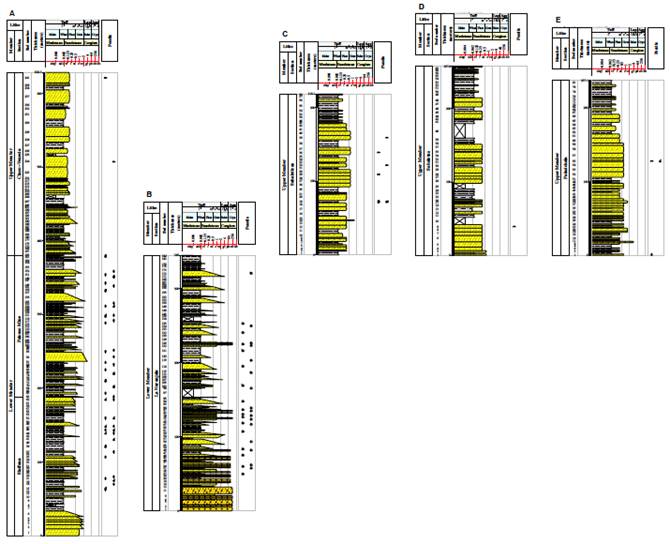
Figure 2 Sedimentary logs of the fossil localities of Sinifaná (Silva-Tamayo et al. 2008), Palomos (Silva-Tamayo et al. 2008), Cinco-Venecia (Silva-Tamayo et al 2008), La Naranjala (Henao, 2012), Sabaleticas (Paéz-Acuña, 2013), Sabaletas (Paéz-Acuña, 2013), and Palmichala (Paéz-Acuña, 2012). The base of the Upper Member of the Amagá Formation was used to correlate the logs. For a detailed sedimentary log of each locality, please read Appendix 1.
Our results also evidenced that the fossil content in the Amagá Formation is composed of four main terrestrial macrofossil groups (Table 2): leaves (73%), wood (24%), gastropods (2%), and vertebrates (1%). Besides, macrofossils were found among three types of lithologies: sandstones (54%), coal beds (26%), and mudstones (20%) (Table 2). Fossil leaves were found mainly in sandstones (72%) and minor percentages in mudstones and coal layers (24% and 14%, respectively) (Table 2). Fossil wood was found in coal layers (65%) and sandstones (35%) (Table 2), gastropods and vertebrates in sandstones at the El Plan and Sabaleticas localities, and gastropods in mudstones (Table 2). Although the number of fossil localities and beds was higher in the Lower Member than in the Upper Member (Tables 1 and 2), the percentages of fossils located in the different lithologies among the Lower and the Upper Members were very similar: sandstones, 53% and 56%, respectively; coal layers 27% and 25%, respectively, and mudstones, 20% and 19%, respectively (Table 2).
Discussion
Why are there more fossil beds in the Lower Member?
In the Late Oligocene, the Lower Member recorded a depositional change regime among braided to meandering fluvial systems as the accommodation space increased likely caused by the breakup of the Farallon Plate. On the other hand, during the Early-Middle Miocene, the Upper Member evidenced a switch in the depositional pattern from meandering to braided fluvial systems, given the decrease in the accommodation space expected by the Early Miocene change from oblique to orthogonal convergence between the Nazca and South American plates and the docking of the Panamá-Chocó Block to northern South America (Lara et al., 2018; Silva-Tamayo et al., 2020). Therefore, the Lower Member had a higher fossil preservation potential considering the high burial capacity due to the combination of the accommodation space, the sediment supply, and a higher frequency of low-energy and low-oxygen environments (e.g., coal swamps, flood plains) developed in a meandering tropical system. Our results agree with the expected pattern, given that the number of fossil beds is five times higher in the Lower Member than in the Upper Member (Table 2). Besides, they show that the number of fossil beds is not biased by the thickness of the sedimentary successions since there is no significant difference between the measured extent of the Lower and the Upper members.
Where were these fossil beds deposited?
Combining the stratigraphic position of the fossil beds in the Amagá Formation with the facies associations interpreted by Silva-Tamayo et al. (2008; 2020), it is possible to postulate that the fossil beds accumulated at the Lower Member in a meandering fluvial system are likely situated at crevasse (sandstones) facies associations and humid flood plains (mudstones) in the La Naranjala locality (Appendix 1,https://www.raccefyn.co/index.php/raccefyn/article/view/1896/3388). Fossil beds at Sinifaná and Palomos localities are possibly related to crevasse facies associations (thick to very thick fine-medium sandstone with primary sedimentary structure beds), humid flood plains (laminated/massive mudstones), and swamps (coal layers) (Appendix 1,https://www. raccefyn.co/index.php/raccefyn/article/view/1896/3388). On the other hand, fossil beds found in the Upper Member (Sabaleticas, Cinco-Venecia, Palmichala, and Sabaletas localities) are likely to be situated at facies associations interpreted as channel braided rivers (thick to very thick massive sandstone beds), crevasse (thick to very thick fine-medium sandstone with primary sedimentary structure beds), and humid floods (laminated/ massive mudstones) in a braided fluvial system (Appendix 1,https://www.raccefyn.co/index.php/raccefyn/article/view/1896/3388). The localities reported by Grosse (1926) and Schönfeld (1947) do not have detailed descriptions of the sedimentary successions. Therefore, inferring the depositional characteristics of the fossil beds at the El Plan and Schönfeld-X1 to -X15 localities is impossible.
Why should we care about the fossils of the Amagá Formation?
According to our results, the fossil assemblage at the Amagá Formation comprises leaves, wood, gastropods, and a crocodile tooth, listed from major to minor components.
Fossil leaves, wood, and terrestrial vertebrates have been fundamental to determining the type of forests, paleotemperatures, and CO2 levels in the Neotropics (e.g. Wing et al., 2009; Head et al., 2009; Carvalho et al., 2011; Londoño et al., 2018; Martínez et al., 2021; Giraldo et al., 2021). Moreover, these empirical fossil data have constrained global and regional climatic models (e.g., Martínez et al., 2020). Therefore, the systematic study of the fossil content of the Amagá Formation could enhance our knowledge of the floristic and faunistic composition and the biologic and paleoclimatic evolution of the Neotropical biomes during the Late Oligocene (~28 to ~23 Ma; Lower Member) and Early-Middle Miocene (~23 to ~11 Ma; Upper Member). Furthermore, terrestrial gastropods have also been essential for paleoenvironmental reconstructions in the Early Miocene (~18 to 14 Ma; Huesser Horizon) of the Neotropics (Gómez et al., 2009). However, in the Amagá Formation, a further use could be to constrain the current uplift hypothesis of the Panamá Isthmus (Montes et al., 2015). According to Grosse (1926) and Paéz-Acuña (2013), the gastropods found in the Upper Member of the Amagá Formation (El Plan and Sabaleticas localities, respectively) belong to the genus Hemisinus (Longiverena). This genus has also been found in the Oligocene of Colombia (Mugrosa Formation in the Middle Magdalena Valley) (Pilsbry & Olsson, 1935) and Panamá (Bohio Formation) (Woodring, 1957) and in the Miocene of Colombia (Castilletes Formation in the Cocinetas Basin, Guajira Peninsula) (Hendy et al., 2015).
Conclusions
Although Schönfeld's (1947) work has been the only fossil report made by a trained paleontologist based on the Amagá Formation, here we show 23 fossil localities with 95 fossil beds along the Lower and the Upper members of this formation. Therefore, there is a tremendous potential for developing paleontological studies based on these rocks. Moreover, given that the sedimentary succession records an intramontane basin dominated by fluvial systems during the Late Oligocene (~28 to ~23 Ma) and the Early-Middle Miocene (~23 to ~11 Ma) (Lara et al., 2018; Silva-Tamayo et al., 2020), its fossils could be critical to understanding the terrestrial biologic response of the Neotropics facing global climatic changes (i.e., Middle Miocene Climatic Optimum and the Middle Miocene climate transition) and regional tectonic changes (i.e., the formation of the Panama Isthmus). However, our study is an attention call to tropical paleontologists. It has been a century since Grosse (1926) showed that the Amagá Formation has exciting fossils (Figure 3), and still, paleontologists have not done the first systematic sampling of its fossil beds. We hope this paper will enhance the paleontological investigation of the Amagá Formation.
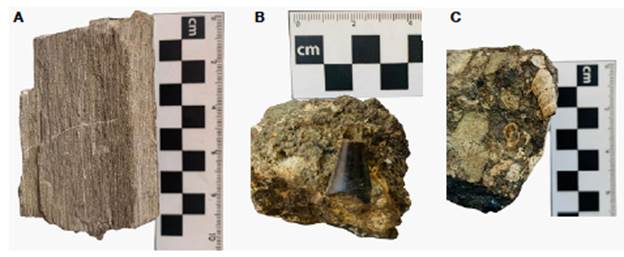
Figure 3 Photographs of some fossils collected by Grosse (1926). A. Fossil wood. B. Crocodile tooth, according to Grosse (1926). C. Hemisinus sp. (terrestrial gastropod) according to G. Steinmann (pers. comm. in Grosse, 1926). Not all the fossils collected by Grosse during his extensive fieldwork in Antioquia (Grosse, 1926) are taxonomically classified. Their repository is at the Museo de Geociencias, Facultad de Minas, Universidad Nacional de Colombia, Sede Medellín.
Supplementary material
See appendix 1 in https://www.raccefyn.co/index.php/raccefyn/article/view/1896/3388

