




 text in
  English (pdf)
 Article in xml format
 Article references
 Automatic translation
 Send this article by e-mail
 Cited by SciELO
  Cited by Google
  Similars in
SciELO
Similars in
SciELO  Similars in Google
 Permalink

I learned about the existence of Colombia Médica journal in a classroom during my clinical pathology rotations at the Universidad Nacional de Colombia in 1989. It was a printed journal, well-designed, with articles that revealed another Colombia, one often unfamiliar in the capital, Bogotá. Reading it allowed me to answer a question a colleague posed to a gynecology professor, one he could not answer: Why were all the cancer studies from Cali? By then, thanks to articles in the journal, I already knew that Cali had a population-based cancer registry.
My subscription ended when the journal announced its transition to an electronic format driven by internet innovation. I lost contact with it because, at the time, I was a physician responding to a dengue outbreak in a town in Tolima, where there was not even a telephone 1.
Years later, after joining Universidad del Valle and completing my master’s degree in pharmacology, I was assigned to review a manuscript. Lacking experience, I went directly to the Colombia Médica office to ask for guidance. There, I met the team led by Dr. Guillermo Llanos, who did not hesitate to laugh at my concerns but also showed me a series of articles titled "The Joy of Publishing" which guided that first review I conducted 2. Other similar assignments followed, in which I was able to contribute modestly to improving manuscripts that were eventually published.
After publishing several papers and submitting a letter to the editor, Dr. Llanos invited me to write an editorial. That challenge opened the doors to the editorial world and led me to explore publication ethics and the role of scientific journals in validating knowledge. I joined the Editorial Committee during a period of global transition in scientific publishing, as bibliometric indicators and citation databases gained prominence. At the same time, foundational values of scientific communication were taking shape: transparency, replicability, and reproducibility. Electronic publishing profoundly influenced the way science was written, communicated, and cited.
Two Editors-in-Chief preceded me: Julián Herrera, who implemented the Open Journal Systems (OJS) editorial platform, and Luis Eduardo Bravo, who understood the importance of the “language” through which scientific journals publish and archive their content: JATS-XML (Journal Article Tag Suite). This development allowed the journal to meet a fundamental requirement when it was accepted into PubMed: establishing a digital repository ensuring long-term preservation and interoperability with other databases. For us, that milestone materialized with inclusion in PubMed Central 3. I accompanied those processes, although my focus was on strengthening editorial workflow and peer review quality. When Luis Eduardo felt his mission was complete, he passed the baton to me. Thus began a ten-year journey with a clear vision: to bring Latin American science to the world (Figure 1).
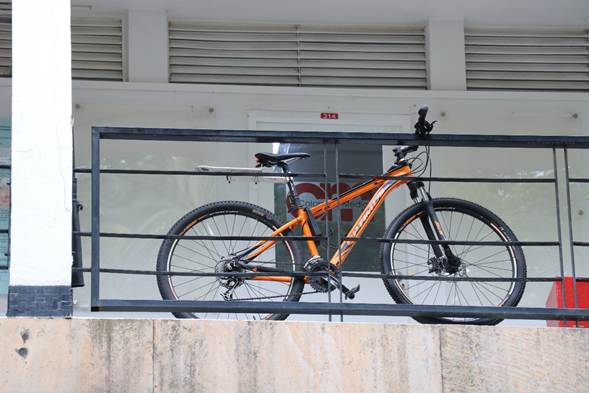
Figure 1 The bicycle parked on the third floor, in front of the Colombia Médica office, became the symbol that the Editor was present.
Editorial work is a continual learning journey. Committee meetings were stimulating spaces where the most valuable phrase was “I don’t know,” an honest expression of scientific humility that drives cooperation and discovery. More than once, I felt those meetings were the best graduate-level classes one could have, especially for those in public health and epidemiology. One of my most meaningful lessons came from Dr. Rodrigo Guerrero, founder and first editor of the journal, who once asked us: Do we run faster when chasing a hare, or when a tiger is chasing us? His message was clear: we must share our knowledge and achievements with other journals in Colombia and Latin America, fostering healthy competition that strengthens a robust editorial community.
As I say goodbye, I extend special thanks to my team: Sonia Gil, Yezid Solarte, and the Editorial Program at Universidad del Valle, who not only collaborated but also believed in this project and in my leadership. And although the achievements of a journal are often attributed to editors, reviewers, and authors, in a university context, they also depend fundamentally on the trust and independence granted by institutional authorities. Three deans served during my tenure, and I want to highlight their steadfast support and unwavering respect for editorial independence, evident signs of a mature university committed to academic transparency.
Today, as I hand over the baton to Dr. Andrés Fandiño, in whom I have complete confidence to lead the journal into a new stage, I would like to share two pieces of advice I received and hold dear. The first, from Dr. Llanos: “When you assume the role of Editor-in-Chief, write and sign your resignation letter without a date and keep it as a safeguard of your independence and ethics.” I did so, and I am proud to say that I only remembered that document while writing these lines. The second came from Dr. César Cabezas, Director of the National Institute of Health of Peru and Editor of the Revista Peruana de Medicina Experimental y Salud Pública: “When you feel indispensable, resign.” That moment has come. There is no greater act of academic leadership than stepping aside at the right time and continuing to contribute from a different place. Like my predecessors, Luis Eduardo Bravo and Rodrigo Guerrero, I know I will never fully part from this great editorial endeavor.

