




 English (pdf)
 Article in xml format
 Article references
 Automatic translation
 Send this article by e-mail
 Cited by SciELO
  Cited by Google
  Similars in
SciELO
Similars in
SciELO  Similars in Google
 Permalink

Introduction
Amid the COVID-19 chaos and uncertainty, a surprising trend emerged on social media: a rapid proliferation of memes related to the virus and resulting lockdowns. This was surprising because, for the first time during a global crisis of this magnitude, humor -especially through memes- became a primary way for people worldwide to cope with and connect over a serious event. However, what role do these seemingly trivial pieces of online ephemera play in shaping our recollection of this historic moment? The 20th-century digital revolution accelerated innovation and transformed our daily lives, leading to a surge in images and their online presence. Advances in digital technology have converted images into numerical codes for Internet integration (Joselit, 2013, p. 14). Digital cameras allow easy image capture, while social media platforms facilitate global dissemination. Digital imaging software, such as Adobe Photoshop, enabled extensive manipulation. As Joselit notes, "the level at which images multiply and the speed with which they circulate today are unprecedented" (p. 1). The Internet has transformed cultural heritage and memory formation. Marton (2011) discussed the migration and birth of cultural heritage into digitality, recognizing the shifting terrain of cultural preservation. Similarly, Schwarz (2013) maintained that memory itself is molded by an expansive network and continuous connectivity offered by digital technologies (p. 8). Therefore, compared to previous decades, our lives today are more visually oriented, with memories tied to media representations rather than personal experiences (Sloan, 2014, p. 535). Against this backdrop, individuals, advocacy groups, and communities use digital archives, databanks, and web platforms to create narratives and memories (Zucker & Simon, 2020, p. 6). This dynamic environment fosters new approaches to memorialization, commemoration, and identity formation.
In line with digital advancements reshaping cultural preservation and memory formation, the COVID-19 pandemic has prompted swift adaptations by worldwide governments. Following the WHO declaration of the pandemic on March 11, 2020, the Romanian government gradually delegated decision-making authority to the National Public Health System. Alongside medical efforts, awareness campaigns to curb the virus's spread were launched and promoted. The efficient transformation of these campaigns into visual data highlights the profound impact of (visual) digital technology. As the campaigns unfolded, images depicted scenes of hospitals overwhelmed with patients, exhausted medical professionals, long lines of ambulances outside crowded facilities, strains on food supply systems, deserted urban areas, and isolated individuals coping with loneliness. One may wonder if these poignant moments sparked discussions, prompted action, and left lasting impressions on society's collective psyche? On the other hand, could new "tools", such as smartphones, cameras, tablets, and computers, have been instrumental in producing a wealth of digital memories? In the last twenty or so years, there have been countless photographs taken with digital cameras or phone cameras, of text messages, digital news, numerous new digital archives, blogs and website posts, and ravenous social networks ready and perfectly organized to blast and re-echo the previous (Garde-Hansen et al., 2009, p. 4). Arising from this digital ecosystem, memes have emerged as distinctive contributors and agents of collective memory. According to Silvestri (2018), these cultural entities possess the innate ability to fashion, diffuse, and regenerate sentiments and tales that compete with authoritative narratives. Thus, memes have a distinct position within a digital pantheon of memory-making materials (p. 2), appealing to users through creative expressions that complement and contrast prevailing mainstream discourses.
As we adapt to increased digital engagement, the influx of virtual legacies and digital memories - valuable and valued (Lagerkvist, 2018, p. 64) - warrants careful consideration. The profound transformation of online bonds and knowledge distribution guided by the pandemic bears significant weight for the development and direction of digital culture and historiography. In this regard, this study examines COVID-19-related memes posted on Romanian Facebook pages from March 10 to May 15, 2020, using quantitative and qualitative methods. By manually browsing posts and using Popsters, popular memes were identified, categorized, and visually analyzed to understand their role in shaping collective memory during the pandemic. This research includes a literature review on memes, lockdown memes, and digital memory, methodology details, results on Romanian lockdown memes, and a discussion on the pandemic's influence on digital culture and the lasting importance of memes in a digital age.
Lockdown memes
During the COVID-19 lockdowns, memes emerged as powerful tools for disseminating information, promoting precautionary measures, and coping with isolation and uncertainty. This section explores how memes function in different cultural contexts, from calming anxiety to fostering civil disobedience. A study in India observed that COVID-19 memes peaked in March 2020, humorously providing information to help slow the virus's spread or promoting precautionary measures (Choursia & Suri, 2020, pp. 2230-2236). In Colombia, COVID-19 memes had a greater reach than other forms of mass media (Garcés-Prettel et al., 2021, p. 10). Similarly, Polish memes played a significant role during the pandemic by promoting preventive behaviors and criticizing inadequate policies (Norstrom & Sarna, 2021, pp. 75-76). In Spain, COVID-19 memes were seen as comforting distractions during challenging times (Cancelas-Ouviña, 2021, pp. 7-10), while in Italy, they helped alleviate boredom (Bischetti et al., 2020, pp. 24-25). In Ecuador, memes have facilitated and enhanced human communication (Carpio-Jimenez et al., 2020, p. 1338).
Digital memories
Technological advancements have digitized archives and collections (García-Gavilanes et al., 2017, pp. 8-9). The rise of digital platforms has fundamentally altered how memory is preserved and shared, providing new avenues for collective remembrance and cultural exchange. Wikipedia, for example, plays a significant role as a vast repository of shared knowledge and historical accounts (Pentzold, 2009). Through global collaboration, people contribute to and mold collective memory that transcends geographical and temporal limits. This collaborative approach embodies communicative memory and fosters a lively exchange of thoughts and perspectives worldwide (Assmann, 1995). Expanding beyond Wikipedia, digital memory has encompassed various media such as memes. Memes, as modern cultural artifacts, capture shared experiences and values in society (cf. Sturken, 1997). Spread on social media, memes are powerful tools for transmitting cultural memory, reflecting, and reinforcing social norms and ideologies. However, the use of memes as digital memories presents its challenges. As memes spread rapidly and widely, they can reshape how events, ideas, and cultural phenomena are perceived, often simplifying complex issues or reinforcing particular viewpoints. This can lead to a distortion of memories, as the narrative conveyed by memes may overshadow more nuanced or factual accounts.
Methodology
The timeframe
In this study, we researched COVID-19-related memes posted by popular Romanian Facebook MPs from March 10 to May 15, 2020, inclusive. The period is of significant importance for several reasons:
Initial response and restrictions (March 10 - April 4). Visual production played an elementary part in conveying the urgency of Romania's initial response to the pandemic. Infographics and informative posters were employed to illustrate the evolution of the pandemic (Humoreanu & Filip, 2021; Cernicova-Buca & Palea, 2021; Vargas et al., 2022) and preventive measures such as bans on public gatherings, school closures, and border restrictions (Rus et al., 2020; Doiciara & Cretana, 2021; Matei, 2022; Túri et al., 2022).
State of emergency (March 16 - May 14). On March 16, President Iohannis declared a state of emergency, initiating a series of strict measures to curb the spread of the virus. This included the implementation of lockdowns, quarantine measures, and restrictions on movement and public activities (Popescu, 2020; Nazarie, 2020; Ungureanu, 2022b). As in Italy (Agamben, 2020a, 2020b), the state of emergency provided a legal framework for the government to enforce these measures effectively. Visual communication remained instrumental in conveying the severity of the situation and the necessity of strict measures (Ungureanu, 2022a).
Healthcare challenges and frontline impact (March 10 - May 15). This period witnessed challenges in the healthcare system, with reports of infected medical personnel and healthcare facilities facing strain due to the increasing number of cases (Pavaluca, 2020). Images and videos depicting overwhelmed hospitals, exhausted medical personnel, and the strain on healthcare facilities effectively conveyed the severity of the situation (Cotoc & Radu, 2022; Ungureanu, 2022a).
Social adaptation and mask mandates (April 4 - May 15). As the pandemic progressed, a gradual adaptation to new norms was observed, including the widespread adoption of protective measures like face masks (Buciu, 2020). The government's decision to mandate the use of masks in public spaces further highlighted the importance of individual responsibility in combating the virus and preventing its spread within communities. Graphics illustrating proper mask use, informative videos demonstrating mask-wearing techniques, and media posts featuring prominent figures wearing masks helped to normalize this protective measure (Ungureanu, 2021, 2022a; Vargas et al., 2022).
Transition to state of alert (May 14 - May 15). The period ended when Romania transitioned from a state of emergency to a state of alert on May 14. This marked a shift in approach toward managing the pandemic, with a focus on the gradual reopening and easing of restrictions while maintaining vigilance and preparedness to respond to any resurgence of cases (Buciu, 2020; M, 2020).
The locus of analysis
In 2019, Holdis reported that over 80% of Romanian households had Internet access, with Facebook being the dominant social media platform, used by over 94% of Internet users (p. 69). Similarweb.com supports this, ranking Facebook as the 3rd most visited website globally and in Romania, behind Google and YouTube (Similarweb, 2023; Romania's Top Websites Ranking in 2020, n.d.). The Digital News report revealed that 69% of Romanians consider Facebook a credible news source, compared to YouTube (31%) and Twitter (7%) (Radu, 2018). This has led scholars to characterize Romania as a "Facebook country" (Holdis, p. 77). Our study focused on Facebook pages with significant reach: Junimea (1.2M followers), Ion Creangã (240K), Omu Paiangãn (240K), and 2Meme (200K), totaling nearly 2 million followers.
Data collection and analysis
Our methodological framework combined quantitative and qualitative methods using manual browsing and the Popsters analytics tool to collect data on memes posted by MPs. We categorized posts into pandemic-themed and non-pandemic-themed, focusing on pandemic-related content with visual elements such as protective measures and stay-at-home messages. We then analyzed the three most liked pandemic-themed memes (PTMs) to understand the correlation between user engagement and the visuals. By concentrating on the most-liked memes, which are likely to be widely viewed, we aimed to understand how these visuals contributed to digital memory formation and the relationship between engagement metrics and impactful content.
Romanian lockdown memes in figures
The pandemic has led to a significant increase in reliance on digital platforms for work, learning, socializing, and entertainment. Statistics from SimilarWeb and Apptopia reveal a surge in website traffic for Facebook, Netflix, and YouTube from January to March 24, 2020 (Koeze & Popper, 2020). Romania had nearly 11 million Facebook users in January 2020 (i.e. over half the population) (Facebook Users in Romania - January 2020, 2020). Hootsuite revealed that Romania has over 26 million mobile connections, indicating widespread use of multiple devices (Raport: În Romania Exista Peste 26 de Milioane de Conexiuni Mobile, Iar 97% Dintre Români Utilizeaza Un Smartphone. Topul Marcilor Preferate de Români, 2021). Ioana (2021) found that 97% of Romanians owned smartphones and points to the country's readiness for a sudden shift to virtual existence.
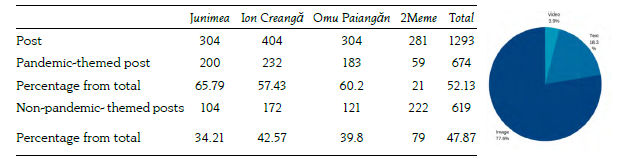
Fig. 1 Left: Pandemic and non-pandemic-themed posts, March 10 - May 15, 2020. Right: Image, video, and text posts' ratio on Romanian MPs
Along with other media, memes played a significant role in spreading the virus through online social networks (Pauliks, 2020). As Internet users' primary focus shifted to the pandemic, MPs and their followers actively engaged in creating and sharing pandemic-related memes. This led to a surge of such memes circulating online, often surpassing traditional text-based interactions. From March 10 to May 15, 2020, Junimea, Omu Paiangãn, 2Meme, and Ion Creangã distributed a significant number of posts and received varying levels of engagement (Fig. 1, left). According to Popsters' formulas, Ion Creangă and 2Meme have an engagement rate of 0.5%, while Omu Paiangãn and Junimea have rates of 0.22% and 0.16%, respectively. In terms of user engagement rate for all daily posts, Ion Creangă had the highest value at 3%, while Junimea had the lowest value at 0.73%.
The percentage of pandemic-themed posts was 65.79% on Junimea, 60.2% on Ion Creangă, 57.43% on Ion Creangă, and 21% on 2Meme (Fig. 1, left). Among these, 18 posts discussed Facebook's care emoji for Coronavirus times, and there were mentions of Free Premium Pornhub access to promote self-isolation. In regular memes, 2Meme MP had the highest engagement (79%), while Junimea had the lowest (34.21%). A prevalent theme in these posts, with 38 references, was the Spanish TV series "Casa de Papel". One thousand four (1004) posts were images, 236 were text posts, 51 were videos, and only 2 were links (Fig. 1, right). Ion Creangă had the highest number of image posts (311) and videos (18), while 2Meme had the highest number of text posts (127), and the only link posts (2). Over the 67 days from March 10 to May 15, 2020, the MPs were consistently active, although slightly less than usual. For instance, during the same period in 2019, Junimea shared 337 posts and received 886K likes, 119K comments, and 95K shares. In 2020, it shared 33 more posts, with 81.9% more likes, 183% more comments, and 43.9% more shared content. Interest in pandemic-related posts peaked between March 10 and April 10, and it gradually declined thereafter.
Mem(e)ories of the Pandemic
Now that we have established the near-ubiquitous presence of Romanian PTMs on Facebook we looked further into what memes could have circulated and promoted during the analyzed interval.
Junimea
The most popular post on Junimea was the "Raed Arafat tuseste" meme (Raed Arafat coughs) (Fig. 2, left). The meme is an image macro composed of a screenshot and descriptive text. The image captures a specific moment in a press conference during which Romanian Secretary of State Raed Arafat coughed. Arafat is positioned on the left, in a thick dark blue jacket. His left hand is raised toward his mouth, indicating that he is trying to cover his cough. Meanwhile, Romanian Minister of Internal Affairs Marcel Vela, stands on the right. He had a leather jacket, with his glasses and his chin slightly lowered, looking directly at Arafat. In addition to the two men, there is also a third in the image - Bogdan Anicescu, the interpreter in the mime-gestural language, positioned right in front of them, making the sign of the cross by overlapping the index fingers of both hands. This gesture adds to the tension in the scene, suggesting that Arafat's cough may be malicious, or even dangerous, and therefore, a cause for concern. The background of the image is blue, with the logo of the Ministry of Internal Affairs on the right, behind Vela, and the flags of Romania and NATO on the left. The desks are illustrated with the coat of arms of Romania and the text "Ministry of Internal Affairs", further emphasizing the official context. The text is also significant because it briefly and simply summarizes the actions and describes the characters in the picture. The one above Arafat annotates "Raed Arafat Coughs", while the one above Anicescu announces "The Translator".
Why is this meme funny, you might ask? The humor stems from situational irony, cultural context, and exaggerated reactions. As a key figure in the nation's pandemic response, Arafat's coughing - a well-known key COVID-19 symptom, and the immediate reaction of Interior Minister Marcel Vela, who sharply eyeballs Arafat the moment he coughs, adds to the comedy. Finally, the exaggerated and fabricated reaction of the translator, who is depicted making the sign of the cross with his fingers, injects a layer of absurdity into the meme. Although this reaction is fictional, within the context of a deadly epidemic and a country influenced by Christian traditions, it amplifies the humor by juxtaposing religious symbolism with the gravity of the situation.
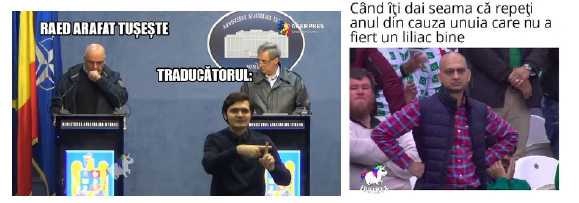
Fig. 2 Left: "Raed Arafat coughs" meme (29.03.2020). Source: Junimea (facebook.com/www.juni.ro). Right: "Angry Pakistani Fan" meme (22.03.2020). Source: Junimea (facebook.com/www.juni.ro)
The artful blending of humor and triviality in the Arafat meme gives rise to innocuous digital memories that can be compared to fleeting shadows across the canvas of the collective unconscious. Devoid of profound significance or deep symbolism, these memories nevertheless stake a claim in our minds, lingering as faint whispers of our shared history. These innocuous digital memories assume a critical role in filling voids within our historical recollections, smoothing rough patches, and dulling sharp edges. They act as mental balancers by compensating for the weightiness of other memories that carry a heavy emotional load. Thus, the Arafat meme provides temporary respite from the relentless barrage of unsettling news and dire predictions.
The second most popular post shared by Junimea was the "Angry Pakistani Fan" meme, which reconceptualized the origin of the virus (Fig. 2, right). Published on March 22, the meme emphasizes the interplay between Muhammad Sarim's image and the added elements, including the Junimea logo, the white unicorn with multicolored hair, and the text. It uses the popular template of "a disappointed croquet fan [...] as a reaction image to express frustration and disappointment" (Disappointed Muhammad Sarim Akhtar, n.d.). The image of Akhtar sitting with his hands on his hips has become iconic. With his expression of frustration and disappointment, he represents a common emotional experience that resonates with many people, transcending the specific cultural and social context in which it originally appeared. The logo (Junimea) carries historical significance and cultural identity. The white unicorn with multicolored hair adds an element of frivolity that contrasts with the serious expression on the character's face. The captions ("When you realize you're repeating the year because of someone who didn't boil a bat properly") provide specific context for the frustration and disappointment Akhtar's image expressed. The text implies that a seemingly trivial mistake had serious consequences for many that has serious consequences for others. This contributes to the critical nature of memes and suggests that individual actions can have wider social consequences. The phrase "boil a bat" hints at xenophobia by oversimplifying and inaccurately blaming Chinese cultural practices for COVID-19. This stereotype-based blame can unfairly reinforce the negative perceptions of Chinese people. However, the humor in the phrase comes from its absurdity and frustration in dealing with the pandemic, and it eventually highlights the tendency to scapegoat in complex situations. The presence of the Pakistani fan, along with references to news bulletins announcing the origin of the novel coronavirus (the bat) and the pandemic's impact on education, illustrates what Shifman (2014) and Milner (2016) describe as the intertextuality of a meme. These recognizable elements of popular culture enhance the meme's resonance and facilitate its widespread circulation in digital spaces.
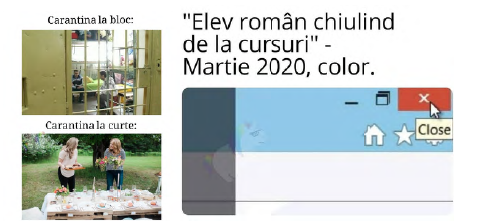
The third most popular pandemic-themed post illustrates the difference between an apartment building and a home lockdown (Fig. 3, left). This includes two distinct images, placed one on top of the other. In the first image, there are two men kept behind bars in a prison cell, alluding to isolation, perhaps even grasping the idea of a cloistered space. This is then attached to the second image, which shows two women enjoying a feast in a garden that displays freedom and abundance. The visual contrast between these images underscores the varied experiences and realities of individuals during quarantine. Accompanying descriptions further reinforce the contrast between the two experiences. The text announcing "lockdown in an apartment building" emphasizes the isolation and restrictions experienced by those living in such a place themselves. On the other hand, "lockdown at the house" already denotes, a more positive and liberating experience. Images of quarantine and freedom propose that the experience of lockdowns is not universal, but rather depends on individual circumstances and social structures. The meme can also be seen as a critique of social inequality and unequal distribution of resources, highlighting the disproportionate impact of lockdowns on urban and/or marginalized communities. However, considering the topic addressed (seclusion) and the context in which it appeared (health crisis and national lockdown), it can be assumed that the features that contributed to the popularity of the meme can be represented by the timeliness and relevance of the message as a way of capturing attention.
Memes like this one can contribute to digital memory formation by capturing the unique experiences and challenges faced by different segments of society during a health crisis. The timely relevance of the message, particularly addressing the consequences of the lockdown, makes the meme a snapshot of the collective consciousness that reflects the public's frustration, concerns, and calls for equality.
Source: Omu Paiangăn (facebook.com/paianganu)Omu Paiangăn
Fig. 3 Left: "Life during lockdown" meme (11.04.2020). Source: Junimea (facebook.com/www.juni.ro). Right: "Modern problems, modern solutions" (13.03.2020).
Omu Paiangăn
The memes on Omu Paiangãn were predominantly pandemic-themed; however, the first and third memes deviated from this norm. Accordingly, these non-pandemic-themed memes were excluded from further analysis. We will redirect our focus to the second-most-liked meme, which aligns with the overarching pandemic theme. The meme summarizes the saying "modern problems require modern solutions" (Fig. 3, right) and is a cutout of a desktop window with the cursor hovering over the X (close), most likely symbolizing the act of skipping classes in a way we can relate to easily. The text announces "Romanian student skipping classes - March 2020, color", as a temporal geographical specificity. The meme alludes to the widespread phenomenon of students struggling to adapt to online classes during the pandemic and the ease with which they can drop out of those classes with a simple click. Shared and created through social media, memes like these exibited the core traits of digital memories, such as accessibility and durability: individuals can repeatedly retrieve and revisit them, fostering connections with past experiences and emotions.
Ion Creangă
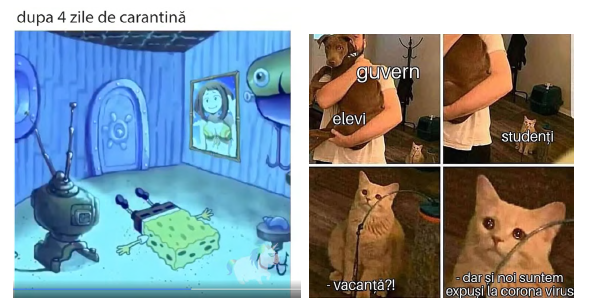
The top-performing posts on Ion Creangă predominantly focused on pandemic-related themes. Among them, one featured a video meme inspired by the famous animated series "SpongeBob SquarePants", popular armong children and adolescents, with the song "Dau Moda" (I set the style) by Jador and Lino Golden in the background (Fig. 4, left). The illustrated scene in which SpongeBob lies motionless on the floor with his face down is an expression of a state of disbelief, fatigue, or even defeat. It carries with it a sense of melancholy and depression that is frequently associated with the contemporary cultural climate of social, economic, and political instability and the constant anticipation of a possible catastrophe. Extending the original scene by adding music and disco lights creates a contrast between the character's mood and an upbeat tone. This antinomy serves to highlight the dissonance between an inner frame of emotions and an outer frame of social and cultural norms.
Source: Ion Creangă (facebook.com/humulesti).
Fig 4 Left: Video meme "Coronavirus strikes again" (22.03.2020). Source: Ion Creangã (facebook.com/humulesti). Right "Cat Looking at Man Holding Dog" (10.03.2020).
By juxtaposing SpongeBob's image in a state of abandonment and physical lethargy (due to defeatism and mental indolence), with external expressions specific to fun and joy, the meme creates a comment on the dichotomy between an individual experience of emotion and the nature of social interaction, which is often performative. The fact that SpongeBob is in the privacy of his house, a few steps from the front door, may indicate that he has just entered the house, where he can drop his mask of optimism and reveal his true state of mind. However, the description of the meme - "coronavirus strikes again" gives a new direction to the interpretation, since the character (Spon-geBob) may be in the privacy of his home for a very long time because of the national lockdown. Finally, this video meme Ion Creangã MP distributed is characterized by intertextuality, topicality, and relevance, as well as by what Ruiz Martinez describes as variation, selection, and preservation (2018), especially because cultural artifacts are deliberately modified to suit specific communication needs (in this case, it is the national lockdown during the state of emergency in Romania).
Additionally, another meme post depicted "a Cat Looking at Man Holding a Dog" template (Fig. 4, right). It was created originally from an image featuring a cat gazing enviously at its owner holding a puppy. The meme has enjoyed extensive use since August 2019 as a tagging meme (Cat Looking at Man Holding Dog, 2019). In the current iteration, the meme ridicules the omission of universities from online education transfer. The man in the image is the government, the dog embodies the students, and the cat mirrors the students' perspectives. The third panel shows the cat inquisitively asking, "Vacation?!", to which the fourth panel responds, "but we're also exposed to the coronavirus". The meme pulls you in with the cat's intense stare, then leads your eyes to the dog tucked in the man's arms. The added text playfully captures the struggles of online school during the COVID-19 pandemic, turning a relatable moment into humor.
The meme's ironic tone produces humor, partly attributable to the cat's envy and melancholy, which come into conflict with the grave nature of online schooling. As an intangible record of collective experiences during the health crisis, this meme encapsulates the challenges and setbacks students faced, forced to adapt to unfamiliar learning environments hastily. Stored and disseminated through digital technology, specifically social media, this type of meme achieves accessibility, allowing users to revisit and reconnect with past emotions and experiences.
2Meme
Finally, we also record the contribution of 2Meme, an atypical page that stood out with a large number of posts without references to the crisis, but whose most popular post also featured a pandemic theme. The meme is a "Coffin Dance" video to which the creator added J. Yolo's song "Te pup, Pa Pa" (Kiss ya, Bye Bye) (Fig. 5). The meme shows a group of Ghanaians dancing with a coffin on their shoulders. They are dressed in black suits, matching sunglasses, and gloves covering their hands. The meme usually begins with a clip of someone making a mistake or experiencing a setback, followed by a dramatic and lively entrance by Ghanaians posing as if they were carrying the person who got it wrong to the place of eternal rest (Coffin Dance / Dancing Pallbearers, n.d.).
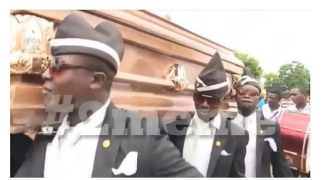
In the context of the pandemic, the meme has been associated with people ignoring social distancing rules or not taking the virus seriously and subsequently suffering consequences. In the present case, replacing the original song with a Romanian song, more precisely a manea1, which repeats the phrase "Kiss ya, Bye Bye" has the potential to change the meaning and significance of the meme. Using the song as a soundtrack creates a humorous and ironic effect because the upbeat music and lyrics contrast with the solemn, serious nature of the meme. The expression "Kiss ya, Bye Bye" could also be interpreted as a final goodbye, a morbid reference to the high death toll associated with the pandemic. This interpretation further highlights the importance of taking the virus seriously and the potential consequences of not doing so.
Has the pandemic sparked a paradigm shift?
The immense popularity of COVID-19 memes witnessed during the lockdown periods can be traced back to two significant transformations in the realms of humor and communication. The first involves developing traditional verbal humor to digitally mediated humor, characterized by memes and videos. Historically, humor has typically existed in the form of spoken jokes, puns, and riddles, which are passed down orally within social circles or entertainment media (Bremmer, 1997; Brunvand, 1972; Dynel, 2009; Holt, 2008). However, the dawn of the Internet age introduced novel avenues for delivering humorous content, particularly through visual formats such as memes and videos, which quickly gained popularity (Chiaro, 2018; Davison, 2012; Dynel, 2016; Grundlingh, 2017; Silva & Garcia, 2012). Internet humor thrives on easily consumable, quick-witted, and often satirical exchanges tailored for immediate sharing and spreading across digital spaces (Chiaro, 2018). Memes, in particular, rose to prominence owing to their simplicity and adaptability, capitalizing on pop culture references and timely socio-political events (Beskow et al., 2020; Danesi, 2019; Knobel & Lankshear, 2007; Shifman, 2014; Xie et al., 2011).
In the context of the COVID-19 pandemic, memes have evolved as a go-to source of laughter and camaraderie, bridging physical distances imposed by lockdowns and travel restrictions (Akram et al., 2021; Mpofu, 2021; Myrick et al., 2021; Norstrom & Sarna, 2021). Despite the cheerfulness they bring, Internet humor formats like memes and videos enable users to archive lockdown experiences with the potential to immortalize fleeting emotions and situations.
The second transformation revolves around the "pictorial turn" that W.J.T. Mitchell (1994) identified in his seminal work "Image Science". The pictorial turn denotes the growing emphasis on visual culture and imagery in contemporary societies, superseding the preceding era dominated by linguistic and literary paradigms (Cohen, 2003). The ubiquity of visual media in everyday life manifests in the overwhelming abundance of images produced, consumed, and shared through digital platforms (Joselit, 2013). In the wake of the COVID-19 pandemic, the pictorial turn finds renewed significance, as the public faces the gravity of lockdowns and isolation. Images encapsulating personal experiences and collective responses flood digital domains, chronicling individual stories and broader social adjustments to the worldwide tragedy (Aiello et al., 2022; Brennen et al., 2020; Hamaguchi et al., 2020; Morcate & Pardo, 2022; Perrino, 2021; Ungureanu, 2021; Wilhelm & VanderPlas, 2022).
The COVID-19 pandemic has certainly amplified the role of memes in visual humor and communication. Traditional humor offers comfort and stress relief, but its reliance on face-to-face interaction poses limitations in dissemination (Dynel & Cho-vanec, 2021; Norrick & Chiaro, 2011; Scheel & Gockel, 2017). On the contrary, Internet humor transcends geographical barriers and thrives on instantaneous connections (Alenezi, 2024; Shifman & Thelwall, 2009), rendering it a powerful tool for negotiating crises like the COVID-19 pandemic. While the former effectively mitigates anxiety, the latter primarily functions as a vehicle for recording history, safeguarding the precious fragments of lived reality for posterity in an expanding universe of digital memories. Nevertheless, the extent to which memes signify a paradigm shift remains debatable, as they often rely on specific language, slang, or cultural references that may not be easily understood outside their original context, thereby limiting their influence to particular cultural or linguistic communities. This suggests that the rise of memes may more accurately reflect the intensification of existing communication trends than a (definitive) paradigm shift.
Conclusions
The COVID-19 pandemic has led to a surge in memes that offer unique perspectives on human experiences during this global crisis. In Romania, PTMs have become a powerful tool for communication, expression, and memory formation in the digital realm. Our research sheds light on how these memes not only respond to the crisis but also extend conversations surrounding its impact on individuals and society.
Our findings support the idea that digital platforms have revolutionized how we form and share collective memories (Assmann, 1995; Pentzold, 2009). Memes, as contemporary cultural artifacts, capture shared experiences and values, serving as dynamic reflections of social norms and beliefs. The rapid proliferation of PTMs during lockdown periods highlights their role in mediating and stimulating human communication, consistent with studies conducted on populations in Ecuador (Carpio-Jimenez et al., 2020).
The prevalence of image macro memes highlights the visual characteristics of digital communication and its ability to efficiently convey complex concepts. As discussed by García-Gavilanes et al. (2017), the digitization of archives and collections has democratized the memory preservation process, enabling individuals with basic technological tools and Internet access to create and share online content.
As with all memes, pandemic-themed memes function as visual modern storytelling tools (cf. Milner, 2016, pp. 50-57), spreading across digital platforms and undergoing modifications based on user engagement. By modifying and disseminating memes, users actively participate in the construction of a shared social discourse and a pandemic imaginary. Moreover, these particular memes, deeply involved in social commenting, serve as expressions of collective resistance against prevailing uncertainties, corroborating Jensen, Neumayer, and Rossi's (2018) observations in their analysis of the 2015 Brussels lockdown memes (pp. 72-73).
Finally, we highlight that during the study interval, when the COVID-19 pandemic posed unprecedented challenges, current research delved into how digital platforms, cultural expression, and memory formation intersected in Romanian PTMs. We observed a transition from traditional to digital humor, which appeared to reflect evolving communication practices and facilitate connections across borders. The prominence of visual culture, as Mitchell discussed in the 90s, was particularly evident on Romanian Facebook pages. Memes, rich with pandemic-related themes, functioned beyond mere entertainment to capture and convey stories of resilience during challenging times. While the increased use of digital platforms may not suggest a (definitive) paradigm shift, it did enhance the accessibility of memory preservation. By sharing PTMs, users actively engaged in ongoing narratives and fostered vibrant meme-sharing communities. This democratization captured diverse experiences and ensured that fleeting moments were remembered online.

