




 English (pdf)
 Article in xml format
 Article references
 Automatic translation
 Send this article by e-mail
 Cited by SciELO
  Cited by Google
  Similars in
SciELO
Similars in
SciELO  Similars in Google
 Permalink

Introduction
The World Health Organization (WHO, 2021) has recognised that today’s world faces an unprecedented health crisis. COVID-19 has changed not only the global economy but also the lives of people and their ways of relating to one another. The WHO points out that one of the main consequences associated with this crisis is the increase in mental health problems among individuals. Along the same lines, the United Nations Organisation (UN, 2015) proposes sustainable development goals and guidelines to guide policies and actions at the global level; specifically, goal number 3 promotes the need to enhance mental health and individual well-being.
If there is a context that can be both positive and negative for the development of individuals’ well-being, it is the workplace. From a quantitative perspective, people dedicate an average of eight hours a day for much of the week to their profession, and during this time, they must face many demands and unforeseen events (Greenhaus et al., 2003). Therefore, the Society for Industrial and Organizational Psychology (SIOP, 2022), reflecting the needs identified by the WHO (2021) and the UN (2015), has established a research trend for 2022 within its specialty: the study of mental health and employee engagement.
The engagement or emotional bond of an employee with the organisation in which they work is one of the factors that most significantly affects their well-being and high levels of job success (Walumbwa et al., 2010). Schaufeli et al. (2002) define work engagement as a positive affective and motivational state of fullness characterised by three dimensions: vigour, dedication, and absorption. However, research results have shown that these three dimensions are not similarly affected by the elements that comprise the organisational context, such as leadership. Rothmann and Jordaan (2006) demonstrated that labour resources, such as organisational support and growth opportunities, have a statistically significant positive relationship with the dedication dimension compared to the vigour dimension. Along the same lines, Abdelrazek (2016) found a positive correlation between transformational leadership style and dedication to work, which did not occur in comparison with the other engagement elements. Finally, support is particularly linked to the dimension of work dedication (Johnson et al., 2017).
Studies such as that of Abdelrazek himself (2016) and the one conducted by Johnson et al. (2017) establish that leadership is one of the variables that most significantly affects dedication. This is because the quality of the exchange relationship between the leader and the subordinate provides resources that foster high levels of dedication among workers (Abdelrazek, 2016), as they feel a greater sense of responsibility at work and tend to make more contributions. According to Feldman (1986), this increase in contributions may be attributed to additional benefits granted by the leader, such as support, feedback, and resources.
However, the influence of leadership on employee dedication does not seem to be direct but occurs through other variables. Models such as the one developed by Bakker and Demerouti (2017) propose the existence of intermediate variables in this relationship of influence, both at the organisational and individual levels. In this sense, from an organisational perspective, research has shown the importance of the perception of organisational climate (Parry, 2002), while at the individual level, personal resources such as psychological capital are significant. The elements of the organisational climate exert a particular emotional burden on employees, whereas psychological capital is one of the main aspects that define each individual (Parker et al., 2003).
Among the aspects of the organisational context, the level of support that the leader provides is a critical element that influences the creation of a positive work environment and the perception of a climate of social support (Luthans y Avolio, 2003).
Among the individual elements that influence the organisational climate, known as personal resources, one of the most important is the level of resilience. This is defined as the ability to overcome significant difficulties and to grow through or in their presence, thereby reaching high levels of motivation (Richardson, 2002, as cited in Avey et al., 2006).
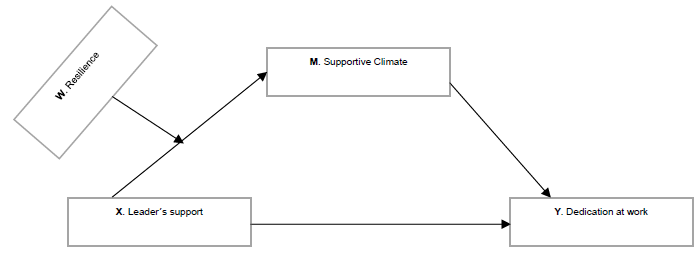
Therefore, the objective of this work is to analyse the influence of the leader’s support on the dimension of dedication in engagement, where the supportive climate will act as a mediating element between the two, and resilience will serve as a moderating element between the leader’s support and the perception of the supportive climate. In other words, the level of dedication of the worker will depend on the perception of support from the leader that the worker develops; this influence is transmitted through the perception of a supportive climate and is further enhanced by the level of personal resilience of the worker.
Our study offers significant contributions to the understanding of dedication intention among workers and sheds light on the motivational process within the Job Demands-Resources model. First, we contribute to the research on motivational crossover by providing valuable insights into the relationship between organisational and personal resources and their impact on dedication intention at work. This understanding helps to elucidate how and why these resources are interconnected in influencing employees’ dedication.
Second, our study delves deeper into the influence hierarchy among the various job resources proposed by the job demands-resources model. By exploring these relationships, we offer a more comprehensive understanding of how these resources are organised and their relative importance in driving dedication intentions among employees.
Third, our research contributes to the existing literature on resources by examining the role of personal resources as moderators in the motivational process. We provide valuable insights into how these personal resources can influence the relationship between job resources and the intention to dedicate oneself, thereby enriching the overall understanding of motivational dynamics in the workplace.
Job demands-resources model
Positive psychology is a branch of psychology that has emerged as an attempt to overcome the negative aspects of life (e.g., pathology) that have dominated this discipline since its inception (Seligman y Csikszentmihalyi, 2000). According to Poseck (2006), positive psychology aims to understand the processes underlying the qualities, strengths, and positive emotions of human beings to help prevent mental health problems and achieve a better quality of life and well-being.
Within the positivist current, Positive Organizational Psychology (POP) is an approach applied to organisational psychology that aims to study the optimal functioning of individuals in the context of work and the effective management of psychosocial well-being (Salanova et al., 2016). One of the theoretical approaches addressing concerns for employee well-being is the Job Demands-Resources model (JDR) (Bakker y Demerouti, 2007).
The Job Demands-Resources model developed by Professors Demerouti and Bakker of Erasmus University of Rotterdam (Bakker y Demerouti, 2007) is one of the models currently having the most significant impact on research aimed at understanding the role of both resources and demands in an organisational context. Demands refer to the psychosocial risk factors associated with physiological and psychological costs and are identified as stressors (Bakker et al., 2004). Likewise, resources constitute the protective psychosocial factors that address work demands and directly influence motivation, well-being, satisfaction, and work commitment (Bakker et al., 2004). In this way, a study of organisational factors oriented towards promoting health, well-being, and work performance is articulated (Demerouti et al., 2001).
The fundamental principle of the Job Demands-Resources model is based on the premise that job demands can trigger a process of deterioration in health. Conversely, job resources generate a motivational process (Bakker y Demerouti, 2007). However, the motivational process does not arise solely from job resources.
Leader support and dedication at work
The Job Demands-Resources model proposed by Bakker and Demerouti (2017) focuses on engagement as a critical variable in the motivational process. Engagement is defined as a positive mental state related to work and characterised by vigour, dedication, and absorption (Schaufeli et al., 2002). Vigor consists of maintaining high levels of energy and resilience, allowing individuals to carry out work despite difficulties. Dedication refers to substantial involvement in work, characterised by enthusiasm, inspiration, meaning, and pride. Finally, the absorption dimension refers to a pleasurable state of total immersion and concentration in the performance of work activities, in which the worker cannot detach from work (Bakker et al., 2008).
When we analyse how the broader work context influences engagement, it becomes evident that not all dimensions of this variable are affected in the same way, with leadership being one of the antecedents that has shown the most significant impact on dedication at work (Abdelrazek, 2016; Johnson et al., 2017). A study by Tripiana and Llorens (2015) demonstrates the influential role of leadership on engagement, as levels of engagement increase due to the leader’s role.
From a positive psychology perspective, transformational leadership, and more specifically, the leader’s support, contribute to increasing psychological well-being and mitigating psychological distress (Cruz-Ortiz et al., 2013). The support dimension of the leader is oriented towards people, paying attention to the personal development needs of their employees. This orientation implies that optimal interactions are generated between the leader and the followers, which, in turn, produces the necessary motivation to achieve the expected performance (Velasquez, 2006). Therefore, we hypothesise the following:
Leadership support, supportive climate, and dedication at work
Several theoretical models explain the relationships between leadership and other variables, such as organisational climate. Kopelman et al. (1990) demonstrate the relationship among human resource management practices, leadership, and organisational climate. These practices are antecedent to how employees perceive and interpret their work context and the impact of climate on cognitive and affective states such as engagement (*anonymized*). In this case, the climate mediates the relationship between leadership and engagement (*anonymized*). This implies a differentiation between levels of resources in the model of demands and labour resources. There exists a first level of personal resources within the individual; a second level of labour resources from the organisation, where the individual observes and analyses the events of the work environment; and a third level of cognitive elaboration resources, where the individual assigns value to these events, forming a perception of their work context that is directly related to the emotional state of the worker and their intention to act.
Of the components of the organisational climate, we will focus on support, as it is the dimension that has been shown to have the most significant impact on employees’ emotions and corporate commitment (Hernández-Sampieri et al., 2014). Various studies have demonstrated how a supportive climate significantly influences different aspects of the organisational context, acting as a mediating variable between leaders’ support and employees’ dedication at work (Lama-Urbina y Estrada-Montes, 2016). However, individual factors may alter the degree of mediation of perceptions of a supportive climate between leadership and engagement. Thus, we hypothesise the following:
Resilience as a determining variable in the motivational process
JDR’s model establishes the relevance of individual characteristics within the motivational process (Bakker y Demerouti, 2007). These authors propose that the characteristics of each individual have a binding effect when perceiving the environment and include them within their model in the category of personal resources, which determine how we respond to the work context. These types of resources refer to people’s beliefs regarding their level of control over their work (Bakker y Demerouti, 2017). One of the personal resources that has become increasingly important is psychological capital (Cuadra-Peralta et al., 2018).
Psychological capital arises in the context of positive organisational behaviour (Luthans y Avolio, 2003). It refers to a state of positive psychological development in human beings (Luthans y Youssef, 2004) that is characterised by self-efficacy, hope, optimism, and resilience. The four dimensions that compose it constitute state-type constructs, indicating that they are susceptible to development, change, and training (Avey et al., 2006; Luthans y Avolio, 2003).
Of these four dimensions, the most studied have been self-efficacy and optimism, leaving aside the impact of resilience on employees’ perceptions of the work context. However, some studies have suggested that this relationship exists, identifying a significant influence between levels of resilience and perceptions of organisational climate (Polat & İskender, 2018). According to research by Luthans et al. (2008), employee resilience mediates the relationship between a supportive climate and job performance. Similarly, in a study conducted by Gooty et al. (2009) on a marching band with 190 members, it was found that leadership influences the psychological capital of workers, motivating them in their work and fostering perseverance towards goals. This enables them to face challenges with greater resilience. Additionally, the authors examined the impact of psychological capital on the relationship between supportive climate and job performance, finding that psychological capital fully mediates this relationship. Taking these arguments into account, we hypothesise the following:
Hypothesis 4. Resilience will moderate the influence between the leader’s support and the perception of a supportive climate.
Method
Procedure
To carry out this study, a meeting was held with the human resources manager of the VML holding company in Colombia to explain its objectives. Next, the questionnaires were sent via a web link to the employees of the different companies who wished to voluntarily participate in work schedules designated by the human management area for that purpose. The evaluation protocol included the study’s objectives, as well as the anonymity and confidentiality of the information provided, the instructions for responding, and the informed consent in accordance with the habeas data law for handling personal data. The ethics committee of the Catholic University of Colombia endorsed the study.
Participants
A total of 418 employees from 15 companies belonging to the VML holding company, linked to the service sector, responded to the evaluation protocol; however, only 394 questionnaires were valid. Sixty-one per cent of the sample were women, while thirty-nine per cent were men. Regarding the level of position, the highest volume of responses was found at the operational level, with 59% of the sample, compared to 35% in administrative positions, 4% in commercial roles, and 2% in managerial positions. In terms of seniority in the company, the group with one to five years of experience was the most numerous, comprising 60%, and concerning age, 64% of the participants were under 36 years old.
Instruments
Each variable was measured through the administration of a questionnaire. The leader’s support was assessed using the questionnaire developed by Rafferty and Griffin (2004), which is based on the MLQ and was adapted to the Spanish language by Salanova et al. (2012). The support dimension of the leader comprises three items, with an example being: “Think about our personal needs." All item responses were recorded on a 7-point Likert scale, ranging from "1: Strongly disagree” to "7: Strongly agree."
Support Climate. The Focus 93 questionnaire was administered; this questionnaire was developed by the European research team FOCUS (“First Organizational Climate/Culture Unified Search”) (Van Muijen et al., 1999). The scale used to evaluate this dimension comprised three items. An example of an item is: “Colleagues help each other to get the job done." All item responses were in a 7-point Likert format, ranging from "1: Strongly disagree” to "7: Strongly agree."
Resilience was evaluated using the PCQ-12 scale (Luthans et al., 2006). This dimension comprised three items. An example of an item is: “I can cope well with difficult moments at work because I already have experience in overcoming difficulties." A Likert scale was employed for the responses, with six options ranging from "1: Strongly disagree” to "6: Strongly agree."
Dedication at work was measured using the Spanish version of the “Utrecht Work Engagement Scale” (Schaufeli et al., 2002), which was adapted for work teams by Salanova et al. (2003). This dimension was assessed through three items. An example of an item is, “I am proud of the work I do." Responses were formatted in a 7-point Likert scale for all items, ranging from "1: Never/Not Once” to "7: Always/Everyday."
Control variables. The data collection protocol was completed with questions designed to gather information about sociodemographic variables such as age, sex, marital status, job level, seniority, and the name of the company in which the participant worked.
Data analysis
Data were processed using the statistical package SPSS version 27 (IBM Corp., Armonk, NY, USA). First, descriptive analyses (mean and standard deviation) and internal consistency (Cronbach’s alpha) were performed for each of the questionnaires considered in the research, and their reliability was assessed.
The correlational analysis utilised the Pearson correlation statistic to examine the relationship between the study variables (leader support, dedication at work, supportive climate, and resilience). This statistic was applied with consideration of the central limit theorem, which states that the distribution tends to be normal in large samples (n > 30). Therefore, the use of nonparametric tests is not necessary (Kwak y Kim, 2017).
Finally, mediation and moderation analyses were performed, following the recommendations of Cristea et al. (2013). A multi-step mediation analysis was used to test whether the supportive climate mediates the effect of leader support on work dedication. The model also includes resilience as a moderator of the relationship between leader support and the supportive climate (Model 7 in PROCESS). The predictor and moderator variables were centred on the mean to avoid potential problems of multicollinearity (Aiken et al., 1991), which explains their negative values in the tables of the regression analyses.
In the mediation and moderation analyses to estimate the direct and indirect influences, the nonparametric bootstrapping process of the PROCESS package was used (Hayes, 2017). Indirect and conditional influences were considered significant if 95% of the bootstrap confidence intervals with bias correction, based on 10,000 samples, did not include zero. Mediation effect sizes were calculated using fully standardized indirect influence (abc), providing 95% bootstrap confidence intervals. This measure of effect size is based on the beta product for pathways a and b. It can be interpreted as the expected change in the dependent variable (i.e., dedication at work) per unit of change in the predictor variable (i.e., leader support) that occurs indirectly through the mediator (i.e., supportive climate). Finally, the Johnson-Neyman method (Hayes, 2017) was used to derive the value of the moderator (i.e., resilience) at which the influence of the predictor variable (i.e., leader support) transitions between statistically significant and non-significant at a level of 0.05.
Results
Descriptive data, internal consistency, and correlations
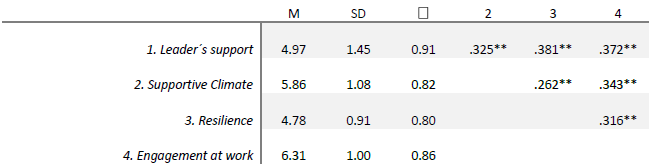
Table 1 presents the descriptive data (mean and standard deviation), the internal consistency obtained for each scale, and the correlations between the variables of the present study. Participants’ mean scores on leader support, supportive climate, resilience, and dedication at work were higher than the midpoint of the scales. The internal consistency of the instruments ranged from 0.80 (resilience) to 0.91 (leader support) and was consistent with previous evidence using these questionnaires. All constructs are strongly and positively correlated in a meaningful way.
Testing the moderated mediation model
A multi-step mediation analysis of the relationship between leader support and dedication at work was conducted, with a supportive climate as the mediator and resilience as the moderator (see Figure 1). Table 2 presents the results of the models tested in this moderately mediated analysis.
Table 2 Results of moderated mediation analyses of the effect of leader support (X) on engagement at work (Y) through supportive climate (M) and resilience (W).
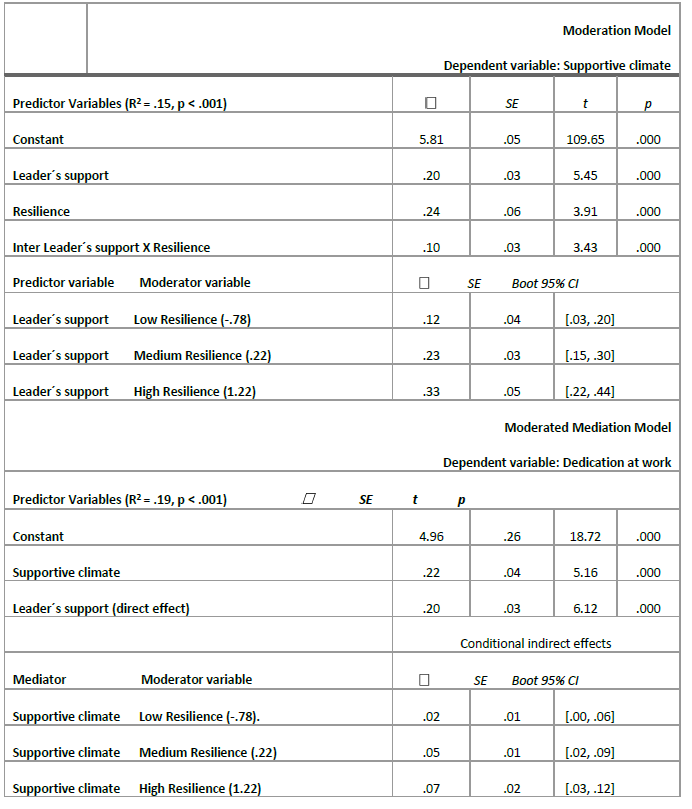
Note. PROCESS, Model 7. The table includes the B coefficients, which are non-standardized regression coefficients.
The results of the moderation model on the mediating variable (supportive climate) demonstrate that the support of the leader was a significant predictor of the supportive climate (B= 0.20; p < 0.001). Simultaneously, the interaction between the leader’s support and resilience shows a significant index of influence on the supportive climate (B = 0.10; p < 0.001). This indicates that the combined effect of resilience and the leader’s support enhances the latter’s ability to influence employees’ perceptions of a supportive climate, shifting from a positive and significant influence of 0.12 (p < 0.001) at low levels of resilience to a positive and significant influence of 0.33 (p < 0.001) when employees exhibit high levels of resilience.
This model demonstrates that the supportive climate (mediator) was also a significant predictor of dedication at work when this variable was included in the regression analysis (B = .22; p < .001). The moderated mediation indices indicate an increase in the indirect effect of the leader’s support on dedication at work through the supportive climate, which rises from .02 to .07 depending on the levels of the moderator variable (resilience), all of which show a significant effect. Finally, the results revealed a significant total moderate mediation index, with a value of .024 (SE = .107, 95% BC CI from .004 to .045).
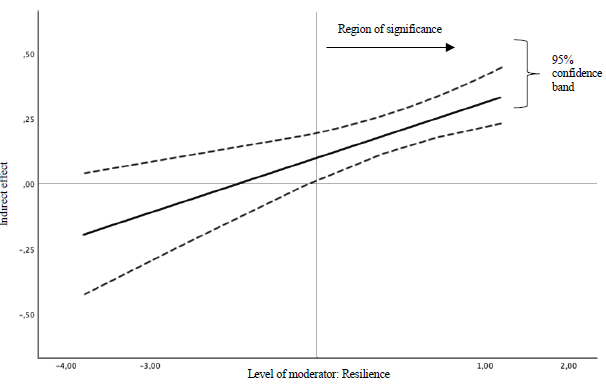
Note. The horizontal line denotes an indirect effect of zero. The vertical line represents the boundaries of the region of significance.
Figure 2 Conditional indirect effect of leaders’ support on dedication at work through supportive climate as a function of resilience.
In Figure 2, we plotted the indirect effect of leader support on work dedication through the supportive climate at different levels of resilience, along with the corresponding 95% confidence interval. According to the plot, the indirect effect was positive and significantly different from zero for high to moderate values of resilience, and statistically non-significant for resilience values below this threshold (3.7 on a scale of 1 to 6). These results were consistent with Hypothesis 4 and demonstrated that the positive indirect effect of leader support on perceived work dedication through the supportive climate was moderated by resilience, such that the indirect effect was strengthened as resilience increased.
In summary, the results confirm that employees with a greater perception of support from their leader experienced a higher degree of perceived supportive climate when their level of resilience was also higher (B = .07, 95% BC CI from .034 to .126), compared to the results when their level of resilience was low or moderate (B = .02, 95% BC CI from .002 to .064 and B = .05, 95% BC CI from .023 to .089, respectively).
Discussion
The objective of this paper is to analyse the influence of a leader’s support on the dimension of dedication in engagement, where the climate of social support can act as a mediating element between the two, with resilience serving as a moderating variable between the leader’s support and the perception of the support climate. To achieve this objective, the first hypothesis proposed is that the leader’s support has a positive and significant impact on dedication at work (B = .20; SE = .03; p < .001). These results are consistent with those found by Abdelrazek (2016) and Rothmann and Jordaan (2006), which indicate that labour resources, such as leadership support, have a statistically significant positive relationship with the dimension of dedication at work. The second hypothesis of this study has also been validated, showing that the leader’s support positively and significantly impacts the climate of support (B = .20; SE = .03; p:<. < .001). The results above align with works by *anonymized* and *anonymized*, which demonstrate that transformational leadership is an antecedent of the organisational climate. This is further supported by the model of Kopelman et al. (1990), which posits that the influence of leadership on employee behaviour occurs through the work environment.
Thirdly, it was shown that the supportive climate has a mediating effect on the relationship between the leader’s support and dedication at work (Direct Effect leader support B = .20; SE = .03; p < .001; Indirect Effect through the supportive climate B = .22; SE = .04; p < .001). These data are also consistent with the research conducted by *anonymized*.
The fourth hypothesis, that resilience will have a moderating effect on the relationship between the leader’s support and the perception of a supportive climate, is confirmed by the following data: low resilience (B: 0.2, SE: 0.01, Boot 95% [.00, .06]); medium resilience (B: 0.5, SE: 0.01, Boot 95% [.02,.09]); and high resilience (B: 0.7, SE: 0.02, Boot 95% [.03, .12]). Finally, the moderate mediation model is demonstrated (B: 0.024, SE: 0.107, 95% BC CI from .004 to .045).
The most important finding of the present work was the moderating role of resilience in the influence of leader support on the supportive climate. This influence indicates that the higher the levels of resilience, the more significant the impact of the leader’s supportive behaviour on employees’ perceptions of a supportive climate, which generates greater dedication to their work. This new finding highlights the relevant role of individual differences as moderating variables. Confirming these hypotheses has theoretical and practical implications, which are discussed below, as well as limitations that could be addressed to develop additional research studies on these topics.
Theoretical implications
Our research makes three contributions to the literature. First, our findings indicate that the supportive climate acts as an intervening variable in understanding the process through which supportive behaviours by the leader positively influence employee dedication at work (Abdelrazek, 2016; Rothmann y Jordaan, 2006; *anonymized*). Our findings identify the supportive climate as the mediating mechanism through which the leader’s support generates greater dedication to work among employees. These findings are theoretically grounded by incorporating Kopelman et al.’s (1990) proposal into the Job Demands- Resources model, wherein the organisational climate, resulting from labour practices such as transformational leadership, becomes an antecedent of cognitive and affective states such as dedication at work.
Second, our study demonstrates that resilience represents a condition that influences the strength of the relationship between a leader’s support and the perception of a supportive climate. The results of the first hypothesis indicate a positive and significant effect of the leader’s supportive behaviour on workers’ perception of the supportive climate. The data from the moderation analysis reveal that this effect of the leader’s supportive behaviour on the supportive climate is amplified in workers with higher levels of personal resources, such as resilience. Therefore, the positive effect of the interaction between these resources will lead to a more significant impact on employee engagement, particularly in this study, dedication to work.
Third, from a theoretical perspective, these results shed light on the motivational process within the Job Demands-Resources model (Bakker et al., 2004). Specifically, they highlight the link between different types of resources in the work context. Consequently, a distinction is proposed between leader support as an antecedent of a supportive climate and resilience as a moderator of the relationship between job resources. This hierarchical relationship in resources reveals two levels. At the first level, there are two antecedent resources: organisational resources, such as the leader’s behaviours, and personal resources, such as resilience. At the second level, cognitive elaboration resources come into play, specifically the worker’s perception of the climate, which is elaborated based on the previous two resources.
Finally, the insights from this study are also relevant for the theoretical development of workers’ emotional attachment. It appears that a worker’s emotional response does not depend directly on the existing resources in the work context. Rather, employees develop a global judgment about their working environment based on their perception of job resources and their own personal resources. As a result, the emotional bond between the employee and their work deepens.
Practical implications
Our findings have clear, practical implications, given that work and personal resources, such as leadership support and resilience, positively impact the perception of a supportive climate and, in turn, dedication at work. It is necessary to create intervention programmes based on the development of supportive behaviours by leaders that foster a pleasant work environment by influencing individuals and teams to perceive their work more positively (Christian et al., 2011), which in turn generates higher levels of employee dedication, an aspect that will result in increased labour productivity. The model of Healthy and Resilient Organizations (HERO) (Salanova, 2008; Salanova et al., 2009) refers to how labour resources, such as transformational leadership, contribute to the development of positive psychological capital and healthy organisational outcomes, influencing the structuring and organisation of work processes.
Therefore, there is a clear need for well-defined policies in human resource management processes that are better suited to the personal characteristics of employees. This alignment ensures that policies positively impact workers, which in turn affects productivity. Starting with the selection process, the personal resources that a worker possesses, such as personality traits or psychological capital, must be evaluated. These factors will determine how the worker relates to others, teams, and work practices, ultimately reflecting in individual, group, and organisational outcomes. This understanding will help clarify the types of individuals selected and how the policies generated by the organisation will affect them.
Limitations and future research
A significant limitation concerning the present study is the method of data collection used; since the information was collected through online questionnaires (self-reports), it could be affected by the variance of the common method. For future research, it is suggested that more emphasis be placed on the measurement method for the variables considered intersubjective responses at the team level. Some techniques that would ensure the validity of the data include direct observation, interviews with employees and superiors, or the collection of objective data to assess productivity and performance. A second limitation of the study is the sample, which is very specific and limited to the staff of a holding company in Colombia. Therefore, the results cannot be generalised to other types of organisations. Thirdly, the research design is cross-sectional and provides less information than other types of studies; it is necessary to conduct longitudinal studies that allow for the analysis of the evolution and causality of the variables studied to improve attitudes, behaviours, and group performance of work teams.
Conclusion
The findings of this study contribute to the field of organisational psychology by advancing the knowledge of dedication intention, the job demands-resources model, and the role of personal resources in shaping employee motivation. The article explains how leaders’ support generates a perception of a supportive climate among employees and how resilience enhances this relationship. These findings have practical implications for organisations seeking to enhance employee dedication at work.

