


 English (pdf)
 Article in xml format
 Article references
 Automatic translation
 Send this article by e-mail
 Cited by SciELO
  Cited by Google
  Similars in
SciELO
Similars in
SciELO  Similars in Google
 Permalink

1. Introduction
Primates are one of the biological groups most vulnerable to extinction due to exploitation of their populations for food, pets, souvenirs, biological models for clinical trials, and habitat destruction (Estrada & Garber, 2022; Kambire et al., 2022). Each primate species has specific ecological requirements that determine its resilience to anthropogenic disturbance (Galán-Acedo, Arroyo-Rodríguez, Andresen, & Arasa-Gisbert, 2019). Primate species most affected by changes in natural vegetation cover are those that are monogamous, have low birth and survival rates, and are territorial and endemic (Arce-Peña, Arroyo-Rodríguez, Dias, Franch-Pardo & Andresen, 2019; Yang et al., 2023). In many countries where primates are found, forest cover is being replaced by crops, grasslands are being used for livestock, and urban and industrial expansion is taking place. As a result, they are losing suitable habitat to persist in the landscape (Dolins, Shaffer, Porter, Hickey & Nibbelink, 2021; Estrada & Garber, 2022; Ramsay, Mercado Malabet, Klass, Ahmed & Muzaffar, 2023).
One of the Colombian primate endemic species that is threatened by habitat loss and fragmentation product of human activities is the ornate titi monkey (Plecturocebus ornatus). This small primate is endemic of Colombia, and it's found mainly in the department of Meta, and it's classified as Vulnerable by IUCN criteria (Defler, 2010; Carretero-Pinzón, Guzman-Caro, Palacios, & Stevenson, 2020). This is a monogamous species, mainly frugivorous who's diet doesn't change in fragmented landscapes, however its behavior does it (Quintero-Tapia & Carretero-Pinzón, 2025). It is a species important as seed disperser and insect predator (Defler, 2010). Its population densities are variable (range: 1.07-400 ind/km2; Wagner, Castro & Stevenson, 2009; Defler, 2010; Carretero-Pinzón, 2013) and it have a tendency of higher densities in fragments of 1-50 ha than in fragments larger than 50 ha had been found (Carretero-Pinzón & Defler, 2016). In fragmented landscapes, it has higher densities in the fragment edges than in the interior (Defler & Carretero-Pinzón 2018). Ornate titi monkeys can be found in fragments of gallery forest, lowland forest and Mauritia flexuosa swamps (Carretero-Pinzón and Defler, 2019). Studies at the landscape scale have shown that the presence and abundance of this species is influenced by landscape and site scale variables at a 1000 m buffer in landscapes dominated by cattle ranching farms (Carretero-Pinzón, Defler, McAlpine, & Rhodes 2017), while in peri-urban areas, the abundance is influenced by landscape connectivity, fragment size, and the presence of other primate species (Ortiz-Moreno, Rojas, Aguilar, Lopes, Ferreira, Carretero-Pinzón, & Pires, 2022).
2. Theoretical framework
Environmental Land-planning Law: Development and application
In Colombia, in the middle of XX century, Law 2 of 1959 is promulgated. In this law, several Forestal Reserves were stablished (Congreso Nacional República de Colombia, 1959), with Article 2 statement of forestal reserve zones as "barren land located in hydrographic basins that serve or can serve as water supply for internal consumption, electrical energy production and irrigation and which slopes are higher than 40 % unless that in the development of what is disposed in the next article, Agricultural Ministry extract from those reserves" (Congreso Nacional República de Colombia, 1959), already identifying hydric resource as a main hub for territorial planning.
Additionally, Law 2 of 1959 present basis for creation of Colombian National Parks system (Article 13) (Congreso Nacional República de Colombia, 1959). This is to "preserve national flora and fauna", showing that biodiversity conservation was considered in the context of preservation and no use, isolating biodiversity elements in far areas from human activities as bastions, without considering species ecological requirements (Treves, Santiago-Ávila & Lynn, 2019).
On the other hand, National code of renewable natural resources and protection of environment (CNRN by its acronym in Spanish) (Presidencia de la República de Colombia, 1974), has a wider focus by considering that: "environment is a common patrimony, State and particulars must participate in its preservation and management, which concerns for public benefit and social interest" (Article 1). Also, in its object involves a rational use of renewable natural resources and equity, as well as the right to enjoy a healthy environment (Part I, article 7). This is in consonance with projected environmental urgencies due to human population growth, explored by Roma Club and United Nation Conference about human environment in 1972, as well as its action plan where "order activities of human environment" are contemplated (United Nations, 1972). It is important to highlight that CNRN (Presidencia de la República de Colombia, 1974) consider under its principles that "management planning of renewable natural resources had to be done in an integral way that contributes to a balance of urban and rural development". This integrity in the planning process is a main difference with Law 2 of 1959 vision. CNRN (Presidencia de la República de Colombia, 1974) can be considered timely and updated, as it is fundamental for environmental considerations in political constitution of 1991 (República de Colombia, 1991), showing a different optic from the more extractive political constitution of 1886 (República de Colombia, 1886).
Colombian political constitution of 1991, also consider that "It is a State and people liability to protect cultural and natural richness of the Nation" (Article 8)(República de Colombia, 1991). In consequence Law 99 of 1993 create Ministry of Environmental and National Environmental System (SINA by its acronym in Spanish), to harmonize responsibilities of different entities that shares natural resource management. This system also covers National Parks, National Authority of Environmental Licenses and it creates Regional Environmental Corporations (PNN, ANLA and CAR by its acronyms in Spanish, respectively) with a decentralization focus (Congreso Nacional República de Colombia, 1993). However, it is only until 1997 with Law 388 that territorial ordinance responsible is defined in Colombia: each town/city (Congreso Nacional República de Colombia, 1997).
Law 388 of 1997 in its objectives had "Harmonize and update dispositions contained in Law 9 of 1989 with new norms established in Political Constitution, Organic Law of Development Plan, Organic Law of Metropolitan Areas and law in which National Environment System is created" (Article 1) (Congreso Nacional República de Colombia, 1997). Additionally, it considers one of the principles of Territorial Ordinance (OT): "Social and ecological function of property" (Article 2), putting general interest over private interest in the context of natural resource management.
On the other hand, it considers that "Municipal and distrital OT is done considering intermunicipal, metropolitan and regional relationships; it had to pay attention to ethnical and cultural diversity conditions, recognizing pluralism and respect to differences and incorporates tools that allows territorial transformation dynamics regulations in a way that optimize natural and human resource use to achieve dignification of life conditions for current and future generations" (Article 6, Object of Law 388 of 1997 (Congreso Nacional República de Colombia, 1997)). In relation to biodiversity states norms at urban and rural levels (Article 8, urbanistic action of Law 388 of 1997; Congreso Nacional República de Colombia, 1997). This materialized in Main Ecological Structure (EEP by its acronym in Spanish) diagnosticated by Territorial Ordinance Plans or its equivalences for towns of less than 100.000 inhabitants, Territorial Ordinance Basic Plans and Territorial Ordinance Schemes (POT, PBOT and EOT by its acronyms in Spanish, respectively). However, diagnostics done by Planning National Department (DNP by its acronym in Spanish) had shown that a lot of POT, PBOT and EOT had not been properly developed and do not correspond with social demands of those territories (Suarez, Árias-Arévalo, Martínez-Mera, 2018; Umaña Maldonado & Quilindo Bolaños, 2019). In this context, there is a need to formulate Law 1454 of 2011 (Congreso Nacional de la República de Colombia, 2011), known as OT Organic Law (LOOT) to harmonize territorial management in towns inside country regions and its productive clusters. But its application field was limited due to intermunicipal negotiation mechanism which wasn't clearly established as well as economic responsibilities of functional cost of thinking as regions (Duque Cante, 2012).
Primate conservation
In this scenario, primate conservation strategies focus on four main areas: increasing in situ populations, providing environmental education to communities interacting with species and its habitat, increasing representation in protected areas that provide essential primate habitat, and harmonizing private production systems with primate habitat conservation (Bezanson & McNamara, 2019; Chapman & Peres, 2021). The last two of these require critical support from legislation to establish mechanisms for land use regulation and compliance monitoring (Schroth & McNeely, 2011; Chazdon, Cullen, Padua & Padua, 2020). Habitat management is fundamental for in situ primate conservation, (Benchimol & Peres, 2014; Bezanson & McNamara, 2019; Chapman & Peres, 2021). Different studies highlight the importance of landscape management (Pozo-Montuy, Serio-Silva & Bonilla-Sánchez, 2011; Arroyo-Rodriguez et al. 2013; Benchimol & Peres, 2013; Carretero-Pinzón, Defler, McAlpine & Rhodes, 2017). For example, Arroyo-Rodríguez et al. (2013) and Carretero-Pinzón et al., (2017) identify that landscape metrics related with landscape configuration and composition are important for primate species presence and abundance at scales of 500 and 100 m depending on the species studied (Alouatta palliata: 500 m scale, Arroyo-Rodríguez et al., 2013; Alouatta seniculus and Saimiri cassiquiarensis albigena: 500 m scale and Plecturocebus ornatus and Sapajus apella fatuellus: 1000 m scale, Carretero-Pinzón, Defler, McAlpine & Rhodes, 2017). Therefore, to conserve primate populations and ecosystem services provided by them it is necessary to conserve not only forest fragments, but also the landscape and associate biodiversity surrounding those fragments. Likewise, it is necessary to regulate the impact of landscape transformation driving forces such as urbanization, agriculture and other economic activities (Estrada, 2013; Carretero-Pinzón, Defler, McAlpine & Rhodes, 2017; Ortiz-Moreno et al., 2022).
There is currently no environmental land-planning legislation (ELL) specifically aimed at primate conservation (García-Frapolli, Ramos-Fernández, Galicia & Serrano, 2009; Minhós et al., 2023). However, ELL indirectly affects their habitat conservation by protecting fragile forests from human exploitation (Zhu & Song, 2021). ELL imposes restrictions on deforestation near water bodies such as rivers, streams, lagoons, and wetlands, as well as in areas with high slopes and fragile soils, to prevent natural disasters and ensure ecosystem services provision that are highly valued by communities and governments. Effectiveness of these indirect measures of ELL for primate conservation, however, is unclear (West & Fearnside, 2021 ; Reydon, Pansani Siqueira, Passos & Honer, 2023). This work aims to analyze the effectiveness of ELL for primate habitat conservation in Colombia.
3. Methodology
Literature review
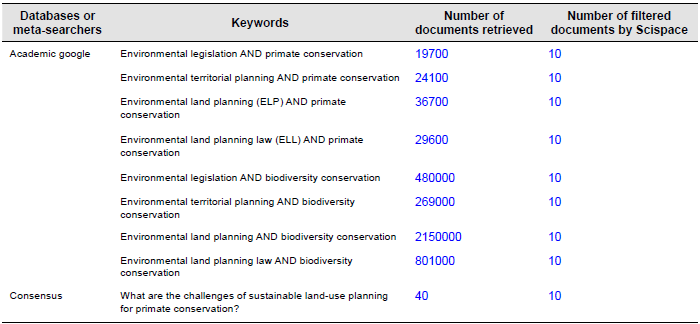
A systematic review of legal and technical literature was carried out using following keywords, as well as Boolean operator AND: environmental legislation; environmental territorial planning; environmental land planning; primate conservation; and biodiversity conservation. Databases or meta searchers consulted were: Academic Google; Scispace and Scopus. Matching articles in filtered search categories were further analyzed (Annexes, Supplementary Table 1).
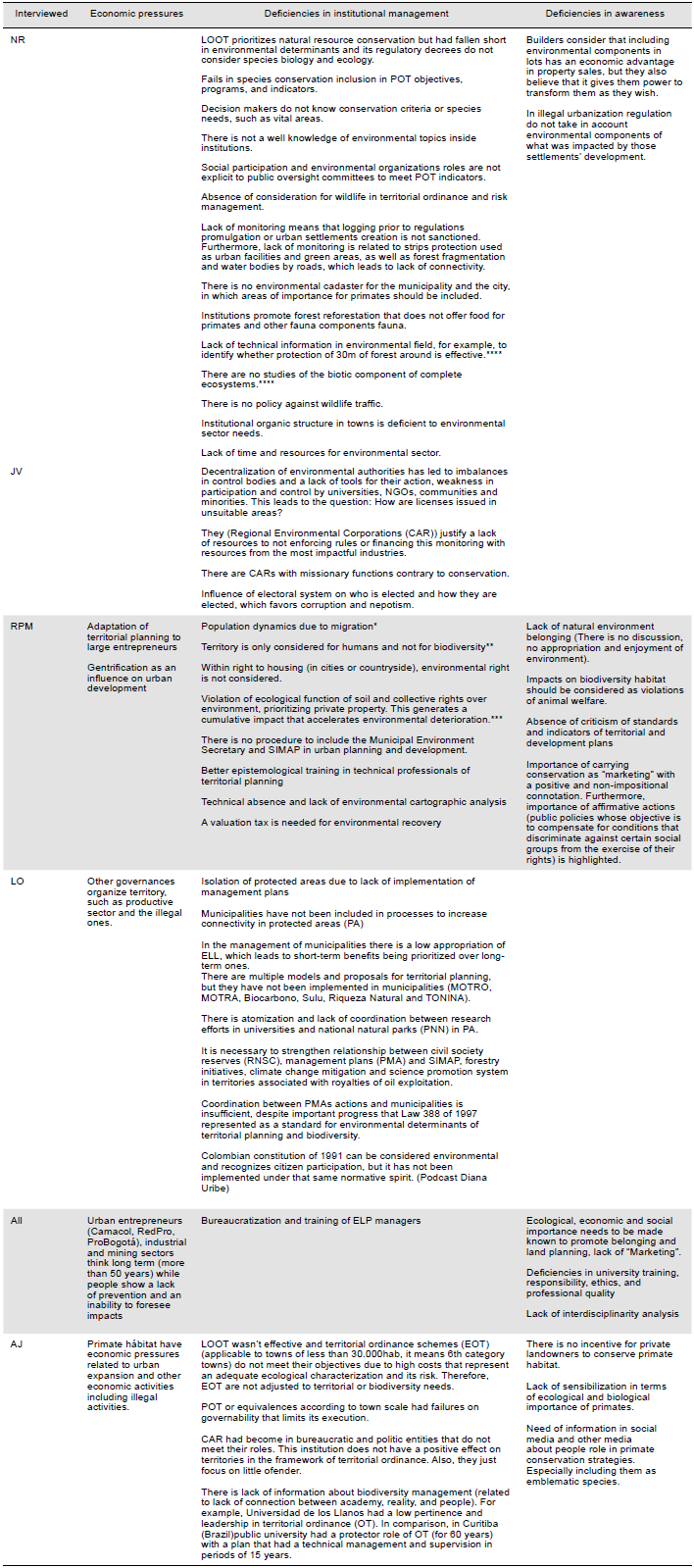
To include actors vision (Cortés-Avizanda, Pereira, Mckee, Ceballos & Martín-López, 2022) at a regional and local level focused on Meta department, related to formulation and execution of territorial planning regulations, semi-structured interviews were conducted with former officials of Municipal System of Protected Areas (SIMAP, by its acronym in Spanish) (Coordinator: Nathaly Rojas (NR), environmental leader William Barrios Foundation NGO; Julián Villa (JV), NGO leader Cabildo Verde and Mesa Hídrica del Piedemonte; Ricardo Perdomo Medina (RPM), Environmental Lawyer), National Parks of Colombia (Orinoquia Territorial Directorate Coordinator: Linda Orjuela (LO)), and ex Deputy of Departmental Assembly Carlos Andrés Jaramillo Silva (AJ), author of ordinance project in favor of ornate titi protection (Plecturocebus ornatus, endemic primate). Additionally, Colombian Primatological Association (APC, by its acronym in Spanish) was invited to participate in our survey, but they declined our invitation due to other obligations.
During interviews, following question was asked: «Do you believe that environmental planning legislation is effective in conserving primates?" In five face-to-face interviews, interviewees were free to express their opinions, give examples, and provide perspectives on this topic (Goyder, 1985). Former SIMAP officials, who were free to complement or contrast each other>s opinions, participated in an expert panel methodology (McKee, Priest, Ginzler & Black, 1991). Aspects that were highlighted by interviewees were taken down by interviewer. To avoid limited opinions of interviewees, face-to-face interviews were not recorded. Interviews were in accordance with guidelines of the Institutional Bioethics Committee. Informed consents and interviews are available in the annexes for consultation.
4. Results
Our literature review found that Colombian legislation focused on primate conservation has been focused on illegal traffic prevention for pet market, individual parts for traditional medicine and biological models for medicine research (Rodriguez et al., 2018; Sogbohossou, Achigan-Dako, Van Andel & Schranz, 2018; Pascual & Wingard, 2021a, b; Legal Atlas, 2024). This means it had been focused on individuals but not on conservation of the landscape their inhabits, therefore Environmental Land planning Laws should play this role. Additionally, in terms of primate habitat conservation, Colombian legislation includes some important contributions in its constitution of 1991 where dispositions for protected area creation and natural resource management are made. However, very few are considered at regional or local levels in terms of environmental land planning laws. In the following sections, we showed how environmental land planning law develops in Colombia from our literature review of normative documents. Additionally, we present a case study of how new normative focused specifically on primates didn't have impacts on Colombian legislation due to a lack of support and a public general perception of primates as a biodiversity accessory element.
The amount of normative and management tools at municipal level had generated unconformities between actors participating in environmental territory ordinance (Santaella Quintero, 2018), as was expressed by our interviewers. Additionally, it is important to highlight that planning tools in Colombia does not meet necessary governability to its execution (Molina Orjuela, 2014), like what was highlighted by our interviewers (Annexes, Supplementary Table 2).
In their context, National Parks (PNN) through SINA tried to integrate zonification of their protected areas to surrounding private properties and make other authorities' part of their citizen participation spaces. In fact, according to LO "PNN has influenced the LOOT in Natural Territorial Planning Council, in addition, territorial directorates have influenced regional territorial planning committees, coordinating Protected Areas declaratory processes, as well as at municipal level. They also promote training private landowners and territorial planning professionals. However, extractive economy pressures make protected area declaration seen as barricades for development and EEP as something wanted, that don't require conservation unless it includes touristic activities or other uses that generates rent". Leading to an undervalue natural resource benefits for human wellbeing.
Study case: department ordinance project for ornate titi monkey (Plecturocebus ornatus, endemic primate)
A project named "ordinance project by which ornate titi monkey (Plecturocebus ornatus) is declared as a natural patrimony and emblematic animal for Meta department, it promotes its habitat preservation and biological corridors consolidation for its conservation and other dispositions are dictated", was presented three times at Meta Department Assembly in 2020 for its consideration. This initiative rise because AJ observed "ornate titi monkeys in rural areas and discover its biological importance, while working in Mesetas town". AJ also observe that Meta department lack of an emblematic species and therefore with help from ornate titi monkey's and biodiversity conservation researchers, he formulates an ordinance project to promote sensibilization of this endemic species and its habitat, also with the purpose of sensibilize against deforestation in this department, one of which had the highest deforestation rates in the country (Arias-Gaviria et al., 2021).
Unfortunately, political coalitions from different sectors were against this project, it did not get attention and even called it "funny" because its purpose was to conserve a primate species, according to AJ. This led to its rejection, despite being presented three times and to be offered shared authorships to favor its belonging. An integration with other projects from the environmental secretary of Villavicencio city was not possible. Despite this, it achieves an increase of records of this species before Cormacarena (Environmental authority in this area), but there is few knowledge of this species by local people and sometimes it is confused with another endemic species, Brumback night monkeys (Aotus brumbacki), another primate species poorly known. In general, emblematic species declaration can only achieve concrete effects in their conservation when it is done together with habitat protection efforts in protected and private areas, as well as environmental education (Marín-Gómez, Garzón Zuluaga, Santa-Aristizabal, López & López-Garcia, 2016).
Social considerations for primate habitat conservation
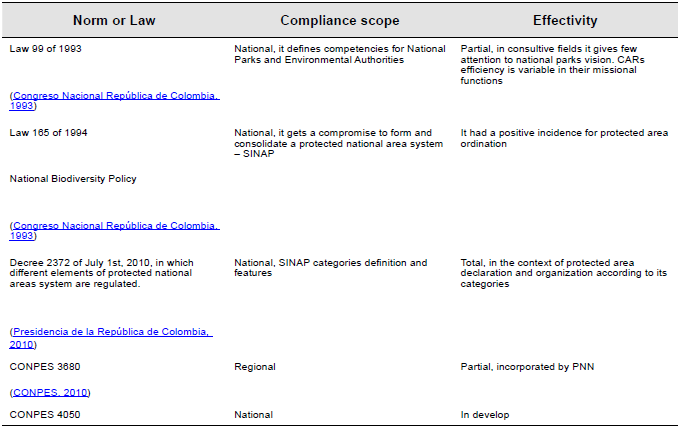
Colombian protected area system has been fundamental for biodiversity habitat conservation, especially for forest protection (Aguilar-Støen, 2015). This is important in the case of primate conservation as all primate species in Colombia are forest dependent, therefore forest conservation leads to primate conservation (Defler, 2010). In general, National Parks (NP) in Colombia had important limitations in their management such as economical resources and personal to monitor a total of 30'470,851.54 hectares belonging to Unique Register of Protected Areas, in all its protected categories (Rodríguez, Armenteras & Retana, 2013; Bonilla-Mejía & Higuera-Mendieta, 2019; RUNAP, 2024a). However, its management and protection are difficult due to "armed conflict and government absence (leading to lack of control)". according to AJ. On the other hand, "Paradoxically, armed actor had been effective at biodiversity and natural resource management, with peace process resulting in deforestation process and natural resource predation that before were illegally prohibited. This unwanted impact of peace process is because there is a need to review tools used for social impact as no territorial connection was made. Development programs with territorial focus and special economic and social zones (PDET and ZESE by its acronyms in Spanish) has resulted in a fantasy because they concentrate their efforts to collect territorial information and not to execution". Liévano-Latorre, Brum & Loyola (2021) also suggested the influence of illegal groups on natural resource management in Colombia. In fact, difficult access and lack of government law enforcement facilitate land grabbing mafias interventions in rural and urban areas to force urbanization in areas not fit for those purposes and in this way to force land extraction that can be vital for PA connectivity and functionality (Feola, Suzunaga, Soler & Goodman, 2019; Garza & Lizieri, 2019; Torres Mora, 2019; 2020). Despite these factors occurring in protected areas, there are multiple normative around protected areas and environmental exclusion (Annexes, Supplementary Table 3, shows a comparison between them).
Finally, in the context of our literature review, society vision of primates and its ecological importance is fundamental to integrate them as a normative motor inside environmental territory ordinance legislation, in the current situation they are considered as a biodiversity accessory element by general public and interviewer actors (Lindshield & Narváez, 2022). Also, economic pressures and poverty can influence people perception of primate importance (Estrada, 2013; Estrada & Garber, 2022).
5. Discussion
Our literature review and interviews found that ELL had not been effective for primate conservation. In general, this had been assumed as another requirement for Mayor offices that need to be met, but it doesn't have any weight on decisions made about their territories. This is another example of a high amount of normative typical from Latin American governments where most of these norms are only in paper, but its application is decided by other forces, which decide what is done and what's not (Rastrollo Suarez, 2021).
Environmental Land planning Law: Development and application
In a global context, normative for natural resource and land regulation use had existed since the beginning of humanity, as civilization sedentarism requires to avoid a predatory use to do not affect their potential survivorship (Black et al., 1998; Parson & Ray, 2018). In fact, there are anthropological hypothesis associating natural resource scarcity and conflicts with the fall of ancient civilizations (Nyman, Ormerod & Bentley, 2023). Natural resource regulation in countries raised by colonization processes had rules to avoid vegetation and fauna resources depletion, as well as parcel delimitation by using natural barriers such as rivers (Gedicks, 1994). These rules had variable acceptance by their receptors, conditioned by its specific time thinking, which conceive nature as an instrument under human dominance and its finite characteristics were considered as impossible, due to its abundance and exuberance in colonized areas (Neff & Larson, 2014; Cuervo Alvarez, 2016).
Industrial revolution amplified a potential transformation of human environments by accelerating economic processes without previous dependence on human labor and animal traction (Albritton Jonsson, 2012). This produced an exponential extraction of natural resources without precedents. According to Estrada, Garber, Chaudhary (2020) practices of sustainability-focused growth and equality (SSP1) are expected to have a positive effect on maintaining biodiversity, protecting environments, and improving human condition. Additionally, according to normative analysis and territorial ordinance evolution in Colombia, importance of resources such as water, fine woods, among others had been identified in a parallel form to colonization and consolidation of the democratic country that it is Colombia today (Gedicks, 1994; Lavelle et al., 2014; Botero, Fanning, Milanés & Planas, 2016). Different from other countries in the world like China or other countries in South America, like Brazil and Argentina, Colombia had more difficulty to think itself in the long-term and at the regional level, which limits its environmental territorial ordinance (Restrepo-Medina & Nieto-Rodríguez, 2020). This is mainly due to its paradoxical life of construction and deconstruction framed on mayor office periods with changes every 4 years (Congreso Nacional República de Colombia, 1997).
On the other hand, protected areas system is the less supported in the national environmental system with scarce resources, low logistic power, and low capacity to face power consequences of territorial transformation driving forces and influences of illegal armed groups (Rodríguez et al., 2013; Aguilar-Støen, 2015; Bonilla-Mejía, & Higuera-Mendieta, 2019). In fact, it seems it is one of the few governmental entities with concerns about meeting the Biological Diversity Agreement, 2030 Agenda, Aichi Targets, RAMSAR Convention among other international compromises (Parques Nacionales Naturales, 2024). This is especially true as DNP role had been feeble and straggler in relation to territorial increased social needs, while ministries act as agencies to promote gremial interest or politic sectors, without any knowledge about regional needs (Suarez et al., 2018; Umaña Maldonado & Quilindo Bolaños, 2019). At a local level, CAR roles in regions are variable and with a particular agenda that can be completely different from biodiversity conservation (Bonilla-Mejía, 2016; Bonilla-Mejía, & Higuera-Mendieta, 2019).
Social considerations for habitat conservation of primates
In this scenario, ethnic groups vision and population in vulnerable conditions had been poorly considered, even though in almost all territorial management tools it is required a participatory management tool and an establishment of communication mechanisms with communities (Molina Orjuela, 2014; Umaña Maldonado & Quilindo Bolaños, 2019). It is evident that collective property and environmental exclusion area role is undervalue inside territorial ordinance in Colombia, as there are not any ponderations about how much biodiversity they hold, what ecosystem services they offer and what is the contribution of regional rural and urban settlements (Parques Nacionales Naturales, 2024; SIB, 2024). In general, decision makers consider those as black boxed where State is not present and will not be in near future (Flórez-Ballesteros & Rodríguez-Ruíz, 2016).
In urban and peri-urban context, environmental territorial ordinance is subrogated to urbanistic expansion projects in a way that it cuts connectivity of protected areas, water courses, flooded areas and building licenses are granted in slopes higher than 25 %, leaving society with an environmental passive of these decisions that benefit urban development conglomerates or particular owners without a long-term vision (Arias Arbeláez & Vargas, 2010; Torres Mora, 2019, 2020). In fact, urbanistic development definition is made on private lobbies, avoiding social participation, and forcing gentrification to increase profits on lands that does not have services or conditions to have constructions (León & Ruíz, 2016). This generates social and landscape affectations for biodiversity, especially primates who are forest-dwellers.
Private landowners had a leadership role in process of declaration of Natural Reserves of Social Society (RNSC by its acronym in Spanish) and specific actions taken for forest conservation beyond CNRN and OT plans at municipal level. These actions have been huge for national parks and in some departments such as Casanare, are the only types of protected area in existence. In Colombia there are 1253 RNSC, equivalent to 285,083.28 ha, widely distributed and part of the distribution areas of critical endangered primates (RUNAP, 2024b; IUCN, 2024). This forest relicts facilitate landscape connectivity fundamental for primate conservation (IUCN, 2024). Despite some efforts to recognize through environmental service payment the good practices of private landowners, these payments are still too low compared with the benefit they are giving (Arias-Arévalo & Pacheco-Valdés, 2022).
As perspectives, LO considers that priority VOCs for PAs (managed by National Parks, regions, municipalities and RNSC) must be determined. To do this, it is necessary to study primate species biology, estimate their critical extinction risk thresholds and thus prioritize them (Brum, Debastiani, Loyola & Duarte, 2014). Considering primates as individual subjects of rights can be a legal path for individuals protection or even for specific species protection (Duck, 2009; Rodriguez et al., 2018). However, in countries with low governability as those in which primate live, government actions around fundamental right are deficient even for their human population (Merry, 2011). This can influence current benefits for primates and their habitat. In this sense, private landowner cooperation can be essential to manage landscapes required for primate survivorship (Bersacola et al., 2023; Mckinney, Waters & Rodrigues, 2023), beyond environmental education programs, payments for environmental service, OMECs and RNSC.
5. Conclusion
Environmental land planning law (ELL) aims to conserve species habitat broadly, without being primate-specific, but it needs to be a higher application, due to lack of governability in many regions with great biological importance and a low level of awareness of biodiversity's importance on human wellness. Economic and conciliatory mechanism between different sectors is needed to secure habitat conservation that can be optimal for primate conservation at the landscape level.