




 English (pdf)
 Article in xml format
 Article references
 Automatic translation
 Send this article by e-mail
 Cited by SciELO
  Cited by Google
  Similars in
SciELO
Similars in
SciELO  Similars in Google
 Permalink

1. Introduction
Suicide is a tragic and complex phenomenon that affects people throughout life, including children and preadolescents. Suicide is a serious public health problem that arises from a variety of factors (e.g., biological, psychological, social, and cultural). Suicide is one of the main causes of death in the young population (Griffin et al., 2023). Biological factors, such as genetic predisposition, can increase the risk of suicide. Psychological factors, such as mental illness, trauma, and substance abuse, can also contribute to suicidal behavior, as can social and cultural factors, such as poverty, social isolation, family conflict, and exposure to violence (McLoughlin et al., 2022).
Detecting suicidal ideation early is crucial, as a history of previous suicide attempts and suicidal thoughts are leading indicators of future suicide risk (Mars et al., 2019). In addition, research has shown that young people have a higher propensity to die by suicide compared to other life stages (Cash & Bridge, 2009; Hawton et al., 2020). On the other hand, the phenomenon of migration is not unconnected with the reality of child and adolescent suicide and can have a disproportionate impact on the migrant population. Suicide risk may differ in minority ethnic communities, as they may face unique risk factors compared to a country’s native population (Spallek et al., 2015).
Research on suicidal ideation has revealed a possible association between suicidal behavior and immigration. This relationship may be due to several factors: upon arriving in a new culture, migrants may experience acculturation stress, as their social status is often devalued relative to the dominant culture. In addition, this can be compounded by experiences of discrimination that typically lead to feelings of loneliness and isolation (Shoval et al., 2007). These experiences can be more frequent and detrimental for young migrants because they are in daily contact with classmates from the receiving country. In this sense, the process of integration and adaptation within the school environment is of utmost importance, because schools can take steps to ensure the migrant student is well received in the host country’s culture, creating new interpersonal networks that consider both the acquisition of the new culture and the maintenance of their own culture (Pumariega et al., 2005). The presence of racism has been established as a factor of considerable relevance in the emergence of suicidal ideation, according to multiple investigations (Walker et al., 2014; Wang et al., 2018). Likewise, discrimination has been found to have an association with suicidal ideation, regardless of the gender or ethnicity of the individuals involved (Assari et al., 2017).
Discrimination, social exclusion, and marginalization can exacerbate feelings of hopelessness and despair and contribute to the development of mental disorders, such as depression and anxiety (Caqueo-Urízar et al., 2019).
There is sufficient evidence showing that the physical and mental health of migrants is negatively affected by the discrimination they may experience in the receiving country (Mera-Lemp et al., 2019; Urzúa et al., 2020). Research on adolescents has shown that the perception of discrimination correlates with higher levels of depressive symptoms, increased post-traumatic stress, and decreased self-esteem in the educational environment (Edwards & Romero, 2008). Students who experience discrimination toward their ethnic group in the school environment may perceive an atmosphere that is less inclusive and committed to their well-being. Consequently, their interest and dedication to school are likely to diminish, leading them to invest less time in their education (Flores et al., 2010).
Despite the above, the paths that could explain the relationship between migration experiences and suicidal ideation in children and preadolescents have been scarcely explored. For this reason, the present study proposes to examine whether issues with classmates and migrant children’s integration and social competence act as mediating variables in the relationship between dis- crimination and suicidal ideation.
Migrant children often report feeling targeted, verbally insulted, excluded from activities, or facing physical threats from peers (Brown, 2015). Addressing the effects of discrimination is challenging, especially considering that its impact on immigrant children can be amplified by other factors in the school environment (Coker et al., 2009). Problems with immigrant children’s classmates in receiving classrooms play a crucial role in suicide prevention. Adjusting to a new school environment can be overwhelming for immigrant children, particularly when they face difficulties in establishing healthy peer relationships (Fortuna et al., 2016). Rejection, isolation, and bullying can have devastating consequences for these children’s mental health, substantially increasing their risk of suicidal thoughts and behaviors (Pottie et al., 2015).
On the other hand, migrant children’s inclusion and their ability to socialize in receiving classrooms are fundamental factors for their development and mental health (Caqueo-Urízar et al., 2021). When migrant children are welcomed and accepted in school settings, they have the opportunity to build meaningful relationships with peers and teachers, which strengthens their sense of belonging and emotional well-being (Kene et al., 2016).
Effective integration involves creating inclusive environments that value cultural diversity, promote mutual respect, and encourage cross-cultural understanding (Wong et al., 2004). Chen and Yang (2022) have shown that social competence plays a key role at the individual level for migrant children to overcome feelings of loneliness. This ability to establish healthy and meaningful relationships may be a crucial protective factor that helps prevent the onset of suicidal thoughts (Ritter, 1990). The sense of social competence within a non- discriminatory classroom environment not only benefits migrant children but also enriches the educational experience for all students, fostering empathy, intercultural understanding, and the development of more cohesive and equitable societies (Oxman-Martinez et al., 2012).
Considering the recent social changes in Chile, particularly regarding the arrival of a significant percentage of migrants, it is necessary to evaluate the consequences that these migratory processes may trigger in migrant children and preadolescents. Such an evaluation would inform the development of culturally appropriate and sensitive strategies for suicide prevention and mental health support. Therefore, the aim of this study is to analyze the mediating role of peer problems and social integration and competence in the relationship between discrimination and suicidal ideation among a sample of migrant children and preadolescents living in Northern Chile.
Based on the literature, the following hypotheses are proposed:
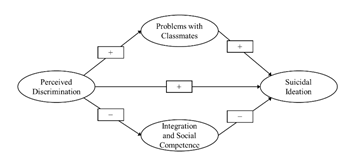
H1: A positive effect of perceived discrimination on suicidal ideation is expected.
H2: A positive effect of perceived discrimination on problems with peers is expected.
H3: A negative effect of perceived discrimination on social integration and competence is expected.
H4: A positive effect of problems with peers on suicidal ideation is expected.
H5: A negative effect of social integration and competence on suicidal ideation is expected.
H6: A mediating effect of peer problems on the relationship between perceived discrimination and suicidal ideation is expected.
H7: A mediating effect of social integration and competence on the relationship between perceived discrimination and suicidal ideation is expected. The hypotheses put forward in this study are shown in Figure 1.
2. Method
2.1 Design and Participants
A cross-sectional study was conducted (Ato et al., 2013), using a purposive sampling approach based on the accessibility of migrant elementary school students in Chile.
2.2 Sample
The sample consisted of 198 migrant students, of whom 101 (51%) were boys and 97 (49%) were girls, with ages ranging from 9 to 13 years (M = 10.18; SD = .92). The participants were Bolivian (n = 93, 47%), Peruvian (n = 65, 32.8%), Venezuelan (n = 13, 6.6%), Colombian (n = 6, 3%), Argentinean (n = 4, 2%), Ecuadorian (n = 2, 1%), and from other countries (n = 15, 7.6%). A total of 71.2% (n = 141) of the participants attended state educational establishments, 27.8% (n = 55) were in state-subsidized establishments, and 1% (n = 2) were in private establishments. Regarding grade level, 71 (35.9%) were in 4th grade, 69 (34.8%) in 5th grade, and 58 (29.3%) in 6th grade.
2.3 Instruments
2.3.1 Suicidal Ideation
To measure Suicidal Ideation, five items (i.e., “I feel alone”, “I think my life has no meaning”, “I want to die”, “I feel that nobody cares about what I do”, and “I suffer a lot”) from the depression subscale of the SENA questionnaire (Child and Adolescent Assessment System, Fernández-Pinto et al., 2016) in its version for elementary school children (6 to 12 years of age) were used. The instructions ask participants to indicate how often they feel the way the item describes. The scale is answered using five options ranging from 1 = Never or almost never to 5 = Always or almost always. Higher scores reflect higher levels of Suicidal Ideation. Cron- bach’s alpha coefficient was greater than .85.
2.3.2 Everyday Discrimination
The Spanish version of the Everyday Discrimination Scale (Williams et al., 1997) was used to measure how often migrant children in Chile perceive themselves as being treated badly or unfairly. The scale includes nine items answered on a six-point scale ranging from 1 = Never to 6 = Almost every day. Higher scores indicate higher levels of perceived discrimination (e.g., “You were treated with less respect than other people”). Cronbach’s alpha coefficient was greater than .88.
2.3.3 Problems with Classmates
This variable was assessed using the Problems with Peers subscale of the SENA questionnaire (Fernández-Pinto et al., 2016) in its version for elementary school children. The instructions ask participants to indicate how often they feel the way the item describes (e.g., “My classmates treat me badly”). The scale comprises seven items answered on a five-point scale ranging from 1 = Never or almost never to 5 = Always or almost always. Higher scores reflect a higher perception of problems with classmates. Cronbach’s alpha coefficient was greater than .79.
2.3.4 Integration and Social Competence
The Integration and Social Competence subscale of the SENA questionnaire (Fernández-Pinto et al., 2016) in its version for primary school children was used to measure this variable. Participants indicate how often they feel the way each item states (e.g., “When I have problems, there are people who listen to me”). The scale con- sists of nine items, each answered on a five-point scale from 1 = Never or almost never to 5 = Always or al- most always. Higher scores indicate greater integration and social competence. Cronbach’s alpha coefficient was greater than .75.
2.4 Procedure
A pilot sampling was conducted with 15 elementary school students to verify that they could adequately understand the questionnaire items. A total of 35 educational institutions were invited to participate in the study, of which 29 agreed to take part voluntarily. The project was presented to parents, explaining the study’s purpose and scope. First, informed consent was obtained from the parents, and then informed assent was obtained from the students themselves. Only migrant elementary school students were included in this study.
Dates were arranged for the administration of the questionnaires, which took place in the students’ own classrooms. To address any questions about the study, two members of the research team and a school teacher were present during all applications. Each assessment lasted approximately 30 minutes. The research design and materials were reviewed and approved by the ethics committee of the first author’s university.
3. Data Analysis
SPSS v.24 and Mplus v.8.9 were used for the statistical analysis. To test the hypotheses presented in the study, two structural equation models were conducted. For the first hypothesis, a structural equation analysis was carried out to estimate the effect of Discrimination on the Suicidal Ideation of migrant primary school students. After completing this initial analysis, a second structural equation model was conducted to test the remaining hypotheses. In this second analysis, which was a multiple mediation model, Peer Problems and Social Integration and Competence were specified as parallel mediators, Perceived Discrimination as the predictor variable, and Suicidal Ideation as the outcome variable. Both analyses controlled for the effects of gender and type of school.
To evaluate model fit, the root mean squared error of approximation (RMSEA) had to be ≤ .08, while both the comparative fit index (CFI) and the Tucker-Lewis index (TLI) had to be ≥ .95 (Schreiber, 2017). Because the data involved non-normal ordinal variables, weighted least squares means and variance adjusted (WLSMV; Beauducel & Herzberg, 2006) was used as the estimation method.
3.1 Results
3.1.1 Descriptive Statistics
Table 1 shows the number of participants, the mean, the standard deviation, and the correlations among the variables.
Table 1 Descriptive Statistics and Correlations
| Variables | n | ME | SD | PD | PCM | ISC |
|---|---|---|---|---|---|---|
| Suicidal Ideation | 198 | 2.02 | 1.03 | .195* | .464* | −.213 |
| Perceived Discrimination | 193 | 2.61 | 1.43 | .199* | −.123 | |
| Problems with Classmates | 198 | 1.53 | .66 | −.278* | ||
| Integration and Social | 198 | 3.34 | .78 | |||
| Competence |
Note. PD=Perceived Discrimination; PCM=Problems with Classmates; ISC=Integration and Social Competence. p < .05*.
Table 2 Goodness-of-fit Indicators of the Models
| Models | Parameters | X 2 | df | p | CFI | TLI | RMSEA | RMSEA Lower | IC 90% Upper |
|---|---|---|---|---|---|---|---|---|---|
| M1 | 88 | 179.820 | 002 | .000 | .967 | .962 | .062 | .047 | .077 |
| M2 | 175 | 741.298 | 458 | .000 | .917 | .910 | .056 | .048 | .063 |
Note. M1=First model; M2=Second model.

3.2 Structural Equation Models
The first model aimed to examine the effect of Discrimination on Suicidal Ideation. Gender and school type were included as control variables in the analysis. As shown in Table 2, the first model presented adequate goodness-of-fit indices (Schreiber, 2017).
As depicted in Figure 2, Discrimination had a positive effect on Suicidal Ideation, and this relationship was of moderate magnitude (b > .30; Cohen, 1988). Therefore, the first research hypothesis is supported.
After establishing the relationship between Discrimination and Suicidal Ideation, we investigated whether Peer Problems and Social Integration and Competence among migrant primary school students could explain this association. To do so, we conducted a second structural equation model, incorporating Peer Problems and Social Integration and Competence as parallel mediating variables (see Figure 1).
Table 2 indicates that the second model presented acceptable goodness-of-fit indices. Figure 3 shows the multiple mediation model, where Discrimination had a positive effect on Peer Problems (moderate magnitude) and a negative effect on Integration and Social Competence (small magnitude, b > .10; Cohen, 1988). The relationship between Discrimination and Suicidal Ideation was not significant in this second model. Moreover, Peer Problems exhibited a large positive effect (b > .50; Cohen, 1988) on Suicidal Ideation, while Integration and Social Competence showed a small negative effect on Suicidal Ideation.
Regarding mediation effects, both Peer Problems (in- direct effect = .209, p = .000) and Integration and Social Competence (indirect effect =.059, p = .020) had statistically significant mediating effects on the relationship between Discrimination and Suicidal Ideation.
These findings suggest that Peer Problems and Integration and Social Competence in migrant students could account for the link between experiences of Discrimination and Suicidal Ideation.
4. Discussion
Suicide is one of the leading causes of death among young people and represents a serious public health problem. Suicidal ideation has been one of the primary variables studied to prevent suicidal risk. Because relatively few studies examine suicidal ideation among migrant children, this study aimed to assess the mediating effects of peer problems and social integration and competence on the association between experiences of discrimination and suicidal ideation in migrant children. The results indicate that peer problems, as well as social integration and competence, are variables that explain the relationship between perceived discrimination and suicidal ideation in migrant children.
First, as hypothesized in H1, migrant children who reported higher levels of perceived discrimination also showed higher levels of suicidal ideation. This is consistent with previous work (Spallek et al., 2015). Some studies indicate that young migrants who experience discriminatory situations are more likely to develop thoughts reflecting social exclusion and marginalization (Oxman-Martinez et al., 2012). These feelings can intensify a sense of hopelessness, thereby increasing the risk of developing mental disorders such as depression and anxiety (Caqueo-Urízar et al., 2019). Other research suggests that some immigrants may be more prone to suicidal ideation due to acculturation, a phenomenon characterized by adopting the attitudes, behaviors, values, beliefs, and customs of the dominant culture (Wyatt et al., 2015). In this context, their new social status, marginalization, and experiences of discrimination in the host country may foster feelings of isolation and loneliness, which could in turn affect suicidal ideation (Shoval et al., 2007). Although there is considerable evidence that immigrant children’s experiences of discrimination can trigger life-threatening thoughts, little is known about how elements of the school context might influence this association.
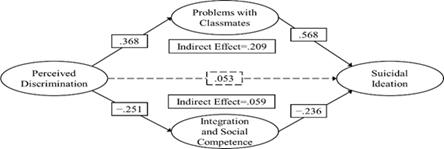
Note. Statistically significant effects are shown by solid paths (p < .05). Dashed lines represent non-significant paths. The regression coefficients are standardized
Figure 3 Mediating effect of Peer Problems and Social Integration and Competence on the relationship between Perceived Discrimination and Suicidal Ideation among migrant children in Chile
According to the literature, migrant children perceive discrimination from their peers more frequently (Coker et al., 2009). In our study, migrant children who reported higher levels of perceived discrimination also had more frequent problems with classmates (H2) and lower levels of integration and social competence (H3). Thus, it is likely that migrant children are discriminated against by their peers, leading to stronger feelings of peer exclusion (Brown & Chu, 2012). Some studies have suggested that discrimination undermines personal resources, such as competence and social integration, negatively affecting immigrant children’s mental health (Kene et al., 2016; Pottie et al., 2015). Brown (2015) found that migrant pupils who experience discrimination by the educational community are more likely to hold unfavorable views toward education and, consequently, show lower motivation, poorer academic performance, and a higher risk of dropping out of formal education. Bullying and loneliness at school can have highly detrimental effects on the mental health of immigrant children, substantially increasing the risk of suicidal thoughts and actions (Pottie et al., 2015). Mitigating the effects of discrimination can be challenging, especially when it involves migrant children, whose experiences may be exacerbated by various contextual factors within the school. These findings align with previous research showing that integration and social competence could serve as a positive resource for coping with suicidal thoughts in migrant children (Brown, 2015).
Another observed result is that migrant students who reported more peer-related problems also showed higher levels of suicidal ideation (H4). Some findings indicate that Latino migrants who experience traumatic events during the migration process, along with sociocultural factors such as perceived discrimination and family problems, are linked to the occurrence of suicidal ideation (Fortuna et al., 2016). Furthermore, as hypothesized in H5, migrant children with higher levels of integration and social competence presented lower levels of suicidal ideation. These results are consistent with earlier research suggesting that integration and social competence may serve as protective resources against suicidal thoughts in migrant children (Chen & Yang, 2022; Oxman-Martinez et al., 2012).
Finally, peer problems and social integration and competence were found to fully mediate (Ato et al., 2013) the relationship between perceived discrimination and suicidal ideation in migrant children (H6; H7). As noted above, previous literature has indicated that experiences of discrimination can negatively affect both a child’s relationship with classmates and their sense of social integration and competence (Brown & Chu, 2012; Kene et al., 2016; Pottie et al., 2015). In turn, peer problems and low social integration and competence have been associated with an increased risk of suicidal ideation in migrant children (Chen & Yang, 2022; Fortuna et al., 2016; Oxman-Martinez et al., 2012). These findings suggest that peer problems and low perceived social integration and competence are crucial issues for migrant children, as they stem from experiences of dis- crimination in the school environment and may lead to undesirable outcomes such as suicidal ideation.
Although these results provide valuable insights into why immigrant children might have suicidal thoughts, certain study limitations need to be highlighted. First, the cross-sectional design used in this research implies that the associations between variables should not be interpreted as causal relationships. Second, participation was voluntary among the student sample, so interpretations and generalizations of the results should be made with caution and may not extend to populations of migrant students beyond those in the sample. Future research could replicate the proposed model in different contexts and with new samples of migrant students.
5. Conclusions
This study examined aspects of peer problems, as well as migrant children’s integration and social competence, which may be relevant for analyzing discrimination experiences and their relationship with suicidal ideation. The findings indicate that students who perceive more discrimination experience higher levels of peer problems and lower levels of social integration and competence, which in turn affect their risk of suicidal ideation.

