




 English (pdf)
 Article in xml format
 Article references
 Automatic translation
 Send this article by e-mail
 Cited by SciELO
  Cited by Google
  Similars in
SciELO
Similars in
SciELO  Similars in Google
 Permalink

Introduction
A transgender person is one with a varied gender identity, different from the assigned sex (Pan American Health Organization, 2011); and, in particular, a transgender woman is one whose sex assigned at birth by a health professional was male, but they identify as female (Lennie et al., 2020).
A study conducted in the United States reported that 47% of transgender people were sexually assaulted at some point in their lives and one in ten in the last year; figures that increase in the black population (James et al., 2016); and in this same country, one in two transgender women has been raped by her partner and one in four has been forced to have sex (Risser et al., 2005). Within the transgender population, women have historically been exposed to adverse situations such as low employability, discrimination, rejection, stigmatization, poor access to education, and physical, verbal and psychological abuse (Beltrán, 2021; Herrera Galvis et al., 2012). Having a gender expression and/or identity different from the sex assigned at birth exposes them to situations of defenselessness of their rights and freedoms in different contexts; in addition, in their condition as "transgressors" in a culture strongly framed in the binary gender, they have less social support and are often rejected and expelled from their homes, even from an early age; which contributes to the emergence of phenomena such as school dropout and the exercise of sex work (James et al., 2016). Several studies have reported that transgender women are more likely to live in poverty, with low income, lower educational levels and difficulties in accessing work than the rest of the population (Fredriksen Goldsen et al., 2022; Grant et al., 2011), and activities such as being a hairstylist or sex work have become their most frequent sources of income (Global Fund to Fight AIDS, Tuberculosis and Malaria, 2016).
In 15 countries in different regions of the world, it was found that the probability of HIV infection in transgender women is almost 50 times higher than of the general population of reproductive age, and they present a high prevalence of mental illness, suicidality, alcohol and other psychoactive substance abuse, among other risks (Baral et al., 2013; Zimmerman et al., 2015).
Although several of the circumstances described are not exclusive to the population of transgender women, they are closely related to their sexual and gender identity; this situation has been called "sexual vulnerability", a concept derived from social vulnerability, which is structured from those situations that closely affect the free, conscious and timely making of decisions related to sexuality and the effective enjoyment of it, from the limited access to guarantees and services that contribute to good health, and from the scarce social support that is relevant in the conditions of vulnerability. Thus, in the context of the transgender population, sexual vulnerability refers to the "inability to make use of health-related assets, to make effective use of their sexual freedoms and the lack of social support caused by their gender identity, self-limitation, burden of stigma and sexualization of the transgender condition in the social context" (Bedoya-Carvajal et al., 2023, p.7).
In order to identify the risk of sexual vulnerability, the Sexual Vulnerability Index of Transgender Women was recently created, which comprises three dimensions: health care, sexual practices and social support, which are related to life and some areas that make up sexuality (affectivity, eroticism and gender) in this population (Bedoya-Carvajal et al., 2023). Since this index is a new measure, it does not have a precise profile of the characteristics corresponding to the various levels of risk of sexual vulnerability in this population, which makes it impossible to identify habits, situations or behaviors that can be strengthened, prevented or treated to reduce risk.
Given the above, this study aims to generate sexual vulnerability risk profiles of transgender women in the city of Medellin (Colombia), classified into three levels (low, medium and high). As a study hypothesis, it was established that a greater number of sexual partners, having sex without a condom, and engaging in sex work are related to higher sexual vulnerability risk profiles.
Method
A descriptive, observational, cross-sectional study was conducted, from which sexual vulnerability risk profiles were created by means of a multiple correspondence analysis (MCA). For this, the database of the study "Vulnerability to HIV and HIV prevalence in transgender women in three cities in Colombia: Bogotá, Medellín and Santiago de Cali, 2019" was used (Berbesi Fernández et al., 2019), which collects information on social, economic characteristics, condom use, number of partners and sex work of this population; from there, the following variables were taken for the creation of the sexual vulnerability risk profiles: age, having a partner, economic dependents, educational level, occupation, frequency of alcohol consumption, condom use, condom use during first sexual intercourse, condom use during the last time anal sex was had with a casual partner, condom use with a client the last time anal sex was had, condom use during casual anal sex in last 6 months, condom use with casual partner during oral sex in last 6 months, reason for not using condom with casual partner, reason for not using condom during first sex, sex with a woman, age of initiation of sex work, number of people you have had sex with in the last year, how many men, transgender people you have had sex with in the last year, had sex with clients, number of clients, how or where casual partners meet, knowledge of last HIV test results, whether or not you talk about HIV and sexually transmitted infections with your partner, reasons for not being tested for HIV, avoidance of health care services, having been forced to have sex, having experienced any type of discrimination for being transgender, asked for support or to report discrimination or being forced to have sex, and having someone to help you in case of mistreatment or abuse.
Instrument
Sexual vulnerability risk index in transgender women (Bedoya-Carvajal et al., 2023) composed of 10 questions divided into 3 three domains; "health care, sexual practices and social support", each item is evaluated between 0 and 1; they are summed and generate values ranging from 0 to 10; higher scores indicate a higher risk of vulnerability. This index has a Kaiser-Meyer-Olkin (KMO) of 0.63 and an explained variance with 3 factors of 71% and was created from the information collected in the study "Vulnerability to HIV and HIV prevalence in transgender women in three cities in Colombia: Bogotá, Medellín and Santiago de Cali, 2019" (Berbesi Fernández et al., 2019). (See Table 1).
Table 1. Index of sexual vulnerability of transgender women.
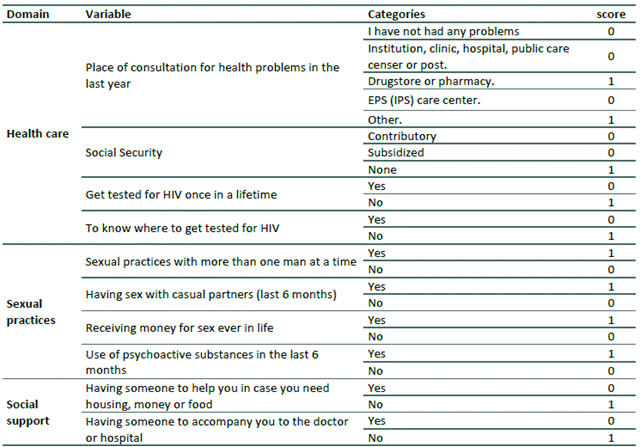
Taken from: Bedoya-Carvajal et al. (2023).
Selection and description of participants
The sampling method used was Respondent-Driven Sampling (RDS) (Grinsztejn et al., 2017), for which there were nine initial informants who fulfil the function of "seeds", selected for being socially recognized within the group of transgender women in the city of Medellín. The inclusion criteria for the participants were: identifying with the female gender, presenting male sex assigned at birth, at least 18 years of age and living in the metropolitan area of the city of Medellín; and as exclusion criteria, any difficulty identified regarding the ability to provide information and presenting falsified or illegible coupons were considered as exclusion criteria.
Each of the participants received three coupons to give to their referrals, once they completed the survey, they received a compensation (bonus) of approximately 8 dollars and when each referral completed the survey, the referrer received an additional 2 dollars. This sequence was repeated for 18 weeks, and a sample size of 217 participants was achieved.
The sample size was calculated using a formula defined for RDS studies (Abdul-Quader et al., 2006):
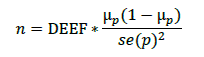
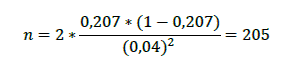
The proxy variable for sexual vulnerability was the prevalence (p) of HIV in transgender women in 2016 (Sierra et al., n. d.). The expected standard error, for this project, was assumed to be 4% and as a design effect (DEEF) the value of 2 was taken. A sample of 205 participants was obtained, as can be seen in the following formula:
Procedure
The data used in this study come from the particular results of the population of the city of Medellin from the study "Vulnerability to HIV and HIV prevalence in transgender women in three cities of Colombia: Bogotá, Medellín and Santiago de Cali, 2019" (Berbesi Fernández et al., 2019). A team of certified nursing assistants with experience in working with transgender women conducted the surveys and HIV testing, in a temporary location hired by the research team, ensuring easy access and the privacy necessary for this type of testing. The collection of information took four and a half months.
Ethical considerations
Each participant provided information freely and autonomously, as proof of the above, they signed an informed consent, which was designed under the guidelines of resolution 8430 of 1993 (Ministry of Health of the Republic of Colombia, 1993). Likewise, to guarantee compliance with all ethical standards, this study was evaluated and approved by the Research Ethics Committee of CES University on October 18, 2019 in the record 141.
Data analysis
The sexual vulnerability risk variable was taken and divided into three levels: low, medium and high risk, and to ensure that these cut-off points were adequate, a canonical discriminant validation analysis was performed (Johnson & Wichern, 2007; Visauta Vinacua & Martoru i Cañas, 2003) and the percentage of correct classification was identified based on the discriminant model. Chi-square tests of independence were then performed between the study variables with the different levels of sexual vulnerability. To make the multiple correspondence model more parsimonious, a multinomial regression using a classification and regression technique (Classification and Regression Trees: CART) (Díaz Sepúlveda & Correa, 2013) was used under the stepwise methodology identifying the main variables from the Wald p-value (Lemonte & Vanegas, 2005). Finally, with those variables that showed statistical significance, a multiple correspondence analysis (MCA) was performed to profile the women according to their level of risk of sexual vulnerability; in the set of points graph (Figure 1) the distances between row points and column points define the geometric distance between the categories of the variables, i.e., the closer the more similarity between the profiles (Aldás & Uriel Jiménez, 2017). The significance value for all statistical analyses was p < 0.05 (Nizami & Prasad, 2017), which were performed using R version 3.6.3 and RWizard, both free license software (R Core Team, 2013; Guisande González et al., 2014), in addition to SPSS version 22 CES University license (IBM Corp., 2017).
Results
In the sample of transgender women from the city of Medellin that is part of the study "Vulnerability to HIV and HIV prevalence in transgender women in three cities of Colombia: Bogota, Medellin and Santiago de Cali, 2019" (Berbesi Fernandez et al., 2019), it was found that 68.2% were between 18 to 28 years old and only 8.0% were over 48 years old; 85.3% did not have a partner, 68.2% had no economic dependents, 70.5% managed to obtain secondary education, and the most frequent occupations were sex work (38.7%) and hairdressing (16.1%); on the other hand, alcohol consumption in the last month was weekly in 30% of the respondents. Regarding condom use, low condom use was found in the first sexual intercourse (21.7%) and when asked about condom use, 93.5% said they used it generally with occasional partners, 8.3% used it for oral sex and 38.7% used it for anal sex (see Table 2).
Table 2. Characteristics associated with condom use among transgender women in the city of Medellín 2019 - n = 217.
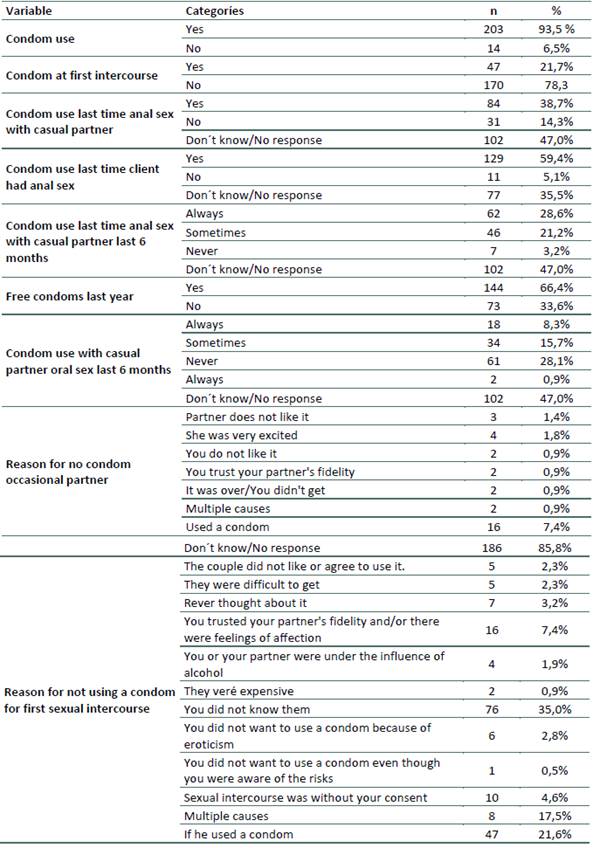
Authors' own design.
Don´t know/No response.
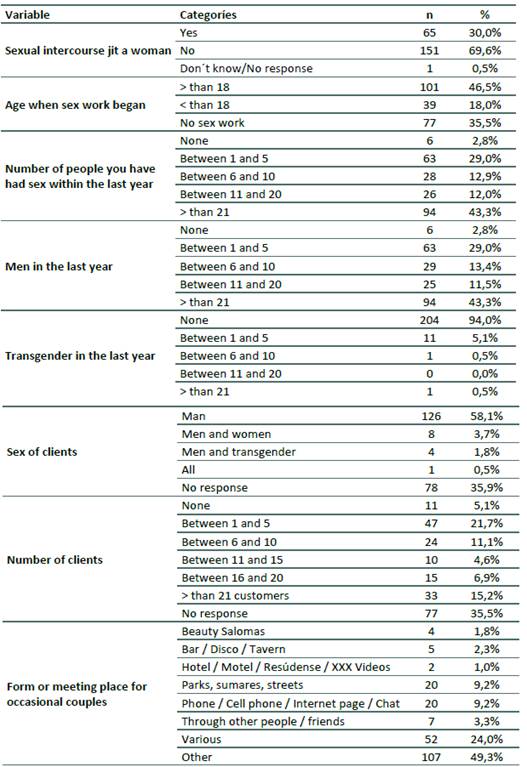
On the other hand, the number of sexual partners in the last year was more than 21 for 43.3% of the participants, and these were also male for 43.3%. The majority (76.1%) of those who have ever engaged in sex work initiated it when they were under 18 years of age; in addition, 58% of the total respondents said that the most frequent sex clients of this activity are usually men (see Table 3).
Table 3. Characteristics related to sex work and partners of transgender women - Medellín 2019 n = 217.
Authors' own design.
Don´t know/No response.
Regarding factors related to HIV testing, 82.9% knew their test results the last time they were tested, 77% reported that the test result was "negative or non-reactive" and 26% stated that they discussed HIV and sexually transmitted infections with their partner. And participants who had not been tested for HIV related it to "not having time" (8.3%), embarrassment about going to the testing site (6.9%), and fear of having HIV and not knowing what to do next (6%). In addition, 13.8% stated that they had ever avoided health care services.
The 9.2% stated that they have been forced to have sex and 47.9% have suffered some type of discrimination for being transgender; 6% requested support or reported discrimination or being forced to have sex, and 75.1% reported having someone to help them in case of mistreatment or abuse.
Sexual vulnerability
For the sexual vulnerability risk variable, a mean of 3.71 was found with a standard deviation of 1.5 and a confidence interval of 3.5 - 3.9, a minimum of zero and a maximum of 8.
In order to establish which variables discriminated adequately according to the levels of risk of sexual vulnerability and to validate the proposed cut-off points, a canonical discriminant analysis was used to define that those participants who obtained scores between 0 and 3 were classified as having a low risk of sexual vulnerability; between 4 and 7, medium risk, and between 8 and 10, high risk. The discriminant model was able to explain 77% of the variance and the model was able to correctly classify 77.43% in the first dimension, that is, through this analysis, it was possible to appreciate how the proposed levels are differentiated and how they can be explained from the structure of the variables, concluding that the cuts in the sexual vulnerability index score are adequate.
Then, having the risk of sexual vulnerability as a categorical variable, relative frequencies were estimated and a low risk was found in 45.6% of transgender women, medium in 49.3% and high in 5.1%.
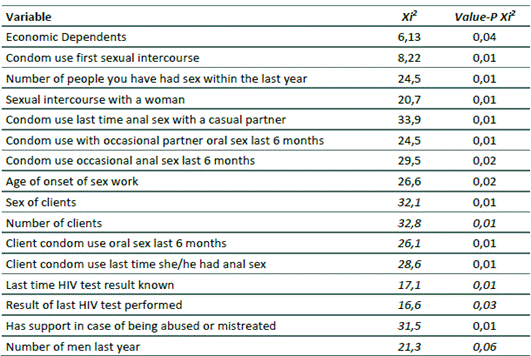
With those variables that had vectors of +/- 1.5 canonical scores, an independence analysis was performed with the Chi-square statistic to identify those that showed a statistically significant association at p-value (0.05) with the risk of sexual vulnerability (see Table 4), thus reducing to sixteen variables, which were taken to a multinomial model using classification and decision trees with the purpose of further adjusting the multiple correspondence model with a smaller number of variables.
Table 4. Xi2 test values and p-value between study variables and levels of sexual vulnerability risk.
Authors' own design.
By performing the multinomial model using classification and decision trees, in stepwise and under the Akaike maximum likelihood criterion, according to Wald P-values, the nine variables were selected and taken to the correspondence analysis to create the sexual vulnerability risk profiles of transgender women.
Sexual vulnerability risk profiles
For the creation of the profiles, it was decided to remove the variable "number of men in the last year" since its results are identical to "number of people in the last year"; likewise, to simplify the model, this variable was grouped into three categories: "None", " Fewer than ten sexual partners" and "More than ten sexual partners" and the variable "condom use last time anal sex with occasional partner" was grouped into "yes", "no" and "Don´t know/No response". In addition, it was decided to take two dimensions to facilitate the understanding of the point set graph.
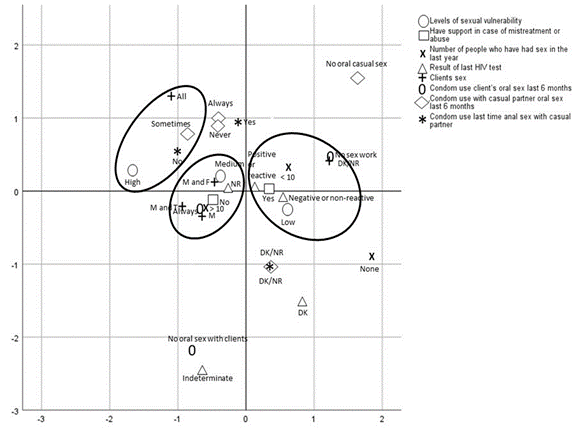
The multiple correspondence analysis found a Cronbach's alpha for the first dimension of 0.71 and for the second of 0.60; the first explains 36.5% of the variance and the second 26.4%; the explanatory power of the model between the two dimensions is 63%.
By means of the discrimination measures, it was observed that the variables that contributed most to the first dimension were: levels of risk of sexual vulnerability (0.43), number of people with whom they have had sex in the last year (0.5), having support in case of being mistreated or abused (0.11), sex of clients (0.74) and condom use with clients while having oral sex in the last 6 months (0.73). On the other hand, the variables with the greatest contribution to the second dimension were: condom use the last time she had anal sex with a casual partner (0.83), result of the last HIV test performed (0.08) and condom use with a casual partner while having oral sex in the last 6 months (0.83).
From the dot plot it was possible to clearly identify the profiles according to the level of risk (see Figure 1). The categories that define the low risk level of sexual vulnerability are: not engaging in sex work, having someone to help them in case of mistreatment or abuse, having had fewer than ten sexual partners in the last year and having a negative HIV test result, not reactive or being positive or reactive, that is, knowing the test result. The profile describing the medium risk level of sexual vulnerability is composed of: having male, female and transgender clients, more than ten sexual partners in the last year, always using condoms to have oral sex with clients, having no one to help them in case of mistreatment or abuse, and refusing to answer regarding the result of the last HIV test. And the high-risk profile of sexual vulnerability is best defined by being farther away from the centroid compared to the other two, and it is defined by the categories: having clients of all sexes, not using a condom for anal sex at last sex with a casual partner and using a condom sometimes for oral sex with a casual partner.
Although, multiple correspondence analysis suggests that the closeness between categories could suggest a profile, and the point set plot (Figure 1) shows a close proximity between the indeterminate HIV test result (n=2) and not having oral sex with clients (n=1), they are not included in the profiles as this result could be due to the low frequencies of these categories. From a statistical point of view, the profile of low risk of sexual vulnerability could be considered as the best constituted, has a larger degree of inertia and explains a higher percentage of variance (36.5%).
Discussion
The aim of this study was to generate sexual vulnerability risk profiles of transgender women in the city of Medellin (Colombia) according to three levels of risk (low, medium and high), based on the information collected in the study "Vulnerability to HIV and HIV prevalence in transgender women in three cities of Colombia: Bogotá, Medellin and Santiago de Cali, 2019" (Berbesi Fernandez et al., 2019).
According to the results of the analyses conducted, the low-risk profile of sexual vulnerability corresponds to those transgender women who do not engage in sex work, know their HIV status, have social support in case they need it, and have few sexual partners. The medium risk profile is made up of those who perform sex work with clients who could be men, men and women and/or men and transgender, have had more than ten sexual partners in the last year, use condoms to have oral sex with clients, do not have support in case they are mistreated or abused, and do not answer about the result of the last HIV test they had. The high-risk profile corresponds to transgender women with clients of all sexes, who do not use condoms for anal sex in the last sexual intercourse with casual partners and sometimes use condoms for oral sex with casual partners.
According to the profiles generated, it is observed that low sexual vulnerability in the population of transgender women in the city of Medellin is related to protective factors and practices, while practices such as low adherence to condom use and sex work are related to increased risk of sexual vulnerability.
In the present study, sex work, historically constituted as a labor option for transgender women (Nuttbrock, 2019), was associated with increased risk of sexual vulnerability; a situation that may be due to the fact that this economic activity is usually developed in high-crime environments and, in addition, is characterized by the limitation to make autonomous decisions regarding the choice of sexual partners, and the generation of situations of stigma and discrimination that are increased by the condition of being transgender (Evens et al., 2019; Turner et al., 2021).
On the other hand, social support was related to lower levels of risk of sexual vulnerability in the participating transgender women. Having the support of someone when one is in situations of abuse or mistreatment is fundamental for any human being, especially for people exposed to situations of violence and abuse; in addition, it is precisely these situations that often lead a person to enter or continue sex work (Fedorko & Berredo, 2017). In order to close this vicious cycle and decrease the levels of risk of sexual vulnerability of transgender women, it is, therefore, essential to guarantee them social support.
The number of sexual partners in the last year behaved as a variable that increases the risk of sexual vulnerability in transgender women in the city of Medellin. A study conducted with cisgender women found that the greater the number of sexual partners, the greater the risk of verbal sexual coercion, and this in turn is related to low sexual assertiveness (Vendrell Ferré, 2012); a situation that could be accentuated in the population of transgender women, given the sexualization of their body, that is, its valuation only as an object of pleasure, without contemplating the possibility of building an affective relationship (Bedoya-Carvajal, 2021). In addition, it is widely known that a greater number of sexual partners is associated with the risk of HIV, sexually transmitted infections (Poteat et al., 2017) and different types of cancer (Grabovac et al., 2020).
According to the profiles found, not knowing the results of HIV tests increases the risk of sexual vulnerability. Despite the importance of knowing one's health status in relation to HIV and other sexually transmitted diseases for decision making regarding one's own life and that of sexual partners, there are still structural, cultural, stigma and health system barriers that hinder access to services that allow early detection of HIV and initiation of treatment (Poteat et al., 2017; Silva-Santisteban et al., 2016). Knowledge of HIV status provides critical information to avoid sexually vulnerable risk practices, as reported in studies in China where people who are regularly tested for HIV are more adherent to condom use (Yan et al., 2020).
Likewise, some sexual practices reported by transgender women in the present research, performed with casual partners, such as not using condoms during anal sexual encounters and the intermittent use of condoms during oral sex, are related to the increase in cases of HIV and sexually transmitted infections (Díaz et al., 2019). This situation is similar to that found in other contexts (Budhwani et al., 2017; Wang et al., 2020; Yi et al., 2019).
The identification of practices and conditions associated with risk profiles of sexual vulnerability in transgender women is an important starting point for the design of strategies and programs to mitigate situations that increase such risk, such as the presence of sex work, or to strengthen habits that reduce it, such as the use of condoms. In this sense, it is worth highlighting continuous accompaniment strategies such as the "nurse navigator", a figure that has been used in cancer patients through which individualized support is provided to patients, their families and caregivers (González & Castro, 2021), and that has also been used effectively in patients with HIV (Loya-Montiel et al., 2019), or through information and communication technologies (Alonzo et al., 2021), which allow reaching a greater number of transgender women at a low cost.
It is very important to generate spaces for accompaniment, especially for transgender women who are beginning their transition process, both to facilitate this process and to favor their social inclusion, and thus reduce their risk of sexual vulnerability. It is also essential to inform about the dangers of sex work and develop strategies to make it safer for transgender women who use it as a means of livelihood, and also to guide them towards alternative employment that can provide them with greater security and financial stability. Along the same lines, educating families on issues of sexual and gender diversity could facilitate their ability to cope, respect and tolerate when a member with a different sexual and/or gender identity is present and, in this way, turn households into protective environments for transgender women.
The measurement of sexual vulnerability in transgender women by means of an index makes it possible to identify, make visible and quantify potential or real risks that affect their physical, psychological and social integrity, and based on these findings, generate studies related to causal factors of sex work, the well-being and good living of transgender women and/or the design of strategies to strengthen health services for this population. This information can reduce the knowledge gap that exists among health personnel regarding the realities experienced by transgender women, negatively affecting their enjoyment of life and the exercise of their sexuality and increasing their risk of sexual vulnerability. In this line, it is recommended to continue validating the sexual vulnerability index of transgender women, used in this study, to identify its stability over time, the need to incorporate new variables or adaptation to other contexts.
It is important to recognize as a limitation of the present study that the type of sampling used (RDS) requires the existence of a degree of relationship among the participants, and the system of coupons and economic rewards that it implies may attract more low-income participants than those with greater purchasing power and/or of high social class, which may reduce the representativeness of some characteristics due to the similarity among the participants.

