




 English (pdf)
 Article in xml format
 Article references
 Automatic translation
 Send this article by e-mail
 Cited by SciELO
  Cited by Google
  Similars in
SciELO
Similars in
SciELO  Similars in Google
 Permalink
Introduction
Urinary incontinence (UI) is defined as any involuntary loss of urine. It can be classified into three main types: (1) Stress urinary incontinence (SUI), which, according to the International Urogynecological Association and the International Continence Society, is defined as "the observation of involuntary leakage from the urethra synchronous with physical effort or sneezing or coughing"1; (2) Urge urinary incontinence, which is reported by the patient as the involuntary leakage of urine accompanied by or immediately preceded by a sudden urge to urinate; and (3) Mixed urinary incontinence, where symptoms of both stress and urge incontinence coexist2,3.
SUI primarily affects women and represents a significant health care and economic burden for society and individuals. It compromises the quality of life and sexual function, increases stress/social isolation, and restricts physical activities4-6. UI contributes to a significant economic burden, with direct costs exceeding $12 billion for women in the United States, surpassing the cost of breast cancer, which is the most common in this population ($8.9 billion) (7. In Colombia, costs can be as high as $189,800,000.00 COP8.
In most studies, the prevalence of UI in women varies between 25% and 45%. It gradually increases with age, peaking early, around 50-54 years (coinciding with menopause), followed by a slight decrease or stabilization until age 70, when the prevalence increases steadily2. Regarding the Colombian population, the prevalence of SUI is approximately 8.6%9. SUI is associated with significant risk factors such as advanced age, pregnancy and vaginal childbirth, smoking, obesity, pelvic surgery (hysterectomy), menopause, and high-impact exercise, among others1. It has been shown that Hispanic women are up to 60% less likely to develop urinary incontinence than non-Hispanic white women10.
Regarding treatment, the first line for managing mild to moderate SUI is conservative, implementing behavioral therapies, pelvic floor muscle exercises, and lifestyle optimization. For medical treatment, medications such as selective serotonin and norepinephrine reuptake inhibitors, such as duloxetine, can be used for 8-12 weeks in patients who do not respond to conservative treatment and those awaiting surgery. Patients requiring surgical intervention have alternatives such as the pubovaginal sling, which involves placing a short graft (8-10 cm) at the bladder neck, with its ends incorporated into the endopelvic fascia and eventually fixed by fibrosis in the retropubic space. Graft types available for this purpose include fascia lata allografts, fascia lata autografts, synthetic grafts, rectus abdominis fascia autografts, dermis allografts, and xenografts11-14.
Autologous fascia slings were commonly used before 1990, but they lost popularity with the advent of minimally invasive synthetic mid-urethral slings. However, severe long-term complications have been observed with these, such as mesh erosion, chronic pelvic pain, and dyspareunia. This has generated controversy and medicolegal implications for surgeons, leading the United States Food and Drug Administration to warn about their use, significantly reducing their availability and use in many countries15. In addition, the European Commission requested the Scientific Committee on Emerging and Newly Identified Health Risks to evaluate the use of synthetic meshes, concluding that their use should only be recommended in cases where conventional surgical procedures have failed16. This has led to the resurgence of natural autologous fascia slings for the surgical treatment of SUI17,18. Cadaveric fascia lata (CFL) slings are attractive due to their lower morbidity, shorter hospital stays, better biocompatibility, and lower risk of erosion post-implantation19. However, there is a clinical practice concern about their use due to the risk of infection and lack of knowledge about their utility. Therefore, this systematic review aimed to synthesize the available scientific evidence on the characterization and outcomes of CFL allografts compared to other available grafts for managing SUI.
Study design
This systematic review of the literature was reported following the PRISMA reporting checklist.
Data sources and search strategy
A literature search was conducted for articles published up to October 6, 2023, in the health field's two most important electronic databases (Medline-PubMed and EMBASE) without any language restrictions. Initially, terms related to the PICO elements were used, resulting in zero results, so a broader and more sensitive search was decided. Consequently, terms related to the population and interventions were combined: Urinary Incontinence [Free], Pubovaginal Slings [Free], OR Allografts Fascia Lata [Free]. The search algorithms were: ([Urinary Incontinence] AND [Pubovaginal Slings]) AND [Allografts Fascia Lata] and "stress incon-tinence"/exp AND "allograft"/exp AND ("fascia lata"/exp OR "fascia lata" OR "fascia lata pediculata" OR "femoral fascia"). The final searches were merged and managed for screening in the rayyan.ai web application.
Eligibility criteria and study selection
Studies were eligible if: (1) the study population was women with SUI; (2) they used CFL slings; and (3) any epidemiological design. Abstracts from scientific events and letters to the editor were excluded. Initially, two reviewers independently screened the titles and abstracts of all studies identified according to the selection criteria. Full texts of studies that met the selection criteria were subsequently retrieved. Any disagreement was resolved by consensus or consultation with a third independent reviewer.
Data extraction
A data extraction form was created in Microsoft Excel to collect relevant information from the included studies. Two reviewers independently extracted the following data from each study: first author's name, year of publication, title, objective, design, sample size, intervention (CFL), comparator, outcomes, and main results related to outcomes, and conclusions. Any disagreement was resolved by consensus or consultation with a third independent reviewer.
Risk of bias assessment of included studies
Two authors independently assessed the quality of the included studies using the Joanna Briggs Institute (JBI) Critical Appraisal Checklist according to the relevant design20. Each criterion in the JBI checklist was assigned an outcome (yes/no/unclear/not applicable). The total JBI appraisal score was used to classify each review as good, moderate, or low. Quality was assessed on an 11 -point scale for cohort studies and systematic reviews (good quality: 9-11 points, moderate quality: 5-8, and low quality: ≤ 4), an 8-point scale for cross-sectional studies (good quality: 7-8 points, moderate quality: 4-6, low quality: ≤ 3), a 6-point scale for narrative reviews (good quality: 5-6 points, moderate quality: 3-4, low quality: ≤ 3), and a 10-point scale for case series (good quality: 8-10 points, moderate quality: 5-7 points, and low quality: ≤ 4 points). Quality was also evaluated in duplicate, with consultation of a third reviewer in case of disagreement.
Results
Identification and selection of studies
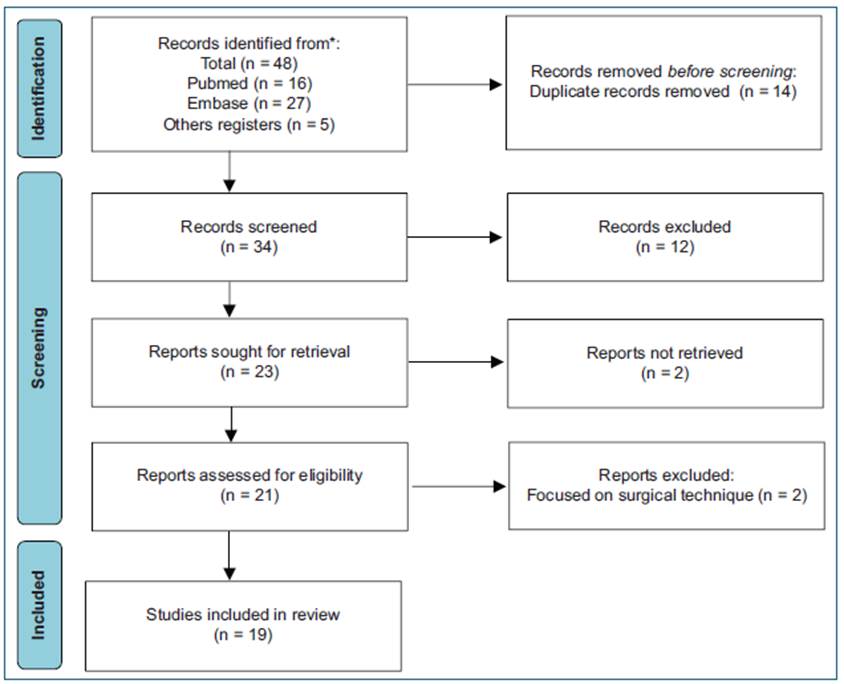
The database searches identified 48 studies, of which 19 (757 participants) met the inclusion criteria (Fig. 1).
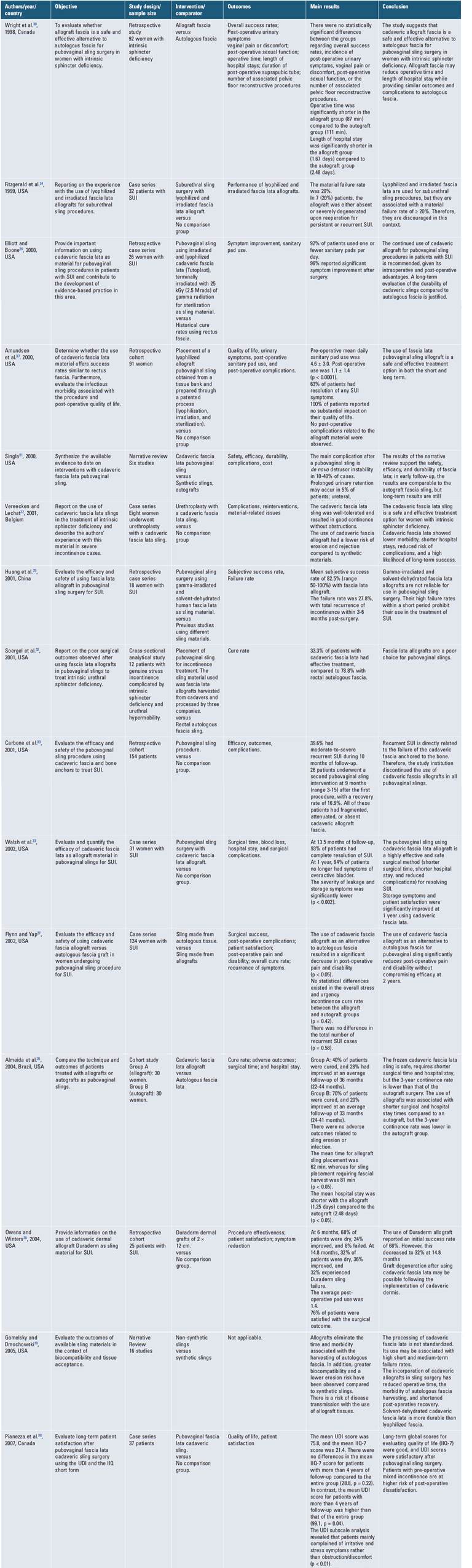
Most of the studies were conducted in the United States (n = 14), followed by Canada (n = 2), and three in other countries, each with one study (Belgium, China, and Brazil), between the years 1998 and 2022. Furthermore, most were case series in design (n = 8; 44%) (Table 1).
Characterization of CFL
SIZE
Most of the included studies reported graft dimensions. Choe et al. (21 considered a size of 2 x 5 cm to be the most commonly used in clinical practice. Gomelsky et al. (19 mentioned that the lengths of CFL slings ranged from 4 to 25 cm. Vereecken et al. (22 mentioned a 2-3 cm fascia lata width. Walsh et al. (23 used a 9-11 cm size. Fitzgerald et al. (24 used dimensions of approximately 3 x 10 cm. Huang et al. (25 used a length of 7 x 2 cm. Elliot and Boone26, Flynn and Yap27, and Owens and Winters28 employed a size of 2 x 12 cm. Amundsen et al. (29, Wright et al. (30, and Singla31 used dimensions of 2 x 15 cm. Soergel et al. (32 used sizes of 2 x 10 cm. Carbone et al. (33 used dimensions of 2 x 6 cm as this size was ideal for providing support and not placing excessive tension on the urethra and bladder neck when anchored laterally to the pubic bone.
PROCESSING
Many studies also included the processing of CFL in their reviews. (19,21,24-27,31-33 Gomelsky and Dmochowski19 conducted a narrative review of the literature, finding that the two main techniques for CFL processing are solvent dehydration and lyophilization. Both techniques require 30 min of rehydration in saline solution before implantation. In addition, they highlighted the lack of standardization in CFL processing in their research. Other researchers used gamma-irradiated CFL processing up to 1.5-2.5 Mrads (15-25 kGy) for tissue sterilization21,24,27,31-33. Authors like Fitzgerald et al. (24 reported up to 20% material failure rates when processed by lyophilization or subjected to irradiation. Huang et al. (25 had up to 27.8% failure rates if processed by solvent dehydration or gamma irradiation.
DURABILITY
Regarding the durability of the CFL sling, Choe et al. (21 and Vereecken and Lechat22 showed greater tensile strength in cadaver allografts compared to synthetic and autologous tissues (p < 0.05). Regarding long-term durability, some authors have followed CFL for 12 months, finding consistent material fragmentation failures of up to 38%33.
On the other hand, authors such as Fitzgerald et al. (24 and Huang et al. (25 mentioned the poor performance of allograft slings according to their processing. Fitzgerald et al. (24 documented fascia autolysis of up to 20% in those processed by lyophilization or irradiation. Huang et al. (25 reported a failure rate of up to 27.8% when using gamma-irradiated and solvent-dehydrated allograft fascia lata. Other authors19,34 observed early failure rates of up to 20% in frozen-processed allograft slings19.
Regarding durability related to rejection or infection transmission risk, Gomelsky and Dmochowski19 and Vereecken and Lechat22 argue that allografts have more excellent biocompatibility and a lower erosion risk than synthetic slings. In addition, Gomelsky and Dmochowski19 point out probable factors influencing CFL sling durability, such as host reaction to the graft, accelerated immunity, and autolysis. Almeida et al. (35 and Singla31 compared outcomes between patients treated with allograft and autograft, finding no adverse events regarding material erosion or infection, concluding that CFL use is safe for patients with an insignificant risk of disease transmission. Cabrales et al. (36 observed lower infection rates with CFL use.
Outcomes
Outcomes were evaluated in various ways, including the number of daily pads used, quality of life, symptom frequency, and patient satisfaction postoperatively23,27,28,30,35.
DECREASE PADS
The success rate was determined by the number of daily pads used, as noted in several studies23,26,28,36,37. The daily average of pads used for managing urinary incontinence ranged between 3.2 and 4.623,26,37.
A significant decrease in pad use was observed immediately after surgery, with an average of 1 ± 1.4 pads (p < 0.0 0 01) (26,37, reaching as low as 0.8 pads at 1 year of follow-up23. Flynn and Yap27 classified urinary incontinence outcomes by the number of pads used in 24 h, categorizing them as cured (0 pads), improved (1 pad), and failed (more than one pad). The mean post-operative pad use was 0.7 ± 1.3. Up to 29% of patients still required one or more pads daily.
QUALITY OF LIFE AND PATIENT SATISFACTION POSTOPERATIVELY
Authors such as Almeida et al. (35 showed that most participants (87%) did not consider urinary incontinence a significant impact on their quality of life, whereas Walsh et al. (23 observed a reduction in symptom frequency at 4 months and 1-year post-surgery. However, variability in patient satisfaction perception was observed among different studies. Flynn and Yap27 identified lower satisfaction in patients who received allografts, although this was not significant (p = 0.05). However, other studies, such as that of Owens and Winters28, reported a 90% satisfaction rate at 6 months postoperatively with allograft use, which decreased to 60% at 14 months. In addition, Pianezza et al. (38 demonstrated satisfactory scores in symptom reduction with CFL use during 2 years of follow-up.
PATIENT SATISFACTION POSTOPERATIVELY
Symptom recurrence was considered one of the outcomes in various studies. Huang et al. (25 observed complete urinary incontinence recurrence in five patients (27.8%) within 3-6 months. In contrast, Flynn and Yap27 found no significant difference in recurrence between allograft and autograft use (eight and seven cases, respectively; p = 0.58).
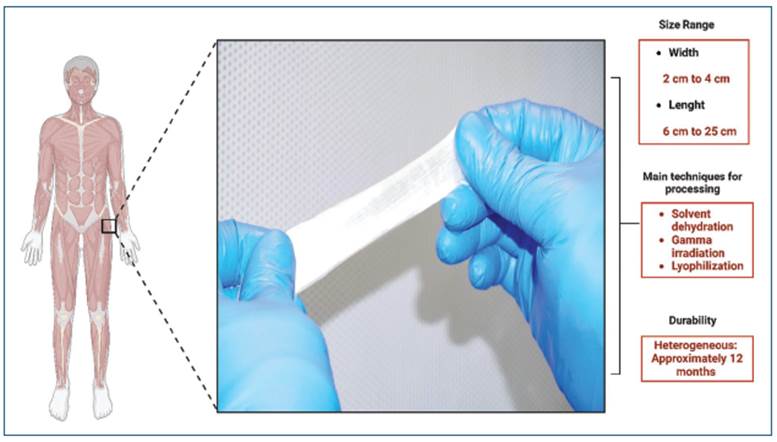
The principal characteristics and findings of the CFL can be found in figure 2.
Quality of the studies
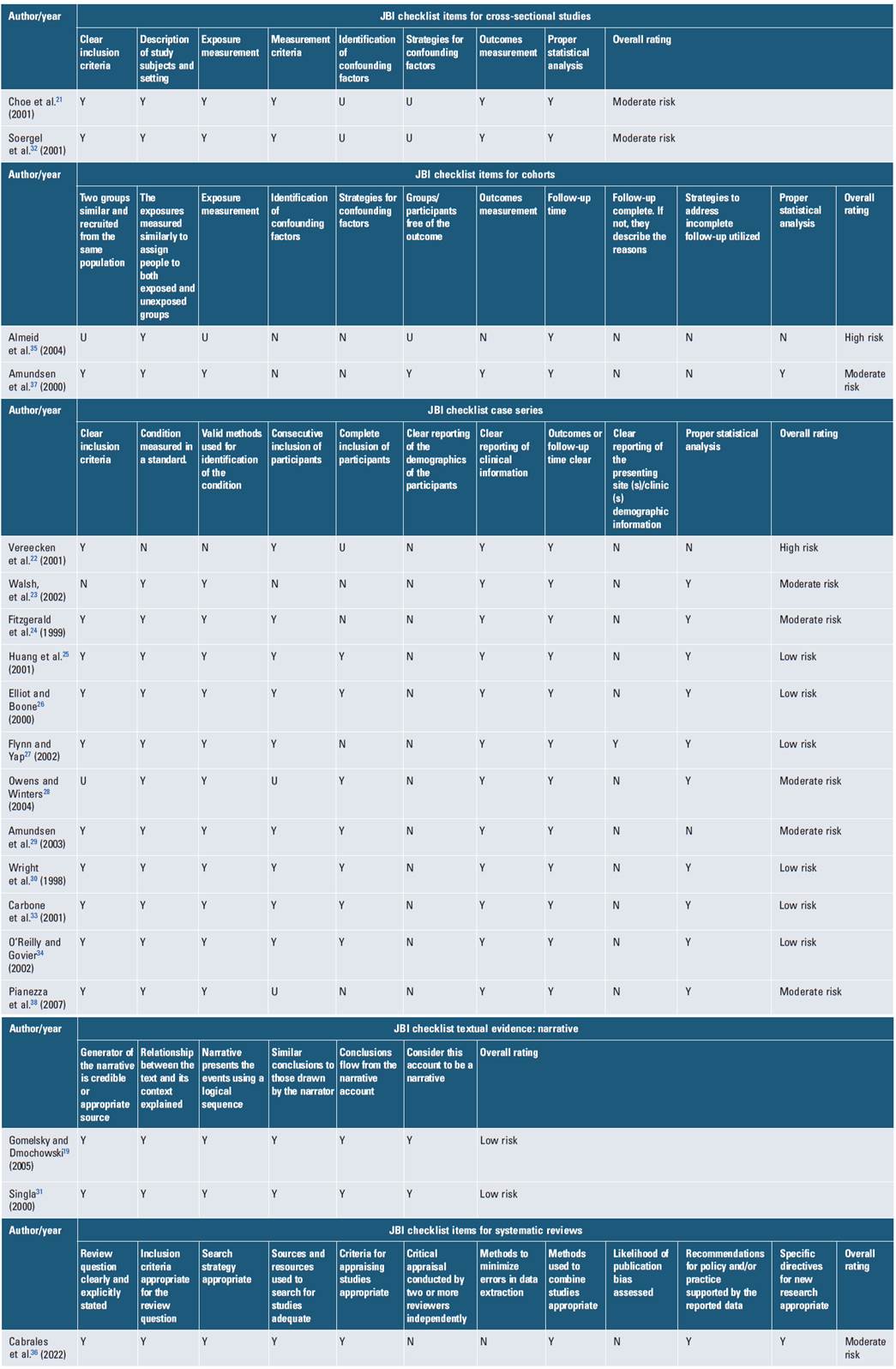
The quality of the included studies was mainly moderate (n = 9; 47.36%). In addition, eight studies (42.10%) were of good quality, whereas two were considered low quality (10.52%). The low quality of the mentioned studies was due to issues in participant selection, sample description, and statistical analysis (Table 2).
Table 2. Risk of bias assessed by the JBI
Discussion
CFL has been considered in recent years as a potential substitute for synthetic materials and non-synthetic tissues for various surgical procedures19. Our literature review shows the use of cadaveric allografts with dimensions generally ranging from 2 cm in width up to 25 cm in length for the surgical treatment of SUI. CFL could be an alternative for pubovaginal sling procedures in women with SUI, as some studies have shown a reduction in operative time, hospital stay, and complications compared to other available grafts. However, the reported evidence is heterogeneous, with small sample sizes, short follow-ups, low-level epidemiological designs for assessing efficacy/safety, and moderate quality.
The success or failure of CFL allografts depends on several factors, such as size, processing, and durability. The three main CFL processing techniques are solvent dehydration, gamma irradiation, and lyophilization. Although the processing method used can influence the tensile strength of the allograft bands21, there is currently a need to standardize this process19, leading to contradictory results in different studies21,24,27,31-33. While authors such as Fitzgerald et al. (24 and Huang et al. (25 reported material failure rates ranging from 20% to 27.8% when processing CFL by solvent dehydration, lyophilization, or irradiation, the sample sizes used in their investigations do not allow for generalizing the results. The recipient's immune system specifics likely influenced these findings19.
The results regarding the durability of CFL allografts are also heterogeneous. Different authors documented alterations in allograft durability19,24,25. Carbone et al. found up to 38% material fragmentation rates during a 12-month follow-up. However, authors like Walsh et al. (23 reported symptom resolution in 93.5% of patients at 13.5 months follow-up, which is also related to CFL durability. Although it has been thought over the years that CFL has lower durability and biocompatibility due to its high risk of disease transmission19, all cadaveric allografts undergo thorough serological screening, with the estimated risk of HIV transmission being one in 8 million people39. Other factors, such as host reaction to the graft, accelerated immunity, and autolysis, may be directly related to material durability19.
The outcomes associated with CFL use have mainly been satisfactory. Studies such as those by Walsh et al. (23 and Elliot et al. (26 showed cure rates above 70% even at 13.5 and 15 months follow-up, respectively. In general, most studies considered a successful surgical procedure based on the number of daily pads used postoperatively and the reduction of SUI symptoms over time. In addition, the decrease in daily pad use was associated with patient satisfaction, with the CFL surgical procedure being recommended by up to 96% at 15 months follow-up26.
This study has several strengths and limitations. Although a more specific rather than sensitive search was prioritized, the found articles answered the established research question, whereas broader searches yielded zero results or identified titles that did not answer the research question. As with all systematic reviews, we are prone to publication bias; however, the search terms were related to the two most important topics in this review (population and intervention). It is also relevant to consider that the quality of the individual studies included in this review was moderate, with small sample sizes, short follow-ups, and epidemiological designs inadequate for evaluating the efficacy and safety of CFL allografts for the surgical treatment of SUI. An advantage of this research is that it includes the characterization of CFL in terms of size, processing, and durability instead of limiting it only to durability and outcome effects.
In conclusion, there are divergent findings regarding the characteristics and efficacy of CFL allografts for managing SUI; however, these allografts have been considered an alternative for managing this condition in recent years. Some studies have shown improved patients' quality of life, finding acceptable satisfaction levels and positive recommendations after surgery. Other studies observed that incorporating CFL significantly reduces hospital stays, complications, and satisfactory success rates. However, the evidence is primarily from observational studies with short follow-ups and limited sample sizes. Future research should focus on designing experimental or quasi-experimental studies with long-term follow-up and adequate sample sizes to evaluate the efficacy and safety of CFL as a therapeutic option for the surgical management of SUI.

