




 English (pdf)
 Article in xml format
 Article references
 Automatic translation
 Send this article by e-mail
 Cited by SciELO
  Cited by Google
  Similars in
SciELO
Similars in
SciELO  Similars in Google
 Permalink

1. Introduction
Territories have become strategic destinations for the promotion of tourism and the culture dwelling in them. Thanks to phenomena such as the pandemic (Félix-Mendoza, et al., 2021), the economic reactivation process has generated the possibility for people to resume their leisure, entertainment and relaxation activities. Thus, destination brands are beginning to play a leading role in order to fulfill the economic and social goals of each geographic scenario. Hence, each city, town or nation is visualized as an organization with its own identity and image that needs to be positioned and valued from the loyalty processes established by the markets (Hanna et al., 2021; Huerta-Alvarez et al., 2020).
Target brands are described as those symbolisms, practices, social representations and actions that stand out in a place created from the thinking and doing of its inhabitants. This type of badges promote the development of towns, allowing their material progress and the consolidation of culture and history as differentiating elements that highlight the richness that such scenery is capable of providing (Sánchez-Castellanos, 2022; De-San-Eugenio & Ginesta, 2020).
Florencia, a municipality in the department of Caquetá, in southern Colombia, displays certain particularities that define it as a city potentially suitable for the development of a destination brand. Thanks to the opening of borders between localities, due to the signing of peace agreements with the subversive group known as FARC, a series of environmental attractions have become evident that are able to promote nature tourism practices due to its geographic position and its cultural denomination: “Golden Gateway to the Colombian Amazon” (García-Capdevilla et al., 2020). These facts have marked the possibility of recognizing Florencia as a place to show the goodness of nature from its biological inventories, plus now that it seeks to promote worldwide the fulfillment of the objectives of sustainable development (Trujillo-López & Rubio-Rodríguez, 2024).
Today, according to data from the Camara de Comercio of Florencia, as of December 2023, there are a total of 198 private entities dedicated to the development of local tourism, comprising: tourist lodging establishments (39.9%), travel agencies (27.7%), tourist homes (14.1%), tourist guides (8.1%) and gastronomic establishments (5.1%). In addition, the initiative of the Secretaria de Emprendimiento y Turismo has advanced the ten-year municipal tourism development plan with a diagnosis of the sectors that make up the chain or cluster.
During this year, agreement No. 2024004 was created through the Concejo Municipal, which grants the mayor the due permissions for the creation of the Florencia city brand, which establishes the following purposes: a) To establish, manage and preserve the visual identity of the city brand. b) To position the city of Florencia as an attractive destination for residing, investing and visiting, transforming the national and international perception of the city. The aim is to consolidate Florencia as a creative, sporty and scenic city, a leading city in human capital development, rich in biodiversity and with outstanding cultural, historical and natural attractions. c) To strengthen the Florencia residents' sense of belonging, replacing negative perceptions with a positive image of the city. d) To create a brand that also represents the city’s institutions and communicates a coherent, unified and distinctive message to citizens, visitors and investors (Municipio de Florencia, 2024).
Based on the above, the problem formulation gives rise to the following question: What are the possible scenarios that might develop the destination brand under study from the analysis of the dimensions established in Anholt’s Hexagon? Providing an answer to this question requires establishing as a general objective, to characterize the scenarios of the destination brand of Florencia, based on the analysis and estimation of the dimensions people, pulse, prerequisites, place, potential, presence theorized by Anholt. The specific objectives are: to analyze the dimensions of the destination brand from the perception of its inhabitants, to formulate scenarios, from a prospective perspective, for the city of Florencia brand, and to validate the proposed scenarios.
2. Methodology
2.1 Anholt Hexagon
Among this first approach, it should be noted that there are still no studies that support the conditions for the development of a destination brand for the municipality under study. According to Castro-Analuiza and Sánchez-Villalba (2020), the territory is placed in people's minds because of its content and meaning, and thus it is necessary to review the dimensions that support its meaning as proposed by Anholt in his hexagon theory (Figure 1), which is still valid in studies on tourism and territorial branding (Mayer-Heft & Samuel-Azran, 2022; Malyarets et al., 2024).
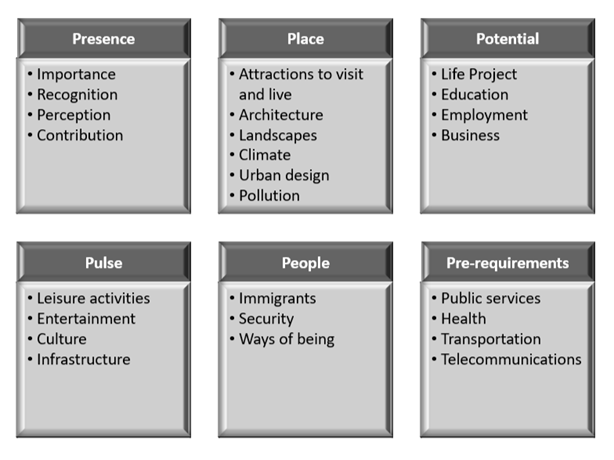
At a theoretical level, the following considerations are presented. García-Capdevilla et al. (2024), explain the urgency of a normative update that allows the understanding of tourism in the territories from the environmental education development and the studies of practices with nature, owing to the new world standards regarding the sustainability fostering. This might be crucial for the establishment and solving of problems linked to the protection and conservation of biodiversity (Flórez-Sterling et al., 2021).
Echeverri-Sucerquia and Quinchía-Ortiz (2023), point out that actions that promote knowledge in the territories offer an opportunity to highlight their image based on the natural, cultural and linguistic heritage that comes from them (Wang & Shen, 2024; Khalid-Hussain et al., 2024; Küster & Vila, 2024). For this purpose, permanent interaction with the markets is important, since the information generated for the promotion of the destination must potentially express the experience that is intended to encourage the user to travel to the site (Dube, 2024; Endang-Sulistya et al., 2024; Alenka-Pahor & Ksenija, 2023). Here digital platforms become valuable (Jiménez-Barreto et al., 2019), as Lim et al. (2021) quoted in Confetto et al., 2023; Furthermore, Stojanovic et al., 2022), above all since communication mechanisms are bilateral and some bargaining power is manifested by the demand side when choosing the destination (Morelos-Gómez et al., 2024), i.e., maintaining a market orientation (Hernández-Gil & Cabrera-Sánchez, 2023).
Long and Tran (2023), explain that destination brands are conditioned by infrastructure, natural environment, tourist adaptation, culture, gastronomy (Nikraftar et al., 2024), safety (Long and Tran, 2023; Zang et al., 2024) and the fundamental services offered by the city. The recognition of these aspects and the comprehensive planning of them, promoting indications of competitiveness, as well as the inclusion of other elements such as history, protection of architectural heritage and tourist guidance (Zang et al., 2024). All these are analyzed from Anholt's hexagon (2003, 2007 and 2010).
2.2 Method
This research was developed under a method with a quantitative approach (Vidal-Guerrero, 2022) validated by measuring the dimensions of the destination brand and subsequently establishing scenarios, from the prospective, to review over a thirty-year horizon (2024-2054), how its behavior or variability could be if it were transferred to the current reality. In addition, it was considered cross-sectional in nature (Hernández-Sampieri et al., 2014), as the information was collected only once within a period of time (year 2024).
The study consisted of two phases. In the first one, a semi-structured questionnaire was designed, made up of two headings: the initial part, on demographic or characterization questions, and the following one, with 34 items that define the dimensions of the theory under study, i.e., presence, place, potential, pulse, people and pre-requirements (López-Roldan & Fachelli, 2015). Each item was assessed through a Likert scale with values from “strongly disagree” (equivalent to 1) up to the option “strongly agree” (with a value of 5). This was applied to a probabilistic sample of 383 people of legal age from the city of Florencia (residents with more than 10 years in the municipality), located in the four comunas into which this territory is divided (north, south, west and east). This was calculated from a population of 113,091 inhabitants (considered adults), representing 64% of the general total according to data from the Departamento Administrativo Nacional de Estadística (DANE, 2022). The total number of surveys were conducted during the month of August to September of 2024 using stratified sampling, based on the location of the comunas and urban and rural areas. The confidence level established was 95% (1.96) with a 5% margin of error.
For the analysis of this phase, the factorial design of factor reduction was used, which defined homogeneous groupings of variables of the hexagon. The factor ratings were estimated from the variables with the highest significance and the factors were rotated using the varimax method, which minimized the number of factors with high loadings in order to adapt their interpretation (Ledesma et al., 2019). Concluding this phase, the correlations between items with greater significance were determined, posing three hypotheses from the theoretical references previously exposed:
H1: Visitor adaptation is associated with the attractiveness of the city (Wang & Shen, 2024; Khalid-Hussain et al., 2024; Küster & Vila, 2024).
H2: Destination safety is associated with peaceful destination coexistence (Long & Tran, 2023; Zang et al., 2024).
H3: The likelihood of doing business in the place is associated with interesting business activities (Dube, 2024; Endang-Sulistya et al., 2024; Alenka-Pahor & Ksenija, 2023).
In the reliability calculation of the instrument based on Cronbach’s Alpha coefficient, taking into account the items of each factor, it showed acceptable results (> 0.7) for each one and at a global level with a level of variance that was also acceptable. Even so, some adjustments were made to the items for a better understanding when answering or assessing on the behalf of each participant.
At the second phase, or prospective development, scenarios were identified (Mojica, 2008) to trace the possible futures from the “art of conjecture” of the destination brand Florencia with a horizon of thirty years (2024-2054). The SEARCH method (Sapio, 1995) was used, which is considered one of the independent methodological proposals to measure uncertainty without relying to a limited extent on quantitative processes, admitting the decomposition of the identified and measurable problematic with constant, predictable and uncertain variables (Pagani, 2009). The formulated scenarios were based on the crossing of variables (Bañuls and Turoff, 2011), which were tested through a cross-impact analysis. This was based on the assessment of success factors established by a group of interdisciplinary professionals and/or academics (Weimer, 2008) from the areas of marketing, tourism, sustainability, culture and history within the regional context of the destination analyzed. The use of expert panels (Abdixhiku et al., 2018) was key within this process to validate each scenario. The selection of this team relied on the principles of non-probabilistic sampling, assigning exclusion and inclusion criteria, i.e., 15 people were selected to support the researchers’ judgment.
3. Results and discussion
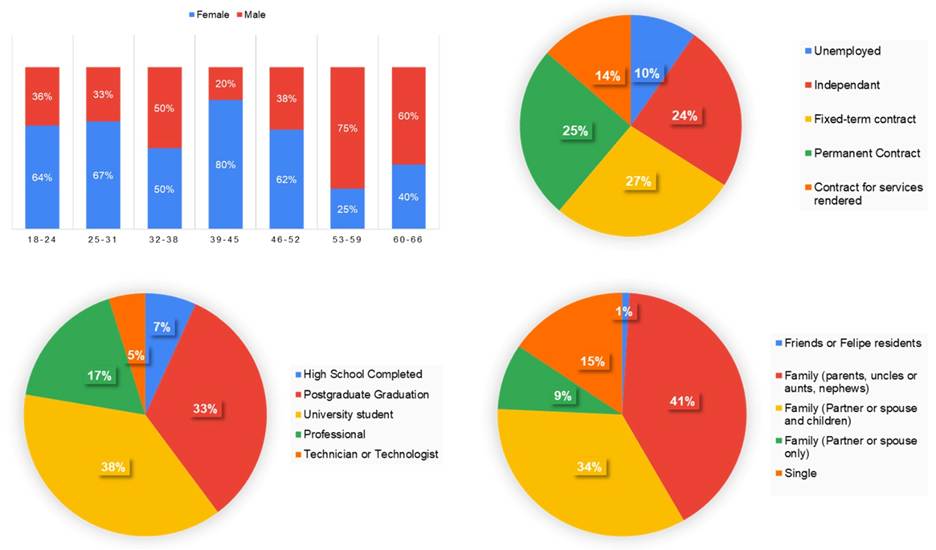
The population who participated in the study presents certain demographic particularities that are necessary to keep in mind and which are mentioned in Figure 2. The proportion for the female gender is 60% compared to 40% of the total for the male case. In terms of age ranges, the largest proportion (79%) corresponds to ages between 18 and 45 years old. About 90% of the people are currently in some condition of employability and a third of the sample has a professional level and/or is in postgraduate studies.
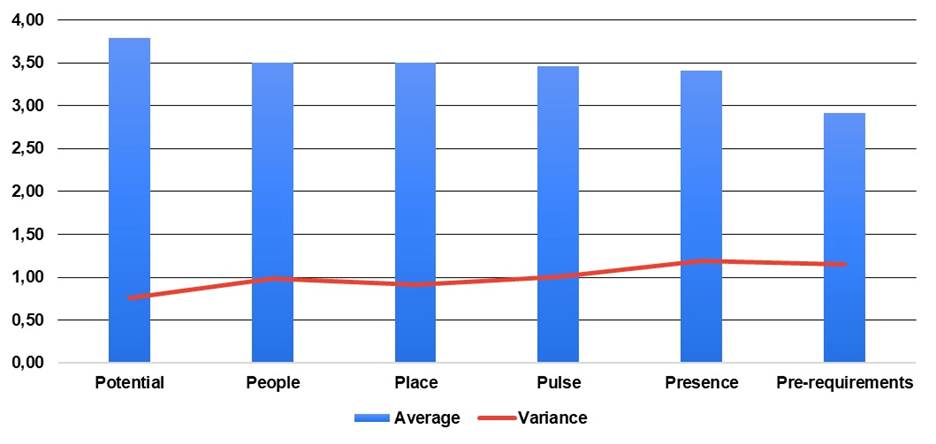
Regarding the averages of the six dimensions analyzed to determine the conditions of the Florencia destination brand, it is verified that five reach an acceptable level according to the scores given by the participants, with the exception of “Pre-requirements” which does not reach the minimum to be admitted in current parameters. This shows an initial approach towards visible descriptors of the city brand, describing it as a place with certain difficulties in its cleanliness and organization systems, as well as possible failures within the provision of basic services, health, education, transportation, telecommunications and access to commerce. The above from the perspective of its inhabitants.
It is verified that the variability or dispersion in terms of means tends to be greater as the average decreases in each group of items analyzed (Figure 3). The dimension with the highest score was “Potential”, highlighting attributes of the destination brand related to the possibilities of developing life projects, university studies, employability schemes and ease of business development. Within the outstanding average items (average equal to or higher than four and variations lower than one), brand attributes characterized by considering Florencia as an attractive tourist destination, safe to live in, with a memorable landscape and whose inhabitants are friendly and welcoming people stand out.
3.1 Factorial analysis of the Florencia destination brand dimensions
According to Table 1, the calculated determining factor indicates that the dimensions of the brand under study are linearly related, i.e., there is normality with the data obtained for the study (value less than 0.05). The Kaiser-Meyer-Olkin measure reached a value of 0.790 which means that the use of factor analysis is worthwhile.
Table 1 KMO and Bartlett test.
| Kaiser-Meyer-Olkin measure of sampling adequacy | 0,790 | |
| Bartlett's sphericity test | Approx. chi-square | 2062,234 |
| gl | 561 | |
| Sig. | 0,000 | |
Subsequently, Table 2 shows the conformation of eight factors, of which the six initially proposed explain 61.58% of the variance of the data, that is, more than 50% of the total of this dispersion indicator. The constructor of this analysis justified a 58.59% of rotation in terms of variance, which is interpreted as a minimum and acceptable level for this inquiry.
Table 2 Matrix of total variance explained.
| Factor | Initial eigenvalues | Sums of loads squared by extraction | Sums of loads squared by rotation | ||||||
|---|---|---|---|---|---|---|---|---|---|
| Total | % of variance | % cumulative | Total | % of variance | % cumulative | Total | % of variance | % cumulative | |
| 1 | 10,523 | 30,951 | 30,951 | 10,146 | 29,841 | 29,841 | 5,634 | 16,571 | 16,571 |
| 2 | 3,240 | 9,530 | 40,481 | 2,860 | 8,411 | 38,252 | 3,140 | 9,236 | 25,807 |
| 3 | 2,410 | 7,088 | 47,570 | 1,985 | 5,838 | 44,090 | 2,499 | 7,349 | 33,156 |
| 4 | 1,783 | 5,244 | 52,814 | 1,408 | 4,141 | 48,232 | 2,038 | 5,994 | 39,150 |
| 5 | 1,563 | 4,597 | 57,411 | 1,097 | 3,225 | 51,457 | 1,986 | 5,841 | 44,991 |
| 6 | 1,421 | 4,178 | 61,589 | 0,950 | 2,793 | 54,250 | 1,702 | 5,005 | 49,996 |
| 7 | 1,211 | 3,563 | 65,152 | 0,828 | 2,434 | 56,684 | 1,700 | 5,000 | 54,996 |
| 8 | 1,054 | 3,100 | 68,251 | 0,648 | 1,907 | 58,591 | 1,223 | 3,596 | 58,591 |
Note: The table continues up to the generated factor No. 34 with a cumulative percentage of 100% and a total of 0.058 and a variance percentage of 0.170.
In Table 3, the conformation of the analyzed factors stands out, of which only the first six are accepted, considering the conditions of minimum grouping of three items to be identified as such. The first factor is made up of attributes associated with cleanliness and order, access to basic services (electricity, water and communications), access to health services, education services, public transportation conditions (including access to rural areas), connectivity, architecture and urban design, pollution and safety.
Table 3 Rotated factor matrix.
| Ítems | Factor | |||||||
|---|---|---|---|---|---|---|---|---|
| 1 | 2 | 3 | 4 | 5 | 6 | 7 | 8 | |
| PRE E1 | 0,787 | 0,115 | 0,177 | 0,218 | ||||
| PRE E3 | 0,729 | 0,212 | 0,117 | -0,146 | 0,19 | |||
| PLA C5 | 0,715 | 0,173 | 0,238 | 0,199 | 0,243 | |||
| PRE E2 | 0,714 | 0,397 | 0,144 | -0,117 | 0,173 | 0,127 | ||
| PE D2 | 0,674 | 0,176 | 0,365 | 0,125 | ||||
| PLA C3 | 0,658 | -0,132 | 0,439 | 0,253 | 0,173 | 0,34 | ||
| PLA C8 | 0,635 | -0,16 | 0,112 | 0,161 | 0,186 | -0,104 | ||
| PRE E4 | 0,596 | 0,256 | 0,238 | 0,458 | ||||
| PRE E5 | 0,558 | 0,129 | 0,253 | 0,152 | 0,135 | -0,163 | 0,205 | 0,551 |
| PRE E6 | 0,546 | 0,279 | 0,287 | -0,124 | 0,126 | 0,197 | ||
| PRE E9 | 0,467 | 0,181 | 0,351 | 0,204 | -0,201 | 0,277 | ||
| PO G1 | 0,761 | 0,123 | 0,117 | 0,153 | 0,122 | |||
| PO G2 | -0,149 | 0,675 | 0,181 | 0,344 | -0,123 | |||
| PO G4 | 0,22 | 0,626 | 0,15 | 0,177 | 0,135 | |||
| PO G3 | 0,333 | 0,605 | 0,164 | 0,134 | 0,15 | |||
| PU F4 | 0,179 | 0,478 | 0,453 | 0,396 | 0,121 | |||
| PU F5 | 0,113 | 0,343 | 0,546 | 0,229 | 0,22 | 0,112 | 0,207 | |
| PRE E8 | 0,374 | 0,19 | 0,535 | 0,101 | 0,188 | |||
| PRE B3 | 0,312 | 0,515 | 0,289 | 0,101 | 0,21 | -0,13 | ||
| PRE B2 | 0,404 | 0,319 | ||||||
| PRE B1 | 0,205 | 0,178 | 0,731 | 0,137 | ||||
| PLA C6 | 0,285 | 0,187 | -0,123 | 0,618 | 0,122 | 0,359 | -0,147 | |
| PLA C7 | 0,228 | 0,141 | 0,528 | 0,378 | ||||
| PRE B4 | 0,215 | 0,132 | 0,358 | 0,425 | 0,181 | 0,307 | ||
| PU F2 | 0,116 | 0,144 | 0,183 | 0,767 | 0,26 | 0,161 | ||
| PU F3 | 0,111 | 0,344 | 0,462 | 0,557 | 0,109 | |||
| PU F1 | 0,201 | 0,278 | -0,106 | 0,508 | 0,266 | |||
| PLA C1 | 0,254 | 0,589 | 0,174 | |||||
| PLA C4 | 0,116 | 0,122 | 0,518 | |||||
| PLA C2 | 0,185 | 0,254 | 0,153 | 0,268 | 0,431 | 0,133 | -0,191 | |
| PE D3 | 0,122 | 0,195 | 0,204 | 0,725 | 0,135 | |||
| PE D4 | 0,191 | 0,146 | 0,144 | 0,179 | 0,318 | 0,113 | 0,588 | |
| PE D1 | 0,3 | 0,123 | 0,284 | 0,309 | 0,388 | |||
| PRE E7 | 0,308 | 0,259 | 0,256 | -0,13 | 0,257 | 0,351 | ||
The second factor integrates the destination brand items: promotion of interesting events, development of life projects, university studies, employability options and doing business. Factor 3 brings together cultural activities, access to the city by different means of transportation, knowledge of the place and perception of it at the national level. Factor 4 comprises the importance of the site for the country, geographic location, climate and contribution to the world. Factor 5 combines outdoor activities, places for entertainment and leisure, and pace of life. Finally, factor 6 clusters tourist destination, landscapes, living conditions.
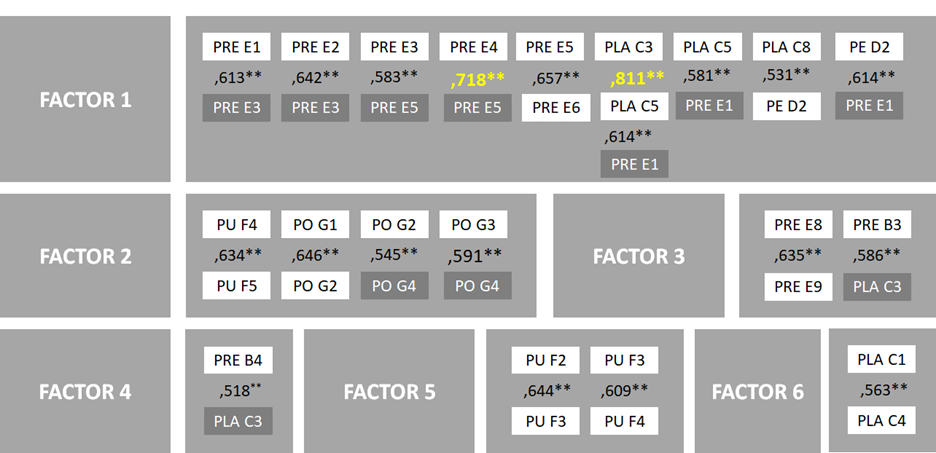
Figure 4 shows the correlations with acceptable, adequate and/or significant levels, i.e., greater than 50% for the value of the coefficients based on Spearman. A correlation of 81.1% between the C3 items stands out. Florencia has an orderly architecture and C5. Florencia has an attractive urban design. There is a 71.8% correlation level between items E4. In Florencia, education services are affordable and are good and E5. In Florencia, public transportation is good. Thus, 100% of the items correlate to some extent.
3.2 Florencia destination brand scenario planning
Initially, the interdisciplinary team prioritized the problematic issues associated with the topic and its key factors, based on the socialization of the results of the dimensions of the target brand under study. Nine sub-scenarios (S) were grouped into three categories of analysis. In the first, called “Attractive to visit”, conditions of order, cleanliness and safety (S1), events and tourist activities (S2) and culture and citizenship (S3) were considered. The second, “Access and fundamental services”, identified: entry to the city and internal transportation (S4), telecommunications and connectivity (S5), and basic services and health (S6). In the third, “recognition and profitability”, options for doing business (S7), probability of employment (S8) and development of a life project (S9) were established.
Each sub-scenario was evaluated according to a scale between one (1) or “unlikely scenario” and five (5) or “probable scenario”. The highest probability of occurrence was estimated for sub-scenario S7 (89%), followed by S6 (81%) and S9 (80%). The others were evaluated based on probabilities below 80%. Subsequently, a cross-impact matrix was assembled using Scenario Wizard Basic 3 software, which yielded three combinations with strong consistency (Table 4).
Table 4 Scenarios with high consistency.
| Scenario Nº. 1 | Scenario Nº. 2 | Scenario Nº. 3 |
|---|---|---|
| Total impact: 18 | Total impact: 17 | Total impact: 16 |
| Events and tourist activities (S2) | Culture and citizenship (S3) | Basic services and health (S6) |
| City entrance and internal transportation (S4) | Tidiness, cleanliness and safety conditions (S1) | Life project development (S9) |
| Telecommunications and connectivity (S5) | Opportunities for doing business (S7) | Likelihood for employment (S8) |
In Table 5, the probability of occurrence of the scenarios with the greatest impact was calculated.
Table 5 Occurrence probabilities of the scenarios.
| Scenario No. 1 | Scenario No. 2 | Scenario No. 3 | |||
|---|---|---|---|---|---|
| Sub-scenarios | Probability | Sub-scenarios | Probability | Sub-scenarios | Probability |
| Events and tourist activities (S2) | 78% | Culture and citizenship (S3) | 79% | Basic services and health (S6) | 81% |
| City entrance and internal transportation (S4) | 77% | Tidiness, cleanliness and safety conditions (S1) | 75% | Life project development (S9) | 80% |
| Telecommunications and connectivity (S5) | 75% | Opportunities for doing business (S7) | 89% | Likelihood for employment (S8) | 76% |
| Occurrence probability | 45,04% | Occurrence probability | 52,73% | Occurrence probability | 49,25% |
Below is a description of each of the scenarios of the destination brand Florencia, Caquetá towards the year 2054, which were validated by the experts through the focus groups.
Scenario No. 1. Florencia: the true golden gateway to the Colombian Amazon
The destination brand in the next three decades will become a scenario that will allow the development of Amazonian-style experiences, promoting good sustainability practices and establishing itself as a national reference in the encouragement of nature tourism focused on the enjoyment of the mangrove, its environmental benefits and the immersion into a culture that takes into consideration the respect for the indigenous, Amazonian and Andean traditions. The road infrastructure and the telecommunications services are being improved to receive Colombian and foreign tourists who will approve the positioning of Florencia as a destination for relaxation, knowledge and disconnection from work.
Scenario No. 2. Florencia: where sustainability and peace is breathed
By the year 2054, the city will have consolidated a culture that is rooted, civic and centered on love and respect for the environment and sustainable activities. A tidy, clean place, with management systems for solid, non-renewable and renewable waste, ready to be part of a circular economy that will contribute to the development of local industry, in which alliances and agreements may be established to stimulate public and private investment in order to support entrepreneurship, the creation of businesses and the improvement of the life quality of its inhabitants and periodic or permanent visitors. The inhabitants will recognize the importance of tourism and consequently will assume a friendly and proactive attitude as hosts of the destination, demonstrating an image of lasting and enduring peace, facilitating the oblivion of a stigma of many years centered on armed conflict and violence.
Scenario No. 3. Florencia: a place for life
The municipality will be able to establish a suitable institutional articulation that allows the improvement of basic services such as water supply (potable water), sewage, electricity, connectivity, among others, as well as social security systems to improve the living conditions of the inhabitants and thus deserve national recognition as a territorial entity to establish a personal, family or work project long-term. This will also foster business development to expand the range of possibilities for employability.
Florencia as a destination brand must significantly value the results presented if it really wants to be recognized nationally and internationally as a place for unconventional tourism development. The pandemic and other political and security processes already mentioned, may allow the analysis of the territory for the explicit recognition of its natural, social, cultural and economic benefits. The city brand is intended to be built and consolidated from the representations and perspectives of its people, the teamwork capacity of its entities and the strengthening of productivity schemes for an effective support of all strategic actions that involve territorial branding.
Florencia should promote governance spaces (Ravelo-Méndez & Mendoza-Gómez, 2023), establishing formal initiatives for the improvement of infrastructure and facilitating access to distribution channels for the offers that the city wishes to promote and visit, arduously reinforcing the institutional framework and good practices that facilitate the social dynamics that optimize its life systems from the individual and collective perspective.
Furthermore, it is also necessary to reinforce research on the meaning and sense of the destination brand through co-creation processes, being a place with a mix of different cultures from the coasts (Caribbean and Pacific), the interior, and central areas of the country. The organization of the Amazonian scenario must ensure a segmentation of the target audiences (local, national and/or international) in order to determine what is to be presented in terms of behaviors associated with the cultural and historical phenomenon.
Florencia must analyze the concepts of regional identity, visible, implicit, and the attributes or characteristics that demonstrate its own capacities and that are articulated with the geographic, climatic and social aspects. It is necessary to work on diversity from a historical approach, which has marked the evolution of the city, due to the migration of different social groups from other areas of Colombia.
Florencia needs a proper institutional articulation, headed by public management, for the design of strategic action based on five principles: effectiveness, progressiveness, holism, comprehensiveness and opportunity. Tourism, as a transversal axis of this process, must be coherent with the interests of locals and visitors. For this task, it is crucial to merge the cultural scheme and idiosyncrasy through complementary aspects such as gastronomy, folkloric traditions, lived experiences, and social responsibility, among others.
Florencia must migrate its promotion to digital schemes where tourism actions and the respective value propositions are communicated (Sánchez-Castellanos, 2022), in order to perfect the image as a reading construct to the sense of belonging and evoke in each individual the reasons to stay and return to the territory.
4. Conclusions
The destination brand Florencia, Caquetá, is framed in two perspectives, a reality that evokes the need for planning that allows the improvement of its image and identity, and an optimistic prospective projection for thirty years that consolidates it as a Colombian reference for the encouragement of tourism and the development of economic, entrepreneurial and social activities.
At the first stage of this research, the conformation of six factors that demonstrate the conditions of the destination brand based on Anholt’s hexagon stands out. Despite the existence of acceptable perceptions regarding the attributes of the destination, there is a need for reinforcement in the reality of operation and technical variables that show the municipality as a potential for the realization of entertainment, leisure and commercial activities.
Secondly, three scenarios were discussed with acceptable and moderate probabilities of occurrence that encourage the validation of the aspects to be improved in Florencia, from its fundamental services for the enjoyment of inhabitants and tourists, to the development of actions oriented to entrepreneurship and employability. It is important to highlight that the capital of the department of Caquetá currently has one of the highest unemployment rates in the country (14%).
Thirdly, the scenarios are validated by means of the selected stakeholders, finding in them certain recommendations ranging from an appropriate institutional articulation between the public and the private sector (brand’s economic objective) and the cultural and historical monitoring of the citizenship to support the conditions of safety, adaptation and service for visitors.
The main limitations of this research were the low participation of randomly selected individuals residing in rural areas, who in most cases were not interested in participating in the study. In addition, a relative proportionality between the participants and their current academic situation is largely recognized, which in over two thirds corresponded to people with a profession and/or postgraduate level. This may generate changes in the perspective of how to understand and perceive the destination brand. On the other hand, the need to evaluate the opinion of visitors regarding the factors or constructs measured during this analysis of the brand Florencia as a destination is recognized.
The main lines of research proposed on the basis of these findings are the possibility of recognizing the identity of the brand under study. Likewise, the analysis of the dimensions based on the experience lived by nationals or foreigners visiting the place. Last but not least, a periodic follow-up of the fulfillment of the variables or items established in the planned scenarios over a horizon of three decades, in order to review adjustments and new paths of tourist, cultural and business orientation.
The most outstanding theoretical contribution of this research was the recognition of new groupings among the items of Anholt’s hexagon, which allow their due updating or adjustment according to the particularities of the territories where they are applied. Furthermore, the ability to articulate the prospective to establish, from a current reality, scenarios that allow the improvement of the conditions, in the future, of a destination brand.

