




 Spanish (pdf)
 Article in xml format
 Article references
 Automatic translation
 Send this article by e-mail
 Cited by SciELO
  Cited by Google
  Similars in
SciELO
Similars in
SciELO  Similars in Google
 Permalink

Introduction
Earnings management is a consolidated field of research, which focuses on financial reports as a vital part of management. Companies, in general, disclose a set of financial reports that are crucial for the balance of financial information, both for the principals (investors) and the agents (administrators) (Pelucio-Greco, 2014).
In this context, financial reports are used by managers to demonstrate the company’s economic and financial situation. Earnings management (EM) arises “when managers use judgment in financial reporting and in structuring transactions to alter financial reports to either mislead some stakeholders about the underlying economic performance of the company or to influence contractual outcomes that depend on reported accounting number” (Healy & Wahlen, 1999, p. 366). Davidson et al. (2004) defined EM as “the use of flexible accounting principles that allow managers to influence reported earnings, thereby causing reported income to be larger or smaller than it would otherwise be” (p. 267).
Throughout the last decades, EM evolved through a set of theoretical contributions (Healy & Wahlen 1999; Dechow & Skinner, 2000), empirical ones (Burgstahler & Dichev, 1997; Davidson et al., 2004) and through the development of econometric models (Jones, 1991; Dechow et al., 1995; Kothari et al., 2005; El Diri, 2020).
All of these contributions have permitted the development of this field of research around the world, including in Latin America. In this region, the studies about EM began with studies conducted by De Almeida et al. (2005), Paulo et al. (2007) and Martinez (2013). In Latin America, EM is studied under different denominations. In Portuguese, it is known in studies as ‘gerenciamento de resultados’ (Paulo et al., 2007; Martinez, 2013; Perafán-Peña et al., 2024), ‘manipulações de resultados’ (Furtado et al., 2016; Polo Jiménez et al., 2023), and ‘manipulação de informação contábil’ (Ferreira et al., 2012). In Spanish, researchers use the terms ‘manipulación del resultado’ (Montoya, 2018), ‘ajustes por devengo’ (Sanchez et al., 2021), ‘gestión de resultados’ (Teodoro & Mapa 2020) and ‘contabilidad creativa’ (Hollander-Sanhueza & Parada, 2017).
Furthermore, in Latin America, the literature on EM also studies this subject linked to topics such as ‘corporate governance’ (Gonzáles & García-Meca, 2014; Fernandes & Machado, 2023; Esteve & Piccoli, 2024), ‘audit quality’ (Ferreira et al., 2012; Silvestre et al., 2018), convergence of the International Financial Reporting Standards (IFRS) (Pelucio-Grecco et al., 2014; Montoya, 2018; Bonilla, 2024) and ‘ownership structure’ (Reyna, 2018; Gomes et al., 2021).
Although these studies represent important advances regarding EM in Latin America, there remains a noticeable lack of research on the recent state of this field in the region. This is the research gap that this study intends to explore. Thus, this study’s objective is to analyse the evolution and content of EM research in the context of Latin America.
To fulfil the proposed objective, the chosen method was a systematic literature review analysing publications regarding EM in Latin America. After the articles were selected, the option was made to review and analyse 132 articles from the period between 1994 to 2023. All of these studies were published in the context of Latin America and indexed in the Scopus and Web of Science databases.
Aside from this introduction, this article has five more sections. The second section discusses the method, whereas the third section outlines the descriptive results. The fourth section contains an analysis of said results and the fifth section sets forth an agenda of research. The article ends with the final considerations.
Method
Data
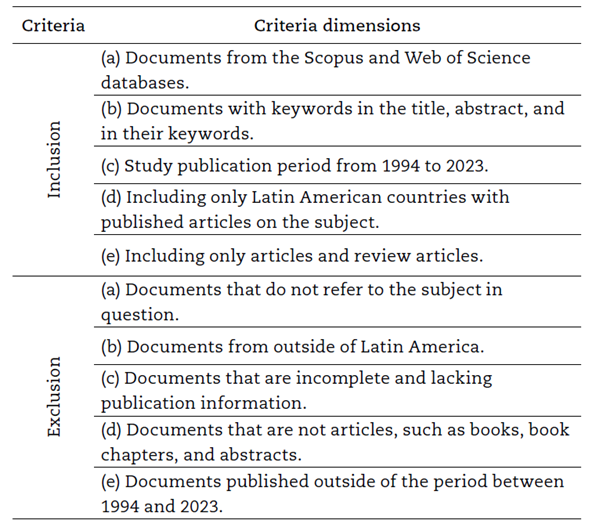
The method used in this study was a systematic literature review. Therefore, the nature of the data and information used for our study was secondary data. More specifically, documents from journals indexed in the world’s two most prestigious scientific databases, Scopus and Web of Science, were used. In systematic review studies, reliability and validity are centralthemes. Reliability is related to reproducing results with the least possible deviation over time. To ensure the reliability of this study, the search and selection process for articles was based on previously established inclusion and exclusion criteria. These criteria are presented on Table 1. On the other hand, validity is a characteristic in which the research measures or captures what it wants to measure. Our study seeks to capture the state of the art of earnings management in Latin America for the period 1994-2023, therefore, making use of a systematic review, based on two universally known databases, using inclusion and exclusion criteria and taking care regarding the procedure for analysing the collected data, we guarantee the validity of this study. Latin American countries were selected according to CEPAL (2014).
Type and scope
Systematic literature reviews can be divided into two large groups, quantitative and qualitative. The quantitative systematic review is the meta-analysis and the qualitative systematic review is the synthesis. In this study, we carried out a qualitative systematic review, the purpose of which is to synthesise research on earnings management in Latin America, for the selected period. Regarding scope, this study had a descriptive scope within the period 1994-2023.
Procedures
The study employed a systematic literature review, adhering to the parameters outlined by Tranfield et al. (2003). These authors propose planning the systematic review in three stages: (1) planning the review, (2) conducting the review and (3) report and disclosure.
In the planning stage of the review, this study discusses the following research question: what was the content and evolution of EM studies as field research in Latin America? The next two stages will be important in terms of answering this research question.
The second stage involved carrying out the review. Thus, inclusion and exclusion criteria were established for selecting the studies to be analysed (see Table 1). The chosen databases were Scopus and Web of Science, considering their credibility and coverage. The previously established inclusion and exclusion criteria were then used to conduct the searches in each of the databases. Since this study focuses on the context of Latin America, the choice was made to use descriptors in three languages (English, Spanish and Portuguese) in order to select the studies. The chosen keywords were “earnings management” in English, “gerenciamento de resultados” in Portuguese and “contabilidad creativa” in Spanish. The third stage of this study was report and disclosure. After applying the inclusion and exclusion criteria (see Table 1), the 132 selected articles were read in full. Initially, articles were selected in July 2023. In the review process of this study, the last selection of articles was updated in June 2024. The collected data procedure is depicted in Figure 1.
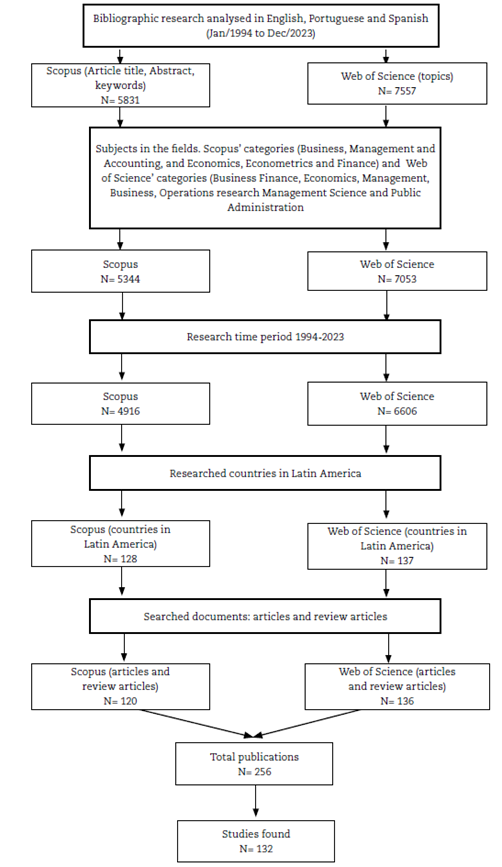
After obtaining the final research sample, it was possible to organise and analyse the data. This process will be discussed in the following item.
Analysis of data
For data processing, after applying the inclusion and exclusion criteria (see Figure 1), 132 articles were selected1. Once data collection was carried out, all articles were downloaded in full in their PDF version. Once we had the full version of the articles, two spreadsheets were organised using Microsoft Excel software. The first spreadsheet aimed to organise all descriptive information, including the number of articles per year, the affiliation of the authors, type of study, etc. The second spreadsheet was organised according to different columns, to perform the content analysis of the articles. Therefore, each time an article was read, all relevant content was filled onto this spreadsheet. The content analysis aimed to systematise and infer the content of the reviewed documents.
Ethical considerations
This systematic review prioritised ethics, fidelity, transparency, and prudence in evaluating information in order to guarantee research results. There was no conflict of interest on the part of the evaluators, and all study members agreed that the analysis of the documentation should always be impartial and maintain scientific rigour. Furthermore, throughout the entire process of this research, there was a permanent concern to avoid any type of bias, based on politics, nationality, race, creed, or gender. The sources used were available in databases for verification by interested parties. In the next section, we present the results of this study.
Descriptive results
The descriptive results are presented in four parts: the evolution of the selected studies, the number of articles published according to the main researcher’s affiliation, the type of studies and the classification of the most-studied topics linked to EM.
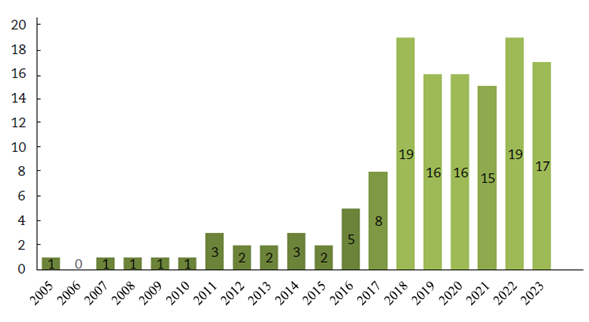
Regarding the evolution of the number of articles published per year, it was apparent that the subject of EM has grown at a constant rate. This fact confirms the growing interest of the Latin American academic community regarding this topic as shown in Figure 2.
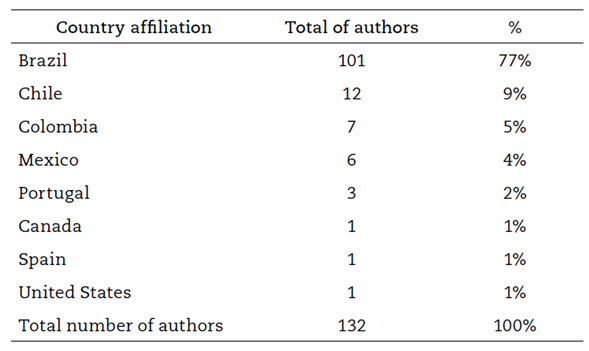
According to the proposal made by Saunila (2020), the term “main author” was used to refer to each article’s first author. Regarding the first author’s affiliation, the study results indicate that the most active researchers in the EM field are researchers affiliated with Brazilian universities. After Brazil, there is a sequence of contributions from authors linked to universities in Chile, Colombia, Mexico, Portugal, Canada, Spain and the United States, as shown on Table 2.
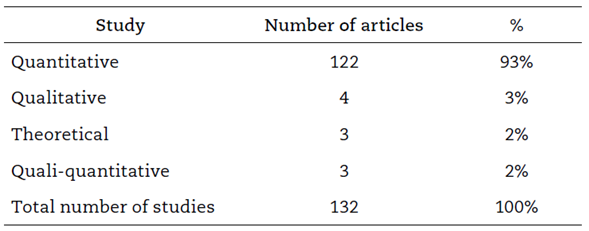
Regarding the analysed sample’s method, it was possible to identify that almost all the studies adopted the quantitative method, representing 93% of the sample (as depicted on Table 3). In the analysed sample, quanlitative studies represent 3%. Similarly, studies that employ quali-quantitative, and both theoretical and methods represent 2% each.
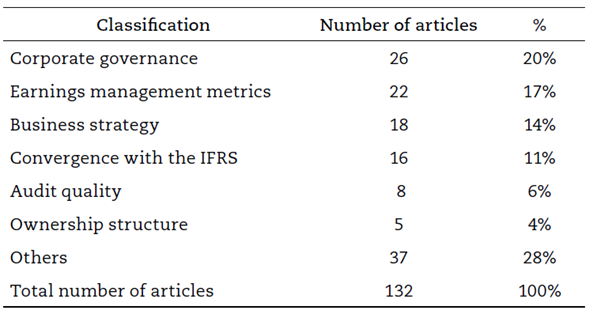
As for the analysed sample’s thematic classification, it was possible to identify that EM studies comprise seven categories: corporate governance (20%), EM metrics (17%), business strategy (14%), convergence with the International Financial Reporting Standards (IFRS) (11%), audit quality (6%), ownership structure (4%) and varied research topics (28%) (see Table 4).
After determining the categories, the following section shows this study’s results.
Results analysis
After reading and analysing all the articles, seven categories were identified within the results for EM studies in Latin America: corporate governance, earnings management metrics, business strategy, convergence with the IFRS, audit quality, ownership structure, and various other earnings management studies. These seven categories will be discussed below.
Corporate governance
Throughout the last few decades, Latin America faced financial scandals in important companies, such as La Polar in Chile, Petrobras in Brazil, Disco in Argentina (Mellado & Saona 2020; Dal Magro & Klann, 2021), etc. These occurrences originated from the alteration of their financial results (Mellado & Saona, 2020; Dal Magro & Klann, 2021; Tobar Arias et al., 2023). The manipulation of financial outcomes is closely associated with business management practices, inwhich corporate governance occupies a central position. As a best practice in business management, corporate governance is a tool used to guarantee that financial reports have more quality and fidelity (Reyes et al., 2018). Thus, corporate governance includes the subject of EM in companies (Alves & Vicente, 2013).
In Latin America, there are studies that link corporate governance and EM (Cardoso et al., 2008; Aguilar et al., 2019; Polo Jiménez et al., 2023), focusing on the connections between this subject and: shareholders (ownership structure), investors, the board of directors, the executives, and other studies. Shareholders, as a part of the ownership structure, have been studied considering discretionary intention in the practice of EM (Torres et al., 2011; Gonzáles & García-Meca, 2014). According to Azevedo et al. (2020), another topic that was studied was the role of minority shareholders in the implementation of protection mechanisms (poison pills) concerning the level of EM. As a research topic, investors are also an investigated topic, more specifically investor sentiment. Thus, investor sentiment has been analysed in the relation that exists between investors and EM, confirming that there is a positive relationship between discretionary accruals and investor sentiment when investing in the Brazilian stock market (Santana et al., 2020; Martinez, 2021). It was further evidenced that after optimistic moments, EM goes down (Santana et al., 2020).
The board of directors and EM were discussed in different studies, such as the independence of the Board of Directors (Moura et al., 2017; Moura et al., 2020), the participation of women on the Board of Directors (Corazza et al., 2020; Fernandes & Machado, 2023), interlocking among the Board of Directors (Dal Magro & Klann, 2021), as well as the social ties between the CEO and the board of directors, covered by Ramos et al., (2023). De Souza et al. (2019) found that the “Dark Triad” personality traces of executives are associated with EM. In this sense, the Dark Triad personality traces of accounting professionals regarding EM were studied (Andrade et al., 2020). The connection between executive compensation and earnings management has also been researched by De Souza et al. (2022). Another study has explored the effects of fiscal aggressiveness, profit variability, and executive compensation on the practice of earnings management within companies (Leal et al., 2023).
It is important to highlight that, in the studies analysed, it was identified that corporate governance acts as a governance mechanism, which influences the levels of EM. These studies have given special attention to issues related to the board of directors, the profile of executives, and the beneficiaries of financial reports. However, issues related to the behavioural area, the use of experiments and in-depth case studies, are still issues that require more research in the context of Latin America.
Earnings management detection metrics
Research revolving around EM has mostly been conducted through metrics models (Martinez, 2013). In Latin America, various studies discuss EM metrics (Paulo et al., 2007; Castro & Martinez, 2009; Martinez, 2013; Bressan et al., 2017; Cappellosso & Rodrigues, 2019; De Abreu Pontes et al., 2023). Among these studies, metrics pertain to discretionary accruals, specific accruals and others.
Concerning the discretionary accruals metrics, studies appeared (e.g., Rodrigues et al., 2019) analysing the evolution of companies’ quarterly financial results, demonstrating the increasing levels of EM through discretionary accruals. Martinez and Carvalho (2022) also used discretionary accruals to study health insurance companies in relation to EM and operational decisions, confirming that health insurance companies practice EM to avoid bad evaluations from the regulatory agency. The study conducted by Costa and Soares (2021) appears as a theoretical contribution to the key concepts and procedures for using EM measurement models through discretionary accruals.
As for the EM metrics involving specific accruals (specific situations), the studies have concentrated on specific sectors. In the financial context, Mazulo et al. (2022) analysed banks, confirming that banks apply EM for specific accruals in the provision for doubtful credits. Another study from the same sector indicates that banks that are not listed in the stock market also applied EM to specific accruals (Galdi et al., 2021), while De Sousa and Bressan (2018) discovered that small banks avoid disclosing losses by using EM for specific accruals
In EM, metrics play a central role. This is because EM is detected using metrics (Martinez, 2013). However, those studying these metrics, to detect earnings management, could move forward by developing metrics that can capture some specificities between regions or continents. For example, it is known that certain regions have some institutional specificities, researchers from Latin America could build some metrics considering this aspect.
Business strategy
Business strategy that uses EM is a subject that is being researched in Latin America. The first study that discussed business strategy through EM was conducted by Almeida et al. (2005). Afterwards, other authors (Borgheti et al., 2019; Queiroz et al., 2018; Pamplona et al., 2018) continued with this more business-oriented approach to earnings management. These studies discussed business strategy and EM based on different topics: economic cycles, business-accounting strategy, financial stress, performance and other strategies used in companies.
Economic cycles affect companies’ lives. Thus, the impact of economic cycles and the adoption of EM strategies were researched by Paulo and Mota (2019). Research on the business-accounting strategy of hedge accounting in companies was included in the study conducted by Borgheti et al. (2019) and the strategy of EM of accruals and real activities in hedge accounting was studied by Pamplona et al. (2018). Financial stress was also a part of researchers’ agendas. Queiroz et al. (2018) studied financial stress in companies and the strategy of EM in good and difficult times. Regarding performance, a study conducted by Jara-Berlin and Sepulveda (2015) analyses family-owned companies and non-family-owned companies that implement EM as a business strategy.
Furthermore, other studies regarding business strategy and EM appeared. These studies covered the following topics: the reviewing of periodic fees (Cruz & Almonte, 2019), dividend persistence (Martins et al., 2022), political connections (Parente, 2020) and stock liquidity (Muñoz-Mendoza et al., 2022).
As a business strategy, EM has two streams of study, accruals EM and real EM (Gunny, 2010; Roychowdhury, 2006). This study has identified that researchers in Latin America are focusing their interest on the study of accruals, however, more studies concerning the second stream are needed.
Convergence of the International Financial Reporting Standards (IFRS)
Generally, changes in accounting practices across the world were investigated according to their convergence or adequation to IFRS. These changes resulted in an improvement of the companies’ financial report quality, as discussed by Pelucio-Grecco (2014) and Black and Nakao (2017). Initially, the convergence of IFRS and EM were the object of studies in Latin America, according to Trepat and Ramirez (2011).
In the literature, the convergence of the IFRS and EM have been researched at various levels, including economic sectors, countries, and other topics. Concerning economic sectors, especially in Chile, research was done on the effects of convergence of the IFRS on EM in Chilean banks (Trepat & Ramirez, 2011). Furthermore, in the non-financial sector, more precisely in Brazil’s public companies, it was observed that the adoption of the IFRS led to the reduction of EM through discretionary accruals (Pelucio-Grecco et al., 2014).
In the context of the countries, research identified the determinants of EM in Argentina, Brazil, Chile, Colombia, Mexico and Peru in the adoption of IFRS (Mongrut & Winkelried, 2019), correlating a study comparing Latin America and the Caribbean in the application of IFRS and the quality of accounting information (Montoya, 2018). The study conducted by Montoya et al. (2019) compared the same processes, adding the legal context of the researched countries in which it was possible to observe improvements in accounting quality through time. Another comparative study between Brazilian and English companies, in the context of IFRS conversion, concluded that the English companies reduced their level of earnings management, while the Brazilian companies increased their level of EM (Klann & Beuren, 2018).
Analysing the evolution of research on EM and IFRS, we observed that this research has been increasingly present. However, comparative studies between regions of Latin America are still necessary.
Audit quality
In general, audit quality has been researched in the last few decades. However, there is still no consensus in the literature on how to measure it. With the intent of advancing the tests that indicate audit quality, some proxies appeared. These proxies are measurements that contribute to the verification of financial report quality (Dantas & Medeiros, 2015). Thus, it is believed that the subject of audit quality and EM has been developing slowly in Latin America. This movement began with a study conducted by Da Silva and Bezerra (2010) and was continued by the studies of Ferreira et al. (2011), Dantas and Medeiros (2015), Silvestre et al. (2018), Martinez and Moraes (2017) and Cunha et al. (2019).
Regarding studies on audit quality and earnings management, various topics were found: factors of quality, external audits, and audit firm fees. Audit quality was studied through EM proxies, demonstrating a negative relationship at the levels of client and auditor importance and a positive relation with the level of precision in the regulatory context (Dantas & Medeiros, 2015).
Aside from these, a study conducted by Ferreira et al. (2011) investigated the association between external audits and the reduction of accounting information manipulation in health insurance companies. The authors concluded that this association does not exist among said companies. Another study analysed whether the intervention of the Big Four audit firms makes a difference in EM regarding operational decisions in relation to audits not conducted by the Big Four (Sena et al., 2020). Concerning audit company fees and earnings management, there is evidence that EM becomes aggressive when companies reduce payments for audit firm services (Martinez & Moraes, 2017).
When analysing research on audit quality and earnings management, it has been identified that the most recurrent themes are external audits, audit firm fees, and audit firm turnover. These studies have a quantitative orientation; however, qualitative research can also shed some light on this field of research.
Ownership structure
In Latin America, there are few studies that discuss ownership structure and earnings management. The first studies began to appear in 2013, considering the studies conducted by researchers from Brazil (Almeida-Santos et al., 2013; Gomes et al., 2021), Chile and Spain (Mellado & Saona, 2020), as well as Mexico (Reyna, 2018). In the literature, ownership structure and EM investigate the characteristics and attributes of ownership structure, the composition of ownership structure, and family-owned companies.
Regarding the characteristics and attributes of ownership structure in earnings management, studies were found that referred to institutional property and the quality of regulatory systems as effective mechanisms for the reduction of real earnings management. Mellado and Saona (2020) confirmed the role played by majority owner monitoring as being vital to diminishing the opportunistic behaviour of executives.
As for the composition of ownership structure, one study demonstrated the relationship between the ownership structure composition, led by shareholders, family, institutions or external blockholders (large investors) and earnings management, finding that family and institutional ownership structure composition reduce the practice of earnings management; however, the effect depends on the size of the company (Reyna, 2018). Another study confirms that the ownership structure of family-owned companies influences the reduction of EM of discretionary accruals, exhibiting low profits compared to non-family-owned companies (Almeida-Santos et al., 2013).
In general, studies that relate ownership structure and EM have paid special attention to the characteristics, attributes and composition of companies’ owners or shareholders, nonetheless, more research is still needed on the ownership structure as an efficient regulatory mechanism that limits EM through greater supervision and involvement in management (Reyna, 2018).
Other varied subjects linked to Earnings Management
Besides the six discussed categories, in Latin America, EM has been studied considering different topics: economic vision (Araújo et al., 2018; Saona & Muro, 2018), the public sector (Parente et al., 2020; Costa & Leão, 2021; Araújo et al., 2023), capital structure (Gomes et al., 2018; Muñoz-Mendoza et al., 2022; Tobar Arias et al., 2023: Moreira et al., 2023) and others.
Within earnings management, the economic vision was studied in relation to the macroeconomy, through subtopics such as the moments of economic crisis (Araújo et al., 2018), economic factors in companies in Latin America (Saona & Muro, 2018), the scenarios of political uncertainty and a company’s life cycle stages (Roma et al., 2021), macroeconomic and institutional instability in developed and emerging countries (Viana et al., 2023), the political-economic instability during the impeachment process in Brazil (Andrade et al., 2023) and the COVID-19 crisis in the stock market (Flores et al., 2023).
EM in the public sector is studied in contexts related to public administrators during the electoral cycle (Costa & Leão, 2021; De Araújo et al., 2023) and the adoption of the accrual basis for government subsidies in philanthropic hospitals (Melillo et al., 2019). The relation between the capital structure and EM was analysed, concluding that the capital structure does not act as an incentive for EM (Gomes et al., 2018).
In recent decades, in Latin America, EM as a field of research has received contributions from various subjects. However, some topics related to EM are scarcely studied or even non-existent, such as: gender diversity, racial diversity, the impact of financial conflicts on earnings management, etc. In Latin America, researchers could develop studies related to these themes.
Towards a research agenda
EM in Latin America has been studied in connection with different topics. However, there are still research gaps that need to be filled. Thus, there is the suggestion of an agenda based on the following subjects: EM metrics, corporate governance, convergence of the IFRS and audit quality.
Regarding EM metrics, there is a need for a cross-country analysis (segregating code law and common law countries) that permits the observation of the relationship between book-tax difference (BTD) and EM (Ferreira et al., 2012). Thus, it is important to discuss other metrics for discretionary accruals; investigating the impact of tax practices regarding result manipulation (operational decisions) (Furtado et al., 2016). Other studies can cover the determining variables of goodwill impairment and losses due to goodwill impairment in EM (Vogt et al., 2016).
Regarding EM and corporate government, new research paths may appear in the form of new determinants for earnings management, intensifying the external factors of the corporate governance of discretionary accruals (De Almeida et al., 2005). Additionally, future research can test other discretionary accruals metrics in other periods of analysis associated with corporate governance levels (Cardoso et al., 2008). Future studies can also discuss the types of emissions, for instance, Seasoned Equity Offering, with the intent of understanding the dynamics of EM in companies (Sincerre et al., 2016). Investigating the reasons why the laws of a country lead to the solidity or non-solidity of the Latin-American model in corporate governance is a topic that must be examined (Alves &Vicente, 2013).
Regarding EM and the International Accounting Standards, for future research, the recommendation is to identify discretionary determinants and the application between “essence over form” in EM and the International Accounting Standards (Da Silva & Bezerra 2010). One suggestion is to create new models for estimating accounting discretionary accruals in countries that adopt the IFRS (Boina & Marcelo, 2018). Another study indicates the analysis of companies from the same economic sector, whose results’ characteristics affect the convergence of the International Accounting Standards (Black & Nakao, 2017). Future investigations can analyse the types of earnings management, such as reducing profit variability (income smoothing) or, showing worse results than they actually are to demonstrate a strong recovery in the future (take a Bath) (Martinez & Moraes, 2017).
Concerning EM and audit quality, future studies can test other audit quality proxies to conduct comparisons and identify other variables which explain the behaviour of audit quality (Dantas & De Medeiros, 2015). Regarding the topic of audit firm rotation, future research can investigate the effects of audit firm rotation on profit quality, for instance: on corporate governance and the characteristics of companies’ ownership and control structures (Silvestre et al., 2018). A suggestion is to test the effects of audit firm rotation on EM by using Barth’s model Landsman e Lang (2008), as well as testing other variables indicated in the literature as factors that investigate the effect of audit firm rotation on earnings management (Cunha et al., 2019).
Final considerations
The objective of this study was to examine the development and content of earnings management research in Latin America. After conducting a systematic literature review of 132 articles regarding earnings management, this study presents three contributions to the subject. The first contribution made by this study was to perform a descriptive analysis of EM studies, identifying different characteristics of EM in Latin America: The evolution of the selected studies, the number of articles published according to the main researcher’s affiliation, the type of studies and the classification of the most-studied topics linked to EM. The second contribution was the identification of seven categories through which EM in Latin America is being researched: EM metrics, corporate governance, business strategy, convergence with the IFRS, audit quality, ownership structure, and various studies on earnings management. InLatin America, earnings management is in full development. However, more research is still needed in this field of study. In this sense, as a third contribution, a research agenda was set forth. We believe that advancing this research agenda can improve financial reporting and corporate governance practices in Latin America.
This article also highlights theoretical implications for public policy and management. Regarding the implications for public policy, it is suggested that regulators and policy creators legislate with more precision with regard to the practices of EM in Latin American countries, since it is a legal accounting practice in companies. As for the management implications, the results of this research suggest that company managers apply control mechanisms to the practice of EM with the goal of protecting the investors and, naturally, the company as time moves on.
This study exhibits limitations regarding its sample choice. The literature review was conducted on two databases: Scopus and Web of Science. A recommendation is to explore other databases to obtain a more comprehensive sample for analysis. Another limitation of this research is the articles analysed since there is a predominance of Brazilian publications, which can lead to an analysis oriented to the Brazilian context. Finally, there is a limitation arising from the type of companies analysed, these being only companies listed on stock exchanges. Currently, most studies on earnings management in the region use data from stock exchanges, with a lack of research on companies that do not list on stock exchanges, but that possibly carry out earnings management 2 3 4.

