




 English (pdf)
 Article in xml format
 Article references

 Automatic translation
 Send this article by e-mail
 Cited by SciELO
 Cited by Google
 Similars in
SciELO
 Similars in Google

 Permalink


Introduction
The growth of democratic societies is partly due to the development of mass communication (Baker & Rojek, 2020). Among new forms of digital communication, the influencer marketing industry has experienced particularly rapid growth. According to the State of Influencer Marketing Benchmark Report (Influencer Marketing Hub, 2025), the industry is expected to be worth around $32.55 billion by the end of 2025, highlighting its increasing significance. Influencer marketing promotes products and shapes public opinion by taking a personal and authentic approach to communication that resonates more effectively with consumers (Fowler & Thomas, 2023). This reflects our increasing reliance on digital influencers, both human and virtual.
Virtual influencers have emerged as a new form of social media communication and marketing. However, they do not fit the existing classification of human influencers due to their lack of human characteristics. These AI-generated VIs, characterised by hyper-realistic appearances, must establish credibility and trustworthiness with users (Fowler & Thomas, 2023). Giannopoulos and Mavragani (2011) emphasised the importance of credibility for individuals seeking a significant digital presence. Nevertheless, despite technological advances in creating virtual influencers that are almost human-like, hyperrealism and humanness alone may not be enough to guarantee credibility among human audiences.
It is also important to note that the use of AI-generated digital influencers is likely to increase. The 2025 State of Influencer Marketing Benchmark Report, published by the Influencer Marketing Hub, found that at least 63% of businesses and organisations intend to use AI to run their influencer campaigns, primarily to generate user-generated content (56%). Furthermore, 85% of respondents believe that influencer marketing is an effective strategy. As Barker and Jane (2016) affirm, everything is changing. Further research is required into the specific effects of virtual influencers on human perception and trust in the context of influencer marketing.
The aim of this research is to distinguish between virtual and human influencers, with a focus on how the narratives of these digital entities affect human trust. The conceptual model of this study aims to address gaps in our understanding of the role of humanised virtual influencers in digital marketing strategies. Building on the existing body of research on virtual influencers -an area which Guo et al. (2025) argue has not yet received sufficient attention from researchers- the study seeks to enhance our understanding of the role of these influencers in digital marketing strategies. Online observational studies conducted by Bahar and Hasan (2024), Kim et al. (2024), and Liu and Lee (2024) will also inform our understanding of virtual influencers as a marketing strategy.
Theoretical background and hypotheses
Digital social networks
Digital social networks are platforms on which users and organisations share content and form communities. According to Kietzmann et al. (2011); Baker & Rojek (2020). These networks enable the rapid sharing of text, photos, and videos with a large audience. These digital social networks play a crucial role in digital marketing by facilitating interaction between brands and individuals (Kaplan & Haenlein, 2010) as well as a more participatory, many-to-many form of interaction (Baker & Rojek, 2020; Kietzmann et al., 2011).
In addition to changing communication models, Baker and Rojek (2020, p. 388) have shown that “social media increases emotional investment, trust, and attention capital in parasocial relationships” in saturated markets. Similarly, Zeljko et al. (2018) argue that social networks are particularly useful for promotional activities and are therefore relevant to digital marketing strategies. These platforms allow users to share, co-create, discuss, and modify user-generated content.
Kietzmann et al. (2011) point out that new platforms and services are constantly emerging and competing for our attention. This has made communication more accessible, enabling ordinary individuals to cultivate large followings and become influential figures in the digital space (Baker & Rojek, 2020; Zeljko et al., 2018). Consequently, influencer marketing has flourished, disseminating advertising messages and fostering relationships between brands and consumers. Fowler and Thomas (2023) observe that influencer marketing continues to grow, fuelled by the culture of sharing embedded in social media.
Human interactions with publications by virtual influencers
‘Human internaut’ refers to the internet users who engage with digital content. Understanding their behaviour and perceptions is crucial to gauging the impact of virtual influencers. The ubiquity of digital communication technologies and online participation in the 21st century has fundamentally altered the nature of celebrity (Baker & Rojek, 2020). As Zeljko et al. (2018) confirm, technology has become an integral part of human life.
This is consistent with Statista’s reports (2025), which indicate that digital activities are now an integral part of the daily lives of at least 5.56 billion people worldwide. Of these, 5.24 billion are active social network users. Kietzmann et al. (2011, p. 241) emphasise that “the social media phenomenon can significantly impact a firm’s reputation, sales, and even survival”. Due to the involvement of human users, user-generated (UGC) content analysis is often undertaken to assess peer trust.
Kaplan and Haenlein (2010) emphasise in their work that user-generated content (UGC) refers to any form of media, such as blogs, videos or images, which is created by users of an online system or service as opposed to content created by the website provider. UGC can be a creative, personal contribution made outside of professional routines. It plays a key role in the success of social media, as users are actively involved in creating, commenting on and modifying content.
On social networks, companies and organisations interact with internet users, who all participate in the co-creation of content. User-generated content (UGC) is important and powerful because it allows companies to assess the effectiveness of their marketing strategies. Furthermore, UGC influences the opinions and decisions of other consumers. As Zeljko et al. (2018, p. 49) point out that “the latest trend of advertising through social networks is the one through influencers”.
Human and virtual influencer diversification
Influencers are celebrities who document every aspect of their daily lives. They have become complex recommendation agents whom consumers trust to inform their purchase decisions (Abidin & Ots, 2016). Zelijko et al. (2018, p. 49) defined influencers as “people who have a significant influence on public decisions regarding the products they buy, the services they use and the initiatives they are supporting”. Nacipucha et al. (2020) also observe that influencers act as role models in society.
Research on influencers continues to gain traction, particularly in the context of social media. Scholars such as Abidin and Ots (2016) and Fowler and Thomas (2023) have acknowledged the growing diversity within this area of study. Influencers are often considered a form of celebrity. Rojek (2001) identifies four types: ascribed, achieved, celetoid and microcelebrity. Ascribed celebrities derive their fame from privileged backgrounds or official roles, while achieved celebrities gain recognition through their talents or accomplishments. Celetoids acquire fame primarily through media exposure, while micro-celebrities use online platforms to engage niche audiences, often relying on perceived authenticity to build relationships (Baker & Rojek, 2020; Senft, 2008).
In addition to these categories, Baker and Rojek (2020) identify two further groups: ‘lifestyle gurus’ and ‘conventional celebrities’. Lifestyle gurus demonstrate their expertise in specific areas, such as fitness or fashion, in order to establish their authority, whereas conventional celebrities maintain their status through sustained presence in the media. Fowler and Thomas (2023) further classify influencers as mega-, macro-, micro- or nano-influencers who exert different levels of influence over their audiences. Conde and Casais (2023) endorse this classification, emphasising the importance of follower numbers and parasocial relationships.
Virtual influencers do not fit into any of these categories because they are not human. Instead, they represent a new evolution: digital avatars created using AI and graphics software. They interact on digital platforms, engaging with specific audiences, and are therefore increasingly being used in marketing campaigns. Following the rise of AI in 2023, Carrillo-Durán et al. (2024) state that VIs are part of a growing market and are expected to become a key strategic tool in the near future. Similarly, Guo et al. (2025) assert that VIs have become an integral component of brand marketing strategies on social media platforms.
Online social interaction trust
In a digital context, trust is defined as the perception among users of an influencer’s authenticity and credibility. It is crucial for the effectiveness of digital marketing and for building relationships between brands and influencers (Hudders et al., 2021). Brand trust has been studied on social media platforms such as TikTok and Instagram due to their dynamism and visibility (Ramos, 2019). In this environment, trust is defined as user belief in the credibility and authenticity of influencers. Consequently, trust is a key factor in the effectiveness of digital marketing (Flanagin & Metzger, 2000).
As Abidin and Ots (2016) point out, influencers occupy a relatively new and ambiguous professional role. They must navigate communal and commercial norms while maintaining authenticity and intimacy. Such strategies are vital for cultivating relationships with brand followers (Kozinets et al., 2010). In this context, credibility and taste are key factors (McQuarrie et al., 2013). Virtual influencers are characters that interact with human users on digital platforms. Their ability to engage specific audiences raises questions about authenticity and trust (Kumar & Gupta, 2021).
Based on the above, the following hypotheses are proposed:
H1. Positive perception of virtual influencers has a significant impact on individuals’ attitudes towards them.
H1a. Hyper-realistic anthropomorphism partially mediates the relationship between these perceptions and attitudes.
H1b. Perceived humanness partially mediates the relationship between perceptions of virtual influencers and subsequent attitudes towards them.
H2. Positive attitudes towards virtual influencers have a significant impact on trust in the virtual influencer.
Figure 1 shows the conceptual model outlining the linear relationships set out in the research hypothesis.
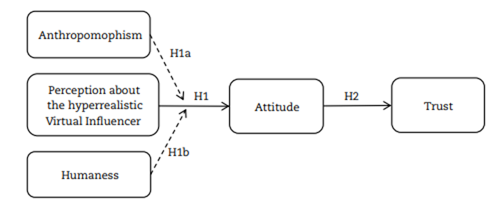
The proposed model focuses on the interaction between hyper-realistic virtual influencers and their audiences. It considers how the narratives constructed by these characters affect public trust, and the potential visual impact of hyper-realistic virtual influencers.
Methodology
Type, scope and design of the research
A conclusive descriptive research design, supported by a mixed methodology, is proposed in order to exploit the advantages and complementarities of each technique. This will provide a comprehensive understanding of the virtual influencer phenomenon. Both qualitative and quantitative techniques will be employed to ascertain whether hyperrealism influences internet users’ trust, ensuring a thorough analysis. These techniques include digital content analysis and online surveys using anonymous user data.
Hyper-realistic virtual influencer selection
Two virtual influencers, both of whom were created using artificial intelligence within the last two years, were selected to carry out the two studies. Both influencers participate in social networks as public figures and have been verified as such by the ‘Blue Check Mark’ label (Arsenyan & Mirowska, 2021). These virtual influencers (VIs) have already published content and interacted with their followers. They were selected due to their hyper-realistic features and nuances, as well as their popularity on social media, as evidenced by the number of interactions they have had in their short time on Instagram. They are shown in Figures 1 and 2 below: Fit_Aitiana and Alba Renai. They are recognised as influencers because of the simplified process by which they were created and, above all, because of the morphologically human hyperrealism of their rendering.
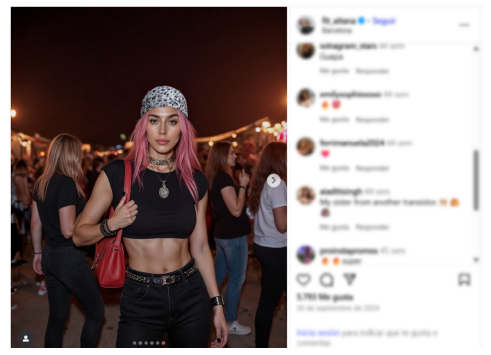
Source: Instagram profile @fit_aitana https://www.instagram.com/p/DAYtjTDigGp/?img_index=1
Figure 2 Fit_aitana, virtual influencer created using AI technology
In June 2023, The Clueless, an agency, created the first AI influencer, Fit_aitana. The first AI influencer had been born.
Number of publications: 189.
Followers: 362 thousand.
Topics: Fitness, fashion, gaming and healthy living.
Interactions: Her storytelling promotes confidence in the fitness lifestyle (3).

Source: Instagram profile @albarenai https://www.instagram.com/p/C8wy_g5MKUP/?img_index=1
Figure 3 Albarenai, virtual influencer created using AI technology
Alba Renai was created by Be A Lion, a subsidiary of Mediaset Spain.
Date of creation: July 2023.
Number of publications: 279.
Followers: 18.4 thousand.
Topics: Shares content on survival, travel and entertainment.
Interactions: As a Mediaset figure, focus is placed on creating credible, entertaining content.
These two VIs were created using the democratisation process. AI and ChatGPT were used to create the algorithms that train the AI model, which agencies then update with environmental and contextual data.
Procedures
The analysis is based on the Zeljko et al. (2018) statement that the term ‘social network’ was essentially coined to describe a social structure defined by social interactions. While interactions within social networks can provide valuable data for decision-making purposes, this data must first be collected and organised. More advanced techniques, such as data mining or web scraping, are required to achieve this.
Web scraping
The first study analysed the content of selected virtual influencer profiles on Instagram using web scraping. This technique involves collecting data from the internet (Almaqbali et al., 2019). According to Sirisuriya (2015), web scraping converts unstructured web data into a form that can be stored and analysed in a central database or spreadsheet. Khder (2021) adds:
Web scraping or web crawling is an important process in areas such as business intelligence in the modern age (…) that allows the automatic extraction of structured data (…) that is far more thorough, accurate and consistent than manual entry (p. 144) …It allows the bot to retrieve large amounts of data in a short amount of time, which is advantageous in today’s world, especially since we have big data that is constantly changing and updating. (p. 146)
Data collection and web scraping analysis
The first stage of web scraping involves collecting data from public or private sources (Chaulagain et al., 2017). In this case, data was collected based on comments and interactions from followers of the chosen virtual influencers and was then analysed. Several tools and pieces of software can facilitate customised web scraping. In this instance, Phantom Buster was used to collect and organise the data to determine its (positive or negative) polarity and to identify patterns. Both the collection and analysis were conducted under human supervision, as suggested by Krotov and Tennyson (2018), in three phases: web analysis, web crawling, and data organisation. Data collection took place in July and the analysis in September of 2024.
Online survey
The second study used an online survey to examine the impact of virtual influencers’ narratives and discourses on users’ online trust. The survey examined the relationship between perceptions of virtual influencers and their effect on human responses, feelings and attitudes. Based on validated scales from previous studies on perception of virtual influencers, the survey included questions related to anthropomorphism and humanness (Arsenyan & Mirowska, 2021), brand attitudes (Da Silva Oliveira & Chimenti, 2021) and trust (Ullman & Malle, 2019). The survey was comprised of 22 items. Each construct was measured using a 7-point Likert scale ranging from 1 (strongly disagree) to 7 (strongly agree).
The sample was selected using convenience sampling. A total of 900 followers of virtual influencers on Instagram were invited to participate in the survey via direct messages on the platform. They were informed of the survey’s objective and provided with a link to access it. To minimise potential risks to participants, they were informed at all times that their responses would be anonymous and that their data would be kept confidential. They were also asked to consent to their responses regarding recognition of the virtual influencer. To minimise error, each respondent was carefully selected. However, since these interactions also included avatars and other digital entities that give their opinions and promote their own creations, such responses were discarded. These digital entities are created by other agencies and seek to gain popularity and attract followers by appearing to be the audience of popular virtual influencers. Avatars or digital entities that appeared to be artificial or to be the exclusive followers of digital influencers were discarded; only human participants were sought.
The sample size was calculated from the total number of followers of VI Aitana and Albareda, amounting to 345,200 followers. Of this number, 40% (138,080) were eliminated because they were potential advertisers, digital entities with commercial interests or bots. The remaining 207,120 followers were considered an infinite population from a statistical perspective. This was accompanied by a 95% confidence level and an expected maximum variability of the parameters. The margin of error was 5%. The calculation was performed using the statsmodels.sta package in Python. The required sample size to achieve 95% confidence was 384; however, 900 people were invited to complete the survey, bearing in mind the low participation rate in formal social network studies. Quotas were used to ensure balanced gender and age distributions within the 18-30 age range.
Data collection and analysis of the online survey
The survey was conducted online using Google Forms in August 2024. Finally, structural equation modelling (SEM) was used to analyse the collected data and evaluate the hypothesised relationships between constructs. First, confirmatory factor analysis (CFA) was conducted to validate the scale structure (Hair et al., 2019). Then, EQS software was used to estimate the structural model, assess its fit to the data, and evaluate the relationships between latent variables (Byrne, 2013). The data was analysed and interpreted in September 2024.
Ethical considerations
The data was collected from the Instagram platform and is publicly available. This public information was web scraped. Virtual influencer profiles were chosen based on their ‘Blue Check Mark’, which recognises their public profile. Internet users who agreed to complete the online survey were informed that their data would be treated confidentially, a commitment which was honoured. Only hyper-realistic virtual influencer profiles available on Instagram were featured.
Results
The results of each technique are shown below once the methodology and processes were finalized.
Content analysis findings
The main findings for the selected virtual influencers are presented below, based on the methodology and content analysis described above. Table 1 shows the two most popular morphologically hyperreal virtual influencers on Instagram. Table 2 shows the predominant interactions with human internet users.
Table 1 Popular hyper-realistic virtual influencers on Instagram
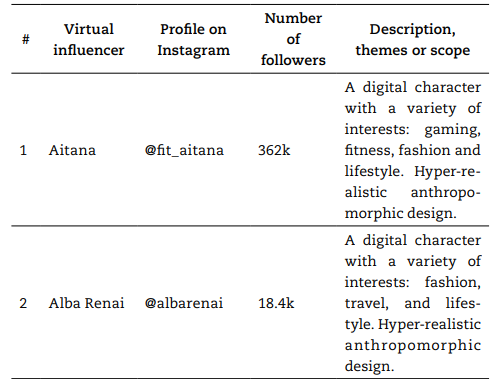
Source: Elaborated by the authors based on collected data.
Note: ‘k’ means ‘thousands’.
Table 2 Hyper-realistic, human-like virtual influencers on Instagram
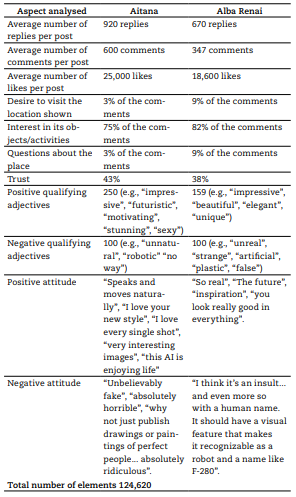
Source: Elaborated by the authors based on collected data
Note: Participating audience (the influencers’ average): 41% are Spanish, 23% are from other European countries, 21% are from the Americas, 13% are Asian and 2% are from other countries. Age: 69% are age 18-34, 22% are age 35-44, and 9% are over 45. Active human followers: 62%. Active IA followers: 38%. Publishing similar information: 12% of active human followers and 51% of active AI followers. Publishing different information: 68% of active followers
Current classifications state that virtual influencers are human-like and, given their substantial following, can be categorised as macro-influencers. Both of these virtual influencers have their own style and promote ideas and lifestyles. They are building a community on Instagram every day and may well be doing the same on other social media platforms. While these digital entities are promoted as influencers, what matters more is whether their followers trust them enough to be influenced by them.
The following patterns can be identified by observing the reactions and responses to the publications of the two VIs: (1) 52% think that the most popular pattern was admiration of the VI’s beauty, showing that followers seem to be indifferent to the discourse or text presented by the VI; (2) 31% express opinions related to the novelty or recognition of the innovation of the VI’s morphology, that is, its high human resemblance; and (3) 17% rejected the VI’s discourse, mainly for recognizing it as AI generated.
Both Aitana and Alba Renai are AI-generated influencers who were created within the last two years. They can both be seen as members of a new category. AI influencers are characterised by their rapid rise in popularity and the increasing number of influencers of this kind with their own followers and interactions.
By studying texts and reactions, and above all analysing the profiles of followers, we have identified many virtual entities that are morphologically hyperreal and almost human. However, they are relatively easy to identify due to their perfection. Many of them also exaggerate certain personality traits or excessively promote fashion.
Among the large number of human followers of the two virtual influencers studied, two positions can currently be confirmed: (1) acceptance, admiration and appreciation of the digital influencer’s presence, and (2) denial and criticism. Some even predict a disastrous future for humanity due to the artificial nature of the virtual entity. Neither of these positions makes it possible to clearly identify the level of trust in the virtual entity.
To validate the information, investigator triangulation was carried out. According to Carter et al. (2014), this involves two or more researchers participating in the same study and providing multiple observations. This results in a richer understanding and more robust conclusions. The following process was followed: (1) comparison of quantitative and qualitative data; (2) observations by researchers; (3) temporal analysis; (4) cross-verification between researchers. Cohen’s kappa coefficient was calculated to measure inter-coder agreement, yielding a value of 0.77 or a high level of agreement.
Triangulation revealed that: (1) higher engagement with human-like influencers was associated with admiration for their realistic appearance; (2) AI influencers sparked more conversations about technology; (3) AI influencers generated more discussions about reality; (4) the number of comments appreciating the perfection of the observed virtual influencers increased by 9%; and (5) 13% of comments mentioned social and/or ethical issues related to AI.
The analysis revealed that videos are more likely to receive likes than photographs. Regardless of the content, internet users do not comment much on either. However, photographs and videos generate more comments and participation, but the comments do not demonstrate trust. The findings suggest that hyper-realistic virtual influencers can elicit admiration and acceptance, and amaze people with the technological advances achieved. This could have implications for how brands and marketers use different types of virtual influencers in their campaigns.
Survey findings
Of the administered questionnaires, 577 valid responses were received, amounting to a response rate of 64.1%. The final sample was comprised of 55% women and 45% men with an average age of 26.7 years (SD = 4.1). The models’ goodness-of-fit indices indicate satisfactory results, with the NFI, NNFI, CFI and IFI all around 0.80, approaching the ideal threshold of 0.90 (Hair et al., 2005). The univariate and multivariate normality of the data was assessed. Skewness (-1.20 to 1.42) and kurtosis (-1.75 to 1.98) were within the acceptable range of ±3 (Kline, 2023). The Mardia coefficient for multivariate kurtosis was 66.78, which is below the critical threshold of 70 (Rodríguez & Ruiz, 2008).
Confirmatory factor analysis (CFA) revealed that the measurement model was well-fitting. The results were as follows: χ²/df = 3.06; CFI = 0.94; TLI = 0.91; RMSEA = 0.061 (90% CI: 0.048-0.060); and SRMR = 0.041. These values correspond to the thresholds recommended by Hu and Bentler (1999): CFI and TLI > 0.95, RMSEA < 0.06, and SRMR < 0.08.
Furthermore, an RMSEA value of 0.061 indicates a good fit, as it is below the recommended threshold of 0.08 (Steiger, 1990). This demonstrates that the structural model fits the data well.
Reliability was assessed using three analytical methods: (1) Cronbach’s alpha (CA): values consistently exceeded 0.7 (Nunnally & Bernstein, 1994), indicating good internal consistency; (2) the composite reliability (CR) analysis for all constructs exceeded the threshold of 0.70 suggested by Carmines and Zeller (1979) and Fornell and Larcker (1981), with values ranging from 0.85 to 0.94; and (3) an Average Variance Extracted (AVE) analysis was performed. The results were 0.69 for Perceptions of Virtual Influencers and 0.78 for Attitudes. Since the AVE for each construct was at least 0.5 -the threshold suggested by Fornell and Larcker (1981)- discriminant validity was confirmed, as the square root of the AVE for each construct was more significant than its correlations to other constructs.
All individual factor loadings exceed 0.6 (Bagozzi & Yi, 1988) and Cronbach’s alpha values for each factor exceed 0.70 (Nunnally & Bernstein, 1994). Furthermore, the composite reliability (CR) values are above 0.70 (Carmines & Zeller, 1979), and the average standardised factor loadings are close to or above 0.7 (Currás, 2007). Together, these findings confirm the convergent validity of the proposed model. Table 3 details the hypothesis testing.
Table 3 Hypothesis testing
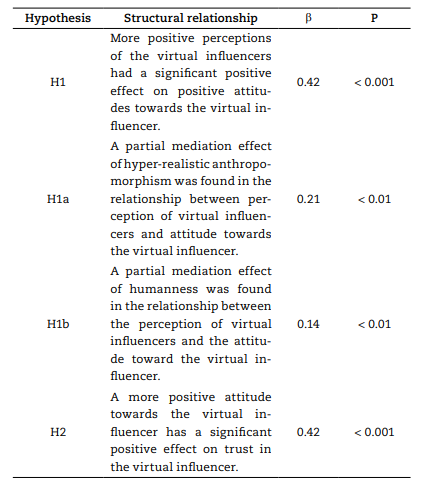
The structural model was a good fit: χ2/ df=3.06, CFI=0.94, TLI=0.91, RMSEA=0.061 (90% CI: 0.048-0.060), SRMR=0.041.
Source: Elaborated by the authors based on collected data.
In the structural model, it is important to note that a partial mediation effect was found in the relationship between perceptions of virtual influencers based on hyper-realistic anthropomorphism and perceived influencer novelty. The overall indirect effect was significant (β=0.35, p < 0.001), with significant indirect effects identified via hyper-realistic anthropomorphism (β=0.21, p < 0.01) and humanness (β=0.14, p < 0.01).
These results support all of the proposed hypotheses, indicating that anthropomorphism and humanness play a significant role in understanding the impact of hyper-realistic virtual influencers on internet users’ attitudes. Consequently, positive attitudes have a direct and positive effect on trust, meaning positive attitudes lead to positive trust, and vice versa. These results are consistent with the expected outcomes based on the hypotheses.
Discussion
As Sanz-Marcos et al. (2024) confirmed, research on virtual influencers is a relatively new field. However, it is expanding rapidly, particularly with regard to the impact of virtual influencers on internet users. Many studies, including this one, use qualitative methods such as analysing the content of social media to examine the behaviour of virtual influencers and their effects. This approach is consistent with that of previous studies, as noted by Sanz-Marcos et al. (2024).
Studies like the one by Liu and Lee (2024) have compared the sense of responsibility displayed by human and virtual influencers. They conducted online experiments examining attitudes and intentions towards various brands and observed perception as a mediator. The study found that human users were more likely to attribute endorsement success to human influencers than to virtual ones. Conversely, virtual influencers were perceived as being less responsible for endorsement outcomes.
Arsenyan and Mirowska (2021) observed that human users employed more positive and fearful language when interacting with virtual influencers alongside real ones. Similarly, Pérez-Sánchez et al. (2024) found that this effect was even more pronounced when virtual influencers exhibited more human-like expressions. This study contributes to existing literature by emphasising the impact of hyper-realistic virtual influencers, whose highly realistic appearance provokes polarised responses from their audience ranging from strong agreement to strong disagreement.
Zeljko et al. (2018) emphasise that technology has become an integral part of everyday life and that companies are increasingly using social media platforms to reach a wider audience. Their research found that 75% of respondents were familiar with influencers and their role in digital marketing. However, the popularity of virtual influencers is still growing and must be monitored closely as they continue to gain visibility. In the current AI era, new proposals must be studied.
The findings of this study are consistent with previous research on trust in influencer marketing. For instance, Pérez-Sánchez et al. (2024) propose that the hyper-realistic appearance of virtual influencers may either facilitate or impede the development of trust among users. Their perfect features create a paradox that calls their ‘reality’ into question, resulting in mixed reactions from their audience.
Fowler and Thomas (2023) confirm that influencer marketing has grown significantly in line with the growth of social networks. As Statista (2025) shows, social media usage continues to rise, making it increasingly important for brands to carefully manage their relationships with internet users. Although metrics such as cost per engagement (CPE) are becoming more standardised, measurement of the success of virtual influencer campaigns is still in its early stages, highlighting the need for further development in this area.
Virtual influencers, in particular, require careful development to build credibility and trust with their audience. They must produce original and honest content to enhance their credibility, as a lack of transparency can negatively affect perceptions of authenticity. This work builds on the contributions of Bahar and Hasan (2024), Kim et al. (2024), and Liu and Lee (2024), who also aimed to advance knowledge in the field of virtual influencer research as a digital marketing strategy.
Conclusions
This study builds upon the exploration of virtual influencers on social media, focusing particularly on how hyper-realistic morphology influences trust among internet users. The research team collected and analysed quantitative and qualitative data using a combination of surveys and web scraping to reveal key insights. Despite their hyperrealism, trust in the communications of these virtual influencers remains elusive. Users often scrutinise influencer content, pointing out errors in images or text, and negative attitudes persist.
It is important to recognise that influencer marketing is evolving rapidly, involving a combination of human and non-human participants. However, success in this field depends on quality, trust and credibility. This research sheds light on the role of hyper-realistic virtual influencers in fostering public trust, offering insights to help improve digital marketing strategies. User-generated content (UGC) plays a key role in shaping audience attitudes and credibility. When evaluating influencer success, it is important to prioritise engagement metrics such as user interactions and feedback.
From a practical standpoint, 63% of companies intend to utilise AI in their marketing campaigns, and 85% of these believe in its effectiveness (Influencer Marketing Hub, 2025). Therefore, before developing marketing strategies, brands must clearly define their mission, vision and values. It is also essential that organisations select influencers based on thorough audience segmentation and make informed decisions when doing so.
The following recommendations are proposed for companies wishing to integrate virtual influencers (VIs) into their marketing strategies, especially in view of current trust issues: (1) authenticity in design and message: based on the work of Ju et al. (2024), the more authentic and hu man a VI appears, the stronger the connection it will have with consumers. For instance, users tend to favour hyper-realistic VIs and those created by non-brand agencies, which highlights the importance of perceived authenticity in the digital space; (2) transparency in creation: According to Kim et al. (2024), transparency in VI creation is important because the perception of these influencers varies depending on their design, which affects the response of the target audience. Therefore, it is important to share as much information as possible to encourage internet users to interact comfortably with the VI; (3) collaboration with real influencers: Following Haikel-Elsabeh’s (2023) research, combining the presence of the VI with that of real influencers is important. This enables brands to reach a wider audience, experiment with creative content and build richer discourse; (4) active and sincere interaction with users: As Dondapati and Dehury (2024) have demonstrated, it is essential to maintain an authentic VI personality in order to influence consumer behaviour and reinforce the notion that the VI is ‘alive’ and engaged, particularly among audiences that are less familiar with social networks. Therefore, it is important to encourage interaction between the VI and its followers; and (5) constant evaluation and adaptation: Based on Gräve’s (2019) work, VI monitoring metrics should be used, as with social media influencers. This shows companies are attentive to their audience’s needs and can respond quickly to build trust with users.
In terms of the ethical risks associated with the use of virtual influencers, the following are highlighted: (1) lack of ethical accountability. According to Liu and Lee (2024), virtual influencers (VIs) may be perceived as less accountable than real influencers. For example, they may be held less accountable for unethical behaviour or the promotion of products/services; (2) inequality of representation: Levkov et al. (2024) argue that it is important to recognize that VIs may perpetuate stereotypes that do not reflect societal diversity. This makes it challenging for VIs to create inclusive content for different ethnic groups; (3) misinformation and deception: Bahar and Hasan (2024) contend that influencers can exploit misinformation to establish long-term credibility on social networks. This can lead consumers to believe their messages and make purchasing decisions based on false information; (4) exploitation of personal data: Garro and Zamora (2023) emphasize the importance of safeguarding privacy and consent regarding personal data. Therefore, to ensure the protection of personal data, it is important to analyse the relevant legal factors from the perspectives of consumption and regulatory control; and (5) manipulation of reality perception: According to Choudhry et al. (2022), VIs can strongly influence the identity and personal image of their followers. It is therefore crucial to emphasize to young audiences that VIs sometimes present an idealised and unrealistic image of themselves.
The phenomenon of digital entities participating in influencer marketing is still in its infancy, particularly for those created using artificial intelligence. This technology is no longer the exclusive domain of professional creative agencies, as it is also being explored by individuals interested in monetising content. The democratisation of AI means that a greater number of people are able to create virtual entities that closely mimic human influencers in the way they engage with audiences (Kuo & Le, 2025). However, recent studies in more specific settings, such as those conducted by Zhang et al. (2025), suggest that virtual influencers are often perceived as outsiders who lack cultural understanding. Guo et al. (2025) have also investigated the impact of virtual influencers on the relationship between brands and their followers. This is a phenomenon that must be constantly monitored. Hyper-realistic VIs are particularly effective at driving engagement (Gou et al., 2025) and surpass other formats, such as narratives. Nevertheless, despite their growing popularity and potential, the effectiveness of virtual influencer endorsements remains uncertain (Gou et al., 2025). Most approaches to studying VIs advance the study of constructs such as attitude, long-term relationships, brand image, brand concept and brand loyalty based on VI promotional activities and in consideration of the progress made thus far. In line with Fowler and Thomas (2023), future research should also examine the ethics of influencer marketing and assess its long-term effectiveness.1 2 3

