




 English (pdf)
 Article in xml format
 Article references

 Automatic translation
 Send this article by e-mail
 Cited by SciELO
 Cited by Google
 Similars in
SciELO
 Similars in Google

 Permalink


Introduction
Cardiac arrhythmias are defined as disturbances in the generation and/or conduction of the electrical impulse in the myocardium [1]. They are characterized by abnormal heart rhythm and can be classified as tachyarrhythmias or bradyarrhythmias depending on heart rate [2]. Atrial fibrillation (AF) is among the most common cardiac arrhythmias, with an estimated global prevalence of 0.5%, particularly affecting people between 55 and 64 years of age [3]. The rising incidence of this type of disease makes it a major challenge for public health, both in developed and developing countries [4-6].
The risk of developing arrhythmias increases with age and is higher in men than in women. Risk factors including obesity, hypertension, diabetes, smoking, alcohol consumption, and sedentary lifestyle further contribute to their incidence [4]. Arrhythmias are multifactorial in origin, with varying degrees of severity and clinical consequences [1]. They can occur in both asymptomatic individuals and in patients with underlying conditions, making their diagnosis frequently incidental [7].
In Colombia, cardiovascular disease remains the leading cause of death [8]. Cardiac arrhythmias are among the most common causes of mortality in primary care centers and emergency departments, representing a frequent diagnostic and therapeutic challenge for healthcare professionals in terms of diagnosis and management [9]. Despite their clinical importance, arrhythmias -other than AF- have been insufficiently studied as a group in the local context. For instance, the estimated prevalence of AF in the Colombian population over 60 years of age is 1.6% [10]. However, data on how arrhythmias are diagnosed and managed in emergency care settings remain scarce.
While international guidelines provide recommendations for patient monitoring and management, there is currently no national clinical practice guideline in Colombia. As a result, emergency department physicians do not have a standardized framework for the timely diagnosis and treatment of arrhythmias in the local context. This gap may contribute to variability in clinical decision-making, limit adherence to evidence-based practices, and compromise patient safety. Therefore, establishing appropriate strategies for early detection and management is essential to prevent complications and reduce healthcare costs [3].
Given the limited information on the diagnostic and therapeutic approaches to arrhythmias at the local level, we conducted an exploratory study to describe the current diagnostic and therapeutic practices for cardiac arrhythmias in the emergency department of a tertiary care hospital in Pereira, Colombia, during the period 2023-2024. By documenting current practices, this study aims to provide baseline real-world information that can inform future efforts to standardize care, improve patient care, and guide the development of local protocols.
Method
A quantitative, cross-sectional, descriptive observational study was conducted at a tertiary care hospital in Pereira, Colombia, which serves as a referral center for patients from Risaralda and northern Valle del Cauca. This tertiary care hospital has a capacity of 535 beds. The emergency department, with 107 adult beds, receives an average of 182 patients daily, including high-complexity cases such as severe trauma, acute cardiovascular disease, and critical infections. The study period extended from November 2023 to May 2024.
The study population comprised all adult patients (≥18 years) diagnosed and treated for cardiac arrhythmias in the emergency department during the study period. A total of 40 patients were identified. To ensure complete case identification, a member of the research team attended the emergency department daily to screen for eligible patients. All patients had an electrocardiogram (ECG) performed at admission, which was used by the treating physician for diagnosis and management. Pregnant women were excluded a priori, though none were encountered during the study period.
Data was collected using a structured digital instrument developed by the research team. Variables collected included sociodemographic and clinical characteristics, type of arrhythmia, comorbidities, management approaches, therapies administered, and treatment responses. All patients had complete medical records regarding the study variables; no patients were excluded for missing data. However, only 33 patients had the original ECG recordings available to the research team for detailed review and assessment of diagnostic and therapeutic adequacy.
For these 33 cases, whose ECG recordings were available, arrhythmia diagnoses and corresponding treatments were reviewed in detail. The ECGs were independently interpreted by one internal medicine resident and one internal medicine specialist. In cases of discrepancy, both reviewers re-evaluated the ECG jointly until consensus was reached. Diagnostic accuracy and appropriateness of treatment were evaluated according to the recommendations of the Spanish Society of Cardiology’s clinical practice guidelines for cardiac arrhythmias [11] and other relevant international guidelines [12,13].
Data were tabulated using Microsoft Excel and analyzed using SPSS version 26.0. Descriptive statistics were applyed: frequencies and proportions were reported for qualitative variables, and measures of central tendency and dispersion for quantitative variables. No inferential statistical analyses were conducted, as the study aimed to provide a descriptive overview of local diagnostic and therapeutic practices. Treatment patterns and combinations were visualized using the UpSet library (version 0.6.1) in Python, and Sankey diagrams were created in R (version 4.3.2) using the Sankey library.
This study adhered to the ethical principles of autonomy, beneficence, nonmaleficence, and justice, in accordance with the Declaration of Helsinki. Data was handled confidentially, accessed only by the research team and used solely for academic purposes. The research was classified as “risk-free” according to Resolution 8430 of 1993 by the Colombian Ministry of Health and did not require informed consent (no direct contact with any patient was made). Ethical approval was obtained from the Bioethics Committee of the Universidad Tecnológica de Pereira (code: 65-260623; June 2023) and the hospital’s Research Committee (September 2023).
Results
A total of 40 patients were included in the study, and none were excluded due to missing data. The mean age was 71.5 years (standard deviation [SD]: 14.1; range: 25-95 years), and most were male (n = 26; 65.0%). Nearly all patients were mestizo (n = 39; 97.5%), with Pereira being the main city of origin (n = 15; 37.5%). Additionally, 65.0% (n = 26) of the patients were referred from other healthcare units. The most frequent comorbidities were hypertension (n = 30; 75.0%) and heart failure (n = 12; 30.0%). Additionally, 10.0% of patients (n = 4) had no prior comorbidities before the arrhythmia episode (Table 1).
Table 1 Sociodemographic characteristics and comorbidities of patients with cardiac arrhythmias presenting to the emergency department (n = 40).
| Variable | n = 40 | % |
|---|---|---|
| Age (years) | ||
| Mean (SD) | 71.5 (14.1) | |
| 65 years or older | 31 | 77.5 |
| Sex | ||
| Male | 26 | 65.0 |
| Female | 14 | 35.0 |
| Race | ||
| Mestizo | 39 | 97.5 |
| Indigenous | 1 | 2.5 |
| City of residence | ||
| Pereira | 15 | 37.5 |
| Dosquebradas | 5 | 12.5 |
| Santa Rosa de Cabal | 4 | 10.0 |
| Other | 16 | 40.0 |
| Comorbidities | ||
| Hypertension | 30 | 75.0 |
| Heart failure | 12 | 30.0 |
| Type 2 diabetes mellitus | 8 | 20.0 |
| COPD | 6 | 15.0 |
| CKD | 5 | 12.5 |
| Hypothyroidism | 5 | 12.5 |
| Ischemic heart disease | 4 | 10.0 |
| Dyslipidemia | 4 | 10.0 |
| Atrial fibrillation | 3 | 7.5 |
| Venous insufficiency | 2 | 5.0 |
| Stroke | 2 | 5.0 |
| Cancer | 1 | 2.5 |
| Other | 6 | 15.0 |
| No other history | 4 | 10.0 |
Note. SD: standard deviation; COPD: chronic obstructive pulmonary disease; CKD: chronic kidney disease
Among the clinical characteristics at admission in patients diagnosed with cardiac arrhythmias, the most common symptoms were dizziness (n = 21; 52.5%) and chest pain (n = 20; 50.0%). Most patients met hemodynamic stability criteria (n = 31; 77.5%). A majority (n = 24; 60.0%) underwent a set of paraclinical tests, including complete blood count, ECG, and troponin levels. After the initial evaluation, 90.0% (n = 36) were diagnosed with tachyarrhythmias, with AF (n = 21; 52.5%) and supraventricular tachycardia (n = 9; 22.5%) being the most frequently identified arrhythmias (Table 2). For those patients with AF, the mean CHA₂DS₂-VASc Score was 3.4 (SD: 1.4) and 90.5% (n = 19/21) had a score ≥2. The mean HAS-BLED score for these patients was 1.7 (SD: 0.8), 14.2% (n=3) with a score of three.
Table 2 Clinical presentation, arrhythmia types, and diagnostic characteristics of patients with cardiac arrhythmias in the emergency department.
| Variable | n = 40 | % |
|---|---|---|
| Symptoms | ||
| Dizziness | 21 | 52.5 |
| Chest pain | 20 | 50.0 |
| Palpitations | 14 | 35.0 |
| Diaphoresis | 13 | 32.5 |
| Syncope | 4 | 10.0 |
| Patient stability | ||
| Stable | 31 | 77.5 |
| Unstable | 9 | 22.5 |
| Clinical tests | ||
| Electrocardiogram (ECG) | 40 | 100.0 |
| Complete blood count (CBC) | 37 | 82.5 |
| Transthoracic echocardiography | 31 | 77.5 |
| Troponins | 25 | 62.5 |
| Combined evaluation (ECG, CBC, Troponins) | 24 | 60.0 |
| Natriuretic peptides | 1 | 2.5 |
| Initial diagnosis | ||
| Atrial fibrillation | 21 | 52.5 |
| Supraventricular tachycardia | 9 | 22.5 |
| Ventricular tachycardia | 5 | 12.5 |
| Complete AV block | 2 | 5.0 |
| First-degree AV block | 1 | 2.5 |
| Second-degree AV block | 1 | 2.5 |
| Atrial flutter | 1 | 2.5 |
| Final diagnosis (n=33)* | ||
| Atrial fibrillation | 11 | 33.3 |
| Supraventricular tachycardia | 6 | 18.2 |
| Atrial flutter | 6 | 18.2 |
| Ventricular tachycardia | 4 | 12.1 |
| Sinus tachycardia | 3 | 9.1 |
| First-degree AV block | 2 | 6.1 |
| Complete AV block | 1 | 3.0 |
Note. AV: Atrioventricular.*Final diagnosis determined only for the 33 patients with an available admission electrocardiogram. Percentages are calculated based on this subgroup (n=33).
Transthoracic echocardiography (TTE) was performed in 31 patients (77.5%), whereas none underwent transesophageal echocardiography (TEE). The mean left ventricle ejection fraction was 52.9% (SD: 18.5%; range: 12.0-72.0%) and the mean left atrial volume indexed to body surface area (LAVI) was 56.0 mL/m2 (SD: 23.1 mL/m2; range: 26.0-120 mL/m2). Only three patients presented with an intracavitary thrombus (9.7% of those with TTE), all of whom had AF or atrial flutter.
The majority of patients received pharmacological therapy (n = 24; 60.0%), while 15.0% (n = 6) required electrical therapy, and 25.0% (n = 10) did not receive any specific treatment. Of note, all patients who did not receive treatment were classified as stable at admission. The most frequently used pharmacological agents were oral metoprolol (n = 11; 27.5%) and intravenous amiodarone (n = 5; 12.5%). Among those who underwent electrical therapy, synchronized cardioversion was the most commonly applied technique (n = 5; 83.3%). Of the five patients who underwent electrical cardioversion, four had prior TTE. All of them were clinically unstable, and none had evidence of thrombi.
Following medical management, 50.0% of patients (n = 20) achieved heart rate control and clinical improvement. Additionally, no fatal outcomes were reported during a one-week follow-up period (Table 3). The distribution and combinations of pharmacological and supportive therapies used in all cases (n = 40) are depicted in Figure 1. The UpSet visualization highlights the most frequent single therapies and combinations, providing an overview of the patterns of care in the emergency department.
Table 3 Management strategies, therapies administered, and response to treatment in patients with cardiac arrhythmias in the emergency department.
| Variable | n = 40 | % |
|---|---|---|
| Pharmacological Therapy (Dose and Route) | 24 | 60.0 |
| Metoprolol, oral | 11 | 27.5 |
| 50 mg | 6 | 15.0 |
| 100 mg | 3 | 7.5 |
| 15 mg | 1 | 2.5 |
| Carvedilol, oral | 6 | 15.0 |
| 12.5 mg | 4 | 10.0 |
| 25 mg | 1 | 2.5 |
| 3.125 mg | 1 | 2.5 |
| Amiodarone, IV | 5 | 12.5 |
| 150 mg | 1 | 2.5 |
| 200 mg | 1 | 2.5 |
| 300 mg | 3 | 7.5 |
| Adenosine, 6 mg IV | 2 | 5.0 |
| Atropine, 1 mg IV | 1 | 2.5 |
| Norepinephrine, 4 mg IV | 1 | 2.5 |
| Electrical therapy | 6 | 15.0 |
| Cardioversion | 5 | 12.5 |
| Transcutaneous pacing | 1 | 2.5 |
| Valsalva maneuver | 2 | 5.0 |
| No therapy provided | 10 | 25.0 |
| Response to management | ||
| Rate controlled and clinical improvement | 20 | 50.0 |
| Restoration of sinus rhythm | 16 | 40.0 |
| Persistent arrhythmia | 2 | 5.0 |
| Clinical deterioration | 2 | 5.0 |
Note. IV: intravenous
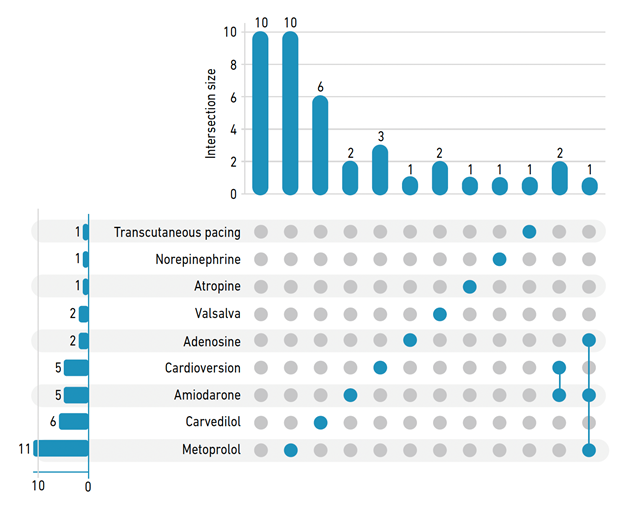
Note: This UpSet plot shows the distribution and combinations of pharmacological and general therapies administered to all 40 patients presenting with cardiac arrhythmias in the emergency department. The bottom matrix of dots represents individual therapies or management categories. A single dot alone indicates patients who received only that therapy. Connected dots represent combinations of therapies administered to the same patients. The vertical bars above each column indicate the number of patients receiving the corresponding therapy or combination.
Figure 1 Patterns of pharmacological and general management in patients with cardiac arrhythmias (n=40).
A total of 17.5% of patients (n = 7) did not have the admission ECG available at the time of the study evaluation and were therefore excluded from the subanalysis assessing the accuracy of diagnosis and appropriateness of management. Among the remaining patients (n = 33), AF was confirmed in 33.3% (n = 11), and supraventricular tachycardia in 18.2% (n = 6), highlighting discrepancies compared to the initial diagnoses documented in the medical records (Table 2, Figure 2).
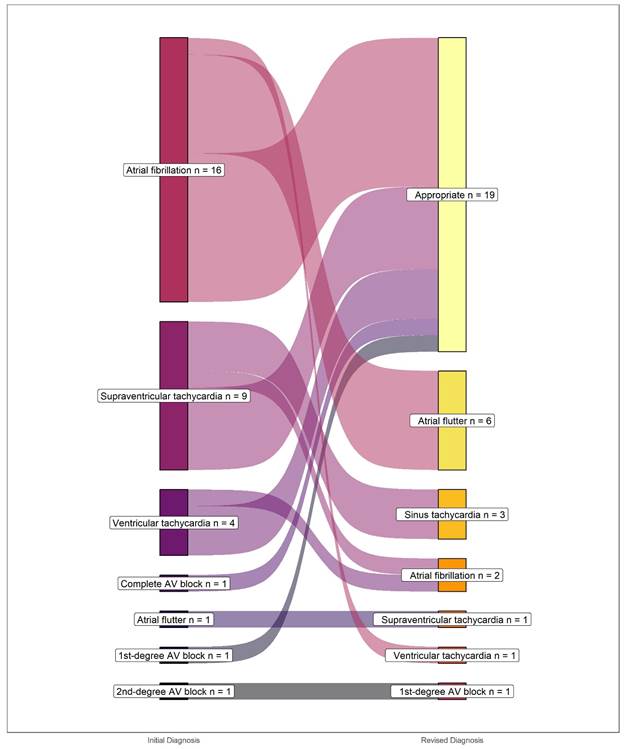
Note. AV: Atrioventricular. This Sankey diagram illustrates the correspondence between the initial arrhythmia diagnoses made by emergency physicians and the final diagnoses established by the research team after ECG review. The width of each flow represents the number of patients following a specific diagnostic path.
Figure 2 Cross-evaluation of initial and final diagnoses in patients with available electrocardiogram (ECG) (n=33).
In this subgroup, 57.6% (n = 19) of the initial diagnoses were confirmed as accurate. Among the most frequent arrhythmias, AF was accurately diagnosed in 56.3% (n = 9) of cases, and supraventricular tachycardia in 55.6% (n = 5) (Table 4, Figure 2). Regarding therapeutic management, 54.5% (n = 18) of patients received appropriate treatment consistent with clinical practice guidelines (Table 4). The Sankey diagram (Figure 2) visually illustrates the correspondence between initial and final diagnoses.
Table 4 Initial diagnostic evaluation and medical management in patients with available electrocardiogram (n = 33).
| Variable | n = 33 | % | Accurate diagnosis (n) | Appropriate management (n) | ||
|---|---|---|---|---|---|---|
| n | %* | n | %* | |||
| Initial diagnosis | ||||||
| Atrial fibrillation | 16 | 48.5 | 9 | 56.3 | 10 | 62.5 |
| Supraventricular tachycardia | 9 | 27.3 | 5 | 55.6 | 5 | 55.6 |
| Ventricular tachycardia | 4 | 12.1 | 3 | 75.0 | 0 | 0.0 |
| Atrial flutter | 1 | 3.0 | 0 | 0.0 | 1 | 100.0 |
| First-degree AV block | 1 | 3.0 | 1 | 100.0 | 1 | 100.0 |
| Second-degree AV block | 1 | 3.0 | 0 | 0.0 | 1 | 100.0 |
| Complete AV block | 1 | 3.0 | 1 | 100.0 | 0 | 0.0 |
Note. AV: Atrioventricular. *Percentages calculated within rows. This table includes only 33 patients whose electrocardiogram recordings were available for review by the investigators. Variables include diagnostic accuracy and appropriateness of management based on guideline recommendations.
Discussion
This study described the spectrum of cardiac arrhythmias diagnosed in the emergency department of a tertiary care hospital and the therapeutic approaches used for their management. Beyond characterizing local patterns, the findings underscore significant issues related to diagnostic accuracy and treatment adequacy in a high-demand emergency care setting. Recognizing these factors can facilitate the evaluation of current diagnostic and therapeutic practices and serve as a foundation for developing institutional strategies aimed at improving the accurate identification and evidence-based management of arrhythmias. In addition, the results have practical implications for the local health system, particularly the need to establish standardized protocols and to strengthen continuing education in arrhythmia management. The study may be of particular interest to general practitioners, emergency physicians, internal medicine specialists or cardiologists directly involved in patient care, as well as to health policy makers responsible for implementing institutional and regional improvements in cardiovascular care.
The mean age of patients with arrhythmias in this study was comparable to that reported in previous Colombian research on antiarrhythmic drug use [14] and to findings in Bosnia and Herzegovina, where the mean age was 68 years [15]. A predominance of male patients was observed, consistent with findings from other studies on populations with AF [16-18], which was also the most frequently diagnosed arrhythmia in the present study. However, this contrasts with the results reported by Rojas et al. in Cuenca, Ecuador, where arrhythmias were more commonly diagnosed in women [19].
Most patients included in this study presented at least one comorbidity, with hypertension and heart failure being the most frequent. These findings are consistent with those reported by Naser et al., where 84% of patients had at least one concomitant condition, and hypertension and heart failure were present in 76% and 27% of cases, respectively [15]. However, our results slightly differ from those of Rojas et al., who reported a lower prevalence of hypertension (44%) among their patients [19]. These results highlight that cardiac arrhythmias, particularly AF, are commonly accompanied by comorbidities that not only contribute to their development but also complicate their clinical management.
The most frequent clinical manifestations were dizziness, chest pain, and palpitations -symptoms typically described as mild [20] and frequently reported as predominant in patients presenting with arrhythmias in emergency settings [21]. The ECG remains the primary diagnostic tool for suspected cardiac arrhythmias [12], consistent with our study, where all patients underwent ECG evaluation, often accompanied by a complete blood count and troponin measurement. Nevertheless, our results revealed a high rate of diagnostic discrepancies, suggesting that availability of the test alone does not guarantee accurate interpretation. This emphasizes the importance of strengthening both training in ECG interpretation and standardized diagnostic protocols in emergency departments.
As reported in literature, AF was the most common arrhythmia, accounting for nearly 50% of cases, consistent with findings from other studies [19,21]. This reinforces that AF is the cardiac arrhythmia with the highest prevalence and incidence both in Colombia and globally. However, it is noteworthy that among patients diagnosed with AF in this study, only 56% were accurately classified, with atrial flutter being the most common alternative diagnosis. Although management of AF and atrial flutter is largely similar according to current guideline recommendations [12], initial misclassification may delay appropriate therapeutic decisions in more complex cases.
Regarding treatment, pharmacological therapy was the predominant approach, with beta-blockers being the most commonly prescribed medications, followed by amiodarone. This pattern aligns with the findings of Berge et al., who reported that 63% of symptomatic patients with AF received rhythm control therapy, with amiodarone and beta-blockers being used in 56% and 27% of cases, respectively [16]. Similarly, this corresponds with the antiarrhythmic medication usage pattern described in Colombia [14]. However, unlike findings in the literature [22], drugs such as propafenone or calcium channel blockers were not administered to any patient in our study, which may be partly explained by the limited sample size. Additionally, it is notable that more than 20% of patients did not receive any specific treatment for their cardiac arrhythmia. This therapeutic gap is worrisome, as timely management is critical to reduce the risk of cardiovascular complications [16] and highlights the need to strengthen adherence to guideline-based protocols in emergency care.
Consistent with recommendations from the Spanish Society of Cardiology [11] and other clinical practice guidelines [12,13], this study identified that over 40% of cardiac arrhythmias were misdiagnosed, and approximately half of the treatments administered were inappropriate. This is concerning, as Baquero et al. emphasize that correctly identifying rhythm disturbances on an ECG is a critical first step in arrhythmia management [22]. Moreover, incorrect diagnosis and improper treatment can lead to adverse patient outcomes, including death [20]. Strengthening emergency care practices, specifically arrhythmias approach, should be directly aligned with regional health priorities, such as reducing cardiovascular morbidity and mortality.
Diagnostic and therapeutic errors likely reflect not only individual clinician performance but also systemic and educational gaps. A systematic review of diagnostic errors in emergency departments highlights that overcrowding, high patient volumes, and atypical case presentations contribute to diagnostic mistakes [23]. At the same time, limited physician training in ECG interpretation has been shown to affect accuracy [24]. These findings suggest that both institutional strategies aimed at reducing emergency department overload and, as stated previously, targeted ECG training programs may be key factors to mitigate misdiagnosis and improve patient outcomes.
This observational study has several limitations. First, the data was obtained from a limited sample of patients at a single tertiary care hospital, which restricts the generalizability of the findings to other regions or healthcare settings. Second, admission ECGs were not available for detailed review for all patients, which reduced the evaluable sample and limited the assessment of diagnostic accuracy. Third, long-term follow-up data is not available, which precludes evaluation of clinical outcomes and the persistence of therapeutic strategies over time. Fourth, information regarding other comorbidities, such as obesity, was not available, and important aspects of arrhythmia management, including anticoagulation therapy for patients with AF, were not evaluated. Finally, relevant predictors of diagnostic errors, such as provider fatigue, emergency department crowding or time of clinical experience, were not measured, which may have influenced the observed results.
Conclusions
This study identified critical gaps in the diagnostic and therapeutic management of cardiac arrhythmias in the emergency department of a local institution, where atrial fibrillation was the most frequently identified diagnosis. While most patients received appropriate care, a significant proportion were diagnosed and managed in ways that potentially diverged from clinical practice guidelines. These findings indicate the clinical relevance of strengthening diagnostic accuracy and therapeutic decision-making, such as through structured ECG training or specific protocol development. Given the descriptive and single-center nature of the study, further research is needed to explore this issue in greater depth, including the role of continuing medical education and additional variables not addressed in the present study.

