




 Article in xml format
 Article references
 Automatic translation
 Send this article by e-mail
 Cited by SciELO
  Cited by Google
  Similars in
SciELO
Similars in
SciELO  Similars in Google
 Permalink

Introduction
Population aging is a defining demographic feature of the 21st century, resulting from advances in living conditions and healthcare. However, it is also accompanied by an increase in the prevalence of non-communicable diseases (NCDs) among older adults [1]. NCDs represent a significant burden for health systems worldwide, including cardiovascular diseases, metabolic diseases, chronic respiratory diseases, and cancer. In older adults, these conditions, if not treated adequately and promptly, often lead to complications and adverse outcomes that compromise independence and autonomy [2].
Globally, the incidence of diabetes has quadrupled over the past three decades, mainly due to type 2 diabetes mellitus (T2DM). In 2022, an estimated 828 million individuals were living with diabetes, resulting in 1.8 million deaths. Approximately 80% of diabetes-related deaths occurred in low- and middle-income countries, primarily affecting individuals of working age [3]. In Central and South America, 29.6 million people live with diabetes, of whom 11.5 million remain undiagnosed. In Colombia, diabetes ranked among the top three causes of mortality between 2005 and 2014. By 2030, the Colombian population is projected to experience a 54% increase in diabetes incidence. National epidemiological reports consistently place diabetes among the top five causes of overall mortality, with higher prevalence in urban compared to rural areas, and disproportionately affecting women [4].
Given this growing burden, understanding factors that influence disease progression and complications becomes increasingly important. In this context, the concept of frailty is particularly relevant for explaining diabetes-related complications. Frailty is an aging-related syndrome characterized by reduced physiological reserve. This translates into an increased risk of disability, loss of musculoskeletal endurance, and greater vulnerability to adverse events, ultimately leading to higher morbidity and mortality [5]. Additionally, cardiovascular capacity naturally declines with age, with an approximate 10% reduction per decade in sedentary individuals and up to 15% in those between 50 and 75 years old. Aerobic capacity is a key determinant of general health, as it directly reflects the functional status of cardiovascular, endocrine, and pulmonary systems [6].
This physiological decline underscores the importance of physical activity and exercise as core components of health maintenance in older adults. Physical activity is defined as any bodily movement produced by skeletal muscles that requires energy expenditure [7]. Exercise refers to planned, structured, and repetitive motor activity performed with the aim of improving or maintaining health, well-being, and physical fitness [8]. Although aging is inevitable, the concept of successful aging highlights the role of exercise as a critical strategy for preserving health, maintaining independence, and preventing disability. Regular, guided exercise enables individuals to age with greater energy, improved performance of daily activities, enhanced coordination, posture, and balance, and a reduced risk of chronic conditions [9]. Cardiovascular, respiratory, and metabolic adaptations associated with exercise have been shown to improve oxygen consumption, perceived health, social participation, and depressive symptoms [10]. Therefore, assessing physical fitness in older adults through these components may constitute an effective strategy for monitoring health status and disease progression.
Supported by this evidence, exercise has multidimensional impacts on health, including sociopsychological, cognitive, and physical benefits, making it an essential intervention for promoting healthy lifestyles. It also plays a central role in weight management, body composition, cardiovascular fitness, and muscle mass preservation, serving both preventive and therapeutic functions in NCDs [11]. Additionally, musculoskeletal endurance training and multimodal programs integrating neuromotor, flexibility, musculoskeletal endurance, and aerobic exercises have been shown to improve anthropometric parameters and muscular functionality in individuals with NCDs [12].
Moreover, in individuals with T2DM, exercise can also produce clinically relevant improvements in glycemic control. A randomized controlled trial of an individualized physical activity intervention reported a significant reduction in HbA1c from baseline to week 24 of -0.25 ± 0.58% in the intervention group, compared to -0.15 ± 0.62% in the control group, highlighting the potential of structured physical activity to improve glycemic outcomes [13].
For this reason, the World Health Organization (WHO) set global targets to reduce insufficient physical activity by 10% by 2025 and 15% by 2030, emphasizing exercise as a key strategy for promoting a healthy lifestyle and enhancing preventive, diagnostic, and therapeutic measures for NCDs [14]. However, structured exercise programs that systematically monitor prescription and follow-up remain limited, reflecting a global challenge in integrating physical activity into routine clinical care, despite strong evidence of its benefits. This is especially relevant given that functional status and frailty are important prognostic indicators in older adults with T2DM and other NCDs [15].
In response to this need, the Alma Mater Hospital in Medellín, Colombia developed in 2017 the comprehensive care program “Ser Más”, which includes approximately 5,105 patients. A 2021 study from this program evaluated the predictive validity of a functional classification method based on functional status, risk factors, and comorbidity control for outcomes such as emergency visits, hospitalization, mortality, and healthcare costs in older adults with NCDs [16]. The results highlighted functional capacity as a key element to guide interventions and the value of objective assessments of functional status and frailty for individualized care planning.
Building on this institutional experience and the global need for evidence-based exercise interventions, the present study was designed to evaluate the effectiveness of a structured physical exercise program on frailty, aerobic capacity, and functional classification in older adults with T2DM.
Materials and Methods
Study Design and Setting
A retrospective quasi-experimental study was conducted using repeated pre- and post-intervention measures obtained from secondary data sources. The study was approved by the Ethics Committees of Fundación Universitaria María Cano (code FR-DV-3329) and Alma Mater Hospital (code 013008003-2023-311). The protocol was registered at ClinicalTrials.gov (Identifier: NCT06476015). All participants provided written informed consent. The study protocol was in line with the Declaration of Helsinki.
Clinical records of patients with T2DM aged 60-90 years who received care at Alma Mater Hospital (Colombia) were reviewed retrospectively. Medical charts from 2021 to 2023 were examined to extract baseline and follow-up outcomes, resulting in a final sample of 587 participants. Inclusion criteria were: adults aged 60 years or older, enrolled in the patient care program “Ser Más”, with a confirmed diagnosis of type 2 diabetes mellitus, who provided informed consent for the use of their clinical data and medical records for academic and research purposes, and who attended at least 80% of the group exercise sessions. Exclusion criteria included incomplete medical records, lack of informed consent for data use, or withdrawal before one year of follow-up for reasons unrelated to study outcomes.
Assessment
Although the study used secondary data obtained retrospectively from clinical records, all baseline and follow-up assessments at 12 months were conducted directly at the time of patient visits to the hospital. Measures including glycated hemoglobin (HbA1c), VO₂ max, METs, Groningen Frailty Indicator, and functional classification were performed by a specialist in sports medicine who was trained and experienced in administering these tests. This approach ensured the accuracy and reliability of the collected data involved in this retrospective study using repeated pre- and post-intervention measures.
Data collection included a medical history questionnaire to assess sociodemographic characteristics and baseline comorbidities. All patients had T2DM, diagnosed by a specialist according to the American Diabetes Association (ADA) criteria. Glycemic control was evaluated using HbA1c, measured from venous blood samples and analyzed in a laboratory by high-performance liquid chromatography (HPLC) using a method certified by the National Glycohemoglobin Standardization Program (NGSP), in accordance with clinical guidelines [17].
Cardiorespiratory fitness was assessed using the NASA non-exercise prediction formula, which indirectly estimates VO₂max and Metabolic equivalent of task (MET) through a multiple linear regression model including sex, age, BMI, resting heart rate, and self-reported physical activity level. Poor physical condition was defined as an estimated maximal oxygen consumption of less than 7 METs [18,19].
Frailty was assessed using the Groningen Frailty Indicator (GFI). Patients were classified as frail when scoring ≥4 [20]. Additional indicators included 5-meter gait speed (cut-off ≤0.6 m/s) and single-leg stance time (<10 seconds) [21].
Functional classification was determined using a validated system based on functional status, risk factors, and comorbidity control [16]. The classification categories were as follows:
Class 1: Preserved functional status with controlled comorbidity
Class 2A: Preserved functional status with controlled comorbidity and presence of risk factors
Class 2B: Preserved functional status with uncontrolled comorbidity
Class 3: Impaired functional status with uncontrolled comorbidity
Class 4: Lost functional status with uncontrolled comorbidity
Exercise Intervention
Group-based exercise sessions were conducted twice weekly and structured with a multi-modal approach, tailored to each patient’s functional classification and individual needs. Each 30-minute session included 5 minutes of warm-up, 20 minutes of a central component that varied according to the session’s objective-cardiovascular, resistance/strength, neuromotor, or flexibility-and 5 minutes of cool-down. The central component included:
Muscle strength: Exercises targeted to lower limbs (hip abductors, quadriceps/hamstrings, gastrocnemius), upper limbs (shoulder girdle, rotator cuff, biceps, triceps, forearm), and core muscles.
Aerobic capacity: Low to moderate intensity cardiovascular exercises.
Neuromotor component: Training focused on gait patterns, balance, and neurocognitive exercises.
Flexibility: Dynamic stretching exercises.
Patients were encouraged to replicate these exercises at home at least three times per week at a similar intensity to reinforce adaptations and improve functional outcomes.
Statistical Analysis
All analyses were performed using SPSS version 22.0 (IBM Corp., Armonk, NY, USA). Continuous variables were summarized as means and standard deviations, while categorical variables were expressed as absolute and relative frequencies. The Kolmogorov-Smirnov test was used to assess data normality. Pre- and post-intervention comparisons for METs, VO₂ max, HbA1c, and frailty were conducted using the Wilcoxon signed-rank test, with effect sizes calculated using Cohen’s d. Outcomes were evaluated at baseline and at 12-month follow-up, with statistical significance set at p < 0.05. In addition to the pre-specified primary and secondary analyses, exploratory post hoc correlations were performed using Spearman’s correlation coefficient to examine the relationships between physical exercise and outcomes of aerobic capacity, frailty, and functional classification.
Results
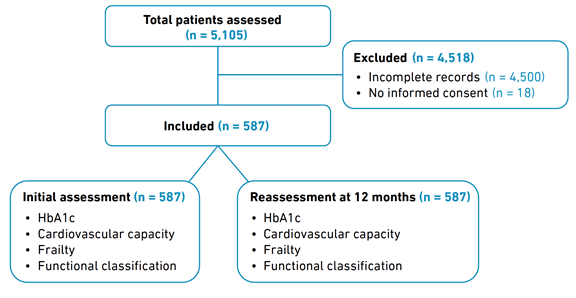
A total of 5,105 patients enrolled in the “Ser Más” program were initially screened. Of these, 4,518 were excluded due to incomplete clinical records (n = 4,500) or lack of informed consent (n = 18). The final sample included 587 participants who attended at least 80% of the group exercise sessions and completed both baseline and 12-month evaluations of HbA1c, cardiovascular capacity, and frailty (Figure 1).
Note. Authors’ elaboration based on study results.
Figure 1 Flowchart of participant inclusion in the study.
Participant characteristics are summarized in (Table 1). The distribution of all continuous variables indicated non-normality (p < .001 for all variables). As a result, continuous variables are described using median and interquartile range (IQR), with means and standard deviations (SD) provided as complementary information.
Table 1 Sociodemographic characteristics of the participants.
| Parameter | Median (IQR) | Complementary: Mean (SD) | Sample N=587 (%) |
|---|---|---|---|
| Age (years) | 73 (58-77) | 72.65 (9.59) | - |
| Weight (kg) | 66 (58-77) | 68.7 (15.3) | - |
| Height (cm) | 155 (150-162) | 156 (9.12) | - |
| BMI (kg/m²) | 27.6 (24.3-31.1) | 28.2 (5.67) | - |
| Gender | - | - | Men: 180 (30.7%) / Women: 407 (69.3%) |
Note. SD = Standard Deviation; IQR = Interquartile Range; BMI = Body Mass Index. Normality of continuous variables was assessed using the Kolmogorov-Smirnov test, which indicated non-normal distributions for all variables (p < .001).
Significant changes in functional classification were observed following the intervention. Both the Bowker test of symmetry (χ² = 55.87, df = 10, p < .001) and the Stuart-Maxwell test (χ² = 66.92, df = 4, p < .001) indicated meaningful shifts in the distribution of functional classes from baseline to follow-up, confirming improvements in functional status. At baseline, most participants were classified as functional class 2B (52.3%) or 2A (31%), followed by classes 3 (6.5%), 4 (9.9%), and 1 (0.2%). Following the intervention, improvements were observed across the sample: the proportion of participants in class 1 increased from 0.2% to 0.9%, class 2A from 31% to 40.4%, while class 2B slightly decreased from 52.3% to 51.1%. Notably, the percentages in the higher-risk classes decreased, with class 3 declining from 6.5% to 4.3% and class 4 from 9.9% to 3.4% (Table 2).
Table 2 Functional classification.
| Class | Pretest | Posttest | ||
|---|---|---|---|---|
| N = 587 | % | N=587 | % | |
| 1 | 1 | 0.17 | 5 | 0.85 |
| 2A | 182 | 31 | 237 | 40.37 |
| 2B | 307 | 52.29 | 300 | 51.10 |
| 3 | 38 | 6.47 | 25 | 4.25 |
| 4 | 58 | 9.88 | 20 | 3.40 |
Note. Changes between pre- and post-intervention distributions were evaluated using the Bowker test of symmetry and the Stuart-Maxwell marginal homogeneity test.
Significant improvements were observed in aerobic capacity (p = 0.000), with increases in both METs (4.46 to 4.53) and VO₂max (15.62 to 15.87 L/min). Although frailty scores measured by the Groningen Frailty Index did not change significantly, functional performance improved, as evidenced by faster gait speed (0.90 to 1.07 m/s) and reduced 5-meter walk time (6.19 to 5.07 seconds). HbA1c levels showed a significant reduction from 7.71% to 7.55% (p=0.000) (Table 3).
Table 3 Changes in Clinical and Functional Outcomes Pre- and Post-Intervention
| Pretest | Posttest | ||
|---|---|---|---|
| Mean-SDa | Mean-SDa | P value | |
| HbA1c % | 7.71±1.68 | 7.55±1.66 | 0.000* |
| Mets (ml/kg x min) | 4.46±1.89 | 4.53±1.92 | 0.000* |
| VO2max (L/min) | 15.62±6.62 | 15.87±6.72 | 0.000* |
| Groningen index | 3.67±2.52 | 3.51±2.42 | 0.209 |
| Single-leg stance (S) | 6.18±4.56 | 6.63±6.41 | 0.072 |
| 5-m walk time (S) | 6.19±1.90 | 5.07±1.78 | 0.000* |
| Gait speed (m/seg) | 0.90±0.33 | 1.07±0.34 | 0.000* |
Note. aStandard deviation; *p < 0.005 indicates statistical significance. Wilcoxon Signed-Rank Test.
Correlations between changes in aerobic capacity (METS) and frailty status were examined by functional class (Table 4). Most classes showed very weak and non-significant associations. However, class 4 demonstrated a moderate and statistically significant negative correlation (r = -0.50, p = 0.025), indicating that greater improvements in METs were associated with lower frailty levels in this subgroup.
Table 4 Correlation between Groningen index and METS change.
| Class | P value | Correlation |
|---|---|---|
| 1 | 0.736 | -0.21 |
| 2A | 0.193 | -0.08 |
| 2B | 0.617 | -0.03 |
| 3 | 0.698 | -0.08 |
| 4 | 0.025* | -0.50 |
Notes. SD = Standard Deviation. Correlations were calculated using Pearson’s correlation coefficient (r). Negative values indicate that greater improvements in METs were associated with lower frailty levels (Groningen index). Strength of correlation was classified as follows: |r| < 0.20 = Very weak; 0.20-0.39 = Weak; 0.40-0.59 = Moderate; ≥ 0.60 = Strong. p < 0.05 was considered statistically significant. Asterisks (*) indicate significant correlations.
Overall, the intervention led to significant improvements in aerobic capacity, functional performance, and glycaemic control, although frailty scores remained stable. No adverse events were reported during the study period.
Discussion
The present study contributes to the understanding of how multimodal exercise programs influence frailty, aerobic capacity, and functional performance in older adults with T2DM. Our main findings showed significant improvements in aerobic capacity and glycaemic control, as well as positive changes in functional parameters such as gait speed and balance, even though some of these latter improvements did not reach statistical significance.
There is a growing prevalence of NCDs in Latin America, which represent a major challenge for public health and healthcare costs [22]. The Pan American Health Organization emphasizes the need for regional policies that integrate prevention, management, and promotion of healthy lifestyles for chronic disease management [23]. Understanding the relationship between frailty, exercise, and T2DM is essential for developing preventive and therapeutic strategies that can be applied across the region [24]. Our results align with these recommendations by demonstrating that a structured, supervised exercise program can produce measurable physical and metabolic benefits for older adults with T2DM.
Previous evidence has shown that functional decline in older adults is strongly associated with increased mortality, hospitalizations, and healthcare costs, underscoring the importance of assessing functionality using validated tools to guide effective interventions [16]. In line with this evidence, our study observed improvements in gait speed (from 0.90 to 1.07 m/s) and single-leg stance performance (from 6.18±4.56 to 6.63±6.41 seconds). Although these changes did not reach statistical significance, they reflect clinically meaningful trends toward reduced fall risk and enhanced ability to perform daily activities in older adults. Functional measures such as gait speed and single-leg stance are well-established predictors of morbidity and premature mortality [25,26], and are particularly relevant in Latin America, where inactivity, malnutrition, and multimorbidity are highly prevalent and accelerate functional decline [27,28]. These risk factors motivated the focus of the present research, which aimed to evaluate the effectiveness of a structured exercise program on frailty, aerobic capacity, and functional classification in older adults with T2DM.
Moreover, physical exercise has been identified as a fundamental therapeutic strategy in T2DM management. Prior research demonstrates benefits of combined aerobic and resistance training on glycaemic control, mediated through mechanisms such as increased GLUT4 expression [29]. Other studies highlight the role of VO₂ max, with physiological limitations such as mitochondrial dysfunction and microvascular alterations contributing to reduced physical performance [30]. Similarly, our study documented a significant improvement in VO₂max (from 15.62±6.62 to 15.87±6.72 L/min, p=0.000) and a significant reduction in HbA1c (p=0.000) after 12 months of twice-weekly group-based exercise. These findings suggest that aerobic capacity is a key determinant of metabolic control and overall prognosis in patients with T2DM.
An unexpected observation was the modest increase in body weight and BMI, despite improvements in functional and metabolic outcomes. Body weight increased from 66.0 kg to 68.0 kg (median), with an estimated change of -1.75 kg according to the Wilcoxon test (p < .001), while body mass index (BMI) increased from 27.6 kg/m² to 28.4 kg/m², with a change of -0.76 kg/m² (p < .001). These results are consistent with recent studies showing that slight weight gain or weight stability may be protective in older adults with frailty or pre-frailty, reflecting maintenance of muscle mass and reduced risk of sarcopenia [31,32]. This interpretation aligns with our functional findings, suggesting that weight change should be interpreted cautiously in older populations undergoing physical training.
Although progress has been made in the treatment of NCDs, structured exercise programs with rigorous monitoring remain limited in Latin America, highlighting the potential of community-based programs [33,34]. To date, few large-scale studies in Latin America have evaluated exercise interventions while simultaneously considering frailty and functionality. Our findings suggest that a multimodal exercise program can promote improvements in metabolic, functional, and frailty-related domains. This supports the need for targeted exercise programs that address regional health needs and align with patient-centered care models.
Strengths of this study include its large sample size and use of validated instruments. However, its quasi-experimental design and lack of a control group limit causal inference. Future studies should employ more robust designs, longer follow-up periods, and explore mechanisms underlying functional improvements in older adults with T2DM.
Conclusion
This study suggests that physical exercise is an effective therapeutic and preventive strategy in older adults with T2DM, particularly in terms of aerobic capacity, functionality, and frailty. The findings show significant improvements in cardiovascular fitness, gait speed, and glycaemic control, supporting the role of multimodal exercise in promoting healthy aging and reducing the burden of chronic diseases.
Although frailty scores did not show statistically significant reductions, correlations between improved aerobic capacity and functional indicators highlight the potential of regular exercise to prevent complications and disability. These results emphasize the importance of structured programs that integrate exercise as an essential component of comprehensive health care.
From a regional perspective, NCDs represent a growing challenge in Latin America. Implementing and scaling exercise-based interventions could improve patient outcomes and reduce healthcare costs. These findings may inform the development of sustainable public policies and institutional programs, promoting healthy aging and strengthening the response to chronic diseases in diverse populations.

