
SciELO - Scientific Electronic Library Online

 
vol.53 issue1Organic salts as a tool for pharmaceutical ingredient purification: Bibliographic reviewPreparation and characterization of copper nanoparticles of Schisandra chinensis and evaluation of its antiproliferative activity author indexsubject indexarticles search
Home Pagealphabetic serial listing  

Services on Demand

Journal

Article

Indicators

Related links

  • On index processCited by Google
  • Have no similar articlesSimilars in SciELO
  • On index processSimilars in Google

Share


Revista Colombiana de Ciencias Químico - Farmacéuticas

Print version ISSN 0034-7418On-line version ISSN 1909-6356

Rev. colomb. cienc. quim. farm. vol.53 no.1 Bogotá Jan,/Apr. 2024  Epub Apr 06, 2024

https://doi.org/10.15446/rcciquifa.v53n1.111422 

Scientific Research Articles

Preferential solvation of triclocarban in N-methyl-2-pyrrolidone + water cosolvent mixtures according to the Inverse Kirkwood-Buff Integrals (IKBI) method and correlation of solubility by means of some mathematical models

Solvatación preferencial de triclocarbán en mezclas de cosolventes de N-metil-2-pirrolidona + agua según el método de la integrales inversas de Kirkwood-Buff y correlación de solubilidad mediante algunos modelos matemáticos

Solvatação preferencial de triclocarban em misturas de N-metil-2-pirrolidona + água cosolvente de acordo com o método da integrais inversas da Kirkwood-Buff e correlação de solubilidade por meio de alguns modelos matemáticos

Cristhian Andrés Muñoz-Ortiz1  2 

Néstor Enrique Cerquera3 

Jennifer Katiusca Castro Camacho4 

Jhonny Osorio-Gallego5 

Rossember Edén Cárdenas-Torres5 

Mauricio Herrera5 

Daniel Ricardo Delgado6 

1Universidad Surcolombiana, Maestría en Ingeniería y Gestión Ambiental

2Sitafi Group Ingeniería S.A.A.

3Facultad de Ingeniería, Programa de Ingeniería Agrícola, Hidroingeniería y Desarrollo Agropecuario, Universidad Surcolombiana

4Facultad de Ingeniería, Programa de Ingeniería Agroindustrial, Hidroingeniería y Desarrollo Agropecuario, Universidad Surcolombiana

5Facultad de Ciencias y Humanidades, Grupo de Fisicoquímica y Análisis Matemático (Línea de Investigación en Inteligencia Artificial Aplicada), Fundación Universidad de América

6Facultad de Ingeniería, Programa de Ingeniería Civil, Grupo de Investigación en Ingenierías UCC-Neiva, Universidad Cooperativa de Colombia


ABSTRACT

Introduction

Solubility is an important thermodynamic property due to its role in product development, as well as the understanding of biological processes. This research aims to evaluate the preferential solvation parameter (δx 1,3) of the triclocarban (TCC) solubility in N-methyl-2-pyrrolidone + water cosolvent mixtures and to assess some correlational and predictive mathematical models of concern to the pharmaceutical industry.

Calculations

δx 1,3 was determined from experimental data following the Inverse Kirkwood-Buff Integrals model (IKBI). The mathematical models were developed using Python, and functions for each model were fitted by non-linear least squares using the libraries scipy.optimize.curve_fit, and sklearn.model_selection.

Results

According to the δx 1,3 heat, TCC has preferential solvation by water in water-rich mixtures, and preferential solvation by N-methyl-2-pyrrolidone in intermediate and N-methyl-2-pyrrolidone-rich mixtures. The models Yalkowsky-Roseman-van't Hoff, Wilson, Modified Wilson, NRTL, van't Hoff, Apelblat, and Buchowski-Ksiazaczak 𝜆ℎ were assessed, finding good correlations with all.

Conclusions

The TCC solubility increase in N-methyl-2-pyrrolidone + water cosolvent mixtures with increasing N-methyl-2-pyrrolidone (NMP) concentration may be related to the rise in the local mole fraction (x 1,3 L) of NMP in the TCC solvation sphere. Regarding the mathematical models, the Yalkowsky-Roseman-van't Hoff model can be considered the most versatile due to its capability estimate solubility data as a function of both temperature and cosolvent composition, given a limited range of experimental data.

Keywords Triclocarban; inverse Kirkwood-Buff integrals; IKBI; preferential solvation; mathematical assessment

RESUMEN

Introducción

La solubilidad es una de las propiedades termodinámicas de mayor importancia debido a su relación en desarrollo de productos como en la elucidación de procesos biológicos. El objetivo del presente trabajo de investigación es determinar y evaluar el parámetro de solvatación preferencial (δx 1,3) de la solubilidad del triclocarbán (TCC) en mezclas cosolventes N-metil-2-pirrolidona + agua, además de desafiar algunos modelos matemáticos de carácter correlacional y predictivo de interés para la industria farmacéutica.

Cálculos

A partir de datos experimentales se determinó δx 1,3 de acuerdo con el modelo de integrales inversas de Kirkwood-Buff. Los modelos matemáticos fueron desarrollados con Python y las funciones de cada modelo se ajustaron mediante mínimos cuadrados no lineales utilizando las bibliotecas scipy.optimize.curve_fit y sklearn.model_selection.

Resultados

De acuerdo con los calores del δx 1,3 el TCC se solvata preferencialmente por el agua en mezclas ricas en agua y en mezclas intermedias y ricas en N-methyl-2-pyrrolidone es solvatado preferencialmente por la N-metil-2-pirrolidona. Se evaluaron los modelos de Yalkowsky-Roseman-van't Hoff, Wilson, Wilson Modificado, NRTL, van't Hoff, Apelblat y Buchowski-Ksiazaczak 𝜆ℎ, obteniendo buenas correlaciones con todos ellos.

Conclusiones

El incremento de la solubilidad del TCC en mezclas cosolventes N-metil-2-pirrolidona + agua, al incrementar la concentración de N-metil-2-pirrolidona (NMP) puede estar relacionada con el incremento de la fracción molar local (x 1,3 L) de NMP en la esfera de solvatación del TCC, en cuanto a los modelos matemáticos el modelo de Yalkowsky-Roseman-van't Hoff, puede definirse como el modelo más versátil al tener la capacidad de calcular datos de solubilidad en función tanto de la temperatura como de la composición cosolventes con un excelente grado de precisión, el cual fue desarrollado a partir de un número limitado de datos experimentales.

Palabras clave Triclocarbán; integrales inversas de Kirkwood-Buff; IKBI; solvatación preferencial; análisis matemático

RESUMO

Introdução

A solubilidade é uma importante propriedade termodinâmica devido ao seu papel no desenvolvimento de produtos, bem como na compreensão de processos biológicos. Esta pesquisa tem como objetivo avaliar o parâmetro de solvatação preferencial (δx 1,3) da solubilidade do triclocarban (TCC) em misturas de co-solventes N-metil-2-pirrolidona + água e avaliar alguns modelos matemáticos correlacionais e preditivos de interesse para a indústria farmacêutica.

Cálculos

δx 1,3 foi determinado a partir de dados experimentais seguindo o modelo da integrais inversas da Kirkwood-Buff. Os modelos matemáticos foram desenvolvidos em Python, e as funções de cada modelo foram ajustadas por mínimos quadrados não lineares usando as bibliotecas scipy.optimize.curve_fit e sklearn.model_selection.

Resultados

De acordo com o calor δx 1,3, o TCC possui solvatação preferencial por água em misturas ricas em água, e solvatação preferencial por N-metil-2-pirrolidona em misturas intermediárias e ricas em N-metil-2-pirrolidona. Os modelos Yalkowsky-Roseman-van't Hoff, Wilson, Wilson modificado, NRTL, van't Hoff, Apelblat e Buchowski-Ksiazaczak 𝜆ℎ foram avaliados, encontrando boas correlações com todos.

Conclusões

O aumento da solubilidade do TCC em misturas de cosolventes de N-metil-2-pirrolidona + água com o aumento da concentração de N-metil-2-pirrolidona (NMP) pode estar relacionado ao aumento na fração molar local (x 1,3 L) de NMP em a esfera de solvatação do TCC. Em relação aos modelos matemáticos, o modelo Yalkowsky-Roseman-van't Hoff pode ser considerado o mais versátil devido à sua capacidade de estimar dados de solubilidade em função da temperatura e da composição do cosolvente, dada uma gama limitada de dados experimentais.

Palavras-chave Triclocarban; integrais inversas de Kirkwood-Buff; IKBI; solvatação preferencial; avaliação matemática

Introduction

Triclocarban (5-Chloro-2-(2,4-dichlorophenoxy)phenol; abbreviated TCC hereafter; Figure 1) is a broad-spectrum antimicrobial agent [1]. Although TCC was initially developed exclusively for medical use due to its antimicrobial properties, it is currently included in more than 2000 commodities, from soaps, toothpaste, detergents, and textiles to construction products and plastics [2]. Due to the potential endocrine-disrupting effect and bacterial resistance associated with this drug, the US Food and Drug Administration (FDA) banned the use of the drug in personal care products and over-the-counter medicines. Despite restrictions, many products still incorporate TCC [3], [4], and consequently, it is discharged into the environment mostly through wastewater, affecting a variety of ecosystems and becoming a public health issue as it generates antimicrobial resistance, among other significant environmental problems [5], [6].
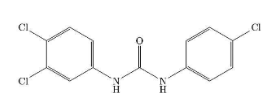
Figure 1. Molecular structure of triclocarban. 

Solubility is one of the main physicochemical properties, as it is crucial in industrial processes such as crystallization, purification, pre-formulation, formulation, and quantification [7], [8]; pharmacological processes such as pharmacokinetics and pharmacodynamics; and environmental processes such as biotoxicity assessment, bioadsorption, bioaccumulation, among others [9] - [11].

The TCC solubility has been studied in different organic solvents [12], [13], and some cosolvent mixtures such as (1,4-dioxane + water) [14], [15], (ethanol + propylene glycol) [16], (cyclohexane + 1,4-dioxane) [17] and (ethylene glycol + water) [18].

Thermodynamic analyses of the solution process are valuable to rationalizing the solubility results since they allow the understanding of the possible molecular phenomena occurring in the process [19], [20]. As a complement, preferential solvation studies permit the analysis of the local cosolvent composition of the solvation sphere [21] - [25]. Another field related to solubility studies is mathematical modeling, which is especially interesting for the industry since it offers computational tools that allow reducing experimental tests or calculating solubility data under other than experimental conditions [26] - [29].

In this context, this research aims to evaluate the preferential solvation of TCC in N-methyl-2-pyrrolidone + water mixtures ({NMP (1) + W (2)}) and to assess some predictive and correlational mathematical models.

RESULTS AND DISCUSSION

The preferential solvation parameter and the mathematical models were computed from the solubility data reported by Caviedes-Rubio et al.[30], the preferential solvation parameter and some mathematical models were calculated or challenged. Figure 2 plots the solubility of TCC as a function of the NMP mass fraction, where is observed a positive cosolvent effect of the NMP, especially in NMP-rich mixtures.
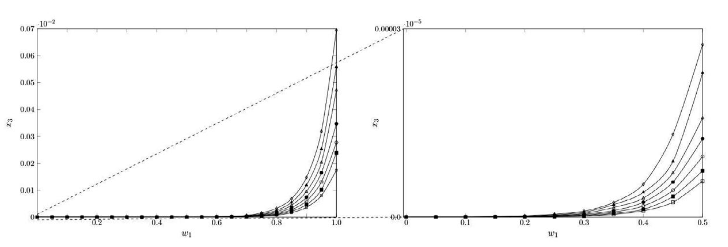
Figure 2. Mole fraction of TCC depending on the mass fraction of NMP in the {NMP (1) + W (2)} mixtures free of TCC. •: 288.15 K; ∘: 293.15 K; △: 298.15 K; ▲: 303.15 K; ◻: 308.15 K; ◼: 313.15 K; ◻: 318.15 K. 

Preferential solvation

The solvation sphere of the TCC molecule in each of the cosolvent mixtures can be evaluated from the equations of the IKBI model [21], [22], [31], [32].


Here G1,3 and G2.3 are the Kirkwood-Buff integrals (in cm3·mol) obtained from the thermodynamic data in equations 2 and 3, and Vcor is the correlation volume around TCC where preferential solvation occurs. In equations 2 and 3κT is the isothermal compressibility of the mixtures (in GPa−1), V3 is the partial molar volume of the solute (206.26 cm3·mol [13]), and V1 and V2 are the partial molar volume of the solvents (in cm3·mol), while D and Q (in kJ·mol−1, as is RT) are given in equations 9 and 10. The compressibility is given to sufficient approximation as the linear expression equation 4 and the partial molar volumes are calculated from the experimental data of the density of the mixtures free of solute through equations 5 and 6. Eq. 7 requires iteration since it depends on the local mole fractions given by equations 1 and 8.

Parameter D is calculated from the TCC Gibbs energy of transfer from the water to each of the cosolvent and neat organic solvent mixtures (Figure 3).
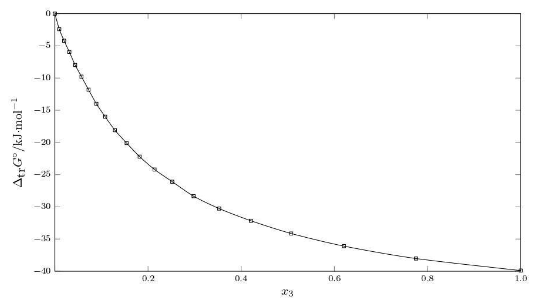
Figure 3. Gibbs energy of transfer of TCC (3) from neat water (2) to {NMP (1) + W (2)} mixtures at 298.15 K 

Equation 11 describes the trends of the TCC Gibbs energy of transfer in each of the cosolvent mixtures, from where D is calculated as the first polynomial derivative, with r2=1.0.

Some data necessary for the model development were taken from the literature to calculate the preferential solvation parameter (Eq. 1). The isothermal compressibility of the mixtures was calculated from the compressibility of the neat solvents (Eq. 4) by using κT of NMP as 0.620 GPa−1, and κT of water as 0.457 GPa−1[33]; V3 = 206.26 cm3·mol−1[14]. The partial molar volume of both solvents (water and NMP), necessary for the calculation of the inverse Kirkwood-Buff integrals (Equations 2 and 3), were taken from literature [34]. r3, necessary to compute Vcor (Eq. 7) was assumed as 0.434 nm [14]; the excess Gibbs energy for the {NMP (1) + water (2)} mixtures free of TCC, necessary for the calculation of Q (Eq. 10), was calculated from the equation and coefficients reported by Marcus [35]. Other values, such as D, were calculated from the experimental solubility data according to Eq. (9). Table 1 presents the data of the solvation parameters and some other parameters required to develop the IKBI model.

Table 1. Some properties associated with preferential solvation of TCC (3) in {NMP (1) + W (2)} mixtures at 298.15 K. 
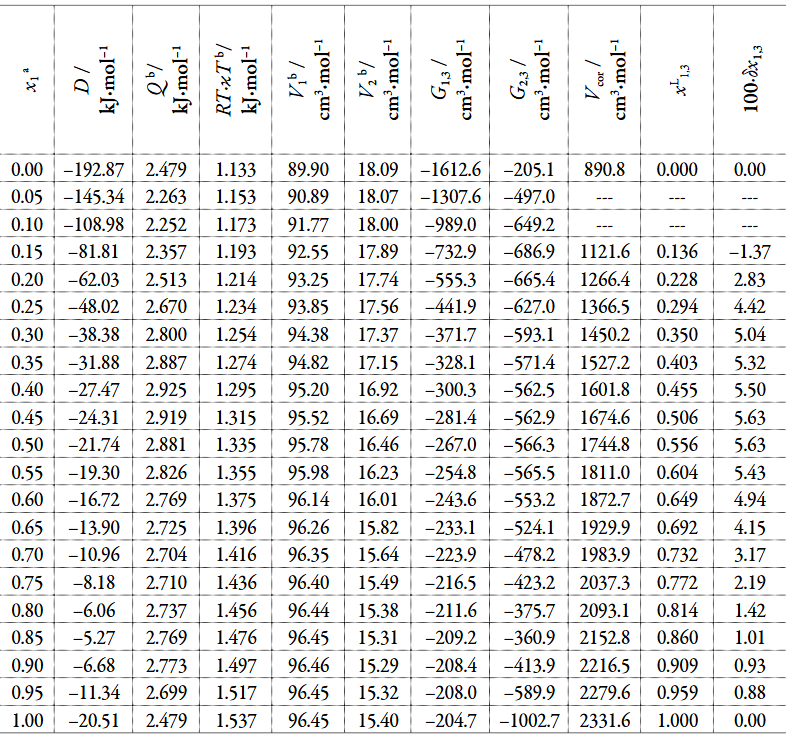
ax1 is the mole fraction of NMP (1) in the {NMP (1) + W (2)} mixtures free of TCC (3).

bFrom Nozohouri et al.[34].

According to the δx1,3 analysis (Figure 4), from neat water to x1 = 0.15, the correlation volume calculations are not possible by iteration because the equations do not converge, yielding inconsistent data since takes negative values (Figure 5) when limited only to values between 0 and 1, even if a trend can be identified. Therefore, it can be inferred that TCC has preferential solvation by water within this range of cosolvent composition. The hydrophobic hydration around the non-polar groups of TCC may contribute to lowering the net δx1,3 to negative values in these water-rich mixtures [36] - [40]. From this cosolvent composition (x1 = 0.15) up to neat NMP, δx1,3 exhibits positive values indicating preferential solvation by NMP.
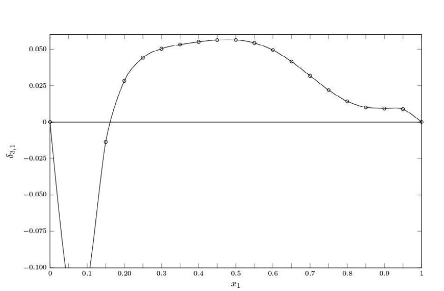
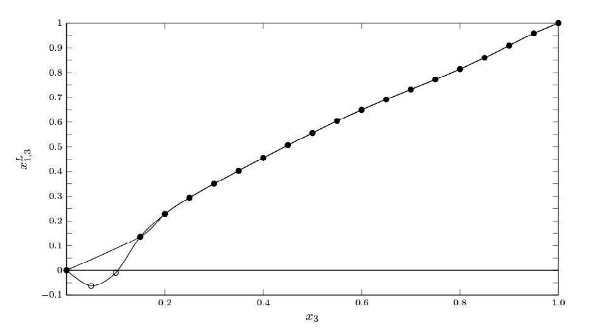
Figure 4. Preferential solvation parameters of TCC in {NMP (1) + W (2)} mixtures at 298.15 K. 

Figure 5. Local mole fraction of NMP (1) in the environment near to TCC in {NMP (1) + W (2)} mixtures at 298.15 K. 

In water-rich cosolvent mixtures, the TCC behaves as a Lewis base against water since the Kamlet-Taft parameter β is 0.14 for water and 0.754 ± 0.019 for the NMP [41]. On the other hand, in intermediate and NMP-rich cosolvent mixtures, where the TCC is preferentially solvated by NMP, the TCC act as a Lewis acid due to the acid hydrogen of the -NH- groups.

Mathematical Assessment of Solubility

One of the most versatile tools for process optimization is mathematical modeling, which allows making approximations under different conditions than experimental ones [42], [43].

Mathematical models to correlate drug solubility in cosolvent systems can be classified into two groups: the models that work as a function of the cosolvent composition and the models that work as a function of temperature. In the former, the most used models are Yalkowsky-Roseman-van't Hoff [44], [45], Wilson [46], Modified Wilson [47], NRTL [46], and Extended Hildebrand [28], [48], [49]. In the latter, the most used models are [26], [50], Apelblat [51], Buchowski-Ksiazczak λh [52], [53] and van't Hoff-Yaws model [54]. The latter models have a significant predictive potential whenever the data to predict are to interpolate.

Hence, the experimental solubility data [30] were correlated with the models Yalkowsky-Roseman-van't Hoff (Eq. 12), van't Hoff (Eq. 13), Apelblat (Eq. 14), Buchowski-Ksiazczak λh (Eq. 15), van't Hoff-Yaws (Eq. 16), NRTL (Eq. 17), Wilson (Eq. 18), and Modified Wilson (Eq. 19).


Here, the parameters A, B, C, D, λ, and h are coefficients for each of the models; T is the temperature (in K); x3,1+2 is the solubility of TCC in the cosolvent mixture; x3,1 is the TCC solubility in NMP; x3,2 is the solubility of TCC in water; and w1 is the mass fraction of NMP in the solvent mixture {NMP (1) + W (2)} free of solute (3).


Where Y3 is the activity parameter of TCC; and τ, G and Λ are model parameters.

Regarding the NRTL model, G is a dimensionless interaction parameter, which depends on the energy interaction parameter, g, and the nonrandomness factor, a. The NRTL model contains three parameters, but the reduction of experimental data for several binary systems indicates that a varies from 0.20 up to 0.47; when experimental data are few, a value is usually settled arbitrarily as a = 0.3. Therefore:

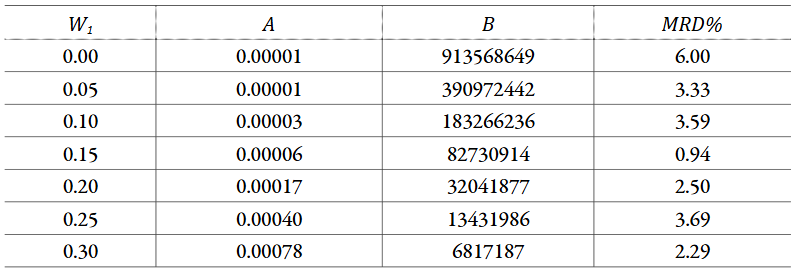
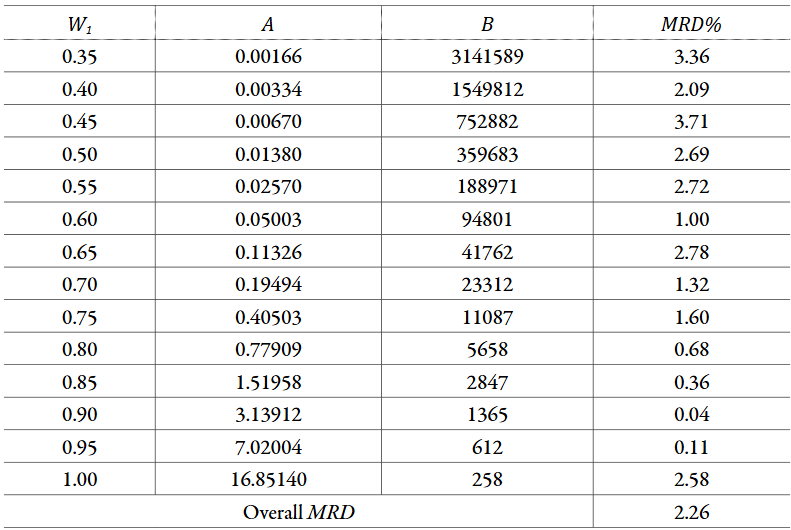
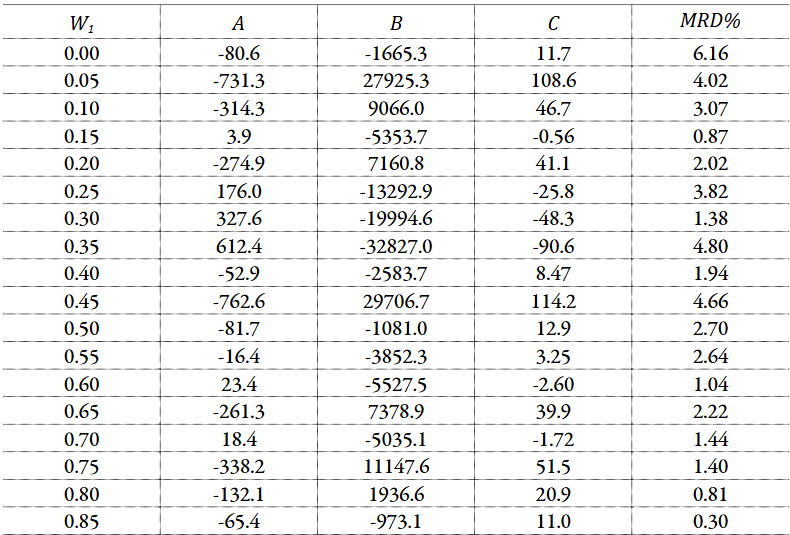
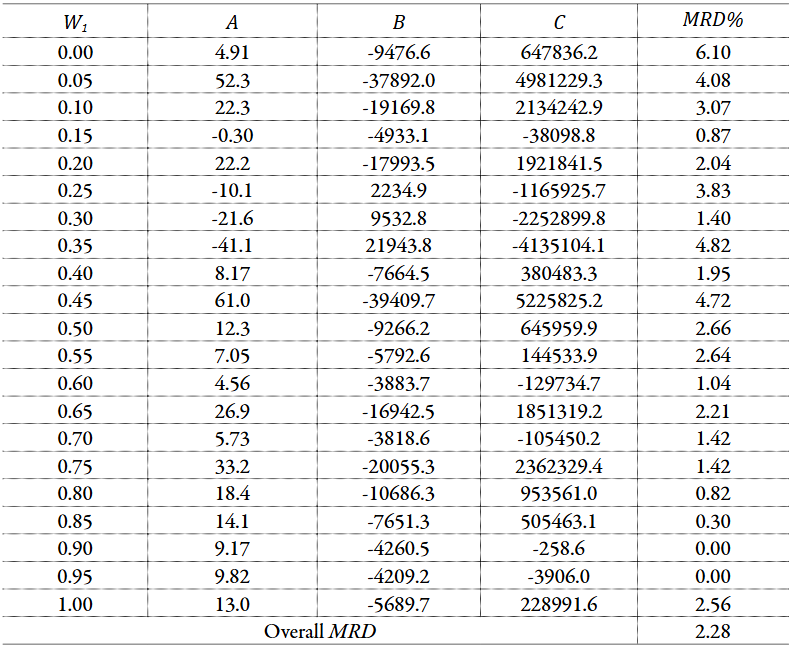
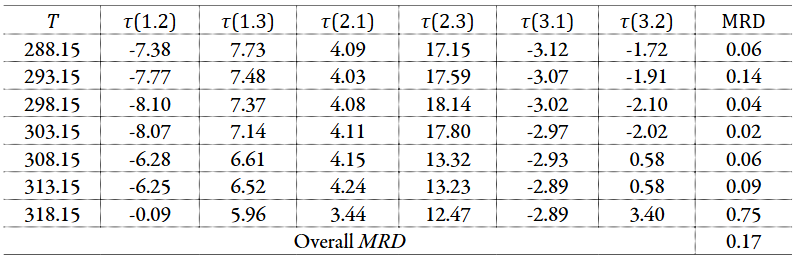
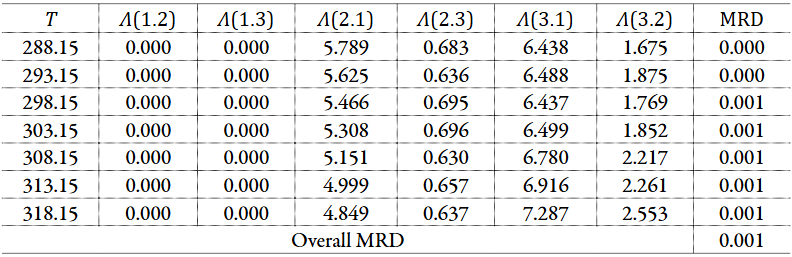
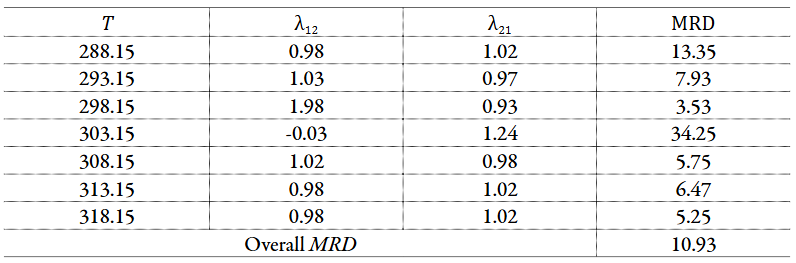
The mathematical models were developed using Python, and functions for each model were fitted through non-linear least squares using the scipy.optimize.curve_fit library [55]. To validate the fit of the models the experimental data were randomly sorted into training and test data using the sklearn.model_selection library [56], [57]. The fit was conducted with 60% of the experimental data, while the remaining 40% was used for validation. An exception to this approach was the Yalkowsky-Roseman-van't Hoff model since the data corresponds to pure solvents at the lowest and highest study temperatures, i.e., TCC solubility in neat water at 278.15 K and 318.15 K, and TCC solubility in neat NMP at the same temperatures. Tables 2 - 9 present the parameters of each of the models and their Mean Relative Difference (MRD) (Eq. 21).

Here, N is the number of solubility data points, while x3e and x3c represent the experimentally measured and calculated solubility.
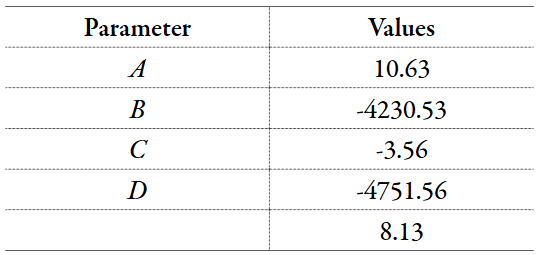
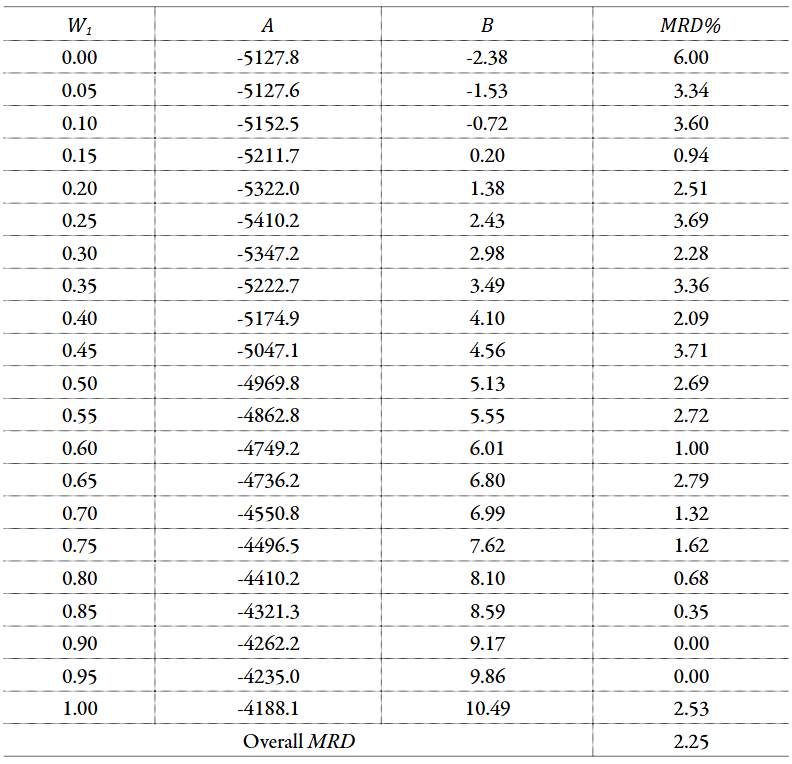
Table 2. Parameters of the Yalkowsky-Roseman-van't Hoff model parameter and its corresponding MRD. 

Table 3. Parameters of the van't Hoff model and its corresponding MRD. 

Table 4. Parameters of the Buchowski-Ksiazczak 𝜆h model and its corresponding MRD. 

Table 5. Parameters of the Apelblat model and its corresponding MRD. 

Table 6. Parameters of the van't Hoff-Yaws model and its corresponding MRD. 

Table 7. Parameters of the NRTL model and its corresponding MRD. 

Table 8. Parameters of the Wilson model and its corresponding MRD. 

Table 9. Parameters of the Modified Wilson model and its corresponding MRD. 

The two models with higher deviations from the experimental data are the Modified Wilson and Yalkowsky-Roseman-van't Hoff (YRvH) models with MRD of 10% and 8%, respectively. However, based on the modeling principle of using the least number of experimental data, the best model was the YRvH. The YRvH model parameters were calculated from only four experimental data and would allow maximum reduction of tests for a wide range of temperatures and cosolvent compositions. Regarding the MRD results, the best models were Wilson (MRD%=0.001%) and NRTL (MRD%=0.17%).

When evaluating the performance of the models (Table 10), it was observed that all correlation coefficients are approximately 1.0 (Figure 6), -values are high, the FCritical- values are low, and p-values are below 0.001. This statistical analysis indicates that the correlation and model constants are meaningful, and the increase in the number of parameters in the models does not represent a significant advantage when predicting solubility. As mentioned before, one of the most versatile models due to the reduced number of experimental data required to calculate its parameters and its great predictive power is the Yalkowsky-Roseman-van't Hoff model. In addition, this model allows the calculation of solubility as a function of both cosolvent composition and temperature, unlike the other models evaluated.
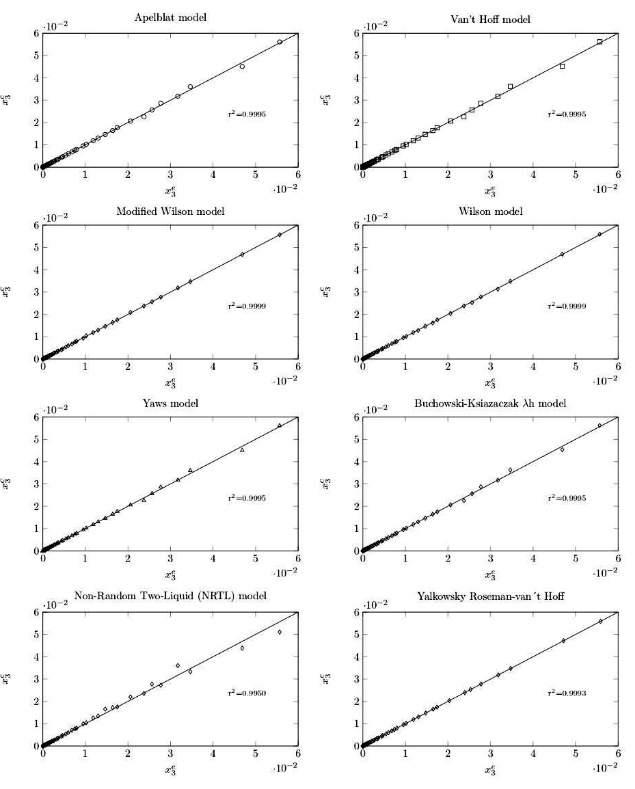
Figure 6. Experimental solubility data versus predicted solubility of TCC (3) in {NMP (1) + W (2)} and cosolvent mixtures. 
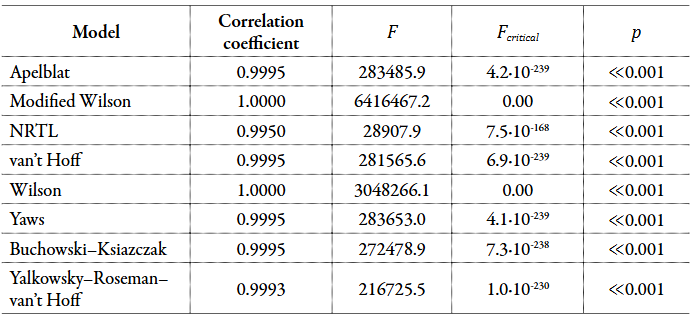
Table 10. Statistical analysis of the correlation for all mathematical models. 

CONCLUSIONS

The TCC solubility in cosolvent mixtures {NMP (1) + W (2)} is strongly controlled by the cosolvent composition. According to the solvation parameter, this increase in the solubility of TCC when increasing the NMP concentration is due to a higher affinity between TCC and NMP. Furthermore, the low solubility of TCC in neat water and water-rich mixtures may be due to a hydrophobic hydration effect around the non-polar groups of TCC, which could also lead to free water structuring.

According to the statistical analysis, all the mathematical models implemented achieved satisfactory results. However, the Yalkowsky-Roseman-van't Hoff model was the most versatile due to its simplicity and ability to use a limited number of experimental data for its development.

References

[1] D. Zhang, S. Lu, A holistic review on triclosan and triclocarban exposure: Epidemiological outcomes, antibiotic resistance, and health risk assessment, Science of The Total Environment, 872, 162114 (2023). Doi: https://doi.org/10.1016/j.scitotenv.2023.162114 [ Links ]

[2] R.U. Halden, On the need and speed of regulating triclosan and triclocarban in the United States, Environmental Sciences & Technology, 48(7), 3603-3611 (2014). Doi: https://doi.org/10.1021/es500495p [ Links ]

[3] H. Barrett, J. Sun, Y. Gong, P. Yang, C. Hao, J. Verreault, Y. Zhang, H. Peng, Triclosan is the predominant antibacterial compound in Ontario sewage sludge, Environmental Sciences & Technology, 56(21), 14923-14936 (2022). Doi: https://doi.org/10.1021/acs.est.2c00406 [ Links ]

[4] D. Kneis, T.U. Berendonk, S.K. Forslund, S. Hess, Antibiotic resistance genes in river biofilms: A metagenomic approach toward the identification of sources and candidate hosts, Environmental Sciences & Technology, 56(21), 14913-14922 (2022). Doi: https://doi.org/10.1021/acs.est.2c00370 [ Links ]

[5] S. Lu, N. Wang, S. Ma, X. Hu, L. Kang, Y. Yu, Parabens and triclosan in shellfish from Shenzhen coastal waters: Bioindication of pollution and human health risks, Environmental Pollution, 246, 257-263 (2019). Doi: https://doi.org/10.1016/j.envpol.2018.12.002 [ Links ]

[6] E.M. Hartmann, R. Hickey, T. Hsu, C.M. Betancourt-Román, J. Chen, R. Schwager, J. Kline, G.Z. Brown, R.U. Halden, C. Huttenhower, J.L. Green, Antimicrobial chemicals are associated with elevated antibiotic resistance genes in the indoor dust microbiome, Environmental Sciences & Technology, 50(18), 9807-9815 (2016). Doi: https://doi.org/10.1021/acs.est.6b00262 [ Links ]

[7] A.N. Martin, P. Bustamante, A.H.C. Chun, Physical Pharmacy: Physical Chemical Principles in the Pharmaceutical Sciences, 4th ed., Lippincott Williams & Wilkins, Philadelphia, 1993. [ Links ]

[8] A.T. Florence, D. Attwood, Physicochemical Principles of Pharmacy: In Manufacture, Formulation and Clinical Use, 6th ed., Pharmaceutical Press, London, 2016. [ Links ]

[9] E. Hart, D. Grover, H. Zettl, V. Koshevarova, S. Zhang, C. Dai, W.E. Acree Jr., I.A. Sedov, M.A. Stolov, M.H. Abraham, Abraham model correlations for solute transfer into 2-methoxyethanol from water and from the gas phase, Journal of Molecular Liquids, 209, 738-744 (2015). Doi: https://doi.org/10.1016/j.molliq.2015.05.064 [ Links ]

[10] J.H. Blanco-Márquez, Y.A. Quigua-Medina, J.D. García-Murillo, J.K. Castro-Camacho, C.P. Ortiz, N.E. Cerquera, D.R. Delgado, Thermodynamic analysis and applications of the Abraham solvation parameter model in the study of the solubility of some sulfonamides, Revista Colombiana de Ciencias Quimico-Farmacéuticas, 49(1), 234-255 (2020). Doi: https://doi.org/10.15446/rcciquifa.v49n1.87038 [ Links ]

[11] C.P. Ortiz, R.E. Cardenas-Torres, D.I. Caviedes-Rubio, S.D.J. Polania-Orozco, D.R. Delgado, Thermodynamic analysis and preferential solvation of sulfanilamide in different cosolvent mixtures, Physics and Chemistry of Liquids, 60(1), 9-24 (2022). Doi: https://doi.org/10.1080/00319104.2021.1888382 [ Links ]

[12] D.R. Delgado, A. Holguin, F. Martínez, Solution thermodynamics of triclosan and triclocarban in some volatile organic solvents, Vitae, 19(1), 79-92 (2012). URL: http://www.scielo.org.co/scielo.php?script=sci_arttext&pid=S0121-40042012000100009 [ Links ]

[13] D.R. Delgado, A. Sosnik, F. Martínez, Transfer thermodynamics of triclosan from water to organic solvents with different hydrogen bonding capability, Latin American Journal of Pharmacy, 30(3), 459-466 (2011). URL: http://www.latamjpharm.org/resumenes/30/3/LAJOP_30_3_1_7.pdf [ Links ]

[14] A.C. Gaviria-Castillo, J.D. Artunduaga-Tole, J.D. Rodríguez-Rubiano, J.A. Zuñiga-Andrade, D.R. Delgado, A. Jouyban, F. Martínez, Solution thermodynamics and preferential solvation of triclocarban in {1,4-dioxane (1) + water (2)} mixtures at 298.15 K, Physics and Chemistry of Liquids, 57(1), 55-56 (2019). Doi: https://doi.org/10.1080/00319104.2017.1416613 [ Links ]

[15] D.R. Delgado, E.M. Mogollon-Waltero, C.P. Ortiz, M. Peña, O.A. Almanza, F. Martínez, A. Jouyban, Enthalpy-entropy compensation analysis of the triclocarban dissolution process in some {1,4-dioxane (1) + water (2)} mixtures, Journal of Molecular Liquids, 271, 522-529 (2018). Doi: https://doi.org/10.1016/j.molliq.2018.09.026 [ Links ]

[16] A.R. Holguin, D.R. Delgado, F. Martínez, Thermodynamic study of the solubility of triclocarban in ethanol + propylene glycol mixtures, Química Nova, 35(2), 280-285 (2012). Doi: https://doi.org/10.1590/S0100-40422012000200009 [ Links ]

[17] J.J. Agredo-Collazos, C.P. Ortiz, N.E. Cerquera, R.E. Cardenas-Torres, D.R. Delgado, M.A. Peña, F. Martínez, Equilibrium solubility of triclocarban in (cyclohexane + 1,4-dioxane) mixtures: Determination, correlation, thermodynamics and preferential solvation, Journal of Solution Chemistry, 51(12), 1603-1625 (2022). Doi: https://doi.org/10.1007/S10953-022-01209-4 [ Links ]

[18] A.M. Cruz-Gonzalez, M.S. Vargas-Santana, S.d.J. Polania-Orozco, C.P. Ortiz, N.E. Cerquera, F. Martinez, D.R. Delgado, A. Jouyban, W.E. Acree Jr., Thermodynamic analysis of the solubility of triclocarban in ethylene glycol + water mixtures, Journal of Molecular Liquids, 325, 115222 (2021). Doi: https://doi.org/10.1016/j.molliq.2020.115222 [ Links ]

[19] M.A. Parra, N.E. Cerquera, C.P. Ortiz, R.E. Cardenas-Torres, D.R. Delgado, M.A. Peña, F. Martinez, Solubility of ciprofloxacin in different solvents at several temperatures: Measurement, correlation, thermodynamics and Hansen solubility parameters, Journal of the Taiwan Institute of Chemical Engineers, 150, 105028 (2023). Doi: https://doi.org/10.1016/j.jtice.2023.105028 [ Links ]

[20] C.P. Ortiz, R.E. Cardenas-Torres, M. Herrera, D.R. Delgado, Thermodynamic analysis of the solubility of propylparaben in acetonitrile----water cosolvent mixtures, Sustainability, 15(6), 4795 (2023). Doi: https://doi.org/10.3390/su15064795 [ Links ]

[21] Y. Marcus, Preferential solvation in mixed solvents, in: P.E. Smith, E. Matteoli, J.P. O'Connell (editors), Fluctuation Theory of Solutions: Applications in Chemistry, Chemical Engineering, and Biophysics, CRC Press, Taylor & Francis Group, Boca Raton (FL), 2013. [ Links ]

[22] Y. Marcus, On the preferential solvation of drugs and PAHs in binary solvent mixtures, Journal of Molecular Liquids, 140(1-3), 61-67 (2008). Doi: https://doi.org/10.1016/j.molliq.2008.01.005 [ Links ]

[23] M.A. Ruidiaz, D.R. Delgado, F. Martinez, Y. Marcus, Solubility and preferential solvation of indomethacin in 1,4-dioxane+water solvent mixtures, Fluid Phase Equilibria, 299(2), 259-265 (2010). Doi: https://doi.org/10.1016/j.fluid.2010.09.027 [ Links ]

[24] A.R. Holguin, D.R. Delgado, F. Martinez, Y. Marcus, Solution thermodynamics and preferential solvation of meloxicam in propylene glycol + water mixtures, Journal of Solution Chemistry, 40(12), 1987-1999 (2011). Doi: https://doi.org/10.1007/s10953-011-9769-0 [ Links ]

[25] D.R. Delgado, A.R. Holguin, O.A. Almanza, F. Martínez, Y. Marcus, Solubility and preferential solvation of meloxicam in ethanol + water solvent mixtures, Fluid Phase Equilibria, 305(1), 88-95 (2011). Doi: https://doi.org/10.1016/j.fluid.2011.03.012 [ Links ]

[26] C.P. Ortiz, R.E. Cardenas-Torres, M. Herrera, D.R. Delgado, Numerical analysis of sulfamerazine solubility in acetonitrile + 1-propanol cosolvent mixtures at different temperatures, Sustainability, 15(8), 6596 (2023). Doi: https://doi.org/10.3390/su15086596 [ Links ]

[27] D.R. Delgado, R.E. Cardenas-Torres, C.P. Ortiz, Mathematical modeling of the aqueous solubility of bioactive substances of environmental interest, Proceedings - 2022 8th International Engineering, Sciences and Technology Conference, IESTEC 2022, Panama, 2022. pp. 498-503. URL: https://ieeexplore.ieee.org/stamp/stamp.jsp?tp=&arnumber=10040875 [ Links ]

[28] D.M. Cristancho, D.R. Delgado, F. Martínez, Meloxicam solubility in ethanol+water mixtures according to the extended Hildebrand solubility approach, Journal of Solution Chemistry, 42(8), 1706-1716 (2013). Doi: https://doi.org/10.1007/s10953-013-0058-y [ Links ]

[29] A. Torres-Cardozo, N.E. Cerquera, C.P. Ortiz, J. Osorio-Gallego, R.E. Cardenas-Torres, F. Angarita-Reina, F. Martinez, D.R. Delgado, Thermodynamic analysis of the solubility of progesterone in 1-octanol + ethanol cosolvent mixtures at different temperatures, Alexandria Engineering Journal, 64, 219-235 (2023). Doi: https://doi.org/10.1016/j.aej.2022.08.035 [ Links ]

[30] D.I. Caviedes-Rubio, C.P. Ortiz, F. Martinez, D.R. Delgado, Thermodynamic assessment of triclocarban dissolution process in N-methyl-2-pyrrolidone + water cosolvent mixtures, Molecules, 28(20), 7216 (2023). Doi: https://doi.org/10.3390/molecules28207216 [ Links ]

[31] Y. Marcus, Preferential solvation of drugs in binary solvent mixtures, Pharmaceutical Analytica Acta, 8, 1000537 (2017). Doi: https://doi.org/10.4172/2153-2435.1000537 [ Links ]

[32] Y. Marcus, Preferential solvation in mixed solvents. 15. Mixtures of acetonitrile with organic solvents, Journal of Chemical Thermodynamics, 135, 55-59 (2019). Doi: https://doi.org/10.1016/j.jct.2019.03.019 [ Links ]

[33] Y. Marcus, The properties of solvents, John Wiley & Sons Ltd, New York, 1999. [ Links ]

[34] S. Nozohouri, A. Shayanfar, Z.J. Cárdenas, F. Martinez, A. Jouyban, Solubility of celecoxib in N-methyl-2-pyrrolidone+water mixtures at various temperatures: Experimental data and thermodynamic analysis, Korean Journal of Chemical Engineering, 34(5), 1435-1443 (2017). Doi: https://doi.org/10.1007/S11814-017-0028-Y [ Links ]

[35] Y. Marcus, Solvent mixtures: Properties and selective solvation, Marcel Dekker, Inc, New York, 2002. [ Links ]

[36] D.I. Caviedes-Rubio, R.G. Sotomayor-Pino, D.R. Delgado, Solvatación preferencial de la naringina en mezclas cosolventes etanol + agua mediante el método de las integrales inversas de Kirkwood-Buff, Revista Colombiana de Ciencias Químico-Farmacéuticas, 44(2), 220-235 (2015). URL: https://revistas.unal.edu.co/index.php/rccquifa/article/view/56295 [ Links ]

[37] D.R. Delgado, M.Á. Peña, F. Martínez, Preferential solvation of acetaminophen in ethanol + water solvent mixtures according to the inverse Kirkwood-Buff integrals method, Revista Colombiana de Ciencias Químico-Farmacéuticas, 42(2), 298-314 (2013). URL: http://www.scielo.org.co/scielo.php?script=sci_arttext&pid=S0034-74182013000200009 [ Links ]

[38] R.G. Sotomayor, D.R. Delgado, F. Martínez, Preferential solvation of naproxen and piroxicam in ethanol + water mixtures, Bulgarian Chemical Communications, 47(2), 571-577 (2015). URL: http://www.bcc.bas.bg/BCC_Volumes/Volume_47_Number_2_2015/BCC-47-2-3556-Sotomayor-571-577.pdf [ Links ]

[39] D.R. Delgado, O.A. Almanza, F. Martínez, M.A. Peña, A. Jouyban, W.E. Acree Jr., Solution thermodynamics and preferential solvation of sulfamethazine in (methanol + water) mixtures, Journal of Chemical Thermodynamics, 97, 264-276 (2016). Doi: https://doi.org/10.1016/j.jct.2016.02.002 [ Links ]

[40] D.R. Delgado, F. Martínez, Solution thermodynamics and preferential solvation of sulfamerazine in methanol + water mixtures, Journal of Solution Chemistry, 44(2), 360-377 (2015). Doi: https://doi.org/10.1007/s10953-015-0317-1 [ Links ]

[41] M.J. Kamlet, R.W. Taft, The solvatochromic comparison method. I. The β-scale of solvent hydrogen-bond acceptor (HBA) basicities, Journal of the American Chemical Society, 98(2), 377-383 (1976). Doi: https://doi.org/10.1021/ja00418a009 [ Links ]

[42] D.R. Delgado, M.A. Peña, F. Martínez, Extended Hildebrand solubility approach applied to sulphadiazine, sulphamerazine and sulphamethazine in some {1-propanol (1) + water (2)} mixtures at 298.15 K, Physics and Chemistry of Liquids, 57(3), 388-400 (2019). Doi: https://doi.org/10.1080/00319104.2018.1476976 [ Links ]

[43] D.R. Delgado, R.E. Cardenas-Torres, C.P. Ortiz, Mathematical modeling of the aqueous solubility of bioactive substances of environmental interest, in: Proceedings - 2022 8th International Engineering, Sciences and Technology Conference, IESTEC 2022, Panama, 2022. pp. 498-503. URL: https://ieeexplore.ieee.org/stamp/stamp.jsp?tp=&arnumber=10040875 [ Links ]

[44] S.H. Yalkowsky, Solubility and solubilization in aqueous media, American Chemical Society, New York, 1999. [ Links ]

[45] M.A. Ruidiaz, D.R. Delgado, F. Martínez, Performance of the Jouyban-Acree and Yalkowsky-Roseman models for estimating the solubility of indomethacin in ethanol+ water mixtures, Revista de la Academia Colombiana de Ciencias, 35(136), 329-336 (2011). URL: https://repositorio.accefyn.org.co/bitstream/001/2763/1/329-336.pdf [ Links ]

[46] J.M. Prausnitz, Termodinámica Molecular de los Equilibrios de Fases, 3a ed., Prentice Hall, Madrid, 2000. [ Links ]

[47] M. Barzegar-Jalali, E. Rahimpour, W.E. Acree, A. Jouyban, A global version of modified Wilson model for solubility prediction of drugs in methanol + water mixtures, Journal of Molecular Liquids, 269, 609-618 (2018). Doi: https://doi.org/10.1016/j.molliq.2018.08.033 [ Links ]

[48] A. Adjei, J. Newburger, A. Martin, Extended Hildebrand approach: Solubility of caffeine in dioxane-water mixtures, Journal of Pharmaceutical Sciences, 69(6), 659-661 (1980). Doi: https://doi.org/10.1002/jps.2600690613 [ Links ]

[49] J.L. Gómez, G.A. Rodríguez, D.M. Cristancho, D.R. Delgado, A. Yurquina, F. Martínez, Extended Hildebrand Solubility Approach applied to Nimodipine in PEG 400 + ethanol mixtures, Revista Colombiana de Ciencias Quimico-Farmaceuticas, 42(1), 103-121 (2013). URL: http://scielo.org.co/pdf/rccqf/v42n1/v42n1a07.pdf [ Links ]

[50] A. Fathi-Azarbayjani, M. Abbasi, J. Vaez-Gharamaleki, A. Jouyban, Measurement and correlation of deferiprone solubility: Investigation of solubility parameter and application of van't Hoff equation and Jouyban-Acree model, Journal of Molecular Liquids, 215, 339-344 (2016). Doi: https://doi.org/10.1016/j.molliq.2015.12.005 [ Links ]

[51] S.V. Blokhina, M.V. Ol'khovich, A.V. Sharapova, I.B. Levshin, G.L. Perlovich, Thermodynamic insights to solubility and lipophilicity of new bioactive hybrids triazole with thiazolopyrimidines, Journal of Molecular Liquids, 324, 114662 (2020). Doi: https://doi.org/10.1016/j.molliq.2020.114662 [ Links ]

[52] T. Jeliński, N. Bugalska, K. Koszucka, M. Przybyłek, P. Cysewski, Solubility of sulfanilamide in binary solvents containing water: Measurements and prediction using Buchowski-Ksiazczak solubility model, Journal of Molecular Liquids, 319, 114342 (2020). Doi: https://doi.org/10.1016/j.molliq.2020.114342 [ Links ]

[53] H. Buchowski, A. Ksiazczak, S. Pietrzyk, Solvent activity along a saturation line and solubility of hydrogen-bonding solids, Journal of Physical Chemistry, 84(9), 975-979 (1980). Doi: https://doi.org/10.1021/j100446a008 [ Links ]

[54] P. Cysewski, T. Jeliński, D. Procek, A. Dratwa, Solubility of sulfanilamide and sulfacetamide in neat solvents: Measurements and interpretation using theoretical predictive models, first principle approach and artificial neural networks, Fluid Phase Equilibria, 529, 112883 (2021). Doi: https://doi.org/10.1016/j.fluid.2020.112883 [ Links ]

[55] P. Virtanen, R. Gommers, T.E. Oliphant, M. Haberland, T. Reddy, D. Cournapeau, E. Burovski, P. Peterson, W. Weckesser, J. Bright, et al., SciPy 1.0: fundamental algorithms for scientific computing in Python, Nature Methods, 17, 261-272 (2020). Doi: https://doi.org/10.1038/s41592-019-0686-2 [ Links ]

[56] L. Buitinck, G. Louppe, M. Blondel, F. Pedregosa, A. Mueller, O. Grisel, V. Niculae, P. Prettenhofer, A. Gramfort, J. Grobler, R. Layton, J. VanderPlas, A. Joly, B. Holt, G. Varoquaux, API Design for Machine Learning Software: Experiences from the Scikit-Learn Project, New York, 2013. Doi: https://doi.org/10.48550/arXiv.1309.0238 [ Links ]

[57] F. Pedregosa, V. Michel, O. Grisel, M. Blondel, P. Prettenhofer, R. Weiss, J. Vanderplas, D. Cournapeau, F. Pedregosa, G. Varoquaux, A. Gramfort, B. Thirion, O. Grisel, V. Dubourg, A. Passos, M. Brucher, M. Perrot, É. Duchesnay, Scikit-learn: Machine Learning in Python, Journal of Machine Learning Research, 12, 2825-2830 (2011). URL: https://jmlr.org/papers/volume12/pedregosa11a/pedregosa11a.pdf [ Links ]

CONFLICTS OF INTERESTThe authors declare no conflict of interest.

How to cite this articleMuñoz Ortiz, C. A., Cerquera, N. E., Castro Camacho, J. K., Osorio Gallego, J., Cárdenas Torres, R. E., Herrera, M. & Delgado, D. R. (2024). Preferential solvation of triclocarban in N-methyl-2-pyrrolidone + water cosolvent mixtures according to the Inverse Kirkwood-Buff Integrals (IKBI) method and correlation of solubility by means of some mathematical models. Revista Colombiana de Ciencias Químico-Farmacéuticas, 53(1). https://doi.org/10.15446/rcciquifa.v53n1.111422

Received: December 15, 2023; Revised: February 05, 2024; Accepted: February 06, 2024

Corresponding author danielr.delgado@campusucc.edu.co

Creative Commons License All the contents of this journal, except where otherwise noted, is licensed under a Creative Commons Attribution License