




 English (pdf)
 Article in xml format
 Article references

 Automatic translation
 Send this article by e-mail
 Cited by SciELO
 Cited by Google
 Similars in
SciELO
 Similars in Google

 Permalink


Developing one’s knowledge of wellbeing is an important tool, especially as education plays a significant role in promoting people’s health and wellbeing (Oades & Johnston, 2017). Wellbeing literacy involves the intentional use of vocabulary, knowledge and language skills to promote wellbeing (Jia et al., 2024; Oades et al., 2021). However, it is essential to recognise and consider cultural differences when evaluating and promoting wellbe ing-related constructs in cross-cultural contexts, ensuring that approaches are sensitive and relevant to the populations in question (Caycho-Rodríguez et al., 2023; Fischer & Karl, 2019). In this sense, studies on invariance allow for the rigour of the conclusions reached and contribute to the advancement of the concept. Invariance analysis permits the examination of the extent to which a psychometric instrument maintains its consistency across different groups (Damásio, 2013).
By developing wellbeing literacy, people become more aware of their own health and wellbeing, and that of those around them, as well as of factors that can be acted upon to improve wellbeing. This empowers people to make more informed decisions about their health and to support others in their own wellbeing processes (Oades et al., 2021). The ability to understand and convey information related to wellbeing, and the ability to create content relevant to wellbeing in different forms of expression, such as writing, speaking or creating, are fundamental components of wellbeing literacy (Oades & Johnston, 2017; Oades et al., 2021).
It is worth noting that well-being literacy has recently been proposed as a key factor that could elucidate why and how positive psychology or well-being-promoting interventions succeed or fail. Greater well-being literacy may enhance the effects of interventions by ensuring that participants not only comprehend the objectives but also so that they more effectively apply the proposed techniques to achieve and maintain well-being (Oades et al., 2020).
Hou et al. (2021) proposed the creation of an abbreviated measure to evaluate wellbeing literacy, aiming to investigate its antecedents, consequences and relation with other constructs. The Wellbeing Literacy 6-item (Well-Lit 6) Scale is a measure composed of six items, and each item is related to dimensions that reflect well being literacy, such as vocabulary, knowledge, skills, comprehension, composition and reflection in different contexts.
Hou et al. (2021) carried out studies to gather validity evidence based on the internal structure, internal consistency and relation with other variables of the Well-Lit 6. The results demonstrated a unidimensional structure, with adequate fit indicators, as well as adequate internal consistency, measured by Cronbach’s alpha. Furthermore, wellbeing literacy showed positive associations with life satisfaction, mental health (emotional, psychological and social wellbeing), emotional regulation and resilience, and negative associations with anxiety, depression, stress and loneliness, among students and also between parents and school workers.
Wellbeing literacy has been recognised as a fundamental construct for understanding and promoting mental health across diverse contexts (Oades et al., 2021). However, the cross-cultural validity of psychological instruments critically depends on measurement invariance, that is, an instrument’s ability to measure the same construct, with the same structure and parameters, across distinct groups (Damásio, 2013; Fischer & Karl, 2019). Invariance is a prerequisite for valid comparisons between populations, as it ensures that the observed score differences reflect true variations in the construct rather than methodological biases or culturally divergent interpretations of items (Chen, 2007). The absence of invariance evidence may lead to erroneous conclusions, such as attributing cultural disparities to psychological differences when they instead stem from metric incomparability (Van de Vijver & Tanzer, 2004).
Subsequently, the Well-Lit 6 was adapted to other languages, such as Chinese (Jia et al., 2024) and Brazilian Portuguese (Romano et al., 2024), and validity evidence was investigated. In general, the results showed a similar structure to the original version, indicating that the measure is consistent and valid in different cultural and linguistic contexts (Jia et al., 2024; Romano et al., 2024). However, data on the scale’s invariance across cultural groups remain scarce, limiting its applicability in comparative research. Thus, testing the invariance of the Well-Lit 6 not only validates its cross-cultural adequacy but also establishes robust methodological foundations for investigating true differences in wellbeing literacy across populations.
No prior studies have examined measurement in variance between Brazilian and French-Canadian populations, despite their distinct cultural and linguistic profiles. Brazil, characterised by collectivistic tendencies and linguistic diversity (Portuguese), contrasts with Quebec’s unique position as a Francophone minority within a predominantly Anglophone Canada. These differences may uniquely influence the interpretation of wellbeing-related constructs, making this comparison novel and theoretically significant.
Therefore, the objective of this study is to obtain validity evidence for the Well-Lit 6, based on the internal structure and on the evaluation of the invariance of the unidimensional measurement model at different levels: configural (factorial structure), metric (factor loadings) and scalar (item intercepts) between different nationalities, specifically Brazilians and French-Canadians, and between genders (woman and men). It is expected that the psychometric instrument and, consequently, the measurement of the Well-Lit 6 will be invariant, or equivalent, for the different groups.
Method
Participants
Sample 1. 323 Brazilians participated in the research (convenience sample, recruited through an online form), aged between 18 and 67 years old (M = 27.9, SD = 10.8). Representing different genders, 58.8% cisgender women, 39% cisgender men, 1.5% non-binary and 0.6% chose not to identify. Of the participants, 69.7% were single, 25.7% married or in a stable union, 4.3% divorced and 0.3% widowed. Regarding ethnic-racial self-declaration, 68.7% identified themselves as white, 21.4% as brown, 6.8% as black, 2.5% as yellow, 0.3% as indigenous and 0.3% preferred not to identify. As for education, 54.8% had uncompleted Higher Education or were currently completing it, 20.5% had completed Postgraduate studies, 14.2% had completed Higher Education, 7.4% were finishing/uncompleted Postgraduate studies, and 3.1% had completed High School. Most of the sample (82.7%) were from the Southeast region of Brazil.
Sample 2. 1,134 French-Canadians (from the province of Quebec) participated in the research (convenience sample, recruited through an online form), aged between 18 and 64 years old (M = 40.2, SD = 12.2). Rep resenting different genders, 66.8% cisgender women, 32.9% cisgender men, 0.18% non-binary and 0.18% chose not to identify. Of the participants, 24.1% were single, 64.1% married or in a stable union, 6.96% divorced or separated and 1.50% widowed. Regarding ethnic-racial self-declaration, 86.11% identified them selves as white, 2.47% as brown, 2.65% as black, 1.94% as yellow, 1.6% as indigenous and 1.4% preferred not to identify. As for education, 48.6% had an education below higher education, 35.14% had completed undergraduate studies, 12.3% had completed a master’s degree, 3.09% had completed a doctoral degree.
Instruments
Sociodemographic questionnaire.
The form was structured specifically for this study to collect pertinent information about the participants, such as age, gender, marital status, ethnicity, educational level and region of origin.
Wellbeing Literacy 6-item (Well-Lit 6) Scale (Hou et al., 2021). The scale evaluates wellbeing literacy in subjects through six items, which measure knowledge about vocabulary, knowledge of the definition, skills to express themselves and the composition of ways to achieve wellbeing. Items are answered using a seven-point Likert scale (ranging from 1 = “strongly disagree” to 7 = “strongly agree”). The scale showed high internal reliability in all samples accessed, such as in the Australian population (students: a = 0.840, workers: a = 0.910, parents: a = 0.910; Hou et al., 2021), Brazilian population (a = 0.947; Romano et al., 2024) and Chinese population (a = 0.986; Jia et al., 2024).
Procedures
Ethical aspects of the Brazilian sample. Initially, the project was submitted to the Research Ethics Commi ttee of Universidade São Francisco (approval number 31959220.6.0000.5514), and, following approval, the instruments were allocated to the Google Forms online platform, and the link was shared on the authors’ social networks and their contact lists. To participate, subjects must agree to the Free and Informed Consent Form (TCLE, for its acronym in Portuguese) and be over 18 years old. They were then directed to the instruments, which were presented in the following order: a sociodemographic questionnaire and the Well-Lit 6. It is estimated that the form was completed in approximately 5 minutes.
Ethical aspects of the Franco-Canadian sample. To participate, individuals needed to be 18 years or older, proficient in reading and understanding French, and either working at least 20 hours per week at the time of the survey or having done so prior to the onset of the COVID-19 pandemic. Participants were recruited through an online panel and completed the questionnaire online on the Qualtrics survey platform. Participants were recruited to ensure some level of representativeness in terms of age, gender, and administrative region. Young adults under 30 and self-employed individuals were intentionally oversampled. Additionally, extra effort was made to recruit racialised and immigrant individuals, though full representativeness was not the primary goal. The project was approved by the Research Ethics Committee of University of Laval (approval number 2020-248/21-08-2020).
Data analysis. Initially, a Confirmatory Factor Analysis (CFA) was performed for each group using the Weighted Least Squares Mean and Variance-adjusted (WLSMV) method. The adequacy of the data to the measurement model was assessed based on the fit indices recommended by Muthén and Muthén (2017), which include: c² (chi-square), degrees of freedom (df), c²/df, RMSEA (Root-Mean-Square Error of Approximation), CFI (Comparative Fit Index) and TLI (Tucker Lewis Index). The reference values commonly used in specialised literature were adopted as adjustment parameters: c²/ df < 5, RMSEA < 0.08, CFI and TLI > 0.90. Subsequently, to evaluate the invariance of the measurement model between groups set according to the citizenship of the participants, a Multigroup Confirmatory Factor Analy sis (MGCFA) was used to estimate the configural, metric and scalar models. The same fit indices adopted in the CFA were considered. The assumption of invariance between groups was evaluated through the variability of the CFI index and RMSEA (∆CFI ≤ 0.01; ∆RMSEA ≤ 0.01), and the McDonald (∆ ≤ 0.02) and Gamma-hat (∆ ≤ 0.001) indices were also considered to verify the adequacy of the adjustments (Cheung & Rensvold, 2002). The analysis was conducted using statistical software Mplus, version 7.3 (Muthén & Muthén, 2012).
Results
First, the factorial model was verified using CFA for each of the samples. The results obtained indicated adequacy of the models, Brazilians: c2 (df) = 211.338(9)*, RMSEA = 0.264 (90% C.I. (0.234 - 0.295)), CFI = 0.977, TLI = 0.961, factor loadings ranging between 0.770 and 0.928; Canadians: c2 (df) = 798.829(9)*, RMSEA = 0.279 (90% C.I. (0.262 - 0.295)), CFI = 0.963, TLI = 0.938, factor loadings ranging between 0.764 and 0.921 (see Figure 1); Brazilian female: c2 (df) = 109.920(9)*, RMSEA = 0.244 (90% C.I. (0.204 - 0.285)), CFI = 0.975, TLI = 0.958, factor loadings ranging between 0.796 and 0.903; Brazilian male: c2 (df) = 60.061(9)*, RMSEA = 0.213 (90% C.I. (0.164 - 0.266)), CFI = 0.988, TLI = 0.979, factor loadings ranging between 0.713 and 0.936; Canadian female: c2 (df) = 93.029(9)*, RMSEA = 0.166 (90% C.I. (0.137 - 0.198)), CFI = 0.991, TLI = 0.986, factor loadings ranging between 0.830 and 0.922; Canadian male: c2 (df) = 151.896(9)*, RMSEA = 0.295 (90% C.I. (0.254 - 0.337)), CFI = 0.980, TLI = 0.966, factor loadings ranging between 0.830 and 0.951. Furthermore, the instrument presented a good accuracy indicator for the Brazilian (alpha = 0.925, omega = 0.927) and Canadian (alpha = 0.914, omega = 0.916) samples.
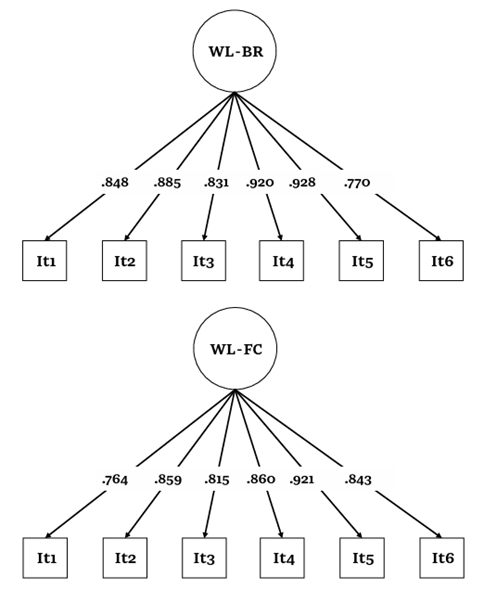
Note. WL-FC = well-lit Franco-Canadian Sample, WL-BR = well-lit Brazilian Sample.
Figure 1 Path diagram of the unidimensional model of the Well-Lit 6
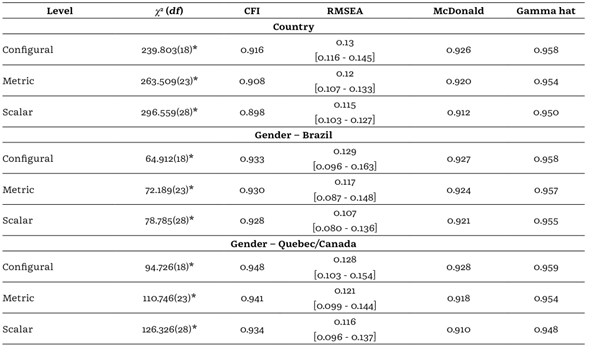
Then, to verify the invariance of the model, an MG CFA was performed. Table 1 describes the invariance analysis according to the country of residence and gender of the respondents. The results obtained in the present study suggest the equivalence of the unidimensional model to evaluate the groups with Brazilian and Canadian samples, as well as people of different genders (woman and men), since the fit indices were not harmed by restricting the models (∆CFI ≤ 0.001; ∆McDonald ≤ 0.02), except the Gamma-hat index (∆Gamma-hat ≤ 0.001) at the metric level for the country of the participants (∆Gamma-hat = 0.005) and gender of the Canadian sample (∆Gamma-hat = 0.005 ), and at the scalar level for the gender of the Brazilian sample (∆Gamma-hat = 0.002).
Discussion
The present study aimed to seek new validity evidence for the operationalisation of the wellbeing literacy construct, based on psychometric invariance analyses. In general, the results indicated the invariance of the model tested to measure wellbeing literacy in different groups, such as Brazilians and Canadians. Therefore, it is possible to conclude that the measurement of wellbeing literacy occurs in a similar way in these groups when using the unidimensional model, in accordance with the original version.
Investigating the measurement invariance of a test is crucial to ensure that it is valid and reliable in different contexts and populations, allowing for a precise and coherent interpretation of the results, since the accumulation of validity evidence permits a coherent interpretation of the scores obtained (AERA et al., 2014; Damásio, 2013). Specifically, this approach consists of checking the equivalence of the factorial structure (how items are grouped), the relevance/difficulty of the items and whether it is possible to compare the scores (Damásio, 2013).
The analysis to verify the factorial structure corroborated the theoretical proposal of Hou et al. (2021), in which wellbeing literacy is evaluated based on five components assessed using a unidimensional structure. The results demonstrated that the fit indices for the model were satisfactory, suggesting its applicability to Brazilian and French-Canadian populations. This corroborates results observed internationally, more precisely in a Chinese-speaking country (Jia et al., 2024). Furthermore, the precision indicators observed for the measurement model for each of the samples demonstrated that errors in relation to the evaluation of scores in the composition of the internal structure are low, since the values obtained for the different indicators (alpha and omega coefficients) were greater than 0.90 (Cunha et al., 2016). Although the RMSEA values (0.264 - 0.295) exceeded the conventional threshold of .08, it is important to highlight that this index is sensitive to models with only a few degrees of freedom (df = 9) and large sample sizes, which can falsely inflate the rejection of the model (Kenny et al., 2015). Other fit indices, such as the CFI and the TLI (> .90), supported the adequacy of the model, aligning with recommendations to prioritise multiple criteria for evaluating structural models (Hu & Bentler, 1999).
Using Multigroup Confirmatory Factor Analysis, it was possible to investigate whether the factor structure was equivalent, as well as to evaluate whether the items had the same relevance for the different groups, and whether the scores obtained by the different populations could be compared. In this sense, considering the results, it was found that the factorial structure of wellbeing literacy was equivalent for Brazilians and Canadians, and the items demonstrated to have the same importance in the groups. Furthermore, the model did not present response bias for the Brazilian and Canadian samples, therefore, the wellbeing literacy scores are invariant for these groups and can be compared with each other.
Similarly, the results also indicated that the factor structure of the Well-Lit 6 was equivalent for women and men in Brazil, as well as for women and men in French-Canada. Thus, despite traditional gender norms, which can influence perceptions and practices related to wellbeing, the instrument demonstrates that it measures wellbeing literacy in a similar way between genders.
In general, the results suggest strong invariance, due to the equivalence of factor structure (configural), fac tor loadings (metric) and item intercepts (scalar), which presented expected values based on the literature, with the exception of gamma-hat at the configural level (∆Gamma-hat = 0.01). Additionally, small variations in Gamma-hat (∆ ≤ 0.005) do not compromise invariance, as more robust criteria (∆CFI ≤ 0.001; ∆McDonald ≤ 0.02) were met (Chen, 2007). The results indicate that the unidimensional structure of the Well-Lit 6 is invariant between Brazilians and French Canadians, even in the face of high RMSEA values. These values may reflect intrinsic limitations of the index in the context of parsimonious models (Kenny et al., 2015), but the consistency of the CFI and the TLI suggests the practical validity of the model. Moreover, although Gamma-hat showed marginal variations, invariance was sustained by widely used criteria in the literature (Chen, 2007), reinforcing the cross-cultural comparability of the scores. These results show that the Well-Lit 6 is a tool applicable to different samples, as the findings point to the stability of the parameters of the scale items in samples with different profiles, allowing for impartial comparisons between them (Sass, 2011).
This study is the first to confirm its equivalence between Brazilian and French-Canadian groups, addressing a unique cultural and linguistic dyad previously overlooked in the literature. The robust configural, metric, and scalar invariance observed here suggests that wellbeing literacy, as operationalised by the Well Lit 6, transcends specific cultural narratives, supporting its use in comparative mental health research. This pioneering effort fills a critical gap in cross-cultural psychometrics, as prior studies have not systematically compared invariance between Latin American and Francophone populations. The Brazil-Quebec comparison provides insights into how linguistic minority status (Quebec) and collectivist values (Brazil) interact with wellbeing literacy measurement.
Well-being is a phenomenon deeply influenced by cultural, social, and individual contexts, which explains its significant variation across different populations. While there are common elements in the pursuit of happiness, the way it is experienced, expressed, and prioritised is shaped by unique cultural contexts. Individualistic cultures, such as those of the U.S. and Canada, emphasise autonomy, self-expression, and personal achievements. In collectivist cultures, such as Japan, China, and many Latin American societies, well-being is rooted in social harmony, interdependence, and fulfiling group duties. Happiness is often associated with balancing family responsibilities, respecting norms, and emotional moderation (Tov & Diener, 2007). These differences highlight the importance of culturally sensitive psychometric tools, such as the Well-Lit 6, which allow for valid comparisons of well-being constructs across distinct groups. Invariance studies, such as the present work, are crucial in order to avoid methodological biases and ensure that observed differences reflect real variations in the construct rather than cultural artifacts. Furthermore, mental health interventions should be adapted to these nuances: in Brazil, strategies that strengthen social networks may be more effective, while in Quebec, approaches that emphasise autonomy and cultural identity tend to resonate better.
Comparing well-being across cultures is a task full of methodological challenges that require sensitivity and rigour. These difficulties are not limited to linguistic or economic differences, but reflect deep variations in values, social norms, and the cognitive structures that shape human experience. Among the critical challenges, it is important to highlight the difficulty in translating concepts, response biases, and the influence of social norms, which illustrate why seemingly simple measurements can conceal insurmountable cultural complexities.
Evaluating measurement invariance across diverse groups is critical to confirm that observed differences in raw results reflect true disparities among subjects rather than measurement errors. This verification ensures the validity of comparisons and safeguards against biases that could disproportionately favour one group over another. Furthermore, it is essential that studies investigate the invariance of positive psychological constructs, as it empirically strengthens recent theories, such as wellbeing literacy, and facilitates interventions (Reppold et al., 2015). It is important to highlight that mental health literacy is broadly defined in the literature, however, the concept of wellbeing literacy is still emerging and requires more robust articulation. Oades et al. (2020) and Hou et al. (2021) were pioneers in proposing an initial framework for wellbeing literacy, therefore, the need to explore this field is highlighted.
Conclusion
The exploration of measurement invariance is crucial for defining constructs and evaluating the structural validity of psychological instruments. This study sought validity evidence for the 6-item Well-Being Literacy Scale (Well-Lit 6) through invariance analysis, demonstrating configural, metric, and scalar equivalence between Brazilian and French-Canadian groups. These results reinforce the cross-cultural applicability of the scale, contributing to the advancement of psychological assessment in diverse contexts. The study has limitations that should be considered. First, the use of convenience samples, with a significant disparity in size (Brazil: N = 323 vs. Canada: N = 1,134), may limit the generalisability of the findings, particularly due to the possible underrepresentation of population subgroups. Second, although incremental indices (CFI/TLI > 0.90) supported the model’s adequacy, the high RMSEA values suggest caution in interpreting the absolute fit, possibly reflecting the index’s sensitivity to parsimonious models with few degrees of freedom (Kenny et al., 2015). Additionally, minimal variations in Gamma-hat (∆ ≤ 0.005) did not compromise invariance, but replication in balanced and probabilistically representative samples is recommended to confirm the robustness of the findings. Finally, the brevity of the scale, while practical, may limit the capture of the construct’s nuances, indicating the need for future studies to expand the number of items without compromising usability. To overcome these limitations, replication of the research in culturally and numerically balanced samples is recommend ed, mitigating disparities such as pronounced group size differences. Longitudinal studies are also relevant to investigate how well-being literacy influences mental health trajectories in populations under chronic stress, such as healthcare professionals. The integration of mediators (e.g., social support) and moderators (e.g., education level) in future analyses could elucidate underlying mechanisms in the relationship between literacy and psychological outcomes.
Finally, mixed methods approaches (quantitative and qualitative) are promising for capturing cultural interpretations of specific items, such as well-being promotion strategies. These initiatives would not only deepen theoretical understanding of the construct but also optimise interventions tailored to diverse needs, aligning with recent proposals in the field. By expanding the evidence base for the Well-Lit 6, its potential as a valid and reliable tool for research and practice in different cultures is strengthened.1 2 3 4 5

