




 text in
 English (pdf)
 Article in xml format
 Article references

 Automatic translation
 Send this article by e-mail
 Cited by SciELO
 Cited by Google
 Similars in
SciELO
 Similars in Google

 Permalink


What do we know about this problem?
Detection of reverse triggering (RT) based on the analysis of the different curves provided by mechanical ventilators poses a great challenge to healthcare staff working in intensive care units (ICU). The ability to identify RT, reported by some studies, is not greater than 59%, and only 50% of the healthcare professionals are able to correctly respond to this type of patient-ventilator asynchrony.
How does this study contribute?
In Chile, attending a specific education program focused on PVA recognition and resolution could result in an improved ability among critical care staff to identify and resolve RT based on ventilation graph analysis.
INTRODUCTION
Reverse triggering (RT) is a frequent type of patient-ventilator asynchrony (PVA) in patients with diminished respiratory drive connected to invasive mechanical ventilation. This PVA has been described as a reflex diaphragmatic contraction after passive insufflation started by the mechanical ventilator (MV) 1,2. The magnitude and duration of this reflex diaphragmatic contraction varies between respiratory cycles 2.
Some studies have documented a significant increase in transpulmy5onary pressure, airway driving pressure, plateau pressure, and lung volume redistribution to gravity-dependent pulmonary areas during RT 3-5. Evidence suggests that, in susceptible patients, PVAs such as RT can lead to the development of ventilation-induced lung injury; moreover, there is a higher association between repetitive patterns of this asynchrony and unfavorable clinical outcomes, including extended time on MV and mortality 6-8. It is still unclear which type of asynchrony has the greatest impact on outcomes in patients on MV and which are the true outcome mediators. However, this has to be confirmed by studies designed to assess potential mediators of these negative outcomes 9.
Detection of this type of PVA through the analysis of the different curves provided by the ventilators is a major challenge for healthcare professionals working in intensive care units (ICU). In fact, the ability to identify RT reported by some studies is not greater than 59% 10-12. Moreover, among healthcare professionals, only 50% are able to correctly manage this type of PVA 10-12.
Despite potential complications associated with this type of asynchrony, there is currently a paucity of reports on the effects of training programs designed to help healthcare professionals acquire the competencies required to identify and resolve this type of PVA. The research group of which the authors of this study are members recently published a study which showed that a targeted program can improve the competencies for detecting and addressing PVAs among ICU staff; however, analyses by asynchrony type were not carried out 10. Furthermore, the inclusion of professionals from different countries makes it difficult to recognize the specific training needs in each context. For this reason, the aim of this study was to conduct a subanalysis of both the immediate and 30-day effect of an education program specifically designed to detect and resolve RT through the analysis of the ventilation graph among Chilean professionals working in the ICU setting. To this purpose, the authors built on the data derived from the previous study 10.
METHODS
A secondary analysis was carried out based on the data used in a quasi-experimental study of the before-and-after type in which each of the participants was assessed at three different points in time 10-12. This research was approved by the ethics committee of Universidad de Chile Clinical Hospital (Page 1097/20). All of the participants gave their informed consent for inclusion of their data in the analysis.
As part of the study, an education program aimed at improving detection and management of the different PVAs by critical care staff in Latin America and Spain was applied. The recruited professionals included 116 volunteer physicians, nurses and physical therapists (respiratory therapists or kinesiologists) of 20 hospitals from Argentina, Bolivia, Brazil, Chile, Colombia, Ecuador, Mexico, Peru, Spain and Uruguay.
Of the 36 hours comprising the program, 6 were dedicated to a synchronous online session through the Zoom® platform (Zoom Video Communications, San José, California) in which 120 real clinical cases of PVA were analyzed. For the remaining 30 hours, study participants were asked to devote one hour a day to personalized learning over the next 30 days.
A six-hour synchronous online session was divided into theory theme blocks covering the following content: 1) fundamentals of pressure/time, flow/ time and volume/time curves (1 hour); 2) fundamentals, definitions and classification of PVAs (1 hour); 3) RT identification, causes and management (2 hours); 4) recognition, etiology and approach for other asynchronies associated with too little or too much flow (2 hours). After completing the session, the ICU professionals participated in daily meetings with the same instructor, during which they could ask questions and discuss real PVA cases observed in their hospitals. Additionally, during these online meetings, the instructor shared supplementary material such as scientific papers, clinical cases and videos for discussion at a later meeting. The main purpose of this training was to determine whether the competencies acquired during the initial session were maintained or even improved over time. For further details, see the study by Ramírez et al. 10.
An assessment tool designed by three experts in PVA was applied before and after the online session. Initial agreement was 83.3%, with disagreement found for five of the questions, which were discussed until consensus was reached and then revised and validated. The assessment tool consisted of 30 multiple choice questions prepared in Google Forms® (Google, Mountain View, California). The aim of the questions was to assess the ability of the healthcare staff to recognize, determine the causes and resolve PVAs. Twenty of the questions showed MV images with pressure/time, flow/time and volume/ time curves. The remaining ten questions were designed to assess basic concepts pertaining to PVAs. The same assessment tool was given to the participants 30 days after the online session, and the right answers were shared at the end of the study. The aim of this was to avoid the effect of learning by repetition.
Procedures
For this secondary analysis, only Chilean healthcare professionals who had participated in the study by Ramírez et al. 10-12 were included. All of the other inclusion and exclusion criteria were maintained: 1) having no formal education regarding PVAs; 2) working in an ICU at the time of the education program; 3) having to work with patients on mechanical ventilation as part of their job; and 4) submitting a validated certificate of their current work activity, specifying years of experience.
Information regarding the participants' performance with the questions designed to understand their ability to recognize RT and determine the right approach to manage this PVA was also extracted. Of the 30 questions in the assessment tool, two were aimed at assessing the ability to recognize RT and one was designed to determine the professional's ability to resolve it.
Statistical analysis
Absolute and relative frequencies were used to describe categorical variables, and means with standard deviation or medians with interquartile ranges (IQR) were used for quantitative variables according to their distribution. The distribution of the quantitative variables was compared against the normal curve using the Shapiro-Wilk test.
Three outcome variables were considered for the inferential analysis: the first corresponds to the three grouped questions, the second covers the questions related to RT recognition, and the third focuses on the question pertaining to RT resolution. The chi-square test was used to compare the proportion of professionals who answered all the questions correctly before the online session (time T0), following the online session (time T1), and 30 days after the on-line session (time T2). The same analysis was carried out by question type. A mixed effects model with simple logistic regression was also used to determine the probability of performance improvement among the participants in the study. Probabilities were presented as odds ratios (OR) with their respective 95% confidence intervals (95% CI). Alluvial diagrams were used to plot staff performance flows between To-T1, and T1-T2.
Additionally, the impact of experience on performance was measured using a mixed effects model with multiple logistic regression, taking into consideration years of experience as a dichotomous variable, with a one-year cut-off point.
The JASP Version 0.19.2 computer software was used for the analysis, with a 5% level of statistical significance. The STATA 15.1 statistical software package (Copyright 1985-2017 StataCorp LLC) was used for the mixed effects model. The alluvial diagrams were prepared in RStudio (Version 2022.02.0+443, © 2009-2022 RStudio, PBC).
RESULTS
This secondary analysis included 49 professionals, accounting for 42.24% of the participants included in the study by Ramírez et al. 10-12. Forty-six (93.88%) were physical therapists and the rest were nursing professionals. Median experience was three years (IQR 0.9 to 4), and 51.02% of the participants had less than one year of experience in critical care.
Correct answers to the three questions were given by 20.41% of the participants at time T0, a proportion which increased significantly at T1 (73.47%) and T2 (69.39%) (p < 0.001) (Table 1, Figure 1). As for the questions pertaining to RT identification, the proportion of participants who answered correctly increased significantly from 34.69% at time To, to 81.63% and 73.45% at T1 and T2, respectively (p < 0.001) (Table 1, Figure 2). Finally, the analysis of the question related to adequate RT management revealed that the proportion of participants who marked the right choice increased significantly from 59.18% at time T0, to 91.84% at T1, and 93.88% at T2 (p<0.001) (Table 1, Figure 3).
Table 1 Odds ratios for improvement in RT recognition and management.
| Time of assessment | |||
|---|---|---|---|
| Reference | T1 | T2 | |
| All questions | T0 | 32.13 (6.81 to 151.66) | 24.14 (5.47 to 106.42) |
| Identification questions | T0 | 38.78 (6.87 to 218.97) | 17.65 (3.94 to 79.02) |
| Management questions | T0 | 17.21 (3.07 to 96.45) | 25.17 (3.82 to 165.69) |
T0: before the online session, T1: after the online session, T2: 30 days after the online session. Values are presented as OR (95% CI).
Source: Authors.
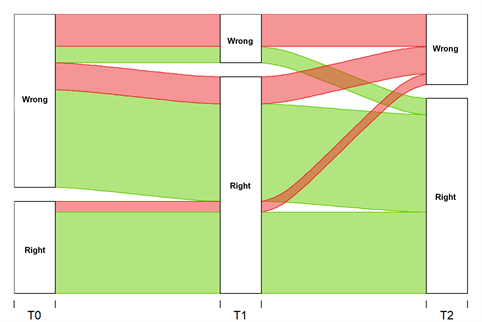
T0: before the online session, T1: after the online session, T2: 30 days after the online session. Source: Authors.
Figure 1 Alluvial diagram of participant performance in the three questions (RT recognition and resolution) at T0, T1 and T2.
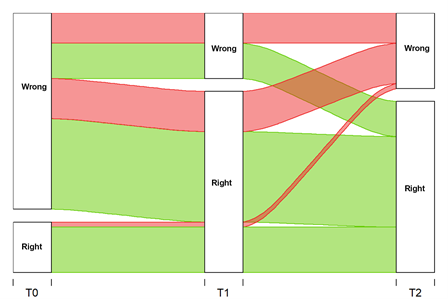
T0: before the online session, T1: after the online session, T2: 30 days after the online session. Source: Authors.
Figure 2 Alluvial diagram of participant performance regarding the questions on RT recognition at T0, T1 and T2.
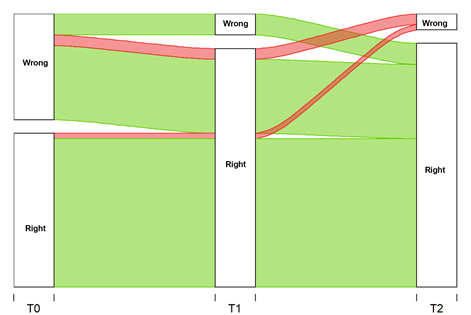
T0: before the online session, T1: after the online session, T2: 30 days after the online session. Source: Authors.
Figure 3 Alluvial diagram of participant performance in relation to the question on RT resolution at T0, T1 and T2.
When adjusting for the effect of the education program on the ability to recognize and resolve RT, experience in years working in the ICU did not have a significant influence (p<0.001) when considering the three questions.
DISCUSSION
This study describes the effect of a hybrid education program on the ability of Chilean healthcare professionals working in the ICU to identify and resolve RT based on ventilation curve analysis. This program enabled critical care professionals to improve their ability to recognize and resolve RT, regardless of experience. However, some of the healthcare professionals were unable to develop the skills to identify and manage this PVA.
In recent years, various types of complications associated with the different PVAs have been identified. Some of the deleterious clinical consequences of PVA are more days on MV, dyspnea, pulmonary and diaphragmatic injury, delayed weaning, and higher in-hospital mortality 7,8,13-15. This highlights the importance of recognizing and addressing the different PVAs which occur in critically ill patients. Despite a growing number of training programs focusing specifically on the recognition and management of PVAs such as RT, few studies have reported their effects.
Initially described by Akouminiaki et al. 16 in 2013, RT manifests as a secondary reflex diaphragmatic contraction in response to passive insufflation by the MV in patients under deep sedation, and even in patients diagnosed with brain death 17. The intensity and duration of the reflex diaphragmatic contraction varies; in some cases it leads to an increase in transpulmonary pressure, airway driving pressure, overdistension of gravity-dependent lung zones, and pulmonary and diaphragmatic injury 1-5.
RT identification and management using pressure/time and flow/time curves requires highly trained healthcare professionals. RT recognition requires evidence of a negative inflection in the pressure/time curve during the trigger phase. However, as it is an MV-triggered reflex, some authors suggest that an expiration pause should be applied in order to identify RT 18, looking for the absence of inspiratory effort on the pressure/time curve to determine that the patient is indeed experiencing RT 18. Different strategies have been proposed for the management of RT, the most frequently reported being to increase support levels, lower respiratory rate, and use neuromuscular blockers 1,4,5,19.
In response to PVA-associated complications, several authors have focused their efforts on assessing the ability of healthcare practitioners to detect and resolve them using ventilation graph analysis 10-12,20-27. Surprisingly, several studies have shown that less than 30% of the healthcare professionals are capable of identifying different types of PVA correctly 20-28. On the other hand, only 12.5% are able to adequately address different types of PVAs 21. In this study, only 34.69% of the participants adequately identified RT while 59.18% resolved it; however, only 20.41% were capable of answering the three questions correctly. After completing the 6-hour online synchronous training, there was a considerable increase in the percentage of professionals who identified and resolved RT correctly, to 81.63% and 91.84%, respectively. Moreover, there were no significant changes between the assessment carried out upon completion of the synchronous phase and the 30-day assessment. Similar results had been previously obtained by Gravante et al. 29. Nursing students showed a significant improvement in their ability to identify asynchrony during the two post-education phases. Similarly, there was no significant increase in the percentage of PVA detection between the immediate and the 30-day post-training assessment. However, unlike the study by Gravante et al. 29, this study did not only assess the ability to detect a specific type of PVA - RT in this case - but also the ability to resolve it. Additionally, this education program considered one-hour daily sessions with the instructor during the 30 days following the online session. This strategy may have contributed to maintain the level of RT recognition and resolution. Moreover, it was also shown, for the participants in this study, that years of experience is not a determinant of the ability to correctly identify or solve RT.
In this study, sample size and selection, as well as the inability to confirm some inclusion criteria and the lack of control variables in the multiple regression analysis, are limitations when it comes to establishing a causal relationship between the participation in the education program and improved RT detection and resolution. These methodological considerations should be taken into account in future studies. Furthermore, participant distribution by profession was asymmetrical, perhaps limiting the ability to generalize the results. As far as professions are concerned, 93% of the participants were physical therapists, while 7% were nurses. Another limitation is the absence of physicians among the participants, given that in most clinical settings, it is physicians who are responsible for MV. Importantly, though, in Chile as well as in other Latin American countries, physical therapists, respiratory therapists or kinesiologists have a specific training level that allows them to manage ventilation therapy together with the medical staff. On the other hand, the absence of a control group can be considered a limitation but, indeed, individual participants were used as their own controls.
Notwithstanding these limitations, the findings reported herein point to the need for ICU professionals to receive constant training on the identification and resolution of PVAs such as RT. Moreover, even with 36 hours of specific training during one month, not all the participants were able to provide correct answers to the evaluation questions 30. In this context, automatic PVA detection algorithms could solve the problem 31-33. However, this technology might no be available everywhere, particularly in low-income settings. A highlight of this study is that the education program was carried out online. This modality allows professionals from different places to participate, without having to spend financial resources in travel to other cities or countries to gain access to this type of training. Additionally, tutoring and daily follow-up during a specific time period create opportunities to improve and apply the acquired knowledge on a daily basis.
CONCLUSIONS
Attending a specific education program focusing on PVA recognition and resolution could help critical care healthcare professionals in Chile, regardless of their experience, to improve their ability to recognize and solve RT based on ventilation graph analysis.
Further research is needed in order to gain an insight into the long-term impact of training programs similar to the one used in this study, and also to determine the potential effect of better prepared professionals on various clinical outcomes in patients on invasive MV.
ETHICAL RESPONSIBILITIES
Ethics committee approval
The study was approved by the ethics committee of the Universidad de Chile Clinical Hospital (Page 1097/20).
Protection of human and animal subjects
No experiments were performed on humans or animals for this study.

