Cartas al editor
Normality Assumption in Health Sciences Research: What Is the Strongest Test? How to Calculate It?
Supuesto de normalidad en la investigación de ciencias de la salud: ¿Cuál es la prueba más potente? ¿Cómo calcular?
1 Psychology Program, Universidad Católica de Pereira, Colombia. MSc in Psychology, Psychologist, Bachelor's Degree in Physical Education and Sports. Representative of the field of Evaluation, Measurement and Applied Statistics of the Colombian College of Psychologists. Research Node Coordinator of Psychology of Physical Activity and Sports (Asociación Colombiana de Facultades de Psicología, ASCOFAPSI). CORREO: haney.aguirre@gmail.com, haney.aguirre@ucp.edu.co. Orcid: https://orcid.org/0000-0002-2582-4941. Cvlac: https://scienti.colciencias.gov.co/cvlac/visualizador/generarCurriculoCv.do?cod_rh=0001149229
2 Universidad de Manizales, Clinical Psychologist, Ms candidate in Clinical Psychology CORREO: laurapatriciaherrera02@gmail.com, Orcid: https://orcid.org/0000-0001-9624-8710, Cvlac: https://scienti.minciencias.gov.co/cvlac/visualizador/generarCurriculoCv.do?cod_rh=0001842738
3 Psychology Program, Universidad Católica de Pereira, Colombia. MSc Educational Neuroscience, Psychologist, Bachelor's Degree in English. Psychology Lecturer UCP, Instituto de Lenguas Extranjeras (ILEX-UTP). CORREO: jonathan.nanez@ucp.edu.co, Orcid: https://orcid.org/0000-0002-2053-2421,
Dear Editor-in-Chief,
Researchers, professionals, and students in training in the health and social sciences fields need to make decisions based on sound scientific evidence. Generally, public mental health policies are based on the strength and robustness of scientifc findings. A critical aspect of research at the methodological level has to do with statistical analyses.
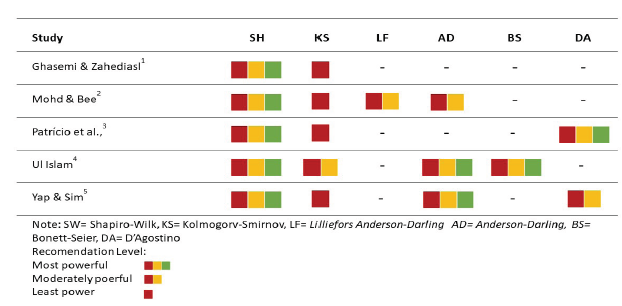
Often, to test hypotheses from a frequentist model approach, many of the performed analyses are conditioned on the assumption of normality of the data distribution. Therefore, the objective of this commentary is to propose an alternative test, with higher statistical power. Likewise, after a brief review of the literature, we make suggestions to students and junior researchers which may prove useful tools for their work (see figure 1).
It has been suggested that for sample sizes >50, the Kolmogorov-Smirnov test (K-S) is recommended; alterantively, for n<50, Shapiro-Will is preferred. These ideas have generally been widely spread through the use of computer statistical packages (e.g., SPPS). However, computer simulations with different sample sizes call for a reconsideration of this belief. Which test has more power? What does the evidence say?
Studies seem to agree that the most recommended test to validate the assumption of normality is Shapiro-Will, while the wide use of the Kolmogorov-Smirnov test should be reconsidered. In conclusion, Shapiro-Will seems to be more sensitive in terms of the normality test. However, with small sample sizes, its interpretation must be assumed with caution 1-5.
WHAT SOFTWARE TO USE?
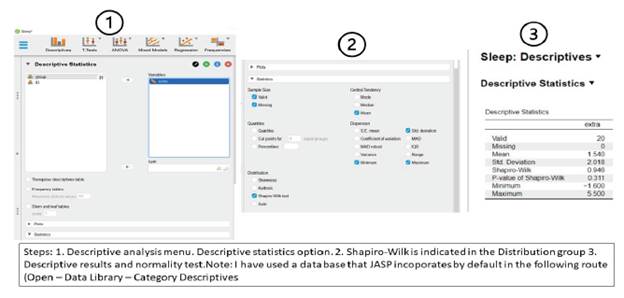
There are different statistical packages available to researchers. For example, from licensed software (e.g., STATA, SPSS), to open access (Jamovi, JASP, Rstudio). To run the Shapiro-Wilk test we recommend JASP® (6. It is a free, flexible, and friendly access software. It is constantly updated and in sync with the R programming language. In addition, for frequentist statistical analyses, it has a main emphasis on Bayesian analysis. Figure 2 shows the estimation of the normality test using Shapiro-Wilk through JASP®.
REFERENCES
1. A, Zahediasl S. Normality tests for statistical analysis: A guide for non-statisticians. Int J Endocrinol Metab. 2012;10:486-9.
[ Links ]
2. Mohd N, Bee Y. Power comparisons of Shapiro-Wilk, Kolmogorov-Smirnov, Lilliefors and Anderson-Darling tests. J Stat Model Anal. 2011;2:13-4.
[ Links ]
3. Patrício M, Ferreira F, Oliveiros B, Caramelo F. Comparing the performance of normality tests with ROC analysis and confidence intervals. Commun Stat Simul Comput. 2017;46:7535-51.
[ Links ]
4. Ul Islam T. Ranking of normality tests: An appraisal through skewed alternative space. Symmetry (Basel). 2019;11.
[ Links ]
5. Yap B, Sim C. Comparisons of various types of normality tests. J Stat Comput Simul. 2011;81:2141-55.
[ Links ]
6. JASP Team. JASP (versión 0.16.31) [Computer software] 2022.
[ Links ]





 Inglés (pdf)
 Articulo en XML
 Referencias del artículo

 Traducción automática
 Enviar articulo por email
 Citado por SciELO
 Citado por Google
 Similares en
SciELO
 Similares en Google

 Permalink