




 Inglês (pdf)
 Artigo em XML
 Referências do artigo

 Tradução automática
 Enviar este artigo por email
 Citado por SciELO
 Citado por Google
 Similares em
SciELO
 Similares em Google

 Permalink


INTRODUCTION
Obesity is a disease evidenced by an excess of body weight, and when it occurs during early adolescence, it increases the risk of chronic non-communicable diseases such as metabolic syndrome, high blood pressure, dyslipidemia, fatty liver, type 2 diabetes, and cardiovascular diseases 1-3 biological and lifestyle factors on the risk of metabolic syndrome (MetS. Although obesity can have multiple causes in adolescents, the most frequent ones are low physical activity and bad eating habits 4-7) moderate and vigorous PA (MVPA.
Several studies in obese adolescents have shown that an increase in physical activity offers multiple benefits including a decrease in body fat, increase in muscle mass, decrease in triglycerides, increase in HDL cholesterol levels, and increase in insulin sensitivity 6,8-12physical fitness, and cardiometabolic risk in adolescents participating in an interdisciplinary program focusing on the treatment of obesity. The final 12-week analyses involved 33 female adolescents who were split into two groups of concurrent training (CT. However, there is no consensus on what type of physical activity is more effective in adolescents, and having such information would be key to developing better physical education programs in schools.
Both, the aerobic MICT and the anaerobic HIIT have shown positive effects over cardiovascular risk variables in adolescents 9,13-18. However, in the adult population with obesity, there is strong evidence supporting that HIIT has greater effects than MICT over cardiovascular risk factors 12,19,20. We aimed to determine whether HIIT or MICT, in conjunction with nutritional counseling, has a greater impact on anthropometric and metabolic variables in obese adolescents.
METHODS
Participant Selection
The present study had a quasi-experimental design with a non-representative sample. Initially, we invited 73 obese adolescents from the public school "Escuela España" (Los Angeles, Chile) to participate in exercise sessions and counseling on healthy eating. Our exclusion criteria were the presence of metabolic disease or chronic disease (dyslipidemia, hypertension, diabetes, or other pathology) that would require specific medical treatment, pharmacological treatment, or that would guard against working out.
From the group of invited subjects, the ones that agreed to participate in the study, and met the inclusion criteria, were in total 35. This group of participants was randomly separated into 2 exercise groups: HIIT (n = 18) and MICT (n = 17), of which only 12 and 11 subjects completed the study, respectively (figure).
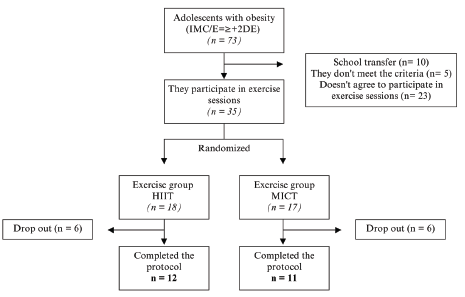
Note. Body mass index for a given age (BMI/E) +2 standard deviation (≥ + 2 SD) is referred to the growth patterns proposed by the WHO and adapted to the Chilean population 24. HIIT: high-intensity interval training, MICT: moderate-intensity continuous training.
Source: own elaboration.
Figure Flow Scheme for the Participant Selection Process
This study was approved by the Ethics Committee of the Universidad Santo Tomás (Chile) (code:5-2016, December 2015). Prior to the beginning of the intervention, all participants signed an informed assent form, and their tutors signed an informed consent form.
Intervention and Workout Protocol
In both intervention groups, the training frequency was set to be 3 times per week over a period of 12 weeks (3 months) 8but it is unknown whether a high-intensity interval training (HIIT. The participants were required to assist for a minimum of 28 sessions (80%) from a total of 36 sessions. Given the low initial attendance to the exercise sessions, it was necessary to extend the length of the intervention adding 2 extra months (8 weeks) to complete the study intervention.
Workshops on eating and healthy lifestyles: in addition to the physical activities, once a week (either before or after the workout) the participants attended workshops on nutritional counseling, conducted by specialized nutritionists, where they discussed the importance of consuming healthy foods (fruits, vegetables, dairy products, legumes, fish) and maintaining a healthy lifestyle. These teachings were delivered through active games and both group and individual methodologies. Each participant learned how to prepare a variety of healthy meals and snacks for their consumption. The contents covered in each workshop were sent to the parents or guardians of the adolescents through a personalized notebook.
High-intensity interval training (HIIT): in this group, the participants performed a cyclic workout on a static bike (Proteus Nitro V4, China) consisting of an active phase of 1 min, to peak at 80 to 100% of the maximum heart rate (HRmax), followed by a resting phase of 2 min. This cycle was repeated a total of 10 times to complete the session. The HR was measured with a heart rate monitor and pulsometer (Polar FT1, Finland) 21,22.
Continuous moderate-intensity exercise (MICT): in this group, participants performed a continuous active phase in the static bike for 30 min. to achieve a peak of 55 to 69% of the HRmax, without any resting phase. The bike and HR monitor were the same used with the HIIT group 22,23.
Sociodemographic Variables and Lifestyle
The sociodemographic data (age, sex, area of residence, educational level of the mother) were consulted with each tutor (mother, father, or close relative) and recorded in an entry form for the project. Data associated with the lifestyle, including food intake habits and physical activity, were collected using validated surveys (clinical test for assessing physical activity in children of Godard M. 2008 24 and Eating Habits Questionnaire of Burrow A. 2008 25). A specific habit was considered as "good" when the survey score was higher than 7 points (10 to 7 points), "regular" between 6 to 4 points, and "bad" below 3 points 24,25.
Anthropometric Variables
The anthropometric evaluation was performed by trained professionals using standardized protocols 26. The body weight was measured on a digital balance (SECA 817, USA) with an accuracy of 100 g. For the measurement, each participant stood upright at the center of the balance in lightweight clothes and barefoot. The height was recorded with a height measurement instrument (SECA 217, USA) having an accuracy of 1 mm. Each participant stood upright over the platform with the knees stretched and the back, buttocks, and heels contacting the vertical portion of the instrument. The waist circumference (WC) was measured with a measuring tape made of non-distensible material (SECA Model 201, USA), by placing the midpoint between the costal flange and the iliac crest along the axillary mid-line. The nutritional status was classified according to the growth patterns for children and adolescents between 5 years 1 month and 19 years (WHO), based on the body mass index for the age: malnutrition (≤-2 SD), risk of malnutrition (between > -2 and ≤ -1 SD), normal (between> -1 and <+1 SD), overweight (between ≥ +1 and <+2 SD), obesity (≥ +2 SD) and severe obesity (≥ +3 SD) (27). To define abdominal obesity, a waist perimeter classification for the age was used: normal (<75%), risk of abdominal obesity (between 75 and 90%), and abdominal obesity (over 90) 27. The body composition was evaluated using a four-pole bodystat bioimpedance meter (QuadScan 4000) on the subjects before an 8-hour liquid and solid fast and at rest (without any intense exercise 12 hours before).
Determination of Metabolic Markers
Blood samples were obtained by venous puncture after 10 to 12 hours of fasting. Basal glycemia, total cholesterol (CT), HDL cholesterol (cHDL), LDL cholesterol (cLDL), VLDL cholesterol (cVLDL), and triglycerides (TG) were analyzed using the Ultra HDL enzymatic method (Abbott Diagnostics, USA) through absorbance measurement in an automated equipment ARCHITECT c4000 (Abbott, USA).
Insulin was determined by immuno-chemiluminescence using microparticles (Abbott Diagnostics, USA) in the ARCHITECT equipment. Systolic (PAS) and diastolic (PAS) blood pressure was measured by placing each patient in a supine position, after a 10-minute rest period, with a mercury sphyg momanometer (aneroid, ADC, 760) and a stethoscope (Littmann classic III). Three blood pressure measurements were made for each patient, by trained professionals, reporting the average value. For the lipid profile parameters, the cut-off point was the one for children over 10 years of age: CT <200 mg/dL, c-HDL ≥40 mg/dL, cLDL <130 mg/dL, and TG <130 mg/dL 28.
The results of all these biochemical tests were reviewed by a physician, who informed the tutors and participants in individual meetings held at the beginning of the intervention. All these measurements were evaluated two times, before the beginning of the physical exercise program and after its completion.
Statistical Analysis
The values obtained for the population studied were analyzed by calculating the average and standard deviation (SD) for continuous variables and as a percentage for categorical variables.
To determine the effect of the HIIT and MICT exercise program over the anthropometric variables and metabolic markers, a t-test for related samples was used, considering p <0.05 as statistically significant.
To compare the exchange rates between HIIT and MICT exercise groups, the difference between pre-intervention and post-intervention values for each group was calculated using a t-test for independent samples, considering p<0.05 as statistically significant. For these tests, the effect size was estimated using Cohen's d model. Scores d <0.2 were considered as a low effect, between 0.2 and 0.8 as a medium effect, and d>0.8 as a large effect29,30.
Given that with a low sample size we might not be able to detect a medium or large effect size as statistically significant, following Cohen's recommendation (1990), we calculated the statistical power (1-ß) for each hypothesis test. In this regard, Cohen recommends that power values below 0.8 indicate the need to increase the sample size to detect statistically significant changes in the analyzed variables.
RESULTS
The characteristics of the children belonging to the MICT and HIIT exercise groups are shown in Table 1. We observed a similar age (11.36 ± 1.21 and 11.58 ± 1.16) and a greater percentage of females (54.5% and 58.3%) in the MICT and HIIT groups, respectively. Most participants were urban residents and their mothers had complete secondary education but did not have a college education. Both groups shared similar anthropometric characteristics, however, the MICT group had a lower percentage of subjects classified with abdominal obesity compared to the HIIT group, where all the subjects presented this diagnostic. Regarding food intake habits, most subjects had "regular" habits. In the HIIT group no one had "bad" habits, while in the MICT, the 18.2% did have "bad" habits. Regarding physical activity, more than half of the subjects in the HIIT group presented "bad" habits before the intervention. In the HIIT group, only 8.3% presented "good" habits, in the MICT only 9.1% did.
Table 1 Characteristics of the Analyzed Groups
| MICT (n=11) | HIIT (n=12) | |
|---|---|---|
| Male, % | 45.5 | 41.7 |
| Female, % | 54.5 | 58.3 |
| Age, years | 11.36 ± 1.21 | 11.58 ± 1.16 |
| Urban, % | 90 | 100 |
| Education level of the mother (%) | ||
| Basic school education | 27.3 | 16.7 |
| Intermediate school education | 72.7 | 83.3 |
| University of technical education | 0 | 0 |
| Anthropometry and body composition | ||
| Weight, kg | 66.30 ± 13.72 | 69.16 ± 14.34 |
| Height, cm | 151.86 ± 8.69 | 153.85 ± 6.08 |
| PC, cm | 92.65 ± 9.55 | 96.79 ± 10.22 |
| IMC, kg/m2 | 28.56 ± 3.86 | 28.95 ± 3.81 |
| Abdominal obesity, % | 90.9 | 100 |
| Fat mass, % | 36.67 ± 3.72 | 39.60 ± 3.09 |
| Food intake habits | ||
| Good (7-10) | 9.1 | 8.3 |
| Regular (6-4) | 72.7 | 91.7 |
| Bad (3-0) | 18.2 | 0 |
| Physical activity habits | ||
| Good (7-10) | 9.1 | 8.3 |
| Regular (6-4) | 45.4 | 25.0 |
| Bad (3-0) | 45.5 | 66.7 |
Note. Table 1 shows the characteristics of the groups analyzed. Depending on the type of exercise: continuous moderate-intensity (MICT) and high-intensity interval (HIIT). Values are expressed as average ± standard deviation, or percentages (%). PC: waist circumference, BMI: body mass index.
Source: own elaboration.
The changes obtained post-intervention are shown in Table 2. In both groups, we observed important changes in terms of body composition, with an increase in lean mass, and a reduction in triglycerides. No other significant differences were found among the anthropometric variables or in the metabolic markers.
Table 2 Analysis of Body Composition, Metabolic Markers, and Health Habits for the MICT and HIIT Groups
| Variables | Pre-intervention | Post-intervention | p-value | p-value | ||
|---|---|---|---|---|---|---|
| MICT | HIIT | MICT | HIIT | MICT | HIIT | |
| Anthropometry and body composition | ||||||
| BMI, kg/m2 | 28.56 ± 3.86 | 28.95 ± 3.81 | 29.09 ±3.81 | 29.00 ±4,28 | 0.269 | 0.905 |
| Waist circumference, cm | 92.65 ± 9.55 | 96.79 ± 10.22 | 91.54 ± 9.22 | 97.42 ± 11,37 | 0.440 | 0.583 |
| Fat mass, % | 36.67 ± 3.72 | 39.60 ± 3.09 | 35.95 ± 3.96 | 39.02 ± 3,00 | 0.244 | 0.516 |
| Fat mass, kg | 24.05 ± 5.09 | 27.71 ± 7.85 | 24.85 ± 5.22 | 27.84 ± 7,80 | 0.202 | 0.863 |
| Lean mass, kg | 41.79 ± 9.30 | 41.45 ± 6.75 | 44.03 ± 8.13 | 42.93 ± 8,26 | 0.008* | 0.030* |
| Metabolic markers | ||||||
| Fasting glycemia, mg/dl | 87.18 ± 5.95 | 84.50 ± 5.93 | 87.40 ± 5.72 | 87.00 ± 6.83 | 0.350 | 0.237 |
| Fasting insulin, mg/dl | 15.85 ± 7.19 | 19.30 ± 5.97 | 15.14 ± 6.50 | 17.62 ± 4.13 | 0.697 | 0.385 |
| HOMA-IR | 3.44 ± 1.63 | 4.00 ± 1.14 | 3.27 ± 1.43 | 3.80 ± 1.04 | 0.706 | 0.564 |
| Total cholesterol, mg/dl | 166.0 ±21.52 | 171.17 ± 35.53 | 154.00 ±21.70 | 168.00 ±42.75 | 0.122 | 0.630 |
| HDL, mg/dl | 41.63 ± 13.65 | 45.00 ± 9.40 | 45.30 ±9.01 | 44.92 ± 5.55 | 0.181 | 0.972 |
| LDL, mg/dl | 96.27 ± 21.50 | 98.50 ± 22.44 | 87.90 ± 21.16 | 97.50 ± 31.88 | 0.317 | 0.857 |
| VLDL, mg/dl | 25.91 ± 17.91 | 27.67 ± 11.73 | 20.80 ± 15.27 | 25.58 ± 11.90 | 0.092 | 0.235 |
| Triglycerides, mg/dl | 129.18 ± 90.23 | 137.75 ± 58.61 | 102.80 ±76.25 | 127.50 ±59.96 | 0.002* | <0.001* |
| PAS, mmhg | 107.10 ±11.63 | 106.67 ± 8.88 | 103.00 ±10.59 | 105.83 ± 9.00 | 0.151 | 0.339 |
| PAD, mmhg | 69.00 ± 9.62 | 70.42 ± 8.65 | 69.01 ± 9.94 | 69.58 ± 9.16 | 0.885 | 0.339 |
| Health habits | ||||||
| Food intake (score) | 5,48 ± 1.26 | 5.63 ± 0.79 | 6.06 ± 1.15 | 5.87 ± 1.23 | 0.262 | 0.589 |
| Physical activity (score) | 3.73 ± 1.42 | 3.17 ± 1.90 | 4.18 ± 1.40 | 3.08 ± 1.56 | 0.534 | 0.886 |
Note. Data are shown as average ± standard deviation or percentages (%). To compare the results of the pre- and post-intervention variables, a student's t-test for related samples was used.
*: statistical significance (p <0.05).
Source: own elaboration.
The rate of change for the anthropometric variables, body composition, and metabolic markers are shown in Table 3. We did not find differences between the groups for the variables studied, however, the MICT group exhibited a greater decrease in the waist circumference in comparison with the HIIT group. Also, we observed decreases in the total cholesterol CT having 8.13 mg less, LDL cholesterol having 5.9 mg less, triglycerides having 20.45 mg less, and systolic blood pressure having 3.27 mmHG less than the HIIT group. Additionally, the MICT group presented an increase in HDL cholesterol of 4.01 mg while the HIIT group showed a slight reduction instead.
Table 3 Comparison of the Change Rate between MICT and HIIT Groups
| Variables | Difference (Δ) | Change (%) | p-value | ||
|---|---|---|---|---|---|
| MICT | HIIT | MICT | HIIT | ||
| Anthropometry and body composition | ↑↓ | ||||
| BMI, kg/m2 | 0.53 ±1.49 | 0.05 ± 1.42 | T1.8% | T0.2% | 0.483 |
| Waist circumference, cm | -1.12 ± 4.61 | 0.62 ± 3.83 | 11.2% | T0.6% | 0.334 |
| Fat mass, % | -0.72 ± 1.92 | -0.57 ± 2.97 | 12,0% | 11.5% | 0.893 |
| Fat mass, kg | 0.80 ± 1.94 | 0.13 ± 2.61 | T3.2% | T0.5% | 0.498 |
| Lean mass, kg | 2.24 ± 2.47 | 1.47 ± 2.06 | T5.1% | T3.4% | 0.406 |
| Metabolic markers | |||||
| Fasting glycemia, mg/dl | 0.90 ± 2.88 | 2.50 ± 6.92 | T1.03% | T2.9% | 0.244 |
| Fasting insulin, mg/dl | -0.66 ± 5.19 | -1.69 ± 6.48 | 14.4% | 19.6% | 0.887 |
| HOMA-IR | -0.14 ± 1.12 | -0.19 ± 1.12 | 14.3% | 15.0% | 0.620 |
| Total cholesterol, mg/dl | -11.30 ± 20.94 | -3.17 ± 22.11 | 17.3% | 11.9% | 0.389 |
| HDL, mg/dl | 4.01 ± 8.74 | -0.08 ± 8.06 | T8.9% | 10.2% | 0.267 |
| LDL, mg/dl | -6.90 ± 20.60 | -1.00 ± 18.83 | 17.8% | 1.0% | 0.491 |
| VLDL, mg/dl | -6.00 ± 10.08 | -2.08 ± 5.74 | 128.8% | 18.1% | 0.266 |
| Triglycerides, mg/dl | -30.70 ± 50.56 | -10.25 ± 27.23 | 129.9% | 18.0% | 0.240 |
| PAS, mmhg | -4.10 ± 8.25 | -0.83 ± 2.89 | 14.0% | 10.8% | 0.259 |
| PAD, mmhg | -0.10 ± 2.13 | -0.83 ± 2.89 | 10.1% | 11.2% | 0.513 |
| Health habits | |||||
| Food intake (score) | 0.58 ± 1.59 | 0.24 ± 1.51 | T9.6% | T4.1% | 0.616 |
| Physical activity (score) | 0.45 ± 2.34 | -0.08 ± 1.98 | T10.8% | 12.6% | 0.557 |
Note. Data are shown as average ± standard deviation. (Δ) = the difference between post-intervention and pre-intervention values. For the change (%), positive values indicate that there was an increase from the initial evaluation to the final, and negative values indicate that there was a decrease from the initial evaluation to the final. To compare the change rate, a student's t-test was used for independent samples.
*: Statistical significance (p <0.05).
Source: own elaboration.
The estimation of the effect size and the statistical power of the comparisons between aerobic and interval exercise, according to Cohen's model, are shown in Table 4.
Table 4 Estimation of the Effect Size and the Statistical Power for the Comparisons between MICT and HIIT Exercise Groups, according to Cohen's Model
| Anthropometry and body composition - group MICT | |||||||
|---|---|---|---|---|---|---|---|
| MICT | n | Average ± S.D. | t (dof) | p-value | d-Cohen | Power | |
| BMI (kg/m2) | Pre | 11 | 28.56 ± 3.86 | -1.17 (10) | 0.269 | 0.353 | 0.186 |
| Post | 11 | 29.09 ± 3.81 | |||||
| Waist circumference (cm) | Pre | 11 | 92.65 ± 9.55 | 0.804 (10) | 0.440 | 0.242 | 0.113 |
| Post | 11 | 91.54 ± 9.22 | |||||
| Fat mass (%) | Pre | 11 | 36.67 ± 3.72 | 1.239 (10) | 0.244 | 0.374 | 0.202 |
| Post | 11 | 35.95 ± 3.96 | |||||
| Fat mass (kg) | Pre | 11 | 24.05 ± 5.09 | -1.365 (10) | 0.202 | 0.411 | 0.235 |
| Post | 11 | 24.85 ± 5.22 | |||||
| Lean mass (kg) | Pre | 11 | 41.79 ± 9.30 | -3.302 (10) | 0.008 | 0.996 | 0.844 |
| Post | 11 | 44.03 ± 8.14 | |||||
| Anthropometry and body composition - group HIIT | |||||||
| HIIT | n | Average ± S.D. | t (dof) | p-value | d-Cohen | Power | |
| IMC (kg/m2) | Pre | 12 | 28.95 ± 3.82 | -0.122 (11) | 0.905 | 0.035 | 0.051 |
| Post | 12 | 29.00 ± 4.29 | |||||
| Waist circumference (cm) | Pre | 12 | 96.79 ± 10.22 | -0.565 (11) | 0.583 | 0.163 | 0.081 |
| Post | 12 | 97.42 ± 11.37 | |||||
| Fat mass (%) | Pre | 12 | 39.60 ± 3.09 | 0.671 (11) | 0.516 | 0.194 | 0.094 |
| Post | 12 | 39.03 ± 3.00 | |||||
| Fat mass (kg) | Pre | 12 | 27.71 ± 7.85 | -0.177 (11) | 0.863 | 0.051 | 0.053 |
| Post | 12 | 27.84 ± 7.80 | |||||
| Lean mass (kg) | Pre | 12 | 41.46 ± 6.75 | -2.485 (11) | 0.030 | 0.717 | 0.62 |
| Post | 12 | 42.93 ± 8.26 | |||||
| Metabolic markers - group MICT | |||||||
| MICT | n | Average ± S.D. | t (dof) | p-value | d-Cohen | Power | |
| Fasting glycemia (mg/dl) | Pre | 10 | 86.5 ± 5.8 | -0.987 (9) | 0.350 | 0.312 | 0.143 |
| Post | 10 | 87.4 ± 5.72 | |||||
| Fasting glycemia (mg/dl) | Pre | 10 | 15.8 ±7.58 | 0.402 (9) | 0.697 | 0.127 | 0.065 |
| Post | 10 | 15.14 ± 6.50 | |||||
| homa-ir | Pre | 10 | 3.41 ± 1.71 | 0.389 (9) | 0.706 | 0.123 | 0.064 |
| Post | 10 | 3.27 ± 1.43 | |||||
| Total cholesterol (mg/dl) | Pre | 10 | 165.3 ± 22.55 | 1.706 (9) | 0.122 | 0.539 | 0.332 |
| Post | 10 | 154 ± 21.7 | |||||
| HDL (mg/dl) | Pre | 10 | 41.29 ± 14.34 | -1.451 (9) | 0.181 | 0.459 | 0.255 |
| Post | 10 | 45.3 ± 9.01 | |||||
| LDL (mg/dl) | Pre | 10 | 94.8 ± 22.07 | 1.059 (9) | 0.317 | 0.335 | 0.158 |
| Post | 10 | 87.9 ± 21.16 | |||||
| VLDL (mg/dl) | Pre | 10 | 26.8 ± 18.62 | 1.883 (9) | 0.092 | 0.595 | 0.391 |
| Post | 10 | 20.8 ± 15.27 | |||||
| Triglycerides (mg/dl) | Pre | 10 | 133.5 ± 93.91 | 1.92 (9) | 0.087 | 0.607 | 0.404 |
| Post | 10 | 102.8 ± 76.25 | |||||
| PAS (mmhg) | Pre | 10 | 107.1 ± 11.63 | 1.571 (9) | 0.151 | 0.497 | 0.29 |
| Post | 10 | 103 ± 10.59 | |||||
| PAD (mmhg) | Pre | 10 | 69.1 ± 9.62 | 0.148 (9) | 0.885 | 0.047 | 0.052 |
| Post | 10 | 69 ± 9.94 | |||||
| Metabolic markers - group HIIT | |||||||
| HIIT | n | Average ± S.D. | t (dof) | p-value | d-Cohen | Power | |
| Fasting glycemia (mg/dl) | Pre | 12 | 84.5 ± 5.93 | -1.251 (11) | 0.237 | 0.361 | 0.208 |
| Post | 12 | 87 ± 6.84 | |||||
| Fasting glycemia (mg/dl) | Pre | 12 | 19.31 ± 5.98 | 0.904 (11) | 0.385 | 0.261 | 0.131 |
| Post | 12 | 17.62 ± 4.14 | |||||
| HOMA-IR | Pre | 12 | 4 ± 1.15 | 0.594 (11) | 0.564 | 0.172 | 0.085 |
| Post | 12 | 3.81 ± 1.04 | |||||
| Total cholesterol (mg/dl) | Pre | 12 | 171.17 ± 35.53 | 0.496 (11) | 0.630 | 0.143 | 0.074 |
| Post | 12 | 168 ± 42.75 | |||||
| HDL (mg/dl) | Pre | 12 | 45 ± 9.4 | 0.036 (11) | 0.972 | 0.010 | 0.05 |
| Post | 12 | 44.92 ± 5.55 | |||||
| LDL (mg/dl) | Pre | 12 | 98.5 ± 22.44 | 0.184 (11) | 0.857 | 0.053 | 0.053 |
| Post | 12 | 97.5 ± 31.88 | |||||
| vldl (mg/dl) | Pre | 12 | 27.67 ± 11.73 | 1.256 (11) | 0.235 | 0.363 | 0.21 |
| Post | 12 | 25.58 ± 11.9 | |||||
| Triglycerides (mg/dl) | Pre | 12 | 137.75 ± 58.62 | 1.304 (11) | 0.219 | 0.376 | 0.222 |
| Post | 12 | 127.5 ± 59.96 | |||||
| PAS (mmhg) | Pre | 12 | 106.67 ± 8.88 | 1 (11) | 0.339 | 0.289 | 0.15 |
| Post | 12 | 105.83 ± 9.00 | |||||
| PAD (mmhg) | Pre | 12 | 70.42 ± 8.65 | 1 (11) | 0.339 | 0.289 | 0.15 |
| Post | 12 | 69.58 ± 9.16 | |||||
| Health habits - group MICT | |||||||
| MICT | n | Average ± S.D. | t (dof) | p-value | d-Cohen | Power | |
| Food intake (ptos) | Pre | 11 | 5.48 ± 1.26 | -1.188 (10) | 0.262 | 0.358 | 0.19 |
| Post | 11 | 6.05 ± 1.15 | |||||
| Food intake (ptos) | Pre | 11 | 3.73 ± 1.42 | -0.644 (10) | 0.534 | 0.194 | 0.09 |
| Post | 11 | 4.18 ± 1.4 | |||||
| Health habits - group HIIT | |||||||
| HIIT | n | Average ± S.D. | t (dof) | p-value | d-Cohen | Power | |
| Food intake (ptos) | Pre | 12 | 5.63 ± 0.79 | -0.556 (11) | 0.589 | 0.160 | 0.08 |
| Post | 12 | 5.87 ± 1.23 | |||||
| Food intake (ptos) | Pre | 12 | 3.17 ± 1.90 | 0.146 (11) | 0.886 | 0.042 | 0.052 |
| Post | 12 | 3.08 ± 1.56 | |||||
Note. The data are presented as average and standard deviation (SD) for continuous variables and as a percentage for categorical variables. To determine the extent to which the HIIT and MICT exercise programs had an impact on the variation of the anthropometric variables and the pre-and post-intervention metabolic markers, a t-test for related samples was used, considering p <0.05 as significant. For these tests, the effect size was estimated according to Cohen's d model considering small effects those with scores d <0.2, medium effects with scores d between 0.2 and 0.8, and large effects in those with scores d> 0.8. dof: degrees of freedom.
Source: own elaboration.
For the MICT exercise, we found a large effect size for lean mass (kg), and average effect sizes were evidenced for the following variables: waist perimeter (cm), fat mass (kg) and fat mass (%), total cholesterol (mg/dl), HDL (mg/dl), LDL (mg/dl), vLDL (mg/dl), triglycerides (mg/dl), PAS (mmHG), and food intake (pts). The variables that showed small effect sizes were fasting insulin (mg/dl), HOMA-IR, PAD (mmHG), and physical activity (pts). It was not relevant to highlight the effect of glycemia during fasting (mg/dl), nor for the BMI (kg/m2), which had an average effect size.
The HIIT exercise group exhibited average effect sizes for the following variables: fat mass (kg), fasting glycemia (mg/dl), fasting insulin (mg/dl), vLDL (mg/dl), triglycerides (mg/dl), PAS (mmHG), and PAD (mmHG). The variables that exhibited small effect sizes were BMI (kg/m2), waist circumference (cm), fat mass (kg), fat mass (%), HOMA-IR, total cholesterol (mg/dl), HDL (mg/dl), LDL (mg/dl), food intake (pts), and physical activity (pts).
DISCUSSION
In the obese adolescents from our study samples, the average age was similar in both exercise groups, and the majority of adolescents lived in the urban area of the city, this fact influenced the levels of obesity observed 31,32.
Regarding the educational level of the participant's mothers, the majority had completed secondary education, a smaller percentage only attended primary education, and none of them had a university or technical degree. Several investigations have reported that a mother's lower educational level can be associated with the development of obesity in their children, and such association can be explained because of the mother's lack of knowledge in health and self-care that comes with having fewer education years 33,34.
Regarding the food intake habits (HI) that were evaluated qualitatively in our study through the frequency of consumption of foods containing fats and sugar 25, we found that the majority of the adolescents in both groups had regular HI, followed by bad HI. Both groups had good HI and the HI score was 5.58 ± 0.13 points. Concerning the survey of physical activity habits (HAF), which evaluated prolonged exposure to minimal energy expenditure exercises and lack of moderate and vigorous physical exercises, most adolescents from both groups had bad HAF, followed by those who had regular HAF. A small percentage of both groups had a good HAF score (3.73 ± 1.42 points). Burrows et al reported slightly lower HI and HAF scores for adolescents, than the ones found in our study (5.0 ± 1.2 and 3.4 ± 1.6, respectively) 24. Another study from Burrows reported that obese adolescents had HAF scores similar to our study (4 points in men and 3 points in women) 25. Fernandez et al., using the same surveys as us, found a lower HI score in obese adolescents (4.46 ± 1.78) than the one obtained in our sample, and a higher HAF score (4.63 ± 1.78). Other studies have described HI and HAF in obese adolescents, but using different surveys, nonetheless, they all have found inadequate eating habits and low physical activity 35,36.
Adolescents from both groups had a metabolic profile characteristic of individuals with cardiovascular risk, as indicated by abdominal obesity, elevated triglycerides 28, and insulin resistance 37. Other Chilean and foreign studies conducted in obese children and adolescents have found a similar metabolic cardiac profile 1,1,28,38-43.
Regarding the overall results, we need to highlight the significant increase in lean mass (kg) for both MICT and HIIT groups, although the effect size was greater in adolescents who practiced MICT (d = 0.996). This finding is consistent with other studies that have reported that both types of exercise increase lean mass in adolescents 10,44.
For the triglycerides (TG), we found a significant decrease in both intervention groups. The effect size was average for both types of exercise (MICT d = 0.607 and HIIT d = 0.376). Most studies on obese adolescents have found similar results 6,48,49.
For the remaining variables analyzed, no significant changes were found, but there was a decreasing trend and an average size effect in waist circumference (∆ = -1.12; p = 0.444; d = 0.242) and fat mass (%) for the MICT group (∆ = -0.72; p = 0.244; d = 0.411), while for the HIIT group, the effect size was small 13. Most research on obese adolescents indicates that HIIT decreases body fat to a greater extent 14,17,45-47.
As for the metabolic variables, no significant differences were found in the MICT group, but there was a tendency to decrease an average effect size in some blood lipids such as CT (∆ = - 11.30; p = 0.122; d = 0.539), c-LDL (∆ = - 6.90; p = 0.317; d = 0.335), c- vLDL (∆ = -6.00; p = 0.092; d = 0.595). In the case of HIIT, only vLDL had a tendency to decrease and an average effect size (∆ = -2.08; p = 0.235; d = 0.363). Studies in obese adolescents have found that both types of exercise reduce these variables 48,49. There was no significant increase in c-HDL, similar to what has been shown in other studies on adolescents practicing HIIT 12,50,51. Fasting insulin did not show significant changes but tended to decrease and had a medium effect size with HIIT (∆ = -1.69; p = 0.385; d = 0.261) 16,45,48,49. It should also be noted that Bea et al. have reported that for the anthropometric variables, the positive effects are detectable between 16 and 24 weeks of intervention, and the metabolic effects may become detectable only after this period 16.
Regarding systolic and diastolic blood pressure (PAS and PAD), no significant changes were observed in either group, but for HIIT, both PAS and PAD showed a tendency to decrease and an average effect size (PAS: Δ= -0.83 ± 2.89; p = 0.339; d = 0.289; and PAD: Δ = -0.83 ± 2.89; p = 0.339; d = 0.289). While for MICT, only PAS had a tendency to decrease and an average effect size (Δ = -4.10 ± 8.25; p = 0.151; d = 0.497). Several studies have found changes in these variables for both types of exercise in adolescents 9,12,48,52,53.
Respecting the change of HI and HAF, although no significant changes were found, there was a tendency to improve HI in the MICT group with a medium effect size (Δ = 0.58 ± 1.59; p = 0.262; d = 0.358) while in the HIIT group, there was a small effect size. Regarding HAF, the effect size was small for both groups 54. A group of researchers found that the practice of physical exercise promotes better eating habits 55,56. It would be interesting in future research to also incorporate self-care online programs about healthy foods and exercise, either through web pages or mobile applications 57,58.
The results obtained could be explained by the small sample size due to the low adherence of the participants. The lack of motivation to maintain adherence to the exercise program and nutritional counseling sessions would probably be one of the causes.
The affective response may also be a predictor of adherence to an exercise program, explaining why several adolescents did not complete the intervention, especially in the HIIT group. It has been described that some HIIT protocols may perturb the metabolic homeostasis leading to a negative affective response. And some studies have even shown that exercises with high intensity, above the anaerobic threshold, produce psychological stress in individuals 59. The lack of adherence could also be influenced by the location of the intervention site. The exercise sessions in our study were carried out in an environment that was very familiar to the participants. For future research, it would be important to conduct outdoor exercise sessions and/or through active games in the school context, in mandatory physical education classes, or increasing the breaks between lectures 46,60. It would be also recommended for the schools to permanently incorporate workshops on healthy eating and take periodic measurements of the children's anthropometric indicators, by school nutritionists 11,61-63.
Regarding the participation of parents and family, although they were very actively involved at the beginning of the intervention, it would have been necessary to include and engage them during the extension of the intervention, to educate them as well, and to reinforce the change of HI and HAF in their children. Studies have shown that the positive reinforcement exerted by the family over the children, in terms of healthy eating and incorporating more exercise, can be very successful. Additionally, if the parents maintain adequate body weight and reduce food portions, the effects of weight control achieved would be even more favorable for the children 54,64,65-67.
According to Prochaska, supporting behavioral techniques in the process of change would allow to the detection of the psychological development stage of the adolescents (pre-contemplation, contemplation, preparation for action or action) and support them with emotional coaching to acquire valuable techniques such as self-assessment, self-motivation, self-regulation, short-term goals, and support to prevent relapses 68.
Within the strengths of our study, we employed validated and standardized documents and protocols used in laboratories, and we were able to answer, to some extent, the questions presented at the beginning of the project.
Today, the greatest challenge is how to implement a good multi-disciplinary program in schools, focusing on the prevention and treatment of obesity in adolescents and their co-morbidities. The most successful interventions are those implemented within school programs and that have continuity over time, which implies a challenge for most schools, especially for public ones.
CONCLUSION
We found that for obese adolescents, both MICT and HIIT exercise programs, along with nutritional counseling, lead to a significant increase in lean mass (kg) and a significant decrease in triglycerides. The size of the effect of decreasing fat mass (kg) was larger in the MICT group than in the HIIT, and for the TG, the effect size was average in both groups.
Although no significant changes were found in the other variables analyzed, we must highlight that for the MICT group, medium effect sizes were found for: a decrease in waist circumference, fat mass percentage, CT, c-LDL, c-vLDL, PAS, PAD, and improvement of HI. In the HIIT group, a medium effect size was observed for: the decrease of vLDL, fasting insulin, and PAS.
The current challenge is to implement physical exercise sessions through active games and outdoor jogging in the mandatory physical education classes, as well as increasing the length of study breaks at school, incorporating healthy eating counseling sessions conducted by school nutritionists and emotional coaching supported by the school psychologists. It is also necessary to involve and engage the families and the school communities in the change of behavior.

