




 English (pdf)
 Article in xml format
 Article references

 Automatic translation
 Send this article by e-mail
 Cited by SciELO
 Cited by Google
 Similars in
SciELO
 Similars in Google

 Permalink


Introduction
Manihot esculenta Crantz (popularly known as cassava, manioc or tapioca) belongs to the Euphorbiaceae family, which consists of about 7,200 species. About 98 species of the genus Manihot have been described, of which only cassava is economically relevant and cultivated. Due to its composition and, above all, its energy value and other characteristics, such as its binding power, it is possible to obtain a range of industrializable products1. Among them, starch stands out for its applicability and added value (2. With the development of cassava processing industries, it is possible to obtain native starch that has been structurally modified by physical, chemical, or enzymatic means, with functional properties superior to those of the natural product3.
As part of the physical transformations of starch, gelatinization, and pregelatinization have multiple applications in the chemical and food industry 4, and methods and technologies for obtaining precolloidal starch have been developed on this basis 2,5. On the other hand, enzymatic modifications avoid generating harmful by-products by possessing product specificity and substrate selectivity. This method has been successfully used to decrease the maximum viscosity and retrogradation value of starch paste 6; however, the cost of using enzymes is still a limiting factor for its industrial use. Finally, the different ways of chemical transformation of native starch should be highlighted for their applicability 7. Among the most attractive is esterification catalyzed in a basic medium 8. As evidence of its use, several authors report the acetylation of starches from different sources, where the modification of the hydrophobic behavior of the polymer makes acetylated starches (AS) attractive for multiple industrial applications 9.
In a basic medium, it is possible to split the hydroxyl groups present in the interlinked Anhydro Glucose Units (AGU) present in the starch structure, releasing the hydrogen from the C-O bonds in the C2, C3, and C6 positions 3. It should be noted that the new properties will depend to a large extent on the degree of substitution (DS) obtained. It is understood that the DS indicates the average number of substitutions per AGU, whose maximum achievable value is 3, coinciding with the number of available reactive hydroxyl groups 10. AS are applied as facilitators of aqueous suspensions in the food, chemical, and pharmaceutical industries at DS less than 0.6. When their DS is higher than 1.5, they are used as thermoplastics. For DS between 0.6 and 1.5, they form highly viscous suspensions 3.
The characteristics of the technologies for acetylated gelatinized starch from cassava have been addressed in a study that includes the design and scale-up of equipment 11. This is based on experimental evaluations of process conditions, kinetic studies, and thermodynamic analyses 2,5,12, which also consider direct acetylation as an intermediate stage. In both cases, carrying out the physical and/or chemical modification is possible and convenient when the product is in an aqueous solution instead of isolating it as a dry solid and dissolving it in water afterwards. For that reason, the most common technological modification situation is gelatinization followed by acetylation or only acetylation as intermediate steps that need to be designed through the development of its processes.
These studies show that the kinetic constant for the acetylation of cassava starch of the INIVIT Y-93-4 variety is higher when starting from gelatinized material than from native material. Thus, the physical modification step facilitates and accelerates nucleophilic substitution due to the structural fractionation involved in gelatinization 13. However, although these effects increase the DS, they give rise to rheological difficulties that increase the technological requirements of the process and do not allow the gelatinized suspension to be dehydrated by traditional physical means, forcing the use of spray drying3.
As a consequence of the above criteria, the size of the acetylating units is reduced when gelatinizing prior to acetylation, but the energy consumption associated with mechanical agitation increases considerably. In addition, from the rheological studies carried out for physical modification 5, a very high fuel consumption rate is derived in the spray drying process, representing a severe energy and environmental difficulty in producing acetylated gelatinized starch. However, the feasibility study carried out 2 showed that, despite the previous drawbacks, the technological proposal developed allows the production of a refined and high-value product, with stable quality and multiple uses, obtained in processes with demanding technology and requirements, and reaching a satisfactory technical-economic effectiveness 14.
On the other hand, a technological proposal for AS would demand larger acetylators due to the speed reduction; in this case, the rheological disadvantages of gelatinization are not present. Therefore, it is possible to work the output concentration of the concentrator centrifuges at levels higher than those of gelatinized starch, although lower than those of native starch via mechanized processing. According to the kinetics and product distribution reported for AS of low substitution degree 12, in the pneumatic drying operation, an intermediate fuel consumption rate is estimated between the variants of native starch and acetylated gelatinized starch.
In view of the previous results and the fact that the direct chemical modification variant has not been implemented with all the rigor in terms of technological design and technical-economic and environmental assessment, the objective of the present research is to optimize economic and dynamic indicators of profitability of acetylated starch production, considering as optimization criteria the production capacity, the DS and the temperature of the drying air, establishing the design of the installation under optimum conditions.
Technologies
Selection of technologies for the production of AS
The characterization of technologies for the gelatinization, acetylation, and drying stages was considered, taking into account the rheology of gelatinized pastes (3, 11) and the pneumatic drying stage for cassava flours 14. An analysis of the existing technologies for the treatment of native cassava starch 15 and of the proposals for acetylated gelatinization mentioned previously, made it possible to select a suitable technological variant for the production of AS directly from its native state.
Technology design for slurry heating, acetylation, and pneumatic drying
In the technological design of the acetylation stage, recently reported methods and design equations 11 were used, which consider the determination of the volume by analytical and graphical means in the gelatinization and acetylation stages. These methods were slightly modified by replacing the gelatinizer with the slurry heater tank, which heats the starch solution from room temperature to 48 °C 5.
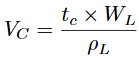
The capacity demanded by the slurry heater, with cylindrical geometry and flat bottom (V C ) expressed in m3 and considering the heating time ( 𝑡 𝐶 ) in hours (h), the mass flow rate ( 𝑊 𝐿 ) in kg/h, and the density of the slurry to be gelatinized ( 𝜌 𝐿 ) in kg/m3, was calculated by the expression:
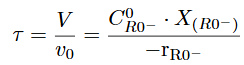
For an acetylator unit, considering a perfect mixing flow pattern, the space time (τ) and therefore, the acetylator volume (V), was calculated by applying the design equation 16 shown in expression (2), for the volumetric flow rate of gelatinized slurry (υ0) expressed in m3/h, the initial concentration of active AGU  in kmol/m3, the acetylation rate
 in kmol/m3h, and the expected monoacetyl glucose conversion X(RO-)
(11 expressed in a fraction.
For the battery of three continuous reactors with stirring in series, it was considered that each unit (i) has a partially converted feed 16, where the graphic design method was applied, at a temperature of 48 ºC set at the heating stage.
Additionally, the concentration of monoacetyl glucose (C RAc ) was determined under the conditions previously reported 12 and at low DS 11, where DS is considered as the mole fraction of monoacetyl glucose substituted at C6, taking into account the low probability of poly substitution when acetylated for values below 0.6. Also, the kinetic constant at the working temperature 2 was obtained to calculate the acetylation rate.
The agitation parameters and conditions were determined by scaling up the previously reported conditions during acetylation tests 12. These tests were carried out on equipment with a volume equal to 0.004 m3, a diameter and height of 0.171 m, an impeller diameter of 0.085 m, and an agitation speed of 650 rpm. Geometric similarity and constant stirrer tip speed were used as scaling criteria for the acetylated gelatinized starch process 11.
An enthalpy of acetylation of native and acetylated cassava starch of -28.4 kJ/molAS2) was considered according to the contribution method of Joback's groups. According to its composition, the heating power of Cuban crude oil (CC) was estimated at 44,725 kJ/kg 14. The electrical power demands for heating and acetylation were calculated according to the procedure established for jacketed vessels 17-19.
Finally, the design of the pneumatic cylindrical duct dryer was based on the classical method previously proposed 20, which has been currently used in the design of this stage of the cassava flour production process 14. Pneumatic systems were set up with a single dryer and starch reflux up to an inlet moisture content of 30 % 2. Since drying occurs by evaporation of moisture during the transport of the paste by a hot air stream, the flow arrangement was in parallel 21. The heat associated with the solid drying demands was determined through the energy balance, considering the sensible heat for paste heating and the latent heat required for moisture evaporation.
Optimization
3.1 Modeling and optimization of project economic indicators
The profit (P) associated with the production of AS was determined from the total production costs and total sales of the main product AS and the by-product bran (dry fiber).
The net present value (NPV) and the internal rate of return (IRR) 3,14 were considered dynamic profitability indicators. These were determined based on the productive capacity of the project (X 1 ) expressed in tcassava/d, the conversion achieved in the process (X 2 ) expressed as DS, and the air feed temperature to the pneumatic dryer (X 3 ). For this analysis, 15 years of the useful life of the project was estimated with a discount factor of 10 %, and an installed capacity utilization of 50 % was considered for the first year, 80 % for the second year, and 100 % from year 3 onwards 14.
The investment and production costs of the process were estimated using a classic methodology 22. The basic raw material, cassava roots, was considered to be purchased at wholesale prices from a network of agricultural producers set up for the project and valued at 0.07 USD/kg. The rest of the raw materials and materials, including the esterifying agent, pH regulating and cleaning agents, as well as energy and natural resources, were valued at current updated international prices and were determined through material and energy balances.
A central composite experimental design (CCD), developed with Statgraphics Centurion XV. II. software, was used to determine the statistical models of the behavior of the economic indicators selected as a response to be evaluated with the (k = 3) factors, capacity, DS, and drying air temperature. A range of variations of production capacity between 8 and 12 tcassava/d was considered, with a maximum agricultural capacity of the region selected for installation of the plant of 13.36 tcassava/d. For DS, a range of values was considered between 0.2, which is usable for food applications, up to 0.5, at the limit of low values [2], but very useful as facilitators of aqueous suspensions. For drying air, a temperature range between 150 °C and 225 °C was considered, with a maximum permissible of 260 °C with drying times of up to 3 seconds, to avoid product deterioration 2.
A 2k full factorial design was generated for the factorial portion of the CCD, a central point in the cube, and 2k axial points at a rotational distance α=1.681 from the center of the design for a total of 15 runs, the results of which were plotted using OriginPro 2022 software. Through regression analysis, the models were adjusted for P, NPV, and IRR, which allowed obtaining the quadratic equations that establish the dependence of the evaluated responses with the independent factors for a significance level of 5 %. Optimization of the obtained surfaces was performed by means of chord analysis according to the methodological bases and the heuristic procedure of the Response Surface Methodology for separate and multiple responses 23.
Estimated AS sales prices as a function of DS
Starch in its native state can be used primarily as a thickener and adhesive in the paper, textile, pharmaceutical, and especially in the food industries 24. Its prices, in the international market, have a high oscillation depending on the source, purity, and other factors. The range of greatest stability in these prices has been between 500 and 1,200 USD/t 25,26, and is currently in the order of 700 to 900 USD/t 27.
However, these products have functional limitations that limit their use in certain applications, mainly in aqueous suspension and freezing, due to insolubility at room temperature, retrogradation, and instability to thermal and pH changes 28,29.
For these reasons, modified materials such as AS, which have much better functional behavior than the native material with multiple specific and highly effective food and industrial applications 30-32, are higher priced in the market. Given the above and the fact that DS represents the advance of the chemical modification of this material, an estimate was made of the probable price of AS, as a function of its DS. For this purpose, a list of prices of AS from cassava, potato, and cereals for different purity levels, applications, suppliers, etc., was obtained. The aforementioned relationship was obtained through multiple online consultations with different suppliers 27,33. As a result, the extreme values were discarded, and the following polynomial regression equation was obtained for a regression coefficient (R2) equal to 85.8 %, which relates the price of AS (PAS) in USD to DS:

Results and discussion
Technologies for the production of AS
Mechanized native starch technology 2 can be used for the initial and final stages of this process. It uses a sequence of washing-shelling, grinding, fiber separation, purification, concentration, and dehydration of the starch by vacuum filtration, and drying. For fiber separation, sieving centrifuges are used, and for purification and concentration of the slurry, plate, and disc centrifuges are used.
In the technological proposal for AS, this technology can be adopted (assimilated), and the new slurry heating and acetylation stages can be inserted into it. Heating and acetylation can be carried out in jacketed equipment with agitation systems suitable for the rheology of the non-gelatinized suspension, which is much less demanding than that of the gelatinized material 5. In the case of AS, unlike acetylated gelatinized material, it is possible to use the typical mechanical paste dehydration processes used in the native starch process, and therefore, the same pneumatic drying method is also applicable. At this stage, air heating is ensured by indirect heat exchangers, using CC combustion as an energy option when renewable options are not available. Figure 1 shows the flow diagram for the slurry heating, acetylation, and pneumatic drying stages, where the first two are highlighted, given their incorporation into the mechanized native starch process. Where W identifies water stream; HW, hot water; CS, concentrated slurry; GS, gelatinized slurry; SH, sodium hydroxide; HA, hydrochloric acid; SP, starch paste; A, air; S, starch; RS, recirculated starch; H-AIR, hot air; RA, recirculated air; CC, Cuban crude; and ES, exhaust steam.
Behavior of project economic indicators
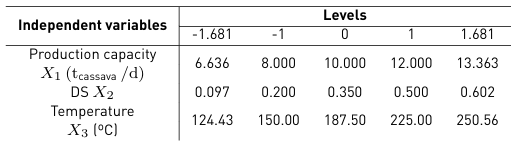
The three coded levels of the optimization parameters ( 𝑋 1 , 𝑋 2 and 𝑋 3 ) generated in the CCD are shown in Table 1.
The results of the estimation of the main design parameters of the main equipment of each stage and the energy demand are shown in Table 2. The sizing of the heater corresponds to the application of Equation (1), that of the acetylator to Equation (2), and that of the pneumatic dryer following previously reported and applied methods 14,20. The energy consumption and indexes refer to 20 hours of daily operation during 300 days per year.
These results show the tendency to increase the volume required in the equipment and the energy demand for drying when the capacity increases. Additionally, there is a tendency to reduce the size of the dryer and the energy demand when the drying air temperature increases.
On the other hand, the increase in DS leads to an increase in the estimated capacity of the acetylators and, therefore, in the associated investment and operating costs. These effects suggest the existence of optimal values in the considered intervals for 𝑋 1 , 𝑋 2 and 𝑋 3 . It should be noted that the energy consumption rate per ton of cassava processed is very advantageous with respect to the process of gelatinization prior to acetylation 3. At the upper limit of the design for acetylated gelatinized starch, spray drying demands a rate of 0.22 tcc/tcassava3, while for higher values of production and air feed temperature at the upper limit of the design for AS, compared to the previous process, pneumatic drying demands a rate of 0.045 tcc/tcassava according to the values reported in Table 2.
Figure 2 shows the results of the estimation of the total investment required, caloric energy costs, total production costs, and the economic indicators considered in the optimization: P, NPV and IRR; valuing production according to the DS achieved as shown in Equation (3).
The results depicted in Figure 2 confirm the trend of increasing investment with increasing capacity and DS and decreasing heat energy cost with decreasing drying air temperature.
Optimal operational parameters
The second-order mathematical models (quadratic) relating the economic optimization indicators to the independent variables ( 𝑋 1 , 𝑋 2 and 𝑋 3 ), obtained for the applied design are shown in Equations (4), (5) and (6).
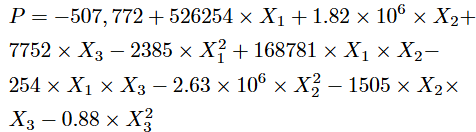
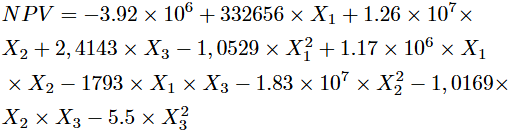
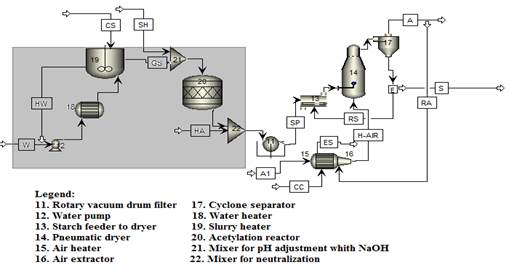
Figure 1 Flow diagram for the slurry heating, acetylation, and drying stages in the AS process. Source: Adapted from 2
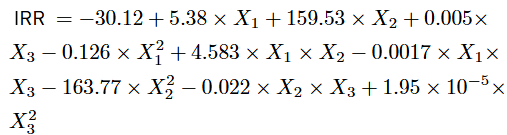
In the statistical evaluation of the degree of adjustment to the results of the design, the analysis of variance indicated that the adjusted models are significant for a 𝑝 less than 0.05. In all cases, the sum of squares of the pure error was small with respect to the sum of squares of the total, indicating good reproducibility at the central point 34. Regarding the regression coefficient R2, the adjusted models explained the variability of the response in 99.92 % for Equation (4), 99.91 % for Equation (5), and 99.95 % for Equation (6), with a good correlation with the source values and a good fit for their optimization.
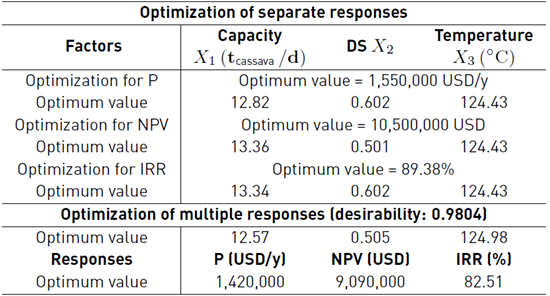
With the fitted quadratic models, the optimization of the separate responses and the optimization of the multiple responses were performed, which are shown in Table 3. The minimum and maximum levels of the factors correspond to the extremes of the design represented in Table 1. This analysis made it possible to determine the configurations of these factors ( 𝑋 1 , 𝑋 2 and 𝑋 3 ) that cover the desired characteristics for the responses (P, NPV and IRR) simultaneously.
To maximize P, NPV and IRR, the optimization of separate responses suggests operating with values of production capacity and DS close to or equal to the upper limit of the CCD. As for the influence of the drying air temperature, these indicators benefit the lower limit of the study range. It should be noted that the values of the factors that optimize the evaluated responses show similar behavior in the three cases. This is beneficial for the subsequent establishment of optimization criteria for the three responses simultaneously.
This analysis achieved high desirability and allowed the establishment of the optimal operating parameters of the AS production plant, at a production capacity of 12.57 (tcassava/d), DS = 0.505 and 124.98 °C in the air feed to the pneumatic dryer, reaching a profit of 1,420,000 USD/y, an NPV of 9,090,000 USD, an IRR of 82.51 %.
Technological design in optimal conditions
The design is based on the previously defined optimum conditions, a  = 1.323 kmol/m3 (at 20 % w/w), isothermal operation at 48 °C and an AS concentration (C
AS
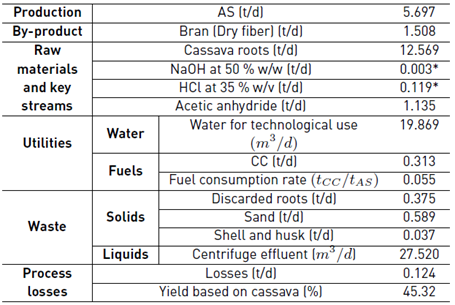
) at the reactor outlet of 2.20 X10⁻² kmol/m3 (2. Table 4 summarizes the results of the material and energy balance under these conditions.
The above results confirm that fuel consumption is significantly lower than for the production of acetylated gelatinized starch 11, mainly due to the use of the mechanical dehydration method of pneumatic drying.
Table 2 Results of the sizing of the main equipment and energy demand in AS production
| Run | Experimental Factors | Design Parameters Volume (m3) | Energy demand | ||||
|---|---|---|---|---|---|---|---|
| Capacity X 1 (tcassava/d) | DS X 2 | Temperature X 3 (ºC) | Heater | Acetylator (Battery) | Drying chamber | CC (tCC/y) | |
| 1 | 8.000 | 0.500 | 150.00 | 0.30 | 19.17 | 6.61 | 73.7 |
| 2 | 10.000 | 0.350 | 250.56 | 0.37 | 20.93 | 2.72 | 147.5 |
| 3 | 13.363 | 0.350 | 187.50 | 0.50 | 27.97 | 4.95 | 144.7 |
| 4 | 10.000 | 0.602 | 187.50 | 0.37 | 29.37 | 6.47 | 124.2 |
| 5 | 12.000 | 0.200 | 150.00 | 0.45 | 16.69 | 5.43 | 93.6 |
| 6 | 8.000 | 0.500 | 225.00 | 0.30 | 19.17 | 3.48 | 108.5 |
| 7 | 8.000 | 0.200 | 150.00 | 0.30 | 11.12 | 5.48 | 62.4 |
| 8 | 12.000 | 0.500 | 150.00 | 0.45 | 28.76 | 6.55 | 110.6 |
| 9 | 6.636 | 0.350 | 187.50 | 0.25 | 13.89 | 3.73 | 71.8 |
| 10 | 12.000 | 0.500 | 225.00 | 0.45 | 28.76 | 3.46 | 162.8 |
| 11 | 10.000 | 0.350 | 124.43 | 0.37 | 20.93 | 5.95 | 68.6 |
| 12 | 8.000 | 0.200 | 225.00 | 0.30 | 11.12 | 2.85 | 91.1 |
| 13 | 10.000 | 0.350 | 187.50 | 0.37 | 20.93 | 3.72 | 108.3 |
| 14 | 10.000 | 0.097 | 187.50 | 0.37 | 10.42 | 4.71 | 92.8 |
| 15 | 12.000 | 0.200 | 225.00 | 0.45 | 16.69 | 2.86 | 136.7 |
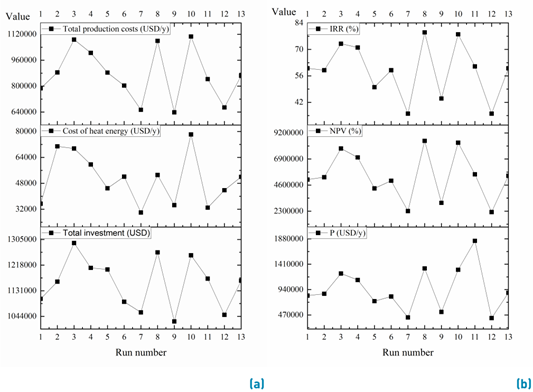
Figure 2 Results of the determination of economic indicators for the production of AS. a) Main cost elements; b) Response variables to be optimized.
A residence time in the heater set to 0.6 h guarantees the heating of the slurry. For this design parameter, a W
L
equal to 863.50 kg/h and a ρ
L
of 1,050 kg/m3(2), the V
C
resulted in 0.5 m3, when applying Equation 2 for a 10% overdesign. From the full kinetic expression for starch acetylation(2), the kinetic constant at 48 °C yielded a value of 3.67 × 10⁻³ , obtaining the reaction rate expression as a function of active AGU concentration (CRO−) and acetic anhydride concentration (CAA), expressed as:
−rR0− = 3.67 × 10 −3 (CR0−) × (CAA)
The conversion to mono acetyl glucose at the optimum DS is  and was calculated with
 . At the reactor exit, a
 was reached, and the acetylation rate resulted in
 according to Equation 7. With these results, a τ = 210 h(16) was calculated for an acetylator unit, so it is obtained that the volume of the equipment V = 165.2m
3
.
The above result demonstrates that direct acetylation of native starch requires high acetylator volumes, so it is not possible from a practical point of view to implement a single acetylator approach. This situation is because the kinetic constant is about 17 times lower when not gelatinized prior to acetylation 12. However, a battery of perfect mixing reactors in series requires a smaller volume than a single reactor 16,19.
Applying the graphical design method, the volume of each acetylator unit is V i =11.63 m3, and the volume of the system of three acetylator units in series is V =34.90 m3. The size of the acetylator battery is 21 % of the size of a stand-alone reactor, which corresponds to the trend of such behavior for positive order reactions 16,19) and allows it to be selected to perform the reaction. Table 5 shows the geometrical characteristics and agitation conditions for these units, resulting from the scale-up criteria applied.
Table 6 shows the results of determining the electrical power and heat transfer demands for the heating and acetylation stages.
In all cases, the available lateral surface area satisfies the heat transfer demand in these units. It should be noted that the low heat transfer requirements in the acetylator units are supported by the moderate acetylation enthalpy values.
The results of the pneumatic dryer design are shown in Table 7. A gas velocity of 25 m/s, considered in the design, allows for overcoming the fluidization velocity and guarantees the entrainment condition 14,20. As the drying duct demands a high length/diameter ratio, its spatial distribution was proposed in the form of vertical forks.
The technological requirements of the optimal variant demand a pneumatic dryer with a duct of 2.52 m3, a standardized diameter of 0.3 m, and a length of 35.66 m, spatially located in a bank of 3 U-shaped forks with a length of 5 m and 5.56 m occupied by the accessories and the rest of the duct up to the cyclone separator.
T, drying gas temperature; t, temperature of AS paste, which at the inlet is a mixture of wet paste and recirculated dry AS (tm); ∆Tm, driving force as a function of temperature differences; G1, relative mass flow between gas and solid; Ua, volumetric heat transfer coefficient; VC, drying chamber volume; and subscripts 1 and 2 denote the input and output of the equipment respectively.
Conclusions
The production of AS can be carried out in technological processes based on the schemes reported for acetylated gelatinized starch, maintaining the principle of adopting the stages of native starch by mechanized means, eliminating the gelatinization stage, and directly acetylating a suspension of native starch.
Table 4 Summary of material and energy balance for AS
*Consumption includes chemical cleaning agents.
Table 5 Dimensions and fundamental parameters of the slurry heater and acetylator applying scale-up ratios for agitation
| Dimension | Heater | Acetylator unit |
|---|---|---|
| Volume (m3) | 0.5 | 11.63 |
| Diameter and height (m) | 0.86 | 2.45 |
| Impeller diameter (m) | 0.43 | 1.21 |
| Agitation speed (rpm) | 130 | 46 |
Table 6 Results of the determination of power and heat transfer requirements for AS production
| Calculated parameters | Results | |
|---|---|---|
| Heater | Acetylator units | |
| Reynolds mixing | 4.09·104 | 1.20·105 |
| Agitator power (kW) | 1.39 | 12.45 |
| Pellicular heat transfer coefficient (kJ/ h m2 ºC) | 4,071.59 | 1,547.48 |
| Pellicle coefficient referred to the outside diameter (kJ/ h m2 ºC) | 4,056.59 | 1,545.51 |
| Total clean heat transfer coefficient (kJ/ h m2 ºC) | 2,032.03 | 773.25 |
| Total dirty heat transfer coefficient (kJ/ h m2 ºC) | 1,196.27 | 610.85 |
| Required heat transfer area (m2) | 1.61 | 0.85 (U1) 0.24 (U2) 0.07 (U3) |
Table 7 Basic dimensions of the pneumatic dryer in the production of AS under optimum conditions
| Parameter | Value |
|---|---|
| Pasta fed (30 % humidity) (Kg/h) | 2,152.56 |
| Recirculated starch (kg/h) | 1,595.00 |
| Dry AS (kg/h) | 285.12 |
| Energy demand (GJ/h) | 0.6 |
| T1 (°C) | 124.98 |
| T2 (°C) | 78.00 |
| tm1 (°C) | 28.26 |
| t2 (°C) | 62.00 |
| ∆Tm (°C) | 56.09 |
| G1 (kg/s m2) | 5.0 |
| Ua (J/s m3 K) | 1,287.96 |
| VC (m3) | 2.52 |
| Duct diameter (m) | 0.30 |
| Duct length (m) | 35.66 |
| Number of forks | 3 |
The optimal operating parameters of the plant for obtaining this product are encouraging economic indicators. They are achieved at a production capacity of 12.57 tcassava/d, DS of 0.505, and 124.98 °C in the air supply to the pneumatic dryer.
Under optimum conditions, 5.997 t/d of AS with a DS of 0.505 is produced. As equipment for acetylation, this production demands a slurry heater of 0.5 m3 and a battery of three acetylating units in series of 35 m3 in total. For drying, with 124.98 °C in the gas feed to the pneumatic dryer, a 2.52 m3 duct with a standardized diameter of 0.3 m and a length of 35.66 m is required, where an energy efficiency significantly higher than that of acetylated gelatinized starch is achieved.

