




 Inglés (pdf)
 Articulo en XML
 Referencias del artículo

 Traducción automática
 Enviar articulo por email
 Citado por SciELO
 Citado por Google
 Similares en
SciELO
 Similares en Google

 Permalink


1. INTRODUCTION
Antibiotics are pharmaceutical products widely used for the treatment of infectious diseases in animals and humans [1]. However, their widespread use and abuse raise concerns globally [2]. In fact, an increase of 65% in antibiotic global consumption has been reported between 2000 and 2015 [3]. This increase can contribute to the rising presence of these emerging pollutants (EPs) in the environment, as they are not completely metabolized in living organisms, allowing between 10 and 90% of the product to be released into water resources [1], [4].
While there are different groups of antibiotics, that conformed by macrolides is the most common [5]. This class of pharmaceuticals generally includes antibiotics that contain in their molecular structure from 16 to 12 carbon lactone rings [6]. Macrolides have antibacterial action against certain gram-negative bacteria and most gram-positive ones; and they have also been used in the treatment of inflammatory, and autoimmune diseases, as well as cancer [7], [8]. Specifically, erythromycin (ERY) has been used for fighting bacterial infections of the respiratory tract, skin, and genitals [9].
After administration, ERY is metabolized in the liver, but around 5% of the active ingredient is excreted through urine, allowing it to reach water [9]. Several studies have reported that ERY has negative effects on photosynthetic aquatic organisms [10]. Additionally, an increase in bacterial resistance has been reported, in some cases, related to gradual but continuous exposure to ERY [7]. Indeed, resistance to antibiotics has been considered as one of the major risks to food security and health worldwide [11]. This is why ERY was included in the first watch list of EPs in water established by the European Union, as well as in the third list of drinking water contaminant candidates set by the United States Environmental Protection Agency [7], [12], [13].
The incomplete removal of ERY from water constitutes a global problem [14]. Wastewater (WW) treatment plants are the main discharge source of ERY to the environment, as they collect effluents from different sectors with potential use of the drug [15]. Likewise, several studies have confirmed that conventional water treatment techniques have not been effective in degrading ERY [2], given that it is a relatively stable aromatic compound [16], [17]. In this regard, advanced oxidation processes (AOPs) emerge as an alternative since they have been shown to be effective in antibiotic treatment [2], [18], [19].
Although various studies on the presence and treatment of ERY in water have been reported in the literature, from the authors' knowledge, there are very few studies that comprehensively analyze simultaneously (i) global patterns of occurrence, (ii) risk assessment based on real-world data, and (iii) comparative efficiency of specific AOP technologies. Under this context, this study was conducted to collect, analyze, and compare worldwide ERY concentrations in water, evaluate environmental and antimicrobial resistance risks, and assess AOP-based treatment technologies.
2. METHODS AND MATERIALS
2.1 Information acquisition
A structured literature study of scientific documents quantifying concentrations of ERY in water and/or employing AOPs for the removal of this pharmaceutical product in water was conducted from 2017 to 2023, being 01/04/2024 the last access to the documents found. The search was carried out in Scopus, using [TITLE-ABS-KEY ((“erythromycin” AND “water”) OR (“erythromycin” AND “wastewater”) OR (“erythromycin” AND “rivers”) OR (“erythromycin” AND “seawater”) OR (“erythromycin” AND “advanced oxidation processes”)) AND PUBYEAR > 2017 AND PUBYEAR < 2024 AND (LIMIT-TO (DOCTYPE , "research") OR LIMIT-TO ( DOCTYPE , "review"))] as the search string.
As inclusion criteria, papers published from 2018 onwards and that were fully available online were considered. Choosing the observation window (2018-2023) allowed to balance timeliness, relevance, and methodological rigor of the files found and used during this study.
On the other hand, as exclusion criteria, articles analyzing the removal of ERY in water by treatments other than AOPs were taken into account. Subsequently, the obtained information was analyzed using VOSviewer® software, through co-authorship analysis by countries and co-occurrence of author keywords.
To compare the reported results related to the presence of ERY in water, all concentration data were converted to ng/L unit. The types of water for concentration analysis were classified as surface water (marine and freshwater), WW (influent and effluent), leachates, and drinking water. The water types used in ERY removal through AOPs were classified as synthetic water and WW.
2.2 Environmental risk assessment
The development of antimicrobial resistance and the ecological toxicity to aquatic organisms were considered for the environmental risk assessment [20].
2.2.1 Ecological risk for aquatic organisms
The ecological risk assessment was conducted by calculating the risk quotient, defined by (1) [21], where RQenv is the risk quotient, PEC (ng/L) and PNEC (ng/L) refer to the predicted environmental concentration and the predicted no-effect concentration, respectively.

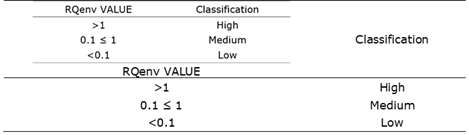
The use of PEC and PNEC values were selected to objectively quantify the environmental risk through the RQ, adopt a precautionary principle in the face of uncertainty and sublethal effects, contextualize the findings within international regulatory frameworks, and provide a solid basis for management recommendations and public policies. This transforms the study from a mere quantification of pollutants into an impact assessment with direct practical implications for the protection of ecosystems and public health. The PNEC value utilized was 200 ng/L [21]. This value allows risk assessment and prioritizing management actions (when RQ > 1) and communicating results to managers and regulators in a standardized and widely recognized technical language. Depending on the obtained RQenv value, the risk was classified as low, medium, or high (Table 1) [22].
2.2.2 Possible risk of antimicrobial resistance
Eq. (2) was used to calculate indirectly the risk associated with antimicrobial resistance [20], where RQamr refers to the risk quotient for antimicrobial resistance, PEC and PNECmin stand for the maximum environmental concentration that is measured, and the predicted no-effect concentration based on the minimum inhibitory concentration.

The PNECmin value used was 1000 ng/L [20]. Based on the obtained RQamr value, the risk was classified as low if the value was less than or equal to 1, while a value greater than 1 indicated a probable risk.
3. RESULTS AND DISCUSSION
3.1 Preliminary results
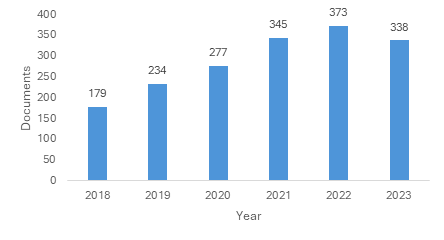
The search yielded a total of 1746 documents published between the years 2018 and 2023. Of these, 90.09% were original papers and 9.91% were state-of-the-art studies. An increase in the number of publications was identified in the period 2018-2022, indicating a growing interest from the scientific community in understanding the dynamics of ERY in water (Figure 1). However, in 2023, there was a decrease of 2.00% in the number of publications compared to 2022. This may have been due to the decline in research in leading countries, given the large amount of research on the topic up to 2022. As a matter of fact, Australia, India, and Spain reduced their publications in 2023 by 56.25%, 17.14%, and 16.67% respectively, compared to 2022. On the other hand, as of the analysis date (April 1, 2024), 104 documents have been reported in 2024.
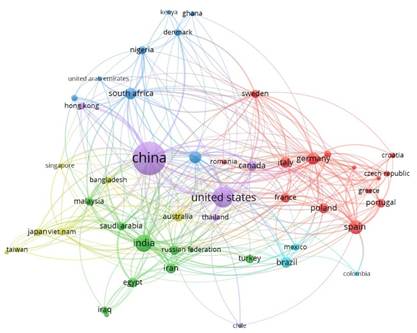
A total of 48 countries has conducted more than 10 publications on the topic, with China being the country with the most publications (520), followed by the United States with 204, and India with 141 (Figure 2). The number of publications by Asian countries that met the analysis criteria represented 65.75% of the total published documents, indicating that this continent led the research on the topic. In addition, 6 scientific communities were identified, each dominated by Spain, India, the United Kingdom, Australia, China, and Brazil. Furthermore, it was observed that the countries with the highest number of international collaborations were China and the United States, each with a total of 34 collaborations. The strongest co-authorship relationship was between China and the United States, both of which belong to the same scientific community. Countries from all continents are conducting research on the topic, demonstrating that the study of ERY environmental presence is of global interest. Furthermore, it was observed that 97.77% of the publications were in English, becoming the preferred language for publishing on the subject.
Source: own elaboration through VOSviewer® software
Figure 2 Co-authorship map by countries for the period 2018-2023
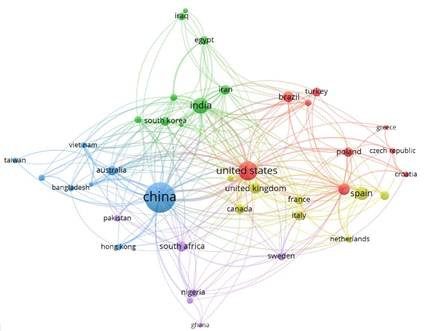
It is noteworthy that during the period comprised between 2018 and 2022, 5 scientific communities were identified (Figure 3). The concentration of ERY studies in waters from these communities reflects a strategic sampling of different global risk scenarios. These regions were prioritized for monitoring since they represent: (1) countries with high analytical capacity and regulatory mandates (e.g., United States and Europe), where monitoring is preventive and systematic; and (2) countries with massive antibiotic production and consumption combined with limited treatment infrastructure (e.g., India and China), where industrial and urban discharges generate extreme environmental concentrations. Together, these regions cover the full spectrum of discharge pathways: from effluents from advanced treatment plants (European/American case) to direct industrial discharges (Asian case). This geographic distribution does not indicate the absence of the problem in other regions, but rather a focus of research resources on areas where the magnitude of the problem or the measurement capacity justified prioritization. However, starting from the year 2023, a new scientific community emerged in Latin America, represented by Brazil, Mexico, and Colombia. This could be attributed to the fact that interest in the issue has shifted to Latin American countries, where research on the impacts of ERY on water resources is recently addressed compared to Asian and European countries. This dynamic in Latin America represents progress in the prevention and mitigation of negative environmental impacts on water resources, given that, in South America, the percentage of over-the-counter antibiotics is higher than in Asia and Southern and Eastern Europe [23].
Source: own elaboration through VOSviewer® software
Figure 3 Co-authorship map by countries for the period 2018-2022
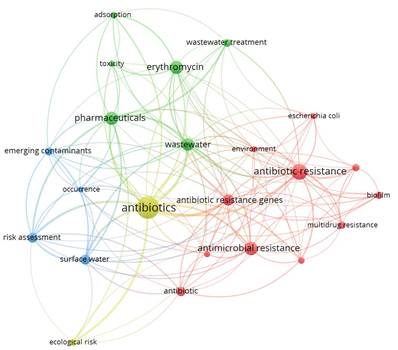
An analysis of author keywords co-occurrence was conducted. Out of a total of 4645 words, 23 met the criterion of appearing at least 20 times (Figure 4). The most frequently occurring word was "antibiotics" with a total of 270 appearances, followed by "antibiotic resistance" with 135 appearances. Some of the words most frequently occurring alongside "antibiotics" were "antibiotic resistance genes", "risk assessment", "wastewater", "surface water", and "ecological risk". Additionally, it was observed that one of the strongest relationships for "antibiotic resistance" and "antimicrobial resistance" was with "wastewater". This allows us to conclude that, in research on the presence of ERY in water worldwide, WW is considered an important factor, probably because it is considered one of the main pathways for the entry of this drug into the environment.
3.2 Concentrations of ERY in water
The presence of ERY in water in different countries exhibited varied ranges (Table 2). According to [21], these differences can be ascribed to the different patterns of pharmaceutical product consumption in each country, the different environmental conditions during measurement, and the absence or presence of WW treatment plants and their efficiency in removing ERY.
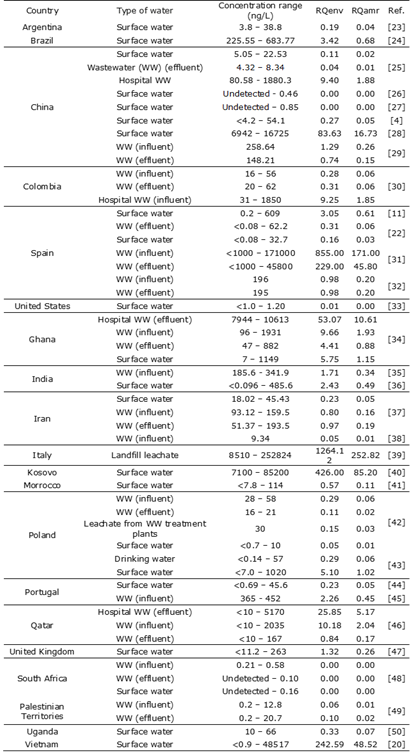
The ERY highest concentrations were found in Italy and Spain, with values of 252824 ng/L and 171000 ng/L, respectively [31], [39]. The largest value was reported in landfill leachate, which is concerning because this type of infrastructure is the most used worldwide for the final disposal of solid waste [39]. Such high concentrations in European Union member countries like Italy and Spain, compared to other countries in the world without regulatory standards for ERY in water, suggest that established measures have been ineffective in preventing and/or mitigating this pharmaceutical product in water resources. In contrast, in other European Union countries like Portugal and Poland, the highest concentrations were lower than the maximum concentration found in Italy by 99.82% and 99.59%, respectively.
It is noteworthy that the third highest concentration was found in Kosovo at a water intake point for human consumption, which becomes a health and environmental alarm, as the purification treatments are not designed to remove this type of contaminants [40].
The lowest concentration of ERY reported above the limits of quantification of the different methods was observed in Spain in surface water [11] and in the Palestinian Territories in WW both in the influent and effluent [49]. However, it should be clarified that, according to the literature review, only one article was found for the Palestinian Territories, which may indicate that there are not enough studies to understand the dynamics of ERY in the water resources in this country. Nonetheless, even at low concentrations, the presence of ERY can contribute to antimicrobial resistance [31].
In surface water, in turn, the reported concentrations were lower than those reported in WW. According to [22], lower concentrations could be expected in water bodies due to possible dilution of contaminants. On the other hand, the lowest number of papers was reported for drinking water; nevertheless, the concentration presented in Kosovo [40] becomes an alarm that encourages further research in this type of water.
3.3 Environmental risk
3.3.1 Ecological risk for aquatic organisms
The highest risk quotient values were observed in countries where the highest levels of ERY in water were reported. The high values in Spain and Italy represent a concerning risk for aquatic organisms and highlight the need for better regulation. 40.74% of the reported maximum concentrations represented a high ecological risk for aquatic organisms, 40.74% represented a medium risk, and 18.52% represented a low risk.
It is worth noting that the PNEC value used was determined based on freshwater species (Daphnia magna, green algae, fish), which is more suitable for assessing ecological risk in freshwater than in seawater. Furthermore, the possible dilution of WW in water bodies should be considered, which could decrease ERY concentrations and contribute to reducing the calculated risk quotient value [22].
The limits of detection may cause an underestimation of potential risk, as concentrations below these limits do not rule out the possibility of negative effects on aquatic organisms [21]. However, even when reported concentrations are lower than the PNEC, the lipophilic behavior, low biodegradability, and environmental pseudo-persistence of ERY should not be overlooked, as the compound can accumulate long-term in organisms, eventually surpassing environmental concentrations and generating toxic effects [51]. For example, [23] found ERY concentrations ranging between 0.44 and 6.73 ng/g dw in muscles of Rhinella arenarum species in Argentina, demonstrating its bioaccumulation potential and its potential as a bioindicator species [23].
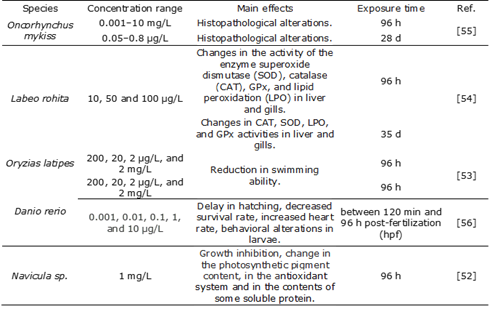
Moreover, the toxicity resulting from the combination of ERY with other types of contaminants should be considered [51]. It was found that the combined effect of ERY plus Levofloxacin was more toxic to Navicula sp. growth compared to the individual effect of each pharmaceutical product [52]. Various studies have reported effects on aquatic organisms exposed to ERY, even at concentrations lower than those reported in water bodies. [53] found that the swimming ability of fish species Oryzias latipes and Danio rerio was significantly reduced when exposed to high levels of ERY, and indirect evidence of behavioral changes and disruptions of the body clock was observed. [54] reported an increase in oxidative stress in the Labeo rohita species. Table 3 presents the main effects detected in aquatic organisms exposed to ERY and the experimental conditions under which the research was conducted.
Finally, to avoid the uncertainty ascribed to the use of maximum concentrations of pollutants, future risk assessments should adopt a dynamic aquatic landscape approach, where risk is assessed as a spatial-temporal field interacting with ecological heterogeneity instead of a single number. Only in this way will the illusion of precision provided by maximum concentration values be overcome and move toward truly protective management of aquatic ecosystems. This perspective is particularly crucial for contaminants such as ERY, where the most significant effects (i.e., resistance selection, microbiome disruption) depend on complex exposure patterns that maximal concentration values cannot capture.
3.3.2 Potential risk of antimicrobial resistance
Water bodies constitute a medium that favors antibiotic resistance, which poses a challenge to human health by reducing the effectiveness of infectious disease treatment [57]. 74.07% of the reported concentrations represented a low risk of promoting antimicrobial resistance, while 25.93% corresponded to a high risk. Like ecological risk, higher values are consistent with the highest concentrations found, corresponding to Italy and Spain. Particularly concerning is the high-risk value in Italy. If these WWs are not properly managed, they could become a public health problem [39], as they are a breeding ground for antibiotic resistance genes (ARG) and antibiotic-resistant bacteria (ARB) [2].
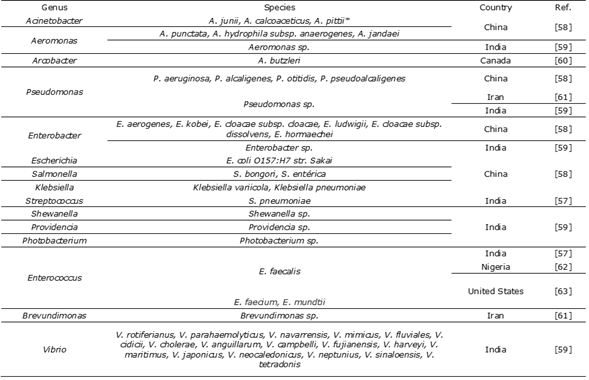
Several studies have found the presence of ERY-resistant bacteria in different water bodies in countries such as China, India, Iran, Canada, the United States, and Nigeria (Table 4). It has been established that the dynamics of urban water can contribute to antibiotic resistance. In this context, suspended solids become a key factor in promoting antimicrobial resistance, either by protecting exopolymer matrices or by facilitating the proximity between bacteria for the transfer of ARG. However, there is still no clarity about the relationship between environmental dynamics and antimicrobial resistance [58]. This highlights the urgency of promoting understanding of this relationship.
On the other hand, it is worth noting that spatial variability creates pollution "hotspots" near sources such as treatment plants, hospitals, or agricultural runoff. Temporal variability, on the other hand, shows seasonal peaks, for example, in winter due to increased medical use or after rainfall that washes pollutants and contributes to the spread of resistance genes from emission sources to larger aquatic ecosystems. This fluctuation makes it difficult to accurately assess ecotoxicological and human health risks, while also acting as a multiplier of environmental and health risks, thus requiring an integrated surveillance approach that incorporates dynamic monitoring strategies to capture both critical points and periods of highest risk.
3.4 Efficiency of advanced oxidation processes in ERY removal from water
Several studies have informed that conventional treatments do not efficiently remove ERY from water [2], allowing this pharmaceutical product to persist in the effluent and be released into surface water. Additionally, biological treatments can become ideal means to promote antimicrobial resistance [64]. However, as an alternative option to conventional treatments, AOPs have proven to be efficient in ERY elimination in water (Table 5), due to the production of radical species, such as hydroxyl radicals (OH.), which are characterized by their non-selectivity and high oxidation potential (Eº= 2.8 V, at 25ºC). Once these radical species are produced in water, they react with contaminants, leading to the pollutant molecules destruction and the formation of water (H2O), carbon dioxide (CO2), and inorganic anions, depending on the elements conforming the parent compound, with its subsequent mineralization [65]-[68].
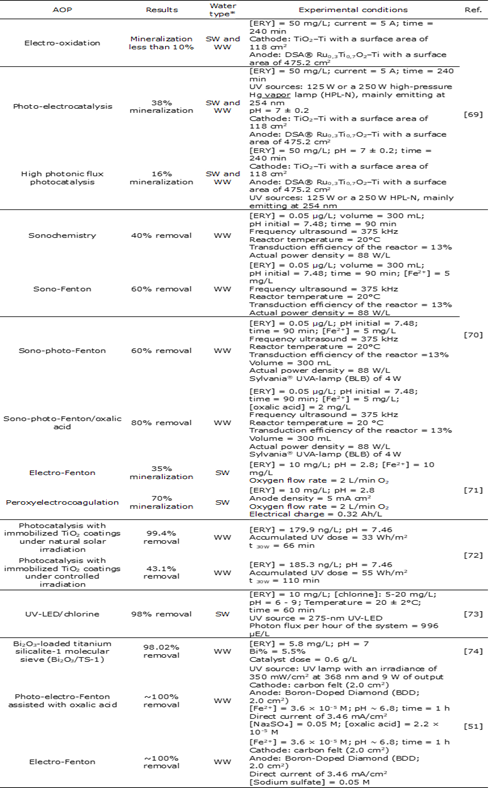
According to the information compiled in Table 5, the photo-electro-Fenton, electro-Fenton, and photo-electro-Fenton assisted by oxalic acid systems removed near 100% of ERY in the water [51]. In this case, the use of UV-A or oxalic acid would not represent additional performance, since electro-Fenton achieved the same elimination percentage. However, it is necessary to evaluate the mechanisms and degradation by-products, as electro-Fenton treatment only achieved 35% mineralization of ERY in synthetic water [71]. Chitosan incorporated nickel ferrite photocatalyst also achieved ~100% removal of ERY [75]. Unlike other processes, this treatment becomes an alternative with high sustainability potential, as it could be reused up to 15 times with an 80% removal rate.
The UV-LED/chlorine process performance is noteworthy, achieving not only 98% elimination but also confirming the absence of residual antibiotics, inactivation of ARG and ARB, and only the generation of two by-products more toxic than ERY, which at low concentrations did not cause acute toxicity [73]. On the other hand, solar photocatalysis using TiO2 allowed almost complete removal of ERY in real WW, while this was not observed when controlled irradiation was used, probably due to the different solar wavelength and xenon lamp [72]. The performance obtained with the peroxielectrocoagulation process is important [71]. This treatment may have high potential for ERY treatment in water, since 70% of the compound was mineralized, with a lower probability of generating toxic by-products.
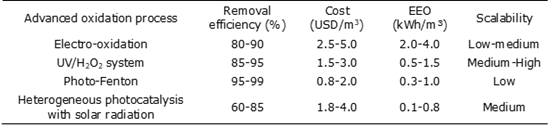
The lowest degradation occurred when the ultrasound treatment was used, which increased between 20% and 40% when iron (II), UV-A light, and oxalic acid were added. This rise was due to OH that were formed from reactions between iron and sonogenerated hydrogen peroxide (H2O2), as well as a greater iron availability to form more radicals in the presence of oxalic acid added. Nonetheless, despite the improved performance, the application of high-frequency ultrasound implies high energy consumption. These improved effects can be extended to other cavitation-based systems, such as hydrodynamic cavitation, which involves lower costs [70]. Furthermore, electrical requirements of these treatments systems, as well as those required by the coupling of H2O2 and ultraviolet (UV) radiation could be provided by using photovoltaic arrays, as reported by [76]. In Table 6, a comparison of several AOPs in terms of ERY removal efficiency, costs of treatment, electrical energy by order of magnitude (EEO) and scalability can be found.
Table 6 Comparison of AOPs in terms of efficiency, costs, and scalability for ERY removal in water
Source: own elaboration.
The viability of AOPs as an environmental remediation technology hinge on a three-dimensional assessment that integrates economic analysis, scalability studies, and energy impact audits. Omitting these dimensions reduces their practical applicability. The criterion for technological validation should focus on effective implementation at an industrial scale, simultaneously ensuring economic sustainability and minimizing environmental footprints. This paradigm shift is essential to transform the theoretical potential of AOPs into tangible contributions to mitigating pharmaceutical contaminants in aquatic systems. This holistic approach acquires critical relevance within the framework of the circular economy and decarbonization, where technological innovation must demonstrate synergy with macro sustainability objectives. In addition, choosing the most suitable treatment, interactions with other contaminants contained in water and the behavior of other water quality parameters should be taken into account. Likewise, it is necessary to analyze degradation mechanisms, generated by-products, and treatment application costs. Especially for ERY, the effects of treatment on the inactivation of ARB and ARG present in water should also be considered. Several AOPs, including advanced ozonation coupled with activated carbon, should also be studied to overcome the problem of ERY in water.
4. CONCLUSIONS
The presence of ERY in water has been detected in several countries around the world at concentrations that may pose a risk to both human health and aquatic life. These high concentrations have been observed in countries that even have regulations governing the presence of ERY in water, which may indicate the ineffectiveness of established regulatory measures. This situation highlights the need for the implementation of effective policies that promote water resource quality worldwide, especially considering that antibiotic resistance knows no boundaries between countries. As an alternative to this issue, AOPs constitute an option for the removal of ERY from water alternative to conventional treatment processes, particularly nickel ferrite photocatalyst incorporated into chitosan, and photo-electro-Fenton, electro-Fenton, and oxalic acid-assisted photo-electro-Fenton systems, since they achieved ~100% removal of ERY. However, future research should evaluate ERY degradation pathways, by-product toxicity, and ARG deactivation under real treatment conditions. Additionally, unified international monitoring standards are urgently needed, particularly in scenarios where concentrations in water resources are low or undetectable and their long-term effects. Moreover, for scaling up purposes, the viability of AOPs as an environmental remediation technology hinge on a three-dimensional assessment that integrates economic, technical and energy analyses.

