




 Inglés (pdf)
 Articulo en XML
 Referencias del artículo

 Traducción automática
 Enviar articulo por email
 Citado por SciELO
 Citado por Google
 Similares en
SciELO
 Similares en Google

 Permalink


1. Introduction
The continuing increase in unemployment, poverty, and low purchasing power has caused a humanitarian crisis in Venezuela (World Bank, 2018). It has forced people to leave their country and migrate to improve their living conditions (Fundación Ideas para la Paz, 2018). Colombia has played an essential role as a host country or transit place for Venezuelan migrants because of its historical, cultural, and geographical proximity (Puche & Villa, 2018). According to a report from Migración Colombia (2019), an average of 2,100 Venezuelans entered the national territory daily through different borders during 2018.
Some authors suggest that immigration could change labor market behavior in the host countries (Aguilera & Massey, 2003; Borjas, 2006; Herranz, 2000). One positive effect on the labor market could occur when migrants have higher levels of schooling than natives. In this case, they could contribute to economic growth, complement innovation processes, and provide new knowledge and skills to natives.
Also, if the migrants are younger than the native population, the former would contribute to expanding the proportion of working-age people, balancing the destination’s population structure (Chiswick & Miller, 2002). Also, sometimes the pressure of migrant workers in low-paying jobs may influence native workers to seek opportunities to improve their employment status. It means a displacement of work activity, where it ends up improving the status work of native workers (Organization for Economic Cooperation and Development [OECD] & International Labour Organization [ILO], 2018).
Regarding the potential negative effects, Bohme & Kups (2017) argue that in the short term, informal jobs and underemployment could increase with the arrival of migrants. The adverse incidence of international migrants in the labor market is more frequent among countries with low coverage of formal jobs and those that are not prepared to receive migratory waves.
The humanitarian crisis in Venezuela and the mass exodus of Venezuelans to Colombia could influence the dynamics of Colombia’s labor market. Venezuelan migrants have increased the economically active population (OECD, 2019). According to Fundación para la Educación Superior y el Desarrollo (Fedesarrollo, 2018), Venezuelans had participated more in the labor market than the non-migrant Colombian population. This differential could be explained by the opportunity cost that represents for Venezuelan migrants to be unemployed. Besides, some migrants are more willing to accept jobs in inappropriate conditions when they have the pressure of satisfying their minimum living conditions. In that case, migrants become socially vulnerable subjects (Reina, Mesa & Ramírez, 2018).
Additionally, the World Bank (2018) evidenced that most of the Venezuelan migrants in Colombia worked in informal employments due to the lack of opportunity to get a formal job. The Colombian productive structure has not generated a sufficient number of employments with proper conditions. Venezuelan migrants have presented numerous difficulties to enter the formal labor market (Bahar, Dooley & Huang, 2018). Therefore, this implies assuming critical economic challenges to properly insert the new workforce into the Colombian labor market (Consejo Nacional de Política Económica y Social [CONPES], 2018).
This article analyzed the labor profile of Venezuelans in Colombia for 2019. Recent Venezuelan migrants get a job in Colombia mainly through their family networks. Also, the principal Venezuelans occupations were being employees in private companies and self-employed workers. However, the majority of Venezuelan migrants had informal jobs (92.3%).
The following section briefly reviews the theories used to analyze the relationship between international migration and labor markets. The empirical analysis is presented below, the methodology is explained first, and then the results are shown. Finally, the conclusions are presented.
1.1. Literature review related to the case of Venezuelan migration
The theory of a dual labor market refers to the existence of two labor markets. As the seminal work of Piore (1979) postulated, there is a primary labor market with better working conditions for the natives, such as decent wages according to the skills of workers, and employment with labor guarantees such as the affiliation to the social protection system. There is also a secondary labor market in which some migrants work in precarious labor conditions, such as low wages, informal labor contracts, and limited opportunities for job advancement.
The concept of a dual labor market has evolved into a labor market segmentation thesis. The mobility from the inferior to the superior sector has been increased over time. The theory of labor segmentation points out that there is a broader range of jobs than the basic division between primary and secondary employment. However, the unequal labor conditions between native workers and a group of migrant workers persist. This outcome is due to migrants are oriented to specific activities with more flexible employment conditions than natives (Hudson, 2007; McCollum & Findlay, 2015).
In Colombia, there is a high level of participation of Venezuelan workers in secondary jobs. The World Bank (2018) evidenced that the recent migration of Venezuelans to Colombia had presented difficulties in getting formal jobs. Also, due to the pressure to satisfy basic needs in the short-run, Venezuelan workers have accepted payments and working conditions that Colombians with similar skills have not taken.
The theory of labor classification of the migrant by Portes & Jensen (1987) indicated that the profile of each migrant influences the assimilation process on the labor market in the host country. Usually, when the migrant has a high education level and complies with the legal requirements to work, he or she could insert in the primary labor market (Beine, Docquier & Rapoport, 2008).
Instead, when foreign workers have low qualifications and are undocumented, they tend to participate in the secondary labor market. Usually, this group of immigrants is socially excluded and has precarious working conditions (Herranz, 2000; Valenzuela et al., 2014). In Colombia, more than half of the Venezuelan migrants had unstable working conditions during 2018 (Ministerio de Relaciones Exteriores, 2019; Puche & Villa, 2018).
The theory of social networks mentions that social capital influences migrants’ employment, their adaptation, and decision-making processes (Garcés, 2011; Silva-Arias & Massey, 2015). In this context, the relationships built by recent migrants with other migrants or natives are essential to get a job and reduce the associated costs to obtain it (Massey et al., 1998). It is easier to develop a particular economic activity when similar occupations have already been carried out by other migrants from the same country (Borjas & Monras, 2017). In this sense, Venezuelan migrants with more time living in Colombia could provide valuable information about available jobs (Proyecto Migración Venezuela, 2018).
Despite the several benefits of social networks, they can also have an adverse effect, as it could contribute to the labor marginalization of migrants. Consequently, a foreign worker who finds employment through social networks is likely to get a job similar to other previous migrants, regardless of their skills and experience in different work activities (Portes & Sensenbrenner, 1993).
The theory of ethnic enclaves refers to the establishment of new businesses by migrants in the host country due to the difficulties that they had previously faced in employing themselves (Wilson & Portes, 1980). These ventures could contribute to the generation of jobs, for other migrants and natives (Light, Sabagh, Bozorgmehr & Der-Martirosian, 1994; Portes, Haller & Guarnizo, 2002). Also, social networks can help establish and maintain a new business (Silva-Arias & Massey, 2015).
2. Methodology
This article used a mixed methods design, particularly an explanatory sequential design. The quantitative phase carried out a descriptive analysis of the labor profile of Venezuelan migrants who arrived in Colombia between 2018 and 2019. A sample of the Venezuelan and the native working-age population was extracted from the first half of 2019 Colombian Household Surveys (GEIH, according to the Spanish acronym). This survey is collected by the Colombian Department of Statistics (Dane for its acronym in Spanish) and provides information to analyze labor and socioeconomic characteristics of the population residing in Colombia. Details on GEIHs data sampling and questionnaires are available on Dane (2018).
The quantitative data was composed of men (12-62 years old) and women (12-57 years old). The upper age limit considers the Colombian full retirement age. A Venezuelan migrant is a person born in that country who lived there twelve months ago. A native is anyone born in Colombia and who has resided for the past twelve months in the country.
To study Venezuelan migrants’ insertion in the Colombian labor market, first, it was calculated how many were working or actively looking for work, and then the type of employment done. Also, informal employment was identified in the sample using the International Labour Organization (ILO) criteria. The primary conditions are 1) the employer does not contribute to the pension fund/retirement scheme, and 2) there is no social security, health plan, or any other protection plan, whether public or private (ILO, 2013a).
In addition, a qualitative design was implemented to explain further and enhance the quantitative findings. It consisted of semi-structured interviews of some Venezuelan migrants. The qualitative component aimed to give voice to the study population. In particular, five interviews were conducted with recent Venezuelan migrants with informal work (See Table 1). The interviews were realized in Bogotá in July 2019. In this document, some extracts of the interviews were analyzed (a video that collects it is available on Silva-Arias, Sarmiento-Espinel, Galvis-Molano & Gómez-Gómez, 2019).
Table N° 1. Profile of Venezuelan migrants interviewed in Bogotá
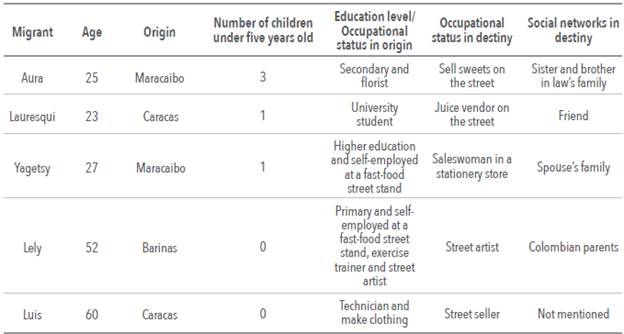
Source: Interviews realized in Bogotá in July 2019. The video is available on Silva-Arias et al. (2019).
For the interviews, participants were asked for authorization through an informed consent document. Following the guidelines of the funding institution’s ethics committee, the confidentiality of the information was guaranteed, keeping the identities of participants anonymous. The authors have no conflict of interest.
3. Results
Table 2 shows descriptive statistics for the 2019 Colombian Household Surveys sample analyzed. In this sample, 1.45% were Venezuelan migrants. On average, these immigrants were approximately seven years younger than natives. Therefore, this migratory flow has helped to rejuvenate the Colombian workforce.
Table N° 2 Labor profile of Venezuelans in Colombia
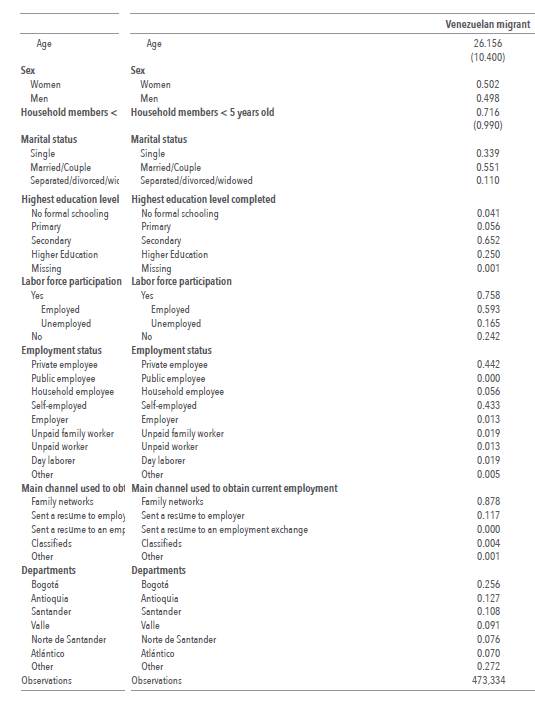
Source: GEIH, 2019, DANE. Own calculations. Note: Standard deviations in parenthesis.
According to Ceritoglu, Yunculer, Torun & Tumen (2017), the arrival of migrants increased the population in productive age, and it had a positive effect on the destination country’s consumption and economic growth. However, these positive effects depend on the efforts made by the recipient country to take advantage of the migratory wave.
Migration could have a positive impact on young people by opening up new opportunities to escape poverty, improve jobs, educational achievement, skills, competencies, and professional experience. However, migrants should face risks, and vulnerabilities include discrimination based on gender, migration status, poor labor conditions, lack of social protection, among others. Then, the migration could represent either an opportunity or a risk for young people (United Nations Department of Economic and Social Affairs, 2016).
Venezuelan female migrants represented a slightly higher proportion than female natives and Venezuelan male migrants. According to Tapia (2011), women have increased their participation in the recent migratory waves. The reason for the increased migratory prevalence of women could be related to the urgency to fulfill the basic needs of their children.
Concerning the presence of children in the household, it has conditioned the men’s labor participation, but mainly women’s. Traditionally, women have concentrated more time in the care of children than men (Oliveira, 2016; de Oliveira & Ariza, 2002). Also, difficulties in inserting the labor market in households with children could be more difficult for the migrant population (Madhavan, Schatz, Clark & Collinson, 2012).
Venezuelan migrant households had more children under five years old than native ones. Approximately, there is a child in seven out of ten Venezuelan families. Instead, the ratio is four out of ten for natives. For example, Aura (25 years old) emigrated from Maracaibo with her husband and three children under five years old. The whole family sold sweets on the street. Lauresqui (23 years old and had a 3-year-old son) emigrated from Caracas and sold juices on the streets with a friend, and she left her son in a place where they charge for taking care of him.
Also, 5 out of10 Venezuelan migrants who recently arrived in Colombia were married or with a couple. For migrants, marital status influenced the decision to migrate (Jang, Casterline & Snyder, 2014). Moreover, if a migrant had a family, this could change the time the migrant devotes to looking for a job and its type (Cooke, Mulder & Thomas, 2016). In the case of Yagetsy (27 years old and had a two-year-old son), for instance, her husband migrated first to Bogotá, where he had relatives. Later, she and her son migrated from Maracaibo. While both spouses work at a stationery store, her sister-in-law cares for their son.
Regarding the level of education, Venezuelans concentrated their studies on secondary and higher education levels (90% versus 80% of the natives). Indeed, 65% of Venezuelan migrants had secondary education, 12 average points more than natives. There is no difference in the share with higher education between both populations. According to Friedberg (2001), the educational level influenced the way of participating in the labor market. Individuals with high levels of education could get a job that matches their skills faster.
The labor force participation of Venezuelan migrants is higher than natives (76% versus 70%). However, the former has a higher unemployment rate of 16.5%, being the double unemployment rate of natives. Venezuelan migrants were more willing to work, but it is more difficult for them to find a job, especially for women (18% versus 9.2% for men).
As natives, the main economic activities carried out by migrants were private employees and self- employed (88% versus 83% for natives). Migrants had no public jobs. Venezuelan women developed more household activities than female natives (11% and 7%, respectively) and worked more as self- employed (46% and 38% respectively).
The geographical location of migrants has been a relevant issue to understand the determinants and consequences of foreigners influx on the recipient labor market. Under the factors to explain migrants’ geographic sorting are their networks of previous waves of immigrants and favorable economic conditions (Altonji & Card, 1991; Bermúdez, Mazuera, Albornoz & Morffe, 2018; Borjas & Monras,(2017)
. Bogota was the principal settle area for Venezuelan migrants (25,6%), followed by Antioquia (12,7%) and Santander (10,8%).
Therefore, the influx of Venezuelans established in the leading economic zones of Colombia. Together with their spatial distribution, the use of social networks to access information and support was essential in the labor insertion of migrants. Indeed, the primary way to found employment for Venezuelan migrants was family networks. Approximately nine out of ten Venezuelans used this channel to get a job (versus 5/10 for natives).
For many of the migrants, family networks are what define the destination places. Aura (25 years old) mentioned that she went to Bogotá because her sister was there. Yagetsy (27 years old) migrated to Bogotá because her husband’s relatives were there. Still, there is a more significant attraction for the capital city as a place where migrants expected to get better economic opportunities. Lauresqui (23 years old) migrated to Bogotá because it is the capital of Colombia, and she thought that there were more sources of employment.
Since the main reason for migrating from Venezuela was to improve living conditions, Venezuelan migrants manifested their need to be inserted rapidly in the newly chosen labor market (Bahar et al., 2017). However, the lack of documentation or labor opportunities are the main barriers to get a formal job. Figure 1 shows that around 9 out of 10 Venezuelan migrants that are employed did not have social protection. In contrast, 8 out of 10 natives were affiliated to the health system, and 4 out of 10 contributed to a pension fund.
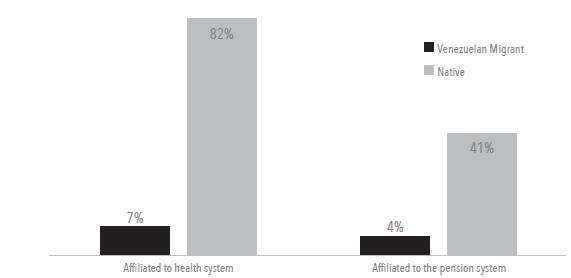
Source: GEIH, 2019, DANE. Own calculations.
Figure 1 Access to Social Protection System by migration status
According to ILO (2013b), a job without social security is considered informal. In the case of Venezuelan workers who recently arrived in Colombia, 96% had informal employment, 43 percentage points more than native workers. Therefore, most Venezuelan migrants in Colombia have a job without labor guarantees and under conditions of social vulnerability.
In the interviews, Aura (25 years old, secondary education) mentioned that the main obstacle to getting a formal job was that she did not have the legal permit to live and work temporarily in Colombia. In specific, she said:
“The fundamental barrier to getting a job has been the special permanence permit. Everywhere I go, there is a job, but I do not have the requirements, that is why I am unemployed “ ( free translation of the authors from Spanish).
Lauresqui (23 years old, technical, and dropped out one year before to obtain a railway engineering degree) reported that she was looking for a formal job since a month ago. As she did not find a job, she stared to sell juice on the streets.
According to the labor market approach, migrants with higher levels of education can enter the formal labor market more quickly. However, the World Bank (2018) indicates that recent Venezuelan migrants have had problems entering labor markets regardless of their education level. Figure 2 shows the educational level of workers who had informal employment. Among the Venezuelans with informal19%
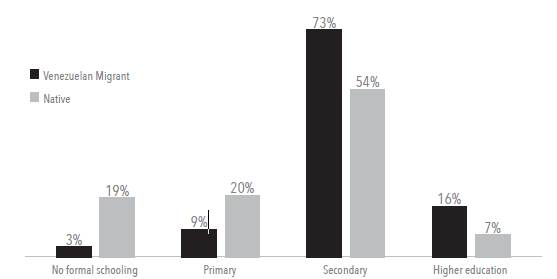
Source: GEIH, 2019, DANE. Own calculations.
Figure 2 Educational level of informal employees by migration status.
jobs, 16% had higher education, and 73% had secondary. Instead, there was a high percentage of natives with at most primary education, 39% versus 11% of Venezuelans. Regardless of the higher human capital compared with natives, Venezuelan migrants had barriers to get formal jobs in Colombia.
Based on the analysis carried out, there is evidence that there is a problem of informal jobs and underemployment in Colombian labor markets, especially for Venezuelan migrants. This evidence was also verified by the interviews in Bogotá to recent Venezuelan migrants with informal employment. All interviewees stated that they had dependent children. Therefore, they had to do some economic activity to support their family.
Also, forced migration seems perceptible in recent Venezuelan migrants. For instance, Lauresqui (23 years old and one child under five years old) was about to finish her higher education, Venezuela’s political and economic situation forced her to drop out and migrate to Colombia. However, she mentioned that it has not been easy to find work with appropriate conditions in the Colombian labor market:
“I thought I was going to improve my quality of life, and this job is not all bad, but I still do not have a formal job. So, I am here asking God to try to accommodate everything and return to my country. I dream of finishing my university studies that I like so much and that I am almost done" (free translation of the authors from Spanish).
These findings seem to reflect the labor characterization of many Venezuelan migrants in Colombia. This section highlights many emerging concerns raised by the results of this research. In general, the findings highlight how labor insertion and family roles are forces that test migrants’ ability to respond to economic survival in destiny, with dependent children that condition labor participation, especially for women.
4. Concluding Remarks
The migratory flows create social and economic challenges in the recipient countries. Nevertheless, it also represents opportunities to generate growth and development in the medium term. For this reason, the countries that share borders with Venezuela, as Colombia, should implement public policies of integration that respond to the needs of the new migration flows. In order to face the growing flow of Venezuelan migrants, Colombia must increase the efforts to regularize the status of Venezuelan migrants and offer them work permits.
This paper evidence that Venezuelans migrants in Colombia were, on average, seven years old younger than natives, which means an increase in the size of the population of productive age. However, 9 out of 10 Venezuelan workers had informal employment, even though most Venezuelans had relatively higher levels of education than the natives.
Colombia is a country with significant social inequalities (OECD, 2019). It has been more difficult for migrants, especially women, to find a proper position for their skills in the Colombian labor markets. Therefore, it is essential to generate a productive structure that incorporates the population into a formal and suitable job.
Access to national employability programs for migrants presents several challenges, including coverage, qualification, and legal requirements. Public employment agencies have not had a very active role in training and other employability services (World Bank, 2018). Therefore, it is necessary for greater participation by the entities providing these services to provide opportunities for learning, information, and promotion of formal jobs to the unemployed population residing in Colombia.
Recipient places must prioritize projects that generate formal jobs for the population residing in the country. In specific, it is important to eliminate bureaucratic obstacles to allow migrants to create and register new companies in the formal sector. Efforts to capitalize on age and education level of these new immigrants will ensure that Colombia’s openness is rewarded with reciprocal economic and productivity gains.
Colombia’s migration programs have focused on Colombians abroad and not foreigners in its territory. Therefore, inadequate public policies could exacerbate or create social vulnerabilities for migrants. Colombia agencies should implement public policies to take advantage of Venezuelans’ mas flow to contribute to the growth and development of the country, together with social programs that focus on those migrants at risk of social exclusion.

