




 Inglês (pdf)
 Artigo em XML
 Referências do artigo

 Tradução automática
 Enviar este artigo por email
 Citado por SciELO
 Citado por Google
 Similares em
SciELO
 Similares em Google

 Permalink

1. INTRODUCTION
Water scarcity is a global problem, which is not limited to arid zones [1]. Agriculture and industrialization represent a higher consumption of water compared to domestic use throughout the world [2]. Likewise, suspended colloidal particles and pathogenic microorganisms are often the principal pollutants in raw water [3]. The turbidity can be effectively removed by the addition of a flocculant, which initiates a coagulation/flocculation process and, therefore, the clarification of the water. Most microorganisms can be efficiently controlled and eliminated by disinfectants such as chlorine, which is commonly used in water treatment plants [4]. Therefore, the main tasks in the treatment of drinking water are the efficient elimination of turbidity and effective sterilization. Traditional technological processes to produce drinking water include coagulation/flocculation, sedimentation, sand filtration and disinfection [5].
The coagulation-flocculation is a physicochemical process of water treatment that can be achieved with the addition of coagulants. This process can be both chemical and natural base, and it is one of the most effective and manageable methods adopted for the purification of water. Often characterized by its anionic nature, colloidal materials that include kaolin particles repel each other and remain suspended to form a stable suspension [6]. However, with rapid industrial development throughout the world, water quality has severely deteriorated. Water must be treated intensively with large doses of flocculants and disinfectants to comply with the health standards of drinking water [7]. This fact implies not only higher treatment costs but also a higher risk of secondary consequence with adverse results for human health, such as disinfection by-products during chlorine disinfection processes. Accordingly, the development of new flocculants with the characteristics of high efficiency, low cost and environmentally friendly is relevant [8].
The coagulation-flocculation process consists of removing particles suspended in water with an average size of 5 to 200 nm, and depends on factors such as temperature, ionic strength, pH, type and dose of coagulant material, size, and type of distribution. , concentration and properties of organic materials and colloidal particles in suspension [9]. Flocculants attract other colloids, dissolved in the liquid phase, in order to form flocs, causing the separation of these particles from the stable suspension [10]. In the purification of water, polymeric flocculants and inorganic coagulating agents have traditionally been used, which are generally synthetic metal salts, which cause effects on bodies of water if they are disposed of without prior treatment since their stability to cutting and biodegradability are low [11]. These include ferric chloride (FeCl3), aluminium hydroxy chloride (PAC), aluminium sulphate (Al2(SO4)3), among others. [12]. Despite its effectiveness, the presence of large amounts of inorganic ions has been found in purified water, which reduces the useful life of wastewater treatment equipment due to corrosion, fouling, and clogging [13]. Furthermore, Ah(SO4b and PAC residues are believed to be potentially responsible for the development of Alzheimer's [14]. Thus, it is necessary to develop flocculants that are biodegradable and based on natural products.
In this sense, flocculants based on natural polymers have been the focus of great interest, due to their full availability, respect for the environment and biodegradability. Among these, the excellent performance of the flocculants based on starch, have received much more attention in the field of water treatment in recent decades due to its significant characteristics of widespread availability, low cost, respect for the environment and biodegradability. Although traditional inorganic and synthetic polymeric flocculants are widely used now, they are related to residual metal ions as well as for toxic organic monomers [1], [15], [16]. Flocculants-coagulants have been used in the removal of turbidity and colorants from materials of plant origin, from oak acorn [17], moringa [18], opuntia [19], Abelmoschus esculentus [20], and Manihot esculenta [21].
Starches are vegetable polysaccharides, highly available, and low cost. They also have interesting physicochemical properties such as biodegradability, biocompatibility, and non-toxicity, and have multiple applications in various industries such as pharmaceutical, biomedical, and polymer [22], [23]. The performance of the final application of starch as coagulant-flocculant depends to a great extent on the structure and molecular weight, in addition to environmental parameters [16]. It has been reported that the components of different species of cassava, in order from highest to lowest, are starch, moisture, fibre, lipids, proteins, and ashes [24]. According to the FTIR, SEM, XRD characterizations, and chemical analysis reported in the literature, cassava starch shows double helix arrangements produced by the amorphous crystalline distribution of starches, which influences the formation of flocs and its subsequent sedimentation [25], [26]. In the present work, the use of cassava starch as natural coagulant was studied, since as a natural source is non-toxic, respectful with the environment, produce less volume of mud and, its post-harvest residual materials have low costs. All these aspects are essentials to ensure high efficiency and viability for water potabilization. The starches under study were obtained from post-harvest residues from the Colombian Caribbean coast, for which the raw material supplied met the condition of not being able to be sold or used as food, mainly due to not having had adequate management for the conservation of its quality.
2. MATERIAL AND METHOD
2.1. Design of experiments
For the development of the following research, an experimental response surface design of the central star composite type was carried out. The response variables were pH, colour and turbidity. The intervening variables were the initial sample concentration, centrifugation time (10 min), centrifugation speed (1500 rpm) and cooling time (24 h). Also, the agitation speed was varied in two levels (30 and 40 rpm) and the concentration of coagulant in three levels (125, 187.5 and 250 mg/L), for a total of 6 experiments.
2.2. Starch extraction
1000 g of post-harvest cassava were taken for the extraction of the starch using water or NaOH. The raw material was peeled and washed with abundant deionized water to remove the outer layer and dirt. Subsequently, they were grated with of diameters of about 0.7 cm, and then 500 g were immersed in deionized water and 500 g in a 2.5% w/v NaOH solution in a 1:2 w/v ratio. Then, the mixture was homogenized and left to cool for 24 h at 4 °C. After cooling, the mixtures were liquefied and filtered, for fürther centrifugation at 1500 rpm for 10 min. To the precipitate obtained in the centrifuge, 200 mL of deionized water was added, and the pH adjusted to neutrality using HCl and 0.2 M NaOH. Then, it was centrifuged again under the same conditions, and the precipitate was dried for 24 h at room temperature, for its subsequent reduction in size in a screw mill [27].
2.3. Coagulation-flocculation tests
For coagulation-flocculation tests, synthetic turbid water was prepared by taking two containers with 800 mL of deionized water and adding 0.3 g of bentonite. This solution was mixed for 1 h at 200 rpm. Then, it was left 21 h at rest for a hydration process. After each solution was diluted in 1.9 L, they were mixed, resulting in turbid water of 32.3 Nephelometric Turbidity Units (NTU). For the coagulation-flocculation assays, 800 mL of each study solution was placed in a jar test kit, according to the experimental design. The pH, colour and turbidity were determined using the techniques Multiparameter 900 Bante Instrument, Digital colourimeter Lovibond PFX195 and Turbidimeter Thomson WGZ 400B respectively in the study of water.
The statistical analysis of results (ANOVA) was done using Software Statgraphics Centurion XV for windows.
3. RESULTS AND DISCUSSION
3.1. Turbidity Removal
From the starch extraction process were obtained 35.3 g of starch by the method with NaOH and 68.1 g of starch when using the hydration method without NaOH.
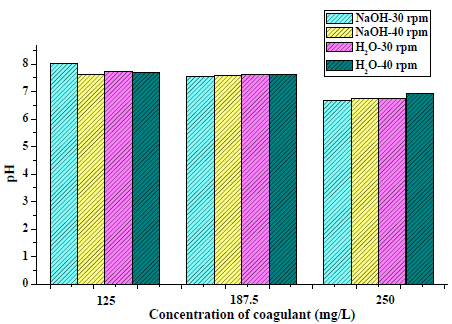
Figure 1 shows the pH values that were obtained from the different water samples with different coagulant concentration and agitation speed. The pH values are between 8.03 and 6.69. Other work has been reported similar results for samples of water from Sinu River after the treatment with Moringa seeds [28].
Moreover, the pH values in the present investigation are within the range used for raw water and are considered suitable for use according to Decree 1575 of 2007 for drinking water. Also, it was indicated that when the coagulant is around the optimal pH (6.5 units), the effectiveness of the natural coagulant is influenced by it [29]. Additionally, it was reported that the pH directly influences the process of water clarification, because it allows determining the optimal conditions to achieve the formation of flocs capable of precipitating [30].
The pH is an important parameter in the coagulation process since it can change the coagulant's surface charge and contaminant [31]. Furthermore, the literature has also reported pH dependence for horse chestnut and acorn as natural coagulants. This fact implies that the cassava starches obtained in the present study are highly stable in a wide pH range and can be used as coagulants to treat real samples of water and wastewater [32].
Using Statgraphics Centurion XV, the ANOVA variance analysis was performed to separate the variations of the various factors affecting a dependent variable, using effect grade 1. Table 1 shows the estimates for each effect studied and the interaction between the study factors, which in this case are the agitation speed (A) and the coagulant concentration (B). The standard error of each one of these effects is also shown, which measures its sampling error. Remarkably, the highest variance inflation factor (V.I.F.) is 1.0. It can be seen in Figure 2 and from the statistical analysis of Table 1 that the pH is not significantly affected by the variation in stirring speed and that it is inversely proportional to the coagulant concentration, presenting a similar behaviour for the two starches extracted.
Table 1 Effects estimated for the pH of cassava starch.
In the analysis of variance ANOVA, it was found that the concentration of the coagulant has a P-value of 0.02 and 0.045 for extraction with NaOH and H2O, respectively. The Durbin-Watson statistician (DW) tests the residues to determine if there is any significant correlation based on the order in which the data are presented in the archive. Since the P-value is higher than 5.0% for starches extracted by the two methods, there is no indication of serial autocorrelation in the residues with a significance level of 5.0%.
3.2. Colour removal
Figure 2 shows the values obtained from the measurement of colour and turbidity of raw water samples after the jar test.
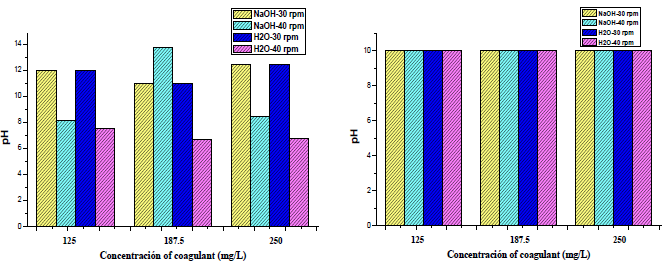
It is observed that all colour values are 10 cobalt-platinum, which indicates that the extracted starch does not degrade the colour present in water; despite the results obtained, it is beneficial to observe that the starch does not add dye to the water. Similar results were reported with using 30 mg/L of Al2(SO4)3) achieving 10.33 [33]. These results are important because the utilization of starch does not increase the initial colour of the raw water. Also, it complies with Decree 1575 of 2007. On the other hand, turbidity behaviour concerning the dose of the coagulant and the agitation speed during the test, it was established that the addition of 250 mg/L reaches a higher percentage of removal turbidity. In the case of NaOH, the lower turbidity was 8.15 NTU, similar to that presented by the coagulant synthetized from Stenocereus griseus, whom registered values between 8.27 and 18.33 NTU in pre-treatment with NaOH solution and 3.25 NTU with starch extracted by H2O [34]. The results obtained show that the preparation of the coagulant solution and the agitation speed affect the reduction of turbidity in the coagulation-flocculation process.
Table 2 shows the estimated effects and interactions, as well as the standard error of each of these effects, which measures its sampling error, as well as the largest variance inflation factor (V.I.F.) equal to 1.0.
Table 2 Estimated effects for turbidity reduction (%) using cassava starch extracted with NaOH and H2O.
| Extraction with NaOH | |||
|---|---|---|---|
| Effect | Estimated | Standard Error | V.I.F. |
| Average | 67.265 | 3.08544 | |
| A: Agitation speed | 5.25 | 6.17087 | 1.0 |
| B: Concentration of Coagulant | -2.695 | 7.55774 | 1.0 |
| Extraction with H2O | |||
| Effect | Estimated | Standard Error | V.I.F. |
| Average | 82.6583 | 1.24618 | |
| A: Agitation speed | 7.19667 | 2.49236 | 1.0 |
| B: Concentration of Coagulant | -1.275 | 3.05251 | 1.0 |
ANOVA variance statistical analysis relates the percentage variability of removal turbidity in separate pieces for each effect. It tests the statistical significance of each effect by comparing its mean square (MS) against an estimate of the experimental error. These allowed establishing that none of the variables was statistically significant (P> 0.05). According to the Durbin-Watson (DW) statistic and since the P-value is higher than 5.0%, there is no indication of serial autocorrelation in residues with a significance level of 5.0%.
Table 3 shows the results obtained from the measurement of colour, turbidity and pH in some samples of raw water after a jar test but using aluminium sulphate (Al2(SO4)3) as a synthetic coagulant and the Colombian regulations was used to compare. It was established when compared with Table 3 for colour and turbidity that the first presented similarity with the synthetic coagulant complying with the required range, while in the case of turbidity the natural coagulants extracted from cassava did not reach the minimum value required by the Colombian regulation. It has been reported that when using Opuntia mucilage to remove turbidity from the Magdalena River, it was not possible to report turbidity below 2NTU, as required by the Colombian standard; however, the efficiency of 93.25% was achieved with the natural coagulant [35]. The other parameters can be reached with some sedimentation and filtration process in the case of turbidity [36]-[38]. Regarding the pH values stipulated in Figure 1 and Table 3 5, starch coagulants are closer to the required range than synthetic coagulants, different from prior results where Al2(SO4)3 had a higher decrease in pH value than natural coagulants [35].
Table 3 Results of colour and turbidity removal using synthetic coagulant Ah(SO4)3.
4. CONCLUSIONS
In the present study, it can be concluded that: (1) a good yield was obtained in obtaining starch from Manihot esculenta, with the aqueous extraction being more efficient than the basic one (2). The pH is inversely proportional to the concentration of the starch and the speed of agitation. (3) The percentage of turbidity reduction was found to be proportional to the stirring speed and with the amount of starch, obtaining removal percentages higher than 70% in all cases; the highest percentages of turbidity reduction were obtained at the highest conditions of agitation speed (40 rpm) and coagulant dose (250 mg/L). (4) The cassava starches do not add or remove colour to raw water samples. In conclusion, the starches studied can be used as natural coagulants.

