


 English (pdf)
 Article in xml format
 Article references

 Automatic translation
 Send this article by e-mail
 Cited by SciELO
 Cited by Google
 Similars in
SciELO
 Similars in Google

 Permalink

Introduction
The term "ophiolites" has been used both with a genetic connotation and as a defining feature. It is employed to refer to remnants of ancient oceanic crust, and upper mantle rocks found along continental edges. These remnants consist of a range of rock suites, including felsic, mafic, and ultramafic rocks, which are temporally and spatially associated (Dilek & Furnes, 2014).
As a concept, "ophiolite" rock has experienced a complex evolution, first appearing in Europe in the early nineteenth century. The development of plate tectonics theory marked a turning point for this concept, enabling the beginning of an ophiolite model and facilitating comparisons between ophiolites and oceanic crust. At the first Penrose Conference in 1972, a close relationship between ophiolitic sequences and seafloor environments spreading was proposed. However, in 1973, Miyashiro challenged this model and, based on geochemical interpretations, suggested that the Troodos ophiolite (located in Cyprus) was a product of magmatism within an island arc. The idea was revolutionary and led to a redefinition of ophiolites in suprasubduction zones during the early 1980s (Dilek, 2003; Dilek & Furnes, 2014).
The occurrence and types of ophiolites result from formation processes (tectonic, magmatic, and geochemical) and preservation during the emplacement. Based on these criteria, Dilek and Furnes (2014) proposed that ophiolites would be classified as related and not related to subduction zones in first order. According to Pearce (2014), no subduction-related ophiolites correspond to those that are formed in ocean ridges, plumes, and continental margins. Subduction-related ophiolites include those which were developed in suprasubduction zones and volcanic arcs.
Ophiolites in suprasubduction zones represent the oceanic lithosphere formed in the upper plates extended to the subduction zones, with forearc, back-arc, and nascent arc environment. Forearc ophiolites expose compositional and geochemical variations defined by time: ocean-ridges similar composition (MORB-like) in the oldest ones, to island-arc tholeiites (IAT), and finally boninite-like in those more recent (Dilek & Polat, 2008; Dilek & Thy, 2009; Ishizuka et al., 2014). Magmatic and geochemical evolution in these kinds of rocks is controlled by (1) the partial melting of the crust under the subduction zone and (2) the dehydration melting of elements in a subducted plate under the overlying mantle (Dilek & Furnes, 2014).
The occurrence and types of ophiolites in the Central Cordillera of the Colombian Andes have not been clearly defined. Therefore, an analysis of ophiolite magmatic evolution in extensional environments and subduction zones has become increasingly relevant. Some Colombian ophiolitic clusters have been studied and characterized, such as the Azules Ultramafic Complex, the Pacora's Ophiolitic body, the Bolivar-Valle Mafic-Ultramafic Complex, the Aburra Valley Ophiolite, and the Ginebra Ophiolitic Complex (Espinosa, 1985; Alvarez, 1995; Nivia, 1994; Correa et al., 2005; Restrepo, 2008). The study of ophiolites in the region is necessary to understand Colombia's western lands formation and accretion processes and the geologic evolution of the South American western side during the Cretaceous and Cenozoic.
Despite current studies, a shared understanding of ophiolites petrogenesis has not been reached. Furthermore, some variables have not been studied enough, such as pressure, temperature conditions, and crystallization age. The GOC is a clear example. This study aims to present an evolutive model for the complex. The approach involves, firstly, the petrographic and geochemical characterization of layered gabbros from the ophiolitic sequence. Secondly, the clustered interpretation with geochemical analyses from other levels within the ophiolite sequence of Amaime Complex and Buga Batholith, previously issued by Ossa and Concha (2007) and Villagomez (2011). The study area is locally known as Puente Piedra, twelve kilometers in northeast of Ginebra municipality, southeast of Vereda Regaderos (rural district), on the pathway going to Costa Rica village (Figure 1). Field research, petrographical and geochemical data suggest the mafic-ultramafic rocks in the GOC have been formed in a subduction zone; then, these rocks are classified as ophiolites in a suprasubduction area.
Geological setting
The mafic-ultramafic rocks of the GOC with oceanic-like features are located in the western flank of the Colombian Andes' Central Cordillera, to the west of the San Jeronimo fault (Alvarez, 1983). The basement of the region has been reported as a sequence of Cretaceous oceanic rocks (Late Mesozoic) (Aspden & McCourt, 1986; McCourt et al., 1984), which represent an incomplete ophiolitic sequence (Espinosa, 1985). Nivia (1987) stated that a significant part of basic igneous rocks forming the basement in the region are basalts from an oceanic plateau, part of the Western Oceanic Cretaceous Lithospheric Province. Based on geochemical data, Ossa and Concha (2007) proposed that these rocks originated in an oceanic ridge environment and later emplaced along continent edges.
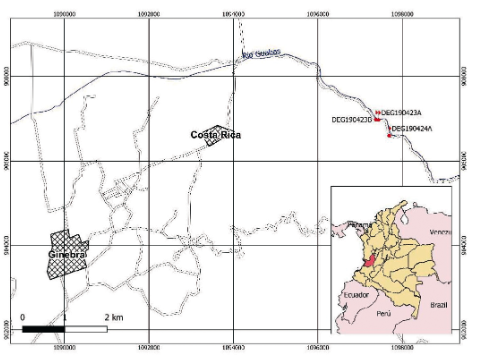
Moreno (2017) recently conducted the petrography and geologic cartography of GOC gabbros exposed in the Ginebra municipality. This work is a continuation of the research developed by Moreno, including, from west to east, the Ginebra Ophiolitic Complex, Buga Batholith, and Amaime Complex (Figure 2). Porphyritic bodies with no-mapping dimensions are observed in the study area, but they represent different and younger geological events (Rodriguez, 2012). Underlying this sequence is reported the Cenozoic La Paila Formation.
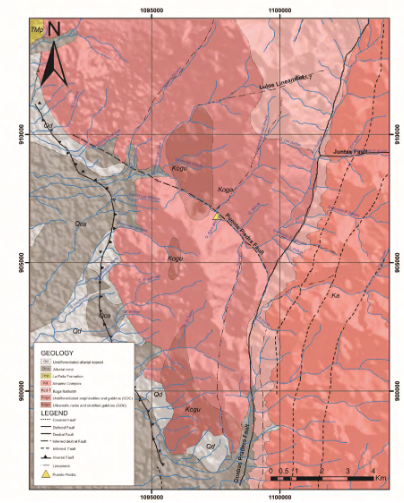
Figure 2. Geological and structural cartography of the Puente de Piedra section region. Modified from Rodriguez (2012).
Amaime Complex (Ka).
Previous studies have used the term "Amaime Formation" (McCourt et al., 1984; Nivia, 1987; Nivia, 2001). However, according to the American Stratigraphic Code guidelines for denotation and terminology of lithodemic units, the authors will use Amaime Complex to reference to this volcanic complex. The Amaime Complex corresponds to a green-dark colored tholeiitic basaltic series, which is hyaline to holocrystalline, and exhibits a subophitic texture (McCourt et al., 1984). It consists of pillow lavas and minor sedimentary layers exposed in the western flank of the Central Cordillera, west of the Cauca-Almaguer Fault (Lopez, 2006; McCourt et al., 1984). Locally, the Amaime Complex borders the west with the Guabas-Pradera Fault, and in contact with the GOC and the Buga Batholith (Figure 2). The age of the Amaime Complex can be established based on the relative temporal relationship of the basalts. During the formation of the basalts, accretion occurred at the continent edge; then, the basalts were intruded by the Buga Batholith (Rodriguez, 2012). Brook (1984) suggested a 94±4 Ma for the Buga Batholith with a calculation based on the Rb/Sr method applied in biotite and hornblende. Furthermore, Villagomez et al. (2011) reported two zircon U-Pb ages of approximately 90 Ma for the same unit. Following this, Moreno (2017) proposed that the age of the Amaime Complex is older than 100 Ma, while Rodriguez (2012) suggested an origin in the Late Jurassic to Early Cretaceous.
Ginebra Ophiolitic Complex (Kog).
The GOC was defined by Espinosa (1985), as a block of mafic and ultramafic rocks. This block exhibits an enlarged geometry in a N-S direction, with an average length of 40 km and a width of 8 km. It is bounded by faults on both flanks. To the east, it is delimited by the Guabas-Pradera Fault, where it comes into contact with the Amaime Complex. To the west, its delimited by the Palmira-Buga fault, making its contact with the Miocene sedimentary units of the La Paila Formation (Figure 2).
Three main groups of rocks form the GOC: amphibolites, gabbros, and pyroxenites and peridotites. The amphibolites represent the most significant percentage of the GOC; fine to medium-grain texture, made of hornblende, plagioclase, quartz, opaque minerals (especially ilmenite), and apatite and epidote in a lower proportion. The amphibolites originated from metamorphism of microgabbros and basalts. Gabbros in the cumulus zone are layered, sub-alkaline, and they are part of the tholeiitic series low in potassium (Nivia, 1987; Ossa & Concha, 2007).
Ossa and Concha (2007) reported that the magmas responsible for the mafic and ultramafic rocks originated from a mid-oceanic ridge, specifically the N segment of the upper mantle (MOR-N). In addition, Ossa and Concha proposed that these magmas, along with the Amaime Complex, appear to form an incomplete ophiolitic sequence which may be part of an older geologic basement. This sequence differs from the Western Oceanic Cretaceous Lithospheric Province defined by Nivia (1987).
Rodriguez (2012) suggested that, based on the contact relationships (McCourt et al., 1984) and calculated ages established for the Buga Batholith, which range from 90-96 Ma (Brito et al., 2010; Villagomez et al., 2011), the minimum age of the GOC is younger than the Early Cretaceous. On the other hand, Nivia et al. (2017) proposed that the Buga Batholith represents an intrusive-syntectonic body within the GOC. This idea is supported by 40Ar-39Ar ages for GOC rocks, revealing a 140.28±3.12 Ma age (in clinopyroxene) for a gabbronorite, interpreted as the crystallization age, and an age of 90.84±0.78 Ma (in hornblende) for an amphibolite, interpreted as the reworking age of the GOC due to the syntectonic crystallization of the Buga Batholith.
Buga Batholith (Kcd-1).
The Buga Batholith as described by Aspden et al. (1987), is a calc-alkaline granitoid in the Buga, San Pedro, and Tulua municipalities. This batholith exhibits a composition ranging from hornblendic to tonalitic quartz diorite, with hornblendic diorite present at its contacts, particularly along the western boundary where the batholith is in contact with metabasalts of the GOC (Nivia, 2001).
The Buga Batholith intrudes the GOC in the northern region, forming a roof pendant structure. This is further supported by the presence of veins and dikes in contact areas where the batholith intrudes the tholeiites of the Amaime Complex, suggesting a clear intrusive relationship with the Amaime Complex. Additionally, a significant area of the contact between these two units correspond to a faulted contact, and the western boundary of the Buga Batholith is defined by the Guabas-Pradera Fault (Figure 2) ( Nivia, 2001).
The age of this batholith has been a subject of various interpretations based on different dating methods. Toussaint and Restrepo (1978) reported a K/Ar age of 113±10 Ma for hornblende; Brook (1984) obtained a Rb/Sr age of 99±4 Ma in biotite; Brito et al. (2010) calculated a U-Pb (SHRIMP) age 96.79 Ma in zircon; and Villagomez et al. (2011) found a range of U-Pb zircon ages from 90.6±1.3 to 92.1±0.8 Ma. Nivia et al. (2017) suggests the existence of two plutons of different ages in the mapped area known as the Buga Batholith, with average ages of 88±1.64 Ma and 69±1.41 Ma using the U-Pb method on zircon. As a result, the areas where samples of 69 Ma age were collected were separated as an independent unit.
Porphyritic bodies.
In 2012, Rodriguez presented the first assessment of the porphyritic bodies within the region and classified these as dacitic porphyries. These bodies intrude Buga Batholith and GOC and ranging in width from two to ten meters. However, they are not mappable on a 1:25000 scale. The age of these porphyritic bodies has been determined through U-Pb LA-ICP-MS dating yielding an age range between 70.61 and 65.4 Ma (Brito et al., 2010).
La Paila Formation (TMp).
This formation initially proposed by Keizer in 1954 is characterized as a conglomerate body with interbedded dacitic tuff layers. Subsequently, Nelson in 1957 divided the formation into two distinct units. The lower unit spans approximately 200 m and is primarily composed of dacitic tuffs, while the upper unit consists of a clastic sequence, predominantly conglomeratic in nature. The thickness of the sequence varies from 400 to 600 m. This unit exhibit a faulted contact with the GOC in the east, and it is partially covered by alluvial and colluvial deposits towards the west (Rodriguez, 2012) ( Figure 2). The age of the La Paila Formation has been a subject of debate among researchers. According to palynological data provided by Van der Hammen in 1958 and Schwin in 1969, the formation is believed to be of Miocene age. However, McCourt, in 1984, suggested that this unit might be older, likely dating back to the Oligocene period. McCourt's perspective also links it partially to the Cauca Group and Amaga Formation.
Methodology
Field observations
In the Puente Piedra section, located in Ginebra municipality, Valle del Cauca (Figure 1), a lithologic and detailed sampling as well as magnetic susceptibility measurements were conducted for this study. An SM30 ZH susceptibility meter was employed to the measurements.
Petrography
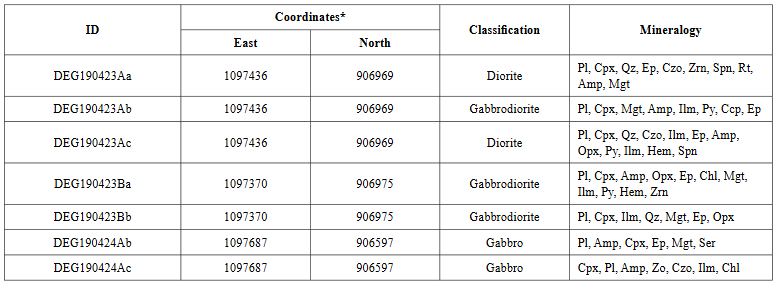
A total of eight polished thin sections were analyzed from the GOC rocks, collected in the Puente Piedra area. Analyses were performed with a Primotech microscope (built-in cam), and each sample was classified following Le Bas & Streckeisen (1991) based on a 300-500 points during point counting according to mineralogic variations and textural characteristics. The complete list of these polished thin sections, their locations, textural classifications, and mineralogy is documented in Annex 1.
Whole Rock geochemistry
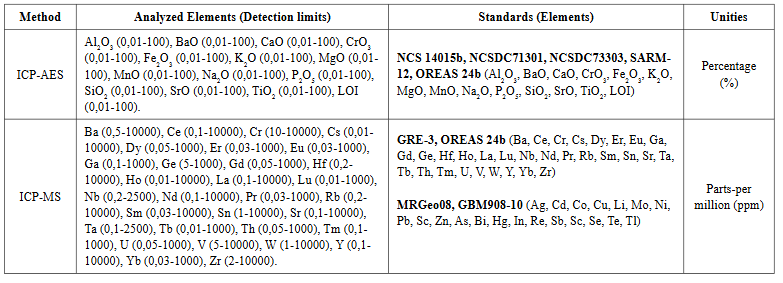
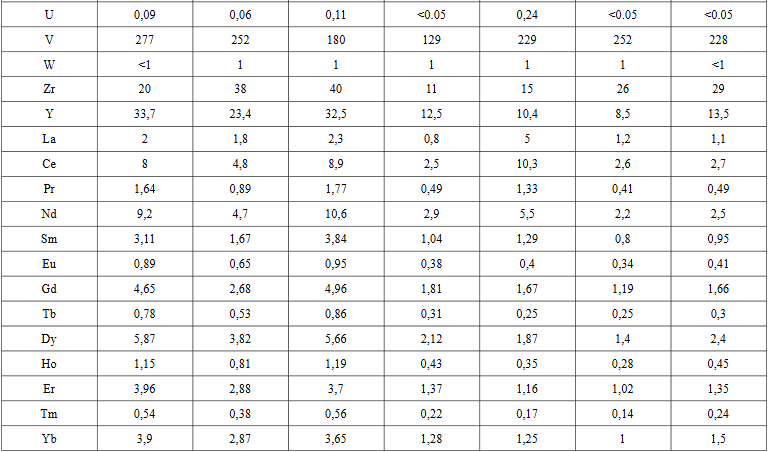
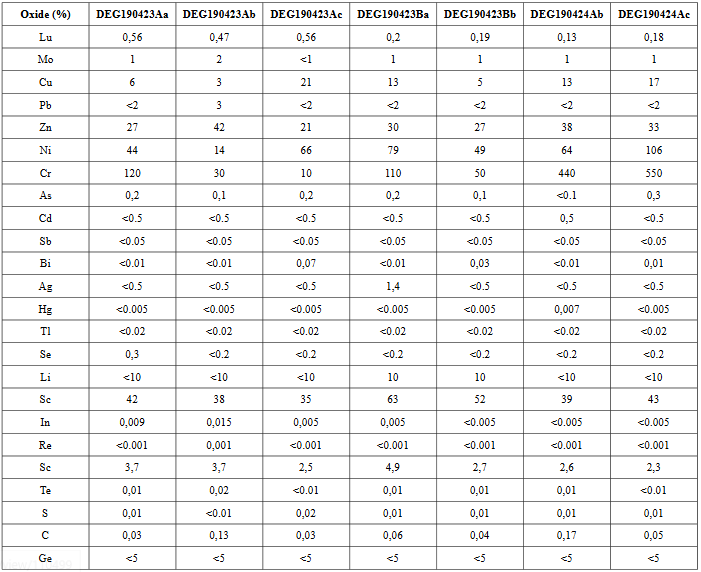
Whole-rock analyses were conducted on seven gabbro rocks from the GOC, including both major and trace elements. The analyses were carried out at the ALS Chemex laboratory, located in Medellin, Colombia, utilizing coupled plasma mass spectrometry (ICP-MS) and coupled plasma atomic emission spectroscopy (ICP-AES). In Annex 2, information of used standards and detection limits for every element can be found.
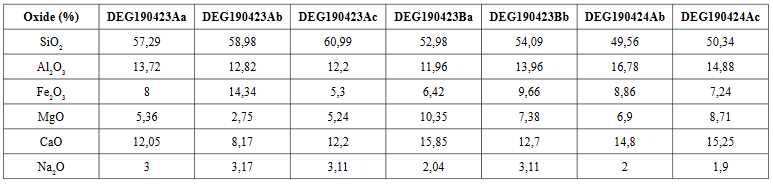
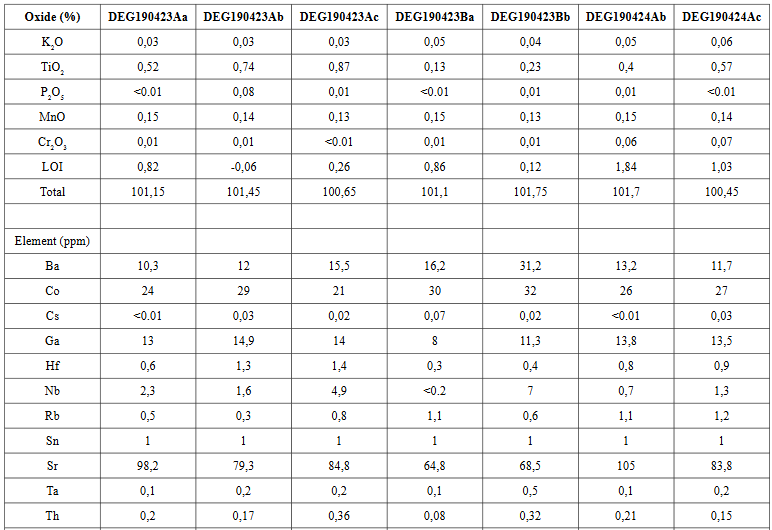
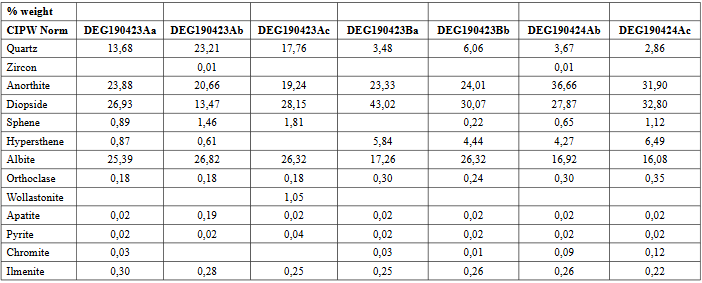
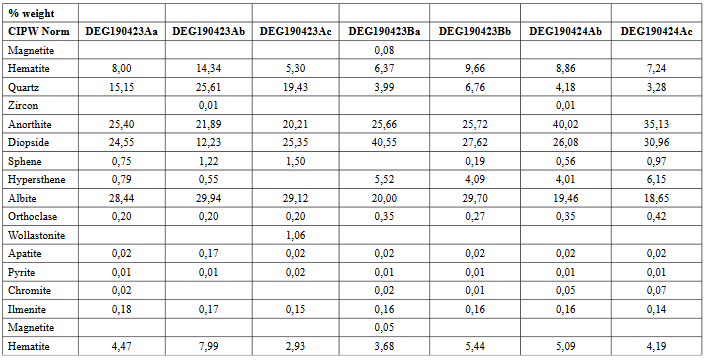
The selected samples for geochemical analyses were homogenous, with no visible inclusions or evidence of hydrothermal alterations. Additionally, this study included geochemical data published by Ossa and Concha (2007), who analyzed 19 samples from the GOC and one from the Amaime Complex. Furthermore, data reported by Villagomez (2011), from three samples of the Amaime Complex and two samples from the Buga Batholith were used. The GCDkit 5.0 software (Janoušek et al., 2006) was employed for the creation and visualization of geochemical diagrams. The plots generated included: alteration index, magmatic series characterization, geochemical classification, Harker diagrams, and tectonic discriminant diagrams proposed by Pearce (2008) and Pearce (1982). SiO2 was chosen as the normalizing element for both major and trace element variation diagrams. For Rare Earth Elements (REE), plotting values of primitive mantle were selected according to McDonough and Sun (1995). Results of normative mineral calculations (CIPW Norm) and analyses standardized to 100% (free of H2O+, H2O-, and CO2) are listed in Annex 3.
Results
Field observations
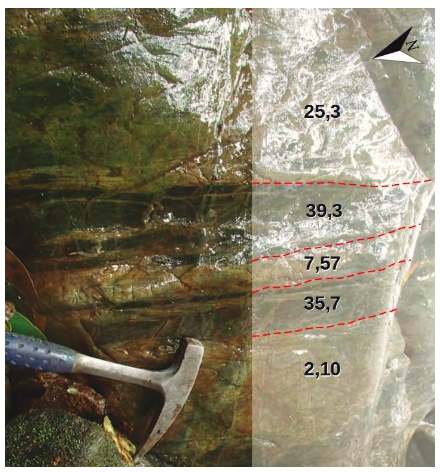
The studied segment in the ophiolitic sequence is composed of intermittent felsic and mafic layering with similar orders of magnitude to one another -from millimetric to 30 cm width (Figure 3). The felsic layers exhibit equigranular textures with hypidiomorphic fine crystals (0.05-1 mm) composed of quartz, plagioclase, and hornblende. The mafic layers present mesocratic, equigranular-phaneritic textures, composed of fine to very-fine (<0.03-1 mm) crystals of plagioclase and pyroxene. The magnetic susceptibility shows a constant proportionality with the color index of the bands ranging from 2 to 8 for leucocratic bands and from 25 to 39 for mesocratic and melanocratic bands.
Petrography and rock compositions
Petrographic analyses confirms that the studied section of the GOC is formed by isotropic gabbros, cumulate gabbros, gabbrodiorites, and diorites that were hydrothermally altered or deformed. Modal analyses and compositional classifications are presented in Figure 4.
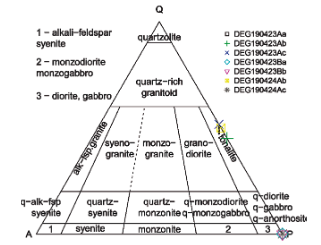
Figure 4. QAP diagram applied to gabbro rocks in the Ginebra Ophiolitic Complex at the Puente de Piedra section.
Isotropic gabbros
The isotropic gabbros are holocrystalline, equigranular, fine to medium crystal size with anhedral to subhedral crystals, composed by plagioclase, clinopyroxene, orthopyroxene, hornblende, magnetite, and ilmenite. These rocks are moderately affected by hydrothermal alteration; the secondary minerals formed as result of hydrothermal alteration are hornblende, epidote, and chlorite (Figure 5a).
Cumulate Gabbros
These rocks exhibit an oriented texture characterized by both broken and thick crystals, surrounded by finely milled material. Multiple twinnings in the plagioclase crystals appear deformed in flame-like shapes. The cumulates are formed dominantly by plagioclase, orthopyroxene, clinopyroxene, and magnetite. When observed using mesoscopic and microscopic techniques cumulate textures are identified, marked by variations in the proportions of minerals (plagioclase/pyroxene), changes in crystal size, and differences in magnetite content.
Gabbrodiorites
The gabbrodiorites exhibit mineral fabrics, holocrystalline and equigranular textures with fine to very fine size anhedral crystals. These rocks are primarily composed by plagioclase and clinopyroxene with smaller amounts of quartz subgrains formed during a deformation stage (Figure 5c).
Diorites
These rocks exhibit holocrystalline inequigranular texture with fine anhedral crystals formed by plagioclase, clinopyroxene, and quartz. The quartz crystals show mosaic texture due to deformation (Figure 5d). In some layers, abundance of pyroxene and ilmenite is observed. There are zones characterized by intense hydrothermal alteration with hornblende and chlorite modifying the pyroxene crystals (main clinopyroxene) and saussurite scattered over plagioclase crystals (Figure 5e). Some clusters of small veins were identified and characterized as follows: (1) amphibole (with magnetite or ilmenite); (2) epidote-rutile; (3) chlorite; (4) amphibole and epidote (with ilmenite and magnetite); and (5) zoisite-clinozoisite-epidote (Figure 5f).
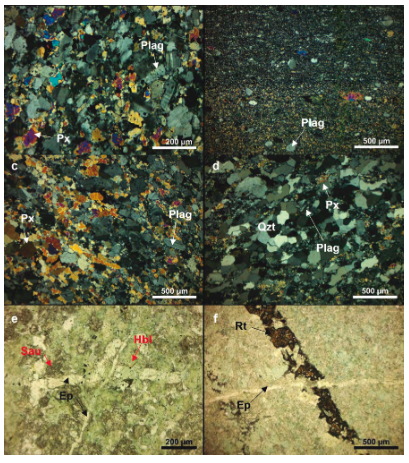
Figure 5. Petrographic observations of characterized rocks in the Puente de Piedra section. a) Isotropic gabbro; b) cumulate gabbros; c) gabbrodiorite; d) diorite; e) hornblende and saussurite formed through hydrothermal alteration of pyroxenes and plagioclases, respectively; f) rutile vein (NW-SE) cut by an epidote vein (W-E). Plagioclase (Plag), pyroxene (Px), quartz (Qzt), saussurite (Sau), hornblende (Hbl), epidote (Ep), rutile (Rt).
Geochemical data
The rocks in the studied section are part of a tholeiitic series with a high concentration of SiO2, varying from 52 to 62 wt% (Figure 6), and an alumina saturation index ranging from ~0.4 to ~0.8. These values indicate that the rocks from the GOC, the Amaime Complex, and Buga Batholith correspond to metaluminous igneous rocks (Figure 7). The differentiation of the three compositional groups within the ophiolitic sequence, gabbros, gabbrodiorites, and diorites (as shown in Figure 8), is based on the SiO2 vs. alkali ratio in the rocks.
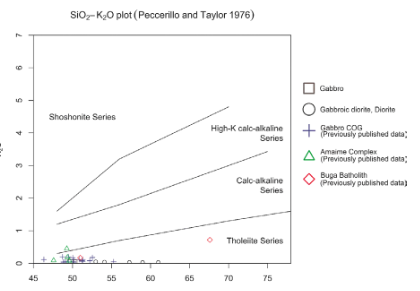
Figure 6. K2O vs. SiO2 chart suggested by Peccerillo and Taylor (1976). These conventions apply to all of the charts listed below.
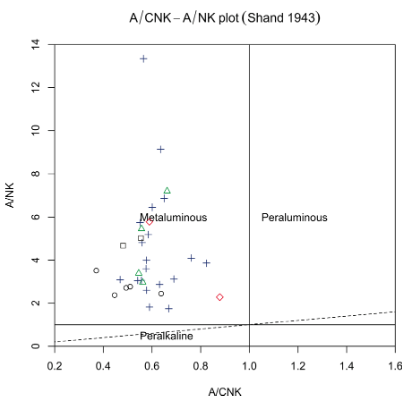
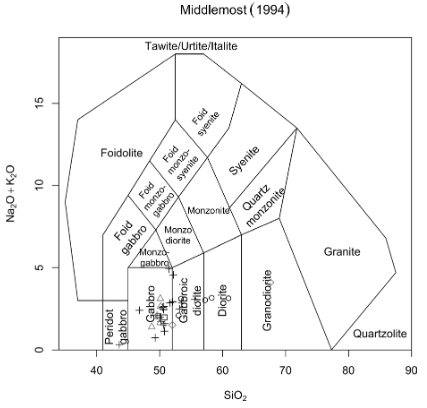
Figure 8. TAS chart for geochemical classification of rocks from the GOC, Complejo Amaime and Buga Batholith.
The variation in major oxides with respect to the SiO2 content in the analyzed rocks reveals two different trends: (a) a positive collinear trend for TiO2 and Na2O, and a negative trend for K2O, Al2O3, FeOt, and CaO in the Puente Piedra section. (b) Conversely, gabbros collected from La Honda (Ginebra municipality) and El Diamante (Buga's municipality) locations exhibits a linear with a steep vertical slope concerning the major oxides in relation to SiO2 (ranging from 46 to 55 wt%), with a wide range of values for K2O and FeOt, and a similar range of values for MgO, CaO, Al2O3, and TiO2 when compared to the samples from the Puente Piedra (Figure 9).
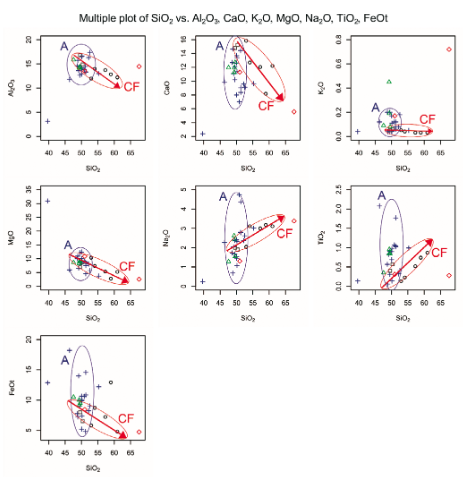
Figure 9. Harker vs. SiO2 variation diagram for major oxides for the GOC, the Amaime complex, and the Buga Batholith. A: Accumulation, CF: Fractioned Crystallization.
Regarding TiO2, the gabbro samples from the GOC generally exhibit concentrations of less than 1.2 wt%, except for two samples analyzed by Ossa and Concha (2007). A similar range is observed in the results obtained by Villagomez (2011) and those of Ossa and Concha (2007) for the basaltic rocks in the Amaime Complex (Figure 10).
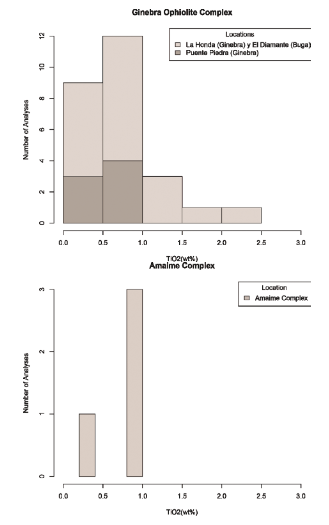
Figure 10. Histogram displaying the weight percentage of TiO2 (wt%) content at two locations: a) GOC and b) Amaime Complex.
In analyzing the behavior of trace elements in the GOC (Figure 11) concerning their variation relative to SiO2 content, two primary trends were observed, consistent with the patterns described for major oxides. Within the Puente Piedra section, rocks display a linear increase with a positive slope for elements such as lanthanum, cerium, yttrium, and zirconium, while showing a slight negative slope for barium and strontium. In contrast, rocks from La Honda and El Diamante, as reported by Ossa and Concha (2007), exhibit a vertical trend over a narrow SiO2 content range.
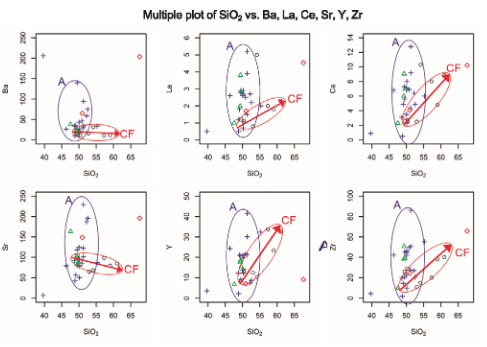
Figure 11. Harker vs. SiO2 variation diagram for trace elements of rocks from the GOC, the Amaime Complex, and the Buga Batholith. A: Accumulation, CF: Fractioned Crystallization.
In general, the rocks from the GOC, Amaime Complex, and Buga Batholith exhibit enriched concentrations of large-ion lithophile elements (LILE: Cs, Rb, Ba, Th, K, Sr, and Pb) and slightly depleted concentrations of high-field strength elements (HFSE: Nb, Ta, Hf, Zr, Ti) with respect to normal mid-ocean ridge basalts (N-MORB) (Figure 12). It is important to mention the similarity in patterns between the gabbros from the GOC, the basalts from Amaime Complex, and the granitic rocks from the Buga Batholith.
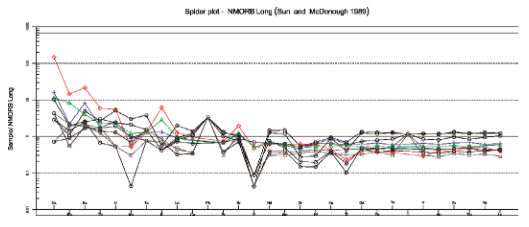
Figure 12. Normalized trace elements with respect to N-MORB for the GOC, Amaime Complex, and Buga Batholith.
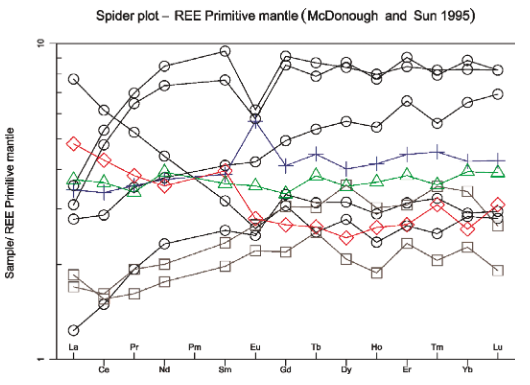
Considering the behavior of the rare-earth elements (REE) as depicted in the multi-elemental diagram (Figure 13), distinct trends for each lithologic unit can be identified. Rocks from the Amaime Complex display a flattened-shaped pattern, enriched in a four-factor ratio concerning the primitive mantle. Rocks from the Buga Batholith show a negative slope, indicating a relative depletion of heavy rare-earth elements (HREE). Finally, the GOC rocks show a flattened-shaped pattern but are depleted in light rare-earth elements (LREE). Within this unit, the more differentiated lithologies, such as gabbrodiorites and diorites, are more enriched in rare-earth elements than the less differentiated lithologies, such as gabbros. Additionally, the gabbros of the GOC display moderate positive Eu anomalies, while the gabbrodiorites and diorites present moderate-to-heavy negative Eu anomalies.
Discussion
The field study observations and the petrography and geochemistry results have allowed authors to characterize the Puente Piedra sections rocks as part of the cumulate gabbros level in the ophiolitic sequence with interbedding of gabbros, gabbrodiorites, and diorites upon fractional crystallization, deformation, and hydrothermal alterations.
The GOC rocks have a sub-alkaline character. They are part of the tholeiitic sequence with a relative enrichment of FeOt with respect to MgO; and display a tholeiitic trend low in potassium. When examining the geochemical behavior of major and trace elements (Figures 9 and 11) for the GOC, two distinct processes governing crystallization become evident. Firstly, in the Puente Piedra section the formation of gabbro was influenced by a fractional crystallization process dominated by a single magma source. The dispersion of data for K2O and Na2O is attributed to the geochemical alterations in the analyzed rocks. The trend observed in Al2O3, FeOt, MgO, and CaO indicates a typical behavior, as these elements participate in the fractional crystallization of olivine, orthopyroxene, clinopyroxene, plagioclase, and hornblende. Conversely, in La Honda and El Diamante locations crystallization appears to have been controlled by extraction and accumulation processes, as evident from the wide range of values found in CaO (2.39-14.65 wt%), FeOt (5.34-20.25 wt%), MgO (3.74-30.93 wt%), Na2O (0.25-4.74 wt%), La (0.50-5.20 wt ppm), Ce (0.50-12.80 wt ppm), Sr (6.60-229.20 wt ppm), Y (2.20-41.50 wt ppm), and Zr (1.80-86.00) for restricted values of SiO2 (46.33-55.27 wt%).
The geochemistry of the Puente Piedra section, as well as that of La Honda and El Diamante locations, displays a chemical signature consistent with the upper mantle (N-MORB), as reported by Ossa and Concha (2007). Certain, distinctive characteristics allow us to suggest that the rocks from the GOC were formed in a tectonic setting associated with subduction rather than an oceanic ridge, challenging previous models.
The TiO2 content in the GOC samples fall within the range of 0.06-2.8 wt% with a mode of 0.9 wt%, while in the Amaime Complex it varies within the range of 0.35 to 0.93 wt%, with a mode close to 0.84 wt%. These TiO2 content levels are consistent with those observed in basalts from modern subduction zones such as the Mariana and Tonga subduction zones (Metcalf & Shervais, 2008).
The content of trace elements in rocks and minerals is influenced by the tectonic setting and conditions controlling magma generation (Pearce, 2014). Rocks formed in island arcs, often exhibit selective enrichment in certain elements, particularly the LILE elements derived from the subducted slab (strontium, potassium, rubidium, barium, Th ± Ce ± Sm ± P); and depletion of HFSE (tantalum, niobium, hafnium, zirconium, titanium, yttrium, ytterbium) as a result of the hydrated melting conditions (Metcalf & Shervais, 2008; Pearce et al., 1984). These enrichment and depletion features were observed in the GOC, the Amaime Complex, and in the Buga Batholith (Figure 12). Notably, these patterns exhibit remarkable similarities across the three geologic units. The similarities are significant, particularly because the Buga Batholith has been classified as part of an island arc based on its calc-alkaline affinity and characteristic magmatic signature from the mantle within the suprasubduction zone, as documented by Villagomez (2010) and Nivia et al. (2019).
Based on the geochemical analyses of the cumulate gabbros at the Puente Piedra section and the data obtained from the Amaime Complex and the GOC, it can be concluded that these units share a genetic relationship and collectively represent an ophiolitic sequence and a potential suprasubduction tectonic environment during its formation. This sequence is distinct from the Western Cretaceous-Oceanic Lithospheric Province, as reported by Ossa and Concha (2007).
Tectonic differentiation
Basaltic rocks from various ophiolitic sequences around the world have played a significant role in distinguishing the formation environments of these sequences, as their geochemistry is indicative of the tectonic processes involved (Pearce, 2008). Thus, by examining the geochemical data compiled in the studies by Ossa & Concha (2007) and Villagomez (2011), the following observations supported the model that the GOC is a suprasubduction zone ophiolite type.
The tectonic discrimination was conducted using the criteria established by Yang et al. (2014) and Dilek & Furnes (2014), which, in turn, rely on the geochemical characteristics outlined by Pearce (2008). The Nb/Yb vs. Th/Yb diagrams are used to compare incompatible elements and can tectonically discriminate mafic rocks (Figure 14).
The Nb/Yb vs. Th/Yb diagram shows interactions between magma and the continental crust in two ways: by indicating either crustal contamination or the presence of a subduction component (Pearce & Peate, 1995). In the diagram, MORB and Ocean Island Basalt (OIB) materials form a diagonal shape with average values for N-MORB, E-MORB, and OIB at the center. Consequently, magmas interacting with the continental crust will exhibit higher Th/Yb values. Some samples from the GOC and the Amaime Complex exhibit thorium enrichment, which is consistent to the enriched values found in subduction zones (Pearce, 2008; Yang et al., 2014).
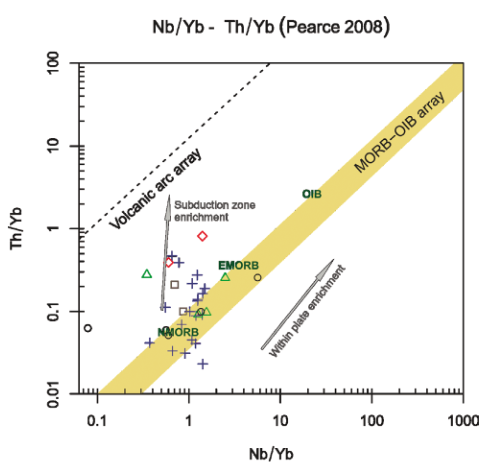
Figure 14. Tectonic Th-Nb differentiation chart applied for the rocks from the GOC, the Amaime Complex, and the Buga Batholith. Modified from Pearce (2008).
TiO2 values for the GOC and Amaime Complex are within the average range, aligning with the statistical distribution of rocks formed in arc environments (Metcalf & Shervais, 2008). The behavior of trace elements in rocks from these units, characterized by LILE enrichment, non-enrichment, and even depletion of HFSE and REE compared to N-MORB, aligns with the pattern of rocks formed in suprasubduction environments, such as the Trinity ophiolite and Troodos ophiolite (Pearce et al., 1984; Metcalf and Shervais, 2008).
Suprasubduction basalts are geochemically characterized by low amounts of Ti, Y, Yb, Ta, Nb, Zr, and Hf. These trace elements exhibit values that are either lower or closer to the average N-MORB values because no enrichment of these trace elements occur in subduction zones. This characteristic would be a consequence of hydrated conditions during partial melting, causing the melting of a refractory crust, increasing the degree of partial melting, or stabilizing minor oxides in the residual molten phase (Pearce et al., 1984). The described patterns were observed in tholeiitic rocks from the Amaime Complex (Figure 15), and the behavior and values of these rocks observed in the N-MORB normalized plot were similar to the South Sandwich basalts, described as tholeiitic basalts from a suprasubduction zone (Ozcan et al., 2020).
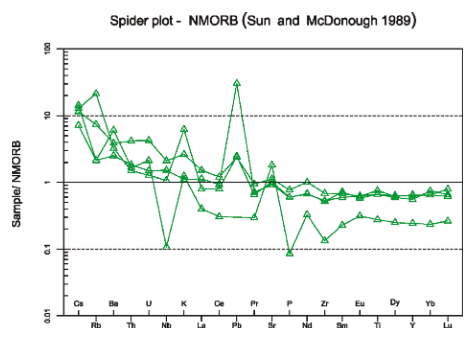
Figure 15. Multi-elements N-MORB normalized chart applied to geochemical data from the Amaime Complex published by Villagomez (2011).
Basalts from the suprasubduction zone exhibit lower Yb in comparison to MORB basalts. This observation is evident in the Cr-Y diagram (Figure 16), where the basalts from the Mariana Trench fall within the zones of island arc tholeiitic basalts (IAT) on the right and, as suggested by Pearce et al. (1984), on the left, representing the analogous elements for suprasubduction ophiolites. Notably, two basalt samples from the Amaime Complex share similarities with the IAT zones, while all three samples show resemblances to rocks from the Mariana trench.
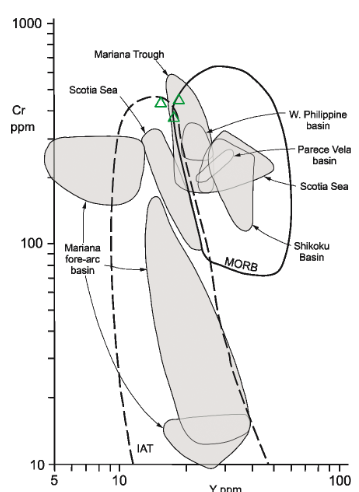
Figure 16. Cr-Y differentiation chart by Pearce (1982) deploying the separation of the oceanic ridge basalts from the Island Arc tholeiitic rocks (IAT) and applied to basaltic rocks from the Amaime Complex. (Pearce, 1984)
The authors wish to emphasize the importance of including geochemistry and single mineral chemistry in future GOC research studies for data analysis and tectonic environment discrimination, following the methodology proposed by Gervilla et al. (2005) and Proenza (2004). This recommendation aims to validate the formation model of the GOC within a suprasubduction tectonic setting, as proposed in this study. Additionally, the authors look forward to future studies and contributions on other petrogenetic variables, such as the pressure, temperature, and the crystallization age of the GOC.