




 English (pdf)
 Article in xml format
 Article references

 Automatic translation
 Send this article by e-mail
 Cited by SciELO
 Cited by Google
 Similars in
SciELO
 Similars in Google

 Permalink


INTRODUCTION
Due to their perennial nature and tropical conditions, citrus crops face numerous phytosanitary problems, from the nursery stage to production, including diseases, phytophagous pests and weeds (León and Kondo, 2017; Sáenz et al., 2019; Martinelli et al. 2022). Weeds have a great impact on citrus production due to the competition generated by growth factors such as nutrients, water, and space and interference in crop management operations, such as pruning, application of pesticides and fertilizers, and harvesting (Gonçalves et al., 2018; Otieno, 2020; Soares et al., 2021). Some species produce exudates of allelopathic substances that can inhibit the development of roots of citrus trees; others, by acting as alternative hosts, increase the populations of pest insects and the infestation of diseases in the plantation (León et al., 2017).
The low adoption of technology in many citrus plantations of the Colombian Caribbean region and the decrease in weed control practices limit the efficiency in the management of the populations of these plants, whose control, in most cases, is performed manually and, to a lesser extent, with the application of herbicides or via a combination of both methods (Gómez-Correa et al., 2021).
Ignorance or underestimation of the weed problem among producers in the region can lead to low yields and disruption of the crop's phytosanitary management plans, such as the management of Huanglongbing (HLB), one of the most important diseases that currently poses a risk to citrus farming in the country (Pérez-Artiles et al., 2018; Murcia-Riaño et al., 2020).
Not all weeds compete with citrus fruits in the same way or to the same degree, depending on their differential capacities to capture water, light and nutrients, as well as their invasiveness (Nasr et al., 2013). These competitive abilities are influenced by the biology and ecology of each species (Menalled, 2010) and the different phenological states of citrus plants (Soares et al., 2021; Martinelli et al., 2022).
In agricultural systems, the associated flora undergoes changes in its composition and abundance due to climatic variations, crop cycle, location, soil type and, mainly, crop management practices (Nichols et al., 2015). In this sense, it is very important to identify the different species that make up the weed complex, since it allows characterizing the plant communities and determining possible changes in the composition, structure, and distribution of the species, useful information to justify and improve management actions (Rios et al., 2015).
In Colombia, there have been no reports of the weeds associated with citrus crops in the Caribbean region. Therefore, the objective of this study was to determine the richness and composition of the weed community associated with citrus crops on the Caribbean coast of Colombia as a first step to determine their biological and ecological characteristics, information that can be considered useful for basing and defining adequate management plans.
MATERIALS AND METHODS
Study area
The study area included citrus farms located in the departments of Atlantico, Bolivar, La Guajira and Magdalena, which are part of the Colombian dry Caribbean subregion. This coastal region includes the lowlands of the La Guajira peninsula and the foothills of the Sierra Nevada de Santa Marta in the departments of Atlantico and Bolivar. In general, the climate is warm and dry with a seasonal distribution of rain (a dry season and a rainy season), which is characteristic of tropical dry forest ecosystems (García-Q. et al., 2021). The citrus plantations of this subregion of the country are characterized by their small-scale production (between 2 and 10 ha), with low technology and serious phytosanitary limitations that have reduced the area planted and harvested, in addition to the yields (Gómez-Correa et al. 2021). Most of the farms have mature plantations of orange Citrus sinensis (L.) Osbeck, Tahiti lemons Citrus latifolia Tanaka, “criollo” or “pajarito” lemons Citrus×aurantiifolia (Christm.) Swingle, either as a monoculture or diversified with other fruit trees.
For the study, representative farms were selected from the main citrus production systems located in the Colombian dry Caribbean subregion. These systems were characterized by AGROSAVIA in the framework of the research project “Actions for the maintenance and improvement of the phytosanitary status in citrus and musaceae production systems in Colombia” (results partially published in Gómez-Correa et al., 2021). The cultivated area (a total of 5 ha to guarantee an equivalent sampling area per farm), the methods of weed control applied, and the accessibility for work (safety, guaranteed access, and mobility) were also taken into account on the farms.
Each sampling site was georeferenced using GPS, and the data was processed using ArcGIS version 10.1 software (Tab. 1).
Table 1. Citrus cultivation, location, climatic characteristics and weed management of the production systems studied.
| Type of citrus production system | Weed control method | Farm/location | Municipality/ Department | Climate characteristics* | |
|---|---|---|---|---|---|
| TLm | Tahiti lemon Citrus latifolia Tanaka | Mechanical | Playa Rica 11°14’17.981” N -73°33’54.036” W | Dibulla/La Guajira | HR 75-80%; P 1,000-1,500 mm; T 26-28°C |
| Om | Orange Citrus sinensis (L.) Osbeck | Mechanical | Marcos 9°9'7.78" N -74°16'56.905" W | Mompos/Bolivar | HR 75-80%; P 1,500-2,000 mm; T > 28°C |
| Omc | Orange Citrus sinensis (L.) Osbeck | Mechanical and chemical | El Tamacal 9°18’15.156” N -74°7’46.379” W | Guamal/Magdalena | HR 75-80%; P 1,500-2,000 mm; T > 28°C |
| CLmc | “Criollo” lemon Citrus×aurantiifolia (Christm.) Swingle | Mechanical and chemical | La Quinta 10°46’9.394” N -74°46’6.065” W | Santo Tomas/Atlantico | HR 80-85%; P 500-1,000 mm; T 26-28°C |
| CLFm | “Criollo” lemon in association with other fruit trees | Mechanical | La Granja 11°2’37.806” N -74°12’4.924” W | Cienaga/Magdalena | HR 75-80%; P 1,000-1,500 mm; T > 28°C |
RH, average annual relative humidity; P, average annual precipitation; T, average annual temperature.
Data collection and information analysis
On the selected farms, inventories of the flora present in the cultivated areas were conducted in 2022 during the rainy season, which corresponds to a period when vegetation growth is at its peak. This approach ensured the presence of adult individuals. Samples of the entire plant were collected in a zigzag pattern across five plots (1 ha) per farm. The botanical samples were subsequently entered into the UTMC herbarium of the Universidad del Magdalena for identification and deposit. The taxonomic determination was carried out by comparison with the herbarium collection, review of specialized bibliography and management of taxonomic keys.
The taxonomic information was updated according to the Angiosperm Phylogeny Group- APG IV classification system (The Angiosperm Phylogeny Group et al., 2016), and the POWO (2022) database was consulted for the nomenclature. The richness and floristic composition were represented by means of a list with the number of species, genera, and families. Through bibliographic consultation, information was obtained on the life cycle, growth habit and origin of each species, as well as those reported as hosts of pests and diseases and invasive species (CABI, 2022).
The Jaccard coefficient of similarity, based on the presence/absence of species and the analysis of clusters, with the method of group of unweighted pairs with arithmetic mean (UPGMA) that presented the best fit as defined by its phenetic distance, was used to express the floristic similarities between the sampling sites. The analysis was implemented in R (R Core Team) using the online complement iNEXT (iNterpolation/EXTrapolation) from Chao et al. (2016).
RESULTS AND DISCUSSION
Weed community composition
The composition of the weed communities of the citrus production systems of the Colombian dry Caribbean comprised 113 species included in 83 genera and 34 families. Fabaceae, with 19 species, was the family with the highest species richness, followed by Poaceae with 13, Malvaceae with ten, and Asteraceae with eight. The Tahiti lemon system with mechanical control (TLm) was the one with the highest richness (53 species), while in the orange production system with mechanical control (Om), the richness was lower, with 24 species (Suppl. Tab. S1, https://revistas.uptc.edu.co/index.php/ciencias_horticolas/article/view/18951/15555).
Studies of weed communities in citrus fruits of the department of Meta, Colombia (Hoyos et al. 2015) and in the western Mediterranean region of Turkey (Onen et al., 2018) also reported the families Asteraceae, Poaceae and Fabaceae to be the richest. The wide distribution of Asteraceae at the global level, with a presence in various agricultural systems, is because the species of this family produce many seeds that are dispersed by different mechanisms and because they present a rate of rapid leaf growth that proliferates in various environments, even under drought conditions (Al Farishy and Salamah, 2021).
In the case of Poaceae, the dominance of many of their genera and taxa in a great diversity of ecosystems, including agricultural ones, is due to the differences that these present in their physiology, biochemistry, anatomy and environmental requirements (Biganzoli and Zuloaga, 2015). Malvaceae is one of the richest families, after Fabaceae, in dry forest locations in the Colombian Caribbean (García-Q. et al., 2021).
Similarity of weed complex composition between citrus production systems
When comparing the weed communities between the sampling sites, the cluster analysis resulted in three groups according to the similarity in floristic composition (Fig. 1).
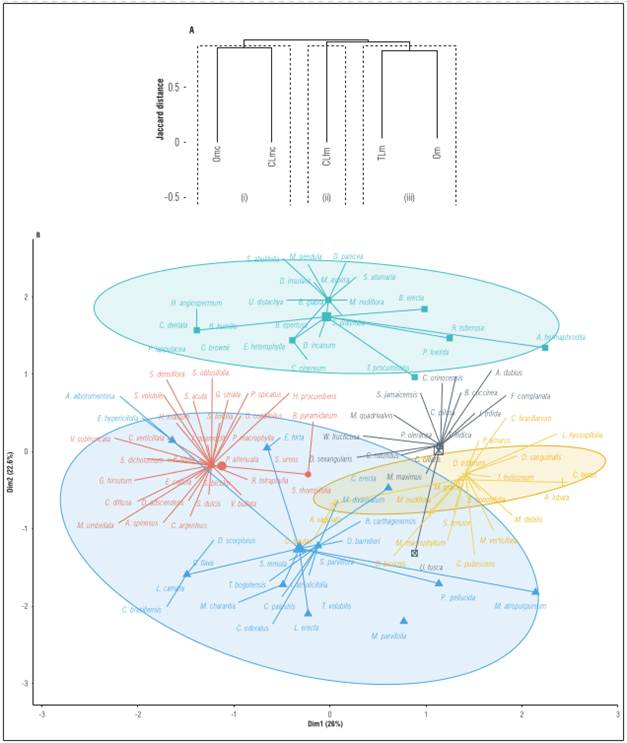
Figure 1. Cluster analysis and (b) non-metric multidimensional scaling (NDMS) of weed species that best characterize the evaluated citrus production systems. 1. TLm: Tahiti lemon with mechanical control; 2. Om: Orange with mechanical control; 3. CLFm: “criollo” lemon and other fruit trees with mechanical control. 4. Omc: Orange with mechanical and chemical control; 5. CLmc: “criollo” lemon with mechanical and chemical control). The dashed lines and ovals indicate cutoff points of similarity used to define the three groups (i, ii, iii). UPGMA grouping method, Jaccard's coefficient of similarity, phenetic fit: 0.85.
The first group (I) comprises the orange and “criollo” lemon production systems with mechanical and chemical control (Omc and CLmc). “Criollo” lemon and other fruit trees with mechanical control (CLFm) make up the second group (II), and the third group (III) is made up of Tahiti lemon and orange with mechanical control (TLm and Om) (Fig. 1A). The group CLFm (II) presented the greatest dissimilarity (greater separation of the group of weed species that characterize it), followed by the group formed by Omc and CLmc (I). The TLm and Om production systems (group III) were the least dissimilar (Fig. 1B).
The production systems Omc and CLmc (group I) have the combination of mechanical and chemical weed control in common and both are monocultures. The CLFm production system (group II), with greater dissimilarity, is characterized by mechanical weed control and is a diversified crop. The production systems TLm and Om (group III) have in common the mechanical control of weeds, which are monocultures and were the ones that presented the highest and lowest specific richness, respectively. We also highlight that the orange production systems (Omc and Om), despite having the same citrus species and being the closest in location (Tab. 1), remained in groups (I) and (III), respectively, which presented greater dissimilarity between them. Both systems are monocultures and differ in the method of weed control.
These results indicate that the composition of the weed community in citrus is heterogeneous and that the weed complex changes between production systems that differ in weed management and the citrus species cultivated. In this sense, weed management, defined by the type of control carried out in citrus plantations, is the main factor related to the dynamics of change in the composition of weed communities between the systems evaluated.
Although climatic variations, location, type of soil, and crop cycle are determining factors in the composition and abundance of the flora associated with agricultural systems, crop management practices mainly influence the change in the complex of weeds (Nichols et al., 2015; Rios et al., 2015). Nagy et al. (2018) argue that both the environmental context (location, soil characteristics, surrounding habitat) and the management associated with crops are the main factors that explain the variation in the composition of the small-scale weed community.
Of the weed complex, only one species was recorded in all the sampling sites: Commelina erecta (Commelinaceae). Three (Tridax procumbens, Euphorbia hirta and Melochia parvifolia) were recorded in four of the five production systems, nine in three, 20 in two and 80 in only one (Suppl. Tab. S1 https://revistas.uptc.edu.co/index.php/ciencias_horticolas/article/view/18951/15555), which generated a differentiating pattern of the composition.
C. erecta was reported by Quintero-Pertúz et al. (2020) as the weed with the highest importance index and was very frequent in the banana plantations of the Magdalena department, which was attributed to its ability to propagate by seeds and vegetatively, characteristics that allow it to be classified as a very competitive weed in agricultural production systems. Also noteworthy is the presence of Cyperus rotundus (Cyperaceae), Amaranthus spinosus (Amaranthaceae), Digitaria sanguinalis, Echinochloa colona (both Poaceae) and Portulaca oleracea (Portulacaceae), which are considered among the worst weeds of many agricultural systems in the world (CABI, 2022).
The success of these weeds is related to their ability to spread both by seeds (which are numerous, small and easily dispersed) and vegetatively (by means of rhizomes and stolons), which allows them to quickly infest new areas, especially in agricultural environments (Zimdahl and Brown, 2013). According to Fried et al. (2019), the biological traits of the weeds and the management given have a positive correlation with the regional frequency, the local abundance and the specific adaptation to the crop that are associated, which makes it possible to predict which may be the most problematic.
Description by life cycle, growth habit, origin
Of the total registered species (Suppl. Tab. S1 https://revistas.uptc.edu.co/index.php/ciencias_horticolas/article/view/18951/15555), 55 are perennial (49%), 34 are annual (30%), 18 are annual/biennial (16%) and 6 are biennial (5%). Regarding their growth habit, 62 species are herbs (55%), 24 are climbers and lianas (21%), 13 are arboreal or shrubby (12%), 11 are herbs/subshrubs (11%) and two are hemiparasites (2%). These results differ from those of the study by Hoyos et al. (2015), who reported the predominance of annual weeds in citrus crops in the department of Meta (Colombia). They also differ from those of the work of Onen et al. (2018), who reported that annual weeds were the most dominant in Mediterranean citrus orchards. Meanwhile, there was agreement with what was reported by Nasr et al. (2013) in citrus crops of Iran, where there was also a greater relative abundance of perennial and biennial weeds than annuals.
The higher proportion of perennial species in the study area may be attributable to the primary method of weed control employed, which is mechanical cutting using tools such as a machete or scythe. According to MacLaren et al. (2020), an increase in perennial species (weeds with vegetative propagules) is a change in the weed community that can occur in response to the prevalence of mechanical control or regular tillage. Onen et al. (2018) pointed out that the abundance of perennial weeds with vegetative propagation can be correlated with ineffective management practices. These factors cause some populations to modify their life cycle from annuals to perennials and change or alternate their reproductive strategies and growth habits (Gaba et al., 2017).
Perennial weeds are more difficult to control, and the continuous suppression of weeds that remain in orchards can generate higher management costs, in addition to negative impacts on the health and productivity of citrus trees (Nasr et al., 2013; Travis, 2019). In the case of annual plants, Onen et al. (2018) highlighted that their predominance in citrus orchards can be attributed to their short lifespan and greater allocation of resources for reproduction, even under adverse weather conditions.
The different growth habits of weeds can also determine the level of competition with crops (Getachew, 2022). Erect and prostrate growing herbaceous plants can be very competitive with citrus fruits for soil moisture, which, due to their rapid growth or vigorous regrowth after cutting, reduces the amount of water available for the absorption of the roots affecting the water status of the trees (Soares et al., 2021). Vines (creepers, lianas), which can germinate in shady areas and grow in the canopy of citrus trees, are more competitive for sunlight than other plants and can cause problems for tree pruning and fruit harvesting operations (Nasr et al., 2013).
On the other hand, the hemiparasites that grow on the branches of citrus trees that they use for anchoring and support can also completely or partially cover the crown (Ngotta et al., 2022). Species of the Loranthaceae family, represented in this study by Oryctanthus cordifolius and Passovia pyrifolia, can become a serious threat to citrus fruits if not efficiently managed (Ngotta et al., 2022). Although mechanical removal (pruning of infected host branches) is the most effective means of controlling hemiparasites in plantations (Watson et al., 2020), understanding the complex ecological and physiological interactions between plants and their hosts, as well as evaluating the economic and environmental impact of the practices introduced, is recommended to develop appropriate and efficient control strategies in citrus plantations (Kebede and Ayana, 2018).
Based on an assessment of the origin of the species, we determined that the native species, with a record of 97 species (86%), predominated over the adventitious or introduced species, of which 16 species (14%) were recorded (Suppl. Tab. S1 https://revistas.uptc.edu.co/index.php/ciencias_horticolas/article/view/18951/15555). The importance of determining the presence of introduced species lies in the fact that these species can become invasive and quickly colonize intervened and natural environments, becoming a serious threat to agricultural productivity and biodiversity (Zimdahl and Brown, 2013). Of the sixteen introduced species recorded in the study area, Cyanthillium cinereum, Murdannia nudiflora, Momordica charantia, Cyperus rotundus, Alysicarpus vaginalis, Bothriochloa pertusa, Urochloa distachya, Digitaria bicornis, D. sanguinalis and Megathyrsus maximus were classified as high-risk invasion and Emilia sonchifolia of moderate risk (Echávez et al., 2022). The records of the presence of these species in the dry Colombian Caribbean merit permanent monitoring and control of the populations of these species due to the potential risk of invasion they represent, both in citrus plantations and in surrounding natural environments.
In addition to direct interference due to competition effects, weeds also have an indirect negative impact on crops because they can be hosts to pest insects and pathogenic organisms that cause diseases in citrus fruits (León et al., 2017; León and Kondo, 2017). Of the 113 species identified in this study (Suppl. Tab. S1 https://revistas.uptc.edu.co/index.php/ciencias_horticolas/article/view/18951/15555), 29 have been reported as hosts of nematodes, pest insects or vectors, mites, viruses, bacteria, and fungi that cause diseases in various crops (CABI, 2022).
The presence of Tridax procumbens as a host of Aphis spiraecola Patch, 1914 (citrus green aphid) stands out, one of the main insect pests of citrus that causes direct damage by feeding on shoots and transmission of sadness diseases the sadness of citrus fruits, CTV (García-Marí, 2012).
Studies in citrus crops in South Florida showed that the psyllid Diaphorina citri, the transmitter of Candidatus Liberibacter asiaticus (CLas), the causal agent of Huanglongbing disease, can use weed species as alternative food sources to survive when the conditions of the main host (citrus trees) are unfavorable (George et al. 2020). Although the three weeds (Bidens alba, Eupatorium capillifolium and Ludwigia octovalvis) reported by George et al. (2020) were not recorded in our study, two species of the genus Ludwigia (L. erecta and L. hyssopifolia) are present in the citrus crops of the Colombian Caribbean region. On the other hand, Almaguer-Vargas et al. (2018) also reported an important correlation between the presence of weeds and the reduction in populations of D. citri, which warrants studies to determine these possible relationships between the insect and local weed species.
The record on the taxonomic identity of the present weed species, as well as the abundance and location, is key information to understand aspects of their biology, ecology and diversity, which gives the possibility of a better understanding of the dynamics of their populations and of analyzing their potential to provide different ecosystem services for the definition of sustainable management strategies (Zimdahl, 2018), which instead of aiming to eradicate them from the agroecosystem, allows the regulation of populations to limit their negative impacts while conserving diversity (MacLaren et al., 2020).
Under an ecological approach, the information obtained about the identity of the weed complex is basic to base adequate management strategies in citrus crops of the Colombian dry Caribbean. However, it is important to expand this knowledge about the abundance, distribution, invasiveness, and potential to provide ecosystem services of the species associated with these agricultural production systems.
CONCLUSION
The composition of the weed complex changes between citrus production systems of the Colombian dry Caribbean region that differ in weed management and cultivated citrus species. Few species were common among all sampling sites.
In general, the weed complex was characterized by numerous herbaceous species, mostly perennial, with a predominance of native species characteristic of the neotropics.
Several species identified are among the most competitive weeds globally, some hosts of citrus pest insects and others categorized as having a high level of invasion risk and biological and ecological traits that, added to the management currently given, suggests that they are the most problematic for these citrus plantations and the regulation of these populations should be prioritized.

