




 English (pdf)
 Article in xml format
 Article references

 Automatic translation
 Send this article by e-mail
 Cited by SciELO
 Cited by Google
 Similars in
SciELO
 Similars in Google

 Permalink


Introduction
Successful newcomer socialization plays a critical role in the process of building and developing an effective organizational workforce (Allen et al., 2017; Didion et al., 2024). Throughout the socialization process, newcomers acquire the knowledge and skills required to deal with the demands of their new roles and learn the practices, operating standards and behaviors valued by the organization (Ashford & Black, 1996; Cooper-Thomas et al., 2020). Furthermore, this process is also key in prompting effective adjustment to the organizational social environment for newcomers, by enabling them to establish supportive interactions with co-workers and managers (Ellis et al., 2017; Liu et al., 2021; Zhou et al., 2022). Indeed, cumulative empirical research indicates that successful organizational socialization contributes to newcomers’ improved job performance and more favorable job-related core attitudes, like job satisfaction, as well as stronger person-organization fit levels and lower levels of intention to leave the organization (Bauer et al., 2019; Fang et al., 2017; Saks & Gruman, 2014).
Despite its benefits, successful newcomer socialization encompasses a rather complex process, implying an important current challenge for employees and organizations. As emphasized by Cooper-Thomas and Burke (2012), “when jobs were for life” and employees rarely exchanged employers, they were expected to remain in the organization for a long period. Nevertheless, several factors related to globalization, constant technological changes, recurrent organizational restructuration, downsizing, mergers and acquisitions, along with the recent boundaryless and protean careers, have been contributing to higher workforce mobility, increasing the frequency with which employees go through new socialization processes (Harris et al., 2022; Zhao et al., 2022). Furthermore, jobs have become more dynamic and ambiguous due to their expanded breadth and autonomy, which in parallel with workplace digitalization and stronger reliance upon virtual and multi-disciplinary teams, has added complexity to newcomers’ adjustment process (Allen et al., 2017; Crant et al., 2017; Didion et al., 2024).
Consequently, not only must employees proactively adjust to new organizational contexts, but organizations also need to go through hiring and socialization processes more often (Cooper-Thomas & Burke, 2012; Zhao et al., 2022). Due to these changes, socialization research has placed a growing emphasis upon the role of newcomer proactivity as a key factor in successful adjustment, since organizations are unable to anticipate and provide socialization resources tailored to each newcomer’s needs (Allen et al., 2017; Saks et al., 2011; Wanberg & Kammeyer-Mueller, 2000). Therefore, in addition to acknowledging the importance of the organizational approach, focused upon organization methods and processes to structure and optimize newcomer’s adjustment, i.e., institutionalized socialization tactics (Bauer et al., 2007; Fang et al., 2017; Wanberg & Choi, 2012), research also emphasizes an individualistic approach (Cooper-Thomas et al., 2020). This is focused on the newcomer’s attributes and resources, i.e., newcomer personality and proactivity (Bauer et al., 2019; Zhao et al., 2022), to build a more comprehensive understanding of how individual and organizational factors interplay to influence newcomers’ socialization success (Fang et al., 2017).
The present recognition of the relevance of this complementary individualistic approach is based upon prior evidence supporting the link between newcomer proactivity and various positive socialization outcomes, such as role clarity and learning, task mastery, social integration, job performance, and positive job attitudes (Bauer et al., 2019; Harris et al., 2022). However, more research is needed to map the key antecedents of proactive newcomer behaviors (Didion et al., 2024; Zhao et al., 2022).
The current study is carried out under this approach and builds upon the socialization resources theory (Saks & Gruman, 2012), acknowledging that newcomers need to leverage relational and personal resources to reduce uncertainty and foster their success in adjusting (Liu et al., 2021; Zhou et al., 2022). Particularly, it aims to answer the calls for further research examining the impact of key personal resources, especially those of the individual disposition of core self-evaluations (CSE, Judge et al., 2003; Yan et al., 2019), on key socialization outcomes, like job satisfaction (Harris et al., 2022; Hurst et al., 2012; Kammeyer-Mueller et al., 2024). This broad and higher-order personality trait encompasses key assumptions that individuals hold about themselves and their functioning, impacting both their behaviors and attitudes in various domains of life, like at work (Judge et al., 2003). Drawing upon previous evidence supporting the prime and distinctive role of CSE, among personality constructs, for predicting job satisfaction (e.g., Judge et al., 2017; Lemelle & Scielzo, 2012), this study aims to contribute to the related literature by examining whether CSE plays a key role in enhancing newcomers’ job satisfaction. While there is extensive evidence supporting the validity of CSE in predicting this job attitude in general work settings and stages (e.g., Judge & Bono, 2001; Judge et al., 2021; Kammeyer-Mueller et al., 2024), less attention has been paid to scrutinizing its impact on job satisfaction during organizational socialization.
Furthermore, the present study also addresses the need for extending current knowledge regarding the mechanisms underlying the relationship between CSE and job satisfaction (Hsieh & Huang, 2017; Zhao et al., 2022), by proposing that proactive newcomer behaviors will represent meaningful mediators of this link. It posits CSE as an important driver of newcomer proactivity by drawing upon the rationale that “newcomers who have favorable core self-evaluations, i.e., fundamental beliefs concerning one’s confidence and self-assurance when approaching situational demands, are better able to proactively explore and experiment, draw from other life experiences to make sense of work situations, and adapt their role identities and career narratives to situational demands” (Fang et al., 2017, p. 519).
As emphasized by Judge and Kammeyer-Mueller (2011), CSE encompasses key attributes needed to deal effectively with change in organizations, as well as to proactively manage current protean and boundaryless careers, which represent inherent challenges that newcomers need to cope in their process of transition and adjustment to a new job (Saks & Gruman, 2012). By enacting these dispositional tendencies towards a positive and agentic profile (Judge & Kammeyer-Mueller, 2011), newcomers with stronger CSE will be more likely to rely on such personal resources to exhibit proactive behaviors to reduce uncertainty, increase control, and cope with their adjustment challenges (Fang et al. 2017; Saks & Gruman, 2012), ultimately benefiting from improved job satisfaction. Building upon these aspects, the current study advocates that CSE will impact newcomer job satisfaction by facilitating newcomer proactivity.
To our knowledge, despite previous calls for research regarding the role of CSE in socialization outcomes (Fang et al. 2017; Hurst et al., 2012), this is one of the first attempts to empirically test whether newcomer proactivity represents a mediating route through which CSE drives newcomers’ job satisfaction.
Core self-evaluations and job satisfaction during organizational socialization
Job satisfaction is commonly defined as a positive, pleasurable emotional state resulting from individuals’ evaluation of their job or their own professional experiences (Judge et al., 2021 for a review). Research has acknowledged its intrinsic value for both individuals and organizations by uncovering its meaningful links to subjective well-being, life satisfaction, and other key work criteria, such as job performance, attendance, turnover, and retirement decisions (Judge et al., 2017; 2021; Kammeyer-Mueller et al., 2024).
This core work attitude has dispositional and situational determinants. Its dispositional antecedents pertain to several constructs of individual differences, in which personality variables play a primary role (Judge et al., 2021; Steel et al., 2018). In the scope of such dispositional approach to job satisfaction determinants (see Judge et al., 2017; 2021; for a review), research has shown that CSE constitutes a key predictor, implying that the way individuals evaluate themselves affects how they feel about their work and how they experience their lives (Judge & Bono, 2001; Lemelle & Scielzo, 2012). This broad personality trait encompasses fundamental individual assessments of their worth, competencies, and capabilities (Judge et al., 2003). Conceptualized as a higher-order construct, the CSE construct is composed of four specific and self-evaluation focused traits, i.e., self-esteem, generalized self-efficacy, emotional stability, and locus of control, which influence individuals’ self-concept and confidence (Chang et al., 2012; Judge et al., 2003). Thereby, individuals with stronger CSE tend to perceive themselves more favorably through adverse situations, as well as being more capable, worthy and in control of their lives (Judge & Kammeyer-Mueller, 2011; Kammeyer-Mueller et al., 2024). Conversely, individuals with low CSE are more prone to hold a negative self-concept focused on their weaknesses and to perceive themselves as less valuable (Chang et al., 2012; Judge et al., 2003).
Despite significant links between CSE and various work outcomes, including performance, it was originally conceived as a key and non-redundant dispositional predictor of job satisfaction, an assumption that has been supported by several meta-analyses (Chang et al., 2012; Judge & Bono, 2001; Lemelle & Scielzo, 2012). Furthermore, research has also shown that CSE displays a significant contribution towards predicting job satisfaction, even when the big five personality factors are also accounted for (Judge et al., 2003, 2021).
Notwithstanding, as previously emphasized, this link remains relatively unexplored in the organizational socialization phase (Fang et al., 2017). Nevertheless, considering all the mentioned aspects, we argue that newcomers with more positive CSE will rely on such personal resources to overcome the challenges of adapting and becoming effective in the new organization, which implies the development of task mastery (self-efficacy) and effective performance of the required role, along with successful social integration (Cooper-Thomas & Burke, 2012; Zhao et al., 2022). This will foster the adjustment process and result in enhanced job satisfaction at the end of their organizational entry stage. Therefore, we hypothesize that:
Hypothesis 1: Core self-evaluations are positively linked to job satisfaction in the context of organizational socialization.
The mediating role of newcomer proactivity on the relationship between CSE and job satisfaction
Due to novelty and uncertainty levels that characterize the organizational socialization process, newcomers tend to perceive a lack of control over the new organizational environment (Ashford & Black, 1996; Zhou et al., 2022). Previous research has shown that while some newcomers act more passively during this stage, others actively pursue a proactive course to reduce uncertainty and regain control over their adjustment process (Ashford & Black, 1996; Bauer et al., 2019). Like other forms of individual proactivity, newcomers’ proactive behaviors comprise motivated work behavior patterns which are anticipatory, future-oriented, and undertaken to increase personal control and bring about change in oneself and/or the environment (Ashford et al., 2016; Kim et al., 2005).
To focus on newcomer proactivity, this study follows prior related research and has adopted Ashford and Black’s (1996) seminal typology of newcomer proactive behaviors (e.g., Bauer et al., 2019; Zhao et al., 2022). These authors have proposed four key dimensions of newcomer proactivity, comprising seven more specific socialization proactive behaviors, as follows: (1) sensemaking, which includes information-seeking and feedback-seeking behaviors; (2) positive framing, (3) relationship building, which includes general socializing, networking and boss-relationship building behaviors; and (4) job-change negotiation behaviors.
Prior empirical studies have supported the relevance of such proactive behaviors for outcomes of socialization for both the individual and the organization, since newcomers who behave proactively tend to adjust faster and more effectively (Bauer et al., 2019; Cooper-Thomas & Burke, 2014). Indeed, research has shown that individual proactivity constitutes an important predictor of multiple newcomer outcomes, such as motivation to learn, task mastery, social integration, role innovation, work engagement, job satisfaction, and intention to remain in the organization (Cooper-Thomas & Burke, 2014; Wanberg & Kammeyer-Mueller, 2000; Zhao et al., 2022). Thus, in addition to the positive, arguably more distal, influence of CSE on job satisfaction, empirical research has also shown the meaningful role of proactive behaviors as proximal antecedents of this attitudinal outcome (Ashford & Black, 1996; Kammeyer-Mueller et al., 2024; Zhao et al., 2022). Notwithstanding, research also suggests that the pattern and strength of relationships with socialization outcomes tend to vary depending on the specific proactive behaviors under consideration (Didion et al., 2024; Zhao et al., 2022). Hence, it ascribes relevance to more fine-grained approaches focusing on specific proactive patterns, as well as a focus on overall socialization proactivity (Bauer et al., 2019; Cooper-Thomas & Burke, 2012; Cooper-Thomas et al., 2014, 2020).
Drawing on socialization resource theory propositions that newcomers tend to use relational and personal resources to reduce uncertainty and facilitate their successful adjustment (Saks & Gruman, 2012; Zhou et al., 2022), we argue that newcomers with more favorable CSE are more likely to rely on such dispositional resources to engage in proactive behaviors. Furthermore, in line with the conceptual framework proposed by Wanberg and Kammeyer-Mueller (2000), newcomer proactivity can be modelled as a mechanism through which personality impacts newcomer job satisfaction. Accordingly, as emphasized by Judge et al. (1998), CSE prompts individuals to exhibit emotional, cognitive and behavioral processes that are consistent with their self-concept. Therefore, when employees have stronger CSE, they will be able to mobilize these processes more effectively (Chang et al., 2012; Kammeyer-Mueller et al., 2024). Judge and Kammeyer-Mueller (2011) further argued that those who have higher CSE are more likely to be self-starters when the situation calls for it, because they are more confident in their capacities and will be less prone to worrying about potentially negative consequences.
As stressed by Fang et al. (2011) in the scope of research regarding newcomer’s socialization, individuals with higher scores in self-monitoring and CSE traits consistently tend to be more “situationally aware, more likely to act proactively to challenge the status quo, as well as to have proclivities for capitalizing on situational advantages” (p. 142). By behaving proactively, individuals tend to be more satisfied with their jobs because they take the initiative to remove the barriers to their job satisfaction, especially when they believe they have control over their actions (self-efficacy), the situation (control appraisals) and the ability (change orientation) to cope with potentially negative consequences (Cooper-Thomas et al., 2014; Crant et al., 2017; Kammeyer-Mueller et al., 2024).
Previous research, albeit limited, provides initial support for these aspects by showing that CSE and some of its encompassing components, such as self-esteem, internal locus of control, and self-efficacy (Bono & Colbert, 2005; Gruman et al., 2006), play an important role as drivers of proactivity, which in turn positively impact on job satisfaction (Kammeyer-Mueller et al., 2024; Yan et al., 2019). However, to our knowledge, this is the first study proposing and empirically testing the role of newcomer proactivity as an intervening variable in the CSE-satisfaction link, within the frame of organizational socialization. Considering the merits of CSE as an antecedent of newcomer proactivity, we argue that this disposition will impact subsequent job satisfaction via specific proactive socialization behaviors, i.e., sensemaking, positive framing and relationship building, specified by Ashford and Black’s (1996) seminal taxonomy.
Regarding sensemaking and its specific behaviors of feedback and information seeking, prior research suggests that CSE and its encompassing elements may play a role in enacting these specific proactive behaviors. While self-esteem and locus of control (i.e., internal) seem to act as an important predictor of feedback seeking (Bono & Colbert, 2005), self-efficacy is posited to have an impact on both feedback and information-seeking behaviors (Gruman et al., 2006). Given their positive self-concept, individuals with higher CSE tend to establish more demanding learning and development goals, as well as adopt congruent and implied behaviors (Chang et al., 2012; Judge et al., 2003), including those concerning sensemaking. Consequently, newcomers who implement proactive sensemaking behaviors will reduce their uncertainty about appropriate behaviors and increase their chances of obtaining rewards based on feedback and information obtained, thus experiencing high levels of job satisfaction, as evidenced by previous studies (Ashford & Black, 1996; Ashford et al., 2016; De Stobbeleir et al., 2017). Moreover, recent meta-analytic evidence showed sense-making positive effects on newcomers’ attitudinal outcomes, like commitment and job satisfaction (Zhao et al., 2022). Thus, we hypothesize that:
Hypothesis 2a: Sensemaking behaviors of feedback seeking and information seeking mediate the link between newcomers’ CSE and job satisfaction.
Similarly, we posit that newcomers’ proactive behavior of positive framing will act as a mechanism through which CSE enhances newcomers’ job satisfaction. Building upon self-verification theory (Swann, 2012), Judge et al. (1998) argued that individuals with higher CSE tend to process information about their work environment from a more positive outlook. The positive self-image inherent in individuals with stronger CSE may create a self-fulfilling prophecy that helps them behave effectively and be more satisfied in a given context due to their related and prompting beliefs that they are effective, in control, and worthwhile (Judge & Kammeyer-Mueller, 2011; Kammeyer-Mueller et al., 2024).
The proposed positive effect of CSE on positive framing is also consistent with the approach/avoidance explanatory framework of the effects of CSE on work outcomes (Chang et al., 2012). According to this model, high-CSE individuals are more likely to evaluate situations from a positive approach and pursue constructive goals and results, as well as avoid negative results and show higher insensitivity to negative stimuli (Chang et al., 2012; Elliot & Trash, 2002). In addition, individuals with stronger CSE and encompassing emotional elements, such as high self-esteem and high generalized self-efficacy, tend to remain optimistic in the face of failure, persist under difficult situations, see unwanted opportunities as challenges rather than a chance to fail, and judge their future actions more successfully (Chang et al., 2012; Judge & Kammeyer-Mueller, 2011). This positive mindset tends to support their initiative and enable more favorable prospects regarding the attainment of future success in life situations, including at work. It also allows them to perceive their current job and workplace as more attractive, which further enhances their job satisfaction levels (Judge et al., 2021; Judge & Bono, 2001). Meta-analytic evidence supports this pivotal role of positive framing in facilitating newcomers’ satisfaction, by showing its strongest contribution in explaining this criterion variance, when the other proactive behaviors, i.e. sensemaking, relationship building, and job change negotiation are also considered (Zhao et al., 2022). Transposing these aspects to the socialization context, we hypothesize that:
Hypothesis 2b: Newcomers’ positive framing behavior mediates the relationship between core self-evaluations and job satisfaction.
Previous research developments also indicate that CSE may have an impact on individuals’ behaviors which aim to establish interpersonal interactions. As highlighted by Judge and Kammeyer-Mueller (2011), individuals with higher levels of CSE tend to be more protective of their reputations. Therefore, they seek to better manage the positive impressions that others have of them. Individuals with a positive self-concept are more likely to move forward in new social situations to establish interpersonal relationships, seeking social support and relevant cues. Likewise, they are more likely to convey and maintain a positive image, which contributes to developing trust relationships with their co-workers (Judge et al., 2003).
Previous empirical research has consistently reported positive links between key CSE encompassing elements, for example, between self-efficacy and general socializing behaviors, networking, and boss-relationship building (Gruman et al., 2006). By engaging in proactive relationship-building actions, newcomers with stronger CSE will obtain more support and information about organizational procedures or policies, expected behaviors and valued skills, which will facilitate their integration and lead to higher levels of job satisfaction (Ashford & Black, 1996; Wanberg & Kammeyer-Mueller, 2000). Consistently, recent meta-analytic results showed that relationship building predicts a larger amount of variance in newcomers’ social integration and emerged as the second strongest predictor, after positive framing, of job satisfaction (Zhao et al., 2022). Drawing upon this theoretical and empirical evidence, we anticipate that newcomers with stronger CSE will be more likely to take the initiative to build and strengthen their social bonds during their adjustment to the new organization and hypothesize that:
Hypothesis 2c: Proactive relationship building behaviors of general socializing, networking and boss-relationship building mediate the link between CSE and newcomer job satisfaction.
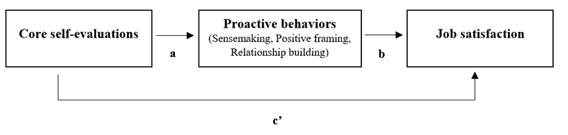
In summary, considering the relevance of the newcomers’ proactivity for the success of their organizational socialization, this study posits that CSE plays an important role in promoting newcomers’ proactive behaviors, which in turn will contribute to stronger satisfaction levels. Figure 1 depicts the multiple mediation model resulting from the integration of the mediating hypotheses presented above.
Method
Participants and procedure
This study was conducted with a sample of 151 final-year master’s students from a large Portuguese university, throughout the completion of their full-time internship in different organizations. To follow their organizational socialization process, a predictive design with two distinct data collection phases was used. The first phase was conducted at the beginning of the internship, while the second phase was conducted five months after the newcomers joined the organization. This procedure follows previous literature recommendations that emphasize the need to cover the first 100 days when the core development of newcomer learning and socialization tends to occur (Song et al., 2017). To implement the first phase, students from all university faculties were invited to participate via a mail sent to the respective faculty coordinators, containing information about the main research goals and data collection procedures. Students who agreed to participate were contacted again just before starting their internships and instructed to complete a paper and pencil questionnaire to measure relevant sociodemographic data and their CSE. Respective informed consent was collected, emphasizing the confidentiality of their answers and their exclusive use for research purposes. Participants were also asked to provide their permission to be further contacted by email to complete the second stage of the study, which took place five months later. In total, 160 valid questionnaires were gathered during this phase.
In the second phase (i.e., after five months), students were emailed to complete an online survey which was designed to assess the frequency with which they exhibited proactive behaviors during this time frame, as well as their level of job satisfaction at the end of their internship. Only data from newcomers with no previous work experience were considered for the purposes of this study, fulfilling its criterion of focusing exclusively on newcomers’ first socialization processes at work. Overall, 151 valid questionnaires were correctly matched with respective data from the first phase (i.e., newcomers’ email addresses were used to match correspondent data from both waves and replaced by subject codes in the data set), corresponding to a response rate of 94.4%.
This final sample (N = 151) consisted of 39.1% male and 60.9% female newcomers, with an average age of 22.93 (SD = 1.63), from master’s courses in psychology (63.6%), electrical and computer engineering (21.9%), sport sciences (9.9%) and management (4.6%). Sampled newcomers belonged to organizations from different industries, including health care (34%), manufacturing (31.3%), services (11.3%) and education (18.7%). The remaining participants (4.7%) did not provide this information.
Measures
Core self-evaluations were measured through the Portuguese form of Judge et al.’s (2003) 12-item CSE scale, developed by Martins et al. (2015). Responses for each item (e.g., “When I try, I generally succeed”) were obtained using a 5-point Likert scale, where 1 = strongly disagree and 5 = strongly agree. Previous research has supported the appropriateness of its psychometric characteristics (e.g., Chang et al., 2012; Judge et al., 2003), including in Portuguese samples (Martins et al, 2015; Rodrigues & Rodrigues, 2023). Cronbach’s alpha was .84 in the current sample.
Socialization proactive behaviors were assessed using Ashford and Black’s (1996) scale. Commonly used in socialization proactivity related-research (e.g. Bauer et al., 2019; Cooper-Thomas, et al., 2012; Song et al., 2017), this 24-item instrument assesses seven specific newcomer proactive behaviors, including sense making-information seeking (4 items, e.g., “Tried to learn the politics of the organization”); sense making-feedback seeking (5 items, e.g., “Sought out feedback on your performance during assignments”); relationship building-general socializing (3 items, e.g., “Attended company social gatherings”); relationship building with supervisor (3 items, e.g., “Tried to form a good relationship with your boss”); relationship building-networking (3 items, e.g., “Tried to socialize with people who are not in your department”) and positive framing (3 items, e.g., “Tried to see your situation as a challenge rather than a threat”). This measure also includes a 4-item subscale to capture job change negotiation proactive behavior (4 items, e.g., “Negotiate with others (including your supervisor and/or co-workers about desirable job changes”). However, this sub-scale was not included in this study under the assumption that it is unlikely that newcomers facing their first socialization process without any previous work experience and in an internship context, such as those included in this sample, would take the initiative to negotiate job changes and adjust task assignments. All newcomers reported the frequency with which they exhibited each proactive behavior during their internship, using a 5-point Likert scale where 1 = never and 5 = always.
To gather evidence regarding discriminant validity of the six forms of proactive behaviors, the respective 21 items were submitted to an exploratory factor analysis with oblique rotation. As expected, a six-factor solution emerged, accounting for 80.08% of the total variance, with all items appropriately loading in the respective factor. Corresponding loadings ranged from .94 to .87 for relationship building-networking, .88 to .47 for sensemaking-feedback seeking, .93 to .83 for sensemaking-information seeking, .94 to .90 for positive framing, .94 to .75 for relationship building with supervisor, .94 to .65 for relationship building-general socializing. Further reliability analysis showed adequate levels of internal consistency for these subscales, with respective Cronbach’s alphas of .92 for information seeking, .85 for feedback seeking, .85 for general socializing, .85 for relationship building with supervisor, .94 for networking, and .93 for positive framing, which are within the range reported in previous research (e.g., Ashford & Black 1996; Saks et al., 2011).
Job satisfaction was measured using the Portuguese version of the 5-item version of Brayfield and Rothe’s (1951) scale. Prior empirical research has supported the validity and reliability of this scale (see Judge et al., 2021 for a review). For the purposes of this study, small item modifications were implemented to refer to the level of job satisfaction experienced by the newcomers in the particular frame of their internships. Specifically, the verb of each item was changed to past tense and the referent “in my internship” was added to all items, e.g., “Most days I was enthusiastic about my work in my internship.” All items were provided with a 5-point Likert scale where 1 = strongly disagree and 5 = strongly agree. Cronbach’s alpha was .87 in the present sample.
Previous research has supported the psychometric adequacy of the Portuguese version of this scale in terms of its unidimensionality and internal consistency (e.g., Rodrigues & Rebelo, 2022a). However, given that minor changes have been made to the wording of the items to assess trainees’ level of satisfaction, evidence should be gathered to examine whether these changes to the items and the time frame may have affected the validity of the scale. Following the recommendations of Heggestad et al. (2019), the similarity of the number of factors and factor loadings between the modified scale and the original scale was checked as an indication that both scales do not work differently. Therefore, the factor solution and respective loading estimates obtained in the current sample were compared with the results reported by Rodrigues and Rebelo (2022a) regarding the Portuguese adaptation of this scale to the organizational context. As expected, the results of an exploratory factor analysis with the current sample revealed a single-factor solution, with factor loadings ranging between .78 and .83, converging with the unifactorial structure of Rodrigues and Rebelo (2022a) sample and with the reported magnitude of the loading estimates, all exceeding .50. These findings suggest that the scale modifications introduced in this study do not appear to have affected the validity of this instrument compared to the original scale adaptation.
Results
Table 1 shows the descriptive statistics and correlations between the variables under examination. As displayed, the predictor under consideration, i.e. CSE, established a positive and significant relationship with job satisfaction, supporting hypothesis H1, which postulated a positive link between these constructs. The moderate size of the observed coefficient criterion (r = .30, p < .001) and of the respective coefficient corrected for unreliability in the predictor and criterion (r xx = .35, 95%, 95% CI [.15, .50]) is consistent with the effect size reported by previous meta-analysis (Judge & Bono, 2001). Regarding the links between the predictor and the mediating variables under examination, i.e. the socialization proactive behaviors, CSE were positively and significantly related to general socializing (r = .21, p < .01) and positive framing (r = .30, p < .001). Unexpectedly, CSE was unrelated to hypothesized mediators of sensemaking, i.e., information-seeking and feedback-seeking proactive behaviors, as well as relationship-building behaviors with the supervisor and networking.
With respect to the relationships between proactive behaviors and job satisfaction, except for the non-significant relationship between relationship building with supervisor and this criterion (r = .15, ns), zero-order correlations show a pattern of positive and significant links between all the hypothesized mediators and this attitudinal outcome, ranging from r = .17 (p < .05) for information seeking and r = .41 (p <.001) for positive framing.
Thus, the obtained positive relationships between CSE., i.e. the predictor, and the hypothesized mediators of positive framing and general socializing, along with the positive links of these proactive behaviors with the job satisfaction criterion, allow carrying on the test of the mediation concerning the hypothesis 2b (positive framing behavior as mediator) and the one related to general socializing included in hypothesis 2c.
Table 1. Means, standard deviations and intercorrelations.
| Variable | M | SD | 1 | 2 | 3 | 4 | 5 | 6 | 7 | 8 | 9 | 10 |
|---|---|---|---|---|---|---|---|---|---|---|---|---|
| 1. Gender a | 1.61 | 0.49 | -- | |||||||||
| 2. Age | 22.63 | 4.42 | -.13 | -- | ||||||||
| 3. Core self-evaluations | 3.47 | 0.51 | -.26** | .08 | -- | |||||||
| 4. Information seeking | 4.11 | 0.77 | .03 | .04 | .05 | -- | ||||||
| 5. Feedback seeking | 2.89 | 0.94 | .03 | .11 | .08 | .23** | -- | |||||
| 6. General socializing | 3.54 | 1.09 | -.19* | .19* | .21** | .31*** | .24** | -- | ||||
| 7. Relationship-supervisor | 4.06 | 0.71 | .13 | .23** | -.11 | .30*** | .20* | .26** | -- | |||
| 8. Networking | 3.57 | 1.11 | -.18* | .06 | .15 | .20* | .21* | .53*** | .38*** | -- | ||
| 9. Positive framing | 4.26 | 0.72 | -.05 | .20* | .30*** | .19* | .17* | .16* | .17* | .23** | -- | |
| 10. Job satisfaction | 3.79 | 0.70 | -.17* | .15 | .30*** | .17* | .40*** | .39*** | .15 | .29*** | .41*** | -- |
Notes:N = 151. a Male = 1, Female = 2. * p < .05. ** p < .01. *** p < .001.
Specifically, a multiple mediation analysis was conducted through ordinary least square path analysis, using PROCESS macro v. 4.2 beta (model 4) for SPSS.
Following the research on mediator models, the completely standardized indirect effect regarding each mediator under test was adopted as a measure of the respective effect size (Coutts & Hayes, 2023; Hayes, 2018; Preacher & Kelley, 2011). Furthermore, the statistical significance of indirect effects was estimated through the calculation of percentile bootstrap confidence intervals (with a 95% level of confidence), based on 5000 samples. Research on mediation methods has shown that bootstrapping allows an appropriate level of control over Type I and II errors and the mitigation of potential power problems resulting from possible non-normal sampling distributions of indirect effects (Hayes, 2018). Since newcomers’ gender was correlated with the criterion under examination, i.e. job satisfaction, it was included as a covariate.
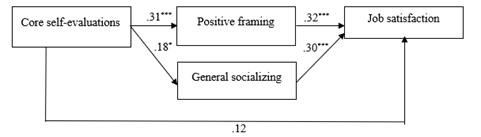
The main results from these analyses are summarized in Table 2. As shown, hypothesized indirect effects through general socializing, with an unstandardized estimate of 0.07 (95% CI [0.003, 0.162]), and via positive framing with an unstandardized estimate of 0.14 (95% CI [0.053, 0.247], were statistically significant, since corresponding bootstrap confidence intervals did not include zero. In terms of the respective effect sizes of the indirect effects of CSE on job satisfaction via these mediators, the completely standardized indirect effect via general socializing was of .05 (95% BC [.002, .117]), whereas the completely standardized indirect effect via positive framing showed a larger magnitude of .10 (95% CI [.040, .168]).
Table 2. Results of mediation analyses examining the mediating role of general socializing and positive framing in the link between CSE and job satisfaction, controlling for gender.
| Unst. Coeff. | SE | Stand Coeff. | p | Bootstrap 95% CI* | ||
|---|---|---|---|---|---|---|
| Lower | Upper | |||||
| General socializing as outcome | ||||||
| Constant | 2.75 | 0.75 | .00 | -1.281 | 4.229 | |
| Gender | -0.32 | 0.18 | -.14 | .09 | -0.678 | 0.473 |
| CSE | 0.37 | 0.18 | .18 | .03 | 0.027 | 0.720 |
| R² = .06** | ||||||
| Positive framing as outcome | ||||||
| Constant | 2.69 | 0.48 | .00 | 1.740 | 3.649 | |
| Gender | 0.04 | 0.12 | .03 | .71 | -0.191 | 0.278 |
| CSE | 0.43 | 0.11 | .31 | .00 | 0.207 | 0.656 |
| R² = .09*** | ||||||
| Job satisfaction as outcome | ||||||
| Constant | 1.33 | 0.48 | .00 | 0.394 | 2.271 | |
| Gender | -0.10 | 0.10 | -.06 | .36 | -0.302 | 0.112 |
| CSE | 0.16 | 0.10 | .12 | .12 | -0.043 | 0.370 |
| General socializing | 0.19 | 0.05 | .30 | .00 | 0.102 | 0.286 |
| Positive framing | 0.32 | 0.07 | .32 | .00 | 0.177 | 0.461 |
| R² = .30*** | ||||||
| Indirect effect of CSE on job satisfaction via general socializing | 0.07 | 0.04 | .05 | 0.003 | 0.162 | |
| Indirect effect of CSE on job satisfaction via positive framing | 0.14 | 0.05 | .10 | 0.053 | 0.247 | |
Note:N = 151. *Percentile bootstrap confidence intervals for unstandardized coefficients. Unst. Coeff. = unstandardized coefficient estimate, Stand. Coeff. = standardized coefficient estimate. ** p < .01. *** p < .001.
These results provided full support for hypothesis 2b and partial support for hypothesis 2c, since for the latter only the indirect effect of general socializing in the CSE-job satisfaction link was supported. Furthermore, bootstrap analyses also revealed that the direct effect of CSE on job satisfaction became non-significant (unstandardized estimate = 0.16, 95% CI [-0.043, 0.370]) when the mediators of general socializing and positive framing were included in the model. Therefore, the effects of CSE on job satisfaction are totally indirect, via the two mediators under study, as depicted in Figure 2.
Discussion
The purpose of this study was twofold. Firstly, it aimed to extend the current understanding of the impact of CSE on job satisfaction in distinct phases of organizational life by studying this link in the stage of organizational socialization. Secondly, it intended to further contribute to identifying the underlying mechanisms through which CSE influences job satisfaction by submitting the mediating effect of newcomer proactivity into an empirical test. Hence, it answers previous calls for further research mapping the role of individual differences in enacting newcomers’ proactivity, due to its meaningful effects on key socialization outcomes, like job satisfaction and performance (Fang et al. 2017, Zhao et al., 2022). To achieve both aims, it relied upon a sample of newcomers in their first organizational entry process, to avoid potential interference of previous socialization experience and related knowledge. As further discussed, the findings obtained provide some contributions to the literature as well as some clues for future research.
Consistent with H1, we found evidence that CSE relates positively to job satisfaction during this specific onboarding phase. The corresponding moderate effect size supports the role of CSE as a meaningful predictor of job satisfaction during organizational socialization, in line with extant evidence showing the relevance of this personality construct in promoting positive attitudes at work (Judge et al., 2021; Kammeyer-Muller et al., 2024). Thus, these results support and extend the assumption that CSE is a key dispositional antecedent of job satisfaction, even during early work experiences, i.e., organizational entry. This implies that it should be mapped in the theoretical models regarding the dispositional sources of satisfaction at work, across organizations and career stages (Judge et al., 2021; Steel et al., 2018; Yan et al., 2019).
Furthermore, our findings also shed light on the psychological mechanisms through which CSE impacts job satisfaction, particularly concerning newcomers’ specific proactive behaviors. As reported, H2b was supported in the current sample, revealing that positive framing constitutes a route through which CSE enhances job satisfaction at this early organizational stage. This implies that newcomers with a more positive self-concept tend to face new professional situations more favorably and positively, perceiving them as challenging rather than a threat, and adopt goals to pursue constructive results, thus experiencing improved levels of satisfaction (Chang et al., 2012; Kammeyer-Mueller, 2024). Thereby, these findings ascribe credit to the theoretical propositions of both self-verification theory (Swann, 2012) and approach/avoidance framework (Elliot & Trash, 2002; see Chang et al., 2012, for a review) to explain the impact of CSE on job satisfaction and other relevant work outcomes. Accordingly, CSE represents a personality disposition capturing a sensitivity to positive stimuli and insensitivity to negative stimuli, predisposing individuals to rely on more positive aspects and information when evaluation situations, enhancing their readiness to take action and persevere (Chang et al., 2012; Elliot & Trash, 2002). Such tendency renders a resourceful and strong approach motivation, allowing the capitalization upon positive emotions and goal-directed behaviors to persist and accomplish, instead of avoiding challenging work demands, which are likely to occur throughout the onboarding process (Chang et al., 2012; Didion et al., 2024; Judge et al., 2021). Hence, they ascertain the merits of CSE in enacting newcomers’ positive framing, a self-controlled cognitive management behavior, that holds the status of strongest proactivity predictor of newcomer’s job satisfaction and turnover intention during organizational socialization (Zhao et al., 2022).
Furthermore, contrary to our expectations, the results showed that proactive sensemaking behaviors, i.e., feedback- and information-seeking actions, do not constitute mechanisms that intervene in the CSE-job satisfaction link. The specific “overt” nature of these behaviors in comparison to positive framing that is considered as less “exposed” behavior might help to explain this pattern of results. Contrary to covert proactive behaviors such as positive framing, sensemaking actions like feedback-seeking might put the subjects’ image, competence and ego “at risk,” due to potential social exposure of newcomer’s doubts, questions and insecurities in front of their colleagues and supervisor (Ashford et al., 2003; De Stobbeleir et al., 2017), which can lead high CSE newcomers to suppress these actions. Accordingly, newcomers, especially those without job experience, may be reluctant to exhibit these behaviors under the assumption that they might signal uncertainty, insecurity, poor performance or incompetence to their coworkers and supervisor (Cooper-Thomas & Burke, 2012; De Stobbeleir et al., 2017). Conversely, as emphasized by Ashford and Black (1996), positive framing encompasses a way of exerting cognitive control over situations, without inherent social exposure risks. Therefore, our results suggest that positive framing, instead of sensemaking, seems to represent a prime proactive route through which CSE impacts job satisfaction.
Another plausible explanation for the absence of CSE effects on proactive sensemaking behaviors is linked with the possibility that newcomers may receive inputs regarding the content of their roles, tasks and activities to perform, in the context of the socialization tactics or through their relationships with the supervisor and peers (Liu et al., 2021; Zhou et al., 2022) which reduces their need to proactively seek such information (Bauer et al., 2019; Kim et al., 2005). Empirical research has also shown that other variables, including motivational constructs, can primarily impact sensemaking behaviors, including learning-goal and performance-goal orientations, cognitive style, and feedback seeking motives, as well as contextual contingencies, like those concerning leader and organizational support (Ashford et al., 2003; Ashford et al., 2016; Batistič & Kaše, 2022). Therefore, future research should include this sort of constructs to allow a more complete picture of the antecedents of distinct newcomer behaviors and related attitudes.
Results also provide only partial support for H2c, since general socialization was the only proactive relationship-building behavior that emerged as a significant mediator. As a form of social integration, this behavior allows newcomers to get to know their new co-workers, through which they can also gain further knowledge concerning aspects of the organization such as its functioning, policies, and culture (Ashford & Black, 1996). Consequently, general socializing implies several advantages without necessarily exposing newcomers’ knowledge or skills (De Stobbeleir et al., 2017). On the contrary, boss-relationship building, and networking behaviors may trigger concerns in newcomers regarding the reputation costs involved in these behaviors. As a result, high CSE newcomers may decrease the frequency of actions of this nature or change to more undercover, lower-cost behaviors to protect their reputation and avoid hurting their positive self-image.
In summary, our results suggest that the influence of CSE on job satisfaction mainly occurs via newcomers’ positive framing and general proactive socializing behaviors. The display of remaining proactive forms may depend upon other individual and contextual antecedents, or primarily on the organization’s socialization tactics (see Bauer et al., 2019; Liu et al., 2021). Indeed, the effectiveness of socialization tactics could suppress the need for newcomers to express certain behaviors, such as sensemaking actions, which are focused on searching for relevant informational support about the job and the organization (Batistič & Kaše, 2022; Cooper-Thomas & Burke, 2012). Therefore, the joint study of proactive socialization behaviors and socialization tactics stands as a particularly insightful avenue for future research towards a better understanding of how these two key socialization facilitators might interplay and affect a newcomer’s adjustment stage (Allen et al., 2017; Didion et al., 2024).
This study also provides some practical implications. First, organizations should encourage their new employees to exhibit proactive behaviors so they can achieve higher levels of satisfaction and ultimately benefit from the effects of this positive job attitude, namely in terms of well-being and job performance (Judge et al., 2021; Steel et al., 2018; Zhao et al., 2022). Second, organizations will benefit from recruiting applicants who are more likely to engage in proactive socialization behaviors, particularly positive framing and general socializing, when the focus is to foster their job satisfaction. To fulfil this purpose, organizations should screen and select applicants with high CSE, given the obtained evidence supporting the effects of this core disposition on newcomer proactivity.
It is also noteworthy to mention that proactivity is not always considered a desirable feature at work, since proactive behaviors may not be appreciated in some organizations and, in some circumstances, may bring costs for employees (Crant et al., 2017). For instance, supervisors tend to appreciate proactive newcomer behavior that is aligned with their values and preferences. An incompatibility between the supervisor’s expectation and the newcomer’s proactive behavior can lead to potential disadvantages and may even compromise their relationship (Bolino et al., 2016; Cooper-Thomas & Burke, 2012; Crant et al., 2017). Therefore, the extent to which proactive behavior intervenes in the CSE-job satisfaction link might be moderated by the degree to which the supervisor endorses the newcomer’s proactivity or suppress it by providing the newcomer with informational and relational resources needed for his/her adjustment (Batistič & Kaše, 2022; Ellis et al., 2017; Liu et al., 2021). As evidenced by Bauer et al. (2019), newcomers engage to a larger extent in proactive behaviors and benefit from stronger effects of these actions on their job satisfaction, when leaders exhibit low levels of servant leadership, as a way to actively look for additional support. The study of these aspects deserves attention in future research to identify the situational contingencies that may render stronger effects of CSE on newcomers’ satisfaction and performance, via newcomers’ proactivity.
Despite these contributions, the current study has some limitations. Specifically, the effects of other key dispositions, such as the big five and proactive personality, should also be considered along with CSE (Kammeyer-Mueller & Wanberg, 2003; Yan et al., 2019) to examine whether CSE remains a non-redundant dispositional predictor of newcomer proactivity and satisfaction. Indeed, previous research has shown that proactive personality and the big-five play a relevant and non-redundant role in enhancing employee proactivity and job satisfaction outcomes (Kammeyer-Muller & Wanberg, 2003; Liao, 2021), including in work crises, like the COVID-19 pandemic (Rodrigues & Rodrigues, 2023; Yi-Feng Chen, 2021). However, the joint effects of CSE and these personality predictors remain untested during the onboarding phase. Likewise, CSE incremental validity over trait-emotional intelligence should also be empirically scrutinized, given the meaningful effects of this disposition on job satisfaction and related job attitudes, even when other personality predictors, like the big-five, are also considered (Miao et al., 2017; Rodrigues & Rebelo, 2021, 2022b).
Additionally, the non-inclusion of job characteristics in the tested model stands as another shortcoming of the current study. As shown by prior research, job autonomy, task variety or feedback represent relevant mediators of the link between CSE and job satisfaction in employee samples (Judge et al., 2021; Kammeyer-Mueller, 2024). Despite remaining less explored in socialization literature, job characteristics may contribute to depicting an even more nuanced picture in this regard, due to their potential to moderate the effects of newcomer proactivity on job satisfaction and performance (Harris et al., 2022; Saks & Gruman, 2012). For example, while a fair amount of autonomy and task variety may enhance newcomer proactivity and strengthen its effects on job satisfaction and performance, a high level of autonomy in this early stage or a level that misfits newcomers’ needs for autonomy, may suppress proactivity and its beneficial effects for newcomers’ learning and adjustment (Harris et al., 2022; Yu & Davis, 2016). These detrimental effects may occur since newcomers mostly strive for guidance and uncertainty reduction during the socialization process, rather than unstructured and potentially ambiguous work endeavors (Harris et al., 2022). Thus, the effects of autonomy and other job characteristics should be considered in further research, to allow a better understanding of boundary conditions of newcomer proactivity mechanisms that translate the effects of individual dispositions, like CSE, on socialization success (Saks & Gruman, 2012; Zhao et al., 2022).
Another limitation stems from the relatively small size of the current sample. A larger sample would add robustness to the obtained results, which calls for the need to replicate these findings with larger and distinct samples of experienced and non-experienced newcomers before drawing more solid conclusions about their generalization. Finally, despite this study’s concern to rely upon two distinct, time-lagged (i.e., 5 months) data collection phases, all variables were measured using newcomers’ self-ratings. Future research with key observer ratings (i.e., supervisor, coworkers) regarding newcomers’ proactivity will be particularly useful to corroborate related findings.
In conclusion, the current study contributes to the literature by assigning credit to CSE as a valid and meaningful predictor of newcomer job satisfaction. Furthermore, it has revealed that the specific proactivity actions of positive framing and general socializing comprise two mechanisms underlying the link between this disposition and job satisfaction. Furthermore, our findings are in accordance with socialization resources theory (Saks & Gruman, 2012) and with the approach/avoidance framework (Elliot & Trash, 2002) in supporting that CSE constitutes an important individual resource that enhances newcomer job satisfaction through proactivity enactment (Chang et al., 2012). Hence, it endorses the relevance of a complementary individualistic approach in socialization and supports the inclusion of CSE and proactive behaviors in the scope of respective individual characteristics and behavioral patterns that effectively matter for newcomers’ adjustment.

