




 English (pdf)
 Article in xml format
 Article references

 Automatic translation
 Send this article by e-mail
 Cited by SciELO
 Cited by Google
 Similars in
SciELO
 Similars in Google

 Permalink


Introduction
Empathy is an attribute that enables interaction between Nursing professionals and patients (intersubjectivity)1. Through this interrelationship, Nursing professionals are able to understand the subjectivity of patients' thoughts, comprehend intellectually or imaginatively their conditions, and experience patients' emotions as if they were their own, but without renouncing the principle of objectivity and avoiding emotional contagion2. The described situation gives patients the opportunity to feel that their health condition is understood, helping to establish deeper bonds with the Nursing professional3. This situation benefits patients, Nursing professionals, and the comprehensive therapeutic process. All these benefits have been extensively described in several studies4,5. Consequently, empathy is an important contributing factor, along with other factors, in establishing a solid foundation for the development and implementation of humane patient care6.
The emergence and development of empathy can only be explained from both an evolutionary perspective (phylogeny) and an individual's life experience (ontogeny)7. Empathy is an attribute characterized by genetic inheritance rooted in phylogenetic processes and by the extent to which this inheritance is expressed through ontogenetic processes8. While phylogeny provides the genetic possibility of developing empathy (genetic makeup), ontogeny determines if that possibility can reach various stages of development. This suggests that ontogenetic processes are directly related to the development of empathic capacity in an individual. The empathy ultimately "achieved" depends on numerous factors influencing development9, beginning in early childhood and continuing until the neural structures that enable the development of positive emotions (limbic system)10 and cognitive abilities (prefrontal and temporal cortex) are fully developed in young adulthood11. Both facets of empathy evolve in parallel. Therefore, empathy development is a process that begins naturally in early childhood and continues until the neural architecture of young adults is consolidated12. As a result, one of the last (and most important) windows of opportunity for cultivating empathy aligned with the professional role of nurses is during their university education.
There are two fundamental stages for ensuring that empathy education for Nursing students has a greater chance of success. The first stage involves conducting an empathy "diagnosis." This diagnosis involves evaluating empathy levels, including cognitive and emotional components, and identifying strengths and weaknesses during the diagnosis. It is followed by a parallel analysis that examines factors that could theoretically have a positive or negative impact on empathy, such as resilience. Such a diagnosis could lead us to recognize that an effective diagnosis of empathy not only depends on the empathy that students have developed throughout their lives before entering university, but also includes assessing how certain factors may contribute to explaining it. Consequently, a serious and responsible intervention would not only include all the necessary elements in the teaching-learning process to consolidate empathy education, but also the need to introduce the factors shown to be predictors of empathy into the aforementioned processes. In line with this rationale, the present study aimed to determine whether the dimensions of resilience can predict the dimensions of empathy in Nursing students.
Materials and Methods
Design
This was a non-experimental, cross-sectional, psychometric study with construct validity.
Population
The study population comprised Nursing students enrolled in the Faculty of Health Sciences at the Universidad Evangélica de El Salvador (El Salvador) (n=160).
Sample
The sample consisted of 110 students assessed in May 2024, representing 68.75% of the total population. Although this sample was not randomly selected, it included almost the entire population; therefore, the results can be extrapolated to the population under study.
Variables
Resilience was considered the independent variable, and empathy the dependent variable.
Eligibility criteria
Inclusion. Students who voluntarily expressed their desire to participate in this research and signed the informed consent form were included.
Exclusion. Students who did not attend classes on the day of data collection or those who completed the instruments but did not sign the informed consent form were excluded from the study.
Instruments
Individual resilience
Trait resilience scale. The Engineering, Ecological, and Adaptive (EEA) resilience scale13 assesses three facets of resilience: engineering (items 1-4), ecological (items 5-8), and adaptive (items 9-12). This scale consists of 12 items rated on a 5-point Likert scale ranging from "Strongly disagree" (1) to "Strongly agree" (5). The EEA resilience scale has demonstrated satisfactory internal consistency and test-retest reliability (MacDonald's omega = 0.70–0.86; Cronbach's alpha = 0.68–0.82). Furthermore, this scale exhibits a stable cross-cultural factor structure, convergent and construct validity in relation to personality traits, and a positive contribution to clinical and non-clinical psychological health statuses13.
Empathy
Jefferson Scale of Empathy-Health Professions students (JSE-HSS)14,15. This scale comprises 20 items that measure empathy levels in health science students across various specialties. Items are rated on a 7-point Likert scale ranging from 1 (strongly disagree) to 7 (strongly agree). The scale measures three dimensions: compassionate care (CC; items 1, 7, 8, 11, 12, 14, 18, 19); perspective taking (PT; items 2, 4, 5, 9, 10, 13, 15, 16, 17, 20); and standing in the patient's shoes (SPS; items 3 and 6). PT and SPS dimensions constitute the cognitive component of empathy, whereas CC reflects the emotional component of this construct. The scale has demonstrated adequate internal consistency (α=0.78- 0.92) and appropriate correlations with other psychological variables15.
Both instruments underwent cultural adaptation through the following processes: translation and back-translation (translation from the original English to Spanish and from Spanish into English), expert panel review of the translation, and finally, pilot testing with 20 volunteer students from the study population to verify content comprehension.
Procedure
Students were assessed in classrooms, in a formal academic setting, using an online questionnaire. The instruments were administered by properly trained educators who ensured students' voluntary participation.
Statistical analysis
Descriptive statistics (mean, standard deviation, skewness, and kurtosis) were calculated for both variables and their dimensions. For continuous quantitative variables, normality was tested using the Kolmogorov-Smirnov test (K-S; n>50).
Confirmatory Factor Analysis (CFA) was performed using the robust maximum likelihood estimator in a multiple linear regression (MLR) analysis16,17, as the items had more than five response categories18. Model fit was evaluated using the following criteria: root mean square error of approximation (RMSEA < 0.08), standardized root mean squared error (SRMR < 0.08), comparative fit index (CFI > 0.95), and Tucker-Lewis Index (TLI > 0.95)19,20. Internal consistency of the scale was assessed using Cronbach's alpha21 and McDonald's omega coefficients22, with values > 0.70 considered acceptable23. All analyses described were conducted in R (RStudio interface) using the following packages: lavaan version 0.6- 17, psych version 2.4.1, semTools version 0.5-6, and MVN version 5.9. Statistical significance was set at p < 0.05 (α = 0.05). All data collected are freely available for access and consultation at OSFHOME24.
Ethical considerations
This study was approved by the Research Directorate and the Health Research Ethics Committee of the Universidad Evangélica de El Salvador (CEIS-UEES), Minutes No. 018 of April 2024. Participating students considered minors (age < 18 years) completed the instrument only after prior parental consent was obtained. The study was classified as minimal risk.
Results
The age data were normal (p >0.05). The sample represented 68.75% of the total population. The distribution by sex was 20.00% male (n= 22) and 80.00% female (n = 88). The mean age of male students was 23.59 years (SD = 3.92), whereas the mean age of female students was 22.89 years (SD = 4.72). Table 1 presents mean, standard deviation, skewness, and kurtosis estimates for each construct studied and its respective dimensions. The skewness and kurtosis estimates are within acceptable ranges.
Table 1 Descriptive results of the studied constructs and their corresponding dimensions. n=110
| Minimum | Maximum | M ± SD | Skewness | Standard error | Kurtosis | Standard error | |
|---|---|---|---|---|---|---|---|
| Empathy | 70 | 127 | 97.38 ± 13.851 | 0.200 | 0.230 | -0.954 | 0.457 |
| Compassionate care | 8 | 53 | 31.66 ± 10.986 | -0.591 | 0.230 | -0.197 | 0.457 |
| Perspective taking | 27 | 70 | 59.25 ± 9.421 | -1.184 | 0.230 | 1.440 | 0.457 |
| Standing in the patient's shoes | 2 | 14 | 6.46 ± 2.515 | 0.179 | 0.230 | -0.113 | 0.457 |
| Resilience | 28 | 60 | 44.44 ± 8.208 | 0.158 | 0.230 | -0.833 | 0.457 |
| Engineering resilience | 4 | 20 | 13.56 ± 3.974 | -0.233 | 0.230 | -0.758 | 0.457 |
| Ecological resilience | 4 | 20 | 16.15 ± 3.118 | -1.037 | 0.230 | 1.588 | 0.457 |
| Adaptative resilience | 4 | 20 | 14.73 ± 3.332 | -0.442 | 0.230 | 0.426 | 0.457 |
M= Mean; SD=Standard Deviation
Measurement models
The present study found that the scale of empathy presents adequate model fit indices (χ2 = 261.00; df= 165; p < 0.001; RMSEA=0.075, 90% CI [0.056 – 0.093]; CFI=0.90; TLI=0.88; SRMR = 0.099), supporting validity based on internal structure. Regarding reliability, all dimensions of the scale show acceptable internal consistency: perspective taking (ω = 0.90; α = 0.89), compassionate care (ω = 0.87; α = 0.84), and standing in the patient's shoes (ω = 0.52; α = 0.51).
In relation to the resilience scale, this instrument also showed strong evidence of validity based on internal structure (χ2 = 79.55; df = 51; p = 0.006; RMSEA=0.076, 90% CI [0.037 – 0.110]; CFI=0.95; TLI=0.93; SRMR = 0.063). In addition, it showed adequate and acceptable reliability across all dimensions: Engineering (ω = 0.88; α = 0.87), ecological (ω = 0.84; α = 0.84), and adaptive (ω = 0.79; α = 0.79). All these results show that both measurement models (empathy and resilience) are adequately represented and are suitable for the structural model.
Explanatory model
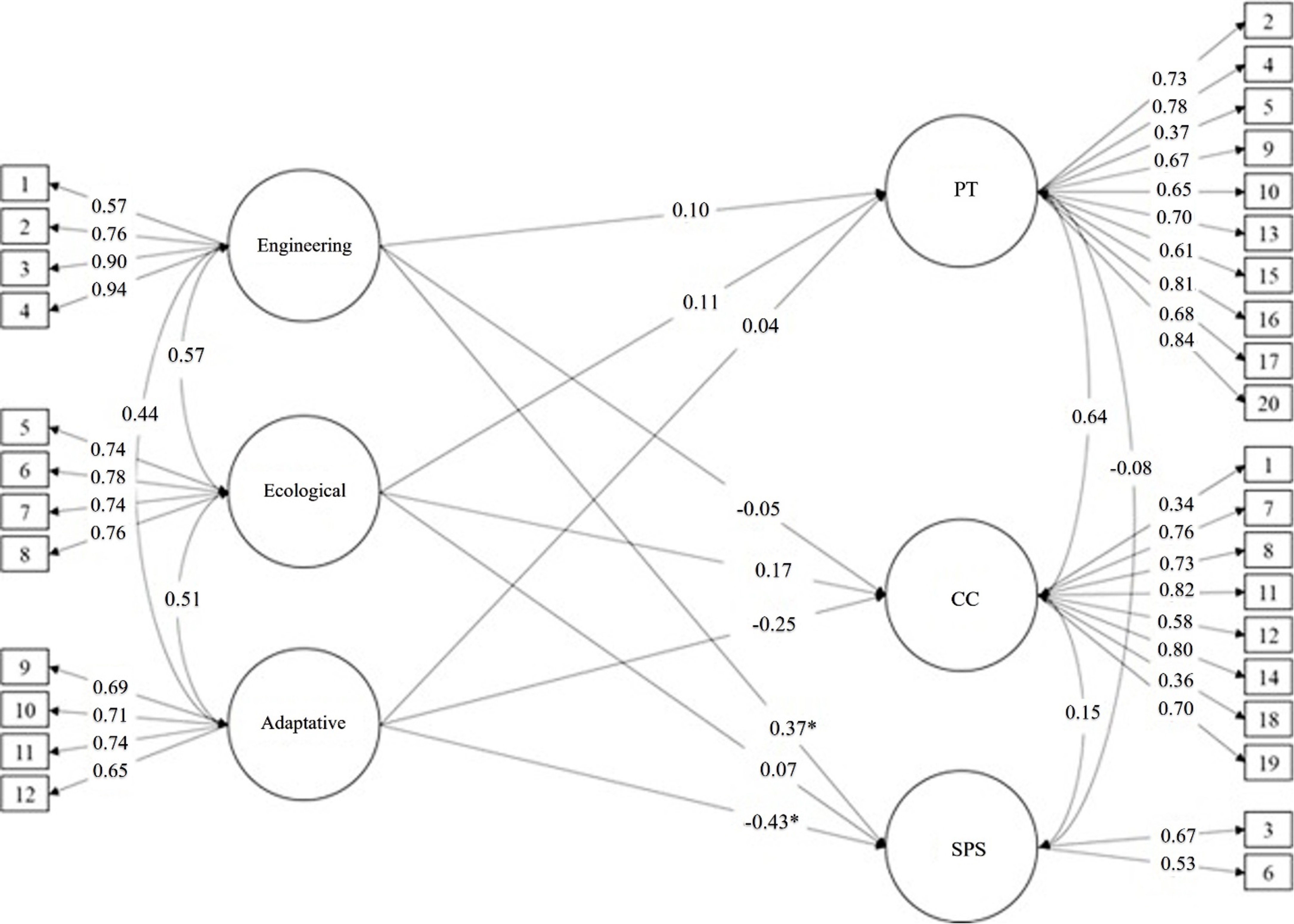
The present study showed that the structural model presents acceptable fit indices (χ2 = 658.46; df= 447; p > 0.001; RMSEA=0.065, 90% CI [0.053 – 0.076]; CFI=0.88; TLI=0.86; SRMR = 0.086). As shown in Figure 1, the engineering resilience dimension did not significantly predict empathy dimensions, except for the "standing in the patient's shoes" dimension (0.37). Regarding the ecological dimension, Figure 1 shows that it did not significantly predict the dimensions of empathy. Furthermore, the adaptive dimension significantly predicted only standing in the patient's shoes dimension (0.43).
Discussion
The results of the psychometric study confirmed that the data collected for both constructs demonstrated internal validity and reliability. Therefore, the analyses derived from these conditions will not be characterized by biases attributable to internal structure validity25. This process should be considered a standard methodological routine in all studies that employ measurement instruments to assess attributes, such as those analyzed in this study.
The concept of resilience generally expresses the personal and interpersonal capacities and internal strengths that enable learning and growth in the face of adverse circumstances. Some authors conceptualize resilience as a dynamic construct encompassing a broad range of phenomena that enable successful adaptation to threats that might otherwise hinder personal development26. Although resilience requires an individual response, it is not exclusively an individual characteristic since it is shaped by the interplay of individual and environmental factors. When these factors converge, they may themselves become sources of threat. In the context of Nursing education, students consistently encounter highly demanding situations that compel them to confront themselves. Such confrontation creates the conditions for students to recognize their potential and abilities, thereby strengthening themselves, learning, and responding effectively to disruptive circumstances encountered during professional practice27.
Within this general framework, the results reported in this article should be analyzed, and the analysis should include how resilience characteristics among Nursing students may predict empathy. In this regard, it should be emphasized that the three dimensions assessed by the resilience instrument represent three different but continuous moments. Partial success in one of them will not guarantee an adequate resilient response; rather, a positive resilient response depends on consistent success across all three moments. However, it should be noted that a positive resilient response does not necessarily translate into higher empathy, as the process of developing empathy follows its own path and distinct characteristics. The function of resilience is to cope with disruptions in such a way that the empathy attained by the student, whether high or low, is not affected.
Ecological resilience reflects the ability to resist and absorb a disturbance before reorganizing essential defense mechanisms to maintain equilibrium at critical levels. It is, therefore, the first response to a disturbance. The results of this study showed that ecological resilience positively predicted all three dimensions of empathy, suggesting that students may possess traits associated with the ability to endure negative events. Such traits include robustness, confidence in one's strengths and abilities, stoicism, resourcefulness, and determination in coping with negative events throughout life28,29.
These traits must be sufficiently strong so as not to affect any of the dimensions of empathy. This means that these traits associated with this dimension appear to have the property of not affecting the ability to engage emotionally and act to help the patient (CC); the ability to understand the patient's condition intellectually or imaginatively (PT); and the ability to appreciate the subjectivity of the patient's thoughts (SPS). It should be noted that the mean score observed for this dimension of resilience was 16.15 (Table 1), which indicates that there is room for considering the need to strengthen this dimension.
Engineering resilience refers to an individual's ability to recover or "bounce back" to baseline following adverse experiences30,31. Consequently, it is the ability to return to the initial state after suffering a negative event. It thus represents the "second moment" of resilient response. This dimension has been positively associated with "spirituality" and "emotional intelligence," some of the specific traits of this dimension31. In the present study, engineering resilience positively predicted AT and SPS (i.e., the cognitive component) but negatively predicted CC. However, the negative predictive value was low (Figure 1), suggesting that its effect is small. The observed mean score for this dimension was 13.56, which shows that there are still opportunities for further development in this dimension.
Adaptive resilience reflects the ability to adapt effectively to changes caused by disruption, adjust to circumstances, be flexible, change according to events, solve problems innovatively, constantly attempt to positively transform adverse aspects, and respond to disruptions with strength and moderation32,33. Adaptive resilience represents the "third moment" of resilient response. The results observed in relation to this dimension showed that adaptive resilience primarily predicted CC and SPS negatively. The relatively low mean score in this dimension (14.73; Table 1) may reduce students' emotional engagement at a given moment and, therefore, reduce their ability to assist patients. Moreover, it may diminish their ability to understand the subjectivity of patients' thoughts, thereby limiting their ability to feel and understand the patient's condition, hindering natural patient-student interactions, and, in the future, affecting the professional's natural activity with the patient.
Overall, the results observed in this study point to deficits in resilience education, particularly in adaptive resilience. These results are relevant to the professional future of Nursing students because they limit their chances of successfully coping with disturbances encountered during their Nursing practice34-36. In parallel, the empathy scores observed, when compared with established cut-off points for Latin American students37, suggest potential for further growth. Specifically, overall empathy scores and their dimensions were as follows: Empathy = 97.38 (high); CC = 31.66 (medium); AT = 59.25 (high), and SPS = 6.46 (medium). These results may hinder the educational initiatives aimed at cultivating the capacities required for humane patient care37-39.
Although not the primary objective of this study, it is necessary to point out that resilience, like empathy, can be enhanced through educational actions40-43. Therefore, these results should be considered by the institution responsible for the education of the participating students to improve their curriculum. Regardless of the specific findings of this study, the predictive role of resilience for empathy appears to be a general phenomenon44. Despite the scarcity of research of this type in Latin America, fostering education about resilience and empathy in Nursing students should be regarded as part of the social responsibility of higher education institutions45-47. Additionally, coping strategies for adverse events should also be taught.
Strengths and limitations
This study is characterized by an evaluation of the measurement model as a prerequisite for ensuring that the values of empathy and resilience (and their respective dimensions) are not biased by errors arising from non-compliance with the measurement model. As a result, the predictive values for some dimensions are robust compared to others. However, the sample cannot be considered representative of the target population, as the study characteristics did not allow for mandatory participation of students in completing the administered instruments.

