<?xml version="1.0" encoding="ISO-8859-1"?><article xmlns:mml="http://www.w3.org/1998/Math/MathML" xmlns:xlink="http://www.w3.org/1999/xlink" xmlns:xsi="http://www.w3.org/2001/XMLSchema-instance">
<front>
<journal-meta>
<journal-id>0012-7353</journal-id>
<journal-title><![CDATA[DYNA]]></journal-title>
<abbrev-journal-title><![CDATA[Dyna rev.fac.nac.minas]]></abbrev-journal-title>
<issn>0012-7353</issn>
<publisher>
<publisher-name><![CDATA[Universidad Nacional de Colombia]]></publisher-name>
</publisher>
</journal-meta>
<article-meta>
<article-id>S0012-73532007000300017</article-id>
<title-group>
<article-title xml:lang="en"><![CDATA[TREATMENT OF FUE DIESEL WITH A PERMEABLE REACTIVE BARRIER TECHNOLOGY]]></article-title>
<article-title xml:lang="es"><![CDATA[TRATAMIENTO DE DIESEL CON LA TECNOLOGÍA DE BARRERA REACTIVA PERMEABLE]]></article-title>
</title-group>
<contrib-group>
<contrib contrib-type="author">
<name>
<surname><![CDATA[CARDONA GALLO]]></surname>
<given-names><![CDATA[SANTIAGO ALONSO]]></given-names>
</name>
<xref ref-type="aff" rid="A01"/>
</contrib>
</contrib-group>
<aff id="A01">
<institution><![CDATA[,Universidad Nacional de Colombia Escuela de Geociencias y Medio Ambiente ]]></institution>
<addr-line><![CDATA[ ]]></addr-line>
</aff>
<pub-date pub-type="pub">
<day>00</day>
<month>11</month>
<year>2007</year>
</pub-date>
<pub-date pub-type="epub">
<day>00</day>
<month>11</month>
<year>2007</year>
</pub-date>
<volume>74</volume>
<numero>153</numero>
<fpage>151</fpage>
<lpage>157</lpage>
<copyright-statement/>
<copyright-year/>
<self-uri xlink:href="http://www.scielo.org.co/scielo.php?script=sci_arttext&amp;pid=S0012-73532007000300017&amp;lng=en&amp;nrm=iso"></self-uri><self-uri xlink:href="http://www.scielo.org.co/scielo.php?script=sci_abstract&amp;pid=S0012-73532007000300017&amp;lng=en&amp;nrm=iso"></self-uri><self-uri xlink:href="http://www.scielo.org.co/scielo.php?script=sci_pdf&amp;pid=S0012-73532007000300017&amp;lng=en&amp;nrm=iso"></self-uri><abstract abstract-type="short" xml:lang="es"><p><![CDATA[La investigación estudió el tratamiento de diesel combustibles de producción mexicana contenidos en agua con un sistema de barrera reactiva permeables a escala de laboratorio (siete columnas). Se uso un suelo agrícola como medio reactivo. Se aplico peroxido de hidrógeno al 50% industrial como fuente de oxigeno y nitrógeno en urea al 46% como nutriente. Se caracterizo el medio reactivo con los principales parámetros de interés (humedad, materia orgánica, pH, nitrógeno total, fósforo disponible, clasificación del suelo, conductividad eléctrica, sólidos suspendidos volátiles, densidad real y aparente, porosidad, textura, color, salinidad, conductividad hidráulica, capacidad de campo y densidad de bacterias. Se determinaron las cinéticas de degradación y la capacidad de adsorción del diesel en el medio reactivo. Las barreras reactivas permeables se diseñaron con los resultados cinéticos obtenidos en los reactores por lotes. Las columnas tenían dimensiones de 30 cm de longitud y 10 cm de diámetro. Las cinéticas de determinaron durante 18 días y las columnas se corrieron durante 70 días presentando remociones arriba del 80%. Se usaron concentraciones iniciales de diesel de 15,000 mg/L. Para la modelación de la adsorción se aplicaron las ecuaciones de Freundlich y Langmuir, donde esta ultima presentó un mejor ajuste a los datos a los datos experimentales y una mayor capacidad de adsorción. Para el suministro de los nutrientes y oxigeno se aplico el modelo propuesto por McCarty y la ecuación media para diesel propuesta por Jackson. Se determinó una velocidad de degradación de 0.0908 d-1, un coeficiente de distribución del diesel en el medio reactivo de 0.8 ml/g, una capacidad de adsorción de diesel en el medio reactivo de 13.50 mg/L y un factor de retardo de 3.69.]]></p></abstract>
<abstract abstract-type="short" xml:lang="en"><p><![CDATA[The objective of this investigation is to study the treatment of the diesel production of Mexican content in water with a system of permeable reactive barriers in laboratory (seven columns). An agricultural soil (ASo) was used as half reagent medium. It was applied peroxide of hydrogen to 50% industrial as source of oxygen and nitrogen in urea to 46% as nutrient. This characterized the reagent medium with the main parameters of interest (humidity, organic matter, pH, total nitrogen, available phosphorus, classification of the soil, volatile suspended solids, electric conductivity, real and apparent density, porosity, texture, color, hydraulic conductivity, field capacity and density of bacteria. The kinetic of degradation and the capacity of adsorption of the diesel was determined in the reagent medium by batches tests. The permeable reactive barriers were designed with the kinetic results obtained in the reactors by batch. The columns had 30 cm of length and 10 cm of diameter. The kinetics was determined during 18 days and the columns were run during 70 days where they presented removals up of 80 % in columns. An initial concentration of diesel of 15,000 mg/L was used. For the modeling of the adsorption the Langmuir equation was applied. For the supply of nutrients and oxygen the pattern proposed by McCarty and the half equation for diesel proposed by Jackson was applied. A velocity of degradation in the reagent medium of 0.0908 d- 1 a coefficient of distribution of the diesel in the reagent medium of 0.8 ml/L, a capacity of adsorption of diesel in the medium reagent of 13.50 mg/L and a factor of retard of 3.69 in the soil is presented.]]></p></abstract>
<kwd-group>
<kwd lng="es"><![CDATA[Diesel combustible]]></kwd>
<kwd lng="es"><![CDATA[barreras reactivas permeables]]></kwd>
<kwd lng="es"><![CDATA[biodegradación]]></kwd>
<kwd lng="es"><![CDATA[nutrientes]]></kwd>
<kwd lng="en"><![CDATA[Fuel diesel]]></kwd>
<kwd lng="en"><![CDATA[permeable reactive barriers]]></kwd>
<kwd lng="en"><![CDATA[biodegradation]]></kwd>
<kwd lng="en"><![CDATA[nutrients]]></kwd>
</kwd-group>
</article-meta>
</front><body><![CDATA[ <p align="center"><font size="4" face="Verdana, Arial, Helvetica, sans-serif"><b>TREATMENT  OF FUE DIESEL WITH A PERMEABLE REACTIVE BARRIER TECHNOLOGY</b></font></p>     <p align="center"><font size="2" face="Verdana, Arial, Helvetica, sans-serif"><b>TRATAMIENTO       DE DIESEL CON LA TECNOLOGÍA  DE BARRERA REACTIVA PERMEABLE</b></font></p>     <p align="center">&nbsp;</p>     <p align="center"><font size="2" face="Verdana, Arial, Helvetica, sans-serif"><b>SANTIAGO ALONSO CARDONA GALLO</b>    <br>   <i>Escuela de Geociencias y Medio  Ambiente, Universidad Nacional de Colombia, <a href="mailto:scardona@unal.edu.com">scardona@unal.edu.com</a></i></font></p>     <p align="center">&nbsp;</p>     <p align="center"><font size="2" face="Verdana, Arial, Helvetica, sans-serif"><b>Recibido       para revisar octubre 02 de 2006, aceptado mayo 18 de 2007, versión final   junio 14 de 2007</b></font></p>     <p>&nbsp;</p> <hr>     <p><font size="2" face="Verdana, Arial, Helvetica, sans-serif"><b><i>RESUMEN: </i></b>La     investigación estudió el tratamiento   de diesel combustibles de producción mexicana contenidos en agua con un sistema   de barrera reactiva permeables a escala de laboratorio (siete columnas). Se   uso un suelo agrícola como medio reactivo. Se aplico peroxido de hidrógeno   al 50% industrial como fuente de oxigeno y nitrógeno en urea al 46% como nutriente.   Se caracterizo el medio reactivo con los principales parámetros de interés   (humedad, materia orgánica, pH, nitrógeno total, fósforo disponible, clasificación   del suelo, conductividad eléctrica, sólidos suspendidos volátiles, densidad   real y aparente, porosidad, textura, color, salinidad, conductividad hidráulica,   capacidad de campo y densidad de bacterias. Se determinaron las cinéticas de   degradación y la capacidad de adsorción del diesel en el medio reactivo. Las   barreras reactivas permeables se diseñaron con los resultados cinéticos obtenidos   en los reactores por lotes. Las columnas tenían dimensiones de 30 cm de longitud y   10 cm de diámetro. Las cinéticas de determinaron durante 18 días y las columnas   se corrieron durante 70 días presentando remociones arriba del 80%. Se usaron   concentraciones iniciales de diesel de 15,000 mg/L. Para la modelación de la   adsorción se aplicaron las ecuaciones de Freundlich y Langmuir, donde esta   ultima presentó   un mejor ajuste a los datos a los datos experimentales y una mayor capacidad   de adsorción. Para el suministro de los nutrientes y oxigeno se aplico el modelo   propuesto por McCarty y la ecuación media para diesel propuesta por Jackson. Se   determinó una velocidad de degradación de 0.0908 d<sup>-1</sup>, un coeficiente   de distribución del diesel en el medio reactivo de 0.8 ml/g, una capacidad   de adsorción de diesel en el medio reactivo de 13.50 mg/L y un factor de retardo   de 3.69.</font></p>     <p><font size="2" face="Verdana, Arial, Helvetica, sans-serif"><b><i>PALABRAS CLAVE:</i></b> Diesel  combustible, barreras reactivas permeables, biodegradación, nutrientes.</font></p>     ]]></body>
<body><![CDATA[<p><font size="2" face="Verdana, Arial, Helvetica, sans-serif"><b><i>ABSTRACT: </i></b>The objective of this investigation  is to study the treatment of the diesel production of Mexican content in water  with a system of permeable reactive barriers in laboratory (seven columns).  An agricultural soil (ASo) was used as half reagent medium. It was applied  peroxide of hydrogen to 50% industrial as source of oxygen and nitrogen in  urea to 46% as nutrient. This characterized the reagent medium with the main  parameters of interest (humidity, organic matter, pH, total nitrogen, available  phosphorus, classification of the soil, volatile suspended solids, electric  conductivity, real and apparent density, porosity, texture, color, hydraulic  conductivity, field capacity and density of bacteria. The kinetic of degradation  and the capacity of adsorption of the diesel was determined in the reagent  medium by batches tests. The permeable reactive barriers were designed with  the kinetic results obtained in the reactors by batch. The columns had 30 cm  of length and 10 cm of diameter. The kinetics was determined during 18 days  and the columns were run during 70 days where they presented removals up of  80 % in columns. An initial concentration of diesel of 15,000 mg/L was used.  For the modeling of the adsorption the Langmuir equation was applied. For the  supply of nutrients and oxygen the pattern proposed by McCarty and the half  equation for diesel proposed by Jackson was applied. A velocity of degradation  in the reagent medium of 0.0908 d- 1 a coefficient of distribution of the diesel  in the reagent medium of 0.8 ml/L, a capacity of adsorption of diesel in  the medium reagent of 13.50 mg/L and a factor of retard of 3.69 in the soil  is presented.</font></p>     <p><font size="2" face="Verdana, Arial, Helvetica, sans-serif"><b><i>KEYWORDS:</i></b> Fuel diesel, permeable reactive  barriers, biodegradation, nutrients.</font></p>   <hr>     <p>&nbsp;</p>     <p><font size="3" face="Verdana, Arial, Helvetica, sans-serif"><b>1. INTRODUCTION</b></font></p>     <p><font size="2" face="Verdana, Arial, Helvetica, sans-serif">The permeable reactive barriers are structures  located under the surface in order to treat the contaminated underground water  in places of dangerous waste. These barriers are put in situ with the gaps  construction through the flow path of the underground water and where the natural  gradients of contaminants transportation make them pass by the place of the  reactive cell. The gap is filled with one or several materials carefully selected,  in order to destroy or stabilize the specific kind of contaminants (Gavaskar  et al., 2000). The main advantage in the walls treatment is that they are passive  systems which treat the contaminants in situ (Fiorenza et al., 2000). Several  methods have been developed for the installation of permeable walls treatment.</font></p>     <p><font size="2" face="Verdana, Arial, Helvetica, sans-serif">Walls treatment or permeable reactive barriers  (PRB) were firstly reported by McMurry and Elton (1985), which involve construction  of permanent, semi permanent or replaceable units across the flow path of a  dissolved phase Contaminant plume (Guerin et al., 2001; Gavaskar et al., 2000;  EPA, 1998). As the contaminated groundwater moves passively through the treatment  wall, contaminants are removed by physical, chemical and/or biological processes,  including precipitation, sorption, oxidation/reduction, fixation or degradation.  This treatment system has presented excellent results with different organic  and inorganic contaminants in several reactive medium where it has removed  different kind of contaminants such as chlorinate solvents, metals, radio nucleotides,  petroleum, hydrocarbon, volatile organic compounds, acid of mines, uranium  VI and other contaminants (Gavaskar et al., 2000; Fiorenza et al., 2000; EPA,  1998). These barriers may contain agents that are placed either in the path  of contaminant plumes to prevent further migration or immediately down gradient  of the contaminant source to prevent plume formation (Gavaskar et al., 2000).  The studies have been done in systems by batches, pilot programs, in situ and  commercially (Cardona, 2004, Gavaskar et al., 2000; Fiorenza et al., 2000;  Blowes et al., 1997).</font></p>     <p><font size="2" face="Verdana, Arial, Helvetica, sans-serif">Such systems consist of low hydraulic conductivity  cut-off walls (e.g.1x10<sup>-6</sup> cm/s) with one or more gaps that obtain  permeable reaction zones (Guerin et al., 2001) There are studies where the  utilization of organic reactive means have been reported where the organic  contaminants removal (moss, sawdust, aquifer sediments, organic matter, municipal  compost, leaves, peat, addition of bacterial inoculants, soils with microorganisms  and activated sludges) with a bacteria content between 1x10<sup>5</sup>-1x10<sup>8</sup> CFU/g  and the addition of nutrients, agricultural fertilizer and a source of oxygen,  air and oxygen (Atlas y Bartha 1972; Ho et al., 1995; Cardona, 2004, Ganzert,  1991; Powell et al., 1995; Robertson et al., 1995; Fiorenza y Ward, 1997; Waybrantt  et al., 1998; Puls et al., 1999; Hebert et al., 2000; Kao et al., 2000; Fiorenza  et al., 2000; Márquez-Rocha et al. (2001); Namkoomg et al., 2002). </font></p>     <p><font size="2" face="Verdana, Arial, Helvetica, sans-serif">The aim of this paper is the diesel removal present  in water, which was done in laboratory using columns with a reactive medium  of agricultural soil (ASo) where corn, sorghum, barley and oats are cultivated.  The soil presented a bacterial density of 6.4x10<sup>5</sup> CFU/g, nitrogen  as urea (46%) was added and industrial hydrogen of hydrogen to the 50% as oxygen  source. Phosphorus was not added because the ASo exceeded recommendations for  studies of bioremediation. The remotions presented were up the 80%.</font></p>     <p>&nbsp;</p>     <p><font size="3" face="Verdana, Arial, Helvetica, sans-serif"><b>2. MATERIALS AND METHODS</b></font></p>     ]]></body>
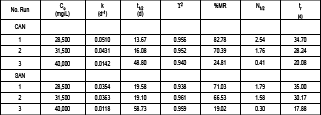
<body><![CDATA[<p><font size="2" face="Verdana, Arial, Helvetica, sans-serif">The study was carried out in two stages. The agricultural  soil was characterized, where the kinetic degradation, the capacity of adsorption  were obtained. With all of them the columns were designed and operated.</font></p>     <p><font size="2" face="Verdana, Arial, Helvetica, sans-serif">The selected soil of this study is an agricultural  soil from the Rancho San Francisco, located in San Andres Mixquic, Mexico ,  D.F., of the Veterinary Faculty of the National Autonomous University of Mexico  (UNAM). In the ASo, corn, sorghum, barley and oats are cultivated. The soil  characteristic allows to obtaining physical and chemical properties in order  to adapt them to the investigation. The soil analysis was carried out according  to validated procedures (Soil Science Society of America, Inc., SSA, and American  Society of Agronomy, Inc., ASA, 1984). The water content, organic carbon of  fraction, pH, total nitrogen, available phosphorus, soil classification, electric  conductivity, volatile suspended solids, real and apparent density of the soil,  porosity, texture, color, hydraulic conductivity, field capacity and bacteria  density were determined. The capacity of adsorption of diesel in the ASo was  carried out with the Langmuir model. Diesel volatilization tests in closed  and open roads with concentrations of 56,000 mg/L of diesel were determined  respectively. The kinetic degradation of diesel during 18 days with three concentrations  (28,500, 31,500 and 40,000 mg/L) adding and no adding nitrogen and peroxide  of hydrogen by hands were determined.</font></p>     <p><font size="2" face="Verdana, Arial, Helvetica, sans-serif">In order to design the columns as barriers to the  contaminated water with diesel the results of the tests of kinetic degradation  and oxidation were taken as the basis, as well as the values obtained on adsorption  and volatilization. With these results the time of half life, resident time,  and thickness of the reactive medium, kinetic constant, transverse area and  volume of the columns were obtained. To design the model of substratum consumption  which follows a kinetic of first order to the biodegradation and the conceptual  model of flow reactor, piston of engineering presented by Smith (1986), <sub><img src="/img/revistas/dyna/v74n153/a17eq002.gif"></sub>, The previous  equation presents the residence time to determinate how long the contaminated  water will be in the column before it can reach the desired concentration.  The diesel, the nitrogen, and the peroxide of hydrogen were supplied according  to the stoichiometric relation of aerobe degradation proposed by McCarty (1998)  and the equation for diesel recommended by Jackson (1990): C<sub>15</sub>H<sub>30</sub>.  4C<sub>15</sub>H<sub>30</sub> + 45O<sub>2</sub> + 9NH<sub>3</sub> &#8594; 9C<sub>5</sub>H<sub>7</sub>O<sub>2</sub>N  + 42H<sub>2</sub>O + 15CO<sub>2</sub>. 1 kg of C<sub>15</sub>H<sub>30</sub> 1.71  kg de O<sub>2</sub> = 3.64 kg of H<sub>2</sub>O<sub>2</sub> and 0.15 kg of  nitrogen. The needs of phosphorus were of 0.025 kg. The previous requirement  is suitable to those found in the literature. 100:15: 1 for C:N:P (carbon,  nitrogen and phosphorus) respectively (Zegarra, 2000).</font></p>     <p><font size="2" face="Verdana, Arial, Helvetica, sans-serif">The columns were operated with downward flow and  saturated during eight days. The mixture of diesel and distillated water was  carried out in a container of 50 liters with continuous agitation of 100 rpm.  The solution fed seven columns of 30 cm of length; the columns were built in  transparent acrylic with 10 cm of diameter. The design flow of the reactors  was 360 ml/d. The diesel concentration was of 15,000 mg/L. The degradation velocity  obtained in the tests by batches was 0.0908d-1. The added nitrogen as urea  was 16 ml/d and the peroxide of hydrogen was 5.9 ml/d. The samples were  taken every seven days from the affluent and the effluent; subsequently they  were analyzed in the gases chromatograph with a mass selector 5890 serie 11  Hewlett Packard. The packing material to the biodegradation was of 514 g of  ASo for each column.</font></p>     <p><font size="2" face="Verdana, Arial, Helvetica, sans-serif">The ASo bacterial density was determined, extracting  core from the columns. The cores were taken at the end of the study of the  diesel biodegradation. A core was extracted from each column of the half of  the reactive medium in a sterile environment. The density was determined using  the technique of account plate as colonies former unities (CFU), CFU/g proposed  by the Soil Science Society of America, Inc., and the American Society of Agronomy  Inc. of the USA (1984). The scanning electron microscopy (SEM) of the surface  of the ASo was carried out in order to observe the characteristics of the soil  before and after of the columns processing. The SEM was taken in the Cell Physiology  Institute, UNAM with an equipment Jeal model JSM-5410LV scanning microscope.  The metal balance of importance in the permeable reactive barriers present  in the affluent and effluent of the 7 continuous columns was carried out. The  objective is to know the precipitation or dragging of the metals by the distillated  water used to prepare the solution. The metals analyzed were magnesium, manganese,  calcium, iron, potassium, sodium and silica. The analysis was carried out with  a spectrophotometer of plasma emission (DUP-ICP) Thermo Jarrel Ash Corporation  in the Engineering Institute, UNAM. </font></p>     <p>&nbsp;</p>     <p><font size="3" face="Verdana, Arial, Helvetica, sans-serif"><b>3. RESULTS</b></font></p>     <p><font size="2" face="Verdana, Arial, Helvetica, sans-serif">Firstly the results of the characterization of  the applied ASo as a reactive medium are presented; secondly the kinetic biodegradation  of the diesel and the adsorption capacity of the ASo, and finally the design  and working of the columns. </font></p>     <p align="center"><font size="2" face="Verdana, Arial, Helvetica, sans-serif"><b><a name="tab01"></a>Table 1.</b> Characterization of  the agricultural soil of interest (Cardona, 2006).    <br>  <b>Tabla 1.</b> Caracterización del  suelo agrícola de interés (Cardona, 2006).</font>    ]]></body>
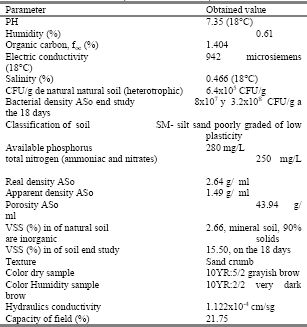
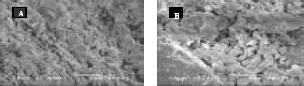
<body><![CDATA[<br>  <img src="/img/revistas/dyna/v74n153/a17tab01.gif"></p>     <p align="center"><font size="2" face="Verdana, Arial, Helvetica, sans-serif"><b><a name="tab02"></a>Table 2.</b> Comparison of velocity,  time of half time, removable mass percentage and number of half lives in three  runs by batches (Cardona, 2006).    <br>  <b>Tabla 2. </b>Comparación  de la velocidad, tiempo de vida media, porcentaje de masa removida y número  de vidas medias en tres corridas intermitentes (Cardona, 2006).</font>    <br>  <img src="/img/revistas/dyna/v74n153/a17tab02.gif"></p>     <p><font size="2" face="Verdana, Arial, Helvetica, sans-serif">The constant of velocity of biodegradation to  the columns design was 0.0908 d-1 and it was obtained from a linear adjustment  of the velocities calculated experimentally. The sorption capacity (C<sub>ads</sub>)  of the ASo was 13.5 mg/g. The coefficient of distribution (K<sub>d</sub>) for  diesel in the ASo was of 0.80 ml/g and the retard factor was 3.69.</font></p>     <p><font size="2" face="Verdana, Arial, Helvetica, sans-serif">SEM: The natural ASo without contact of diesel  with a bacterial density of 6.4x10<sup>5</sup> CFU/g with the ASo at the end  of the diesel biodegradation process, with a bacterial density between 8x10<sup>7</sup> to  3.2x10<sup>8</sup> CFU (<a href="#fig02">Fig 2</a>) was compared. The SEM presents a change in the  layer and density of the biofilm of the ASo. Therefore the ASo presented a  possible assimilation of the carbon source (diesel), nutrients (nitrogen as  urea) and the oxygen source (H<sub>2</sub>O<sub>2</sub>) applied by hands that  shows that is the appropriated to the process. (Pardieck et al., 1992, Fiorenza  et al., 1997). In this study the characteristics of the stay of the soil and  the biomass increasing of the ASo are observed. The soil surface has the same  physical configuration and the same characteristics of the film of microorganisms  in the agricultural soil. Given this it shows how the characteristics of the  soil did not change adding H<sub>2</sub>O<sub>2</sub> as oxygen source (<a href="#fig02">Figs  2A</a> and <a href="#fig02">2B</a>).</font></p>     <p align="center"><font size="2" face="Verdana, Arial, Helvetica, sans-serif"><b><a name="fig01"></a><img src="/img/revistas/dyna/v74n153/a17fig01.gif">    <br>   Figure       1.</b> Comparison  of the unchangeable soil, photo A and soil the end of the biodegradation process  of the day 18, photo B.    <br>  <b>Figura 1. </b>Comparación entre  el suelo inalterado, foto A y el suelo al final del proceso de biodegradación al día 18, foto B.</font></p>     <p align="center"><font size="2" face="Verdana, Arial, Helvetica, sans-serif"><b><a name="tab03"></a>Table 3.</b> Summary of parameters  of columns design.    ]]></body>
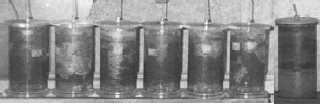
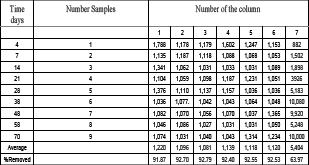
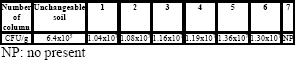
<body><![CDATA[<br>  <b>Tabla 3.</b> Parámetros de diseño  de las columnas.</font>    <br>  <img src="/img/revistas/dyna/v74n153/a17tab03.gif"></p>     <p align="center"><font size="2" face="Verdana, Arial, Helvetica, sans-serif"><b><a name="fig02"></a><img src="/img/revistas/dyna/v74n153/a17fig02.gif">    <br>   Figure 2.</b> Columns working with  agricultural soil as packing.    <br>  <b>Figura 2. </b>Desempeño de las  columnas con suelo agrícola empacado.</font></p>     <p><font size="2" face="Verdana, Arial, Helvetica, sans-serif">The results of biodegradation obtained from the  columns are presented in the following table.</font></p>     <p align="center"><font size="2" face="Verdana, Arial, Helvetica, sans-serif"><b><a name="tab04"></a>Table 4.</b> Residual concentrations  (mg/L) of diesel biodegradation in continuous columns.    <br>  <b>Tabla 4.</b> Concentraciones residuales  (mg/L) de diesel en las columnas de biodegradación.</font>    <br>  <img src="/img/revistas/dyna/v74n153/a17tab04.gif"></p>     <p><font size="2" face="Verdana, Arial, Helvetica, sans-serif">The columns 1 to 6 were working with diesel, nitrogen  and peroxide of hydrogen. The column 7 worked in a sterile agricultural soil  and only diesel was added to it.</font></p>     ]]></body>
<body><![CDATA[<p><font size="2" face="Verdana, Arial, Helvetica, sans-serif">Bacterial density in the columns: The table 7 shows  the results obtained from the core culture of the columns and is compared with  the agricultural soil before the study. In the data obtained an increase of  microorganisms is appreciated.</font></p>     <p align="center"><font size="2" face="Verdana, Arial, Helvetica, sans-serif"><b><a name="tab05"></a>Table       5.</b> Bacterial density  in continuous column.    <br>  <b>Tabla 5.</b> Densidad bacterial  en las columnas continuas.</font>    <br>  <img src="/img/revistas/dyna/v74n153/a17tab05.gif"></p>     <p>&nbsp;</p>     <p><font size="3" face="Verdana, Arial, Helvetica, sans-serif"><b>4. DISCUSSION</b></font></p>     <p><font size="2" face="Verdana, Arial, Helvetica, sans-serif">The characterization of the ASo showed the desired  qualities to be used in a process of treatment in contaminated underground  water by diesel. It shows the great influence of the concentration in diesel  transformation in the batches which make smaller or bigger the biotransformation  rate by the agricultural soil. In the system of biodegradation is showed that  the removable contaminants percentages are smaller with the increasing of the  concentration due to the inhibition caused by the hydrocarbons on the bacterial  soil. In this study the diesel biodegradation was presented by the consortium  of microorganisms of an ASo. Similar velocities of biotransformation were  observed on the literature ( Jackson, 1994). The CFU/g showed the growing of  the microbial biomass being the appropriate tools to observe the change in  the microorganisms as agent of biodegradation. The H<sub>2</sub>O<sub>2</sub> had  an appropriate behavior as source of O<sub>2</sub> in the aerobe process of  the diesel removal, which is consequent with the CFU/g. Both methods with nutrients  or without them show a smaller difference for low concentrations due to the  high presence of phosphorus. However to higher a concentration more accentuated  difference is presented. The kinetic biodegradation was properly presented  by the equation of grade one. The diesel adsorption has a proper behavior according  to the Langmuir equation. Any important volatilization in the diesel tests  was not appreciated. The reactors out of the site allow observing the evolution  of the mineralization of the diesel.</font></p>     <p><font size="2" face="Verdana, Arial, Helvetica, sans-serif">The results also     allow to observe that the columns with the agricultural soil as a reactive     medium presented high discharge with the addition of N and H2O2 which is     similar with other reports of studies where organic reactive medium has been     used (moss, sawdust, aquifer sediments, organic matter, municipal compost,     leaves, peat, addition of bacterial inoculants, soils with microorganisms     and activated sludges), with a bacterial content between 1x10⁵ -1x10⁸ and     the addition of nutrients, agricultural fertilizer and an oxygen source,     air or oxygen (Atlas y Bartha (1972); Ho et al., (1995); Ganzert, (1991);     Powell et al., (1995); Robertson et al., (1995); (Fiorenza y Ward (1997);     Waybrantt et al., (1998); Puls et al., (1999); Hebert et al., (2000); Kao     et al., (2000); Fiorenza et al., (2000); Márquez-Rocha et al. (2001);  Namkoomg et al., (2002)). The diesel adsorption by the ASo was an important  process at the beginning of the process because the high adsorption of the  hydrocarbon, however it became constant in the time. </font></p>     <p><font size="2" face="Verdana, Arial, Helvetica, sans-serif">The columns presented a similar behavior with the  addition of N and H<sub>2</sub>O<sub>2</sub>. The process of efficiency of  discharge of the seven columns is 89.4 % which is very satisfactory considering  the high concentration of diesel (15,000 mg/L). The design parameters to the  permeable reactive barrier as a chemical reactor, the reaction of velocity  time, time of half life, thickness of the reactive medium, adsorption capacity  and bacterial density of the ASo were determined. The evaluation of the conditions  of the aerobe biodegradation allowed deducing that diesel can be biodegradable  by the bacteria of an agricultural soil, which was used as a reactive medium  in the columns by batches. The study of sweep electronic microscope presented  the same structure of the agricultural soil before and after the process.</font></p>     <p>&nbsp;</p>     ]]></body>
<body><![CDATA[<p><font size="3" face="Verdana, Arial, Helvetica, sans-serif"><b>5. CONCLUSIONS</b></font></p>     <p><font size="2" face="Verdana, Arial, Helvetica, sans-serif">The study presented the treatment of contaminated  water by diesel through the PRB with an agricultural soil, which has not been  studied and where a good behavior of discharge of diesel was presented. The  study achieves its objectives since one can confirm that a permeable reactive  barrier is efficient on the treatment of contaminated underground water by  diesel. The agricultural soil with the characteristics presented is suitable  to be used in a treatment of contaminated underground water by diesel. The  initial concentration of diesel has a big influence in the biotransformation  rate. In the conditions of the carried out study the biodegradation of diesel  by the consortium of microorganisms of the agricultural soil is presented.  The absorption of the Langmuir model presented a good adjustment to the experimental  data. Volatilization in the test with diesel was not appreciated. The biodegradation  was properly presented with a kinetic of first grade. The sweep electronic  microscopy presented the same structures of the agricultural soil before and  after of the process. The diesel discharge efficiency in the PRB is greater  than 89.4% in the case of the addition of nutrients and peroxide of hydrogen. </font></p>     <p>&nbsp;</p>     <p><font size="3" face="Verdana, Arial, Helvetica, sans-serif"><b>6. ACKNOWLEDGMENTS</b> </font></p>     <p><font size="2" face="Verdana, Arial, Helvetica, sans-serif">This work was     supported by the Researcher Rosario Iturbe Argüelles of Engineering Institute  the National University of Mexico .</font></p>     <p>&nbsp;</p>     <p><font size="3" face="Verdana, Arial, Helvetica, sans-serif"><b>REFERENCES</b></font></p>     <!-- ref --><p><font size="2" face="Verdana, Arial, Helvetica, sans-serif"><b> [1]</b> ATLAS, R. Y BARTHA, R. Degradation and mineralization of petroleum in sea water: Limitation by nitrogen and phosphorous. Biotechnology and Bioengineering. Vol. XIV, 309-318. 1972.    &nbsp;&nbsp;&nbsp;&nbsp;&nbsp;&nbsp;&nbsp;&nbsp;[&#160;<a href="javascript:void(0);" onclick="javascript: window.open('/scielo.php?script=sci_nlinks&ref=000070&pid=S0012-7353200700030001700001&lng=','','width=640,height=500,resizable=yes,scrollbars=1,menubar=yes,');">Links</a>&#160;]<!-- end-ref --><!-- ref --><br>     <b>[2]</b> CARDONA, S. Tratamiento de hidrocarburos con un sistema de barrera     reactiva permeable. Tesis de Doctorado. Instituto de Ingeniería, Universidad Nacional Autónoma de México. México,     D.F. 2004.    &nbsp;&nbsp;&nbsp;&nbsp;&nbsp;&nbsp;&nbsp;&nbsp;[&#160;<a href="javascript:void(0);" onclick="javascript: window.open('/scielo.php?script=sci_nlinks&ref=000071&pid=S0012-7353200700030001700002&lng=','','width=640,height=500,resizable=yes,scrollbars=1,menubar=yes,');">Links</a>&#160;]<!-- end-ref --><!-- ref --><br>     <b>[3]</b> CARDONA, S. Biodegradation of diesel fuel in water by microbial consortium. Submitted to Journal of Environmental Engineering. In Press. 2006.    &nbsp;&nbsp;&nbsp;&nbsp;&nbsp;&nbsp;&nbsp;&nbsp;[&#160;<a href="javascript:void(0);" onclick="javascript: window.open('/scielo.php?script=sci_nlinks&ref=000072&pid=S0012-7353200700030001700003&lng=','','width=640,height=500,resizable=yes,scrollbars=1,menubar=yes,');">Links</a>&#160;]<!-- end-ref --><!-- ref --><br>     <b>[4]</b> BLOWES, D., PTACEK, C. AND JAMBOR, J. In-situ remediation of Cr (VI)-contaminated groundwater using permeable reactive walls: laboratory studies. Environ. Sci. Techno.Vol. 31, No. 12, 3348-3357. 1997.    &nbsp;&nbsp;&nbsp;&nbsp;&nbsp;&nbsp;&nbsp;&nbsp;[&#160;<a href="javascript:void(0);" onclick="javascript: window.open('/scielo.php?script=sci_nlinks&ref=000073&pid=S0012-7353200700030001700004&lng=','','width=640,height=500,resizable=yes,scrollbars=1,menubar=yes,');">Links</a>&#160;]<!-- end-ref --><!-- ref --><br>     <b>[5]</b> EPA. Permeable Reactive Barrier Technologies for Contaminant Remediation. Environmental Protection Agency, EPA. EPA/600/R-98/125. Cincinnati, Ohio. 1998.    &nbsp;&nbsp;&nbsp;&nbsp;&nbsp;&nbsp;&nbsp;&nbsp;[&#160;<a href="javascript:void(0);" onclick="javascript: window.open('/scielo.php?script=sci_nlinks&ref=000074&pid=S0012-7353200700030001700005&lng=','','width=640,height=500,resizable=yes,scrollbars=1,menubar=yes,');">Links</a>&#160;]<!-- end-ref --><!-- ref --><br>     <b>[6]</b> FIORENZA, S. AND WARD, CH. Microbial adaptation to hydrogen peroxide     and biodegradation of aromatic hydrocarbons. J. of Industrial Microbiology & Biotechnology.     18: 140-151. 1997.    &nbsp;&nbsp;&nbsp;&nbsp;&nbsp;&nbsp;&nbsp;&nbsp;[&#160;<a href="javascript:void(0);" onclick="javascript: window.open('/scielo.php?script=sci_nlinks&ref=000075&pid=S0012-7353200700030001700006&lng=','','width=640,height=500,resizable=yes,scrollbars=1,menubar=yes,');">Links</a>&#160;]<!-- end-ref --><!-- ref --><br>     <b>[7]</b> FIORENZA, S., OUBRE, C. AND WARD, C. Sequenced reactive barriers for groundwater remediation. Lewis Publishers, CRC Press LLC. Boca Raton, Florida. 2000.    &nbsp;&nbsp;&nbsp;&nbsp;&nbsp;&nbsp;&nbsp;&nbsp;[&#160;<a href="javascript:void(0);" onclick="javascript: window.open('/scielo.php?script=sci_nlinks&ref=000076&pid=S0012-7353200700030001700007&lng=','','width=640,height=500,resizable=yes,scrollbars=1,menubar=yes,');">Links</a>&#160;]<!-- end-ref --><!-- ref --><br>     <b>[8]</b> GANTZER, Ch. Reductive dechlorination catalyzed by bacterial transition-metal coenzymes. Environ. Sci. Techno. 25, 715-722. 1991.    &nbsp;&nbsp;&nbsp;&nbsp;&nbsp;&nbsp;&nbsp;&nbsp;[&#160;<a href="javascript:void(0);" onclick="javascript: window.open('/scielo.php?script=sci_nlinks&ref=000077&pid=S0012-7353200700030001700008&lng=','','width=640,height=500,resizable=yes,scrollbars=1,menubar=yes,');">Links</a>&#160;]<!-- end-ref --><!-- ref --><br>     <b>[9]</b> GAVASKAR, A., GUPTA, N., SASS, B., JANOSY, R. AND SULLIVAN, D. Design Guidance for Application of Permeable Reactive Barriers for Groundwater Remediation, F08637-95-D-6004 DO 5503. BATTELLE, Strategic Environmental Research and Development Program, SERDP of U.S. Air Force Research Laboratory, AFRL. Washington, D.C. 20503. 2000.    &nbsp;&nbsp;&nbsp;&nbsp;&nbsp;&nbsp;&nbsp;&nbsp;[&#160;<a href="javascript:void(0);" onclick="javascript: window.open('/scielo.php?script=sci_nlinks&ref=000078&pid=S0012-7353200700030001700009&lng=','','width=640,height=500,resizable=yes,scrollbars=1,menubar=yes,');">Links</a>&#160;]<!-- end-ref --><!-- ref --><br>     <b>[10]</b> GUERIN, T., MCGOVERN, T. AND HORNER, S. A funnel and gate system     for remediation of dissolved phase petroleum hydrocarbons in groundwater.     Land Contamination & Reclamation, vol. 9 (2), 1-13. 2001.    &nbsp;&nbsp;&nbsp;&nbsp;&nbsp;&nbsp;&nbsp;&nbsp;[&#160;<a href="javascript:void(0);" onclick="javascript: window.open('/scielo.php?script=sci_nlinks&ref=000079&pid=S0012-7353200700030001700010&lng=','','width=640,height=500,resizable=yes,scrollbars=1,menubar=yes,');">Links</a>&#160;]<!-- end-ref --><!-- ref --><br>     <b>[11]</b> HERBERT JR, R., BENNER, S. and BLOWES, D. Solid phase iron-sulfur geochemistry of a reactive barrier for treatment of mine drainage. Applied Geochemistry, 15, 1331-1343. 2000.    &nbsp;&nbsp;&nbsp;&nbsp;&nbsp;&nbsp;&nbsp;&nbsp;[&#160;<a href="javascript:void(0);" onclick="javascript: window.open('/scielo.php?script=sci_nlinks&ref=000080&pid=S0012-7353200700030001700011&lng=','','width=640,height=500,resizable=yes,scrollbars=1,menubar=yes,');">Links</a>&#160;]<!-- end-ref --><!-- ref --><br>     <b>[12]</b> HO, T., JOHN, D. and FORSTER, C. Batch niquel removal from aqueous solution by sphagnum moss peat. Ground Water, Vol. 29, No. 5, 1327-1332. 1995.    &nbsp;&nbsp;&nbsp;&nbsp;&nbsp;&nbsp;&nbsp;&nbsp;[&#160;<a href="javascript:void(0);" onclick="javascript: window.open('/scielo.php?script=sci_nlinks&ref=000081&pid=S0012-7353200700030001700012&lng=','','width=640,height=500,resizable=yes,scrollbars=1,menubar=yes,');">Links</a>&#160;]<!-- end-ref --><!-- ref --><br>     <b>[13]</b> HORNER, S. A funnel and gate system for remediation of dissolved     phase petroleum hydrocarbons in groundwater. Land Contamination & Reclamation,     vol. 9 (2), 1-13. 2001.    &nbsp;&nbsp;&nbsp;&nbsp;&nbsp;&nbsp;&nbsp;&nbsp;[&#160;<a href="javascript:void(0);" onclick="javascript: window.open('/scielo.php?script=sci_nlinks&ref=000082&pid=S0012-7353200700030001700013&lng=','','width=640,height=500,resizable=yes,scrollbars=1,menubar=yes,');">Links</a>&#160;]<!-- end-ref --><!-- ref --><br>     <b>[14]</b> JACKSON, J. Bioremediation of diesel contaminated soils. Processing of 3th annual Symposium of the Hydrology Society, Casa Grande, Arizona. 309-316. September 20-21. 1990.    &nbsp;&nbsp;&nbsp;&nbsp;&nbsp;&nbsp;&nbsp;&nbsp;[&#160;<a href="javascript:void(0);" onclick="javascript: window.open('/scielo.php?script=sci_nlinks&ref=000083&pid=S0012-7353200700030001700014&lng=','','width=640,height=500,resizable=yes,scrollbars=1,menubar=yes,');">Links</a>&#160;]<!-- end-ref --><!-- ref --><br>     <b>[15]</b> JACKSON, J. Using microbial kinetics in the bioremediation of contaminated soils. In: Donald L. Wise and Bebra J. Trantolo (Eds). Remediation of Hazardous Waste Contaminated Soils. Marcel Dekker, Inc. New York, pp. 681-989. 1994.    &nbsp;&nbsp;&nbsp;&nbsp;&nbsp;&nbsp;&nbsp;&nbsp;[&#160;<a href="javascript:void(0);" onclick="javascript: window.open('/scielo.php?script=sci_nlinks&ref=000084&pid=S0012-7353200700030001700015&lng=','','width=640,height=500,resizable=yes,scrollbars=1,menubar=yes,');">Links</a>&#160;]<!-- end-ref --><!-- ref --><br>     <b>[16]</b> KAO, M. and LEI, S. Using a peat biobarrier to remediate PCE/TEC contaminated aquifers. Water Research. Vol. 34, No. 3, pp. 835-845. 2000.    &nbsp;&nbsp;&nbsp;&nbsp;&nbsp;&nbsp;&nbsp;&nbsp;[&#160;<a href="javascript:void(0);" onclick="javascript: window.open('/scielo.php?script=sci_nlinks&ref=000085&pid=S0012-7353200700030001700016&lng=','','width=640,height=500,resizable=yes,scrollbars=1,menubar=yes,');">Links</a>&#160;]<!-- end-ref --><!-- ref --><br>     <b>[17]</b> MÁRQUEZ-ROCHA, F., HERNÁNDEZ-ROGRÍGUEZ, V. and LAMELA, M. Biodegradation     of diesel oil in soil by a microbial consortium. Water, Air and soil Pollution,     128: 313-320. 2001.    &nbsp;&nbsp;&nbsp;&nbsp;&nbsp;&nbsp;&nbsp;&nbsp;[&#160;<a href="javascript:void(0);" onclick="javascript: window.open('/scielo.php?script=sci_nlinks&ref=000086&pid=S0012-7353200700030001700017&lng=','','width=640,height=500,resizable=yes,scrollbars=1,menubar=yes,');">Links</a>&#160;]<!-- end-ref --><!-- ref --><br>     <b>[18]</b> MCCARTY, P. Bioengineering issues related to in situ remediation of contaminated soils and groundwater. In Environmental Biotechnology, Reducing risks from environmental chemicals trough biotechnology. Edited by Gilbert S. Omenn. Plenum Press. New York. 1988. 1988.    &nbsp;&nbsp;&nbsp;&nbsp;&nbsp;&nbsp;&nbsp;&nbsp;[&#160;<a href="javascript:void(0);" onclick="javascript: window.open('/scielo.php?script=sci_nlinks&ref=000087&pid=S0012-7353200700030001700018&lng=','','width=640,height=500,resizable=yes,scrollbars=1,menubar=yes,');">Links</a>&#160;]<!-- end-ref --><!-- ref --><br>     <b>[19]</b> MCMURTY, D. and ELTON, R. (1985) New approach to in situ treatment of contaminated groundwater. Environmental Progress, 4 (3), 3413- 3423. In Guerin, T., McGovern, T. and []</b> Horner,     S. A funnel and gate system for remediation of dissolved phase petroleum     hydrocarbons in groundwater. Land Contamination & Reclamation, vol. 9 (2),     1-13. 2001.    &nbsp;&nbsp;&nbsp;&nbsp;&nbsp;&nbsp;&nbsp;&nbsp;[&#160;<a href="javascript:void(0);" onclick="javascript: window.open('/scielo.php?script=sci_nlinks&ref=000088&pid=S0012-7353200700030001700019&lng=','','width=640,height=500,resizable=yes,scrollbars=1,menubar=yes,');">Links</a>&#160;]<!-- end-ref --><!-- ref --><br>     <b>[20]</b> NAMKOONG, W., HWANG, E., PARK, J. AND CHOI, J. Bioremediation of diesel-contaminate soil with composting. Environmental Pollution, 119, 23-31. 2002.    &nbsp;&nbsp;&nbsp;&nbsp;&nbsp;&nbsp;&nbsp;&nbsp;[&#160;<a href="javascript:void(0);" onclick="javascript: window.open('/scielo.php?script=sci_nlinks&ref=000089&pid=S0012-7353200700030001700020&lng=','','width=640,height=500,resizable=yes,scrollbars=1,menubar=yes,');">Links</a>&#160;]<!-- end-ref --><!-- ref --><br>     <b>[21]</b> PARDIECKN, D., BOUWER, E. and STONE, A. hydrogen peroxide use to increase oxidant capacity for in situ bioremediation of contaminated soils and aquifers: A review. J. of Contaminant Hydrology, 9, 221-242. 1992.    &nbsp;&nbsp;&nbsp;&nbsp;&nbsp;&nbsp;&nbsp;&nbsp;[&#160;<a href="javascript:void(0);" onclick="javascript: window.open('/scielo.php?script=sci_nlinks&ref=000090&pid=S0012-7353200700030001700021&lng=','','width=640,height=500,resizable=yes,scrollbars=1,menubar=yes,');">Links</a>&#160;]<!-- end-ref --><!-- ref --><br>     <b>[22]</b> POWELL, R., PULS, R., HIGHTOWER, S. and SABATINI, D. Coupled iron corrosion and chromate reduction: mechanisms for subsurface remediation. Environ. Sci. Techno. 29, 1913-1922. 1995.    &nbsp;&nbsp;&nbsp;&nbsp;&nbsp;&nbsp;&nbsp;&nbsp;[&#160;<a href="javascript:void(0);" onclick="javascript: window.open('/scielo.php?script=sci_nlinks&ref=000091&pid=S0012-7353200700030001700022&lng=','','width=640,height=500,resizable=yes,scrollbars=1,menubar=yes,');">Links</a>&#160;]<!-- end-ref --><!-- ref --><br>     <b>[23]</b> PULS, R., PAUL, C. and POWELL, R. The application of in situ permeable reactive (zero-valent iron) barrier technology for the remediation of chrolate contaminated groundwater: a field test. Applied Geochemistry. 14, 989-1000. 1999.    &nbsp;&nbsp;&nbsp;&nbsp;&nbsp;&nbsp;&nbsp;&nbsp;[&#160;<a href="javascript:void(0);" onclick="javascript: window.open('/scielo.php?script=sci_nlinks&ref=000092&pid=S0012-7353200700030001700023&lng=','','width=640,height=500,resizable=yes,scrollbars=1,menubar=yes,');">Links</a>&#160;]<!-- end-ref --><br>     <b>[24]</b> ROBERTSON, W. and CHERRY, J. In situ denitrification of septic-system nitrate using reactive porous media barriers: field trials. Ground Water, Vol. 33, 995.       <!-- ref --><br>     <b>[25]</b> SMITH, J. Chemical engineering kinetics, 3ª edition. McGraw Hill.     New York. 1986. Soil Science Society of America, Inc. y American Society     of Agronomy, Inc. Methods of soil analysis. Part 1, 2 y 3. Soil Science Society     of America, Inc. y American Society of Agronomy, Inc. Madison, Wisconsin,     USA . 1984.    &nbsp;&nbsp;&nbsp;&nbsp;&nbsp;&nbsp;&nbsp;&nbsp;[&#160;<a href="javascript:void(0);" onclick="javascript: window.open('/scielo.php?script=sci_nlinks&ref=000094&pid=S0012-7353200700030001700025&lng=','','width=640,height=500,resizable=yes,scrollbars=1,menubar=yes,');">Links</a>&#160;]<!-- end-ref --><!-- ref --><br>     <b>[26]</b> WAYBRANT, K., BLOWES, D. and PTACEK, C. Selection of reactive mixtures for use in permeable reactive walls for treatment of mine drainage. Environ. Sci. Techno. Vol. 32, No. 13, 1972-1979. 1998.    &nbsp;&nbsp;&nbsp;&nbsp;&nbsp;&nbsp;&nbsp;&nbsp;[&#160;<a href="javascript:void(0);" onclick="javascript: window.open('/scielo.php?script=sci_nlinks&ref=000095&pid=S0012-7353200700030001700026&lng=','','width=640,height=500,resizable=yes,scrollbars=1,menubar=yes,');">Links</a>&#160;]<!-- end-ref --><!-- ref --><br>     <b>[27]</b> ZEGARRA, H. Optimización de la biodegradación de diesel industrial en un suelo contaminado mediante la metodología de superficie de respuesta. Tesis de Maestría Ingeniería Ambiental. División de Estudios de Posgrado de la Facultad de Ingeniería de la UNAM. México, D.F. 2000. </font>&nbsp;&nbsp;&nbsp;&nbsp;&nbsp;&nbsp;&nbsp;&nbsp;[&#160;<a href="javascript:void(0);" onclick="javascript: window.open('/scielo.php?script=sci_nlinks&ref=000096&pid=S0012-7353200700030001700027&lng=','','width=640,height=500,resizable=yes,scrollbars=1,menubar=yes,');">Links</a>&#160;]<!-- end-ref --> ]]></body><back>
<ref-list>
<ref id="B1">
<label>1</label><nlm-citation citation-type="journal">
<person-group person-group-type="author">
<name>
<surname><![CDATA[ATLAS]]></surname>
<given-names><![CDATA[R.]]></given-names>
</name>
<name>
<surname><![CDATA[BARTHA]]></surname>
<given-names><![CDATA[R.]]></given-names>
</name>
</person-group>
<article-title xml:lang="en"><![CDATA[Degradation and mineralization of petroleum in sea water: Limitation by nitrogen and phosphorous]]></article-title>
<source><![CDATA[Biotechnology and Bioengineering]]></source>
<year>1972</year>
<volume>XIV</volume>
<page-range>309-318</page-range></nlm-citation>
</ref>
<ref id="B2">
<label>2</label><nlm-citation citation-type="">
<person-group person-group-type="author">
<name>
<surname><![CDATA[CARDONA]]></surname>
<given-names><![CDATA[S.]]></given-names>
</name>
</person-group>
<source><![CDATA[Tratamiento de hidrocarburos con un sistema de barrera reactiva permeable]]></source>
<year></year>
</nlm-citation>
</ref>
<ref id="B3">
<label>3</label><nlm-citation citation-type="">
<person-group person-group-type="author">
<name>
<surname><![CDATA[CARDONA]]></surname>
<given-names><![CDATA[S.]]></given-names>
</name>
</person-group>
<source><![CDATA[Biodegradation of diesel fuel in water by microbial consortium: Submitted to Journal of Environmental Engineering]]></source>
<year>2006</year>
</nlm-citation>
</ref>
<ref id="B4">
<label>4</label><nlm-citation citation-type="journal">
<person-group person-group-type="author">
<name>
<surname><![CDATA[BLOWES]]></surname>
<given-names><![CDATA[D.]]></given-names>
</name>
<name>
<surname><![CDATA[PTACEK]]></surname>
<given-names><![CDATA[C.]]></given-names>
</name>
<name>
<surname><![CDATA[JAMBOR]]></surname>
<given-names><![CDATA[J.]]></given-names>
</name>
</person-group>
<article-title xml:lang="en"><![CDATA[In-situ remediation of Cr (VI)-contaminated groundwater using permeable reactive walls: laboratory studies]]></article-title>
<source><![CDATA[Environ. Sci. Techno.]]></source>
<year>1997</year>
<volume>31</volume>
<numero>12</numero>
<issue>12</issue>
<page-range>3348-3357</page-range></nlm-citation>
</ref>
<ref id="B5">
<label>5</label><nlm-citation citation-type="">
<collab>EPA</collab>
<article-title xml:lang="en"><![CDATA[Permeable Reactive Barrier Technologies for Contaminant Remediation]]></article-title>
<source><![CDATA[]]></source>
<year>1998</year>
</nlm-citation>
</ref>
<ref id="B6">
<label>6</label><nlm-citation citation-type="journal">
<person-group person-group-type="author">
<name>
<surname><![CDATA[FIORENZA]]></surname>
<given-names><![CDATA[S.]]></given-names>
</name>
<name>
<surname><![CDATA[WARD]]></surname>
<given-names><![CDATA[CH.]]></given-names>
</name>
</person-group>
<article-title xml:lang="en"><![CDATA[Microbial adaptation to hydrogen peroxide and biodegradation of aromatic hydrocarbons]]></article-title>
<source><![CDATA[J. of Industrial Microbiology & Biotechnology]]></source>
<year>1997</year>
<volume>18</volume>
<page-range>140-151</page-range></nlm-citation>
</ref>
<ref id="B7">
<label>7</label><nlm-citation citation-type="book">
<person-group person-group-type="author">
<name>
<surname><![CDATA[FIORENZA]]></surname>
<given-names><![CDATA[S.]]></given-names>
</name>
<name>
<surname><![CDATA[OUBRE]]></surname>
<given-names><![CDATA[C.]]></given-names>
</name>
<name>
<surname><![CDATA[WARD]]></surname>
<given-names><![CDATA[C.]]></given-names>
</name>
</person-group>
<source><![CDATA[Sequenced reactive barriers for groundwater remediation]]></source>
<year>2000</year>
<publisher-loc><![CDATA[Boca Raton^eFlorida Florida]]></publisher-loc>
<publisher-name><![CDATA[CRC Press LLC]]></publisher-name>
</nlm-citation>
</ref>
<ref id="B8">
<label>8</label><nlm-citation citation-type="journal">
<person-group person-group-type="author">
<name>
<surname><![CDATA[GANTZER]]></surname>
<given-names><![CDATA[Ch]]></given-names>
</name>
</person-group>
<article-title xml:lang="en"><![CDATA[Reductive dechlorination catalyzed by bacterial transition-metal coenzymes]]></article-title>
<source><![CDATA[Environ. Sci. Techno]]></source>
<year>1991</year>
<volume>25</volume>
<page-range>715-722</page-range></nlm-citation>
</ref>
<ref id="B9">
<label>9</label><nlm-citation citation-type="">
<person-group person-group-type="author">
<name>
<surname><![CDATA[GAVASKAR]]></surname>
<given-names><![CDATA[A.]]></given-names>
</name>
<name>
<surname><![CDATA[GUPTA]]></surname>
<given-names><![CDATA[N.]]></given-names>
</name>
<name>
<surname><![CDATA[SASS]]></surname>
<given-names><![CDATA[B.]]></given-names>
</name>
<name>
<surname><![CDATA[JANOSY]]></surname>
<given-names><![CDATA[R.]]></given-names>
</name>
<name>
<surname><![CDATA[SULLIVAN]]></surname>
<given-names><![CDATA[D.]]></given-names>
</name>
</person-group>
<source><![CDATA[Design Guidance for Application of Permeable Reactive Barriers for Groundwater Remediation: F08637-95-D-6004 DO 5503]]></source>
<year>2000</year>
<publisher-loc><![CDATA[Washington ]]></publisher-loc>
</nlm-citation>
</ref>
<ref id="B10">
<label>10</label><nlm-citation citation-type="journal">
<person-group person-group-type="author">
<name>
<surname><![CDATA[GUERIN]]></surname>
<given-names><![CDATA[T.]]></given-names>
</name>
<name>
<surname><![CDATA[MCGOVERN]]></surname>
<given-names><![CDATA[T.]]></given-names>
</name>
<name>
<surname><![CDATA[HORNER]]></surname>
<given-names><![CDATA[S.]]></given-names>
</name>
</person-group>
<article-title xml:lang="en"><![CDATA[A funnel and gate system for remediation of dissolved phase petroleum hydrocarbons in groundwater]]></article-title>
<source><![CDATA[Land Contamination & Reclamation]]></source>
<year>2001</year>
<volume>9</volume>
<numero>2</numero>
<issue>2</issue>
<page-range>1-13</page-range></nlm-citation>
</ref>
<ref id="B11">
<label>11</label><nlm-citation citation-type="journal">
<person-group person-group-type="author">
<name>
<surname><![CDATA[HERBERT JR]]></surname>
<given-names><![CDATA[R.]]></given-names>
</name>
<name>
<surname><![CDATA[BENNER]]></surname>
<given-names><![CDATA[S.]]></given-names>
</name>
<name>
<surname><![CDATA[BLOWES]]></surname>
<given-names><![CDATA[D.]]></given-names>
</name>
</person-group>
<article-title xml:lang="en"><![CDATA[Solid phase iron-sulfur geochemistry of a reactive barrier for treatment of mine drainage]]></article-title>
<source><![CDATA[Applied Geochemistry]]></source>
<year>2000</year>
<volume>15</volume>
<page-range>1331-1343</page-range></nlm-citation>
</ref>
<ref id="B12">
<label>12</label><nlm-citation citation-type="journal">
<person-group person-group-type="author">
<name>
<surname><![CDATA[HO]]></surname>
<given-names><![CDATA[T.]]></given-names>
</name>
<name>
<surname><![CDATA[JOHN]]></surname>
<given-names><![CDATA[D.]]></given-names>
</name>
<name>
<surname><![CDATA[FORSTER]]></surname>
<given-names><![CDATA[C.]]></given-names>
</name>
</person-group>
<article-title xml:lang="en"><![CDATA[Batch niquel removal from aqueous solution by sphagnum moss peat]]></article-title>
<source><![CDATA[Ground Water]]></source>
<year>1995</year>
<volume>29</volume>
<numero>5</numero>
<issue>5</issue>
<page-range>1327-1332</page-range></nlm-citation>
</ref>
<ref id="B13">
<label>13</label><nlm-citation citation-type="journal">
<person-group person-group-type="author">
<name>
<surname><![CDATA[HORNER]]></surname>
<given-names><![CDATA[S.]]></given-names>
</name>
</person-group>
<article-title xml:lang="en"><![CDATA[A funnel and gate system for remediation of dissolved phase petroleum hydrocarbons in groundwater]]></article-title>
<source><![CDATA[Land Contamination & Reclamation]]></source>
<year>2001</year>
<volume>9</volume>
<numero>2</numero>
<issue>2</issue>
<page-range>1-13</page-range></nlm-citation>
</ref>
<ref id="B14">
<label>14</label><nlm-citation citation-type="">
<person-group person-group-type="author">
<name>
<surname><![CDATA[JACKSON]]></surname>
<given-names><![CDATA[J.]]></given-names>
</name>
</person-group>
<article-title xml:lang="en"><![CDATA[Bioremediation of diesel contaminated soils]]></article-title>
<source><![CDATA[Processing of 3th annual Symposium of the Hydrology Society]]></source>
<year>Sept</year>
<month>em</month>
<day>be</day>
<page-range>309-316</page-range><publisher-loc><![CDATA[Casa Grande^eArizona Arizona]]></publisher-loc>
</nlm-citation>
</ref>
<ref id="B15">
<label>15</label><nlm-citation citation-type="book">
<person-group person-group-type="author">
<name>
<surname><![CDATA[JACKSON]]></surname>
<given-names><![CDATA[J.]]></given-names>
</name>
</person-group>
<article-title xml:lang="en"><![CDATA[Using microbial kinetics in the bioremediation of contaminated soils]]></article-title>
<person-group person-group-type="editor">
<name>
<surname><![CDATA[Donald L.]]></surname>
<given-names><![CDATA[Wise]]></given-names>
</name>
<name>
<surname><![CDATA[Bebra J.]]></surname>
<given-names><![CDATA[Trantolo]]></given-names>
</name>
</person-group>
<source><![CDATA[Remediation of Hazardous Waste Contaminated Soils]]></source>
<year>1994</year>
<page-range>681-989</page-range><publisher-loc><![CDATA[New York ]]></publisher-loc>
<publisher-name><![CDATA[Marcel Dekker]]></publisher-name>
</nlm-citation>
</ref>
<ref id="B16">
<label>16</label><nlm-citation citation-type="journal">
<person-group person-group-type="author">
<name>
<surname><![CDATA[KAO]]></surname>
<given-names><![CDATA[M.]]></given-names>
</name>
<name>
<surname><![CDATA[LEI]]></surname>
<given-names><![CDATA[S.]]></given-names>
</name>
</person-group>
<article-title xml:lang="en"><![CDATA[Using a peat biobarrier to remediate PCE/TEC contaminated aquifers]]></article-title>
<source><![CDATA[Water Research]]></source>
<year>2000</year>
<volume>34</volume>
<numero>3</numero>
<issue>3</issue>
<page-range>835-845</page-range></nlm-citation>
</ref>
<ref id="B17">
<label>17</label><nlm-citation citation-type="journal">
<person-group person-group-type="author">
<name>
<surname><![CDATA[MÁRQUEZ-ROCHA]]></surname>
<given-names><![CDATA[F.]]></given-names>
</name>
<name>
<surname><![CDATA[HERNÁNDEZ-ROGRÍGUEZ]]></surname>
<given-names><![CDATA[V.]]></given-names>
</name>
<name>
<surname><![CDATA[LAMELA]]></surname>
<given-names><![CDATA[M.]]></given-names>
</name>
</person-group>
<article-title xml:lang="en"><![CDATA[Biodegradation of diesel oil in soil by a microbial consortium]]></article-title>
<source><![CDATA[Water, Air and soil Pollution]]></source>
<year>2001</year>
<numero>128</numero>
<issue>128</issue>
<page-range>313-320</page-range></nlm-citation>
</ref>
<ref id="B18">
<label>18</label><nlm-citation citation-type="book">
<person-group person-group-type="author">
<name>
<surname><![CDATA[MCCARTY]]></surname>
<given-names><![CDATA[P.]]></given-names>
</name>
</person-group>
<article-title xml:lang="en"><![CDATA[Bioengineering issues related to in situ remediation of contaminated soils and groundwater]]></article-title>
<person-group person-group-type="editor">
<name>
<surname><![CDATA[Omenn]]></surname>
<given-names><![CDATA[Gilbert S.]]></given-names>
</name>
</person-group>
<source><![CDATA[Environmental Biotechnology: Reducing risks from environmental chemicals trough biotechnology]]></source>
<year>1988</year>
<publisher-loc><![CDATA[New York ]]></publisher-loc>
<publisher-name><![CDATA[Plenum Press]]></publisher-name>
</nlm-citation>
</ref>
<ref id="B19">
<label>19</label><nlm-citation citation-type="journal">
<person-group person-group-type="author">
<name>
<surname><![CDATA[MCMURTY]]></surname>
<given-names><![CDATA[D.]]></given-names>
</name>
<name>
<surname><![CDATA[ELTON]]></surname>
<given-names><![CDATA[R.]]></given-names>
</name>
</person-group>
<article-title xml:lang="en"><![CDATA[New approach to in situ treatment of contaminated groundwater]]></article-title>
<source><![CDATA[Environmental Progress]]></source>
<year>1985</year>
<volume>4</volume>
<numero>3</numero>
<issue>3</issue>
<page-range>3413- 3423</page-range></nlm-citation>
</ref>
<ref id="B20">
<label>20</label><nlm-citation citation-type="journal">
<person-group person-group-type="author">
<name>
<surname><![CDATA[NAMKOONG]]></surname>
<given-names><![CDATA[W.]]></given-names>
</name>
<name>
<surname><![CDATA[HWANG]]></surname>
<given-names><![CDATA[E.]]></given-names>
</name>
<name>
<surname><![CDATA[PARK]]></surname>
<given-names><![CDATA[J.]]></given-names>
</name>
<name>
<surname><![CDATA[CHOI]]></surname>
<given-names><![CDATA[J.]]></given-names>
</name>
</person-group>
<article-title xml:lang="en"><![CDATA[Bioremediation of diesel-contaminate soil with composting]]></article-title>
<source><![CDATA[Environmental Pollution]]></source>
<year>2002</year>
<numero>119</numero>
<issue>119</issue>
<page-range>23-31</page-range></nlm-citation>
</ref>
<ref id="B21">
<label>21</label><nlm-citation citation-type="journal">
<person-group person-group-type="author">
<name>
<surname><![CDATA[PARDIECKN]]></surname>
<given-names><![CDATA[D.]]></given-names>
</name>
<name>
<surname><![CDATA[BOUWER]]></surname>
<given-names><![CDATA[E.]]></given-names>
</name>
<name>
<surname><![CDATA[STONE]]></surname>
<given-names><![CDATA[A.]]></given-names>
</name>
</person-group>
<article-title xml:lang="en"><![CDATA[hydrogen peroxide use to increase oxidant capacity for in situ bioremediation of contaminated soils and aquifers: A review]]></article-title>
<source><![CDATA[. of Contaminant Hydrology]]></source>
<year>1992</year>
<volume>9</volume>
<page-range>221-242</page-range></nlm-citation>
</ref>
<ref id="B22">
<label>22</label><nlm-citation citation-type="journal">
<person-group person-group-type="author">
<name>
<surname><![CDATA[POWELL]]></surname>
<given-names><![CDATA[R.]]></given-names>
</name>
<name>
<surname><![CDATA[PULS]]></surname>
<given-names><![CDATA[R.]]></given-names>
</name>
<name>
<surname><![CDATA[HIGHTOWER]]></surname>
<given-names><![CDATA[S.]]></given-names>
</name>
<name>
<surname><![CDATA[SABATINI]]></surname>
<given-names><![CDATA[D.]]></given-names>
</name>
</person-group>
<article-title xml:lang="en"><![CDATA[Coupled iron corrosion and chromate reduction: mechanisms for subsurface remediation]]></article-title>
<source><![CDATA[Environ. Sci. Techno]]></source>
<year>1995</year>
<numero>29</numero>
<issue>29</issue>
<page-range>1913-1922</page-range></nlm-citation>
</ref>
<ref id="B23">
<label>23</label><nlm-citation citation-type="journal">
<person-group person-group-type="author">
<name>
<surname><![CDATA[PULS]]></surname>
<given-names><![CDATA[R.]]></given-names>
</name>
<name>
<surname><![CDATA[PAUL]]></surname>
<given-names><![CDATA[C.]]></given-names>
</name>
<name>
<surname><![CDATA[POWELL]]></surname>
<given-names><![CDATA[R.]]></given-names>
</name>
</person-group>
<article-title xml:lang="en"><![CDATA[The application of in situ permeable reactive (zero-valent iron) barrier technology for the remediation of chrolate contaminated groundwater: a field test]]></article-title>
<source><![CDATA[Applied Geochemistry]]></source>
<year>1999</year>
<numero>14</numero>
<issue>14</issue>
<page-range>989-1000</page-range></nlm-citation>
</ref>
<ref id="B24">
<label>24</label><nlm-citation citation-type="journal">
<person-group person-group-type="author">
<name>
<surname><![CDATA[ROBERTSON]]></surname>
<given-names><![CDATA[W.]]></given-names>
</name>
<name>
<surname><![CDATA[CHERRY]]></surname>
<given-names><![CDATA[J.]]></given-names>
</name>
</person-group>
<article-title xml:lang="en"><![CDATA[In situ denitrification of septic-system nitrate using reactive porous media barriers: field trials]]></article-title>
<source><![CDATA[Ground Water]]></source>
<year>1995</year>
<volume>33</volume>
</nlm-citation>
</ref>
<ref id="B25">
<label>25</label><nlm-citation citation-type="book">
<person-group person-group-type="author">
<name>
<surname><![CDATA[SMITH]]></surname>
<given-names><![CDATA[J.]]></given-names>
</name>
</person-group>
<source><![CDATA[Chemical engineering kinetics]]></source>
<year>1986</year>
<edition>3</edition>
<publisher-loc><![CDATA[New York ]]></publisher-loc>
<publisher-name><![CDATA[McGraw Hill]]></publisher-name>
</nlm-citation>
</ref>
<ref id="B26">
<label>26</label><nlm-citation citation-type="journal">
<person-group person-group-type="author">
<name>
<surname><![CDATA[WAYBRANT]]></surname>
<given-names><![CDATA[K.]]></given-names>
</name>
<name>
<surname><![CDATA[BLOWES]]></surname>
<given-names><![CDATA[D.]]></given-names>
</name>
<name>
<surname><![CDATA[PTACEK]]></surname>
<given-names><![CDATA[C.]]></given-names>
</name>
</person-group>
<article-title xml:lang="en"><![CDATA[Selection of reactive mixtures for use in permeable reactive walls for treatment of mine drainage]]></article-title>
<source><![CDATA[Environ. Sci. Techno]]></source>
<year>1998</year>
<volume>32</volume>
<numero>13</numero>
<issue>13</issue>
<page-range>1972-1979</page-range></nlm-citation>
</ref>
<ref id="B27">
<label>27</label><nlm-citation citation-type="">
<person-group person-group-type="author">
<name>
<surname><![CDATA[ZEGARRA]]></surname>
<given-names><![CDATA[H.]]></given-names>
</name>
</person-group>
<source><![CDATA[Optimización de la biodegradación de diesel industrial en un suelo contaminado mediante la metodología de superficie de respuesta]]></source>
<year></year>
</nlm-citation>
</ref>
</ref-list>
</back>
</article>