<?xml version="1.0" encoding="ISO-8859-1"?><article xmlns:mml="http://www.w3.org/1998/Math/MathML" xmlns:xlink="http://www.w3.org/1999/xlink" xmlns:xsi="http://www.w3.org/2001/XMLSchema-instance">
<front>
<journal-meta>
<journal-id>0012-7353</journal-id>
<journal-title><![CDATA[DYNA]]></journal-title>
<abbrev-journal-title><![CDATA[Dyna rev.fac.nac.minas]]></abbrev-journal-title>
<issn>0012-7353</issn>
<publisher>
<publisher-name><![CDATA[Universidad Nacional de Colombia]]></publisher-name>
</publisher>
</journal-meta>
<article-meta>
<article-id>S0012-73532007000300021</article-id>
<title-group>
<article-title xml:lang="es"><![CDATA[THE SUB-STRUCTURAL SYNTHESIS METHOD (SSM) ON A HEAT CONDUCTION PROBLEM]]></article-title>
<article-title xml:lang="en"><![CDATA[APLICACIÓN DEL MÉTODO DE SÍNTESIS SUBESTRUCTURAL (SSM) A UN PROBLEMA DE CONDUCCIÓN DE CALOR]]></article-title>
</title-group>
<contrib-group>
<contrib contrib-type="author">
<name>
<surname><![CDATA[RAMÍREZ PATIÑO]]></surname>
<given-names><![CDATA[JUAN FERNANDO]]></given-names>
</name>
<xref ref-type="aff" rid="A01"/>
</contrib>
<contrib contrib-type="author">
<name>
<surname><![CDATA[ESPINOSA BEDOYA]]></surname>
<given-names><![CDATA[ALBEIRO]]></given-names>
</name>
<xref ref-type="aff" rid="A02"/>
</contrib>
</contrib-group>
<aff id="A01">
<institution><![CDATA[,Universidad Nacional de Colombia, Sede Medellín Departamento de Ingeniería Mecánica ]]></institution>
<addr-line><![CDATA[ ]]></addr-line>
</aff>
<aff id="A02">
<institution><![CDATA[,Universidad Nacional de Colombia, Sede Medellín Departamento de Ingeniería Mecánica ]]></institution>
<addr-line><![CDATA[ ]]></addr-line>
</aff>
<pub-date pub-type="pub">
<day>00</day>
<month>11</month>
<year>2007</year>
</pub-date>
<pub-date pub-type="epub">
<day>00</day>
<month>11</month>
<year>2007</year>
</pub-date>
<volume>74</volume>
<numero>153</numero>
<fpage>187</fpage>
<lpage>194</lpage>
<copyright-statement/>
<copyright-year/>
<self-uri xlink:href="http://www.scielo.org.co/scielo.php?script=sci_arttext&amp;pid=S0012-73532007000300021&amp;lng=en&amp;nrm=iso"></self-uri><self-uri xlink:href="http://www.scielo.org.co/scielo.php?script=sci_abstract&amp;pid=S0012-73532007000300021&amp;lng=en&amp;nrm=iso"></self-uri><self-uri xlink:href="http://www.scielo.org.co/scielo.php?script=sci_pdf&amp;pid=S0012-73532007000300021&amp;lng=en&amp;nrm=iso"></self-uri><abstract abstract-type="short" xml:lang="es"><p><![CDATA[En éste trabajo se presenta la aplicación del método de síntesis subestructural (SSM) basado en la teoría de Rayleigh-Ritz a un problema de ingeniería. Dicho problema es el análisis de conducción de calor unidimensional en sistemas bidimensionales formados por miembros unidimensionales. Para este problema de conducción de calor se obtienen los autovalores asociados y su convergencia. Las soluciones obtenidas con el MSS son comparadas con las asociadas a la versión h del método del elemento finito convencional (MEF). Los resultados obtenidos abren un nuevo panorama de investigación relacionado con determinar la influencia del orden de las ecuaciones diferenciales que rigen el problema sobre la precisión y velocidad de convergencia de la solución dada por las funciones de aproximación.]]></p></abstract>
<abstract abstract-type="short" xml:lang="en"><p><![CDATA[In this paper, the application of the Substructural Synthesis Method (SSM) on an engineering problem is presented, based on the theory by Rayleigh-Ritz. This problem is the unidimensional heat conduction analysis on bidimensional systems made of unidimensional members. For this heat conduction problem the associated eigenvalues and their convergence are obtained. Solutions obtained with the SSM are compared to those associated to the h version of the conventional Finite Element Method (FEM). The results obtain opened a whole new panorama of investigation related with determinate the influence on the order of differential equations that ruled the problem about the precision and velocity of the convergence of the solution given by the approximation functions.]]></p></abstract>
<kwd-group>
<kwd lng="es"><![CDATA[Método de Síntesis Subestructural]]></kwd>
<kwd lng="es"><![CDATA[Método de Elementos Finitos]]></kwd>
<kwd lng="es"><![CDATA[Conducción]]></kwd>
<kwd lng="en"><![CDATA[Substructural Synthesis Method]]></kwd>
<kwd lng="en"><![CDATA[Finite Elements Method]]></kwd>
<kwd lng="en"><![CDATA[Heat Conduction]]></kwd>
<kwd lng="en"><![CDATA[Eigenvalues Problem]]></kwd>
</kwd-group>
</article-meta>
</front><body><![CDATA[ <p align="center"><font size="4" face="Verdana, Arial, Helvetica, sans-serif"><b>THE SUB-STRUCTURAL  SYNTHESIS METHOD (SSM) ON A HEAT CONDUCTION PROBLEM</b></font></p>     <p align="center"><font size="2" face="Verdana, Arial, Helvetica, sans-serif"><b>APLICACIÓN DEL  MÉTODO DE SÍNTESIS SUBESTRUCTURAL (SSM) A UN PROBLEMA DE CONDUCCIÓN DE CALOR</b></font></p>     <p align="center">&nbsp;</p>     <p align="center"><font size="2" face="Verdana, Arial, Helvetica, sans-serif"><b>JUAN       FERNANDO RAMÍREZ PATIÑO</b>    <br>     <i>Departamento de Ingeniería Mecánica.  Universidad Nacional de Colombia, Sede Medellín,<a href="mailto:jframirp@unalmed.edu.co">jframirp@unalmed.edu.co</a></i></font></p>     <p align="center"><font size="2" face="Verdana, Arial, Helvetica, sans-serif"><b>ALBEIRO ESPINOSA BEDOYA</b>    <br>   <i>Departamento de Ingeniería Mecánica. Universidad Nacional de Colombia, Sede Medellín</i></font></p>     <p align="center">&nbsp;</p>     <p align="center"><font size="2" face="Verdana, Arial, Helvetica, sans-serif"><b>Recibido       para revisión   agosto 31 de 2006, Aceptado septiembre 14 de 2007, Versión final septiembre   21 de 2007</b></font></p>     <p>&nbsp;</p> <hr>     ]]></body>
<body><![CDATA[<p><font size="2" face="Verdana, Arial, Helvetica, sans-serif"><b><i>RESUMEN.</i></b> En éste trabajo se presenta la aplicación  del método de síntesis subestructural (SSM) basado en la teoría de Rayleigh-Ritz  a un problema de ingeniería. Dicho problema es el análisis de conducción de  calor unidimensional en sistemas bidimensionales formados por miembros unidimensionales.  Para este problema de conducción de calor se obtienen los autovalores asociados  y su convergencia. Las soluciones obtenidas con el MSS son comparadas con las  asociadas a la versión h del método del elemento finito convencional (MEF).  Los resultados obtenidos abren un nuevo panorama de investigación relacionado  con determinar la influencia del orden de las ecuaciones diferenciales que  rigen el problema sobre la precisión y velocidad de convergencia de la solución  dada por las funciones de aproximación.</font></p>     <p><font size="2" face="Verdana, Arial, Helvetica, sans-serif"><b><i>PALABRAS CLAVE:</i></b> Método de Síntesis Subestructural,  Método de Elementos Finitos, Conducción</font></p>     <p><font size="2" face="Verdana, Arial, Helvetica, sans-serif"><b><i>ABSTRACT.</i></b> In     this paper, the application of the Substructural Synthesis Method (SSM) on     an engineering problem is presented, based on the theory by Rayleigh-Ritz.     This problem is the unidimensional heat conduction analysis on bidimensional     systems made of unidimensional members. For this heat conduction problem     the associated eigenvalues and their convergence are obtained. Solutions     obtained with the SSM are compared to those associated to the h version of     the conventional Finite Element Method (FEM). The results obtain opened a     whole new panorama of investigation related with determinate the influence     on the order of differential equations that ruled the problem about the precision     and velocity of the convergence of the solution given by the approximation  functions.</font></p>     <p><font size="2" face="Verdana, Arial, Helvetica, sans-serif"><b><i>KEY WORDS:</i></b> Substructural Synthesis Method, Finite  Elements Method, Heat Conduction, Eigenvalues Problem.</font></p>   <hr>     <p>&nbsp;</p>     <p><font size="3" face="Verdana, Arial, Helvetica, sans-serif"><b>1. INTRODUCTION</b></font></p>     <p><font size="2" face="Verdana, Arial, Helvetica, sans-serif">Substructural     synthesis is a method conceived to dynamically modeling a complex structure     by using a reduce Degrees Of Freedom (DOF). The concept of sub-structural     synthesis can be attributed to Hurty (1960-1965) [1], [2], who inspired by     the idea of sub-structures, developed a dynamical analysis method also known     as synthesis of component modes. After Hurty’s work, Hale  and Meirovitch (1980) [3] and Meirovitch and Hale (1981) [4] establish that  the synthesis of component modes method and all of its variants are fundamentally  different forms of Rayleigh-Ritz method, this new methodology was named as  sub-structural synthesis, in which a constraint process forces the individually  modeled substructures to act like a fully joint structure.</font></p>     <p><font size="2" face="Verdana, Arial, Helvetica, sans-serif">Meirovitch and Kwak (1990) [5] during the analysis  of simple members and for the purpose of improve convergence, introduce a new  class of functions that were named quasi-comparison functions, these functions  are a lineal combination of admissible functions; </font></p>     <p><font size="2" face="Verdana, Arial, Helvetica, sans-serif">Quasi-comparison functions besides satisfying geometric  boundary conditions (GBC) are capable to approximate the natural boundary conditions  (NBC) and the differential equation on the desired level. These new quasi-comparison  functions are applied in the sub-structural synthesis method by Meirovitch  and Kwak (1991) [6], and that is how its real effectiveness is shown.</font></p>     <p><font size="2" face="Verdana, Arial, Helvetica, sans-serif">In general, structures do not posses the characteristics  for which Meirovitch and Kwak (1991) had developed the SSM. It is for this  kind of structures that Morales (2000) [7] combines a kinematic process with  a constraint generalizing the application of the SSM. </font></p>     ]]></body>
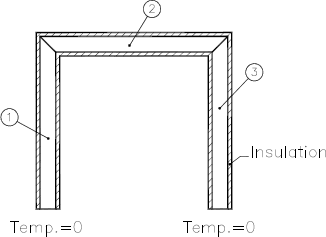
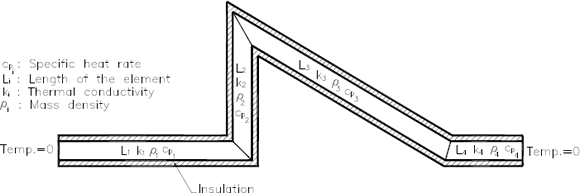
<body><![CDATA[<p><font size="2" face="Verdana, Arial, Helvetica, sans-serif">After Morales’s work (2000), Zarzalejo (2001) [8]  dynamically analyses three-dimensional structures. According to the excellent  results showed by the sub-structural synthesis method in dynamical analysis  [5], [7], [8], and the stability analysis in the solution of the eigenvalues  problem associated with buckling presented by Ramírez (2002) [9], this investigation  is meant to develop a formulation that allows to apply the SSM in another engineering  area, heat conduction.</font></p>     <p>&nbsp;</p>     <p><font size="3" face="Verdana, Arial, Helvetica, sans-serif"><b>2. HEAT CONDUCTION GENERAL MODEL </b></font></p>     <p><font size="2" face="Verdana, Arial, Helvetica, sans-serif">For a structure as the one showed on <a href="#fig01">Fig.       1</a>, a  methodology that allows to apply SSM in problems related to heat conduction  will be developed. </font></p>       <p align="center"><font size="2" face="Verdana, Arial, Helvetica, sans-serif"><b><a name="fig01"></a><img src="/img/revistas/dyna/v74n153/a21fig01.gif">    <br>   Figure 1: </b>General model of heat conduction.    <br>   <b>Figura 1:</b> Modelo general de conducción de calor</font></p>     <p><font size="2" face="Verdana, Arial, Helvetica, sans-serif">Formulation for this problem is done under the  following considerations:</font></p> <ul>    <li><font size="2" face="Verdana, Arial, Helvetica, sans-serif">All     the constituent elements of the structure have an equal and uniform straight     section. </font></li>       <li><font size="2" face="Verdana, Arial, Helvetica, sans-serif">The     material of two consecutive substructures is different generally, but homogenous     within a same element.</font></li>       ]]></body>
<body><![CDATA[<li><font size="2" face="Verdana, Arial, Helvetica, sans-serif">An     ideal isolation around all the elements will be considered.</font></li>       <li><font size="2" face="Verdana, Arial, Helvetica, sans-serif">The     dimensions of any cross section are considered small enough as to say that     the temperature is constant in the section</font></li>       <li><font size="2" face="Verdana, Arial, Helvetica, sans-serif">There     is no internal heat generation.</font></li>       <li><font size="2" face="Verdana, Arial, Helvetica, sans-serif">An     initial condition of functional temperature exists, and it is different from     zero.</font></li>       <li><font size="2" face="Verdana, Arial, Helvetica, sans-serif">All     the boundary conditions (BC) supposed are homogenous.</font></li>     </ul>     <p><font size="2" face="Verdana, Arial, Helvetica, sans-serif">Using the previous considerations, it is possible  to say that the outlined generic system is equivalent to the one shown in <a href="#fig02">Fig.  2</a>, where the elements can only be differentiated by the change in the material  from a substructure to another one.</font></p>       <p align="center"><font size="2" face="Verdana, Arial, Helvetica, sans-serif"><a name="fig02"></a><b><img src="/img/revistas/dyna/v74n153/a21fig02.gif">    <br>   Figure 2:</b> Equivalent model of heat conduction    <br>   <b>Figura 2:</b> Modelo equivalente de conducción de calor </font></p>     ]]></body>

<body><![CDATA[<p><font size="2" face="Verdana, Arial, Helvetica, sans-serif">For this heat conduction case, the totality of  development in SSM made in the vibrations area is not applicable, in particular  the Lagrangian formulation that allows to obtain the mass and stiffness matrices,  then is necessary to define as departure point the partial differential equation  that governs the heat conduction in one dimension, and then starting from this  to determinate the eigenvalues problem associated as showed on Ec. (1).</font></p>     <p><font size="2" face="Verdana, Arial, Helvetica, sans-serif"><img src="/img/revistas/dyna/v74n153/a21eq01.gif"></font></p>     <p><font size="2" face="Verdana, Arial, Helvetica, sans-serif">where:</font></p>     <blockquote>       <p><font size="2" face="Verdana, Arial, Helvetica, sans-serif"><i>U</i>: Temperature    <br>     <i>k</i>: Thermal Conductivity    <br>     <i>c<sub>p</sub></i>: Specific heat rate    <br>     <i>r</i>: Mass density    <br>      l: Associated eigenvalues.</font></p> </blockquote>     <p><font size="2" face="Verdana, Arial, Helvetica, sans-serif">To transform Ec (1) to a matrix from is necessary  to outline the weak form of itself. In order to achieve this the weight function <i>w</i> is  defined. Ec. (1) defines an eigenvalue problem, and multiplying it by the weight  function the following is obtained:</font></p>     ]]></body>
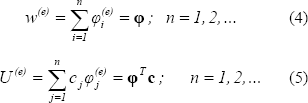
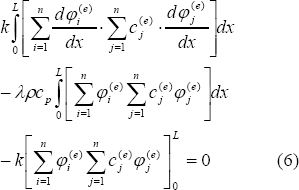
<body><![CDATA[<p><font size="2" face="Verdana, Arial, Helvetica, sans-serif"><img src="/img/revistas/dyna/v74n153/a21eq02.gif"></font></p>     <p><font size="2" face="Verdana, Arial, Helvetica, sans-serif">Integrating Ec. (2) by parts over the domain, the  following is obtained:</font></p>     <p><font size="2" face="Verdana, Arial, Helvetica, sans-serif"><img src="/img/revistas/dyna/v74n153/a21eq03.gif"></font></p>     <p><font size="2" face="Verdana, Arial, Helvetica, sans-serif">it represents the weak form of the equation that  rules the heat conduction in one dimension. Expressing temperature <i>U</i> and  weight function<i> w</i> in terms of approximation functions: </font></p>     <p><font size="2" face="Verdana, Arial, Helvetica, sans-serif"><img src="/img/revistas/dyna/v74n153/a21eq0405.gif"></font></p>     <p><font size="2" face="Verdana, Arial, Helvetica, sans-serif">where<sub><img border=0 src="/img/revistas/dyna/v74n153/a21eq008.gif"></sub> is an admissible  functions vector of different families and <b>c</b> is a vector of unknown  coefficients, superscript <i>(e)</i> means that these approximations apply  on each element and <i>n</i> is the approximation grade.</font></p>     <p><font size="2" face="Verdana, Arial, Helvetica, sans-serif">Replacing the Ecs. (4) and (5) in Ec. (3) :</font></p>     <p><font size="2" face="Verdana, Arial, Helvetica, sans-serif"><img src="/img/revistas/dyna/v74n153/a21eq06.gif"></font></p>     <p><font size="2" face="Verdana, Arial, Helvetica, sans-serif">Here the first term represents the coefficients  of the stiffness matrix, the second one the coefficients of the mass matrix,  and the last one represents the BC of the eigenvalue problem [10]. Considering  the solution of eigenvalue problems by means of the SSM, the GBC of the system  are satisfied combining a correct selection of the approximation functions  and a constraint process, and that approximation functions must also be able  to approximate to the desired degree the NBC of the system, the last term of  the Ec. (6) can be omitted in the formulation. Now under this simplification  the Ec. (6) can be rewrite it as:</font></p>     <p><font size="2" face="Verdana, Arial, Helvetica, sans-serif"><img src="/img/revistas/dyna/v74n153/a21eq07.gif"></font></p>     ]]></body>
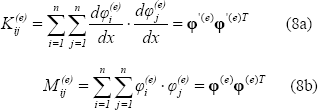
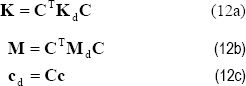
<body><![CDATA[<p><font size="2" face="Verdana, Arial, Helvetica, sans-serif">where:</font></p>     <p><font size="2" face="Verdana, Arial, Helvetica, sans-serif"><img src="/img/revistas/dyna/v74n153/a21eq08.gif"></font></p>     <p><font size="2" face="Verdana, Arial, Helvetica, sans-serif">Clearly is seen that Ec. (7) can be written in  a matrix form:</font></p>     <p><font size="2" face="Verdana, Arial, Helvetica, sans-serif"><img src="/img/revistas/dyna/v74n153/a21eq09.gif"></font></p>     <p><font size="2" face="Verdana, Arial, Helvetica, sans-serif">Ec. (9) defines the eigenvalue problem in matrix  form for a constituent element or substructure and based on this equation write  the eigenvalues problem in a matrix form in order to create a complete structure  like the one shown one <a href="#fig01">Fig. 1</a>, the following is obtained:</font></p>     <p><font size="2" face="Verdana, Arial, Helvetica, sans-serif"><img src="/img/revistas/dyna/v74n153/a21eq10.gif"></font></p>     <p><font size="2" face="Verdana, Arial, Helvetica, sans-serif">The matrices of the Ec. (10) can be transformed  to the assembled system by using the constraint matrix <b>C</b>, which is generated  when the compatibility of the temperature in the tie points of two contiguous  substructures is guaranteed. Rewriting the Ec. (10) for the assembled system:</font></p>     <p><font size="2" face="Verdana, Arial, Helvetica, sans-serif"><img src="/img/revistas/dyna/v74n153/a21eq11.gif"></font></p>     <p><font size="2" face="Verdana, Arial, Helvetica, sans-serif">where:</font></p>     <p><font size="2" face="Verdana, Arial, Helvetica, sans-serif"><img src="/img/revistas/dyna/v74n153/a21eq12.gif"></font></p>     ]]></body>
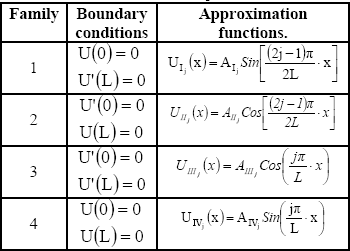
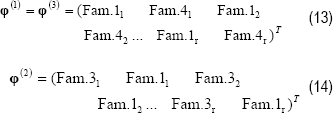
<body><![CDATA[<p><font size="2" face="Verdana, Arial, Helvetica, sans-serif">and <b>C</b> is the constraint matrix</font></p> <font size="2" face="Verdana, Arial, Helvetica, sans-serif"><b>2.1 Application To A Particular System    <br>  </b>The detailed solution of the particular heat conduction  problem by means of the SSM is showed next, the system appears in Fig 3. </font>     <p align="center"><font size="2" face="Verdana, Arial, Helvetica, sans-serif"><b><a name="fig03"></a><img src="/img/revistas/dyna/v74n153/a21fig03.gif">    <br>   Figure 3:</b> Particular structure    for the analysis of heat conduction    <br>    <b>Figura 3:</b> Estructura particular para el análisis de conducción de calor</font></p>     <p><font size="2" face="Verdana, Arial, Helvetica, sans-serif">Equations (8a,b)      defined the mass and stiffness matrix coefficients for a system’s constituent      element, in these equations it is necessary insert the approximation functions  for each one of the substructures of the system.</font></p>  <font size="2" face="Verdana, Arial, Helvetica, sans-serif">Approximation functions. Solving the Ec.(1) under different boundary conditions is possible to obtain the approximation families that are going to be used and these appear in <a href="#tab01">Table 1</a>. </font><font face="Verdana, Arial, Helvetica, sans-serif">     <p align="center"><font size="2"><b><a name="tab01"></a>Table 1:</b> Approximation families    <br>     <b>Tabla 1:</b> Familias de aproximación</font>    <br>     <img src="/img/revistas/dyna/v74n153/a21tab01.gif"></p>     <p><font size="2">Where <i>A<sub>I</sub></i>, ..., <i>A<sub>IV</sub></i> are  constants used to normalize the width of the approximation functions.</font></p>   <font size="2">Approximation functions selection: Approximation functions selection is done based on <a href="#fig04">Figure 4</a> and the BC offered by each one of the approximation families (<a href="#tab01">Table 1</a>), with which the functions vectors of the Ec. (8a, b) end up as showed in the Ecs. (13) and (14).       ]]></body>
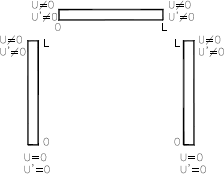
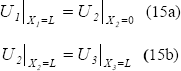
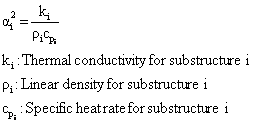
<body><![CDATA[<p align="center"><b><a name="fig04"></a><img src="/img/revistas/dyna/v74n153/a21fig04.gif">    <br>   Figure 4:</b> Boundary conditions of each substructure    <br>     <b>Figura 4:</b> Condiciones de borde de cada subestructura.</p>       <p><img src="/img/revistas/dyna/v74n153/a21eq1314.gif"></p>       <p>Inserting the Ecs. (13) and (14) in the Ecs. (8a,    b), and all this as well in the Ec. (7), the eigenvalues problem of the disjoint    system can be obtained as Ec. (10) shows. Now with the previously selected    families the GBC in the starting points are satisfied automatically for substructures    1 and 3. In order to transform the eigenvalue problem of the disjoint system    to the assembled one it is necessary to guarantee the compatibility in the    temperature of the tie points of substructure 1 with the 2, and of substructure   2 with the 3. This can be done mathematically by means of the following equations</p>       <p><img src="/img/revistas/dyna/v74n153/a21eq15.gif"></p>       <p>Introducing    the Ec. (5) in the Ecs. (15a, b) and where the vectors <sub><img border=0 src="/img/revistas/dyna/v74n153/a21eq010.gif"></sub> are based    on the Ecs. (13) and (14), the constrain matrix C can be obtained, and as it    shows the Ecs. (12a, b, c) transform the matrices from the disjoint system    to the assembled one, thus to solve the eigenvalue problem associated to the   heat conduction.</p>   Results. In order to develop this example numerically the following properties for each one substructures of the system are considered:       <p><img src="/img/revistas/dyna/v74n153/a21eq151.gif"></p>       <p>Where <sub><img border=0 src="/img/revistas/dyna/v74n153/a21eq012.gif"></sub> is thermal   diffusivity for substructure i, calculated by:</p>       <p><img src="/img/revistas/dyna/v74n153/a21eq014.gif"> </p>       ]]></body>
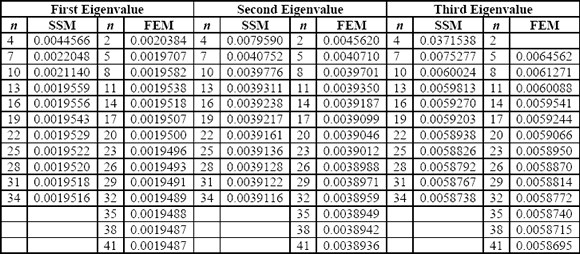
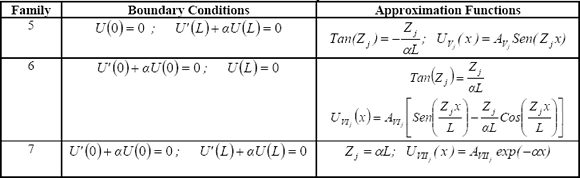
<body><![CDATA[<p>Eigenvalue problem is solved by means of the proposed    SSM, in addition with the purpose of validating and comparing the obtained    results it is also solved by means of the FEM using link elements with 1 DOF    by node and polynomials of Lagrange like approximation functions. The convergence    of the three first eigenvalues of the system, and for an equal precision up    to five significant figures are showed in <a href="#tab02">Table 2</a>, where <i>n</i> represents    the order of the involved matrices in eigenvalue problem and that is equivalent   as well to the DOF of the assembled system.</p>   </font></font>     <p align="center"><font size="2" face="Verdana, Arial, Helvetica, sans-serif"><b><a name="tab02"></a>Table       2:</b> Convergence of the three first eigenvalues    <br>      <b>Tabla 2:</b> Convergencia de los tres primeros autovalores</font>    <br>      <img src="/img/revistas/dyna/v74n153/a21tab02.gif"></p> <font face="Verdana, Arial, Helvetica, sans-serif"><font size="2">     <p>On <a href="#tab02">Table 2</a> it is possible to see that for two first    eigenvalues and the precision given, the solution obtained by means of the    FEM presents characteristics of convergence superior to the ones showed by    the SSM. Specifically for the first eigenvalue, by means of the FEM the convergence    of five significant figures is reached with 38 DOF, whereas applying the SSM    that level of precision is not possible to reach it with the approximation    degree that allows the model (34 DOF), because from that point numerical problems    appear, and that prevent to increase the DOF of the approximation. Considering    that both methods of solution present a uniform convergence from above, for    the second eigenvalue although neither methods reach the given precision, can    be said that the eigenvalue found by means of the FEM with 38 DOF is more accurate    to the actual eigenvalue that the presented one with 34 DOF by the SSM. Now    for the third eigenvalue a very similar behavior in the approximation by means    of both methods is notice, but the speed of convergence of the SSM, is minimally superior that the one of the FEM.</p>     <p>Because convergence problems exist, in particular    the fact that it is not possible to go beyond of 34 DOF in the SSM approximation,    a new group of approximation families will allow making a combination of three    families by each substructure. For these new approximation functions a BC of radiating end will be considered and showed in <a href="#tab03">Table 3</a>.</p>     <p align="center"><b><a name="tab03"></a>Table 3:</b> Approximation Families    <br>   <b>Tabla 3:</b> Familias de Aproximación    <br>   <img src="/img/revistas/dyna/v74n153/a21tab03.gif"></p>     <p>In families the from 5 to 7 <i>a</i> is a positive    constant, and <i>A<sub>V</sub></i> , <i>A<sub>VI</sub></i> , <i>A<sub>VII</sub></i> are    constants that will allow to standardize the amplitude of the approximation functions. [11]</p>     ]]></body>
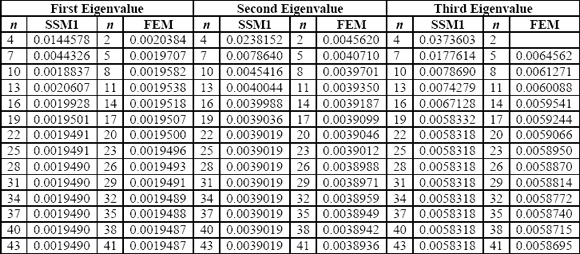
<body><![CDATA[<p>Considering the 7 approximation families available    and not to violate the Homogeneous Geometric Boundary Condition (HGBC) other possible combinations were made, the one that threw better results is shown: </p>     <p><b>SSM1: </b></p>     <p>Substructures 1 and 3: Family 1 + Family 5 + Family    4.    <br>   Substructures 2: Family 3 + Family 1 + Family 2. <i>a</i> = 1</p> </font></font>     <p><font size="2" face="Verdana, Arial, Helvetica, sans-serif">On Table 4 it is possible to see the combination  of 3 families by each substructure in the SSM, not only allows to improve the  convergence, but that also can increased the DOF, switching from 34 DOF in  the previous combinations up to 43 DOF in this one. Specifically the convergence  of the first eigenvalue for precision of five significant figures is reached  by means of the FEM with 38 DOF, whereas applying the SSM this precision is  not reached in the level of 43 DOF, is clearly possible to see that the convergence  of the SSM stops in the same number since 28 DOF. Comparing the eigenvalues  thrown by each one of the methods, the superiority of the SSM over the FEM  is clearly seen.</font></p>     <p align="center"><font size="2" face="Verdana, Arial, Helvetica, sans-serif"><b><a name="tab04"></a>Table       4:</b> Convergence of the three first     <br>  <b>Tabla 4: </b>Convergencia de los tres primeros autovalores</font>    <br>  <img src="/img/revistas/dyna/v74n153/a21tab04.gif"></p>     <p>&nbsp;</p>     <p><font size="3" face="Verdana, Arial, Helvetica, sans-serif"><b>3. CONCLUSIONS </b></font></p>     ]]></body>
<body><![CDATA[<p><font size="2" face="Verdana, Arial, Helvetica, sans-serif">The SSM can be applied in other areas of the engineering  in which eigenvalue problems exist and can be solved.</font></p>     <p><font size="2" face="Verdana, Arial, Helvetica, sans-serif">The solution of the heat conduction eigenvalue  problem by means of the SSM, although is viable because it throws values very  near to those of the FEM, is not as efficient as in the case of vibrations  or buckling, because in general FEM converges with a given precision to the  eigenvalue using a smaller number of DOF for the approximation. This reduction  of the convergence characteristics of the SSM in heat conduction can be attributed  to the fact that heat problem is mathematically different from the dynamic  problems (vibrations and buckling); additionally in the heat conduction model  a kinematic process which help to increase the convergence speed of the method  can not be applied.</font></p>     <p>&nbsp;</p>     <p><font size="3" face="Verdana, Arial, Helvetica, sans-serif"><b>REFERENCES</b></font></p>     <!-- ref --><p><font size="2" face="Verdana, Arial, Helvetica, sans-serif"><b>[1]</b> HURTY,     W.C. (1960),“Vibrations of Structural ystems by Component-Mode Synthesis.” Journal     of the Engineering Mechanics Division , ASCE, Vol.86, pp.51-69.    &nbsp;&nbsp;&nbsp;&nbsp;&nbsp;&nbsp;&nbsp;&nbsp;[&#160;<a href="javascript:void(0);" onclick="javascript: window.open('/scielo.php?script=sci_nlinks&ref=000117&pid=S0012-7353200700030002100001&lng=','','width=640,height=500,resizable=yes,scrollbars=1,menubar=yes,');">Links</a>&#160;]<!-- end-ref --><!-- ref --><br>   <b>[2]</b> HURTY, W.C. (1965),“Dynamic Analysis of Structural Systems Using Component Modes.” AIAA     Journal, Vol.3, No.4, pp.678-685.    &nbsp;&nbsp;&nbsp;&nbsp;&nbsp;&nbsp;&nbsp;&nbsp;[&#160;<a href="javascript:void(0);" onclick="javascript: window.open('/scielo.php?script=sci_nlinks&ref=000118&pid=S0012-7353200700030002100002&lng=','','width=640,height=500,resizable=yes,scrollbars=1,menubar=yes,');">Links</a>&#160;]<!-- end-ref --><!-- ref --><br>     <b>[3]</b> HALE, A.L., MEIROVITCH, L. (1980), “A General Substructure Synthesis Method for the Dynamic Simulation of Complex Structures.” Journal     of Sound and Vibration, Vol.69, No.2, pp. 309-326.    &nbsp;&nbsp;&nbsp;&nbsp;&nbsp;&nbsp;&nbsp;&nbsp;[&#160;<a href="javascript:void(0);" onclick="javascript: window.open('/scielo.php?script=sci_nlinks&ref=000119&pid=S0012-7353200700030002100003&lng=','','width=640,height=500,resizable=yes,scrollbars=1,menubar=yes,');">Links</a>&#160;]<!-- end-ref --><!-- ref --><br>     <b>[4]</b> MEIROVITCH, L., HALE, A.L. (1981), “On the Substructure Synthesis Method.” AIAA     Journal, Vol.19, No.7, pp. 940-947.    &nbsp;&nbsp;&nbsp;&nbsp;&nbsp;&nbsp;&nbsp;&nbsp;[&#160;<a href="javascript:void(0);" onclick="javascript: window.open('/scielo.php?script=sci_nlinks&ref=000120&pid=S0012-7353200700030002100004&lng=','','width=640,height=500,resizable=yes,scrollbars=1,menubar=yes,');">Links</a>&#160;]<!-- end-ref --><!-- ref --><br>     <b>[5]</b> MEIROVITCH, L., KWAK, M.K.,(1990), “Convergence of the Classical Rayleigh-Ritz Method and the Finite Element Method.” AIAA     Journal, Vol.28, No.8, pp. 1509-1516.    &nbsp;&nbsp;&nbsp;&nbsp;&nbsp;&nbsp;&nbsp;&nbsp;[&#160;<a href="javascript:void(0);" onclick="javascript: window.open('/scielo.php?script=sci_nlinks&ref=000121&pid=S0012-7353200700030002100005&lng=','','width=640,height=500,resizable=yes,scrollbars=1,menubar=yes,');">Links</a>&#160;]<!-- end-ref --><!-- ref --><br>     <b>[6]</b> MEIROVITCH, L., KWAK, M.K.,(1991), “Rayleigh-Ritz Based Substructure Synthesis Method for Flexible Multibody systems.” AIAA     Journal, Vol.29, No.10, pp. 1709-1519.    &nbsp;&nbsp;&nbsp;&nbsp;&nbsp;&nbsp;&nbsp;&nbsp;[&#160;<a href="javascript:void(0);" onclick="javascript: window.open('/scielo.php?script=sci_nlinks&ref=000122&pid=S0012-7353200700030002100006&lng=','','width=640,height=500,resizable=yes,scrollbars=1,menubar=yes,');">Links</a>&#160;]<!-- end-ref --><!-- ref --><br>     <b>[7]</b> MORALES, C.A. , (2000), “Rayleigh-Ritz based substructure synthesis for multiply supported structures.” Journal     of Vibration and Acoustics, Vol22, pp. 2-6.    &nbsp;&nbsp;&nbsp;&nbsp;&nbsp;&nbsp;&nbsp;&nbsp;[&#160;<a href="javascript:void(0);" onclick="javascript: window.open('/scielo.php?script=sci_nlinks&ref=000123&pid=S0012-7353200700030002100007&lng=','','width=640,height=500,resizable=yes,scrollbars=1,menubar=yes,');">Links</a>&#160;]<!-- end-ref --><!-- ref --><br>     <b>[8]</b> ZARZALEJO, E.J. Análisis Dinámico de Estructuras en Tres Dimensiones Utilizando Síntesis Subestructural Basado en el Método de Rayleigh-Ritz. Tesis de Maestría. Universidad Simón Bolívar, Caracas – Venezuela,     2001.    &nbsp;&nbsp;&nbsp;&nbsp;&nbsp;&nbsp;&nbsp;&nbsp;[&#160;<a href="javascript:void(0);" onclick="javascript: window.open('/scielo.php?script=sci_nlinks&ref=000124&pid=S0012-7353200700030002100008&lng=','','width=640,height=500,resizable=yes,scrollbars=1,menubar=yes,');">Links</a>&#160;]<!-- end-ref --><!-- ref --><br>     <b>[9]</b> RAMÍREZ, J.F. Autosolución de Problemas de Pandeo y Conducción de Calor Mediante Síntesis Subestructural. Tesis de Maestría. Universidad Simón Bolívar, Caracas – Venezuela,     2002.    &nbsp;&nbsp;&nbsp;&nbsp;&nbsp;&nbsp;&nbsp;&nbsp;[&#160;<a href="javascript:void(0);" onclick="javascript: window.open('/scielo.php?script=sci_nlinks&ref=000125&pid=S0012-7353200700030002100009&lng=','','width=640,height=500,resizable=yes,scrollbars=1,menubar=yes,');">Links</a>&#160;]<!-- end-ref --><!-- ref --><br>     <b>[10]</b> REDDY J.N. An Introduction to the Finite Element Method. Mc Graw Hill, 1993.    &nbsp;&nbsp;&nbsp;&nbsp;&nbsp;&nbsp;&nbsp;&nbsp;[&#160;<a href="javascript:void(0);" onclick="javascript: window.open('/scielo.php?script=sci_nlinks&ref=000126&pid=S0012-7353200700030002100010&lng=','','width=640,height=500,resizable=yes,scrollbars=1,menubar=yes,');">Links</a>&#160;]<!-- end-ref --><!-- ref --><br>     <b>[11]</b> O’NEIL, P.V. Matemáticas Avanzadas para Ingeniería. CECSA, 1994. </font>&nbsp;&nbsp;&nbsp;&nbsp;&nbsp;&nbsp;&nbsp;&nbsp;[&#160;<a href="javascript:void(0);" onclick="javascript: window.open('/scielo.php?script=sci_nlinks&ref=000127&pid=S0012-7353200700030002100011&lng=','','width=640,height=500,resizable=yes,scrollbars=1,menubar=yes,');">Links</a>&#160;]<!-- end-ref --> ]]></body><back>
<ref-list>
<ref id="B1">
<label>1</label><nlm-citation citation-type="journal">
<person-group person-group-type="author">
<name>
<surname><![CDATA[HURTY]]></surname>
<given-names><![CDATA[W.C.]]></given-names>
</name>
</person-group>
<article-title xml:lang="en"><![CDATA[Vibrations of Structural ystems by Component-Mode Synthesis]]></article-title>
<source><![CDATA[Journal of the Engineering Mechanics Division]]></source>
<year>1960</year>
<volume>86</volume>
<page-range>51-69</page-range></nlm-citation>
</ref>
<ref id="B2">
<label>2</label><nlm-citation citation-type="journal">
<person-group person-group-type="author">
<name>
<surname><![CDATA[HURTY]]></surname>
<given-names><![CDATA[W.C.]]></given-names>
</name>
</person-group>
<source><![CDATA[AIAA Journal]]></source>
<year></year>
<volume>3</volume>
<numero>4</numero>
<issue>4</issue>
<page-range>678-685</page-range></nlm-citation>
</ref>
<ref id="B3">
<label>3</label><nlm-citation citation-type="journal">
<person-group person-group-type="author">
<name>
<surname><![CDATA[HALE]]></surname>
<given-names><![CDATA[A.L.]]></given-names>
</name>
<name>
<surname><![CDATA[MEIROVITCH]]></surname>
<given-names><![CDATA[L.]]></given-names>
</name>
</person-group>
<article-title xml:lang="en"><![CDATA[A General Substructure Synthesis Method for the Dynamic Simulation of Complex Structures]]></article-title>
<source><![CDATA[Journal of Sound and Vibration]]></source>
<year>1980</year>
<volume>69</volume>
<numero>2</numero>
<issue>2</issue>
<page-range>309-326</page-range></nlm-citation>
</ref>
<ref id="B4">
<label>4</label><nlm-citation citation-type="journal">
<person-group person-group-type="author">
<name>
<surname><![CDATA[MEIROVITCH]]></surname>
<given-names><![CDATA[L.]]></given-names>
</name>
<name>
<surname><![CDATA[HALE]]></surname>
<given-names><![CDATA[A.L.]]></given-names>
</name>
</person-group>
<article-title xml:lang="en"><![CDATA[On the Substructure Synthesis Method]]></article-title>
<source><![CDATA[AIAA Journal]]></source>
<year>1981</year>
<volume>19</volume>
<numero>7</numero>
<issue>7</issue>
<page-range>940-947</page-range></nlm-citation>
</ref>
<ref id="B5">
<label>5</label><nlm-citation citation-type="journal">
<person-group person-group-type="author">
<name>
<surname><![CDATA[MEIROVITCH]]></surname>
<given-names><![CDATA[L.]]></given-names>
</name>
<name>
<surname><![CDATA[KWAK]]></surname>
<given-names><![CDATA[M.K.]]></given-names>
</name>
</person-group>
<article-title xml:lang="en"><![CDATA[Convergence of the Classical Rayleigh-Ritz Method and the Finite Element Method]]></article-title>
<source><![CDATA[AIAA Journal]]></source>
<year>1990</year>
<volume>28</volume>
<numero>8</numero>
<issue>8</issue>
<page-range>1509-1516</page-range></nlm-citation>
</ref>
<ref id="B6">
<label>6</label><nlm-citation citation-type="journal">
<person-group person-group-type="author">
<name>
<surname><![CDATA[MEIROVITCH]]></surname>
<given-names><![CDATA[L.]]></given-names>
</name>
<name>
<surname><![CDATA[KWAK]]></surname>
<given-names><![CDATA[M.K.]]></given-names>
</name>
</person-group>
<article-title xml:lang="en"><![CDATA[Rayleigh-Ritz Based Substructure Synthesis Method for Flexible Multibody systems]]></article-title>
<source><![CDATA[AIAA Journal]]></source>
<year>1991</year>
<volume>29</volume>
<numero>10</numero>
<issue>10</issue>
<page-range>1709-1519</page-range></nlm-citation>
</ref>
<ref id="B7">
<label>7</label><nlm-citation citation-type="journal">
<person-group person-group-type="author">
<name>
<surname><![CDATA[MORALES]]></surname>
<given-names><![CDATA[C.A.]]></given-names>
</name>
</person-group>
<article-title xml:lang="en"><![CDATA[Rayleigh-Ritz based substructure synthesis for multiply supported structures]]></article-title>
<source><![CDATA[Journal of Vibration and Acoustics]]></source>
<year>2000</year>
<volume>22</volume>
<page-range>2-6</page-range></nlm-citation>
</ref>
<ref id="B8">
<label>8</label><nlm-citation citation-type="">
<person-group person-group-type="author">
<name>
<surname><![CDATA[ZARZALEJO]]></surname>
<given-names><![CDATA[E.J.]]></given-names>
</name>
</person-group>
<source><![CDATA[Análisis Dinámico de Estructuras en Tres Dimensiones Utilizando Síntesis Subestructural Basado en el Método de Rayleigh-Ritz]]></source>
<year></year>
</nlm-citation>
</ref>
<ref id="B9">
<label>9</label><nlm-citation citation-type="">
<person-group person-group-type="author">
<name>
<surname><![CDATA[RAMÍREZ]]></surname>
<given-names><![CDATA[J.F.]]></given-names>
</name>
</person-group>
<source><![CDATA[Autosolución de Problemas de Pandeo y Conducción de Calor Mediante Síntesis Subestructural]]></source>
<year></year>
</nlm-citation>
</ref>
<ref id="B10">
<label>10</label><nlm-citation citation-type="book">
<person-group person-group-type="author">
<name>
<surname><![CDATA[REDDY]]></surname>
<given-names><![CDATA[J.N.]]></given-names>
</name>
</person-group>
<source><![CDATA[An Introduction to the Finite Element Method]]></source>
<year>1993</year>
<publisher-name><![CDATA[Mc Graw Hill]]></publisher-name>
</nlm-citation>
</ref>
<ref id="B11">
<label>11</label><nlm-citation citation-type="book">
<person-group person-group-type="author">
<name>
<surname><![CDATA[O’NEIL]]></surname>
<given-names><![CDATA[P.V.]]></given-names>
</name>
</person-group>
<source><![CDATA[Matemáticas Avanzadas para Ingeniería]]></source>
<year>1994</year>
<publisher-name><![CDATA[CECSA]]></publisher-name>
</nlm-citation>
</ref>
</ref-list>
</back>
</article>