<?xml version="1.0" encoding="ISO-8859-1"?><article xmlns:mml="http://www.w3.org/1998/Math/MathML" xmlns:xlink="http://www.w3.org/1999/xlink" xmlns:xsi="http://www.w3.org/2001/XMLSchema-instance">
<front>
<journal-meta>
<journal-id>0012-7353</journal-id>
<journal-title><![CDATA[DYNA]]></journal-title>
<abbrev-journal-title><![CDATA[Dyna rev.fac.nac.minas]]></abbrev-journal-title>
<issn>0012-7353</issn>
<publisher>
<publisher-name><![CDATA[Universidad Nacional de Colombia]]></publisher-name>
</publisher>
</journal-meta>
<article-meta>
<article-id>S0012-73532008000100009</article-id>
<title-group>
<article-title xml:lang="en"><![CDATA[LEAN MANAGEMENT IMPLEMENTATION IN MINING INDUSTRIES]]></article-title>
<article-title xml:lang="es"><![CDATA[LA APLICACIÓN DE LA ADMINISTRACIÓN LEAN EN LAS INDUSTRIAS DE MINERÍA]]></article-title>
</title-group>
<contrib-group>
<contrib contrib-type="author">
<name>
<surname><![CDATA[FLAMARION KLIPPEL]]></surname>
<given-names><![CDATA[ALTAIR]]></given-names>
</name>
<xref ref-type="aff" rid="A01"/>
</contrib>
<contrib contrib-type="author">
<name>
<surname><![CDATA[PETTER]]></surname>
<given-names><![CDATA[CARLOS OTÁVIO]]></given-names>
</name>
<xref ref-type="aff" rid="A02"/>
</contrib>
<contrib contrib-type="author">
<name>
<surname><![CDATA[VALLE ANTUNES JR]]></surname>
<given-names><![CDATA[JOSÉ ANTONIO]]></given-names>
</name>
<xref ref-type="aff" rid="A03"/>
</contrib>
</contrib-group>
<aff id="A01">
<institution><![CDATA[,Universidad Federal de Rio Grande do Sul  ]]></institution>
<addr-line><![CDATA[ ]]></addr-line>
</aff>
<aff id="A02">
<institution><![CDATA[,Universidad Federal de Rio Grande do Sul  ]]></institution>
<addr-line><![CDATA[ ]]></addr-line>
</aff>
<aff id="A03">
<institution><![CDATA[,Universidad del Vale do Rio dos Sinos  ]]></institution>
<addr-line><![CDATA[ ]]></addr-line>
</aff>
<pub-date pub-type="pub">
<day>00</day>
<month>03</month>
<year>2008</year>
</pub-date>
<pub-date pub-type="epub">
<day>00</day>
<month>03</month>
<year>2008</year>
</pub-date>
<volume>75</volume>
<numero>154</numero>
<fpage>81</fpage>
<lpage>89</lpage>
<copyright-statement/>
<copyright-year/>
<self-uri xlink:href="http://www.scielo.org.co/scielo.php?script=sci_arttext&amp;pid=S0012-73532008000100009&amp;lng=en&amp;nrm=iso"></self-uri><self-uri xlink:href="http://www.scielo.org.co/scielo.php?script=sci_abstract&amp;pid=S0012-73532008000100009&amp;lng=en&amp;nrm=iso"></self-uri><self-uri xlink:href="http://www.scielo.org.co/scielo.php?script=sci_pdf&amp;pid=S0012-73532008000100009&amp;lng=en&amp;nrm=iso"></self-uri><abstract abstract-type="short" xml:lang="es"><p><![CDATA[Entre las alternativas para asegurar su supervivencia, una particularmente pertinente para las Organizaciones es la innovación. La innovación tiene varias dimensiones entre que es posible incluir: i) materia prima; ii) producto; iii) proceso; iv) mercado; v) la manera cómo es realizada la administración. Este artículo tiene el objetivo de mostrar la posibilidad de llevar a cabo una nueva manera de dirección en las industrias de extracción de mineral a través del uso integrado de los conceptos desarrollados en la construcción del Sistema de Producción Toyota (SPT) / el Sistema de Producción Lean, y los conceptos y técnicas tradicionales que se originan de la Ingeniería Minera y la Ingeniería Industrial. El artículo muestra esta integración en dos situaciones de la minería (fluorita y amatista). Los resultados indican la reducción del costo de la producción y aumento de la productividad y la mejora de la Calidad de Vida de Trabajadores.]]></p></abstract>
<abstract abstract-type="short" xml:lang="en"><p><![CDATA[Among the alternatives to assure its survival, a particularly relevant one for Organizations is innovation. Innovation has several dimensions among which it is possible to include: i) raw material; ii) product; iii) process; iv) market; v) the way how administration is made. This paper has the objective to show the possibility to implement a new management way in the industries of mineral extraction through the integrated use of the concepts developed in the construction of the Toyota of Production System (TPS)/ Lean Production System, and the concepts and traditional techniques originating from the Mining Engineering and the Industrial Engineering. The paper shows this integration in two sceneries of the mining (fluospar and amethyst). The results indicate the reduction of the production costs and increase of the productivity and the improvement of the Workers Life Quality.]]></p></abstract>
<kwd-group>
<kwd lng="es"><![CDATA[Innovación]]></kwd>
<kwd lng="es"><![CDATA[Minería]]></kwd>
<kwd lng="es"><![CDATA[Administración]]></kwd>
<kwd lng="es"><![CDATA[Sistema de Producción Toyota]]></kwd>
<kwd lng="es"><![CDATA[Producción Lean]]></kwd>
<kwd lng="en"><![CDATA[Mining]]></kwd>
<kwd lng="en"><![CDATA[Management]]></kwd>
<kwd lng="en"><![CDATA[Innovation]]></kwd>
<kwd lng="en"><![CDATA[Toyota Production System]]></kwd>
<kwd lng="en"><![CDATA[Lean Production]]></kwd>
</kwd-group>
</article-meta>
</front><body><![CDATA[ <p align="center"><font size="4" face="Verdana, Arial, Helvetica, sans-serif"><b>LEAN MANAGEMENT IMPLEMENTATION IN MINING INDUSTRIES </b></font></p>     <p align="center"><font size="3" face="Verdana, Arial, Helvetica, sans-serif"><b>LA       APLICACI&Oacute;N DE LA ADMINISTRACI&Oacute;N LEAN EN LAS INDUSTRIAS DE  MINER&Iacute;A </b></font></p>     <p align="center">&nbsp;</p>     <p align="center"> <font size="2" face="Verdana, Arial, Helvetica, sans-serif"><b>ALTAIR FLAMARION KLIPPEL</b>    <br>   <i>Profesor en la Universidad del Vale do Rio dos Sinos, <a href="mailto:altair@klippel.com.br">altair@klippel.com.br</a> </i></font></p>      <p align="center"><font size="2" face="Verdana, Arial, Helvetica, sans-serif"><b>CARLOS        OTÁVIO PETTER</b>    <br>     <i>Profesor en la Universidad Federal  de Rio Grande do Sul, <a href="mailto:cpetter@ufrgs.br">cpetter@ufrgs.br</a></i></font></p>      <p align="center"><font size="2" face="Verdana, Arial, Helvetica, sans-serif"><b>JOSÉ ANTONIO        VALLE ANTUNES JR</b>    <br>     <i>Profesor en la Universidad del  Vale do Rio dos Sinos, <a href="mailto:junico@produttare.com.br">junico@produttare.com.br</a> </i></font></p>      <p align="center">&nbsp;</p>      ]]></body>
<body><![CDATA[<p align="center"><font size="2" face="Verdana, Arial, Helvetica, sans-serif"><b>Recibido        para revisar Febrero 06 de 2007, aceptado Diciembre 12 de 2007, versión  final Diciembre 26 de 2007 </b></font></p>      <p>&nbsp;</p>  <hr>      <p><font size="2" face="Verdana, Arial, Helvetica, sans-serif"><b>RESUMEN: </b>Entre      las alternativas para asegurar su supervivencia, una particularmente pertinente      para las Organizaciones es la innovación. La innovación tiene varias dimensiones entre que es posible  incluir: i) materia prima; ii) producto; iii) proceso; iv) mercado; v) la  manera cómo es realizada la administración. Este artículo tiene el objetivo  de mostrar la posibilidad de llevar a cabo una nueva manera de dirección  en las industrias de extracción de mineral a través del uso integrado de  los conceptos desarrollados en la construcción del Sistema de Producción  Toyota (SPT) / el Sistema de Producción Lean, y los conceptos y técnicas  tradicionales que se originan de la Ingeniería Minera y la Ingeniería Industrial.  El artículo muestra esta integración en dos situaciones de la minería (fluorita  y amatista). Los resultados indican la reducción del costo de la producción  y aumento de la productividad y la mejora de la Calidad de Vida de Trabajadores.</font></p>      <p><font size="2" face="Verdana, Arial, Helvetica, sans-serif"><b>PALABRAS CLAVE</b>:      Innovación, Minería, Administración, Sistema de Producción  Toyota, Producción Lean</font></p>      <p><font size="2" face="Verdana, Arial, Helvetica, sans-serif"><b>ABSTRACT</b>:      Among the alternatives to assure its survival, a particularly relevant one      for Organizations is innovation. Innovation has several dimensions among      which it is possible to include: i) raw material; ii) product; iii) process;      iv) market; v) the way how administration is made. This paper has the objective      to show the possibility to implement a new management way in the industries      of mineral extraction through the integrated use of the concepts developed      in the construction of the Toyota of Production System (TPS)/ Lean Production      System, and the concepts and traditional techniques originating from the      Mining Engineering and the Industrial Engineering. The paper shows this      integration in two sceneries of the mining (fluospar and amethyst). The      results indicate the reduction of the production costs and increase of the  productivity and the improvement of the Workers Life Quality.</font></p>      <p><font size="2" face="Verdana, Arial, Helvetica, sans-serif"><b>KEYWORDS</b>: Mining, Management, Innovation, Toyota Production  System, Lean Production</font></p>  <hr>      <p>&nbsp;</p>      <p><font size="3" face="Verdana, Arial, Helvetica, sans-serif"><b>1. INTRODUCTION</b></font></p>      <p><font size="2" face="Verdana, Arial, Helvetica, sans-serif">It  is possible to devise efficient ways of utilizing production resources available  in mining companies by means of modern management technologies involving:  (i) the flow of raw-material, (ii) personnel management; and (iii) equipment  management.</font></p>      <p><font size="2" face="Verdana, Arial, Helvetica, sans-serif">Mineral  raw material is obtained through mining and processing methods specific to  each kind of mine and ore. The technological knowledge of these mining and  processing methods is not enough to ensure the survival of mining organizations.</font></p>      ]]></body>
<body><![CDATA[<p><font size="2" face="Verdana, Arial, Helvetica, sans-serif">It  is also necessary that the management methods be aligned with the logic of  competitiveness seeking a reduction in production costs and an increase in  profits.</font></p>      <p><font size="2" face="Verdana, Arial, Helvetica, sans-serif">The present paper aims to present the potential of a new form of management  in mining companies through the integrated and synergic use of concepts developed  by the Toyota Production System/Lean Production and the concepts and traditional  techniques derived from Mining Engineering and Industrial Engineering.</font></p>      <p>&nbsp;</p>      <p><font size="3" face="Verdana, Arial, Helvetica, sans-serif"><b>2. METHOD</b></font></p>      <p><font size="2" face="Verdana, Arial, Helvetica, sans-serif">The  Research Method followed in the development of this paper was the Survey-Action  Method. The Working Method, grounded on the general principles defended by  the Survey-Action Method describes the objective steps leading to the fulfillment  of the study.</font></p>      <p><font size="2" face="Verdana, Arial, Helvetica, sans-serif"><b>2.1&nbsp; Research  Method    <br>  </b>The  Survey-Action Method fosters the involvement of workers in the research process  based on the fact that it encourages the urge of an intense interaction between  the researcher and the workers of the company under study.</font></p>      <p><font size="2" face="Verdana, Arial, Helvetica, sans-serif">Thiollent  (1997) states that the Survey-Action tool suggests conducting a survey involving  individuals or groups at different hierarchical levels in the organization  in connection with the problem in order to get a diagnosis that will lead  to changes in the organization.</font></p>      <p><font size="2" face="Verdana, Arial, Helvetica, sans-serif">Thiollent  (2002) considers every Survey-Action a kind of involvement once the participation  of individuals engaged in the problem is absolutely necessary.</font></p>      <p><font size="2" face="Verdana, Arial, Helvetica, sans-serif"><b>2.2 Working  Method    ]]></body>
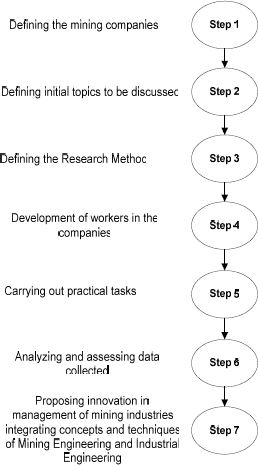
<body><![CDATA[<br>  </b>In  this study, the Working Method proposing an innovation in the management  of mining companies is represented in <a href="#fig01">Figure 1</a>, consisting of the following  steps:</font></p>      <p align="center"><font size="2" face="Verdana, Arial, Helvetica, sans-serif"><b><a name="fig01"></a><img src="/img/revistas/dyna/v75n154/a09fig01.gif">    <br>   Figure       1.</b> Working Method</font></p>      <p><font size="2" face="Verdana, Arial, Helvetica, sans-serif"><b>Step  1</b>: Defining the mining companies in order to propose the development  of this study. Two mining companies were chosen (fluorspar and amethyst),  located in the Southern Region of Brazil.</font></p>      <p><font size="2" face="Verdana, Arial, Helvetica, sans-serif"><b>Step  2</b>: Defining initial topics to be discussed. It was decided to use the  Toyota Production System concepts and techniques to be integrated with  the concepts and techniques of Mining Engineering and Production Engineering.</font></p>      <p><font size="2" face="Verdana, Arial, Helvetica, sans-serif"><b>Step  3</b>: Defining the Research Method. The Survey-Action methodology was  selected.</font></p>      <p><font size="2" face="Verdana, Arial, Helvetica, sans-serif"><b>Step  4</b>: Development of workers in the company. Theoretical meetings were  held between the authors of this paper and the workers of the companies.</font></p>      <p><font size="2" face="Verdana, Arial, Helvetica, sans-serif"><b>Step  5</b>: Carrying out practical tasks. Workers of the companies collected  and analyzed data in the underground mining.</font></p>      <p><font size="2" face="Verdana, Arial, Helvetica, sans-serif"><b>Step  6</b>: Analyzing and assessing data collected. This activity is based on  the practical tasks performed in the previous step.</font></p>      <p><font size="2" face="Verdana, Arial, Helvetica, sans-serif"><b>Step  7</b>: Proposing innovation in the management of mining industries through  this paper integrating concepts and techniques of Mining Engineering and  Industrial Engineering.</font></p>      ]]></body>
<body><![CDATA[<p>&nbsp;</p>      <p><font size="3" face="Verdana, Arial, Helvetica, sans-serif"><b>3. THEORETICAL REFERENCE</b></font></p>      <p><font size="2" face="Verdana, Arial, Helvetica, sans-serif">The Theoretical Reference adopted in this study is presented next. Topics  were as follows: i) Value; ii) Innovation; iii) Toyota Production System.</font></p>      <p><font size="2" face="Verdana, Arial, Helvetica, sans-serif"><b>3.1 Value    <br>  </b>The value of a product may be defined by the relation between    its function and cost. One may say that the value of a product is the lowest    cost attributed to a product or service which must meet the costumer’s expectation and it  is called “added value”. From the producer’s point of view, value is related  to profit, that is, the value of the product will be as big as the appropriation  of riches resulting from this product along the chain. This value is called “appropriated  value” (CSILLAC, 1991).</font></p>      <p><font size="2" face="Verdana, Arial, Helvetica, sans-serif">Antunes et alli (2007) comment that the analysis of the value chain of a  specific product will suggest opportunities and needs for innovation not  only in the development of the product itself, but also in terms of progress,  production and logistics of materials.</font></p>      <p><font size="2" face="Verdana, Arial, Helvetica, sans-serif"><b>3.2 Innovation    <br>  </b>In a competitive and globalized scenario like today,    innovation is an essential element for the survival of organizations. According    to Schumpeter (1982, p.112) “the fundamental impulse that starts and keeps the change process  in organizations stems from news consumer goods, new methods of production  and transportation, new markets and forms of industrial organization devised  by the same”.</font></p>      <p><font size="2" face="Verdana, Arial, Helvetica, sans-serif">Schumpeter (1976) main precursor of the innovation theory, featured the  following general types of innovations: i) introduction of a new product  or a qualitative change in an existing product; ii) innovation of a process  completely new to an industry; iii) opening a new market; iv) development  of new sources of raw material supply and other inputs and v) changes in  the industrial organization through the change of the form of management.</font></p>      <p><font size="2" face="Verdana, Arial, Helvetica, sans-serif">These five types of innovation may be copied by the competitors more or  less easily. The most complicated type of innovation to be replicated is  the management innovation because presumably one must understand a range  of principles that oftentimes carry a cultural content difficult to understand  if you are not familiar with the internal environment of a company.</font></p>      ]]></body>
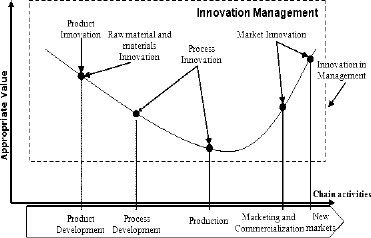
<body><![CDATA[<p><font size="2" face="Verdana, Arial, Helvetica, sans-serif">Urabe (1988) <i>apud</i> Popadiuk      and Choo (2007) says that “Innovation  consists of the generation of a new idea and its implementation into a new  product, process or service, leading to the dynamic growth of the national  economy and the increase of employment as well as to a creation of pure profit  for the innovative business enterprise. Innovation is never a one-time phenomenon,  but a long and cumulative process of a great number of organizational decision-making  process, ranging from the phase of generation of a new idea to its implementation  phase. New idea refers to the perception of a new customer need or a new  way to produce. It is generated in the cumulative process of information-gathering,  coupled with an ever-challenging entrepreneurial vision. Through the implementation  process the new idea is developed and commercialized into a new marketable  product or a new process with attendant cost reduction and increased productivity”</font></p>      <p><font size="2" face="Verdana, Arial, Helvetica, sans-serif">Antunes et alli (2007) suggest a model aiming to associate the appropriated  value and the activities played by the value chain to a specific organization.  In <a href="#fig02">Figure 2</a> a simplified adaptation of this model is shown.</font></p>      <p align="center"><font size="2" face="Verdana, Arial, Helvetica, sans-serif"><b><a name="fig02"></a><img src="/img/revistas/dyna/v75n154/a09fig02.gif">    <br>   Figure 2.</b> Innovation x Activities  in the value chain.</font></p>      <p><font size="2" face="Verdana, Arial, Helvetica, sans-serif">The analysis of <a href="#fig02">Figure        2</a> shows that activities leading to add greater value  from the innovation perspective are associated with market innovations. Secondly,  activities related to the development of the product are conceptually associated  with product and material innovations. Thirdly, process and development activities  related to process innovations proportionally tend to add less value to the  business process. At this injunction, it is important to point out that innovations  may definitely contribute to competitiveness.</font></p>      <p><font size="2" face="Verdana, Arial, Helvetica, sans-serif">To make sure that innovations in the market, product, process and raw material  take place efficiently, systematically and systemically it is necessary to  adopt management strategies focused on innovations. Adding value through  methods of innovative management is important since it formalizes and establishes  a constant pursuit for innovation in the organizations.</font></p>      <p><font size="2" face="Verdana, Arial, Helvetica, sans-serif">Among the new management forms is the implementation of new concepts and  techniques of the Toyota Production System in unison with the best intrinsic  technological practices available in the industry in question (i.e., the  mining industry).</font></p>      <p><font size="2" face="Verdana, Arial, Helvetica, sans-serif">Analyzing a generic production system in a mining industry, one may point  out the different means of generating innovations, as shown in <a href="#fig03">Figure  3</a>.</font></p>      <p align="center"><font size="2" face="Verdana, Arial, Helvetica, sans-serif"><b><a name="fig03"></a><img src="/img/revistas/dyna/v75n154/a09fig03.gif">    <br>   Figure 3. </b>Innovation in  the mining industry.</font></p>      ]]></body>
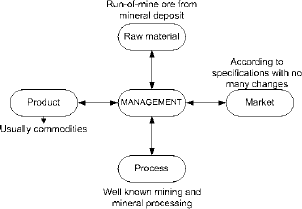
<body><![CDATA[<p><font size="2" face="Verdana, Arial, Helvetica, sans-serif">In the mining industry, the raw material constitutes a natural resource.  For this reason, probably this kind of industrial activity is the only one  in which innovation does not take place.</font></p>      <p><font size="2" face="Verdana, Arial, Helvetica, sans-serif">Despite the fact that mining process are well-known worldwide, technological  advance can enhance them with innovation, for instance, through the use of  remote controls to monitor mining equipment in underground coal mines of  low thickness.</font></p>      <p><font size="2" face="Verdana, Arial, Helvetica, sans-serif">Products deriving      from the mining industry feature well-defined specifications without undergoing      great alterations. As new products are developed because of technology,  the market innovates, expanding the mining companies’ performance.</font></p>      <p><font size="2" face="Verdana, Arial, Helvetica, sans-serif">The innovation of products, services, processes and market, based on the  raw material extracted from nature, may be conquered through a management  innovation, responsible for the interaction of the innovation with the other  dimensions considered. </font></p>      <p><font size="2" face="Verdana, Arial, Helvetica, sans-serif"><b>3.3 The Toyota Production System    <br>  </b>The highly competitive and globalized current world economic scenario highlights  the success of Japanese companies in that it makes Western companies seek  management innovation by copying and adapting their best practices to their  reality, such as the concepts and techniques developed by Toyota Motor Company  during the construction of the Toyota Production System (TPS)/Lean Production  System.</font></p>      <p><font size="2" face="Verdana, Arial, Helvetica, sans-serif">Liker (2005)      comments that “when the TPS is applied in a company, the first  question is to analyze the production flow from the costumer’s expectation: “What  the customer wants with this process?” This defines the value. (LIKER, 2005,  p. 46) </font></p>      <p><font size="2" face="Verdana, Arial, Helvetica, sans-serif">Shingo ( 1996 a) states that there are four phenomena underlying the raw  material flow: <b>processing</b> – alterations in shape or quality, assembly,  disassembly; <b>inspection</b> – a comparison with the standards; <b>transportation</b> – location  changes; and <b>waiting </b>– a time when no changes occur (SHINGO, 1996  a, p.39). Of all the phenomena mentioned above, only processing adds value  to the product; the others may be seen as a waste (SHINGO, 1996 a, p. 11).</font></p>      <p><font size="2" face="Verdana, Arial, Helvetica, sans-serif">TPS has revolutionized the concept of waste, considering as waste all the  activities that generate costs and do not add any value to the product. Analyzing  the production system, Shingo identified seven (7) types of wastes, namely:  i) overproduction wastes; ii) transportation wastes; iii) processing wastes;  iv) defective production wastes; v) waiting; vi) inventory wastes and vii)  motion wastes (SHINGO, 1996 a, p. 22).</font></p>      <p><font size="2" face="Verdana, Arial, Helvetica, sans-serif">According to      Shingo’s  classification (SHINGO, 1996 a, p.76) operations may be useful or useless. </font></p>      ]]></body>
<body><![CDATA[<p><font size="2" face="Verdana, Arial, Helvetica, sans-serif">Among the useful ones are the main operations that are classified as essential  operations (A) and auxiliary operations (B). Essential operations relate  to the net labor, which adds value to the product, whereas auxiliary operations  do not add value to the product but are necessary for an essential operation  to be carried out. Useless operations (C) mean wastes along the process and  must be eliminated.</font></p>      <p>&nbsp;</p>      <p><font size="3" face="Verdana, Arial, Helvetica, sans-serif"><b>4. MANAGEMENT INNOVATION IN MINING COMPANIES</b></font></p>      <p><font size="2" face="Verdana, Arial, Helvetica, sans-serif">Following, two cases of innovation in mining companies are presented: i)  the fluorspar mining case and ii) the amethyst mining case.</font></p>      <p><font size="2" face="Verdana, Arial, Helvetica, sans-serif"><b>4.1 Fluorspar mining    <br>  </b>This study was conducted in a fluorspar mining company located in the southernmost  region of Santa Catarina State, Brazil, which belongs to Grupo Votorantim,  one of the mining leaders in the country. </font></p>      <p><font size="2" face="Verdana, Arial, Helvetica, sans-serif">Through a careful mapping of the production process based on TPS concepts  and techniques it was possible to classify the operations carried out in  a mining block underground at the company studied. <a href="#fig03">Figure 3</a> is the result  of this mapping.</font></p>      <p align="center"><font size="2" face="Verdana, Arial, Helvetica, sans-serif"><b><a name="fig04"></a><img src="/img/revistas/dyna/v75n154/a09fig04.gif">    <br>   Figure 4. </b>Operations  carried out in a mining block – 1<sup>st</sup> measurement</font></p>      <p><font size="2" face="Verdana, Arial, Helvetica, sans-serif">Inside the mining block, drilling  and blasting are essential operations (A) to be optimized. In the first measurement  done only 45.5% of the total amount of time was spent on its execution.</font></p>      ]]></body>
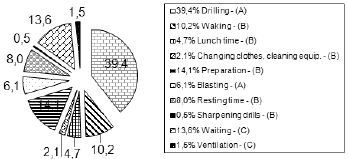
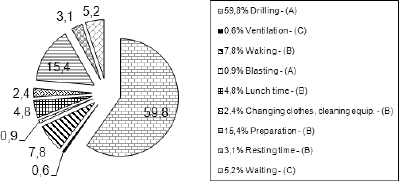
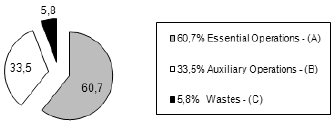
<body><![CDATA[<p><font size="2" face="Verdana, Arial, Helvetica, sans-serif">Preparation, an auxiliary  operation (B), includes putting down loose rocks from the roof and connecting  compressed-air hoses, among other activities. 14.1% of the time was spent  on this task. Sharpening drills (0.5%), changing clothes (2.1%), commuting  (10.2%) and having lunch (4.7%) are also considered auxiliary activities  (B).</font></p>      <p><font size="2" face="Verdana, Arial, Helvetica, sans-serif">The resting period      (8.0%) is considered a break from work to relieve miners’ fatigue and is  part of the useful operations.</font></p>      <p><font size="2" face="Verdana, Arial, Helvetica, sans-serif">Waiting (13.0%) is considered  waste (C) in the process as well as the interruption due to the lack of ventilation  (0.5%).</font></p>      <p><font size="2" face="Verdana, Arial, Helvetica, sans-serif">Putting together      all operations carried out in the mining block concerning the breakage of  ore according Shingo’s classification, <a href="#fig05">Figure 5</a> is obtained.</font></p>      <p align="center"><font size="2" face="Verdana, Arial, Helvetica, sans-serif"><b><a name="fig05"></a><img src="/img/revistas/dyna/v75n154/a09fig05.gif">    <br>   Figure 5. </b>Operations  based on Shingo’s classification in a mining block – 1<sup>st</sup> measurement</font></p>      <p><font size="2" face="Verdana, Arial, Helvetica, sans-serif">The analysis of the data collected  made it possible to identify the main causes of the low profit of the operations  carried out inside the mining block, pointing out the following wastes:</font></p>      <p><font size="2" face="Verdana, Arial, Helvetica, sans-serif">The essential drilling and  blasting operations were performed individually by the driller who was also  in charge of sharpening the drills and fetching explosives in the magazine.  While he was busy doing such tasks, the drilling machine was idle, which  characterizes a waste caused by the processing itself.</font></p>      <p><font size="2" face="Verdana, Arial, Helvetica, sans-serif">Adopting the brainstorming technique, the most significant decision was  organizing teams of drillers for the essential operations, with a team of  three drillers alternating functions: while two of them perform the drilling,  a third one, called supported, performs the other supporting tasks, thus  providing a higher value adding time than the previous one.</font></p>      <p><font size="2" face="Verdana, Arial, Helvetica, sans-serif">The drill sharpening      operation, included in the driller’s activities, used to cause a waste by      the processing itself. The same was transformed into an external setup,  where a worker from the mine was placed to perform this task. </font></p>      ]]></body>
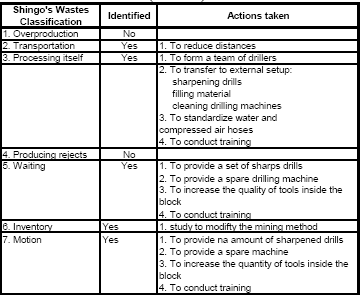
<body><![CDATA[<p><font size="2" face="Verdana, Arial, Helvetica, sans-serif">Because the compressed-air  filters were not lubricated and the hoses were excessively long and reduced  in diameter, there was also a waste by the processing itself in the essential  operation. </font></p>      <p><font size="2" face="Verdana, Arial, Helvetica, sans-serif">The stop valves in the compressed  air and water hoses were too far from the other end of the drilling machine  so that the drillers had to come and go to shut off and open the valves,  thus interrupting the drilling task, causing a waste by motion as well as  the lack of tools used for putting down loose rocks from the roof inside  the block.</font></p>      <p><font size="2" face="Verdana, Arial, Helvetica, sans-serif">The correction of this condition  transformed the wasted time into added value time in the drilling operation  and also made drillers less tired.</font></p>      <p><font size="2" face="Verdana, Arial, Helvetica, sans-serif">Because of the lack of efficient ventilation inside the block, drillers  had to wait after the blasting until the gases had been released, causing  a waste by waiting as well as the lack of a spare drilling machine inside  the block and the distance from the magazine, located on the other level  of the mine. <a href="#tab01">Table 1</a> shows the wastes and the actions taken to eliminate  them.</font></p>      <p align="center"><font size="2" face="Verdana, Arial, Helvetica, sans-serif"><b><a name="tab01"></a>Table 1.</b> Wastes x Actions  taken in a mining block</font>    <br>  <img src="/img/revistas/dyna/v75n154/a09tab01.gif"></p>      <p><font size="2" face="Verdana, Arial, Helvetica, sans-serif">Once the previous discussed and analysed improvement were done, a new measurement  was carried out, resulting in the data shown in <a href="#fig06">Figure 6</a>.</font></p>      <p align="center"><font size="2" face="Verdana, Arial, Helvetica, sans-serif"><b><a name="fig06"></a><img src="/img/revistas/dyna/v75n154/a09fig06.gif">    <br>   Figure 6. </b>Operations  carried out in a mining block – 2<sup>nd</sup> measurement</font></p>      <p><font size="2" face="Verdana, Arial, Helvetica, sans-serif">Putting together      the operations concerning the extraction of ore in the mining block according      to Shingo’s  classification, <a href="#fig07">Figure 7</a> is obtained.</font></p>      ]]></body>
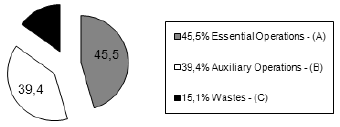
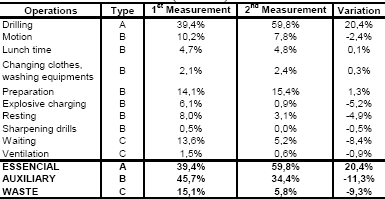
<body><![CDATA[<p align="center"><font size="2" face="Verdana, Arial, Helvetica, sans-serif"><b><a name="fig07"></a><img src="/img/revistas/dyna/v75n154/a09fig07.gif">    <br>   Figure 7.</b> Operations  based on Shingo’s classification in a mining block – 2<sup>nd</sup> measurement</font></p>      <p><font size="2" face="Verdana, Arial, Helvetica, sans-serif">The comparative analysis of the data obtained from the two measurements,  shown in <a href="#tab02">Table 2</a>, allows the conclusion that implementation of the improvements  proposed increased the useful time of the essential operation, reducing the  time spent on auxiliary operations and on wastes.</font></p>      <p align="center"><font size="2" face="Verdana, Arial, Helvetica, sans-serif"><b><a name="tab02"></a>Table 2</b>. Comparison of measurement  timing </font>    <br>  <img src="/img/revistas/dyna/v75n154/a09tab02.gif"></p>      <p><font size="2" face="Verdana, Arial, Helvetica, sans-serif">The evolution of the main  data, after and before implementation of improvements is shown in <a href="#tab03">Table  3</a>.</font></p>      <p align="center"><font size="2" face="Verdana, Arial, Helvetica, sans-serif"><b><a name="tab03"></a>Table 3</b>. Main comparative  data</font>    <br>  <img src="/img/revistas/dyna/v75n154/a09tab03.gif"></p>      <p><font size="2" face="Verdana, Arial, Helvetica, sans-serif">The analysis shows that the  volume of ore extracted in the block went from 15.72 tons/driller to 22.58  tons/driller. As a result, the monthy volume extracted inside the block increased  gradually, going from 5,661 tons to 8,129 tons, representing a higher yield  in relation to the first measurement of 43.6%. </font></p>      <p><font size="2" face="Verdana, Arial, Helvetica, sans-serif">The plan of costs of the company shows that the cost per ton extracted inside  the block during the improvement implementation period was reduced from US$  5.23/ton to US$ 3.51/ton.</font></p>      ]]></body>
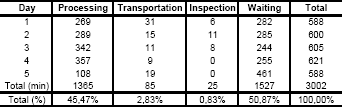
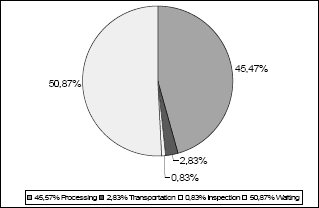
<body><![CDATA[<p><font size="2" face="Verdana, Arial, Helvetica, sans-serif"><b>4.2 Amethyst mining    <br>  </b>The production process of this type of mineral, in the North of Rio Grande  do Sul State, Brazil , is limited to a rudimentary underground mining method  using hillside galleries.</font></p>      <p><font size="2" face="Verdana, Arial, Helvetica, sans-serif">The cycle task in this mining method comprises <i>i</i>) drilling; <i>ii</i>)  explosive loading; <i>iii</i>) blasting and waiting for gas dispersion; <i>iv</i>)  removal of the broken rock; <i>v</i>) geode quality assurance and <i>vi</i>)  geode removal.</font></p>      <p><font size="2" face="Verdana, Arial, Helvetica, sans-serif">In a pilot mining      area, the main problems identified were the necessity of removing the drilling      dust, as well as eliminating the blasting gases, since they are harmful  and decrease the workers’ life expectation and quality.</font></p>      <p><font size="2" face="Verdana, Arial, Helvetica, sans-serif">Based on the mapping process done in this pilot mining area, in a five day  period, the subsequent results are presented in <a href="#tab04">Table 4</a> and <a href="#fig08">Figure  8</a>.</font></p>      <p align="center"><font size="2" face="Verdana, Arial, Helvetica, sans-serif"><b><a name="tab04"></a>Table 4.</b> Tabulated data in  the pilot mining area (minutes) after improvements</font>    <br>  <img src="/img/revistas/dyna/v75n154/a09tab04.gif"></p>      <p align="center"><font size="2" face="Verdana, Arial, Helvetica, sans-serif"><b><a name="fig08"></a><img src="/img/revistas/dyna/v75n154/a09fig08.gif">    <br>   Figure 8</b>. Percentual of activities  in an amethyst mining area after improvements</font></p>      <p><font size="2" face="Verdana, Arial, Helvetica, sans-serif">According to these data, less then 50% of the time was used to processing  adds value to the product, showing that it was necessary to realize improvements  to increase the add value time of the process.</font></p>      ]]></body>
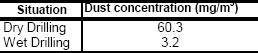
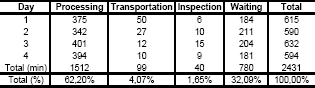
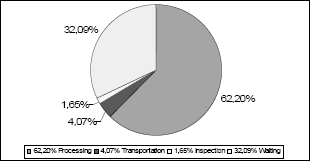
<body><![CDATA[<p><font size="2" face="Verdana, Arial, Helvetica, sans-serif"><a href="#tab04">Table        4</a> indicates waiting as the major waste, corresponding to more than  50% of the monitored time period. Among all the monitored period wastes,  it is possible to highlight:</font></p>      <p><font size="2" face="Verdana, Arial, Helvetica, sans-serif"><b>Waiting waste</b>: the dust removal waiting period, a consequence of  dry drilling and blasting gases in an inefficient ventilation system are  the two of major causes of waiting wastes. The installation of exhauster  fans and ventilation ducts reduces this type of waste, thereby improving  the working environment due to the reduction of dust concentration inside  the galleries. The dust reduction in the gallery, together with the introduction  of a wet drilling process, is shown in <a href="#tab05">Table 5</a>.</font></p>      <p align="center"><font size="2" face="Verdana, Arial, Helvetica, sans-serif"><b><a name="tab05"></a>Table 5.</b> Dust concentration  inside the gallery in the pilot mining area</font>    <br>  <img src="/img/revistas/dyna/v75n154/a09tab05.gif"></p>      <p><font size="2" face="Verdana, Arial, Helvetica, sans-serif"><b>Processing waste</b>: the use of a dry drilling process increases the  necessary time to drill holes, causing health problems to workers as well.  When introducing the wet drilling process, the processing time was reduced,  so that it: <i>i</i>) enhanced the visibility of all tasks; <i>ii</i>) improved  productivity by reducing the dust and gas removal waiting time and <i>iii</i>)  reduced accident risk. The use of fast clips to connect the compressed air/water  hoses with the drilling equipment also reduced the processing waste.</font></p>      <p><font size="2" face="Verdana, Arial, Helvetica, sans-serif"><b>Motion waste</b>:      when restricting the availability of drilling equipment to a smaller number      of working faces, located close to each other, the worker’s  motion time  – used to pick up the equipment – was reduced, also reducing its movement.  Studies should be developed in order to define the maximum number of working  faces that an individual drill is responsible for, focusing on not causing  any kind of interruption in the operation, thereby reducing workers’ movements  and minimizing motion wastes.</font></p>      <p><font size="2" face="Verdana, Arial, Helvetica, sans-serif">Before implementation of improvements to reduce wastes mentioned above,  a new measurement was carried out in a four day period. The data collected  are shown in <a href="#tab06">Table 6</a> and <a href="#fig09">figure 9</a>.</font></p>      <p align="center"><font size="2" face="Verdana, Arial, Helvetica, sans-serif"><b><a name="tab06"></a>Table 6.</b>Tabulated data in  the pilot mining area (minutes) before improvements</font>    <br>  <img src="/img/revistas/dyna/v75n154/a09tab06.gif"></p>      <p align="center"><font size="2" face="Verdana, Arial, Helvetica, sans-serif"><b><a name="fig09"></a><img src="/img/revistas/dyna/v75n154/a09fig09.gif">    ]]></body>
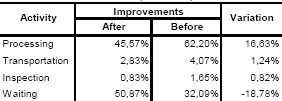
<body><![CDATA[<br>   Figure 9. </b>Percentual of activities  in an amethyst mining area before improvements</font></p>      <p><font size="2" face="Verdana, Arial, Helvetica, sans-serif">The comparison of data collected  after and before implementation of improvements to increase the add value  time of the process is shown in <a href="#tab07">Table 7</a>.</font></p>      <p align="center"><font size="2" face="Verdana, Arial, Helvetica, sans-serif"><b><a name="tab07"></a>Table 7.</b>Data collected after  and before implementation of improvements</font>    <br>  <img src="/img/revistas/dyna/v75n154/a09tab07.gif"></p>      <p>&nbsp;</p>      <p><font size="3" face="Verdana, Arial, Helvetica, sans-serif"><b>5. CONCLUSIONS</b></font></p>      <p><font size="2" face="Verdana, Arial, Helvetica, sans-serif">The purpose of this paper is to show the possibility of implementing a new  form of management in mining industries through the integrated use of concepts  developed in the construction of the Toyota Production System (TPS)/Lean  Production System with the concepts and traditional techniques stemming from  Mining Engineering and Industrial Engineering. </font></p>      <p><font size="2" face="Verdana, Arial, Helvetica, sans-serif">This paper shows      this integration in two mining companies (fluorspar and amethyst). In the      first one, there was a cost reduction from US$ 5.23 to US$ 3.51 inside the      mining block, corresponding to 32.9% and increase in productivity of 43.6%      while in the second company the main improvement was in relation to Worker’s      Quality of Life (WQL) by reducing the dust concentration inside the galleries      from 60.3 mg/m<sup>3</sup> to 3.2 mg/m<sup>3</sup>,  simultaneously reducing the waste caused by waiting from 50,87% to 32,09%  of the waiting time. In consequence of the actions taken, there was a 16,63%  increase on the add value time of the process.</font></p>      <p><font size="2" face="Verdana, Arial, Helvetica, sans-serif">The results obtained      through the practical use of the Survey-Action Method show the potentials      of adopting the integrated model proposed – The Toyota  Production System and the best Mining Engineering Practices – in true-to-life  cases. Furthermore it is important to emphasize that the innovation concepts  are a significant backcloth for the integration and synergy proposed in this  paper. </font></p>      <p>&nbsp;</p>      ]]></body>
<body><![CDATA[<p><font size="3" face="Verdana, Arial, Helvetica, sans-serif"><b>REFERENCES </b>  </font></p>      <!-- ref --><p>    <font size="2" face="Verdana, Arial, Helvetica, sans-serif"><b> [1]</b> ANTUNES    J. A. V., PANTALEÃO, L. H., PELLEGRIN, I. A Inovação e a Curva da Riqueza, Foz do Iguaçu, Paraná.    ENEGEP 2007     &nbsp;&nbsp;&nbsp;&nbsp;&nbsp;&nbsp;&nbsp;&nbsp;[&#160;<a href="javascript:void(0);" onclick="javascript: window.open('/scielo.php?script=sci_nlinks&ref=000144&pid=S0012-7353200800010000900001&lng=','','width=640,height=500,resizable=yes,scrollbars=1,menubar=yes,');">Links</a>&#160;]<!-- end-ref --><!-- ref --><br>    <b>[2]</b> CSILLAC, J.M. Análise de Valor: metodologia do valor. São Paulo:    Atlas, 1991.     &nbsp;&nbsp;&nbsp;&nbsp;&nbsp;&nbsp;&nbsp;&nbsp;[&#160;<a href="javascript:void(0);" onclick="javascript: window.open('/scielo.php?script=sci_nlinks&ref=000145&pid=S0012-7353200800010000900002&lng=','','width=640,height=500,resizable=yes,scrollbars=1,menubar=yes,');">Links</a>&#160;]<!-- end-ref --><!-- ref --><br>    <b>[3]</b> LIKER, JEFFREY K. O Modelo Toyota: 14 princípios de gestão do maior    fabricante do mundo. Porto Alegre: Bookman, 2005.     &nbsp;&nbsp;&nbsp;&nbsp;&nbsp;&nbsp;&nbsp;&nbsp;[&#160;<a href="javascript:void(0);" onclick="javascript: window.open('/scielo.php?script=sci_nlinks&ref=000146&pid=S0012-7353200800010000900003&lng=','','width=640,height=500,resizable=yes,scrollbars=1,menubar=yes,');">Links</a>&#160;]<!-- end-ref --><!-- ref --><br>    <b>[4]</b> POPADIUK, S., CHOO, C. W. Innovation and knowledge creation: How    are these concepts related? International Journal of Information Management,    Volume 27, Issue 1, 01february 2007, p. 302 – 312.     &nbsp;&nbsp;&nbsp;&nbsp;&nbsp;&nbsp;&nbsp;&nbsp;[&#160;<a href="javascript:void(0);" onclick="javascript: window.open('/scielo.php?script=sci_nlinks&ref=000147&pid=S0012-7353200800010000900004&lng=','','width=640,height=500,resizable=yes,scrollbars=1,menubar=yes,');">Links</a>&#160;]<!-- end-ref --><!-- ref --><br>    <b>[5]</b> SHINGO, SHIGEO. O Sistema Toyota de Produção: Do ponto de vista da engenharia de produção.    Porto Alegre: Bookman, 1996 a.     &nbsp;&nbsp;&nbsp;&nbsp;&nbsp;&nbsp;&nbsp;&nbsp;[&#160;<a href="javascript:void(0);" onclick="javascript: window.open('/scielo.php?script=sci_nlinks&ref=000148&pid=S0012-7353200800010000900005&lng=','','width=640,height=500,resizable=yes,scrollbars=1,menubar=yes,');">Links</a>&#160;]<!-- end-ref --><!-- ref --><br>    <b>[6]</b> SCHUMPETER, JOSEPH A. Teoria do Desenvolvimento Econômico: uma investigação sobre Lucros, Capital, Crédito, Juro e o Ciclo Econômico. Coleção Os Economistas. São    Paulo: Abril Cultural,1982.     &nbsp;&nbsp;&nbsp;&nbsp;&nbsp;&nbsp;&nbsp;&nbsp;[&#160;<a href="javascript:void(0);" onclick="javascript: window.open('/scielo.php?script=sci_nlinks&ref=000149&pid=S0012-7353200800010000900006&lng=','','width=640,height=500,resizable=yes,scrollbars=1,menubar=yes,');">Links</a>&#160;]<!-- end-ref --><!-- ref --><br>    <b>[7]</b> SCHUMPETER, J. A. Capitalism, Socialism and Democracy. New York:    Harper & Brothers, 1976.     &nbsp;&nbsp;&nbsp;&nbsp;&nbsp;&nbsp;&nbsp;&nbsp;[&#160;<a href="javascript:void(0);" onclick="javascript: window.open('/scielo.php?script=sci_nlinks&ref=000150&pid=S0012-7353200800010000900007&lng=','','width=640,height=500,resizable=yes,scrollbars=1,menubar=yes,');">Links</a>&#160;]<!-- end-ref --><!-- ref --><br>    <b>[8]</b> THIOLLENT, MICHAEL. Pesquisa-Ação nas Organizações. São Paulo:    1997.     &nbsp;&nbsp;&nbsp;&nbsp;&nbsp;&nbsp;&nbsp;&nbsp;[&#160;<a href="javascript:void(0);" onclick="javascript: window.open('/scielo.php?script=sci_nlinks&ref=000151&pid=S0012-7353200800010000900008&lng=','','width=640,height=500,resizable=yes,scrollbars=1,menubar=yes,');">Links</a>&#160;]<!-- end-ref --><!-- ref --><br>    <b>[9]</b> THIOLLENT, MICHAEL. Metodologia da Pesquisa-Ação. 11ª ed. São Paulo:  Cortez, 2002. </font>&nbsp;&nbsp;&nbsp;&nbsp;&nbsp;&nbsp;&nbsp;&nbsp;[&#160;<a href="javascript:void(0);" onclick="javascript: window.open('/scielo.php?script=sci_nlinks&ref=000152&pid=S0012-7353200800010000900009&lng=','','width=640,height=500,resizable=yes,scrollbars=1,menubar=yes,');">Links</a>&#160;]<!-- end-ref --> ]]></body><back>
<ref-list>
<ref id="B1">
<label>1</label><nlm-citation citation-type="book">
<person-group person-group-type="author">
<name>
<surname><![CDATA[ANTUNES]]></surname>
<given-names><![CDATA[J. A. V.]]></given-names>
</name>
<name>
<surname><![CDATA[PANTALEÃO]]></surname>
<given-names><![CDATA[L. H.]]></given-names>
</name>
<name>
<surname><![CDATA[PELLEGRIN]]></surname>
<given-names><![CDATA[I.]]></given-names>
</name>
</person-group>
<source><![CDATA[A Inovação e a Curva da Riqueza]]></source>
<year>2007</year>
<publisher-loc><![CDATA[Foz do Iguaçu^eParaná Paraná]]></publisher-loc>
<publisher-name><![CDATA[ENEGEP]]></publisher-name>
</nlm-citation>
</ref>
<ref id="B2">
<label>2</label><nlm-citation citation-type="book">
<person-group person-group-type="author">
<name>
<surname><![CDATA[CSILLAC]]></surname>
<given-names><![CDATA[J.M.]]></given-names>
</name>
</person-group>
<source><![CDATA[Análise de Valor: metodologia do valor]]></source>
<year>1991</year>
<publisher-loc><![CDATA[São Paulo ]]></publisher-loc>
<publisher-name><![CDATA[Atlas]]></publisher-name>
</nlm-citation>
</ref>
<ref id="B3">
<label>3</label><nlm-citation citation-type="book">
<person-group person-group-type="author">
<name>
<surname><![CDATA[LIKER]]></surname>
<given-names><![CDATA[JEFFREY K.]]></given-names>
</name>
</person-group>
<source><![CDATA[O Modelo Toyota: 14 princípios de gestão do maior fabricante do mundo]]></source>
<year>2005</year>
<publisher-loc><![CDATA[Porto Alegre ]]></publisher-loc>
<publisher-name><![CDATA[Bookman]]></publisher-name>
</nlm-citation>
</ref>
<ref id="B4">
<label>4</label><nlm-citation citation-type="journal">
<person-group person-group-type="author">
<name>
<surname><![CDATA[POPADIUK]]></surname>
<given-names><![CDATA[S.]]></given-names>
</name>
<name>
<surname><![CDATA[CHOO]]></surname>
<given-names><![CDATA[C. W.]]></given-names>
</name>
</person-group>
<article-title xml:lang="en"><![CDATA[Innovation and knowledge creation: How are these concepts related?]]></article-title>
<source><![CDATA[International Journal of Information Management]]></source>
<year>01fe</year>
<month>br</month>
<day>ua</day>
<volume>27</volume>
<numero>1</numero>
<issue>1</issue>
<page-range>302 - 312</page-range></nlm-citation>
</ref>
<ref id="B5">
<label>5</label><nlm-citation citation-type="book">
<person-group person-group-type="author">
<name>
<surname><![CDATA[SHINGO]]></surname>
<given-names><![CDATA[SHIGEO]]></given-names>
</name>
</person-group>
<source><![CDATA[O Sistema Toyota de Produção: Do ponto de vista da engenharia de produção]]></source>
<year>1996</year>
<publisher-loc><![CDATA[Porto Alegre ]]></publisher-loc>
<publisher-name><![CDATA[Bookman]]></publisher-name>
</nlm-citation>
</ref>
<ref id="B6">
<label>6</label><nlm-citation citation-type="book">
<person-group person-group-type="author">
<name>
<surname><![CDATA[SCHUMPETER]]></surname>
<given-names><![CDATA[JOSEPH A]]></given-names>
</name>
</person-group>
<article-title xml:lang="pt"><![CDATA[Teoria do Desenvolvimento Econômico: uma investigação sobre Lucros, Capital, Crédito, Juro e o Ciclo Econômico]]></article-title>
<source><![CDATA[Coleção Os Economistas]]></source>
<year>1982</year>
<publisher-loc><![CDATA[São Paulo ]]></publisher-loc>
<publisher-name><![CDATA[Abril Cultural]]></publisher-name>
</nlm-citation>
</ref>
<ref id="B7">
<label>7</label><nlm-citation citation-type="book">
<person-group person-group-type="author">
<name>
<surname><![CDATA[SCHUMPETER]]></surname>
<given-names><![CDATA[J. A.]]></given-names>
</name>
</person-group>
<source><![CDATA[Capitalism, Socialism and Democracy]]></source>
<year>1976</year>
<publisher-loc><![CDATA[New York ]]></publisher-loc>
<publisher-name><![CDATA[Harper & Brothers]]></publisher-name>
</nlm-citation>
</ref>
<ref id="B8">
<label>8</label><nlm-citation citation-type="">
<person-group person-group-type="author">
<name>
<surname><![CDATA[THIOLLENT]]></surname>
<given-names><![CDATA[MICHAEL]]></given-names>
</name>
</person-group>
<source><![CDATA[Pesquisa-Ação nas Organizações]]></source>
<year>1997</year>
<publisher-loc><![CDATA[São Paulo ]]></publisher-loc>
</nlm-citation>
</ref>
<ref id="B9">
<label>9</label><nlm-citation citation-type="book">
<person-group person-group-type="author">
<name>
<surname><![CDATA[THIOLLENT]]></surname>
<given-names><![CDATA[MICHAEL]]></given-names>
</name>
</person-group>
<source><![CDATA[Metodologia da Pesquisa-Ação]]></source>
<year>2002</year>
<edition>11</edition>
<publisher-loc><![CDATA[São Paulo ]]></publisher-loc>
<publisher-name><![CDATA[Cortez]]></publisher-name>
</nlm-citation>
</ref>
</ref-list>
</back>
</article>