<?xml version="1.0" encoding="ISO-8859-1"?><article xmlns:mml="http://www.w3.org/1998/Math/MathML" xmlns:xlink="http://www.w3.org/1999/xlink" xmlns:xsi="http://www.w3.org/2001/XMLSchema-instance">
<front>
<journal-meta>
<journal-id>0012-7353</journal-id>
<journal-title><![CDATA[DYNA]]></journal-title>
<abbrev-journal-title><![CDATA[Dyna rev.fac.nac.minas]]></abbrev-journal-title>
<issn>0012-7353</issn>
<publisher>
<publisher-name><![CDATA[Universidad Nacional de Colombia]]></publisher-name>
</publisher>
</journal-meta>
<article-meta>
<article-id>S0012-73532009000100016</article-id>
<title-group>
<article-title xml:lang="en"><![CDATA[EVALUATION OF SOLVENTS EFFICIENCY IN CONDENSATE BANKING REMOVAL]]></article-title>
<article-title xml:lang="es"><![CDATA[EVALUACION DE LA EFICIENCIA DE SOLVENTES EN LA REMOCION DEL BANCO DE CONDENSADO]]></article-title>
</title-group>
<contrib-group>
<contrib contrib-type="author">
<name>
<surname><![CDATA[CORREA]]></surname>
<given-names><![CDATA[TOMAS]]></given-names>
</name>
<xref ref-type="aff" rid="A01"/>
</contrib>
<contrib contrib-type="author">
<name>
<surname><![CDATA[TIAB]]></surname>
<given-names><![CDATA[DJEBBAR]]></given-names>
</name>
<xref ref-type="aff" rid="A02"/>
</contrib>
<contrib contrib-type="author">
<name>
<surname><![CDATA[RESTREPO]]></surname>
<given-names><![CDATA[DORA PATRICIA]]></given-names>
</name>
<xref ref-type="aff" rid="A03"/>
</contrib>
</contrib-group>
<aff id="A01">
<institution><![CDATA[,Instituto Tecnológico Metropolitano  ]]></institution>
<addr-line><![CDATA[ ]]></addr-line>
</aff>
<aff id="A02">
<institution><![CDATA[,Universidad de Oklahoma  ]]></institution>
<addr-line><![CDATA[ ]]></addr-line>
<country>USA</country>
</aff>
<aff id="A03">
<institution><![CDATA[,Universidad Nacional de Colombia  ]]></institution>
<addr-line><![CDATA[ ]]></addr-line>
</aff>
<pub-date pub-type="pub">
<day>00</day>
<month>06</month>
<year>2009</year>
</pub-date>
<pub-date pub-type="epub">
<day>00</day>
<month>06</month>
<year>2009</year>
</pub-date>
<volume>76</volume>
<numero>157</numero>
<fpage>163</fpage>
<lpage>171</lpage>
<copyright-statement/>
<copyright-year/>
<self-uri xlink:href="http://www.scielo.org.co/scielo.php?script=sci_arttext&amp;pid=S0012-73532009000100016&amp;lng=en&amp;nrm=iso"></self-uri><self-uri xlink:href="http://www.scielo.org.co/scielo.php?script=sci_abstract&amp;pid=S0012-73532009000100016&amp;lng=en&amp;nrm=iso"></self-uri><self-uri xlink:href="http://www.scielo.org.co/scielo.php?script=sci_pdf&amp;pid=S0012-73532009000100016&amp;lng=en&amp;nrm=iso"></self-uri><abstract abstract-type="short" xml:lang="en"><p><![CDATA[This work describes experimental design and tests performed to simulate gas condensate reservoir conditions below dew point in the laboratory using three different compositions of synthetic gas condensate. Methanol, propanol and methylene chloride are the solvents used to remove the condensate banking and improve the gas effective permeability near to the wellbore. Solvents are injected in Berea sandstone rock with similar petrophysical properties in order to compare the efficiency at removing the condensate banking. It was observed that all of the solvents improved the gas effective permeability after removing banking condensate; however, methanol was the more efficient solvent to remove it while methylene chloride had the lowest values of gas effective permeability after removing the banking condensate.]]></p></abstract>
<abstract abstract-type="short" xml:lang="es"><p><![CDATA[Este estudio describe el montaje experimental y las pruebas realizadas en el laboratorio para simular las condiciones de un yacimiento de gas condensado por debajo del punto de burbuja usando tres diferentes composiciones sintéticas de gas condensado. Metanol, Propanol y cloruro de metileno son los solventes usados para remover el banco de condensado y mejorar la permeabilidad efectiva al gas en la cara del núcleo. Ellos son inyectados en areniscas Berea con propiedades petrofísicas similares con el fin de comparar el grado de eficiencia en la remoción del banco de condensado. Los experimentos muestran que los tres solventes mejoraron la permeabilidad efectiva al gas después de remover el banco de condensado; sin embargo el metanol fue el solvente más eficiente para remover el banco de condensado, mientras el cloruro de metileno mostró los valores más bajos de permeabilidad efectiva al gas indicando menor eficiencia en la remoción el banco de condensado.]]></p></abstract>
<kwd-group>
<kwd lng="en"><![CDATA[Gas condensate reservoir]]></kwd>
<kwd lng="en"><![CDATA[miscible displacement]]></kwd>
<kwd lng="en"><![CDATA[experimental work]]></kwd>
<kwd lng="en"><![CDATA[enhanced recovery]]></kwd>
<kwd lng="en"><![CDATA[gas effective permeability]]></kwd>
<kwd lng="en"><![CDATA[condensate banking removal]]></kwd>
<kwd lng="es"><![CDATA[Yacimientos de gas condensado]]></kwd>
<kwd lng="es"><![CDATA[desplazamiento miscible]]></kwd>
<kwd lng="es"><![CDATA[trabajo experimental]]></kwd>
<kwd lng="es"><![CDATA[recobro mejorado]]></kwd>
<kwd lng="es"><![CDATA[permeabilidad efectiva al gas]]></kwd>
<kwd lng="es"><![CDATA[remoción del banco de condensado]]></kwd>
</kwd-group>
</article-meta>
</front><body><![CDATA[ <p align="center"><font size="4" face="Verdana, Arial, Helvetica, sans-serif"><b>EVALUATION OF SOLVENTS  EFFICIENCY IN CONDENSATE BANKING REMOVAL</b></font></p>     <p align="center"><i><font size="3" face="Verdana, Arial, Helvetica, sans-serif"><b>EVALUACION DE   LA  EFICIENCIA DE SOLVENTES EN LA REMOCION DEL BANCO DE  CONDENSADO</b></font></i></p>     <p align="center">&nbsp;</p>     <p align="center"><font size="2" face="Verdana, Arial, Helvetica, sans-serif"><b>TOMAS  CORREA</b>    <br> </font><font size="2" face="Verdana, Arial, Helvetica, sans-serif"><i>Msc. en Gas Natural y Gerencia de  Energía, Instituto Tecnológico Metropolitano ITM, <a href="mailto:tomascorrea@itm.edu.co">tomascorrea@itm.edu.co</a></i></font></p>     <p align="center"><font size="2" face="Verdana, Arial, Helvetica, sans-serif"><b>DJEBBAR  TIAB</b>    <br> </font><font size="2" face="Verdana, Arial, Helvetica, sans-serif"><i>Dr. en Ingeniería de Petróleos,  Universidad de Oklahoma, USA, <a href="mailto:dtiab@ou.edu">dtiab@ou.edu</a></i></font></p>     <p align="center"><font size="2" face="Verdana, Arial, Helvetica, sans-serif"><b>DORA PATRICIA RESTREPO</b>    <br> </font><font size="2" face="Verdana, Arial, Helvetica, sans-serif"><i>Dr. en Ingeniería de Petróleos, Universidad Nacional de Colombia, <a href="mailto:dprestre@ou.edu">dprestre@ou.edu</a></i></font></p>     <p align="center">&nbsp;</p>     ]]></body>
<body><![CDATA[<p align="center"><font size="2" face="Verdana, Arial, Helvetica, sans-serif"><b>Recibido para revisar septiembre 14 de 2008, aceptado noviembre 4 de 2008,  versión final noviembre 11 de 2008</b></font></p>     <p>&nbsp;</p> <hr>     <p><font size="2" face="Verdana, Arial, Helvetica, sans-serif"><b>ABSTRACT</b>: This work describes experimental design  and tests performed to simulate gas condensate reservoir conditions below dew  point in the laboratory using three different compositions of synthetic gas  condensate. Methanol, propanol and methylene chloride are the solvents used to  remove the condensate banking and improve the gas effective permeability near  to the wellbore. Solvents are injected  in   Berea  sandstone rock with similar petrophysical properties in order to compare the  efficiency at removing the condensate banking. It was observed that all of the  solvents improved the gas effective permeability after removing banking  condensate; however, methanol was the more efficient solvent to remove it while  methylene chloride had the lowest values of gas effective permeability after removing  the banking condensate. </font></p>     <p><font size="2" face="Verdana, Arial, Helvetica, sans-serif"><b>KEY WORDS:</b> Gas condensate reservoir, miscible displacement, experimental work,  enhanced recovery, gas  effective permeability, condensate banking removal. </font></p>     <p><font size="2" face="Verdana, Arial, Helvetica, sans-serif"><b>RESUMEN: </b>Este estudio describe  el montaje experimental y las pruebas realizadas en el laboratorio para simular  las condiciones de un yacimiento de gas condensado por debajo del punto de  burbuja usando tres diferentes composiciones sintéticas de gas condensado.  Metanol, Propanol y cloruro de metileno son los solventes usados para remover  el banco de condensado y mejorar la permeabilidad efectiva al gas en la cara  del núcleo. Ellos son inyectados en areniscas Berea con propiedades  petrofísicas similares con el fin de comparar el grado de eficiencia en la  remoción del banco de condensado. Los experimentos muestran que los tres  solventes mejoraron la permeabilidad efectiva al gas después de remover el  banco de condensado; sin embargo el metanol fue el solvente más eficiente para  remover el banco de condensado, mientras el cloruro de metileno mostró los  valores más bajos de permeabilidad efectiva al gas indicando menor eficiencia  en la remoción el banco de condensado.</font></p>     <p><font size="2" face="Verdana, Arial, Helvetica, sans-serif"><b>PALABRAS CLAVE</b>:  Yacimientos de gas condensado, desplazamiento miscible, trabajo experimental,  recobro mejorado, permeabilidad efectiva al gas, remoción del banco de  condensado. </font></p> <hr>     <p>&nbsp;</p>     <p><font size="3" face="Verdana, Arial, Helvetica, sans-serif"><b>1. INTRODUCCION</b></font></p>     <p><font size="2" face="Verdana, Arial, Helvetica, sans-serif">Many of the largest natural gas reservoirs  (30-35%) have reservoir conditions which result in retrograde condensation due  to pressure decreases during the production of gas. During depletion of these  gas condensate reservoirs, as the pressure drop below the dew point pressure,  liquid drops out of the gas phase and forms condensate banking near the  wellbore, reducing the gas productivity significantly. The condensate continues  accumulating in portions of the pore space that otherwise would be available  for gas flow, thus blocking the gas flow. Once the condensate saturation  exceeds the residual saturation, the condensate continuously forms and flows  towards the wellbore. Liquid saturations near the wells can reach 50 to 60%  under pseudo steady state flow of gas and condensate. Productivity reductions  of 40-80% have been reported for some fields. Reductions in relative  permeability greater than 95% in laboratory cores at low capillary number have  been reported for both low and high permeability rocks.</font></p>     <p><font size="2" face="Verdana, Arial, Helvetica, sans-serif">The  degree of condensate banking depends indirectly on a combination of several factors  including fluids properties (interfacial tension, densities and wetting characteristics),  formation characteristics, flow rate and pressure [1]. </font></p>     ]]></body>
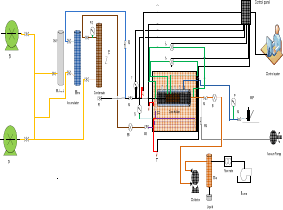
<body><![CDATA[<p><font size="2" face="Verdana, Arial, Helvetica, sans-serif">Many strategies have been proposed for  stimulations in wells that show condensate banking effects: recycling gas,  water injection, water alternating with gas (WAG), hydraulic fracture  stimulation, viscosity reduction and chemical treatments, thereby delaying the  onset of condensate formation around the wellbore [2],[3]. </font></p>     <p><font size="2" face="Verdana, Arial, Helvetica, sans-serif">There are some mechanisms proposed to  explain the enhancement in gas effective permeability and also the higher  degree of cleaning and liquid removing obtained in laboratory and field studies  [4]. Three of them are: miscible displacement, interfacial tension reduction  and alteration of wettability. Miscible  displacement uses solvents to remove water and hydrocarbons from the region  near to the wellbore. Interfacial tension reduction uses surfactant injection  with solvents. The surfactant reduces  the interfacial tension between formation fluids and once the interfacial tension  decreases, the solvent is injected. The  third mechanism is the alteration of rock wettability. Li and Firoozabadi [5]  used polymeric surfactants and Kumar [7] used fluorosurfactants to remove the  condensate banking for altering the wettability of reservoir from liquid to  intermediate gas wet. They concluded  that this mechanism is more efficient to remove the banking condensate. Various  chemicals were found that work well, and stimulations showed that this process  could be economic. Firoozabadi and co-workers [5] first proposed to use  chemicals to alter the wettability of the formation in the near wellbore region  to mitigate the damage caused by condensate banking. Since most gas reservoirs  are thought to be water wet, it is predicted that by changing the wettability  to neutral wet (contact angle of ± 90), the relative permeability of the  condensate banking and gas would both increase, resulting in substantial  increase of productivity [6]. Kumar [7] conducted flow test at reservoir  conditions to study the effect of various fluorosurfactants on wettability as  well as the changes in critical parameters: gas relative permeability and  capillary number (Krg = f(Krg/Kro, Nc)). In all instances, capillary forces  trap some of this liquid in the pores resulting in a high liquid saturation and  a reduction in the relative permeability of both the gas and condensate, which is  the cause of the loss in production. Even for lean gas (1% liquid dropout)  significant liquid condensate saturations can build up near the wells and can  decrease production by a factor of two or three. </font></p>     <p><font size="2" face="Verdana, Arial, Helvetica, sans-serif">The  objective of this study is to simulate three different gas condensate reservoir  conditions in the laboratory (using three different compositions of synthetic  gas condensate) below dew point and injecting three different solvents  (methanol, propanol and methylene chloride) for each gas condensate reservoir conditions  and evaluate which is the best solvent to remove the condensate banking. Gas  effective permeability (K<sub>G</sub>) is measured in three different stages:  a) Stage 1: at residual water saturation, b) Stage 2: when generating  condensate banking, and c) Stage 3: after removing condensate banking. The more  efficient solvent was selected based on comparison of gas effective  permeabilities in stages 2 and 3.</font></p>     <p>&nbsp;</p>     <p><font size="3" face="Verdana, Arial, Helvetica, sans-serif"><b>2. EXPERIMENTNAL   APPARATUS AND PROCEDURE </b></font></p>     <p><font size="2" face="Verdana, Arial, Helvetica, sans-serif"><b>2.1 Core flood set  up    <br> </b><a href="#fig01">Figure 1</a> shows a schematic diagram of the core flood apparatus.  Positive displacement pumps were used to inject fluids at constant fluid rate.  Multiple ports were used to measure pressure at the ends of the core holder. Two back pressures regulators were used to  control the flowing pressure upstream and downstream. The core holder and flow  lines are inside a temperature-controlled oven. Three different temperatures were used depending on the composition of  synthetic gas.</font></p>     <p align="center"><font size="2" face="Verdana, Arial, Helvetica, sans-serif"><b><a name="fig01"></a><img src="/img/revistas/dyna/v76n157/a16fig01.gif">    <br> Figure 1</b>. Scheme of core flood system</font></p>     <p><font size="2" face="Verdana, Arial, Helvetica, sans-serif"><b>2.2 Gas  mixtures properties    ]]></body>
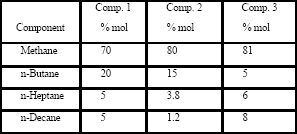
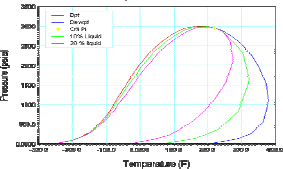
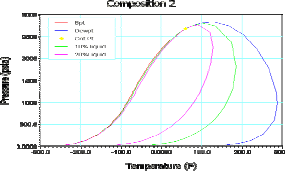
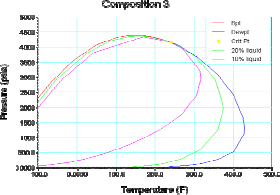
<body><![CDATA[<br> </b></font><font size="2" face="Verdana, Arial, Helvetica, sans-serif"><a href="#tab01">Table 1</a> shows the  composition of three different synthetic gas condensate fluids that were used  to perform experiments at   150°F, 200°F  and 250°F.  Peng Robinson equation was used to generate phase envelops in Hysys Program and  <a href="#fig02">figures 2</a>, <a href="#fig03">3</a>, <a href="#fig04">4</a> shows the phase envelopes. The selection of each composition was done base in previous experimental  works [7].</font></p>     <p align="center"><font size="2" face="Verdana, Arial, Helvetica, sans-serif"><b><a name="tab01"></a>Table  1. </b>Components of synthetic gas compositions</font>    <br>  <img src="/img/revistas/dyna/v76n157/a16tab01.gif"></p>     <p align="center"><font size="2" face="Verdana, Arial, Helvetica, sans-serif"><b><a name="fig02"></a><img src="/img/revistas/dyna/v76n157/a16fig02.gif">    <br>   Figure  2. </b>Composition 1</font></p>     <p align="center"><font size="2" face="Verdana, Arial, Helvetica, sans-serif"><b><a name="fig03"></a><img src="/img/revistas/dyna/v76n157/a16fig03.gif">    <br> Figure 3. </b>Composition 2</font></p>     <p align="center"><font size="2" face="Verdana, Arial, Helvetica, sans-serif"><b><a name="fig04"></a><img src="/img/revistas/dyna/v76n157/a16fig04.gif">    <br> Figure 4. </b>Composition 3</font></p>     <p><font size="2" face="Verdana, Arial, Helvetica, sans-serif"><b>2.3 Rock properties    ]]></body>
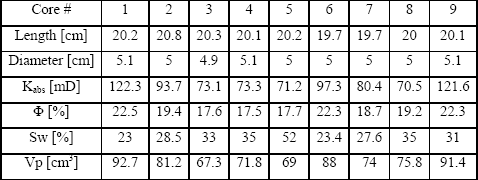
<body><![CDATA[<br> </b>Berea sandstone was used in the core flood experiments. <a href="#tab02">Table 2</a> list the properties  of nine cores  used in the tests. The cores were dried in an  oven at 95<sup>o</sup>C for 48 hours and wrapped in aluminum foil to eliminate  the diffusion of gases and possible interaction of fluids with the viton  sleeve. </font></p>     <p align="center"><font size="2" face="Verdana, Arial, Helvetica, sans-serif"><b><a name="tab02"></a>Table 2. </b> Core properties</font>    <br>   <img src="/img/revistas/dyna/v76n157/a16tab02.gif"></p>     <p><font size="2" face="Verdana, Arial, Helvetica, sans-serif"><b>2.4  Compatibility Test    <br> </b></font><font size="2" face="Verdana, Arial, Helvetica, sans-serif">Compatibility test was the main tool to be  sure that the used solvents didn’t generate additional formation damage when  mixed with formation fluids. The objective was to determine if the fluids  generate any kind of precipitated solids, gums, or colloidal particles when  they are mixed. Bottle test were  performed and no precipitated solids were observed, therefore the fluids used  in this experimental study guarantee no damage in the core caused by fluids  incompatibility.</font></p>     <p><font size="2" face="Verdana, Arial, Helvetica, sans-serif"><b>2.5  Core flood Procedure    <br> </b></font><font size="2" face="Verdana, Arial, Helvetica, sans-serif">The cores were placed into a core holder  inside the oven at three different temperatures depending on the synthetic gas composition.  An overburden pressure of 2,000 psi was applied and vacuum pump was turned on  for three hours to assure no air is kept inside the core. After vacuum three  pore volumes of Brine were injected a constant flow rate (1 cc/min) to guarantee  100% water saturation. </font></p>     <p><font size="2" face="Verdana, Arial, Helvetica, sans-serif">The experimental procedure designed for  each run is as follow: 1. Flooding the core with brine, 2. Displacing brine  using nitrogen to get residual water saturation, 3. Measuring gas effective  permeability using methane( flow rate was between 1lt/sec to 5lt/sec), 4.  Generating banking condensate, 5. Measuring gas effective permeability using  methane, 6. Removing of banking condensate, 7. Measuring gas effective  permeability using methane, and 8. Collect produced fluids.</font></p>     <p><font size="2" face="Verdana, Arial, Helvetica, sans-serif"><b>2.6 Gas effective permeability    <br> </b></font><font size="2" face="Verdana, Arial, Helvetica, sans-serif">Gas  effective permeability is the ability to preferentially flow or transmit a  particular fluid when other immiscible fluids are present in the reservoir [8].  It was necessary to assure that the only fluid that was moving through the core  was methane so residual liquid saturation was reached and gas effective  permeability could be measured in the laboratory. Inlet and outlet pressures of  the core and average flow rate (it was measured as a function of injected gas  pore volume) were measured as well. Gas effective permeability was measured in  three different stages: at specific water saturation (stage 1), after  condensate banking generation (stage 2) and after removing banking condensate (stage 3). </font></p>     ]]></body>
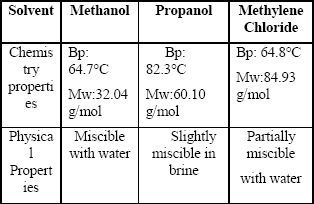
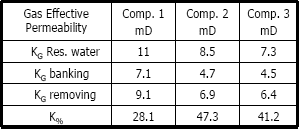
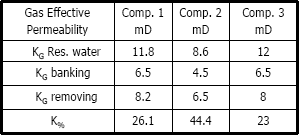
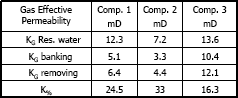
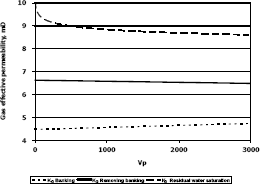
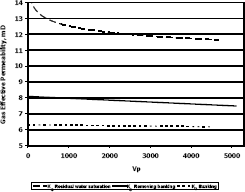
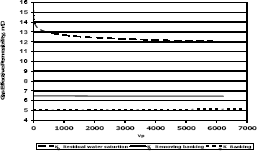
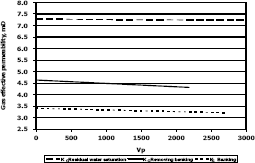
<body><![CDATA[<p><font size="2" face="Verdana, Arial, Helvetica, sans-serif"><b>2.7 Miscible displacement    <br> </b></font><font size="2" face="Verdana, Arial, Helvetica, sans-serif">Miscible displacement in hydrocarbon  reservoir has been described as the displacement of heavier hydrocarbons from  pore space in a rock using a solvent action that prevent formation of  interfaces between formation fluids. Miscible displacement is considered to be  very efficient because it eliminates capillary forces. In the absence of  capillary pressure, no interface exists between miscible fluids of different  composition [9]. They fall generally into two classes: process in which the injected  fluid and in-place-fluid form a single-phase solution for all compositions and  processes in which the injected fluid and in-place-fluid don’t form a single  equilibrium phase but which may generate a zone of contiguous single-phase by  multi-contacts miscibility [10]. There  are some studies [11] which are focused in the second class of miscible  displacement to explain the improvement in mobility at the region near to the wellbore after injection solvents. </font></p>     <p><font size="2" face="Verdana, Arial, Helvetica, sans-serif">This project considered three different solvents  to remove the gas condensate banking: methanol, propane and methylene chloride.  Methanol has been widely used in experimental works and fields worldwide  basically because it demonstrated to be effective when mixed with hydrocarbons  and most water formations. There are not published results of experimental  works using propane and methylene chloride as solvents even though they are  used broadly as solvents in the chemical industry and both of them are miscible  in water. In this way this work seeks other alternative mixtures of solvents to  get more efficient solutions in order to remove banking condensate.</font></p>     <p>&nbsp;</p>     <p><font size="2" face="Verdana, Arial, Helvetica, sans-serif"><b><font size="3">3. RESULTS   AND DISCUSION</font></b></font></p>     <p><font size="2" face="Verdana, Arial, Helvetica, sans-serif"><b>3.1  Effect of Solvents Treatment    <br> </b><a href="#tab03">Table 3</a> shows the basic chemical and  physical properties of the solvents used to remove the banking condensate. <a href="#fig05">Figures 5</a> to <a href="#fig13">13</a> are plots of gas effective  permeability vs. pore volume of gas methane injected to measure gas effective  permeability during the three different stages for every solvent. <a href="#tab04">Tables 4</a>, <a href="#tab05">5</a>  and <a href="#tab06">6</a> summarize results of gas effective permeability for each run.</font></p>     <p align="center"><font size="2" face="Verdana, Arial, Helvetica, sans-serif"><b><a name="tab03"></a>Table  3. </b>Chemical and Physical Properties of Solvents</font>    <br>  <img src="/img/revistas/dyna/v76n157/a16tab03.gif"></p>     <p align="center"><font size="2" face="Verdana, Arial, Helvetica, sans-serif"><b><a name="tab04"></a>Table 4. </b> Gas effective permeability using methanol</font>    ]]></body>
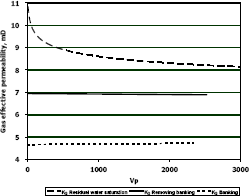
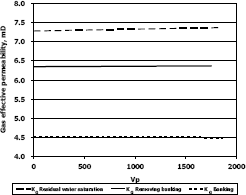
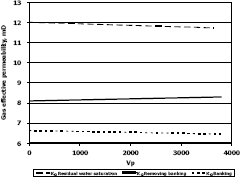
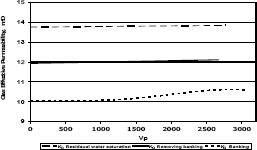
<body><![CDATA[<br>   <img src="/img/revistas/dyna/v76n157/a16tab04.gif"></p>     <p align="center"><font size="2" face="Verdana, Arial, Helvetica, sans-serif"><b><a name="tab05"></a>Table 5.</b> Gas effective permeability   using propanol</font>    <br>   <img src="/img/revistas/dyna/v76n157/a16tab05.gif"></p>     <p align="center"><font size="2" face="Verdana, Arial, Helvetica, sans-serif"><b><a name="tab06"></a>Table 6</b>. Gas effective permeability using methylene chloride</font>    <br>   <img src="/img/revistas/dyna/v76n157/a16tab06.gif"></p>     <p><font size="2" face="Verdana, Arial, Helvetica, sans-serif"><b>3.2 Methanol Injection    <br> </b><a href="#fig05">Figures  5</a>, <a href="#fig06">6</a> and <a href="#fig07">7</a> show a plot of gas effective permeability for each stage vs. pore  volumes injected for the three different compositions of gas condensate. <a href="#tab04">Table  4</a> shows gas effective permeability for each stage for the three different  composition of gas condensate fluid. When removing banking condensate using  methanol the gas effective permeability improved and the percentages with respect  to the banking condensate were 28.1 %, 47.3 % and 41.2 %, respectively. This  means gas effective permeability after injection of methanol to remove banking  condensate improved 28.1 %, 47.3 % and 41.2 % with respect to the gas effective permeability of the banking condensate.</font></p>     <p align="center"><font size="2" face="Verdana, Arial, Helvetica, sans-serif"><b><a name="fig05"></a><img src="/img/revistas/dyna/v76n157/a16fig05.gif">    <br>   Figure 5. </b>Gas effective permeability vs.  pore volumes for<b> c</b>omposition 1,  solvent methanol </font></p>     <p align="center"><font size="2" face="Verdana, Arial, Helvetica, sans-serif"><b><a name="fig06"></a><img src="/img/revistas/dyna/v76n157/a16fig06.gif">    ]]></body>
<body><![CDATA[<br>   Figure 6. </b>Gas  effective permeability vs. pore volumes for<b> c</b>omposition 2, solvent methanol</font></p>     <p align="center"><font size="2" face="Verdana, Arial, Helvetica, sans-serif"><b><a name="fig07"></a><img src="/img/revistas/dyna/v76n157/a16fig07.gif">    <br> Figure 7. </b>Gas effective permeability vs. pore volumes for<b> c</b>omposition 3, solvent methanol</font></p>     <p><font size="2" face="Verdana, Arial, Helvetica, sans-serif">The highest increase in gas  effective permeability was obtained for composition 2 which is 47.3% as showed  in <a href="#tab04">table 4</a>. </font></p>     <p><font size="2" face="Verdana, Arial, Helvetica, sans-serif"><b>3.3 Propanol Injection    <br> </b><a href="#fig08">Figures  8</a>, <a href="#fig09">9</a> and <a href="#fig10">10</a> present gas effective permeability for each stage vs. pore volumes  injected for three different composition of gas condensate. <a href="#tab05">Table 5</a> shows gas  effective permeability for each stage for the three different composition of  gas condensate fluid. When removing banking condensate using propanol the gas  effective permeability improved and the percentages with respect to the banking condensate were 26.1%, 44.4% and 23%, respectively. </font></p>     <p align="center"><font size="2" face="Verdana, Arial, Helvetica, sans-serif"><b><a name="fig08"></a><img src="/img/revistas/dyna/v76n157/a16fig08.gif">    <br> Figure 8. </b>Gas effective permeability vs. pore volumes for<b> c</b>omposition 1, solvent propanol</font></p>     <p align="center"><font size="2" face="Verdana, Arial, Helvetica, sans-serif"><b><a name="fig09"></a><img src="/img/revistas/dyna/v76n157/a16fig09.gif">    <br> Figure 9. </b>Gas effective permeability vs. pore volumes for composition 2, solvent propanol </font></p>     ]]></body>
<body><![CDATA[<p align="center"><font size="2" face="Verdana, Arial, Helvetica, sans-serif"><b><a name="fig10"></a></b><img src="/img/revistas/dyna/v76n157/a16fig10.gif"><b>    <br>   Figure 10. </b>Gas effective permeability   vs. pore volumes for<b> c</b>omposition 3,   solvent propanol </font></p>     <p><font size="2" face="Verdana, Arial, Helvetica, sans-serif">This means gas effective permeability after injection  of propanol to remove banking condensate improved 26.1%, 44.4% and 23% with  respect to the gas effective permeability of the banking condensate.</font></p>     <p><font size="2" face="Verdana, Arial, Helvetica, sans-serif">The highest increase in gas  effective permeability was obtained for composition 2 which is 44.4% as showed  in <a href="#tab05">table 5</a>. </font></p>     <p><font size="2" face="Verdana, Arial, Helvetica, sans-serif"><b>3.4 Methylene chloride injection    <br> </b><a href="#fig11">Figures 11</a>, <a href="#fig12">12</a> and <a href="#fig13">13</a> present gas effective  permeability for each stage vs. pore volumes injected for the three different  composition of synthetic gas condensate. <a href="#tab06">Table 6</a> shows an average of gas  effective permeability for each stage for the three different composition of  gas condensate fluid. When removing banking condensate using propanol the gas  effective permeability improved and the percentages with respect to the banking  condensate were 24.5%, 33% and 16.3%, respectively. This means gas effective  permeability after injection of propanol to remove banking condensate improved  24.5%, 33% and 16.3% with respect to the gas effective permeability of the  banking condensate. The highest increase in gas effective permeability was obtained for composition 2 which is 33.0% as showed in <a href="#tab06">table 6</a>. </font></p>     <p align="center"><font size="2" face="Verdana, Arial, Helvetica, sans-serif"><b><a name="fig11"></a><img src="/img/revistas/dyna/v76n157/a16fig11.gif">    <br> Figure 11. </b>Gas effective permeability vs. pore volumes for<b> c</b>omposition 1, solvent methylene chloride</font></p>     <p align="center"><font size="2" face="Verdana, Arial, Helvetica, sans-serif"><b><a name="fig12"></a><img src="/img/revistas/dyna/v76n157/a16fig12.gif">    <br> Figure 12. </b>Gas effective permeability vs. pore volumes for<b> c</b>omposition 2, solvent methylene chloride</font></p>     ]]></body>
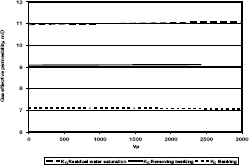
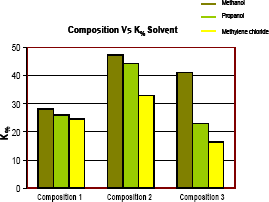
<body><![CDATA[<p align="center"><font size="2" face="Verdana, Arial, Helvetica, sans-serif"><b><a name="fig13"></a><img src="/img/revistas/dyna/v76n157/a16fig13.gif">    <br> Figure 13. </b>Gas effective permeability vs. pore volumes for<b> c</b>omposition 3, solvent methylene chloride</font></p>     <p><font size="2" face="Verdana, Arial, Helvetica, sans-serif">The three solvents  demonstrated to remove the banking condensate in all of the gas synthetic gas  condensate compositions as showed in <a href="#fig05">figures 5</a> to <a href="#fig13">13</a> because values of gas  effective permeability were higher after removing banking condensate compared  with respect to gas effective permeability of banking condensate. These results  are close to previous experimental studies that showed that alcohols can be  used as solvents to remove banking condensate and enhance gas relative  permeability [12], [13].</font></p>     <p><font size="2" face="Verdana, Arial, Helvetica, sans-serif"><a href="#fig14">Figure 14</a> shows that values of  gas effective permeability when using methanol were the highest compared with  other solvents. It could be explained because methanol has dual miscibility  with water and hydrocarbons while propanol and methylene chloride are partially  miscible in some water formation. Since all of solvent used are miscible in  hydrocarbons, multi contact miscible displacement could be the mechanism that  displace the liquid hydrocarbon in the banking condensate. The efficiency of  solvent depends on many variables such as properties of formation fluids, pore  volume of the solvent injected and formation characteristics.</font></p>     <p align="center"><font size="2" face="Verdana, Arial, Helvetica, sans-serif"><b><a name="fig14"></a><img src="/img/revistas/dyna/v76n157/a16fig14.gif">    <br>   Figure 14. </b>Gas permeability percentage increase   for 3 compositions and 3 solvents </font></p>     <p><font size="2" face="Verdana, Arial, Helvetica, sans-serif">Permeability of the rock will  affect drastically the efficiency of solvent. Cores with low permeability have small  pores so interfacial forces and capillary pressures will be stronger than in those  cores with high permeability. Pore size distribution, therefore permeability,  will affect miscibility when solvents are injected because solvents could be  concentrated in pores of intermediate and high diameter removing hydrocarbons  in those pores efficiently.</font></p>     <p>&nbsp;</p>     <p><font size="3" face="Verdana, Arial, Helvetica, sans-serif"><b>5. CONCLUSIONS</b></font></p> <ul>    <li><font size="2" face="Verdana, Arial, Helvetica, sans-serif">Laboratory design allowed the evaluation of     effectiveness in removing damage caused by banking condensate using three     different solvents: methanol, methylene chloride and propanol.</font></li>       ]]></body>
<body><![CDATA[<li><font size="2" face="Verdana, Arial, Helvetica, sans-serif">All of the solvents used for removing     banking condensate presented high values of gas effective permeability when     compared with the values of the gas curve of effective permeability before     treatment using solvents, therefore they removed condensate blocking.</font></li>       <li><font size="2" face="Verdana, Arial, Helvetica, sans-serif">The best solvent to remove condensate     banking for all gas condensate compositions was methanol because it gives the     highest increases in the gas effective permeability.</font></li>       <li><font size="2" face="Verdana, Arial, Helvetica, sans-serif">Ø Methylene chloride, although removed     condensate blocking presented the lowest increases in gas effective     permeability. </font></li>     </ul>     <p>&nbsp;</p>     <p><font size="2" face="Verdana, Arial, Helvetica, sans-serif"><b>6. RECOMMENDATIONS</b></font></p> <ol>       <li><font size="2" face="Verdana, Arial, Helvetica, sans-serif">Mixing methanol with other solutions     should be done in order to improve the miscibility of methanol in hydrocarbons     and water formation and also will reduce the cost associated with pure     solvents.</font></li>       <li><font size="2" face="Verdana, Arial, Helvetica, sans-serif">Additional work needs to be done to study the phase     behavior of hydrocarbons hydrocarbons-water- methanol mixtures that may be used     under different reservoir conditions, in particular at higher temperatures and     different compositions.</font></li>     </ol>     <p><font size="2" face="Verdana, Arial, Helvetica, sans-serif"><b>NOMENCLATURE</b></font></p>     ]]></body>
<body><![CDATA[<blockquote>       <p><font size="2" face="Verdana, Arial, Helvetica, sans-serif">Bp:     Boiling Point    <br> </font><font size="2" face="Verdana, Arial, Helvetica, sans-serif">K<sub>G</sub>:   water residual: gas effective permeability at residual water mD    <br>   </font><font size="2" face="Verdana, Arial, Helvetica, sans-serif">K<sub>G</sub>:     banking: gas effective permeability before treatment, mD    <br>     </font><font size="2" face="Verdana, Arial, Helvetica, sans-serif">K<sub>G</sub>:       removing: gas effective permeability after treatment, mD    <br>     </font><font size="2" face="Verdana, Arial, Helvetica, sans-serif">K<sub>abs</sub>:         Absolute permeability to liquid, mD    <br>     </font><font size="2" face="Verdana, Arial, Helvetica, sans-serif">K%:           Increase in percent of gas effective permeability when compared gas effective           permeability of removing banking with gas effective permeability of banking           condensate.    <br>     </font><font size="2" face="Verdana, Arial, Helvetica, sans-serif">Krg:             gas relative permeability    <br>     </font><font size="2" face="Verdana, Arial, Helvetica, sans-serif">Kro:               oil relative permeability    <br>     </font><font size="2" face="Verdana, Arial, Helvetica, sans-serif">Mw:                 molecular weight    ]]></body>
<body><![CDATA[<br>     </font><font size="2" face="Verdana, Arial, Helvetica, sans-serif">Nc:                   capillary number    <br>     </font><font size="2" face="Verdana, Arial, Helvetica, sans-serif">Sw: Residual water saturation    <br>     </font><font size="2" face="Verdana, Arial, Helvetica, sans-serif">Vp: pore volume </font></p> </blockquote>     <p><font size="2" face="Verdana, Arial, Helvetica, sans-serif"><b>Greek Symbols</b></font></p>     <blockquote>       <p><font size="2" face="Verdana, Arial, Helvetica, sans-serif">&#934;: Porosity, %</font></p> </blockquote>     <p>&nbsp;</p>     <p><font size="3" face="Verdana, Arial, Helvetica, sans-serif"><b>REFERENCES</b></font></p>     <!-- ref --><p>   <font size="2" face="Verdana, Arial, Helvetica, sans-serif"><b> [1]</b> KUMAR V., POPE G.A., SHARMA M. M., “Improving the gas and Condensate Relative Permeability Using Chemical Treatments ”, SPE 100529 presented by at the 2006 SPE Gas Technology Symposium Held in Calgary, Alberta, Canada, 15-17 may 2006.    &nbsp;&nbsp;&nbsp;&nbsp;&nbsp;&nbsp;&nbsp;&nbsp;[&#160;<a href="javascript:void(0);" onclick="javascript: window.open('/scielo.php?script=sci_nlinks&ref=000131&pid=S0012-7353200900010001600001&lng=','','width=640,height=500,resizable=yes,scrollbars=1,menubar=yes,');">Links</a>&#160;]<!-- end-ref --><!-- ref --><br>   <b>[2]</b> DU L., WALKER J., POPE G., SHARMA M., WANG P., “Use of Solvents to Improve the Productivity of Gas Condensate Wells”, SPE 62935 presented at the 2000 SPE Annual technical conference and exhibition held in Dallas, Texas, 1-4 October 2000.    &nbsp;&nbsp;&nbsp;&nbsp;&nbsp;&nbsp;&nbsp;&nbsp;[&#160;<a href="javascript:void(0);" onclick="javascript: window.open('/scielo.php?script=sci_nlinks&ref=000132&pid=S0012-7353200900010001600002&lng=','','width=640,height=500,resizable=yes,scrollbars=1,menubar=yes,');">Links</a>&#160;]<!-- end-ref --><!-- ref --><br>   <b>[3]</b> FAM L., HARRIS B., JANALUDDIN A., KAMMATH J., MOTT R., POPE G., SHANDRYGIN A., WHITSON C., “Understanding Gas Condensate Reservoirs,” Oilfield Review. Winter 2005-2006. Chevron     &nbsp;&nbsp;&nbsp;&nbsp;&nbsp;&nbsp;&nbsp;&nbsp;[&#160;<a href="javascript:void(0);" onclick="javascript: window.open('/scielo.php?script=sci_nlinks&ref=000133&pid=S0012-7353200900010001600003&lng=','','width=640,height=500,resizable=yes,scrollbars=1,menubar=yes,');">Links</a>&#160;]<!-- end-ref --><!-- ref --><br>   <b>[4]</b> AL-ANAZI H., WALKER J., POPE G., SHARMA M., HACKNEY D., “A successful Methanol Treatment in Gas-Condensate Reservoir: Field Application”, SPE 80901 presented at SPE production and Operations symposium held in Oklahoma City , USA, 22-25 March 2003.    &nbsp;&nbsp;&nbsp;&nbsp;&nbsp;&nbsp;&nbsp;&nbsp;[&#160;<a href="javascript:void(0);" onclick="javascript: window.open('/scielo.php?script=sci_nlinks&ref=000134&pid=S0012-7353200900010001600004&lng=','','width=640,height=500,resizable=yes,scrollbars=1,menubar=yes,');">Links</a>&#160;]<!-- end-ref --><!-- ref --><br>   <b>[5]</b> FIROOZABADI F., “Wettability Alteration to intermediate Gas Wetting in gas/Condensate Reservoirs at high temperatures,” SPE 96184, presented at the SPE Annual Technical Conference and Exhibition, Dallas, October 9-12, 2005.    &nbsp;&nbsp;&nbsp;&nbsp;&nbsp;&nbsp;&nbsp;&nbsp;[&#160;<a href="javascript:void(0);" onclick="javascript: window.open('/scielo.php?script=sci_nlinks&ref=000135&pid=S0012-7353200900010001600005&lng=','','width=640,height=500,resizable=yes,scrollbars=1,menubar=yes,');">Links</a>&#160;]<!-- end-ref --><!-- ref --><br>   <b>[6]</b> KAMATH J., “Deliverability of gas Condensate Reservoir-field Experiences and predictions techniques”, JPT Volume 59 Number 4, April 2007.    &nbsp;&nbsp;&nbsp;&nbsp;&nbsp;&nbsp;&nbsp;&nbsp;[&#160;<a href="javascript:void(0);" onclick="javascript: window.open('/scielo.php?script=sci_nlinks&ref=000136&pid=S0012-7353200900010001600006&lng=','','width=640,height=500,resizable=yes,scrollbars=1,menubar=yes,');">Links</a>&#160;]<!-- end-ref --><!-- ref --><br>   <b>[7]</b> KUMAR V., “Chemical Stimulation of gas Condensate Reservoirs: An Experimental and Stimulation Study,” PhD. Dissertation, The University of Texas at Austin. 2006.    &nbsp;&nbsp;&nbsp;&nbsp;&nbsp;&nbsp;&nbsp;&nbsp;[&#160;<a href="javascript:void(0);" onclick="javascript: window.open('/scielo.php?script=sci_nlinks&ref=000137&pid=S0012-7353200900010001600007&lng=','','width=640,height=500,resizable=yes,scrollbars=1,menubar=yes,');">Links</a>&#160;]<!-- end-ref --><!-- ref --><br>   <b>[8]</b> TIAB D., DONALDSON E., Petrophysics Second Edition. Elsevier Gulf Professional Publishing, Oxford 2004.    &nbsp;&nbsp;&nbsp;&nbsp;&nbsp;&nbsp;&nbsp;&nbsp;[&#160;<a href="javascript:void(0);" onclick="javascript: window.open('/scielo.php?script=sci_nlinks&ref=000138&pid=S0012-7353200900010001600008&lng=','','width=640,height=500,resizable=yes,scrollbars=1,menubar=yes,');">Links</a>&#160;]<!-- end-ref --><!-- ref --><br>   <b>[9]</b> SALAMA D., KANTZAS A., “Experimental Observations of Miscible Displacement of Heavy Oils with Hydrocarbon Solvents ”, SPE 97854 presented at the 2005 SPE International Thermal Operations and heavy Oil Symposium Held in Calgary, Alberta Canada, 1-3 November 2005.    &nbsp;&nbsp;&nbsp;&nbsp;&nbsp;&nbsp;&nbsp;&nbsp;[&#160;<a href="javascript:void(0);" onclick="javascript: window.open('/scielo.php?script=sci_nlinks&ref=000139&pid=S0012-7353200900010001600009&lng=','','width=640,height=500,resizable=yes,scrollbars=1,menubar=yes,');">Links</a>&#160;]<!-- end-ref --><!-- ref --><br>   <b>[10]</b> RATHMELL, J., STALKUP F., HASSINGER, R., “A laboratory investigation of miscible Displacement by carbon dioxide,” SPE paper 3483, presented by the 46th annual Fall Meeting of the AIME, held in New Orleans, La., Oct. 3-6, 1971.    &nbsp;&nbsp;&nbsp;&nbsp;&nbsp;&nbsp;&nbsp;&nbsp;[&#160;<a href="javascript:void(0);" onclick="javascript: window.open('/scielo.php?script=sci_nlinks&ref=000140&pid=S0012-7353200900010001600010&lng=','','width=640,height=500,resizable=yes,scrollbars=1,menubar=yes,');">Links</a>&#160;]<!-- end-ref --><!-- ref --><br>   <b>[11]</b> WALKER J., “Laboratory evaluation of alcohols and surfactants to increase production from gas condensate reservoirs,” M.S. Thesis, the University of Texas Austin, December 2000.    &nbsp;&nbsp;&nbsp;&nbsp;&nbsp;&nbsp;&nbsp;&nbsp;[&#160;<a href="javascript:void(0);" onclick="javascript: window.open('/scielo.php?script=sci_nlinks&ref=000141&pid=S0012-7353200900010001600011&lng=','','width=640,height=500,resizable=yes,scrollbars=1,menubar=yes,');">Links</a>&#160;]<!-- end-ref --><!-- ref --><br>   <b>[12]</b> ZHAO L., “Steam Alternating Solvent Process”, SPE 86957 presented at the SPE International Thermal Operations and Heavy oil Symposium and western regional meeting held in Bakersfield, California, U.S.A. , 16-18 March 2004.    &nbsp;&nbsp;&nbsp;&nbsp;&nbsp;&nbsp;&nbsp;&nbsp;[&#160;<a href="javascript:void(0);" onclick="javascript: window.open('/scielo.php?script=sci_nlinks&ref=000142&pid=S0012-7353200900010001600012&lng=','','width=640,height=500,resizable=yes,scrollbars=1,menubar=yes,');">Links</a>&#160;]<!-- end-ref --><!-- ref --><br>   <b>[13]</b> KOOL H., AZARI M., SOLIMAN M., PROETTT M., IRANI C., DYBDAHL B., “Testing of Gas Condensate Reservoirs-Sampling, Test Design and Analysis” SPE 68668 presented at the SPE Asia Pacific Oil and Gas Conference and Exhibition held in Jakarta, Indonesia, 17-19 April 2001. </font>&nbsp;&nbsp;&nbsp;&nbsp;&nbsp;&nbsp;&nbsp;&nbsp;[&#160;<a href="javascript:void(0);" onclick="javascript: window.open('/scielo.php?script=sci_nlinks&ref=000143&pid=S0012-7353200900010001600013&lng=','','width=640,height=500,resizable=yes,scrollbars=1,menubar=yes,');">Links</a>&#160;]<!-- end-ref --> ]]></body><back>
<ref-list>
<ref id="B1">
<label>1</label><nlm-citation citation-type="confpro">
<person-group person-group-type="author">
<name>
<surname><![CDATA[KUMAR]]></surname>
<given-names><![CDATA[V.]]></given-names>
</name>
<name>
<surname><![CDATA[POPE]]></surname>
<given-names><![CDATA[G.A.]]></given-names>
</name>
<name>
<surname><![CDATA[SHARMA]]></surname>
<given-names><![CDATA[M. M.]]></given-names>
</name>
</person-group>
<article-title xml:lang="en"><![CDATA[Improving the gas and Condensate Relative Permeability Using Chemical Treatments]]></article-title>
<source><![CDATA[]]></source>
<year></year>
<conf-name><![CDATA[ SPE 100529 presented by at the 2006 SPE Gas Technology Symposium Held]]></conf-name>
<conf-date>15-17 may 2006</conf-date>
<conf-loc>Calgary Alberta</conf-loc>
</nlm-citation>
</ref>
<ref id="B2">
<label>2</label><nlm-citation citation-type="confpro">
<person-group person-group-type="author">
<name>
<surname><![CDATA[DU]]></surname>
<given-names><![CDATA[L.]]></given-names>
</name>
<name>
<surname><![CDATA[WALKER]]></surname>
<given-names><![CDATA[J.]]></given-names>
</name>
<name>
<surname><![CDATA[POPE]]></surname>
<given-names><![CDATA[G.]]></given-names>
</name>
<name>
<surname><![CDATA[SHARMA]]></surname>
<given-names><![CDATA[M.]]></given-names>
</name>
<name>
<surname><![CDATA[WANG]]></surname>
<given-names><![CDATA[P.]]></given-names>
</name>
</person-group>
<article-title xml:lang="en"><![CDATA[Use of Solvents to Improve the Productivity of Gas Condensate Wells]]></article-title>
<source><![CDATA[]]></source>
<year></year>
<conf-name><![CDATA[ 2000 SPE Annual technical conference and exhibition held]]></conf-name>
<conf-date>1-4 October 2000</conf-date>
<conf-loc>Dallas Texas</conf-loc>
</nlm-citation>
</ref>
<ref id="B3">
<label>3</label><nlm-citation citation-type="">
<person-group person-group-type="author">
<name>
<surname><![CDATA[FAM]]></surname>
<given-names><![CDATA[L.]]></given-names>
</name>
<name>
<surname><![CDATA[HARRIS]]></surname>
<given-names><![CDATA[B.]]></given-names>
</name>
<name>
<surname><![CDATA[JANALUDDIN]]></surname>
<given-names><![CDATA[A.]]></given-names>
</name>
<name>
<surname><![CDATA[KAMMATH]]></surname>
<given-names><![CDATA[J.]]></given-names>
</name>
<name>
<surname><![CDATA[MOTT]]></surname>
<given-names><![CDATA[R.]]></given-names>
</name>
<name>
<surname><![CDATA[POPE]]></surname>
<given-names><![CDATA[G.]]></given-names>
</name>
<name>
<surname><![CDATA[SHANDRYGIN]]></surname>
<given-names><![CDATA[A.]]></given-names>
</name>
<name>
<surname><![CDATA[WHITSON]]></surname>
<given-names><![CDATA[C.]]></given-names>
</name>
</person-group>
<source><![CDATA[Understanding Gas Condensate Reservoirs: Oilfield Review]]></source>
<year></year>
<publisher-loc><![CDATA[Chevron ]]></publisher-loc>
</nlm-citation>
</ref>
<ref id="B4">
<label>4</label><nlm-citation citation-type="confpro">
<person-group person-group-type="author">
<name>
<surname><![CDATA[AL-ANAZI]]></surname>
<given-names><![CDATA[H.]]></given-names>
</name>
<name>
<surname><![CDATA[WALKER]]></surname>
<given-names><![CDATA[J.]]></given-names>
</name>
<name>
<surname><![CDATA[POPE]]></surname>
<given-names><![CDATA[G.]]></given-names>
</name>
<name>
<surname><![CDATA[SHARMA]]></surname>
<given-names><![CDATA[M.]]></given-names>
</name>
<name>
<surname><![CDATA[HACKNEY]]></surname>
<given-names><![CDATA[D.]]></given-names>
</name>
</person-group>
<article-title xml:lang="en"><![CDATA[A successful Methanol Treatment in Gas-Condensate Reservoir: Field Application]]></article-title>
<source><![CDATA[]]></source>
<year></year>
<conf-name><![CDATA[ SPE production and Operations symposium held]]></conf-name>
<conf-date>22-25 March 2003</conf-date>
<conf-loc>Oklahoma City </conf-loc>
</nlm-citation>
</ref>
<ref id="B5">
<label>5</label><nlm-citation citation-type="confpro">
<person-group person-group-type="author">
<name>
<surname><![CDATA[FIROOZABADI]]></surname>
<given-names><![CDATA[F.]]></given-names>
</name>
</person-group>
<article-title xml:lang="en"><![CDATA[Wettability Alteration to intermediate Gas Wetting in gas/Condensate Reservoirs at high temperatures]]></article-title>
<source><![CDATA[]]></source>
<year></year>
<conf-name><![CDATA[ SPE Annual Technical Conference and Exhibition]]></conf-name>
<conf-date>October 9-12, 2005</conf-date>
<conf-loc>Dallas </conf-loc>
</nlm-citation>
</ref>
<ref id="B6">
<label>6</label><nlm-citation citation-type="journal">
<person-group person-group-type="author">
<name>
<surname><![CDATA[KAMATH]]></surname>
<given-names><![CDATA[J.]]></given-names>
</name>
</person-group>
<article-title xml:lang="en"><![CDATA[Deliverability of gas Condensate Reservoir-field Experiences and predictions techniques]]></article-title>
<source><![CDATA[JPT]]></source>
<year>Apri</year>
<month>l </month>
<day>20</day>
<volume>59</volume>
<numero>4</numero>
<issue>4</issue>
</nlm-citation>
</ref>
<ref id="B7">
<label>7</label><nlm-citation citation-type="">
<person-group person-group-type="author">
<name>
<surname><![CDATA[KUMAR]]></surname>
<given-names><![CDATA[V.]]></given-names>
</name>
</person-group>
<source><![CDATA[Chemical Stimulation of gas Condensate Reservoirs: An Experimental and Stimulation Study]]></source>
<year></year>
</nlm-citation>
</ref>
<ref id="B8">
<label>8</label><nlm-citation citation-type="book">
<person-group person-group-type="author">
<name>
<surname><![CDATA[TIAB]]></surname>
<given-names><![CDATA[D.]]></given-names>
</name>
<name>
<surname><![CDATA[DONALDSON]]></surname>
<given-names><![CDATA[E.]]></given-names>
</name>
</person-group>
<source><![CDATA[Petrophysics]]></source>
<year>2004</year>
<edition>Second</edition>
<publisher-loc><![CDATA[Oxford ]]></publisher-loc>
<publisher-name><![CDATA[Elsevier Gulf Professional Publishing]]></publisher-name>
</nlm-citation>
</ref>
<ref id="B9">
<label>9</label><nlm-citation citation-type="confpro">
<person-group person-group-type="author">
<name>
<surname><![CDATA[SALAMA]]></surname>
<given-names><![CDATA[D.]]></given-names>
</name>
<name>
<surname><![CDATA[KANTZAS]]></surname>
<given-names><![CDATA[A.]]></given-names>
</name>
</person-group>
<article-title xml:lang="en"><![CDATA[Experimental Observations of Miscible Displacement of Heavy Oils with Hydrocarbon Solvents]]></article-title>
<source><![CDATA[]]></source>
<year></year>
<conf-name><![CDATA[ SPE International Thermal Operations and heavy Oil Symposium Held]]></conf-name>
<conf-date>1-3 November 2005</conf-date>
<conf-loc>Calgary Alberta</conf-loc>
</nlm-citation>
</ref>
<ref id="B10">
<label>10</label><nlm-citation citation-type="confpro">
<person-group person-group-type="author">
<name>
<surname><![CDATA[RATHMELL]]></surname>
<given-names><![CDATA[J.]]></given-names>
</name>
<name>
<surname><![CDATA[STALKUP]]></surname>
<given-names><![CDATA[F.]]></given-names>
</name>
<name>
<surname><![CDATA[HASSINGER]]></surname>
<given-names><![CDATA[R.]]></given-names>
</name>
</person-group>
<article-title xml:lang="en"><![CDATA[A laboratory investigation of miscible Displacement by carbon dioxide]]></article-title>
<source><![CDATA[]]></source>
<year></year>
<conf-name><![CDATA[46th annual Fall Meeting of the AIME]]></conf-name>
<conf-date>Oct. 3-6, 1971</conf-date>
<conf-loc>New Orleans </conf-loc>
</nlm-citation>
</ref>
<ref id="B11">
<label>11</label><nlm-citation citation-type="">
<person-group person-group-type="author">
<name>
<surname><![CDATA[WALKER]]></surname>
<given-names><![CDATA[J.]]></given-names>
</name>
</person-group>
<source><![CDATA[Laboratory evaluation of alcohols and surfactants to increase production from gas condensate reservoirs]]></source>
<year></year>
</nlm-citation>
</ref>
<ref id="B12">
<label>12</label><nlm-citation citation-type="confpro">
<person-group person-group-type="author">
<name>
<surname><![CDATA[ZHAO]]></surname>
<given-names><![CDATA[L.]]></given-names>
</name>
</person-group>
<article-title xml:lang="en"><![CDATA[Steam Alternating Solvent Process]]></article-title>
<source><![CDATA[]]></source>
<year></year>
<conf-name><![CDATA[ SPE International Thermal Operations and Heavy oil Symposium and western regional meeting held in Bakersfield]]></conf-name>
<conf-date>16-18 March 2004</conf-date>
<conf-loc>California </conf-loc>
</nlm-citation>
</ref>
<ref id="B13">
<label>13</label><nlm-citation citation-type="confpro">
<person-group person-group-type="author">
<name>
<surname><![CDATA[KOOL]]></surname>
<given-names><![CDATA[H.]]></given-names>
</name>
<name>
<surname><![CDATA[AZARI]]></surname>
<given-names><![CDATA[M.]]></given-names>
</name>
<name>
<surname><![CDATA[SOLIMAN]]></surname>
<given-names><![CDATA[M.]]></given-names>
</name>
<name>
<surname><![CDATA[PROETTT]]></surname>
<given-names><![CDATA[M.]]></given-names>
</name>
<name>
<surname><![CDATA[IRANI]]></surname>
<given-names><![CDATA[C.]]></given-names>
</name>
<name>
<surname><![CDATA[DYBDAHL]]></surname>
<given-names><![CDATA[B.]]></given-names>
</name>
</person-group>
<article-title xml:lang="en"><![CDATA[Testing of Gas Condensate Reservoirs-Sampling, Test Design and Analysis]]></article-title>
<source><![CDATA[]]></source>
<year></year>
<conf-name><![CDATA[ SPE Asia Pacific Oil and Gas Conference and Exhibition held]]></conf-name>
<conf-date>17-19 April 2001</conf-date>
<conf-loc>Jakarta </conf-loc>
</nlm-citation>
</ref>
</ref-list>
</back>
</article>