<?xml version="1.0" encoding="ISO-8859-1"?><article xmlns:mml="http://www.w3.org/1998/Math/MathML" xmlns:xlink="http://www.w3.org/1999/xlink" xmlns:xsi="http://www.w3.org/2001/XMLSchema-instance">
<front>
<journal-meta>
<journal-id>0012-7353</journal-id>
<journal-title><![CDATA[DYNA]]></journal-title>
<abbrev-journal-title><![CDATA[Dyna rev.fac.nac.minas]]></abbrev-journal-title>
<issn>0012-7353</issn>
<publisher>
<publisher-name><![CDATA[Universidad Nacional de Colombia]]></publisher-name>
</publisher>
</journal-meta>
<article-meta>
<article-id>S0012-73532009000100022</article-id>
<title-group>
<article-title xml:lang="en"><![CDATA[EVALUATION OF WHITE CEMENT COLOURED WITH ULTRAMARINE BLUE PIGMENT]]></article-title>
<article-title xml:lang="es"><![CDATA[EVALUACIÓN DEL DESEMPEÑO MECÁNICO DEL CEMENTO BLANCO COLOREADO CON PIGMENTO AZUL ULTRAMAR]]></article-title>
</title-group>
<contrib-group>
<contrib contrib-type="author">
<name>
<surname><![CDATA[RESTREPO GUTIÉRREZ]]></surname>
<given-names><![CDATA[JUAN CAMILO]]></given-names>
</name>
<xref ref-type="aff" rid="A01"/>
</contrib>
<contrib contrib-type="author">
<name>
<surname><![CDATA[RESTREPO BAENA]]></surname>
<given-names><![CDATA[OSCAR JAIME]]></given-names>
</name>
<xref ref-type="aff" rid="A02"/>
</contrib>
<contrib contrib-type="author">
<name>
<surname><![CDATA[TOBÓN]]></surname>
<given-names><![CDATA[JORGE IVÁN]]></given-names>
</name>
<xref ref-type="aff" rid="A03"/>
</contrib>
</contrib-group>
<aff id="A01">
<institution><![CDATA[,National University of Colombia Cement Group and Building Materials ]]></institution>
<addr-line><![CDATA[Medellín ]]></addr-line>
</aff>
<aff id="A02">
<institution><![CDATA[,National University of Colombia Cement Group and Building Materials ]]></institution>
<addr-line><![CDATA[Medellín ]]></addr-line>
</aff>
<aff id="A03">
<institution><![CDATA[,National University of Colombia Cement Group and Building Materials ]]></institution>
<addr-line><![CDATA[Medellín ]]></addr-line>
</aff>
<pub-date pub-type="pub">
<day>00</day>
<month>06</month>
<year>2009</year>
</pub-date>
<pub-date pub-type="epub">
<day>00</day>
<month>06</month>
<year>2009</year>
</pub-date>
<volume>76</volume>
<numero>157</numero>
<fpage>225</fpage>
<lpage>231</lpage>
<copyright-statement/>
<copyright-year/>
<self-uri xlink:href="http://www.scielo.org.co/scielo.php?script=sci_arttext&amp;pid=S0012-73532009000100022&amp;lng=en&amp;nrm=iso"></self-uri><self-uri xlink:href="http://www.scielo.org.co/scielo.php?script=sci_abstract&amp;pid=S0012-73532009000100022&amp;lng=en&amp;nrm=iso"></self-uri><self-uri xlink:href="http://www.scielo.org.co/scielo.php?script=sci_pdf&amp;pid=S0012-73532009000100022&amp;lng=en&amp;nrm=iso"></self-uri><abstract abstract-type="short" xml:lang="en"><p><![CDATA[In this study the performance of white cement coloured with ultramarine blue pigment was evaluated. The performance is explained through of the mineralogical changes occurring in the replacement of cement by pigment in percentages of 5, 10, 15 and 20%. It produced concrete and pastes to be studied to 3, 7, 28 and 90 days of standard cured. It was found that the ultramarine blue pigment to come in touch with the C3A of cement and water, allows the formation of large quantities of primary ettringite (disordered and dispersed in the matrix), thank to its sulphur content. It implies an increase of mechanical strength of the concrete blended whit Ultrramarine blue pigment as much as 45% to 90 days of standard curing.]]></p></abstract>
<abstract abstract-type="short" xml:lang="en"><p><![CDATA[En el presente trabajo se evalúa el desempeño mecánico del cemento blanco coloreado con pigmento azul ultramar y se explica su desempeño a partir de las modificaciones mineralógicas acaecidas por la sustitución de cemento por pigmento en porcentajes de 5, 10, 15 y 20%. Se fabricaron hormigones y pastas para ser estudiados a 3, 7, 28 y 90 días de curado normal. Se encontró que el pigmento Azul Ultramar al entrar en contacto con el C3A del cemento y el agua, y debido a su contenido de azufre, permite la formación de grandes cantidades de etringita primaria (desordenada y dispersa en la matriz), lo cual se traduce en un incremento de la resistencias mecánicas de los hormigones sustituidos con Azul Ultramar hasta en un 45% a 90 días de curado normal.]]></p></abstract>
<kwd-group>
<kwd lng="es"><![CDATA[Blended white cement]]></kwd>
<kwd lng="es"><![CDATA[Hydration products]]></kwd>
<kwd lng="es"><![CDATA[ultramarine blue pigment]]></kwd>
<kwd lng="es"><![CDATA[ettringite]]></kwd>
<kwd lng="es"><![CDATA[pozzolan]]></kwd>
<kwd lng="en"><![CDATA[Cemento blanco pigmentado]]></kwd>
<kwd lng="en"><![CDATA[hormigones coloreados]]></kwd>
<kwd lng="en"><![CDATA[azul ultramar]]></kwd>
<kwd lng="en"><![CDATA[etringita primaria]]></kwd>
<kwd lng="en"><![CDATA[cemento adicionado]]></kwd>
</kwd-group>
</article-meta>
</front><body><![CDATA[ <p align="center"><font size="4" face="Verdana, Arial, Helvetica, sans-serif"><b>EVALUATION OF WHITE CEMENT COLOURED WITH  ULTRAMARINE BLUE PIGMENT</b></font></p>     <p align="center"><i><font size="3" face="Verdana, Arial, Helvetica, sans-serif"><b>EVALUACIÓN DEL DESEMPEÑO MECÁNICO DEL CEMENTO BLANCO  COLOREADO CON PIGMENTO AZUL ULTRAMAR</b></font></i></p>     <p align="center">&nbsp;</p>     <p align="center"><font size="2" face="Verdana, Arial, Helvetica, sans-serif"><b>JUAN CAMILO RESTREPO GUTIÉRREZ</b>    <br>   </font><font size="2" face="Verdana, Arial, Helvetica, sans-serif"><i>Cement Group and Building     Materials, National      University     of Colombia, Medellín, <a href="mailto:jcrestre@unalmed.edu.co">jcrestre@unalmed.edu.co</a></i></font></p>     <p align="center"><font size="2" face="Verdana, Arial, Helvetica, sans-serif"> <b>OSCAR JAIME RESTREPO  BAENA</b>    <br> </font><font size="2" face="Verdana, Arial, Helvetica, sans-serif"><i>Cement Group and Building Materials, National   University of Colombia, Medellín, <a href="mailto:ojrestre@unalmed.edu.co">ojrestre@unalmed.edu.co</a></i></font></p>     <p align="center"><font size="2" face="Verdana, Arial, Helvetica, sans-serif"> <b>JORGE IVÁN TOBÓN</b>    <br> </font><font size="2" face="Verdana, Arial, Helvetica, sans-serif"><i>Cement Group and Building Materials, National   University of Colombia, Medellín, <a href="mailto:jitobon@unal.edu.co">jitobon@unal.edu.co</a></i></font></p>     <p align="center">&nbsp;</p>     ]]></body>
<body><![CDATA[<p align="center"><font size="2" face="Verdana, Arial, Helvetica, sans-serif"><b>Recibido para revisar mayo 20 de 2008, aceptado octubre 14 de 2008, versión final noviembre 11 de  2008</b></font></p>     <p>&nbsp;</p> <hr>     <p><font size="2" face="Verdana, Arial, Helvetica, sans-serif"><b>ABSTRACT: </b>In this study the performance of white cement coloured  with ultramarine blue pigment was evaluated. The performance is explained through of the mineralogical changes  occurring in the replacement of cement by pigment in percentages of 5, 10, 15  and 20%. It produced concrete and pastes to be studied to 3, 7, 28 and 90 days  of standard cured.</font></p>     <p><font size="2" face="Verdana, Arial, Helvetica, sans-serif">It  was found that the ultramarine blue pigment to come in touch with the C3A of cement  and water, allows the formation of large quantities of primary ettringite  (disordered and dispersed in the matrix), thank to its sulphur content. It  implies an increase of mechanical strength of the concrete blended whit  Ultrramarine blue pigment as much as 45% to 90 days of standard curing.</font></p>     <p><font size="2" face="Verdana, Arial, Helvetica, sans-serif"><b>KEYWORDS:</b> Blended white cement, Hydration products, ultramarine  blue pigment, ettringite, pozzolan.</font></p>     <p><font size="2" face="Verdana, Arial, Helvetica, sans-serif"><b>RESUMEN: </b>En el presente trabajo se evalúa el desempeño mecánico  del cemento blanco coloreado con pigmento azul ultramar y se explica su  desempeño a partir de las modificaciones mineralógicas acaecidas por la  sustitución de cemento por pigmento en porcentajes de 5, 10, 15 y 20%. Se  fabricaron hormigones y pastas para ser estudiados a 3, 7, 28 y 90 días de  curado normal.</font></p>     <p><font size="2" face="Verdana, Arial, Helvetica, sans-serif">Se encontró que el pigmento Azul Ultramar al entrar en contacto con el  C3A del cemento y el agua, y debido a su contenido de azufre, permite la  formación de grandes cantidades de etringita primaria (desordenada y dispersa  en la matriz), lo cual se traduce en un incremento de la resistencias mecánicas  de los hormigones sustituidos con Azul Ultramar hasta en un 45% a 90 días de  curado normal.</font></p>     <p><font size="2" face="Verdana, Arial, Helvetica, sans-serif"><b>PALABRAS CLAVE: </b>Cemento  blanco pigmentado, hormigones coloreados, azul ultramar, etringita primaria,  cemento adicionado.</font></p> <hr>     <p>&nbsp;</p>     <p><font size="3" face="Verdana, Arial, Helvetica, sans-serif"><b>1. INTRODUCTION </b></font></p>     ]]></body>
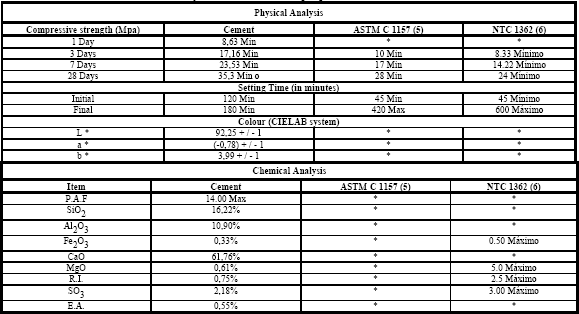
<body><![CDATA[<p><font size="2" face="Verdana, Arial, Helvetica, sans-serif">Pigments are powdery materials consisting of very small particles, in  some cases with sizes less than 1 &#956;m. Pigments colour depends on its nature,  mineralogical and chemical composition, manufacturing process, purity, particle  forms and size distribution, specific surface area and other properties. Colour  in concrete can be obtain in two different ways, the first one to paint its  hardened surface and the second one by adding colouring agents to the mix  during its manufacturing process or during the process of hardening. </font></p>     <p><font size="2" face="Verdana, Arial, Helvetica, sans-serif">Ultramarine blue is an inorganic pigment, it is a silicate aluminium  complex with sodium and sulphur, and it is formed from kaolin in a thermic  process. </font></p>     <p><font size="2" face="Verdana, Arial, Helvetica, sans-serif">B. Kronne [1] made a comparative study of the influence of various  mineral pigments, such as ultramarines and oxides, in improving the mechanical  properties of concrete products. This work reported a significant increase in  compression strength, to 7 days, in concrete using ultramarine blue pigment. Restrepo  [2] and Sweep [3] explain this phenomenon by two possible hypotheses, the  packaging of pigment in the paste gaps or from an ion exchange between the  pigment and cement.</font></p>     <p><font size="2" face="Verdana, Arial, Helvetica, sans-serif">These experiments indicate that the ultramarine blue pigment reacts  directly with calcium hydroxide free in the hydration of Portland cement,  forming a complex of aluminium, calcium and silicon, which make an additional  resistance to the product, assuming behaviour like natural pozzolans.</font></p>     <p><font size="2" face="Verdana, Arial, Helvetica, sans-serif">Present work is focused on evaluating and identifying the  crystallization and the transformations that are generated in the  microstructure of concrete from the mixing of white cement with ultramarine  blue pigment in different replacement proportions of white cement and to  identify and understand the changes occurring in the pigment that is in contact  with the alkaline solution, produced during cement hydration.</font></p>     <p>&nbsp;</p>     <p><font size="3" face="Verdana, Arial, Helvetica, sans-serif"><b>2. MATERIALS AND METHODS</b></font></p>     <p><font size="2" face="Verdana, Arial, Helvetica, sans-serif">It was used white   Portland  cement Type I according to ASTM C 150-02a (4), supplied by Cementos Argos S.  A., Nare plant. It was compared with ASTM C 1157-02 (5) and NTC- 1362 (6) and  It could be classified as a hydraulic cement for general construction and as  White Portland Cement type 1B respectively. Its main physical and chemical  characteristics are outlined in <a href="#tab01">Table 1</a>. </font></p>     <p align="center"><font size="2" face="Verdana, Arial, Helvetica, sans-serif"><b><a name="tab01"></a>Table 1.</b> Physical and chemical properties of used cement</font>    <br>   <img src="/img/revistas/dyna/v76n157/a22tab01.gif"></p>     ]]></body>
<body><![CDATA[<p><font size="2" face="Verdana, Arial, Helvetica, sans-serif">Ultramarine  blue pigment U-301, is a commercial pigment of Nubiola Colombia S.A. Quartz  standardized from of Toxement, Eucofiller type was used as fine sand, coarse  grain size, between 10 and 20 Tyler  mesh (crystalline silica up to 90%). As coarse  aggregate an alluvial deposit of   Medellin river with  igneous and metamorphic rocks was used, with maximum size defined as 12.5 mm or ½ &quot;.</font></p>     <p><font size="2" face="Verdana, Arial, Helvetica, sans-serif">In  the concrete of reference (Mixture type 1) the following dosage was used =  1:1.8:2.65 and water/cement (w/c) = 0,493. Where: <b>1</b> - white cement, <b>1.8</b> – fine  material and <b>2.65</b> – coarse material.  The water/cement (w/c) guarantees the settlement required. Cylinders were  immersed in a tank of water cured until the day that they were failed. </font></p>     <p><font size="2" face="Verdana, Arial, Helvetica, sans-serif">Mixture  type 2 (5% replacement) - White Cement =   3,667 kg. Pigment = 0,193 kg. w/c = 0,493 -   1.93 litres.    <br> </font><font size="2" face="Verdana, Arial, Helvetica, sans-serif">Mixture  type 3 (10% replacement) - White Cement =   3,474 kg. Pigment = 0,386 kg. w/c = 0,493 -  1.93 litres.    <br>  </font><font size="2" face="Verdana, Arial, Helvetica, sans-serif">Mixture  type 4 (15% replacement) - White Cement =   3,281 kg. Pigment = 0,579 kg. w/c = 0,493 -  1.93 litres.    <br>  </font><font size="2" face="Verdana, Arial, Helvetica, sans-serif">Mixture  type 5 (20% replacement) - White Cement =   3,088 kg. Pigment = 0,772 kg. w/c = 0,493 -  1.93 litres. </font></p>     <p><font size="2" face="Verdana, Arial, Helvetica, sans-serif">For mineralogical analysis and the determination of their possible phase  transformations pastes were manufactured, according to the different amounts of  pigment replacement. The water/binder relation (w/b) was defined through the  test for normal consistency of hydraulic cement, NTC 110 (7) or ASTM C187 (8). </font></p>     <p><font size="2" face="Verdana, Arial, Helvetica, sans-serif">For this analysis it was used a scanning electron microscope (SEM) Jeol  JSM LV 5910, with accelerating voltage of 30 KV, vacuum system combined with mechanical  pump, filament of tungsten, with secondary electron detector (SE), retro  projected (BSE) and X-ray type EDS and WDS; of National University of Colombia,  Medellin. Analyses were performed in the way of high vacuum of the equipment. </font></p>     <p>&nbsp;</p>     <p><font size="3" face="Verdana, Arial, Helvetica, sans-serif"><b>3. RESULTS </b></font></p>     ]]></body>
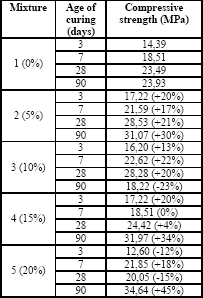
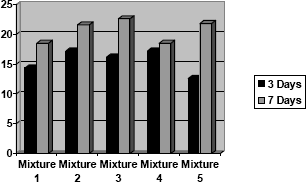
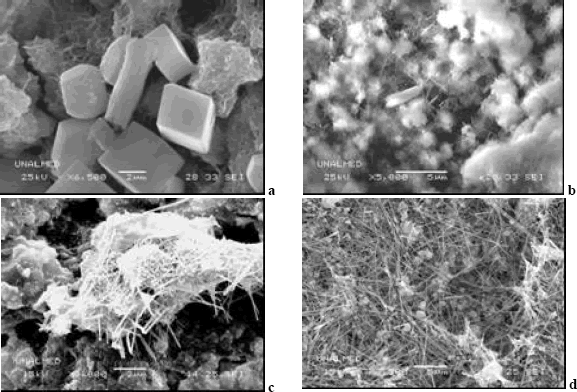
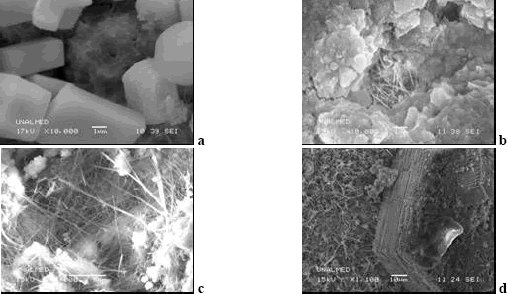
<body><![CDATA[<p><font size="2" face="Verdana, Arial, Helvetica, sans-serif"><b>3.1 Mechanical Strength    <br> </b>In     <a href="#tab02">Table 2</a> and <a href="#fig01">Figure 1</a> it is presented the results for the compressive strength of concrete cylinders with and without replacement of pigment.</font></p>     <p align="center"><font size="2" face="Verdana, Arial, Helvetica, sans-serif"><b><a name="tab02"></a>Table 2</b>. Compressive strength of the pigmented concretes</font>    <br>   <img src="/img/revistas/dyna/v76n157/a22tab02.gif"></p>     <p align="center"> <font size="2" face="Verdana, Arial, Helvetica, sans-serif"><b> <a name="fig01"></a><img src="/img/revistas/dyna/v76n157/a22fig01.gif">    <br> Figure 1.</b> Mechanical strength of concrete cylinders</font></p>     <p><font size="2" face="Verdana, Arial, Helvetica, sans-serif">It  is possible to see that there is a clear trend on pigmented concrete with  ultramarine blue to have greater strength compared to concrete reference as  much as 45%, it becomes more significant over cured time and the percentage of  replacement. The results also suggest that the early  strength are diminished with  substitutions above 15%, however, the finals strength are benefiting from very high  rates of replacement obtaining  profits by 34%  and 45% in the resistance  to the concrete with replacement 15% and  20% respectively, compared to concrete without any replacement.</font></p>     <p><font size="2" face="Verdana, Arial, Helvetica, sans-serif"><b>3.2 Mineralogical  Analysis    <br> </b><a href="#fig02">Figure 2</a> presents the images obtained in SEM for the different samples  for 7 days of cured.</font></p>     <p align="center"><font size="2" face="Verdana, Arial, Helvetica, sans-serif"><b><a name="fig02"></a><img src="/img/revistas/dyna/v76n157/a22fig02.gif">    ]]></body>
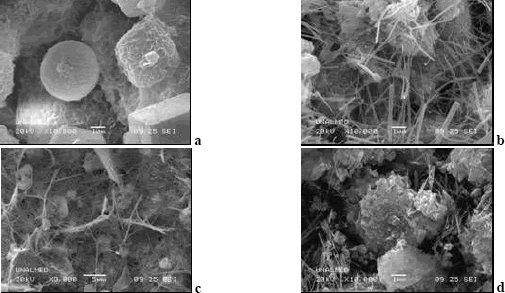
<body><![CDATA[<br>   Figure 2.</b> Different pastes mineralogy to 7 days of cured: mixture  1, b:2 mixture, c:mixture  3, and d:mixture 4</font></p>     <p><font size="2" face="Verdana, Arial, Helvetica, sans-serif">This figure shows that ettringite is most important mineralogical phase (in  quantity) and it increases as the percentage of pigment in mixtures grows. This  is because the possible chemical reaction between the sulphur content in the  pigment with the tricalcium aluminate (C3A) present in the white cement, in the  presence of water. In the photographs c and d of <a href="#fig01">Figure 1</a> is clear the relationship  ettringite/pigment.</font></p>     <p><font size="2" face="Verdana, Arial, Helvetica, sans-serif">With the excess of ettringite and C3A (natural in white cement) is  carried out the formation of monosulfoaluminate (Afm) (<a href="#fig03">Figure 2-d</a>).</font></p>     <p><font size="2" face="Verdana, Arial, Helvetica, sans-serif"><a href="#fig03">Figure 3</a> shows SEM images obtained in the different samples for 28 days of  cured. <b>a</b>: mixture 1, <b>b</b>: mixture 2, c:mixture 3 and <b>d</b>: mixture 4.</font></p>     <p align="center"><font size="2" face="Verdana, Arial, Helvetica, sans-serif"><b><a name="fig03"></a><img src="/img/revistas/dyna/v76n157/a22fig03.gif">    <br>   Figure 3</b>. Different pastes mineralogy to 28  days of cured: mixture 1, b: 2 mixture,  c: mixture 3, and d: mixture 4</font></p>     <p><font size="2" face="Verdana, Arial, Helvetica, sans-serif"><a href="#fig03">Figure 3-a</a> did not show the presence of structures like  ettringite, while that another mixes showed growth in the number of ettringite  crystals with the increasing of the percentage of replacement of cement by  pigment. Actually, Note that all the ettringite formed is disorderly, and intertwined  in the matrix. Even now to this time is possible to find fragments of pigment without reacting and the crystals  of ettringite are forming from them (<a href="#fig03">Figure 3-d</a>)</font>.</p>     <p><font size="2" face="Verdana, Arial, Helvetica, sans-serif"><a href="#fig04">Figure 4</a> shows the SEM images obtained in the different samples for 90  days of cured.</font></p>     <p align="center"><font size="2" face="Verdana, Arial, Helvetica, sans-serif"><b><a name="fig04"></a><img src="/img/revistas/dyna/v76n157/a22fig04.gif">    <br>   Figure 4.</b> Different pastes mineralogy to  28 days of cured: mixture 1, b: 2 mixture, c: mixture 3, and d: mixture 4</font></p>     ]]></body>
<body><![CDATA[<p><font size="2" face="Verdana, Arial, Helvetica, sans-serif">At  the age of 90 days of cured (<a href="#fig04">Figure 4-a</a>) it was recognised, for first time, in  this study ettringite in the mixture 1 (no added pigment). In the other  mixtures, at this age, to carry on been clear the greatest formation of ettringite  with increasing replacement of cement by pigment, It was observed crystals  ettringite (<a href="#fig04">Figure 4-d</a>) even now with few magnifies. As is shown in <a href="#fig04">Figure 4-c</a> remaining pigment without reacting and monosulfoaluminate has been formed.</font></p>     <p>&nbsp;</p>     <p><font size="3" face="Verdana, Arial, Helvetica, sans-serif"><b>4. DISCUSSION </b></font></p>     <p><font size="2" face="Verdana, Arial, Helvetica, sans-serif">The formation of ettringite needles for all mixtures with pigment is  directly proportional to the increase in the replacement of cement by pigment  and age cured. Additionally, it is possible to see the link between the pigment  and these crystalline structures, because from them the structures in the form  of needles were formed. </font></p>     <p><font size="2" face="Verdana, Arial, Helvetica, sans-serif">The formation of ettringite within the matrix of concrete is produced  through the sulphur content of pigment and the large quantity of C3A present in the  white cement used in the tests. The pozzolanic effect of the ultramarine blue  could not be verified through the mineralogical tests because we did not find a  decrease on portlandite quantity with the increase of the substitution the  cement by pigment.</font></p>     <p><font size="2" face="Verdana, Arial, Helvetica, sans-serif">It was found that an improvement in the mechanical strength of the  concrete occur with increasing replacement of cement by pigment and age cured.  This shows that the formation of primary ettringite is responsible for the  increasing resistance of concrete through the inter-growing of theses crystals.  This agrees with the explanation for the development of resistance makes   Taylor of cements over sulphates  [9]. This work fits well with research [10 and 11] that have been made nowadays  with the aim of reducing the emission of gases during the manufacture of cement  working with oversulphate belitic cements to produce large amounts of ettringite  and increase the early strength.</font></p>     <p><font size="2" face="Verdana, Arial, Helvetica, sans-serif">It is possible that the pigment also carries the physical effect of  filling pores in the matrix thanks to its small particle size and that this mechanism  in some measures is providing for the development of resistance on concrete blended.  While this is perfectly possible, the work of Giraldo and colleagues [12] show  that substituting different pigments only in the ultramarine blue mortars  increases the resistance compared with the reference, this suggests that is  possible that exist a physical effect but that is the chemical effect which  controls the increase in mechanical strength. This means that the Ultramarine  Blue is an active addition, although it does not have the typical behaviour of  pozzolan materials.</font></p>     <p><font size="2" face="Verdana, Arial, Helvetica, sans-serif">For 90 days of curing persist fragments of pigment without reacting to  the case of mixtures with 10% and 15% replacement of cement by pigment, which  could be suggesting that the mechanical resistance may increase more over time  until the C3A hydrated are consumed entirely.</font></p>     <p><font size="2" face="Verdana, Arial, Helvetica, sans-serif">Another topic that should be explored is the durability of concrete made  with this type of blended cement especially concerning the carbonation as was  proposed by authors such as Zhou &amp; Glasser [13]</font></p>     <p>&nbsp;</p>     ]]></body>
<body><![CDATA[<p><font size="3" face="Verdana, Arial, Helvetica, sans-serif"><b>5. CONCLUSION</b></font></p>     <p><font size="2" face="Verdana, Arial, Helvetica, sans-serif">Concrete with replacement of cement by Ultramarine Blue pigment shows  increases in the values of compressive strength near to 45% in comparison  concrete reference (0% substitution). These improvements are directly  proportional to the percentage of replacement  and cured age.</font></p>     <p><font size="2" face="Verdana, Arial, Helvetica, sans-serif">The C3A of cement reacts with Ultramarine Blue pigment, in water  presence, to form a large number of ettringite structures with needle habits,  which create a very dense structure by the intersecting needles that provide  significant mechanical resistance to concrete. The amount of ettringite  increases directly with increasing the percentage of replacement of cement by  pigment. </font></p>     <p><font size="2" face="Verdana, Arial, Helvetica, sans-serif">The images obtained by SEM allowed identify the relationship between the  pigment and ettringite. These needles of ettingite are formed from the pigment particles. </font></p>     <p>&nbsp;</p>     <p><font size="3" face="Verdana, Arial, Helvetica, sans-serif"><b>REFERENCES</b></font></p>     <!-- ref --><p><font size="2" face="Verdana, Arial, Helvetica, sans-serif"><b> [1]</b> KROONE, B. “Las reacciones entre el cemento Portland hidratado y el Azul Ultramar”. Division of Building Research, Commonwealth Scientific and Industrial Research Organization, Melbourne, Australia , 1968.    &nbsp;&nbsp;&nbsp;&nbsp;&nbsp;&nbsp;&nbsp;&nbsp;[&#160;<a href="javascript:void(0);" onclick="javascript: window.open('/scielo.php?script=sci_nlinks&ref=000079&pid=S0012-7353200900010002200001&lng=','','width=640,height=500,resizable=yes,scrollbars=1,menubar=yes,');">Links</a>&#160;]<!-- end-ref --><!-- ref --><br>   <b>[2]</b> RESTREPO BAENA, O.J. Pigmento Azul Ultramar, Caracterización del proceso y producto. Doctoral Thesis, Oviedo Un iversity, Oviedo, Spain. 1995.    &nbsp;&nbsp;&nbsp;&nbsp;&nbsp;&nbsp;&nbsp;&nbsp;[&#160;<a href="javascript:void(0);" onclick="javascript: window.open('/scielo.php?script=sci_nlinks&ref=000080&pid=S0012-7353200900010002200002&lng=','','width=640,height=500,resizable=yes,scrollbars=1,menubar=yes,');">Links</a>&#160;]<!-- end-ref --><!-- ref --><br>     <b>[3]</b> BARRER, R.M. Y RAITT, J.S. Intercambio iónico del Ultramar. Universidad de Aberdeen, Agosto de 1954.    &nbsp;&nbsp;&nbsp;&nbsp;&nbsp;&nbsp;&nbsp;&nbsp;[&#160;<a href="javascript:void(0);" onclick="javascript: window.open('/scielo.php?script=sci_nlinks&ref=000081&pid=S0012-7353200900010002200003&lng=','','width=640,height=500,resizable=yes,scrollbars=1,menubar=yes,');">Links</a>&#160;]<!-- end-ref --><!-- ref --><br>     <b>[4]</b> ASTM C 150-02a.Standard Specification for Portland Cement.    &nbsp;&nbsp;&nbsp;&nbsp;&nbsp;&nbsp;&nbsp;&nbsp;[&#160;<a href="javascript:void(0);" onclick="javascript: window.open('/scielo.php?script=sci_nlinks&ref=000082&pid=S0012-7353200900010002200004&lng=','','width=640,height=500,resizable=yes,scrollbars=1,menubar=yes,');">Links</a>&#160;]<!-- end-ref --><!-- ref --><br>     <b>[5]</b> ASTM C1157. Standard Performance Specification for Hydraulic Cement. 2002.    &nbsp;&nbsp;&nbsp;&nbsp;&nbsp;&nbsp;&nbsp;&nbsp;[&#160;<a href="javascript:void(0);" onclick="javascript: window.open('/scielo.php?script=sci_nlinks&ref=000083&pid=S0012-7353200900010002200005&lng=','','width=640,height=500,resizable=yes,scrollbars=1,menubar=yes,');">Links</a>&#160;]<!-- end-ref --><!-- ref --><br>     <b>[6]</b> NTC 1362. Cemento Pórtland Blanco. Normas Técnicas Colombianas para el Sector de la Construcción– I.    &nbsp;&nbsp;&nbsp;&nbsp;&nbsp;&nbsp;&nbsp;&nbsp;[&#160;<a href="javascript:void(0);" onclick="javascript: window.open('/scielo.php?script=sci_nlinks&ref=000084&pid=S0012-7353200900010002200006&lng=','','width=640,height=500,resizable=yes,scrollbars=1,menubar=yes,');">Links</a>&#160;]<!-- end-ref --><!-- ref --><br>     <b>[7]</b> Norma Técnica Colombiana (NTC) 110. Método para determinar la consistencia normal del cemento.    &nbsp;&nbsp;&nbsp;&nbsp;&nbsp;&nbsp;&nbsp;&nbsp;[&#160;<a href="javascript:void(0);" onclick="javascript: window.open('/scielo.php?script=sci_nlinks&ref=000085&pid=S0012-7353200900010002200007&lng=','','width=640,height=500,resizable=yes,scrollbars=1,menubar=yes,');">Links</a>&#160;]<!-- end-ref --><!-- ref --><br>     <b>[8]</b> ASTM C187. Standard Test Method for Normal Consistency of Hydraulic Cement. 1998.    &nbsp;&nbsp;&nbsp;&nbsp;&nbsp;&nbsp;&nbsp;&nbsp;[&#160;<a href="javascript:void(0);" onclick="javascript: window.open('/scielo.php?script=sci_nlinks&ref=000086&pid=S0012-7353200900010002200008&lng=','','width=640,height=500,resizable=yes,scrollbars=1,menubar=yes,');">Links</a>&#160;]<!-- end-ref --><!-- ref --><br>     <b>[9]</b> H.F.W TAYLOR. Cement Chemistry. 2nd edition. Thomas Telford, 1997. 459p.    &nbsp;&nbsp;&nbsp;&nbsp;&nbsp;&nbsp;&nbsp;&nbsp;[&#160;<a href="javascript:void(0);" onclick="javascript: window.open('/scielo.php?script=sci_nlinks&ref=000087&pid=S0012-7353200900010002200009&lng=','','width=640,height=500,resizable=yes,scrollbars=1,menubar=yes,');">Links</a>&#160;]<!-- end-ref --><!-- ref --><br>     <b>[10]</b> GLASSER, F. & ZHANG, L. High-performance cement matrices based on calcium sulfoaluminate- belite compositions. Cement and Concrete Research 31 (2001) 1881 – 1886.    &nbsp;&nbsp;&nbsp;&nbsp;&nbsp;&nbsp;&nbsp;&nbsp;[&#160;<a href="javascript:void(0);" onclick="javascript: window.open('/scielo.php?script=sci_nlinks&ref=000088&pid=S0012-7353200900010002200010&lng=','','width=640,height=500,resizable=yes,scrollbars=1,menubar=yes,');">Links</a>&#160;]<!-- end-ref --><!-- ref --><br>     <b>[11]</b> QUILLIN, K. Performance of belite-sulfoaluminate cements. Cement and Concrete Research 31 (2001) 1341 – 1349.    &nbsp;&nbsp;&nbsp;&nbsp;&nbsp;&nbsp;&nbsp;&nbsp;[&#160;<a href="javascript:void(0);" onclick="javascript: window.open('/scielo.php?script=sci_nlinks&ref=000089&pid=S0012-7353200900010002200011&lng=','','width=640,height=500,resizable=yes,scrollbars=1,menubar=yes,');">Links</a>&#160;]<!-- end-ref --><!-- ref --><br>     <b>[12]</b> GIRALDO, C.; TOBÓN, J. I.; RESTREPO, J. C. Y RESTREPO, O. J. Resistencia a la compresión de morteros pigmentados con azul ultramar. Scientia Técnica, Año XIII, No 36, septiembre de 2007. Universidad Tecnológica de Pereira, ISSN 0122-1701. Pp 893 – 896.    &nbsp;&nbsp;&nbsp;&nbsp;&nbsp;&nbsp;&nbsp;&nbsp;[&#160;<a href="javascript:void(0);" onclick="javascript: window.open('/scielo.php?script=sci_nlinks&ref=000090&pid=S0012-7353200900010002200012&lng=','','width=640,height=500,resizable=yes,scrollbars=1,menubar=yes,');">Links</a>&#160;]<!-- end-ref --><!-- ref --><br>  <b>[13]</b></b> ZHOU, Q. & GLASSER, F. Kinetics and mechanism of carbonation of ettringite. Advances in Cement Research 3 (2000). 131 – 136.</font>&nbsp;&nbsp;&nbsp;&nbsp;&nbsp;&nbsp;&nbsp;&nbsp;[&#160;<a href="javascript:void(0);" onclick="javascript: window.open('/scielo.php?script=sci_nlinks&ref=000091&pid=S0012-7353200900010002200013&lng=','','width=640,height=500,resizable=yes,scrollbars=1,menubar=yes,');">Links</a>&#160;]<!-- end-ref --> ]]></body><back>
<ref-list>
<ref id="B1">
<label>1</label><nlm-citation citation-type="book">
<person-group person-group-type="author">
<name>
<surname><![CDATA[KROONE]]></surname>
<given-names><![CDATA[B.]]></given-names>
</name>
</person-group>
<source><![CDATA[Las reacciones entre el cemento Portland hidratado y el Azul Ultramar]]></source>
<year>1968</year>
<publisher-loc><![CDATA[Melbourne ]]></publisher-loc>
<publisher-name><![CDATA[Division of Building Research, Commonwealth Scientific and Industrial Research Organization]]></publisher-name>
</nlm-citation>
</ref>
<ref id="B2">
<label>2</label><nlm-citation citation-type="">
<person-group person-group-type="author">
<name>
<surname><![CDATA[RESTREPO BAENA]]></surname>
<given-names><![CDATA[O.J.]]></given-names>
</name>
</person-group>
<source><![CDATA[Pigmento Azul Ultramar: Caracterización del proceso y producto]]></source>
<year></year>
</nlm-citation>
</ref>
<ref id="B3">
<label>3</label><nlm-citation citation-type="book">
<person-group person-group-type="author">
<name>
<surname><![CDATA[BARRER]]></surname>
<given-names><![CDATA[R.M.]]></given-names>
</name>
<name>
<surname><![CDATA[RAITT]]></surname>
<given-names><![CDATA[J.S.]]></given-names>
</name>
</person-group>
<source><![CDATA[Intercambio iónico del Ultramar]]></source>
<year>Agos</year>
<month>to</month>
<day> d</day>
<publisher-name><![CDATA[Universidad de Aberdeen]]></publisher-name>
</nlm-citation>
</ref>
<ref id="B4">
<label>4</label><nlm-citation citation-type="">
<source><![CDATA[ASTM C 150-02a: Standard Specification for Portland Cement]]></source>
<year></year>
</nlm-citation>
</ref>
<ref id="B5">
<label>5</label><nlm-citation citation-type="">
<source><![CDATA[ASTM C1157: Standard Performance Specification for Hydraulic Cement]]></source>
<year>2002</year>
</nlm-citation>
</ref>
<ref id="B6">
<label>6</label><nlm-citation citation-type="book">
<source><![CDATA[NTC 1362: Cemento Pórtland Blanco]]></source>
<year></year>
<publisher-name><![CDATA[No rmas Técnicas Colombianas para el Sector de la Construcción- I]]></publisher-name>
</nlm-citation>
</ref>
<ref id="B7">
<label>7</label><nlm-citation citation-type="">
<source><![CDATA[Norma Técnica Colombiana (NTC) 110: Método para determinar la consistencia normal del cemento]]></source>
<year></year>
</nlm-citation>
</ref>
<ref id="B8">
<label>8</label><nlm-citation citation-type="">
<source><![CDATA[ASTM C187: Standard Test Method for Normal Consistency of Hydraulic Cement]]></source>
<year>1998</year>
</nlm-citation>
</ref>
<ref id="B9">
<label>9</label><nlm-citation citation-type="book">
<person-group person-group-type="author">
<name>
<surname><![CDATA[TAYLOR]]></surname>
<given-names><![CDATA[H.F.W]]></given-names>
</name>
</person-group>
<source><![CDATA[Cement Chemistry]]></source>
<year>1997</year>
<edition>2nd</edition>
<publisher-name><![CDATA[Thomas Telford]]></publisher-name>
</nlm-citation>
</ref>
<ref id="B10">
<label>10</label><nlm-citation citation-type="journal">
<person-group person-group-type="author">
<name>
<surname><![CDATA[GLASSER]]></surname>
<given-names><![CDATA[F.]]></given-names>
</name>
<name>
<surname><![CDATA[ZHANG]]></surname>
<given-names><![CDATA[L.]]></given-names>
</name>
</person-group>
<article-title xml:lang="en"><![CDATA[High-performance cement matrices based on calcium sulfoaluminate- belite compositions]]></article-title>
<source><![CDATA[Cement and Concrete Research]]></source>
<year></year>
<volume>31</volume>
<numero>2001</numero>
<issue>2001</issue>
<page-range>1881 - 1886</page-range></nlm-citation>
</ref>
<ref id="B11">
<label>11</label><nlm-citation citation-type="journal">
<person-group person-group-type="author">
<name>
<surname><![CDATA[QUILLIN]]></surname>
<given-names><![CDATA[K.]]></given-names>
</name>
</person-group>
<article-title xml:lang="en"><![CDATA[Performance of belite-sulfoaluminate cements]]></article-title>
<source><![CDATA[Cement and Concrete Research]]></source>
<year></year>
<volume>31</volume>
<numero>2001</numero>
<issue>2001</issue>
<page-range>1341 - 1349</page-range></nlm-citation>
</ref>
<ref id="B12">
<label>12</label><nlm-citation citation-type="journal">
<person-group person-group-type="author">
<name>
<surname><![CDATA[GIRALDO]]></surname>
<given-names><![CDATA[C.]]></given-names>
</name>
<name>
<surname><![CDATA[TOBÓN]]></surname>
<given-names><![CDATA[J. I.]]></given-names>
</name>
<name>
<surname><![CDATA[RESTREPO]]></surname>
<given-names><![CDATA[J. C.]]></given-names>
</name>
<name>
<surname><![CDATA[RESTREPO]]></surname>
<given-names><![CDATA[O. J.]]></given-names>
</name>
</person-group>
<article-title xml:lang="es"><![CDATA[Resistencia a la compresión de morteros pigmentados con azul ultramar]]></article-title>
<source><![CDATA[Scientia Técnica]]></source>
<year>sept</year>
<month>ie</month>
<day>mb</day>
<volume>XIII</volume>
<numero>36</numero>
<issue>36</issue>
<page-range>893 - 896</page-range><publisher-name><![CDATA[Universidad Tecnológica de Pereira]]></publisher-name>
</nlm-citation>
</ref>
<ref id="B13">
<label>13</label><nlm-citation citation-type="journal">
<person-group person-group-type="author">
<name>
<surname><![CDATA[ZHOU]]></surname>
<given-names><![CDATA[Q.]]></given-names>
</name>
<name>
<surname><![CDATA[GLASSER]]></surname>
<given-names><![CDATA[F.]]></given-names>
</name>
</person-group>
<article-title xml:lang="en"><![CDATA[Kinetics and mechanism of carbonation of ettringite]]></article-title>
<source><![CDATA[Advances in Cement Research]]></source>
<year></year>
<volume>3</volume>
<numero>2000</numero>
<issue>2000</issue>
<page-range>131 - 136</page-range></nlm-citation>
</ref>
</ref-list>
</back>
</article>