<?xml version="1.0" encoding="ISO-8859-1"?><article xmlns:mml="http://www.w3.org/1998/Math/MathML" xmlns:xlink="http://www.w3.org/1999/xlink" xmlns:xsi="http://www.w3.org/2001/XMLSchema-instance">
<front>
<journal-meta>
<journal-id>0012-7353</journal-id>
<journal-title><![CDATA[DYNA]]></journal-title>
<abbrev-journal-title><![CDATA[Dyna rev.fac.nac.minas]]></abbrev-journal-title>
<issn>0012-7353</issn>
<publisher>
<publisher-name><![CDATA[Universidad Nacional de Colombia]]></publisher-name>
</publisher>
</journal-meta>
<article-meta>
<article-id>S0012-73532009000200018</article-id>
<title-group>
<article-title xml:lang="en"><![CDATA[MARKOV PROCESSES IN MODELING LAND USE AND LAND COVER CHANGES IN SINTRA-CASCAIS, PORTUGAL]]></article-title>
<article-title xml:lang="es"><![CDATA[PROCESOS DE MARKOV EN LA MODELIZACIÓN DE ALTERACIONES DEL USO E OCUPACIÓN DEL SUELO EN SINTRA-CASCAIS, PORTUGAL]]></article-title>
</title-group>
<contrib-group>
<contrib contrib-type="author">
<name>
<surname><![CDATA[CABRAL]]></surname>
<given-names><![CDATA[PEDRO]]></given-names>
</name>
<xref ref-type="aff" rid="A01"/>
</contrib>
<contrib contrib-type="author">
<name>
<surname><![CDATA[ZAMYATIN]]></surname>
<given-names><![CDATA[ALEXANDER]]></given-names>
</name>
<xref ref-type="aff" rid="A02"/>
</contrib>
</contrib-group>
<aff id="A01">
<institution><![CDATA[,Universidade Nova de Lisboa Instituto Superior de Estatística e Gestão de Informação, ISEGI ]]></institution>
<addr-line><![CDATA[Lisboa ]]></addr-line>
<country>Portugal</country>
</aff>
<aff id="A02">
<institution><![CDATA[,Tomsk Polytechnic University  ]]></institution>
<addr-line><![CDATA[Tomsk ]]></addr-line>
<country>Russia</country>
</aff>
<pub-date pub-type="pub">
<day>00</day>
<month>06</month>
<year>2009</year>
</pub-date>
<pub-date pub-type="epub">
<day>00</day>
<month>06</month>
<year>2009</year>
</pub-date>
<volume>76</volume>
<numero>158</numero>
<fpage>191</fpage>
<lpage>198</lpage>
<copyright-statement/>
<copyright-year/>
<self-uri xlink:href="http://www.scielo.org.co/scielo.php?script=sci_arttext&amp;pid=S0012-73532009000200018&amp;lng=en&amp;nrm=iso"></self-uri><self-uri xlink:href="http://www.scielo.org.co/scielo.php?script=sci_abstract&amp;pid=S0012-73532009000200018&amp;lng=en&amp;nrm=iso"></self-uri><self-uri xlink:href="http://www.scielo.org.co/scielo.php?script=sci_pdf&amp;pid=S0012-73532009000200018&amp;lng=en&amp;nrm=iso"></self-uri><abstract abstract-type="short" xml:lang="en"><p><![CDATA[In this article the process of land use and land cover change (LUCC) is investigated using remote sensing and Markov chains for the municipalities of Sintra and Cascais ( Portugal ) between years 1989 and 2000. The role of the Natural Park of Sintra-Cascais (PNSC) in LUCC dynamics is evaluated. Results show that, inside PNSC, present LUCC depends on the immediate past land use and land cover following a Markovian behavior. Outside PNSC, LUCC change is random and does not follow a Markovian process. Estimates of LUCC for year 2006 are presented for the area inside the PNSC. These results reinforce the role of the PNSC as an indispensable tool for preserving LUCC stability and to guarantee its functions.]]></p></abstract>
<abstract abstract-type="short" xml:lang="es"><p><![CDATA[En este artículo los procesos de alteración de la utilización y ocupación del suelo (LUCC) son investigados recorriendo-se a técnicas de teledetección y a cadenas de Markov en las municipalidades de Sintra y Cascais (Portugal) entre los anos de 1989 y 2000. El papel del Parque Natural de Sintra-Cascais (PNSC) es evaluado. Los resultados demuestran que, dentro del PNSC, el LUCC presente depende del pasado inmediato del uso y ocupación del suelo siguiendo un comportamiento Markoviano. Fuera del PNSC, LUCC es aleatorio y no sigue un proceso Markoviano. Estimativas del LUCC para el ano de 2006 son presentadas para el área dentro del PNSC. Estos resultados refuerzan el papel del PNSC como una herramienta indispensable para preservar la estabilidad del LUCC y garantizar sus funciones.]]></p></abstract>
<kwd-group>
<kwd lng="en"><![CDATA[Markov chains]]></kwd>
<kwd lng="en"><![CDATA[LUCC]]></kwd>
<kwd lng="en"><![CDATA[Remote sensing]]></kwd>
<kwd lng="en"><![CDATA[Environmental monitoring]]></kwd>
<kwd lng="es"><![CDATA[Cadenas de Markov]]></kwd>
<kwd lng="es"><![CDATA[LUCC]]></kwd>
<kwd lng="es"><![CDATA[Teledetección]]></kwd>
<kwd lng="es"><![CDATA[Monitorización ambiental]]></kwd>
</kwd-group>
</article-meta>
</front><body><![CDATA[ <p align="center"><font size="4" face="Verdana, Arial, Helvetica, sans-serif"><b>MARKOV  PROCESSES IN MODELING LAND USE AND LAND COVER CHANGES IN SINTRA-CASCAIS, PORTUGAL</b></font></p>     <p align="center"><b><i><font size="3" face="Verdana, Arial, Helvetica, sans-serif">PROCESOS DE MARKOV EN LA MODELIZACI&Oacute;N DE ALTERACIONES DEL  USO E OCUPACI&Oacute;N DEL SUELO EN SINTRA-CASCAIS, PORTUGAL</font></i></b></p>     <p align="center">&nbsp;</p>     <p align="center"><font size="2" face="Verdana, Arial, Helvetica, sans-serif"><b>PEDRO CABRAL</b>    <br>   </font><font size="2" face="Verdana, Arial, Helvetica, sans-serif"><i>Instituto     Superior de Estatística e Gestão de Informação, ISEGI, Universidade Nova de     Lisboa, Portugal, <a href="mailto:pcabral@isegi.unl.pt">pcabral@isegi.unl.pt</a></i></font></p>     <p align="center"><font size="2" face="Verdana, Arial, Helvetica, sans-serif"><b>ALEXANDER ZAMYATIN</b>    <br> <i>Tomsk Polytechnic University, Tomsk, Russia, <a href="mailto:zamyatin@tpu.ru">zamyatin@tpu.ru</a></i></font></p>     <p align="center">&nbsp;</p>     <p align="center"><font size="2" face="Verdana, Arial, Helvetica, sans-serif"><b>Recibido para revisar julio 10 de 2008, aceptado noviembre   13 de 2008, versión final noviembre 18 de 2008</b></font></p>     <p align="center">&nbsp;</p> <hr> <font face="Verdana, Arial, Helvetica, sans-serif">     ]]></body>
<body><![CDATA[<p><font size="2"><b>ABSTRACT</b>: In this article the process of land    use and land cover change (LUCC) is investigated using remote sensing and    Markov chains for the municipalities of Sintra and Cascais (    Portugal ) between years 1989 and    2000. The role of the Natural Park of Sintra-Cascais (PNSC) in LUCC dynamics is    evaluated. Results show that, inside PNSC, present LUCC depends on the    immediate past land use and land cover following a Markovian behavior. Outside    PNSC, LUCC change is random and does not follow a Markovian process. Estimates    of LUCC for year 2006 are presented for the area inside the PNSC. These results    reinforce the role of the PNSC as an indispensable tool for preserving LUCC  stability and to guarantee its functions.</font></p>     <p><font size="2"><b>KEYWORDS</b>: Markov chains, LUCC, Remote sensing, Environmental monitoring.</font></p>     <p><font size="2"><b>RESUMEN: </b>En este artículo los procesos de alteración de la    utilización y ocupación del suelo (LUCC) son investigados recorriendo-se a    técnicas de teledetección y a cadenas de Markov en las municipalidades de Sintra    y Cascais (Portugal) entre los anos de 1989 y 2000. El papel del Parque Natural    de Sintra-Cascais (PNSC) es evaluado. Los resultados demuestran que, dentro del    PNSC, el LUCC presente depende del pasado inmediato del uso y ocupación del    suelo siguiendo un comportamiento Markoviano. Fuera del PNSC, LUCC es aleatorio    y no sigue un proceso Markoviano. Estimativas del LUCC para el ano de 2006 son    presentadas para el área dentro del PNSC. Estos resultados refuerzan el papel    del PNSC como una herramienta indispensable para preservar la estabilidad del  LUCC y garantizar sus funciones.</font></p> </font>     <p><font size="2" face="Verdana, Arial, Helvetica, sans-serif"><b>PALABRAS CLAVE</b>: Cadenas de Markov, LUCC, Teledetección, Monitorización  ambiental.</font></p> <hr>     <p>&nbsp;</p>     <p><b><font size="3" face="Verdana, Arial, Helvetica, sans-serif">1. INTRODUCTION </font></b></p> <font face="Verdana, Arial, Helvetica, sans-serif">    <p><font size="2">Remote sensing can be used to acquire spatio-temporal series of    geographical data and to perform land use and land cover change (LUCC) analysis [1-8]. Obtained data can be processed using geographical information system  (GIS) techniques and varied modelling approaches thus providing </font></p>     <p><font size="2">useful information for environmental monitoring and analysis [9-14]. In    this study, stochastic modeling with Markov chains is the approach selected for    studying LUCC in the municipalities of Sintra and     Cascais, Portugal .  Other studies have investigated this phenomenon with Markov chain models. [15] </font></p>     <p><font size="2">used a first order Markov chain to make quantitative comparisons of the    land use changes in the Niagara region,     Canada , between 1935 and 1981. [16]    presented a Markov-based model to study and predict forest cover in the Upper    Midwest, USA. This approach could include important bias [17]. More recently, [1]    used a first order Markov chain model to study land use and change analysis in    the Zhujiang Delta,   China .</font></p> </font>    <p><font size="2" face="Verdana, Arial, Helvetica, sans-serif">In this article,    we investigate if the LUCC, inside and outside PNSC are Markov Chains,    i.e., if future land use and land cover is dependent of the present land use    and land cover. The objective is to evaluate if the PNSC is an important factor  in LUCC of Sintra and Cascais municipalities.</font></p>     ]]></body>
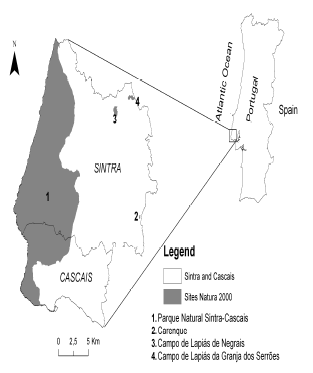
<body><![CDATA[<p>&nbsp;</p>     <p><font size="3" face="Verdana, Arial, Helvetica, sans-serif"><b>2. STUDY AREA</b></font></p>     <p><font size="3" face="Verdana, Arial, Helvetica, sans-serif"></font><font size="2" face="Verdana, Arial, Helvetica, sans-serif">The study   area analyzed in this research comprises the Sintra and Cascais municipalities   in    Portugal   with an area of approximately 416 Km<sup>2</sup>. These municipalities are   integrated in the Lisbon Metropolitan Area (<a href="#fig01">Figure 1</a>).</font></p>     <p align="center"><font size="2" face="Verdana, Arial, Helvetica, sans-serif"><b><a name="fig01"></a><img src="/img/revistas/dyna/v76n158/a18fig01.gif">    <br>   Figure   1.</b> Sintra and    Cascais Municipalities and Natura  2000 protected areas</font></p>     <p><font size="2" face="Verdana, Arial, Helvetica, sans-serif">There are   four Natura 2000 protected areas in the study area. The largest one, the PNSC,   has an area of 145 Km<sup>2</sup> and represents, approximately, 35% of total   area. The vegetation of the PNSC is composed by Mediterranean   and Western-Mediterranean species from which about 10% are endemic. In this   last group, are included species like the <i>Armeria</i> <i>pseudarmeria</i>, <i>Dianthus</i> <i>cintranus</i> <i>cintyranus</i> and the <i>Omphalodes</i> <i>kusyn</i>-<i>skianae</i> which are considered threatened   species at Community level. Endangered phauna species include <i>Rhinolophus</i> <i>hipposideros</i>, <i>Rhinolophus</i> <i>euryale</i>, <i>Putorius</i> <i>putorius</i>, <i>Bubo</i> <i>bubo</i>, <i>Hieraaetus</i> <i>fasciatus</i> and <i>Falco</i> <i>peregrinus</i> among many others [18]. </font></p> <font face="Verdana, Arial, Helvetica, sans-serif">     <p><font size="2">It was in    1981 that the government created the Protected Landscape Area of Sintra-Cascais    (<i>Área de Paisagem Protegida de      Sintra-Cascais</i> by the <i>Decreto-lei</i> 292/81). The creation of this area had as objective to “preserve the natural,    cultural and esthetical values inside its areas”. All actions taken inside its    areas were subject to strict authorizations from legal entities and included,    among others, the introduction or change of new economic activities,    urbanization, construction of roads and railroads, change the morphology of the    terrain, destruction of natural vegetation, and introduction of new animal and  plant species. In 1994, this area changed its name to PNSC (<i>Decreto</i>-<i>lei</i> 19/93) and the protected areas national network was created (<i>Decreto</i> <i>regulamentar</i> nº 8, 9/94). </font></p> </font>    <p><font size="2" face="Verdana, Arial, Helvetica, sans-serif">According    to the census [19], Sintra and Cascais municipalities have faced significant    demographic growth between 1991 and 2001 (29%). The strong construction  pressure in recent years may threaten PNSC functions.</font></p>     <p>&nbsp;</p>     <p><font size="3" face="Verdana, Arial, Helvetica, sans-serif"><b>3. DATA AND METHODS </b></font></p>     ]]></body>
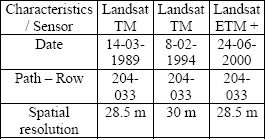
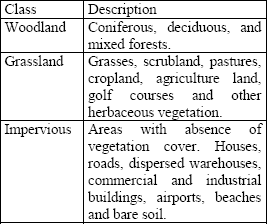
<body><![CDATA[<p><font size="2" face="Verdana, Arial, Helvetica, sans-serif"><b>3.1 Data    <br>   </b>Two Landsat   Thematic Mapper 5 (TM) and one Landsat 7 Enhanced Thematic Mapper Plus (ETM+) images   were used in this research (<a href="#tab01">Table 1</a>). The 1989 and 2000 images were downloaded   from Global Land Cover Facility of the University of Maryland (USA). The 1994   TM image was specifically acquired for the purpose of this research.</font></p>     <p align="center"><font size="2" face="Verdana, Arial, Helvetica, sans-serif"><b><a name="tab01"></a>Table    1. </b> Satellite images used in this study</font>    <br>    <img src="/img/revistas/dyna/v76n158/a18tab01.gif"></p>      <p><font size="2" face="Verdana, Arial, Helvetica, sans-serif"><b>3.2 Methods 3.2.1 Image    preprocessing    <br>  </b></font><font size="2" face="Verdana, Arial, Helvetica, sans-serif">A 1:25,000   scale vectorial layer with administrative boundaries was used to create a   subset of the images corresponding to the extent of Sintra and Cascais   municipalities. The 1989 and 2000 images were previously geometrically and   radiometrically corrected by USGS Earth Resource Observation Systems Data   Center (EROS) to a quality level of 1G. The same quality level was available   for the 1994 image by the European Space Agency. Both 1989 and 2000 images were   already orthorectified to a UTM (Universal Transverse Mercator) projection   using WGS (World Geodetic System) 84 datum. The 1994 image was co-registered to   the 2000 image with a root mean square less than half a pixel (0.49). Both 1989   and 2000 images had a 28.5m pixel resolution. The image of 1994 was resampled   to match this resolution using nearest-neighbor algorithm. This research is   based on the detection of changes on surface reflectances of objects. This   reason justifies the use of a relative radiometric correction with image   regression [20] over 1989 and 1994 images. Brightness values of pixels of all   the bands of 1989 and 1994 images were calibrated with image of year 2000 to   create a linear regression equation. This procedure minimized effects caused by   using time-series of satellite data collected in different dates and with   different sun angles [20]. </font></p>      <p><font size="2" face="Verdana, Arial, Helvetica, sans-serif"><b>3.2.2 Classification écheme    <br>  </b>This study   aims to analyze the global trend of LUCC for the Sintra and Cascais   municipalities. For this reason, the adopted land use/cover classification  scheme included three generalized classes (<a href="#tab02">Table 2</a>).</font></p>      <p align="center"><font size="2" face="Verdana, Arial, Helvetica, sans-serif"><b><a name="tab02"></a>Table    2. </b> Classification    scheme used in this study</font>    <br>    <img src="/img/revistas/dyna/v76n158/a18tab02.gif"></p>      ]]></body>
<body><![CDATA[<p><font size="2" face="Verdana, Arial, Helvetica, sans-serif">About 90    training samples were selected for each image. These training samples were as    pure as possible and their location was maintained over the three images.    Images were classified using the maximum-likelihood algorithm implemented in    Clark Labs - Idrisi Kilimanjaro software [21]. Image classification was made    over bands 2, 3, 4 and 5 because they were found to be the ones that best    discriminated considered classes. Accuracy of classified maps was evaluated    using 150 sample points systematically distributed. These points were converted    into cells with the same resolution of the satellite images (28.5m) and    classified as woodland, grassland and impervious. Selected pixels had to be    pure instead of mixed pixels to ensure that the correct class was identified    for each pixel [22]. These pixels were chosen using large-scale aerial photos    and 1:25,000 scale land use/cover maps. Whenever it was not a pure pixel, the    closest pure pixel was selected. Confusion matrices were used to compare    ground information    determined by the inspection of large-scale images and 1:25,000 scale land    use/cover maps with the classification results.</font></p>      <p><font size="2" face="Verdana, Arial, Helvetica, sans-serif"><b>3.2.3 Markov chains and LUCC    <br>   </b>Stochastic   processes generate sequences of random variables {X<sub>n</sub>, n<img src="/img/revistas/dyna/v76n158/a18eq002.gif">T} by    probabilistic laws. In this article, index n represents time. The process is    considered discrete in time and T = {0, 5, 10 …} years approximately, which is    a reasonable time unit for studying land use/cover change phenomenon. If the    stochastic process is a Markov process then the sequence of random variables    will be generated by the Markov property (1), formally: </font></p>  <font face="Verdana, Arial, Helvetica, sans-serif"><font size="2">    <p>P    <st2:citation w:st="on">[X<sub>n+1</sub> = a<sub>in+1</sub> | X<sub>0</sub> = a<sub>i0</sub>,     ..., X<sub>in</sub>= a<sub>in</sub>]</st2:citation>  = </p>      <p>P[X<sub>in+1</sub> = a<sub>in+1</sub> |X<sub>in</sub> = a<sub>in</sub>] (1) </p>      <p>Where the   double index means, in our study, for n <img src="/img/revistas/dyna/v76n158/a18eq002.gif">T and T =   {0, 5, 10,…} and i the range of possible values that ai can assume, in this   case the 3 classes defined previously. When the range of possible values for a<sub>i</sub> is either finite or infinite denumerable, as in this study, the Markov process   may be referred as a Markov chain. To demonstrate that land use/cover change in   Sintra-Cascais area is a Markovian process, one must prove that: there is a   statistical dependence between X<sub>n+1</sub> and X<sub>n</sub> (2); and that  statistical dependence is a first-order Markov process (3).</p>      <p>P(X<sub> n</sub> =   a<sub> n</sub> | X<sub> n-1</sub> = a<sub> n-1</sub>)<sub><img src="/img/revistas/dyna/v76n158/a18eq004.gif"></sub> </p>      <p>P (X<sub> n</sub> = a<sub> n</sub>) * P(X<sub> n-1</sub> = a<sub> n-1</sub>) (2)</p>      <p>P    <st2:citation w:st="on">[X<sub> n</sub> = a<sub> n</sub> | X<sub> n-1</sub> = a<sub> n-1</sub>]</st2:citation>  = </p>      <p>P    <st2:citation w:st="on">[X<sub> n</sub> = a<sub> n</sub>, X<sub> n-1</sub> = a<sub> n-1</sub>]</st2:citation>  / P [X<sub> n-1</sub> = a<sub> n-1</sub>] (3)</p>      ]]></body>
<body><![CDATA[<p>A   first-order Markov process is a Markov process where the transition from a   class to any other does not require intermediate transitions to other states.   The statistical dependence can be tested as in any contingency table [23]   displaying the land use/cover change between X<sub>n</sub> and X<sub>n-     1</sub>. In our study, this test is performed for the land     use/cover change between 1994 and 2000. To infer from the association or     independence between the land use/cover classes in different years from the     contingency table, the random variable, with the chi-square distribution will  be defined by (4):</p>      <p><sub><img src="/img/revistas/dyna/v76n158/a18eq006.gif"></sub> = <sub><img src="/img/revistas/dyna/v76n158/a18eq008.gif"><img src="/img/revistas/dyna/v76n158/a18eq010.gif"></sub>((N<sub>ij</sub> – M<sub>ij</sub>)<sup>2</sup> / M<sub>ij</sub>) (4)</p>      <p>Where N   will be the contingency matrix displaying the land use/cover change between   1994 and 2000, and M the contingency matrix with the expected values of change   assuming the independence hypotheses (Murteira, 1990). <img src="/img/revistas/dyna/v76n158/a18eq006.gif"> measures the distance between the observed   values of land use/cover change and the expected ones assuming independence and   must be high enough to prove (2), for 4 degrees of freedom. The same   non-parametric test will be used to test the Markov property. In this case, the   values to be compared with the observed ones will be calculated from the   Chapman-Kolmogorov equation (5) [24], assuming that these variables are generated  by a first-order Markov process:</p>  </font></font>    <p><font size="2" face="Verdana, Arial, Helvetica, sans-serif">P(X<sub> n</sub> =   a<sub> n</sub> | X<sub> m</sub> = a<sub> m</sub>) = P(X<sub> 1</sub> =   a<sub> 1</sub> | X<sub> m</sub> = a<sub> m</sub>).P(X<sub> n</sub> = a<sub> n</sub> | X<sub> 1</sub> = a<sub> 1</sub>), </font></p>      <p><font size="2" face="Verdana, Arial, Helvetica, sans-serif">m &#8804; l   &#8804; n (5) (<b>1</b>)</font></p>  <font face="Verdana, Arial, Helvetica, sans-serif"><font size="2">    <p>As far as   concerned in this study, the Chapman-Kolmogorov equation states that transition   probabilities from years 1989 to 2000 can be calculated by multiplying the   transition probabilities matrix from years 1989 to 1994 by the transition  probabilities matrix from years 1994 to 2000 (6).</p>      <p><sub><img src="/img/revistas/dyna/v76n158/a18eq006.gif"></sub> = <sub><img src="/img/revistas/dyna/v76n158/a18eq008.gif"><img src="/img/revistas/dyna/v76n158/a18eq010.gif"></sub>((N<sub>ij</sub> – O<sub>ij</sub>)<sup>2</sup> / O<sub>ij</sub>) (6) (<b>2</b>)</p>  </font></font>    <p><font size="2" face="Verdana, Arial, Helvetica, sans-serif">As the name   itself indicates the transition probabilities matrix will be estimated by the   contingency matrix displaying the relative frequencies of LUCC in a certain  period of time.</font></p>      <p>&nbsp;</p>      <p><font size="3" face="Verdana, Arial, Helvetica, sans-serif"><b>4.</b> <b>RESULTS </b></font></p> <font face="Verdana, Arial, Helvetica, sans-serif"><font size="2"><b>4.1 Image classification and accuracy assessment    ]]></body>
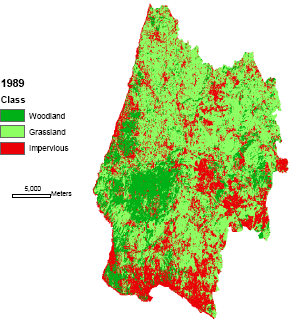
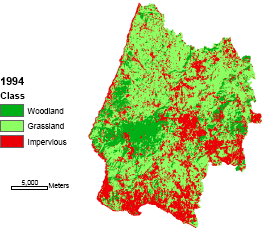
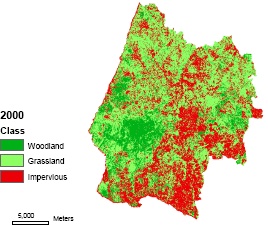
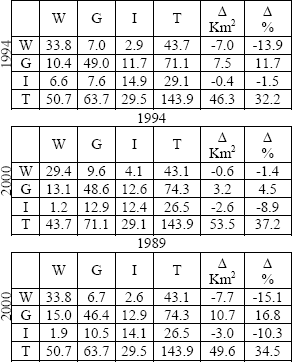
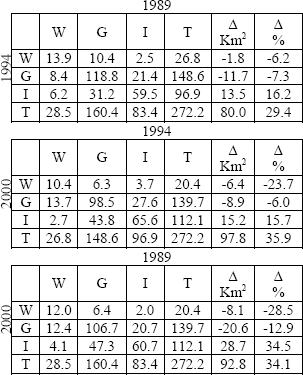
<body><![CDATA[<br> </b></font></font><font size="2" face="Verdana, Arial, Helvetica, sans-serif">Three land   use/cover maps were produced, respectively, for years 1989, 1994 and 2000 using  the maximum-likelihood algorithm (<a href="#fig02">Figures 2</a>-<a href="#fig04">4</a>).</font>      <p align="center"><font size="2" face="Verdana, Arial, Helvetica, sans-serif"><a name="fig02"></a><b><img src="/img/revistas/dyna/v76n158/a18fig02.gif">    <br>   Figure   2.</b> Land use/cover map for year 1989</font></p>      <p align="center"><font size="2" face="Verdana, Arial, Helvetica, sans-serif"><b><a name="fig03"></a><img src="/img/revistas/dyna/v76n158/a18fig03.gif">    <br>   Figure   3.</b> Land use/cover map for year 1994</font></p>      <p align="center"><font size="2" face="Verdana, Arial, Helvetica, sans-serif"><b><a name="fig04"></a><img src="/img/revistas/dyna/v76n158/a18fig04.gif">    <br>   Figure   4.</b> Land use/cover map for year 2000</font></p>      <p><font size="2" face="Verdana, Arial, Helvetica, sans-serif">The 2000   ETM+ image accuracy was assessed using large-scale orthophotos and land cover   maps. There was no ground truth data available for this study to assess 1994   image accuracy. However, the classification methodology used for image of year   1989 was replicated for classifying 1994 image. Both images were collected in   the rainy season at the same time of the day using the same satellite sensor.   For these reasons, we assumed that the overall accuracy of 1994 classification   should be identical to the 1989 classification. Overall accuracies obtained for   1989 and 2000 images were, respectively, 88.8% and 90.7%. The Kappa indices for   years 1989 and 2000 were, respectively, 85.3% and 87.1%. These values are   considered above the minimum value (85%) stipulated for interpretation accuracy   in the identification of land use and land cover categories from remotely  sensed data [25].</font></p> <font face="Verdana, Arial, Helvetica, sans-serif"><font size="2"><b>4.2 Hypothesis testing    <br> </b></font></font><font size="2" face="Verdana, Arial, Helvetica, sans-serif">As described   in the methodology, the main hypothesis to be tested in this study is that LUCC   in the study area is generated by a first order Markov process. This will be   our H<sub>0</sub>. To prove H<sub>0</sub> two subsidiary hypotheses must be   verified: H<sub>1</sub> - land use/cover in different time periods is not   statistically independent and H<sub>2</sub>- LUCC in the study area is a Markov   process. For the purpose of the analysis inside and outside PNSC, six   contingency tables were used to quantify land cover changes between years 1989  and 1994, 1989 and 2000 and 1994 and 2000 for each area (<a href="#tab03">Tables 3</a>-<a href="#tab06">8</a>).</font>     <p align="center"><font size="2" face="Verdana, Arial, Helvetica, sans-serif"><b><a name="tab03"></a>Tables    3-5. </b> Contingency    tables inside PNSC (W:     Woodland;    G: Grassland; I: Impervious; T: Total)</font>    ]]></body>
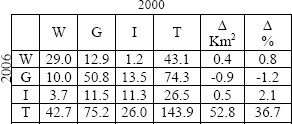
<body><![CDATA[<br>    <img src="/img/revistas/dyna/v76n158/a18tab0305.gif"></p>      <p align="center"><font size="2" face="Verdana, Arial, Helvetica, sans-serif"><b><a name="tab06"></a>Tables   6-8. </b> Contingency   tables outside PNSC (W:    Woodland;   G: Grassland; I: Impervious; T: Total)    <br>  </font><font size="2" face="Verdana, Arial, Helvetica, sans-serif"><b>Tablas 6-8.</b> Tablas de contingencia   fuera del PNSC </font>    <br>   <img src="/img/revistas/dyna/v76n158/a18tab0608.gif"></p> <font face="Verdana, Arial, Helvetica, sans-serif"><font size="2">    <p>The <sub><img src="/img/revistas/dyna/v76n158/a18eq006.gif"></sub> value obtained to measure the association   between the contingency table 1989-2000 inside PNSC (<a href="#tab03">Table 5</a>) and the   Chapman-Kolmogrov equation is 0.605039. This value is clearly below the   critical value of the distribution for a significance level of 0.950 which is   0.710721. This result allows the assumption that LUCC is a Markovian process   inside the natural park. For the remaining area, where the LUCC has been more   dynamic, the chi-square calculated to measure the association between the   Chapman-Kolmogrov matrix and the contingency table 1989-2000 is now clearly   above the critical value of the distribution for 0.950 confidence level with a  value of 1.286519. </p>  </font></font>     <p><font face="Verdana, Arial, Helvetica, sans-serif"><font size="2"><b>4.3 LUCC estimates for year 2006    <br>   </b>To use   Markov chains to predict future land use/cover inside de PNSC, one must prove   that the Markov chain is stationary. However, this property can only be defined   for recurrent Markov chains [24]. A Markov chain is said to be recurrent if it   is certain that the chain will return to the same state, but uncertain when   that will happen (aperiodic). We have no reason to assume that LUCC is a   recurrent aperiodic chain; therefore we must ignore the stationary equation. On   the other hand, it is reasonable to assume that LUCC inside PNSC will continue   to be this Markov chain in the near future because all the factors affecting   this process will continue to be regulated by the park administration.   Considering all these, future land use/cover quantities for year 2006 were estimated for the area inside PNSC (<a href="#tab09">Table 9</a>).</font></font></p>     <p align="center"><font size="2" face="Verdana, Arial, Helvetica, sans-serif"><b><a name="tab09"></a>Table   9. </b> Contingency   table 2000-2006 inside PNSC</font>    <br>   <img src="/img/revistas/dyna/v76n158/a18tab09.gif"></p>     <p><font size="2" face="Verdana, Arial, Helvetica, sans-serif">This   prediction is not spatial because Markov chains assume spatial independence of   the area units. LUCC inside the PNSC are not predicted to be significant between 2000 and 2006. This conclusion reinforces the  importance of the PNSC in maintaining LUCC dynamics stable inside its area.</font></p> <font face="Verdana, Arial, Helvetica, sans-serif"><font size="2">     ]]></body>
<body><![CDATA[<p>Estimates   for what happens outside the PNSC are not presented because there was no   significant statistical evidence to state that it was a Markov chain. This fact   also means that LUCC outside the PNSC is not dependent of current LUCC. It may  follow any other probabilistic law but not a Markovian one.</p>      <p>&nbsp;</p> </font></font>     <p><b><font size="3" face="Verdana, Arial, Helvetica, sans-serif">5. CONCLUSIONS</font></b></p>  <font face="Verdana, Arial, Helvetica, sans-serif"><font size="2">    <p>This paper   describes an integrated approach of remote sensing and stochastic modeling   techniques in explaining LUCC in Sintra-Cascais area. It was found that the   behavior of LUCC inside the PNSC was a Markov process between years 1989 and   2000. The land use/cover dynamics of the area outside the park did not follow a   Markovian behavior. The transition mechanism of LUCC outside the park is very   unstable for the defined land use/cover scheme. This means that it does not   depend on the previous land use/cover. These findings reinforce the existence   of the PNSC as an important factor in the stability of this highly dynamic  area. </p>      <p>Although   Markov chains constitute a good tool for describing and projecting LUCC   quantities, they are insufficient for spatial explicit LUCC predictions,   because they assume statistical independence of spatial units. However, LUCC   modelers can use Markov transitions coupled with spatially explicit models like   cellular automata and/or linear extrapolation models. The methodology here   presented can be employed to investigate if it is correct or not to use Markov   transition probabilities in their modeling processes. Future research includes   the experimentation of spatially explicit models to better understand the LUCC dynamics  of this area.</p>      <p>&nbsp;</p>  <b><font size="3">REFERENCES</font></b></font></font>     <!-- ref --><p>   <font size="2" face="Verdana, Arial, Helvetica, sans-serif"><b>[1]</b> WENG, Q. Land use change analysis in the Zhujiang Delta of China using satellite remote sensing, GIS and stochastic modelling. Journal of Environmental Management. Vol. 64. 2002. pp. 273-284.    &nbsp;&nbsp;&nbsp;&nbsp;&nbsp;&nbsp;&nbsp;&nbsp;[&#160;<a href="javascript:void(0);" onclick="javascript: window.open('/scielo.php?script=sci_nlinks&ref=000089&pid=S0012-7353200900020001800001&lng=','','width=640,height=500,resizable=yes,scrollbars=1,menubar=yes,');">Links</a>&#160;]<!-- end-ref --><!-- ref --><br>   <b>[2]</b> GLUCH, R, Urban growth detection using texture analysis on merged Landsat TM and SPOT-P data. Photogrammetric Engineering & Remote Sensing. Vol. 68. 2002. pp. 1283-1288.    &nbsp;&nbsp;&nbsp;&nbsp;&nbsp;&nbsp;&nbsp;&nbsp;[&#160;<a href="javascript:void(0);" onclick="javascript: window.open('/scielo.php?script=sci_nlinks&ref=000090&pid=S0012-7353200900020001800002&lng=','','width=640,height=500,resizable=yes,scrollbars=1,menubar=yes,');">Links</a>&#160;]<!-- end-ref --><!-- ref --><br>   <b>[3]</b> KWARTENG, A.; P. CHAVEZ. Change detection study of Kuwait city and environs using multi-temporal Landsat Thematic Mapper data. International Journal of Remote Sensing, Vol. 19. 1998. pp. 1651-1662.    &nbsp;&nbsp;&nbsp;&nbsp;&nbsp;&nbsp;&nbsp;&nbsp;[&#160;<a href="javascript:void(0);" onclick="javascript: window.open('/scielo.php?script=sci_nlinks&ref=000091&pid=S0012-7353200900020001800003&lng=','','width=640,height=500,resizable=yes,scrollbars=1,menubar=yes,');">Links</a>&#160;]<!-- end-ref --><!-- ref --><br>   <b>[4]</b> MASEK, J.; F. LINDSAY; S. GOWARD. Dynamics of urban growth in the Washington DC metropolitan area, 1973-1996, from Landsat observations. International Journal of Remote Sensing. Vol. 21. 2000. pp. 3473-3486.    &nbsp;&nbsp;&nbsp;&nbsp;&nbsp;&nbsp;&nbsp;&nbsp;[&#160;<a href="javascript:void(0);" onclick="javascript: window.open('/scielo.php?script=sci_nlinks&ref=000092&pid=S0012-7353200900020001800004&lng=','','width=640,height=500,resizable=yes,scrollbars=1,menubar=yes,');">Links</a>&#160;]<!-- end-ref --><!-- ref --><br>   <b>[5]</b> ZHANG Q.; WANG J.; PENG X.; GONG P.; SHI P. Urban built-up land change detection with road density and spectral information from multi-temporal Landsat TM data. International Journal of Remote Sensing. Vol. 23. 2002. pp. 3057-3078.    &nbsp;&nbsp;&nbsp;&nbsp;&nbsp;&nbsp;&nbsp;&nbsp;[&#160;<a href="javascript:void(0);" onclick="javascript: window.open('/scielo.php?script=sci_nlinks&ref=000093&pid=S0012-7353200900020001800005&lng=','','width=640,height=500,resizable=yes,scrollbars=1,menubar=yes,');">Links</a>&#160;]<!-- end-ref --><!-- ref --><br>   <b>[6]</b> STEFANOV, W.; RAMSEY M.; CHRISTENSEN P. Monitoring urban land cover change: An expert system approach to land cover classification of semiarid to arid urban centers. Remote Sensing of Environment. Vol. 77. 2001. pp. 173-185.    &nbsp;&nbsp;&nbsp;&nbsp;&nbsp;&nbsp;&nbsp;&nbsp;[&#160;<a href="javascript:void(0);" onclick="javascript: window.open('/scielo.php?script=sci_nlinks&ref=000094&pid=S0012-7353200900020001800006&lng=','','width=640,height=500,resizable=yes,scrollbars=1,menubar=yes,');">Links</a>&#160;]<!-- end-ref --><!-- ref --><br>   <b>[7]</b> MUCHER, C.; STEINNOCHER K.; KRESSLER F. Land cover characterization and change detection for environmental planning of Pan-Europe. International Journal of Remote Sensing, 2000. Vol. 21. pp. 1159-1181.    &nbsp;&nbsp;&nbsp;&nbsp;&nbsp;&nbsp;&nbsp;&nbsp;[&#160;<a href="javascript:void(0);" onclick="javascript: window.open('/scielo.php?script=sci_nlinks&ref=000095&pid=S0012-7353200900020001800007&lng=','','width=640,height=500,resizable=yes,scrollbars=1,menubar=yes,');">Links</a>&#160;]<!-- end-ref --><!-- ref --><br>   <b>[8]</b> CABRAL, P.; GILG J.-P.; PAINHO M. Monitoring urban growth using remote sensing, GIS and spatial metrics. Proceedings of SPIE Optics & Photonics: Remote sensing and modeling of ecosystems for sustainability. 2005. San Diego, USA . pp. 1-9.    &nbsp;&nbsp;&nbsp;&nbsp;&nbsp;&nbsp;&nbsp;&nbsp;[&#160;<a href="javascript:void(0);" onclick="javascript: window.open('/scielo.php?script=sci_nlinks&ref=000096&pid=S0012-7353200900020001800008&lng=','','width=640,height=500,resizable=yes,scrollbars=1,menubar=yes,');">Links</a>&#160;]<!-- end-ref --><!-- ref --><br>   <b>[9]</b> BAKER, W. A review of models of landscape change. Landscape Ecology. Vol. 2. 1989. pp. 111-133.    &nbsp;&nbsp;&nbsp;&nbsp;&nbsp;&nbsp;&nbsp;&nbsp;[&#160;<a href="javascript:void(0);" onclick="javascript: window.open('/scielo.php?script=sci_nlinks&ref=000097&pid=S0012-7353200900020001800009&lng=','','width=640,height=500,resizable=yes,scrollbars=1,menubar=yes,');">Links</a>&#160;]<!-- end-ref --><!-- ref --><br>   <b>[10]</b> CHENG, J. Modeling Spatial & Temporal Urban Growth. 2003. PhD thesis Utrecht University. Faculty of Geographical Sciences.    &nbsp;&nbsp;&nbsp;&nbsp;&nbsp;&nbsp;&nbsp;&nbsp;[&#160;<a href="javascript:void(0);" onclick="javascript: window.open('/scielo.php?script=sci_nlinks&ref=000098&pid=S0012-7353200900020001800010&lng=','','width=640,height=500,resizable=yes,scrollbars=1,menubar=yes,');">Links</a>&#160;]<!-- end-ref --><!-- ref --><br>   <b>[11]</b> BENENSON, I.; TORRENS P.,Geosimulation: Automata-based modeling of urban phenomena. Chichester: John Wiley & Sons, Ltd. 2004.    &nbsp;&nbsp;&nbsp;&nbsp;&nbsp;&nbsp;&nbsp;&nbsp;[&#160;<a href="javascript:void(0);" onclick="javascript: window.open('/scielo.php?script=sci_nlinks&ref=000099&pid=S0012-7353200900020001800011&lng=','','width=640,height=500,resizable=yes,scrollbars=1,menubar=yes,');">Links</a>&#160;]<!-- end-ref --><!-- ref --><br>   <b>[12]</b> WHITE, R.; ENGELEN G. High-resolution integrated modelling of the spatial dynamics of urban and regional systems. Computers, environment and urban systems, Vol. 24. 2000. pp. 383-400.    &nbsp;&nbsp;&nbsp;&nbsp;&nbsp;&nbsp;&nbsp;&nbsp;[&#160;<a href="javascript:void(0);" onclick="javascript: window.open('/scielo.php?script=sci_nlinks&ref=000100&pid=S0012-7353200900020001800012&lng=','','width=640,height=500,resizable=yes,scrollbars=1,menubar=yes,');">Links</a>&#160;]<!-- end-ref --><!-- ref --><br>   <b>[13]</b> BATTY, M. Cities and complexity: Understanding cities with cellular automata, agent-based models and fractals. Cambridge, London: MIT Press. 2005.    &nbsp;&nbsp;&nbsp;&nbsp;&nbsp;&nbsp;&nbsp;&nbsp;[&#160;<a href="javascript:void(0);" onclick="javascript: window.open('/scielo.php?script=sci_nlinks&ref=000101&pid=S0012-7353200900020001800013&lng=','','width=640,height=500,resizable=yes,scrollbars=1,menubar=yes,');">Links</a>&#160;]<!-- end-ref --><!-- ref --><br>   <b>[14]</b> CABRAL, P.; ZAMYATIN A. Three land change models for urban dynamics analysis in the Sintra-Cascais area. Proceedings of First Workshop of the EARSEL SIG on Urban Remote Sensing: Challenges and solutions. 2006. Berlin.    &nbsp;&nbsp;&nbsp;&nbsp;&nbsp;&nbsp;&nbsp;&nbsp;[&#160;<a href="javascript:void(0);" onclick="javascript: window.open('/scielo.php?script=sci_nlinks&ref=000102&pid=S0012-7353200900020001800014&lng=','','width=640,height=500,resizable=yes,scrollbars=1,menubar=yes,');">Links</a>&#160;]<!-- end-ref --><!-- ref --><br>   <b>[15]</b> MULLER, M.; MIDDLETON J. A. Markov model of land-use change dynamics in the Niagara Region, Ontario, Canada . Landscape Ecology. Vol. 9. 1994. pp. 151-157.    &nbsp;&nbsp;&nbsp;&nbsp;&nbsp;&nbsp;&nbsp;&nbsp;[&#160;<a href="javascript:void(0);" onclick="javascript: window.open('/scielo.php?script=sci_nlinks&ref=000103&pid=S0012-7353200900020001800015&lng=','','width=640,height=500,resizable=yes,scrollbars=1,menubar=yes,');">Links</a>&#160;]<!-- end-ref --><!-- ref --><br>   <b>[16]</b> BROWN, D.; PIJANOWSKI B.; DUH J. Modeling the relationships between land use and land cover on private lands in the Upper Midwest, USA. Journal of Environmental Management. Vol. 59. 2000. pp. 247-263.    &nbsp;&nbsp;&nbsp;&nbsp;&nbsp;&nbsp;&nbsp;&nbsp;[&#160;<a href="javascript:void(0);" onclick="javascript: window.open('/scielo.php?script=sci_nlinks&ref=000104&pid=S0012-7353200900020001800016&lng=','','width=640,height=500,resizable=yes,scrollbars=1,menubar=yes,');">Links</a>&#160;]<!-- end-ref --><!-- ref --><br>   <b>[17]</b> HUBER, W. Estimating Markov transitions. Journal of Environmental Management. Vol. 61. 2001. pp. 381-385.    &nbsp;&nbsp;&nbsp;&nbsp;&nbsp;&nbsp;&nbsp;&nbsp;[&#160;<a href="javascript:void(0);" onclick="javascript: window.open('/scielo.php?script=sci_nlinks&ref=000105&pid=S0012-7353200900020001800017&lng=','','width=640,height=500,resizable=yes,scrollbars=1,menubar=yes,');">Links</a>&#160;]<!-- end-ref --><br>   <b>[18]</b> ICN. Instituto da Conservação da Natureza e Biodiversidade. [cited 2004 November 2004]. Available from: URL: <a href="http://www.icnb.pt">http://www.icnb.pt</a>. 2004.     <!-- ref --><br>   <b>[19]</b> INE, Instituto Nacional de Estatística. Lisboa. 2003.    &nbsp;&nbsp;&nbsp;&nbsp;&nbsp;&nbsp;&nbsp;&nbsp;[&#160;<a href="javascript:void(0);" onclick="javascript: window.open('/scielo.php?script=sci_nlinks&ref=000107&pid=S0012-7353200900020001800019&lng=','','width=640,height=500,resizable=yes,scrollbars=1,menubar=yes,');">Links</a>&#160;]<!-- end-ref --><!-- ref --><br>   <b>[20]</b> JENSEN, J.R. Introductory Digital Image Processing: A remote sensing perspective. Second edition, edited by K.C. Clarke. New Jersey: Prentice Hall. 1996.    &nbsp;&nbsp;&nbsp;&nbsp;&nbsp;&nbsp;&nbsp;&nbsp;[&#160;<a href="javascript:void(0);" onclick="javascript: window.open('/scielo.php?script=sci_nlinks&ref=000108&pid=S0012-7353200900020001800020&lng=','','width=640,height=500,resizable=yes,scrollbars=1,menubar=yes,');">Links</a>&#160;]<!-- end-ref --><!-- ref --><br>   <b>[21]</b> IDRISI, Idrisi Kilimanjaro. Clark Labs: Worcester, MA. 2004.    &nbsp;&nbsp;&nbsp;&nbsp;&nbsp;&nbsp;&nbsp;&nbsp;[&#160;<a href="javascript:void(0);" onclick="javascript: window.open('/scielo.php?script=sci_nlinks&ref=000109&pid=S0012-7353200900020001800021&lng=','','width=640,height=500,resizable=yes,scrollbars=1,menubar=yes,');">Links</a>&#160;]<!-- end-ref --><!-- ref --><br>   <b>[22]</b> GONG, P.; HOWARTH J. The use of structural information for improving land-cover classification accuracies at the rural-urban fringe. Photogrammetric Engineering & Remote Sensing. Vol 56. 1990. pp. 67-73.    &nbsp;&nbsp;&nbsp;&nbsp;&nbsp;&nbsp;&nbsp;&nbsp;[&#160;<a href="javascript:void(0);" onclick="javascript: window.open('/scielo.php?script=sci_nlinks&ref=000110&pid=S0012-7353200900020001800022&lng=','','width=640,height=500,resizable=yes,scrollbars=1,menubar=yes,');">Links</a>&#160;]<!-- end-ref --><!-- ref --><br>   <b>[23]</b> MURTEIRA, B. Probabilidades e estatística. Vol. II, 2ª Edição, McGraw-Hill de Portugal. 1990.    &nbsp;&nbsp;&nbsp;&nbsp;&nbsp;&nbsp;&nbsp;&nbsp;[&#160;<a href="javascript:void(0);" onclick="javascript: window.open('/scielo.php?script=sci_nlinks&ref=000111&pid=S0012-7353200900020001800023&lng=','','width=640,height=500,resizable=yes,scrollbars=1,menubar=yes,');">Links</a>&#160;]<!-- end-ref --><!-- ref --><br>   <b>[24]</b> KIJIMA, M. Markov processes for stochastic modeling. Stochastic Modeling Series, London: Chapman & Hall. 1997.    &nbsp;&nbsp;&nbsp;&nbsp;&nbsp;&nbsp;&nbsp;&nbsp;[&#160;<a href="javascript:void(0);" onclick="javascript: window.open('/scielo.php?script=sci_nlinks&ref=000112&pid=S0012-7353200900020001800024&lng=','','width=640,height=500,resizable=yes,scrollbars=1,menubar=yes,');">Links</a>&#160;]<!-- end-ref --><!-- ref --><br>   <b>[25]</b> ANDERSON, J.R.; HARDY E.; ROACH J.; WITMER R. A Land Use And Land Cover Classification System For Use With Remote Sensor Data. U.S. Geological Survey: Washington, DC. 1976.</font>&nbsp;&nbsp;&nbsp;&nbsp;&nbsp;&nbsp;&nbsp;&nbsp;[&#160;<a href="javascript:void(0);" onclick="javascript: window.open('/scielo.php?script=sci_nlinks&ref=000113&pid=S0012-7353200900020001800025&lng=','','width=640,height=500,resizable=yes,scrollbars=1,menubar=yes,');">Links</a>&#160;]<!-- end-ref --> ]]></body><back>
<ref-list>
<ref id="B1">
<label>1</label><nlm-citation citation-type="journal">
<person-group person-group-type="author">
<name>
<surname><![CDATA[WENG]]></surname>
<given-names><![CDATA[Q.]]></given-names>
</name>
</person-group>
<article-title xml:lang="en"><![CDATA[Land use change analysis in the Zhujiang Delta of China using satellite remote sensing, GIS and stochastic modelling.]]></article-title>
<source><![CDATA[Journal of Environmental Management.]]></source>
<year>2002</year>
<volume>64</volume>
<page-range>273-284</page-range></nlm-citation>
</ref>
<ref id="B2">
<label>2</label><nlm-citation citation-type="journal">
<person-group person-group-type="author">
<name>
<surname><![CDATA[GLUCH]]></surname>
<given-names><![CDATA[R]]></given-names>
</name>
</person-group>
<article-title xml:lang="en"><![CDATA[Urban growth detection using texture analysis on merged Landsat TM and SPOT-P data.]]></article-title>
<source><![CDATA[Photogrammetric Engineering & Remote Sensing.]]></source>
<year>2002</year>
<volume>68</volume>
<page-range>1283-1288</page-range></nlm-citation>
</ref>
<ref id="B3">
<label>3</label><nlm-citation citation-type="journal">
<person-group person-group-type="author">
<name>
<surname><![CDATA[KWARTENG]]></surname>
<given-names><![CDATA[A.]]></given-names>
</name>
<name>
<surname><![CDATA[CHAVEZ]]></surname>
<given-names><![CDATA[P.]]></given-names>
</name>
</person-group>
<article-title xml:lang="en"><![CDATA[Change detection study of Kuwait city and environs using multi-temporal Landsat Thematic Mapper data.]]></article-title>
<source><![CDATA[International Journal of Remote Sensing,]]></source>
<year>1998</year>
<volume>19</volume>
<page-range>1651-1662</page-range></nlm-citation>
</ref>
<ref id="B4">
<label>4</label><nlm-citation citation-type="journal">
<person-group person-group-type="author">
<name>
<surname><![CDATA[MASEK]]></surname>
<given-names><![CDATA[J.]]></given-names>
</name>
<name>
<surname><![CDATA[LINDSAY]]></surname>
<given-names><![CDATA[F.]]></given-names>
</name>
<name>
<surname><![CDATA[GOWARD]]></surname>
<given-names><![CDATA[S.]]></given-names>
</name>
</person-group>
<article-title xml:lang="en"><![CDATA[Dynamics of urban growth in the Washington DC metropolitan area, 1973-1996, from Landsat observations.]]></article-title>
<source><![CDATA[International Journal of Remote Sensing.]]></source>
<year>2000</year>
<volume>21</volume>
<page-range>3473-3486</page-range></nlm-citation>
</ref>
<ref id="B5">
<label>5</label><nlm-citation citation-type="journal">
<person-group person-group-type="author">
<name>
<surname><![CDATA[ZHANG]]></surname>
<given-names><![CDATA[Q.]]></given-names>
</name>
<name>
<surname><![CDATA[WANG]]></surname>
<given-names><![CDATA[J.]]></given-names>
</name>
<name>
<surname><![CDATA[PENG]]></surname>
<given-names><![CDATA[X.]]></given-names>
</name>
<name>
<surname><![CDATA[GONG]]></surname>
<given-names><![CDATA[P.]]></given-names>
</name>
<name>
<surname><![CDATA[SHI]]></surname>
<given-names><![CDATA[P.]]></given-names>
</name>
</person-group>
<article-title xml:lang="en"><![CDATA[Urban built-up land change detection with road density and spectral information from multi-temporal Landsat TM data.]]></article-title>
<source><![CDATA[International Journal of Remote Sensing.]]></source>
<year>2002</year>
<volume>23</volume>
<page-range>3057-3078</page-range></nlm-citation>
</ref>
<ref id="B6">
<label>6</label><nlm-citation citation-type="journal">
<person-group person-group-type="author">
<name>
<surname><![CDATA[STEFANOV]]></surname>
<given-names><![CDATA[W.]]></given-names>
</name>
<name>
<surname><![CDATA[RAMSEY]]></surname>
<given-names><![CDATA[M.]]></given-names>
</name>
<name>
<surname><![CDATA[CHRISTENSEN]]></surname>
<given-names><![CDATA[P.]]></given-names>
</name>
</person-group>
<article-title xml:lang="en"><![CDATA[Monitoring urban land cover change:: An expert system approach to land cover classification of semiarid to arid urban centers.]]></article-title>
<source><![CDATA[Remote Sensing of Environment.]]></source>
<year>2001</year>
<volume>77</volume>
<page-range>173-185</page-range></nlm-citation>
</ref>
<ref id="B7">
<label>7</label><nlm-citation citation-type="journal">
<person-group person-group-type="author">
<name>
<surname><![CDATA[MUCHER]]></surname>
<given-names><![CDATA[C.]]></given-names>
</name>
<name>
<surname><![CDATA[STEINNOCHER]]></surname>
<given-names><![CDATA[K.]]></given-names>
</name>
<name>
<surname><![CDATA[KRESSLER]]></surname>
<given-names><![CDATA[F.]]></given-names>
</name>
</person-group>
<article-title xml:lang="en"><![CDATA[Land cover characterization and change detection for environmental planning of Pan-Europe.]]></article-title>
<source><![CDATA[International Journal of Remote Sensing,]]></source>
<year>2000</year>
<volume>21</volume>
<page-range>1159-1181</page-range></nlm-citation>
</ref>
<ref id="B8">
<label>8</label><nlm-citation citation-type="">
<person-group person-group-type="author">
<name>
<surname><![CDATA[CABRAL]]></surname>
<given-names><![CDATA[P.]]></given-names>
</name>
<name>
<surname><![CDATA[GILG]]></surname>
<given-names><![CDATA[J.-P.]]></given-names>
</name>
<name>
<surname><![CDATA[PAINHO]]></surname>
<given-names><![CDATA[M.]]></given-names>
</name>
</person-group>
<source><![CDATA[Monitoring urban growth using remote sensing, GIS and spatial metrics. Proceedings of SPIE Optics & Photonics:: Remote sensing and modeling of ecosystems for sustainability.]]></source>
<year>2005</year>
<page-range>1-9</page-range><publisher-loc><![CDATA[San Diego ]]></publisher-loc>
</nlm-citation>
</ref>
<ref id="B9">
<label>9</label><nlm-citation citation-type="journal">
<person-group person-group-type="author">
<name>
<surname><![CDATA[BAKER]]></surname>
<given-names><![CDATA[W.]]></given-names>
</name>
</person-group>
<article-title xml:lang="en"><![CDATA[A review of models of landscape change.]]></article-title>
<source><![CDATA[Landscape Ecology.]]></source>
<year>1989</year>
<volume>2</volume>
<page-range>111-133</page-range></nlm-citation>
</ref>
<ref id="B10">
<label>10</label><nlm-citation citation-type="">
<person-group person-group-type="author">
<name>
<surname><![CDATA[CHENG]]></surname>
<given-names><![CDATA[J.]]></given-names>
</name>
</person-group>
<source><![CDATA[Modeling Spatial & Temporal Urban Growth.]]></source>
<year>2003</year>
</nlm-citation>
</ref>
<ref id="B11">
<label>11</label><nlm-citation citation-type="book">
<person-group person-group-type="author">
<name>
<surname><![CDATA[BENENSON]]></surname>
<given-names><![CDATA[I.]]></given-names>
</name>
<name>
<surname><![CDATA[TORRENS]]></surname>
<given-names><![CDATA[P.]]></given-names>
</name>
</person-group>
<source><![CDATA[Geosimulation:: Automata-based modeling of urban phenomena.]]></source>
<year>2004</year>
<publisher-name><![CDATA[Chichester: John Wiley & Sons, Ltd.]]></publisher-name>
</nlm-citation>
</ref>
<ref id="B12">
<label>12</label><nlm-citation citation-type="journal">
<person-group person-group-type="author">
<name>
<surname><![CDATA[WHITE]]></surname>
<given-names><![CDATA[R.]]></given-names>
</name>
<name>
<surname><![CDATA[ENGELEN]]></surname>
<given-names><![CDATA[G.]]></given-names>
</name>
</person-group>
<article-title xml:lang="en"><![CDATA[High-resolution integrated modelling of the spatial dynamics of urban and regional systems.]]></article-title>
<source><![CDATA[Computers, environment and urban systems,]]></source>
<year>2000</year>
<volume>24</volume>
<page-range>383-400</page-range></nlm-citation>
</ref>
<ref id="B13">
<label>13</label><nlm-citation citation-type="book">
<person-group person-group-type="author">
<name>
<surname><![CDATA[BATTY]]></surname>
<given-names><![CDATA[M.]]></given-names>
</name>
</person-group>
<source><![CDATA[Cities and complexity:: Understanding cities with cellular automata, agent-based models and fractals.]]></source>
<year>2005</year>
<publisher-name><![CDATA[Cambridge]]></publisher-name>
</nlm-citation>
</ref>
<ref id="B14">
<label>14</label><nlm-citation citation-type="">
<person-group person-group-type="author">
<name>
<surname><![CDATA[CABRAL]]></surname>
<given-names><![CDATA[P.]]></given-names>
</name>
<name>
<surname><![CDATA[ZAMYATIN]]></surname>
<given-names><![CDATA[A.]]></given-names>
</name>
</person-group>
<source><![CDATA[Three land change models for urban dynamics analysis in the Sintra-Cascais area.: Proceedings of First Workshop of the EARSEL SIG on Urban Remote Sensing:]]></source>
<year>2006</year>
<publisher-loc><![CDATA[Berlin ]]></publisher-loc>
</nlm-citation>
</ref>
<ref id="B15">
<label>15</label><nlm-citation citation-type="journal">
<person-group person-group-type="author">
<name>
<surname><![CDATA[MULLER]]></surname>
<given-names><![CDATA[M.]]></given-names>
</name>
<name>
<surname><![CDATA[MIDDLETON]]></surname>
<given-names><![CDATA[J. A.]]></given-names>
</name>
</person-group>
<article-title xml:lang="en"><![CDATA[Markov model of land-use change dynamics in the Niagara Region, Ontario, Canada .]]></article-title>
<source><![CDATA[Landscape Ecology.]]></source>
<year>1994</year>
<volume>9</volume>
<page-range>151-157</page-range></nlm-citation>
</ref>
<ref id="B16">
<label>16</label><nlm-citation citation-type="journal">
<person-group person-group-type="author">
<name>
<surname><![CDATA[BROWN]]></surname>
<given-names><![CDATA[D.]]></given-names>
</name>
<name>
<surname><![CDATA[PIJANOWSKI]]></surname>
<given-names><![CDATA[B.]]></given-names>
</name>
<name>
<surname><![CDATA[DUH]]></surname>
<given-names><![CDATA[J.]]></given-names>
</name>
</person-group>
<article-title xml:lang="en"><![CDATA[Modeling the relationships between land use and land cover on private lands in the Upper Midwest, USA.]]></article-title>
<source><![CDATA[Journal of Environmental Management.]]></source>
<year>2000</year>
<volume>59</volume>
<page-range>247-263</page-range></nlm-citation>
</ref>
<ref id="B17">
<label>17</label><nlm-citation citation-type="journal">
<person-group person-group-type="author">
<name>
<surname><![CDATA[HUBER]]></surname>
<given-names><![CDATA[W.]]></given-names>
</name>
</person-group>
<article-title xml:lang="en"><![CDATA[Estimating Markov transitions.]]></article-title>
<source><![CDATA[Journal of Environmental Management.]]></source>
<year>2001</year>
<volume>61</volume>
<page-range>381-385</page-range></nlm-citation>
</ref>
<ref id="B18">
<label>18</label><nlm-citation citation-type="">
<collab>ICN. Instituto da Conservação da Natureza e Biodiversidade..</collab>
<source><![CDATA[]]></source>
<year>2004</year>
</nlm-citation>
</ref>
<ref id="B19">
<label>19</label><nlm-citation citation-type="">
<collab>INE, Instituto Nacional de Estatística.</collab>
<source><![CDATA[]]></source>
<year>2003</year>
<publisher-loc><![CDATA[Lisboa ]]></publisher-loc>
</nlm-citation>
</ref>
<ref id="B20">
<label>20</label><nlm-citation citation-type="book">
<person-group person-group-type="author">
<name>
<surname><![CDATA[JENSEN]]></surname>
<given-names><![CDATA[J.R.]]></given-names>
</name>
</person-group>
<source><![CDATA[Introductory Digital Image Processing:: A remote sensing perspective.]]></source>
<year>1996</year>
<publisher-loc><![CDATA[New Jersey ]]></publisher-loc>
<publisher-name><![CDATA[edited by K.C. Clarke.]]></publisher-name>
</nlm-citation>
</ref>
<ref id="B21">
<label>21</label><nlm-citation citation-type="book">
<collab>IDRISI^dIdrisi Kilimanjaro</collab>
<source><![CDATA[Clark Labs:]]></source>
<year>2004</year>
<publisher-name><![CDATA[Worcester]]></publisher-name>
</nlm-citation>
</ref>
<ref id="B22">
<label>22</label><nlm-citation citation-type="journal">
<person-group person-group-type="author">
<name>
<surname><![CDATA[GONG]]></surname>
<given-names><![CDATA[P.]]></given-names>
</name>
<name>
<surname><![CDATA[HOWARTH]]></surname>
<given-names><![CDATA[J.]]></given-names>
</name>
</person-group>
<article-title xml:lang="en"><![CDATA[The use of structural information for improving land-cover classification accuracies at the rural-urban fringe.]]></article-title>
<source><![CDATA[Photogrammetric Engineering & Remote Sensing.]]></source>
<year>1990</year>
<volume>56</volume>
<page-range>67-73</page-range></nlm-citation>
</ref>
<ref id="B23">
<label>23</label><nlm-citation citation-type="book">
<person-group person-group-type="author">
<name>
<surname><![CDATA[MURTEIRA]]></surname>
<given-names><![CDATA[B.]]></given-names>
</name>
</person-group>
<source><![CDATA[Probabilidades e estatística.]]></source>
<year>1990</year>
<volume>II</volume>
<publisher-name><![CDATA[McGraw-Hill]]></publisher-name>
</nlm-citation>
</ref>
<ref id="B24">
<label>24</label><nlm-citation citation-type="book">
<person-group person-group-type="author">
<name>
<surname><![CDATA[KIJIMA]]></surname>
<given-names><![CDATA[M.]]></given-names>
</name>
</person-group>
<source><![CDATA[Markov processes for stochastic modeling.]]></source>
<year>1997</year>
<publisher-name><![CDATA[Chapman & Hall]]></publisher-name>
</nlm-citation>
</ref>
<ref id="B25">
<label>25</label><nlm-citation citation-type="book">
<person-group person-group-type="author">
<name>
<surname><![CDATA[ANDERSON]]></surname>
<given-names><![CDATA[J.R.]]></given-names>
</name>
<name>
<surname><![CDATA[HARDY]]></surname>
<given-names><![CDATA[E.]]></given-names>
</name>
<name>
<surname><![CDATA[ROACH]]></surname>
<given-names><![CDATA[J.]]></given-names>
</name>
<name>
<surname><![CDATA[WITMER]]></surname>
<given-names><![CDATA[R.]]></given-names>
</name>
</person-group>
<source><![CDATA[A Land Use And Land Cover Classification System For Use With Remote Sensor Data.]]></source>
<year>1976</year>
<publisher-loc><![CDATA[Washington^eDC DC]]></publisher-loc>
<publisher-name><![CDATA[Geological Survey:]]></publisher-name>
</nlm-citation>
</ref>
</ref-list>
</back>
</article>