<?xml version="1.0" encoding="ISO-8859-1"?><article xmlns:mml="http://www.w3.org/1998/Math/MathML" xmlns:xlink="http://www.w3.org/1999/xlink" xmlns:xsi="http://www.w3.org/2001/XMLSchema-instance">
<front>
<journal-meta>
<journal-id>0012-7353</journal-id>
<journal-title><![CDATA[DYNA]]></journal-title>
<abbrev-journal-title><![CDATA[Dyna rev.fac.nac.minas]]></abbrev-journal-title>
<issn>0012-7353</issn>
<publisher>
<publisher-name><![CDATA[Universidad Nacional de Colombia]]></publisher-name>
</publisher>
</journal-meta>
<article-meta>
<article-id>S0012-73532009000400001</article-id>
<title-group>
<article-title xml:lang="en"><![CDATA[CLOSE RANGE DIGITAL PHOTOGRAMMETRY AND SOFTWARE APPLICATION DEVELOPMENT FOR PLANAR PATTERNS COMPUTATION]]></article-title>
<article-title xml:lang="es"><![CDATA[FOTOGRAMETRÍA TERRESTRE DIGITAL Y APLICACIÓN SOFTWARE PARA EL DESARROLLO DE PATRONES PLANOS]]></article-title>
</title-group>
<contrib-group>
<contrib contrib-type="author">
<name>
<surname><![CDATA[ARIAS]]></surname>
<given-names><![CDATA[PEDRO]]></given-names>
</name>
<xref ref-type="aff" rid="A01"/>
</contrib>
<contrib contrib-type="author">
<name>
<surname><![CDATA[ARMESTO]]></surname>
<given-names><![CDATA[JULIA]]></given-names>
</name>
<xref ref-type="aff" rid="A02"/>
</contrib>
<contrib contrib-type="author">
<name>
<surname><![CDATA[VALLEJO]]></surname>
<given-names><![CDATA[JAVIER]]></given-names>
</name>
<xref ref-type="aff" rid="A03"/>
</contrib>
<contrib contrib-type="author">
<name>
<surname><![CDATA[LORENZO]]></surname>
<given-names><![CDATA[HENRIQUE]]></given-names>
</name>
<xref ref-type="aff" rid="A04"/>
</contrib>
</contrib-group>
<aff id="A01">
<institution><![CDATA[,University of Vigo Dep. Natural Resources and Environmental Engineering ]]></institution>
<addr-line><![CDATA[ ]]></addr-line>
<country>Spain</country>
</aff>
<aff id="A02">
<institution><![CDATA[,University of Vigo Dep. Natural Resources and Environmental Engineering ]]></institution>
<addr-line><![CDATA[ ]]></addr-line>
<country>Spain</country>
</aff>
<aff id="A03">
<institution><![CDATA[,. Superior School of Engineering Dep. Engineering Design and Technical Projects ]]></institution>
<addr-line><![CDATA[ ]]></addr-line>
<country>Spain</country>
</aff>
<aff id="A04">
<institution><![CDATA[,University of Vigo Dep. Natural Resources and Environmental Engineering ]]></institution>
<addr-line><![CDATA[ ]]></addr-line>
<country>Spain</country>
</aff>
<pub-date pub-type="pub">
<day>00</day>
<month>12</month>
<year>2009</year>
</pub-date>
<pub-date pub-type="epub">
<day>00</day>
<month>12</month>
<year>2009</year>
</pub-date>
<volume>76</volume>
<numero>160</numero>
<fpage>7</fpage>
<lpage>15</lpage>
<copyright-statement/>
<copyright-year/>
<self-uri xlink:href="http://www.scielo.org.co/scielo.php?script=sci_arttext&amp;pid=S0012-73532009000400001&amp;lng=en&amp;nrm=iso"></self-uri><self-uri xlink:href="http://www.scielo.org.co/scielo.php?script=sci_abstract&amp;pid=S0012-73532009000400001&amp;lng=en&amp;nrm=iso"></self-uri><self-uri xlink:href="http://www.scielo.org.co/scielo.php?script=sci_pdf&amp;pid=S0012-73532009000400001&amp;lng=en&amp;nrm=iso"></self-uri><abstract abstract-type="short" xml:lang="en"><p><![CDATA[This paper shows there processes for the particular case of objects with complex surfaces: the 3D modelling of the object and its development to 2D model. The procedure to obtain accurate 3D CAD models of objects with complex surfaces through close range digital photogrammetry is described; several methodological considerations are presented that allow obtaining high accuracy results and minimize processing time. Furthermore a software application that calculates the corresponding planar profiles is developed. The application automatically outputs a CAD neutral file with the definition of the optimized planar patterns needed for the NC cutting machines. The computation of the planar patterns is based on the solution of an optimization problem that takes into consideration the geodesic curvature of the surface of the isoparametric curves.]]></p></abstract>
<abstract abstract-type="short" xml:lang="es"><p><![CDATA[Este artículo muestra estos procesos para el caso particular de objetos con superficies complejas: el modelado 3D de objetos y su desarrollo a modelos 2D. Se describe el procedimiento para obtener modelos CAD 3D precisos de objetos con superficies complejas a través de fotogrametría terrestre digital; se realizan varias consideraciones metodológicas que permitirán obtener resultados con alta precisión y minimizado de los tiempos de procesado. Además fue programada una aplicación software para el desarrollo de superficies complejas en el plano. La aplicación proporciona automáticamente archivos CAD estándar, definiendo patrones planos optimizados necesarios para los sistemas CNC. El cálculo de estos patrones planos está basado en la solución de un problema de optimización que tiene en cuenta la curvatura geodésica de las superficies de curvas isoparamétricas.]]></p></abstract>
<kwd-group>
<kwd lng="en"><![CDATA[3D modelling]]></kwd>
<kwd lng="en"><![CDATA[Close Range Digital Photogrammetry]]></kwd>
<kwd lng="en"><![CDATA[complex surfaces]]></kwd>
<kwd lng="en"><![CDATA[cutting profiles]]></kwd>
<kwd lng="es"><![CDATA[Modelado 3D]]></kwd>
<kwd lng="es"><![CDATA[Fotogrametría Terrestre Digital]]></kwd>
<kwd lng="es"><![CDATA[Superficies Complejas]]></kwd>
<kwd lng="es"><![CDATA[cutting profiles]]></kwd>
</kwd-group>
</article-meta>
</front><body><![CDATA[ <p align="center"> <font size="4" face="Verdana, Arial, Helvetica, sans-serif"><b>CLOSE RANGE DIGITAL  PHOTOGRAMMETRY AND SOFTWARE APPLICATION DEVELOPMENT FOR PLANAR PATTERNS COMPUTATION</b></font></p>     <p align="center"><i><font size="3" face="Verdana, Arial, Helvetica, sans-serif"><b>FOTOGRAMETR&Iacute;A TERRESTRE DIGITAL Y APLICACI&Oacute;N SOFTWARE PARA EL DESARROLLO DE PATRONES PLANOS</b></font></i></p>     <p align="center">&nbsp;</p>     <p align="center"><font size="2" face="Verdana, Arial, Helvetica, sans-serif"><b>PEDRO ARIAS</b>    <br>   <i>Dep. Natural Resources and Environmental Engineering, University of Vigo, Spain, <a href="mailto:parias@uvigo.es">parias@uvigo.es</a></i></font></p>     <p align="center"><font size="2" face="Verdana, Arial, Helvetica, sans-serif"><b>JULIA ARMESTO</b>    <br>   <i>Dep. Natural Resources and Environmental Engineering, University of Vigo, Spain, <a href="mailto:julia@uvigo.es">julia@uvigo.es</a></i></font></p>     <p align="center"><font size="2" face="Verdana, Arial, Helvetica, sans-serif"><b>JAVIER VALLEJO</b>    <br>   <i>Dep. Engineering Design and Technical Projects. Superior School of Engineering.Bilbao, Spain, <a href="mailto:eppvamaj@bi.ehu.es">eppvamaj@bi.ehu.es</a></i></font></p>     <p align="center"><font size="2" face="Verdana, Arial, Helvetica, sans-serif"><b>HENRIQUE LORENZO</b>    ]]></body>
<body><![CDATA[<br>   <i>Dep. Natural Resources and Environmental Engineering, University of Vigo, Spain, <a href="mailto:hlorenzo@uvigo.es">hlorenzo@uvigo.es</a></i></font></p>     <p align="center">&nbsp;</p>     <p align="center"><font size="2" face="Verdana, Arial, Helvetica, sans-serif"><b>Recibido   para revisar diciembre 29 de 2008, aceptado abril 13 de 2009, versi&oacute;n final mayo 26 de 2009</b></font></p>     <p>&nbsp;</p> <hr>     <p><font size="2" face="Verdana, Arial, Helvetica, sans-serif"><b>ABSTRACT: </b>This paper shows there  processes for the particular case of objects with complex surfaces: the 3D  modelling of the object and its development to 2D model. The procedure to  obtain accurate 3D CAD models of objects with complex surfaces through close  range digital photogrammetry is described; several methodological  considerations are presented that allow obtaining high accuracy results and  minimize processing time. Furthermore a software application that calculates  the corresponding planar profiles is developed. The application automatically  outputs a CAD neutral file with the definition of the optimized planar patterns  needed for the NC cutting machines. The computation of the planar patterns is  based on the solution of an optimization problem that takes into consideration the geodesic curvature of the surface of the isoparametric curves.</font></p>     <p><font size="2" face="Verdana, Arial, Helvetica, sans-serif"><b>KEYWORDS:</b> 3D modelling, Close Range Digital Photogrammetry, complex surfaces, cutting profiles.</font></p>     <p><font size="2" face="Verdana, Arial, Helvetica, sans-serif"><b>RESUMEN: </b>Este art&iacute;culo muestra estos procesos para el caso  particular de objetos con superficies complejas: el modelado 3D de objetos y su  desarrollo a modelos 2D. Se describe el procedimiento para obtener modelos CAD  3D precisos de objetos con superficies complejas a trav&eacute;s de fotogrametr&iacute;a  terrestre digital; se realizan varias consideraciones metodol&oacute;gicas que  permitir&aacute;n obtener resultados con alta precisi&oacute;n y minimizado de los tiempos de  procesado. Adem&aacute;s fue programada una aplicaci&oacute;n software para el desarrollo de  superficies complejas en el plano. La aplicaci&oacute;n proporciona autom&aacute;ticamente  archivos CAD est&aacute;ndar, definiendo patrones planos optimizados necesarios para  los sistemas CNC. El c&aacute;lculo de estos patrones planos est&aacute; basado en la  soluci&oacute;n de un problema de optimizaci&oacute;n que tiene en cuenta la curvatura geod&eacute;sica de las superficies de curvas isoparam&eacute;tricas.</font></p>     <p><font size="2" face="Verdana, Arial, Helvetica, sans-serif"><b>PALABRAS CLAVE: </b>Modelado 3D,  Fotogrametr&iacute;a Terrestre Digital, Superficies Complejas, cutting profiles.</font></p> <hr>     <p>&nbsp;</p>     <p><font size="3" face="Verdana, Arial, Helvetica, sans-serif"><b>1. INTRODUCTION</b></font></p>     ]]></body>
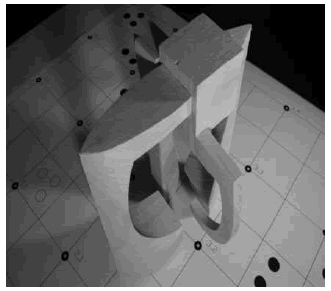
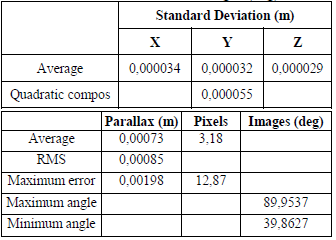
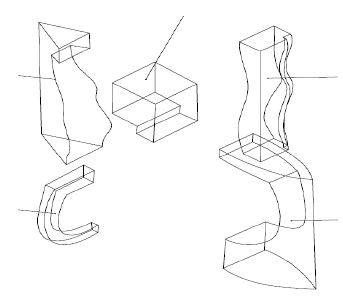
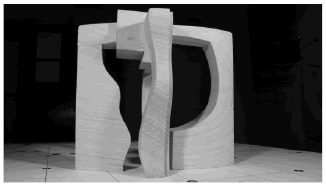
<body><![CDATA[<p><font size="2" face="Verdana, Arial, Helvetica, sans-serif">The only way European  manufacturing companies can succeed in a global marketplace is by implementing  newer manufacturing processes that enable them to respond quickly to market  changes and provide high quality, low cost products.</font></p>        <p><font size="2" face="Verdana, Arial, Helvetica, sans-serif">Automation is one major step  towards achieving the quality, cost and delivery targets. Due to cost effectiveness  and quality results, CAD/CAM and CNC machining are replacing the old manual or  semi-automated machinery in a wide range of industries. Frequently, it is  common that the design drawings corresponding to an object or a prototype to be  manufactured through a CNC system are not available. In such cases, reverse  engineering techniques must be used in order to generate a 3D digital model of  the object. Afterwards, this model is developed to obtain the cutting planar  patterns that will allow us to program the CNC machinery operations. The 3D  modelling and its development into planar profiles are key processes for the  automation and the reliability of this type of manufacturing process when it affects objects with complex surfaces.</font></p>     <p><font size="2" face="Verdana, Arial, Helvetica, sans-serif">The trouble of creating  development profiles of 3D surfaces with double curvature to be manufactured at  later time by forming planar pieces of metal sheets have been wide treated in  the design community of industrial products since it is present in a great  variety of industrial areas: automation, aircraft, navigation, boiler-making,  inclusive in the textile and the shoe-making industry &#91;1&#93; &#91;2&#93;. The current CNC  manufacturing systems along with CAD/CAM systems are becoming one of the major  expansion and renovation areas in this type of industries. But the  implementation of CNC cutting machinery in the flat sheet manufacturing systems  brings serious problems when trying to manufacture complex geometry objects,  since defining the optimal form of the cutting profiles, which is essential to  program the cutting path, raises serious difficulties. Furthermore, when  original design drawings of the objects or prototypes to be manufactured are  not available, it is necessary to carry out a previous modelling phase with the  purpose to get the precise knowledge of the object geometry and dimensions. The  3D modelling and its development into planar profiles are key processes for the  automation and the reliability of this type of manufacturing process when it affects objects with complex surfaces &#91;3&#93;.</font></p>     <p><font size="2" face="Verdana, Arial, Helvetica, sans-serif">In recent years, research  efforts led to object modelling with complex surfaces in the industrial  application fields have been focused on laser scanning technology &#91;4&#93; &#91;5&#93;.  However, surface reconstruction from random scanned data usually requires a complex  time consuming reconstruction process and significant amount of computation  &#91;6&#93;. These considerations have led us to concentrate in evaluating the  feasibility of applying digital monoscopic photogrammetry in modelling objects  with complex geometry. Some interesting previous works can be found in  &#91;7&#93;-&#91;11&#93;. This paper is focused on the monoscopic digital photogrammetry since  it has several advantages such as: equipment cost, flexibility, simplicity and  calculation volume data processing &#91;12&#93;. In our opinion, these factors make it  more viable in industrial applications in terms of cost-efficiency balance  point of view than the stereophotogrammetric techniques or single image based  processes &#91;13&#93;. Several methodological indications are established that allow  us to optimize the time required for the data processing and the final 3D model accuracy.</font></p>     <p><font size="2" face="Verdana, Arial, Helvetica, sans-serif">Furthermore, a custom  application has been developed that implements an efficient algorithm for the  planar development, for the CAD model obtained from the photogrammetric  procedure. This application allows us to obtain a CAD file that has the  definition of the optimum cutting profiles of the curved surfaces. The  mathematical principles of this application are shown. The method is applied  over a wooden sculpture that has simple and complex curved surfaces (see <a href="#fig01">figure 1</a>).</font></p>     <p align="center"><font size="2" face="Verdana, Arial, Helvetica, sans-serif"><b><a name="fig01"></a><img src="/img/revistas/dyna/v76n160/a01fig01.gif">    <br>   Figure 1</b>. The methodology was applied over a wooden sculpture that has simple and complex curved surfaces</font></p>     <p>&nbsp;</p>     <p><font size="3" face="Verdana, Arial, Helvetica, sans-serif"><b>2. METHOD</b></font></p>     <p><font size="2" face="Verdana, Arial, Helvetica, sans-serif"><b>2.1 Photogram Metric Procedure: 3D Modelling    ]]></body>
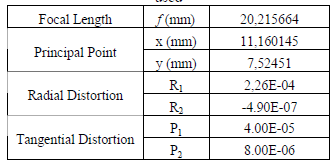
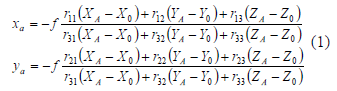
<body><![CDATA[<br> </b>Close range photogrammetry  basically involves the use of a network of photographs of an object taken from  different angles. In our case study, the photography network was designed  considering the parameters that determine the strength of the geometry according  to &#91;14&#93;. A digital calibrated camera, Canon EOS 10D of 6.291.456 pixels CCD resolution was used. The interior orientation parameters are showed in <a href="#tab01">table 1</a>.</font></p>     <p align="center"><font size="2" face="Verdana, Arial, Helvetica, sans-serif"><b><a name="tab01"></a>Table 1.</b> Interior orientation  parameters of the camera used</font> <font size="2" face="Verdana, Arial, Helvetica, sans-serif">The sculpture was placed on a  supported base covered by a   10 cm grid (see <a href="#fig02">figure 2</a>).    <br> </font><img src="/img/revistas/dyna/v76n160/a01tab01.gif"></p>     <p align="center"><font size="2" face="Verdana, Arial, Helvetica, sans-serif"><b><a name="fig02"></a><img src="/img/revistas/dyna/v76n160/a01fig02.gif">    <br>   Figure 2</b>. The wooden sculpture was placed on a supported  base covered by a   10 cm grid</font></p>     <p><font size="2" face="Verdana, Arial, Helvetica, sans-serif">As photogrammetric system we  have used a monoscopic digital photogrammetric software, the package  Photomodeler Pro 5.0 &#91;15&#93;. The system is used for the digital orientation and  restitution of photographs. It enables us to work with pictures obtained either  with digital cameras. The results obtained can be of two types: numeric for  quality control of results (in ASCII format) and graphic (DXF, 3D Studio, RAW, 3dm and Iges).</font></p>     <p><font size="2" face="Verdana, Arial, Helvetica, sans-serif">The cross points within the  grid and the sculpture vertex are taken as target points for the camera poses  computation. Additionally, a grid of dots set at   5 cm among them was projected  over the complex curved surfaces for inner point restitution. The photographs  were taken all around the object from a distance of 1 meter, keeping the convergence of rays at 40º to 90º.</font></p>     <p><font size="2" face="Verdana, Arial, Helvetica, sans-serif">The image measurement was made  as a manual process for the identification of common pixels in different images  in the external orientation, as well as in the line drawing (points and lines).  The process of image measurement was automatic from grid of dots set projected  over the complex curved surfaces. The inner points in this kind of surfaces  (and due the texture of the model) were calculated using a structure light  system. The photogrammetric system used has implemented algorithms to calculate  Cartesian coordinates of the grid of dots set with shape of circle or ellipse.  The structure light system was builded using a little searchlight with a grid of dots built-in.</font></p>     <p><font size="2" face="Verdana, Arial, Helvetica, sans-serif">The problem of obtaining a  digital model that properly defines the geometry of the object from digital  images can be stated as follows: (<i>X<sub>i</sub>,  Y<sub>i</sub>, Z<sub>i</sub></i>) of a set of <i>n</i> points within the object surface must be calculated in a common  Cartesian system given the image coordinates (<i>x<sub>i</sub>, y<sub>i</sub></i>); then a surface <i>S</i> might be found that approximates or interpolates the set of points.</font></p>     <p><font size="2" face="Verdana, Arial, Helvetica, sans-serif">There is a perspective  relationship between the 3D co-ordinates in the object space and the 2D  corresponding coordinates in the image plane, since an image point <i>i&#8217;</i> (<i>x<sub>i</sub>, y<sub>i</sub>, -f</i>), the perspective centre <i>O</i> of the camera (<i>X<sub>o</sub>, Y<sub>o</sub>, Z<sub>o</sub></i>) and the object point <i>i</i> (<i>X<sub>i</sub>,  Y<sub>i</sub>, Z<sub>i</sub></i>), are over the same line <i>i&#8217;oi</i>. This relationship can be written mathematically according to equation (1).</font></p>     ]]></body>
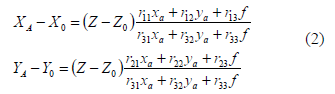
<body><![CDATA[<p><img src="/img/revistas/dyna/v76n160/a01eq01.gif"></p>     <p><font size="2" face="Verdana, Arial, Helvetica, sans-serif">Where (<i>x, y</i>) are image co-ordinates of target  points, <i>f</i>, the principal distance; (<i>X, Y, Z</i>) are object space co-ordinates  of target points; (<i>X<sub>0</sub>, Y<sub>0</sub>,  Z<sub>0</sub></i>) are object space co-ordinates of the projection centre; <i>r<sub>ij</sub></i> are the components of the  rotation matrix <i>R</i>, which is a  function of the three rotation angles <i>&#969;,  &#954;, &#966;</i> that define the spatial rotation between the object space system to the image co-ordinate system.</font></p>     <p><font size="2" face="Verdana, Arial, Helvetica, sans-serif">The  photogrammetric model generation involves the previous computation of the six  orientation parameters corresponding to the position (space co-ordinates) and  orientation (rotation angles) of the camera projection centre in a Cartesian  coordinate system for each image plane. For this end, the target points in the  object space are matched with the corresponding ones in the image planes of the  network. If a number enough of target points are used, the six unknowns for  each image plane can be found. Generally more than the necessary minimum are  used and the parameters are estimated by the bundle adjustment functional  model, which is based on least squares estimation (for further information see &#91;16&#93;).</font></p>     <p><font size="2" face="Verdana, Arial, Helvetica, sans-serif">The  bundle adjustment procedure was carried out using, 12 control points located on  the supported base that allowed to scale the 3D model and to fix the reference  system, 17 images in digital format of the sculpture. After the bundle  adjustment the photogrammetric system used to gauge project quality the value  called &#963;<sub>0 </sub>(or more properly a priori &#963;<sub>0</sub>), calculated like the variances of the residuals. The value of &#963;<sub>0</sub> was estimated in 0.85 pixels.</font></p>     <p><font size="2" face="Verdana, Arial, Helvetica, sans-serif">The  computation of the spatial 3D co-ordinates of the object vertexes and the  projected dots within the doubly curved surface is analogue to the method described for the camera poses calculation, see equation (2).</font></p>     <p><img src="/img/revistas/dyna/v76n160/a01eq02.gif"></p>     <p><font size="2" face="Verdana, Arial, Helvetica, sans-serif">Now the  unknowns are the co-ordinates (<i>X<sub>A</sub>,  Y<sub>A</sub>, Z<sub>A</sub></i>) of the points, and they are computed given the corresponding (<i>x<sub>a</sub>, y<sub>a</sub></i>) image co-ordinates and the  co-ordinates and rotation angles of the camera projection centre, which were  obtained for each image plane in the prior stage. In order to achieve enough  level of redundancy measurements, which is essential for obtaining high  accuracy results according to &#91;14&#93;, more than three images were used for the  restitution of each point. The system is also solved by bundle adjustment, in  this last process the photogrammetric system allow us to adjust together the  co-ordinates of the grid of dots set with the exterior orientation parameters.</font></p>     <p><font size="2" face="Verdana, Arial, Helvetica, sans-serif">The  photogrammetric software used is a convergent monoscopic multistation, this  system is based in a process of intersection of rays common for the calculate  of co-ordinates. This process is used for the restitution of all points, including the grid of dots.</font></p>     <p><font size="2" face="Verdana, Arial, Helvetica, sans-serif">Reconstruction  of flat surfaces is performed by fitting a flat surface to sets of coplanar  points and edges, in such a way that the normal distance from the surface to  the vertexes is minimized. Constrictions concerning parallel and perpendicular  conditions of edges are previously established in order to minimize errors in  the points restitution process. For the reconstruction of the curved surfaces a  Delaunay triangulation is performed that approximates them. The triangular mesh is then smoothed in order to get a better fitting with the original surface.</font></p>     <p><font size="2" face="Verdana, Arial, Helvetica, sans-serif"><b>2.2 Surface Flattening Method    ]]></body>
<body><![CDATA[<br> </b></font><font size="2" face="Verdana, Arial, Helvetica, sans-serif">The  procedure implemented here and  described in points 2.2.2 and 2.2.3, is based on the Azariadis and Aspragathos method (see &#91;17&#93;, &#91;18&#93; for details).</font></p>     <p><font size="2" face="Verdana, Arial, Helvetica, sans-serif"><i><b>2.2.1 Application plug-in development    <br> </b></i>The  computation of the planar profiles of the developed surfaces starts from the 3D  model definition obtained as result of the photogrammetric process. The faces  of the model defined with developable surfaces (Gaussian curvature = 0) are  easily developed using the functionality of a commercial CAD application.  However, this is not possible for the faces with doubly curved geometry that  cannot be flattened into a map without stretching, tearing, or compressing  itself. When Gaussian curvature is not very high, an optimization procedure  could be proposed that provides a fair approximation to the shape of the planar pattern minimizing the deformation of the plate. </font></p>     <p><font size="2" face="Verdana, Arial, Helvetica, sans-serif">The  mathematics of this method takes into account the isometric development of the  isoparametric curves with geodesic curvature preservation. Manipulation and  complex data computation of model geometry was required therefore the  application for planar patterns computation was conceived as a custom plug-in  to a CAD application. A plug-in is a software module that extends the functionality adding new commands or features to the application.</font></p>     <p><font size="2" face="Verdana, Arial, Helvetica, sans-serif">The  application plug-in was developed with the Rhino 3.0 SDK, an API that allows  the access to the functions of Rhinoceros 3.0 CAD application. This plug-in is  build with Microsoft Visual C++ 6.0 as a Windows DLL (Dynamic Link Library) that could be executed from Rhino&#8217;s command line.</font></p>     <p><font size="2" face="Verdana, Arial, Helvetica, sans-serif">A neutral  file of the model is generated in order to manage its geometry into the CAD  application. Rhino&#8217;s SDK provides all the functionality needed to select  the surface patches and access the data structure of the model, computing position, normal and tangent vectors, needed for the mathematical procedure</font></p>     <p><font size="2" face="Verdana, Arial, Helvetica, sans-serif">The  resulting planar pattern obtained with the plug-in is a geometrical entity of  the CAD application and can be exported in different formats of CAD standard neutral files.</font></p>     <p><font size="2" face="Verdana, Arial, Helvetica, sans-serif"><i><b>2.2.2 Mesh definition    <br> </b></i></font><font size="2" face="Verdana, Arial, Helvetica, sans-serif">The mesh  development procedure that is applied is based on the development of one of the  families of isoparametric curves. Therefore, the surface is accurately  approximated by a set of flat triangular elements that are homogeneously  distributed. This means that their vertexes are placed at the intersection of a <i>u</i>-isoparametric curve and a <i>v</i>-isoparametric curve of the <i>x= f(u, v)</i> surface. Each strip of  triangles is defined between two <i>u</i>-  or <i>v</i>-isoparametric curves that are approximated by the set of triangle sides with vertices on the same curve.</font></p>     <p><font size="2" face="Verdana, Arial, Helvetica, sans-serif"><i><b>2.2.3 Isometric mapping of a surface curve with geodesic curvature preservation    ]]></body>
<body><![CDATA[<br> </b></i></font><font size="2" face="Verdana, Arial, Helvetica, sans-serif">The  second stage consists of an initial estimation of the mesh development. One set  of isoparametric curves is developed preserving the length of the curve between  each two points (isometric map) and the geodesic curvature. This criterion is  essential since it guarantees the uniqueness of the resulting curve. The  development procedure of a curve <i>C </i>lying  on a surface requires the approximation by a finite set of points <i>C<sub>i</sub></i> taken on the curve. The  tangent plane <i>T<sub>i</sub></i> and the  normal vector <i>N<sub>i</sub></i> to the  surface has to be known at each of these points. The curve <i>C</i> is isometricly mapped onto a planar curve <i>C*</i> making the chord lengths of <i>C*</i> the same as the distance between the corresponding points of <i>C</i>. The geodesic curvature of <i>C</i> is preserved at each intermediate  point <i>C<sub>i</sub></i> if we keep the  angle <i>&#952;<sub>i</sub></i> between two  successive chords (<i>C<sub>i-1</sub>*, C<sub>i</sub>*, C<sub>i+1</sub>*</i>) of the planar curve <i>C*</i> the same as the angle defined by the projections onto the tangent plane <i>T<sub>i</sub></i> of the segments (<i>C<sub>i-1</sub>, C<sub>i</sub>, C<sub>i+1</sub></i>).</font></p>     <p><font size="2" face="Verdana, Arial, Helvetica, sans-serif">In the  triangular mesh of the surface, the sides of the triangles that join the  vertexes lying on these curves approximate the <i>u</i>- and <i>v</i>-isoparametric  curves. The first estimation of the developed mesh is obtained applying an  isometric map to these lines with geodesic curvature preservation. By carrying  out this procedure, developable surfaces are flattened without distortions,  while a distorted flattened mesh is obtained in the case of doubly curved surfaces.</font></p>     <p><font size="2" face="Verdana, Arial, Helvetica, sans-serif"><i><b>2.2.4 Reduction of the distortions: an energy based method    <br> </b></i></font><font size="2" face="Verdana, Arial, Helvetica, sans-serif">The  development of the surface approximate triangulation may be expressed by the  same procedure applied to the mapping of one unique curve. Isometric mapping  requires the preservation of the distances between pairs of nodes measured on  the 3D mesh. It should be taken into account that each node of the  triangulation lies on the crossing point of two <i>u</i>- and <i>v</i>-isoparametric  surface curves. Preservation of the geodesic curvature at each mesh node  requires the angle to be preserved between the projected segments of each one of the isoparametric curves and also the relative angle between them.</font></p>     <p><font size="2" face="Verdana, Arial, Helvetica, sans-serif">If the  surface is doubly curved, it is not possible to preserve the geodesic curvature  and the isometric map, therefore the planar development of the mesh will have  an error. To estimate this error an energy function is proposed. This function  combines two main error components. The first error term estimates the error  due to the distance difference between the nodes in the 3D mesh and the  corresponding nodes in the planar development. The second term estimates the angular distortion between the isoparametric curves at each node.</font></p>     <p>&nbsp;</p>     <p><font size="3" face="Verdana, Arial, Helvetica, sans-serif"><b>3. RESULTS</b></font></p>     <p><font size="2" face="Verdana, Arial, Helvetica, sans-serif"><b>3.1 3D Modelling: Photogrammetric Procedure    <br> </b>The 3D  surfaces modeling was obtained with 74 restituted points (including the  projected grid of dots). The bundle adjustment provide the results show in the  <a href="#tab02">table 2</a>, for all points (including the grid of dots) used to generate the 3D  model. This table shows information about: standard deviation of the cloud of  points (average values in X, Y, Z axes and quadratic composition of the  averages); the mean quadratic error, the mean error and the maximum error  observed in the parallax (m); Root Mean Square (RMS) error and maximum residual error (pixels); angle maximum and minimum between images (deg).</font></p>     <p align="center"><font size="2" face="Verdana, Arial, Helvetica, sans-serif"><b><a name="tab02"></a>Table 2.</b> 3D model accuracy   assessment: standard deviation (m) of the cloud of points (average values in X,   Y, Z axes and quadratic composition); the mean square error, the mean error and   the maximum error observed in the parallax (m); Root Mean Square error and maximum residual error (pixels); angle maximum and minimum between images (deg)</font>    ]]></body>
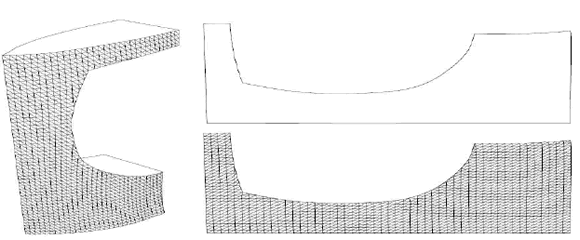
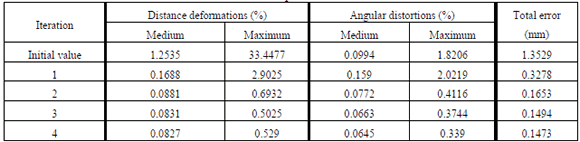
<body><![CDATA[<br> <img src="/img/revistas/dyna/v76n160/a01tab02.gif"></p>     <p><font size="2" face="Verdana, Arial, Helvetica, sans-serif">The use  of a flat grid as support base for the object simplifies the processing stage,  since the point identification on a 2D surface is significantly less affected  by visual perception errors than the identification of 3D points. The  generation of the 3D surface model through digital monoscopic photogrammetry  has shown to be a straightforward, fast and reliable method when developable  surfaces are surveyed (see <a href="#fig03">figure 3</a>). In the case of complex surfaces, the use  of the projected grid of dots has shown to be a simple and affordable system that provides high accuracy results (see <a href="#tab02">table 2</a>).</font></p>     <p align="center"><font size="2" face="Verdana, Arial, Helvetica, sans-serif"><b><a name="fig03"></a><img src="/img/revistas/dyna/v76n160/a01fig03.gif">    <br> Figure 3</b>. Wire-frame 3D model of the wooden sculpture</font></p>     <p><font size="2" face="Verdana, Arial, Helvetica, sans-serif">Nevertheless  we must point out that the effectiveness of this method depends on the size of  the object and the complexity of the surface, since the larger and/or the more  complex it is, the higher number of dots might be projected and processed to warrantee the match between the 3D digital model and the prototype.</font></p>     <p><font size="2" face="Verdana, Arial, Helvetica, sans-serif"><b>3.2 Surface Flattening Method    <br> </b></font><font size="2" face="Verdana, Arial, Helvetica, sans-serif">A custom Rhino plug-in application that  obtains the planar development of doubly curved surfaces starting from the CAD definition of the surfaces has been developed and implemented.</font></p>     <p><font size="2" face="Verdana, Arial, Helvetica, sans-serif">The  application generates a CAD neutral file with the shape of the cutting profile  that is needed for the machining processes of the metal sheets (see <a href="#fig04">figure 4</a>).  The mathematics of this method is based on the solution of an optimization problem  that takes into account the isometric development of the isoparametric curves  with geodesic curvature preservation. The surface is first approximated with a  triangular mesh. Distance deformations and angular distortions are measured  between each pair of mesh nodes and each pair of crossing isoparametric curves  at the nodes respectively, are observed as a result of the mesh flattening  process. An optimization procedure is applied to a function based on the value  of these deformations. <a href="#tab03">Table 3</a> shows the evolution of these values in  successive iterations, where the values of distance deformations and angular  distortions are expressed as a percentage of the actual distances and angles.  The medium and the maximum values are computed each iteration.</font></p>       <p align="center"><font size="2" face="Verdana, Arial, Helvetica, sans-serif"><b><a name="fig04"></a><img src="/img/revistas/dyna/v76n160/a01fig04.gif">    <br>   Figure 4</b>. 3D model of the grid surface with a doubly curved surface (left), plannar</font> <font size="2" face="Verdana, Arial, Helvetica, sans-serif">development of the grid (up right) and cutting profile (down right)</font></p>     ]]></body>
<body><![CDATA[<p align="center"><font size="2" face="Verdana, Arial, Helvetica, sans-serif"><b><a name="tab03"></a>Table 3</b>. Results of the  minimization development method used on double curved surfaces</font>    <br>  <img src="/img/revistas/dyna/v76n160/a01tab03.gif"></p>     <p>&nbsp;</p>     <p><font size="3" face="Verdana, Arial, Helvetica, sans-serif"><b>4. CONCLUSIONS</b></font></p>     <p><font size="2" face="Verdana, Arial, Helvetica, sans-serif">In this  paper an approach to the application of digital monoscopic photogrammetry  technique in the 3D modelling of doubly curved objects is presented, a surface  flattening method, based on isometric mapping and geodesic curvature  preservation, is implemented as a CAD application plug-in, and finally, an  iterative energy based optimization procedure is applied that minimises distortions in the final planar profiles.</font></p>     <p><font size="2" face="Verdana, Arial, Helvetica, sans-serif">The use  of Photogrammetric procedures in this kind of industrial applications has shown some advantages from other classical methodologies, could be appointed:</font></p> <ul>       <li><font size="2" face="Verdana, Arial, Helvetica, sans-serif"> Easy methodology and with fast results. For people     without previous knowledge about photogrammetric procedures.</font></li>       <li><font size="2" face="Verdana, Arial, Helvetica, sans-serif"> Low cost and simple equipment. Infrastructures or     complex devices are not necessary.</font></li>       <li><font size="2" face="Verdana, Arial, Helvetica, sans-serif"> The results can get it with accuracy better than     millimeters in the final model.</font></li>     </ul>     ]]></body>
<body><![CDATA[<p><font size="2" face="Verdana, Arial, Helvetica, sans-serif">For other  side, we can see same aspects or characteristics would have to be more developed, for example:</font></p> <ul>       <li><font size="2" face="Verdana, Arial, Helvetica, sans-serif"> The grid of dots projected on complex surfaces is     essential to get quality results.</font></li>       <li><font size="2" face="Verdana, Arial, Helvetica, sans-serif"> When the complex surfaces can be observed in the     element. The use of grid of dots make necessary the development and building of     industrial structure light systems, like this, the device will allow the     automatic process of the grid of dots projected on the surface.</font></li>       <li><font size="2" face="Verdana, Arial, Helvetica, sans-serif"> There is an important influence in the final results     for the kind of software CAD used, to process the cloud of points and to adjust     there to surfaces models can be development later, to get and extract planar     patches to manufacture process. Independently of the procedure or system     photogrammetric used.</font></li>     </ul>     <p><font size="2" face="Verdana, Arial, Helvetica, sans-serif">In  conclusion, two main contributions should be highlighted. Digital  photogrammetry has shown to be a feasible and affordable tool in the accurate  3D model generation of complex objects; it is relevant that both of the aspects  of feasibility and affordability are decisive factors in the accomplishment of  automated manufacturing processes. Then the 3D model is saved to a neutral file  format that could be processed with a CAD application. The surface flattening  method is implemented as a customized plug-in. The proposed development and  optimization methods have been proven to be effective and highly efficient in  the case study. Finally, the resulting planar pattern is then saved to a  neutral file that could be accessible from a wide number of different machine tool programming applications.</font></p>     <p>&nbsp;</p>     <p><font size="3" face="Verdana, Arial, Helvetica, sans-serif"><b>5. ACKNOWLEDGMENTS</b></font></p>     <p><font size="2" face="Verdana, Arial, Helvetica, sans-serif">This  article is part of a research project financed by Ministry Education and  Science &#8220;Utilizacion de tecnicas geomaticas para el analisis  dimensional-estructural y conservacion de puentes historicos singulares&#8221; (BIA2006-10259).</font></p>     <p>&nbsp;</p>     ]]></body>
<body><![CDATA[<p><font size="3" face="Verdana, Arial, Helvetica, sans-serif"><b>REFERENCES</b></font></p>     <!-- ref --><p>   <font size="2" face="Verdana, Arial, Helvetica, sans-serif"><b>&#91;1&#93;</b> KARUNAKARAN, K.P., AGRAWAL, S., VENGURLEKAR,P.D., SAHASRABUDHE, O.S., PUSHPA,.V. AND ELY, R. Segmented object manufacturing. IEEE Transactions, 39, 291-302, 2005.       &nbsp;&nbsp;&nbsp;&nbsp;&nbsp;&nbsp;&nbsp;&nbsp;[&#160;<a href="javascript:void(0);" onclick="javascript: window.open('/scielo.php?script=sci_nlinks&ref=000104&pid=S0012-7353200900040000100001&lng=','','width=640,height=500,resizable=yes,scrollbars=1,menubar=yes,');">Links</a>&#160;]<!-- end-ref --><!-- ref --><br>   <b>&#91;2&#93;</b> ARIAS, P., ARMESTO, J., LORENZO, H. AND ORDO&Ntilde;EZ, C. 3D terrestrial laser technology in sporting craft 3D modelling. International Journal of Simulation Modelling, 6 (2), 65-72, 2007.     &nbsp;&nbsp;&nbsp;&nbsp;&nbsp;&nbsp;&nbsp;&nbsp;[&#160;<a href="javascript:void(0);" onclick="javascript: window.open('/scielo.php?script=sci_nlinks&ref=000105&pid=S0012-7353200900040000100002&lng=','','width=640,height=500,resizable=yes,scrollbars=1,menubar=yes,');">Links</a>&#160;]<!-- end-ref --><!-- ref --><br>   <b>&#91;3&#93;</b> CUARTAS, E AND PRIETO, F. Reconstrucci&oacute;n de objetos con superficies Tipo 2-variedad diferenciable. Dyna, 156 (75), 7-18, 2008.     &nbsp;&nbsp;&nbsp;&nbsp;&nbsp;&nbsp;&nbsp;&nbsp;[&#160;<a href="javascript:void(0);" onclick="javascript: window.open('/scielo.php?script=sci_nlinks&ref=000106&pid=S0012-7353200900040000100003&lng=','','width=640,height=500,resizable=yes,scrollbars=1,menubar=yes,');">Links</a>&#160;]<!-- end-ref --><!-- ref --><br>   <b>&#91;4&#93;</b> RABBANI, T., DIJKMAN, S., VAN DEN HEUVEL, F. AND VOSSELMAN, G. An integrated approach for modelling and global registration of point clouds. ISPRS Journal of Photogrammetry and Remote Sensing, 61 (6), 355-370, 2007.       &nbsp;&nbsp;&nbsp;&nbsp;&nbsp;&nbsp;&nbsp;&nbsp;[&#160;<a href="javascript:void(0);" onclick="javascript: window.open('/scielo.php?script=sci_nlinks&ref=000107&pid=S0012-7353200900040000100004&lng=','','width=640,height=500,resizable=yes,scrollbars=1,menubar=yes,');">Links</a>&#160;]<!-- end-ref --><!-- ref --><br>   <b>&#91;5&#93;</b> ROCA-PARDIÑAS, J., LORENZO, H., ARIAS, P. AND ARMESTO, J. From laser point clouds to surfaces: Statistical nonparametric methods for three-dimensional reconstruction. Computer Aided Design, 40 (5), 646-652, 2008.     &nbsp;&nbsp;&nbsp;&nbsp;&nbsp;&nbsp;&nbsp;&nbsp;[&#160;<a href="javascript:void(0);" onclick="javascript: window.open('/scielo.php?script=sci_nlinks&ref=000108&pid=S0012-7353200900040000100005&lng=','','width=640,height=500,resizable=yes,scrollbars=1,menubar=yes,');">Links</a>&#160;]<!-- end-ref --><!-- ref --><br>   <b>&#91;6&#93;</b> YAU, H.T., LEE, R.K., CHUANG, C.M. AND HSU, C.Y. NC Tool-Path Generation Based on Surfel Models Constructed from Random Scanned Data. Computer-Aided Design & Applications, 2 (1-4), 567-576, 2005.     &nbsp;&nbsp;&nbsp;&nbsp;&nbsp;&nbsp;&nbsp;&nbsp;[&#160;<a href="javascript:void(0);" onclick="javascript: window.open('/scielo.php?script=sci_nlinks&ref=000109&pid=S0012-7353200900040000100006&lng=','','width=640,height=500,resizable=yes,scrollbars=1,menubar=yes,');">Links</a>&#160;]<!-- end-ref --><!-- ref --><br>   <b>&#91;7&#93;</b> Y. ZHANG. Measurement of industrial sheetmetal parts with CAD, designed data and nonmetric image sequence. Proceedings of the XXth ISPRS Congress Commission 5, Istanbul, Turkey , 2004.       &nbsp;&nbsp;&nbsp;&nbsp;&nbsp;&nbsp;&nbsp;&nbsp;[&#160;<a href="javascript:void(0);" onclick="javascript: window.open('/scielo.php?script=sci_nlinks&ref=000110&pid=S0012-7353200900040000100007&lng=','','width=640,height=500,resizable=yes,scrollbars=1,menubar=yes,');">Links</a>&#160;]<!-- end-ref --><!-- ref --><br>   <b>&#91;8&#93;</b> TANGELDER, J.W.H., ERMES, P., VOSSELMAN, G. AND VAN DEN HEUVEL, F.A. CAD-based photogrammetry for reverse engineering of industrial installations. Computer-Aided Civil and Infrastructure Engineering, 18, 264-274, 2003.       &nbsp;&nbsp;&nbsp;&nbsp;&nbsp;&nbsp;&nbsp;&nbsp;[&#160;<a href="javascript:void(0);" onclick="javascript: window.open('/scielo.php?script=sci_nlinks&ref=000111&pid=S0012-7353200900040000100008&lng=','','width=640,height=500,resizable=yes,scrollbars=1,menubar=yes,');">Links</a>&#160;]<!-- end-ref --><!-- ref --><br>   <b>&#91;9&#93;</b> BOSEMANN, W. Advances in photogrammetric measurement solutions. Computers in Industry, 56 (8-9), 886-893, 2005.       &nbsp;&nbsp;&nbsp;&nbsp;&nbsp;&nbsp;&nbsp;&nbsp;[&#160;<a href="javascript:void(0);" onclick="javascript: window.open('/scielo.php?script=sci_nlinks&ref=000112&pid=S0012-7353200900040000100009&lng=','','width=640,height=500,resizable=yes,scrollbars=1,menubar=yes,');">Links</a>&#160;]<!-- end-ref --><!-- ref --><br>   <b>&#91;10&#93;</b> ERGUN, B. An expert measurement system for photogrammetric industrial application. Measurement, 39 (5), 415-419, 2006.       &nbsp;&nbsp;&nbsp;&nbsp;&nbsp;&nbsp;&nbsp;&nbsp;[&#160;<a href="javascript:void(0);" onclick="javascript: window.open('/scielo.php?script=sci_nlinks&ref=000113&pid=S0012-7353200900040000100010&lng=','','width=640,height=500,resizable=yes,scrollbars=1,menubar=yes,');">Links</a>&#160;]<!-- end-ref --><!-- ref --><br>   <b>&#91;11&#93;</b> D'ANGELO, P., WOHLER, C. Image-based 3D surface reconstruction by combination of photometric, geometric, and real-aperture methods. ISPRS Journal of Photogrammetry and Remote Sensing, 63 (3), 297-321, 2008.        &nbsp;&nbsp;&nbsp;&nbsp;&nbsp;&nbsp;&nbsp;&nbsp;[&#160;<a href="javascript:void(0);" onclick="javascript: window.open('/scielo.php?script=sci_nlinks&ref=000114&pid=S0012-7353200900040000100011&lng=','','width=640,height=500,resizable=yes,scrollbars=1,menubar=yes,');">Links</a>&#160;]<!-- end-ref --><!-- ref --><br>   <b>&#91;12&#93;</b> ARIAS, P., CAAMAÑO, J.C., LORENZO, H. AND ARMESTO, J. 3D Modeling and Section Properties of Ancient Irregular Timber Structures by Means of Digital Photogrammetry. Computer-Aided Civil and Infrastructure Engineering, 22 (8), 597-611, 2007.     &nbsp;&nbsp;&nbsp;&nbsp;&nbsp;&nbsp;&nbsp;&nbsp;[&#160;<a href="javascript:void(0);" onclick="javascript: window.open('/scielo.php?script=sci_nlinks&ref=000115&pid=S0012-7353200900040000100012&lng=','','width=640,height=500,resizable=yes,scrollbars=1,menubar=yes,');">Links</a>&#160;]<!-- end-ref --><!-- ref --><br>   <b>&#91;13&#93;</b> SALAZAR, A., S&Aacute;NCHEZ, L.G. AND PRIETO, F. Sistema de adquisici&oacute;n de im&aacute;genes de rango con base en est&eacute;reo-activo. Dyna, 153 (74), 301-311, 2007.     &nbsp;&nbsp;&nbsp;&nbsp;&nbsp;&nbsp;&nbsp;&nbsp;[&#160;<a href="javascript:void(0);" onclick="javascript: window.open('/scielo.php?script=sci_nlinks&ref=000116&pid=S0012-7353200900040000100013&lng=','','width=640,height=500,resizable=yes,scrollbars=1,menubar=yes,');">Links</a>&#160;]<!-- end-ref --><!-- ref --><br>   <b>&#91;14&#93;</b> MASON, S.O. Conceptual Model of the convergent multistation network configuration task. Photogrammetric Record, 15 (86), 277-299, 1995.       &nbsp;&nbsp;&nbsp;&nbsp;&nbsp;&nbsp;&nbsp;&nbsp;[&#160;<a href="javascript:void(0);" onclick="javascript: window.open('/scielo.php?script=sci_nlinks&ref=000117&pid=S0012-7353200900040000100014&lng=','','width=640,height=500,resizable=yes,scrollbars=1,menubar=yes,');">Links</a>&#160;]<!-- end-ref --><!-- ref --><br>   <b>&#91;15&#93;</b> EOS SYSTEMS INC. Photomodeler Pro 5.0. User manual. Vancouver, Canada, 2003.       &nbsp;&nbsp;&nbsp;&nbsp;&nbsp;&nbsp;&nbsp;&nbsp;[&#160;<a href="javascript:void(0);" onclick="javascript: window.open('/scielo.php?script=sci_nlinks&ref=000118&pid=S0012-7353200900040000100015&lng=','','width=640,height=500,resizable=yes,scrollbars=1,menubar=yes,');">Links</a>&#160;]<!-- end-ref --><!-- ref --><br>   <b>&#91;16&#93;</b> COOPER, M. AND ROBSON, S.. Theory of Close Range Photogrammetry, In: Close Range Photogrammetry and Machine Vision (Ed. K.B.Atkinson), Whittles Publishing, 9-51, 2001.       &nbsp;&nbsp;&nbsp;&nbsp;&nbsp;&nbsp;&nbsp;&nbsp;[&#160;<a href="javascript:void(0);" onclick="javascript: window.open('/scielo.php?script=sci_nlinks&ref=000119&pid=S0012-7353200900040000100016&lng=','','width=640,height=500,resizable=yes,scrollbars=1,menubar=yes,');">Links</a>&#160;]<!-- end-ref --><!-- ref --><br>   <b>&#91;17&#93;</b> AZARIADIS,P. AND ASPRAGATHOS, N. Design of plane patterns of doubly curved surfaces. Computer-Aided Design, 29 (10), 675-85, 1997.       &nbsp;&nbsp;&nbsp;&nbsp;&nbsp;&nbsp;&nbsp;&nbsp;[&#160;<a href="javascript:void(0);" onclick="javascript: window.open('/scielo.php?script=sci_nlinks&ref=000120&pid=S0012-7353200900040000100017&lng=','','width=640,height=500,resizable=yes,scrollbars=1,menubar=yes,');">Links</a>&#160;]<!-- end-ref --><!-- ref --><br>   <b>&#91;18&#93;</b> AZARIADIS,P. AND ASPRAGATHOS, N. Geodesic curvature preservation in surface flattening through constrained global optimization. Computer-Aided Design, 33, 581-591, 2001.</font>&nbsp;&nbsp;&nbsp;&nbsp;&nbsp;&nbsp;&nbsp;&nbsp;[&#160;<a href="javascript:void(0);" onclick="javascript: window.open('/scielo.php?script=sci_nlinks&ref=000121&pid=S0012-7353200900040000100018&lng=','','width=640,height=500,resizable=yes,scrollbars=1,menubar=yes,');">Links</a>&#160;]<!-- end-ref --> ]]></body><back>
<ref-list>
<ref id="B1">
<label>1</label><nlm-citation citation-type="journal">
<person-group person-group-type="author">
<name>
<surname><![CDATA[KARUNAKARAN]]></surname>
<given-names><![CDATA[K.P.]]></given-names>
</name>
<name>
<surname><![CDATA[AGRAWAL]]></surname>
<given-names><![CDATA[S.]]></given-names>
</name>
<name>
<surname><![CDATA[VENGURLEKAR]]></surname>
<given-names><![CDATA[P.D.]]></given-names>
</name>
<name>
<surname><![CDATA[SAHASRABUDHE]]></surname>
<given-names><![CDATA[O.S.]]></given-names>
</name>
<name>
<surname><![CDATA[PUSHPA]]></surname>
<given-names><![CDATA[V.]]></given-names>
</name>
<name>
<surname><![CDATA[ELY]]></surname>
<given-names><![CDATA[R.]]></given-names>
</name>
</person-group>
<article-title xml:lang="en"><![CDATA[Segmented object manufacturing]]></article-title>
<source><![CDATA[IEEE Transactions]]></source>
<year>2005</year>
<volume>39</volume>
<page-range>291-302</page-range></nlm-citation>
</ref>
<ref id="B2">
<label>2</label><nlm-citation citation-type="journal">
<person-group person-group-type="author">
<name>
<surname><![CDATA[ARIAS]]></surname>
<given-names><![CDATA[P.]]></given-names>
</name>
<name>
<surname><![CDATA[ARMESTO]]></surname>
<given-names><![CDATA[J.]]></given-names>
</name>
<name>
<surname><![CDATA[LORENZO]]></surname>
<given-names><![CDATA[H.]]></given-names>
</name>
<name>
<surname><![CDATA[ORDOÑEZ]]></surname>
<given-names><![CDATA[C.]]></given-names>
</name>
</person-group>
<article-title xml:lang="en"><![CDATA[3D terrestrial laser technology in sporting craft 3D modelling]]></article-title>
<source><![CDATA[International Journal of Simulation Modelling]]></source>
<year>2007</year>
<volume>6</volume>
<numero>2</numero>
<issue>2</issue>
<page-range>65-72</page-range></nlm-citation>
</ref>
<ref id="B3">
<label>3</label><nlm-citation citation-type="journal">
<person-group person-group-type="author">
<name>
<surname><![CDATA[CUARTAS]]></surname>
<given-names><![CDATA[E]]></given-names>
</name>
<name>
<surname><![CDATA[PRIETO]]></surname>
<given-names><![CDATA[F.]]></given-names>
</name>
</person-group>
<article-title xml:lang="es"><![CDATA[Reconstrucción de objetos con superficies Tipo 2-variedad diferenciable]]></article-title>
<source><![CDATA[Dyna]]></source>
<year>2008</year>
<volume>75</volume>
<numero>156</numero>
<issue>156</issue>
<page-range>7-18</page-range></nlm-citation>
</ref>
<ref id="B4">
<label>4</label><nlm-citation citation-type="journal">
<person-group person-group-type="author">
<name>
<surname><![CDATA[RABBANI]]></surname>
<given-names><![CDATA[T.]]></given-names>
</name>
<name>
<surname><![CDATA[DIJKMAN]]></surname>
<given-names><![CDATA[S.]]></given-names>
</name>
<name>
<surname><![CDATA[VAN DEN HEUVEL]]></surname>
<given-names><![CDATA[F.]]></given-names>
</name>
<name>
<surname><![CDATA[VOSSELMAN]]></surname>
<given-names><![CDATA[G.]]></given-names>
</name>
</person-group>
<article-title xml:lang="en"><![CDATA[An integrated approach for modelling and global registration of point clouds]]></article-title>
<source><![CDATA[ISPRS Journal of Photogrammetry and Remote Sensing]]></source>
<year>2007</year>
<volume>61</volume>
<numero>6</numero>
<issue>6</issue>
<page-range>355-370</page-range></nlm-citation>
</ref>
<ref id="B5">
<label>5</label><nlm-citation citation-type="journal">
<person-group person-group-type="author">
<name>
<surname><![CDATA[ROCA-PARDIÑAS]]></surname>
<given-names><![CDATA[J.]]></given-names>
</name>
<name>
<surname><![CDATA[LORENZO]]></surname>
<given-names><![CDATA[H.]]></given-names>
</name>
<name>
<surname><![CDATA[ARIAS]]></surname>
<given-names><![CDATA[P.]]></given-names>
</name>
<name>
<surname><![CDATA[ARMESTO]]></surname>
<given-names><![CDATA[J.]]></given-names>
</name>
</person-group>
<article-title xml:lang="en"><![CDATA[From laser point clouds to surfaces: Statistical nonparametric methods for three-dimensional reconstruction]]></article-title>
<source><![CDATA[Computer Aided Design]]></source>
<year>2008</year>
<volume>40</volume>
<numero>5</numero>
<issue>5</issue>
<page-range>646-652</page-range></nlm-citation>
</ref>
<ref id="B6">
<label>6</label><nlm-citation citation-type="journal">
<person-group person-group-type="author">
<name>
<surname><![CDATA[YAU]]></surname>
<given-names><![CDATA[H.T.]]></given-names>
</name>
<name>
<surname><![CDATA[LEE]]></surname>
<given-names><![CDATA[R.K.]]></given-names>
</name>
<name>
<surname><![CDATA[CHUANG]]></surname>
<given-names><![CDATA[C.M.]]></given-names>
</name>
<name>
<surname><![CDATA[HSU]]></surname>
<given-names><![CDATA[C.Y.]]></given-names>
</name>
</person-group>
<article-title xml:lang="en"><![CDATA[NC Tool-Path Generation Based on Surfel Models Constructed from Random Scanned Data]]></article-title>
<source><![CDATA[Computer-Aided Design & Applications]]></source>
<year>2005</year>
<volume>2</volume>
<numero>1</numero>
<issue>1</issue>
<page-range>567-576</page-range></nlm-citation>
</ref>
<ref id="B7">
<label>7</label><nlm-citation citation-type="confpro">
<person-group person-group-type="author">
<name>
<surname><![CDATA[ZHANG]]></surname>
<given-names><![CDATA[Y.]]></given-names>
</name>
</person-group>
<article-title xml:lang="en"><![CDATA[Measurement of industrial sheetmetal parts with CAD, designed data and nonmetric image sequence]]></article-title>
<source><![CDATA[]]></source>
<year></year>
<conf-name><![CDATA[ Proceedings of the XXth ISPRS Congress Commission 5]]></conf-name>
<conf-date>2004</conf-date>
<conf-loc>Istanbul </conf-loc>
</nlm-citation>
</ref>
<ref id="B8">
<label>8</label><nlm-citation citation-type="journal">
<person-group person-group-type="author">
<name>
<surname><![CDATA[TANGELDER]]></surname>
<given-names><![CDATA[J.W.H.]]></given-names>
</name>
<name>
<surname><![CDATA[ERMES]]></surname>
<given-names><![CDATA[P.]]></given-names>
</name>
<name>
<surname><![CDATA[VOSSELMAN]]></surname>
<given-names><![CDATA[G.]]></given-names>
</name>
<name>
<surname><![CDATA[VAN DEN HEUVEL]]></surname>
<given-names><![CDATA[F.A.]]></given-names>
</name>
</person-group>
<article-title xml:lang="en"><![CDATA[CAD-based photogrammetry for reverse engineering of industrial installations]]></article-title>
<source><![CDATA[Computer-Aided Civil and Infrastructure Engineering]]></source>
<year>2003</year>
<volume>18</volume>
<page-range>264-274</page-range></nlm-citation>
</ref>
<ref id="B9">
<label>9</label><nlm-citation citation-type="journal">
<person-group person-group-type="author">
<name>
<surname><![CDATA[BOSEMANN]]></surname>
<given-names><![CDATA[W.]]></given-names>
</name>
</person-group>
<article-title xml:lang="en"><![CDATA[Advances in photogrammetric measurement solutions]]></article-title>
<source><![CDATA[Computers in Industry]]></source>
<year>2005</year>
<volume>56</volume>
<numero>8</numero>
<issue>8</issue>
<page-range>886-893</page-range></nlm-citation>
</ref>
<ref id="B10">
<label>10</label><nlm-citation citation-type="journal">
<person-group person-group-type="author">
<name>
<surname><![CDATA[ERGUN]]></surname>
<given-names><![CDATA[B.]]></given-names>
</name>
</person-group>
<article-title xml:lang="en"><![CDATA[An expert measurement system for photogrammetric industrial application]]></article-title>
<source><![CDATA[Measurement]]></source>
<year>2006</year>
<volume>39</volume>
<numero>5</numero>
<issue>5</issue>
<page-range>415-419</page-range></nlm-citation>
</ref>
<ref id="B11">
<label>11</label><nlm-citation citation-type="journal">
<person-group person-group-type="author">
<name>
<surname><![CDATA[D'ANGELO]]></surname>
<given-names><![CDATA[P.]]></given-names>
</name>
<name>
<surname><![CDATA[WOHLER]]></surname>
<given-names><![CDATA[C.]]></given-names>
</name>
</person-group>
<article-title xml:lang="en"><![CDATA[Image-based 3D surface reconstruction by combination of photometric, geometric, and real-aperture methods]]></article-title>
<source><![CDATA[ISPRS Journal of Photogrammetry and Remote Sensing]]></source>
<year>2008</year>
<volume>63</volume>
<numero>3</numero>
<issue>3</issue>
<page-range>297-321</page-range></nlm-citation>
</ref>
<ref id="B12">
<label>12</label><nlm-citation citation-type="journal">
<person-group person-group-type="author">
<name>
<surname><![CDATA[ARIAS]]></surname>
<given-names><![CDATA[P.]]></given-names>
</name>
<name>
<surname><![CDATA[CAAMAÑO]]></surname>
<given-names><![CDATA[J.C.]]></given-names>
</name>
<name>
<surname><![CDATA[LORENZO]]></surname>
<given-names><![CDATA[H.]]></given-names>
</name>
<name>
<surname><![CDATA[ARMESTO]]></surname>
<given-names><![CDATA[J.]]></given-names>
</name>
</person-group>
<article-title xml:lang="en"><![CDATA[3D Modeling and Section Properties of Ancient Irregular Timber Structures by Means of Digital Photogrammetry]]></article-title>
<source><![CDATA[Computer-Aided Civil and Infrastructure Engineering]]></source>
<year>2007</year>
<volume>22</volume>
<numero>8</numero>
<issue>8</issue>
<page-range>597-611</page-range></nlm-citation>
</ref>
<ref id="B13">
<label>13</label><nlm-citation citation-type="journal">
<person-group person-group-type="author">
<name>
<surname><![CDATA[SALAZAR]]></surname>
<given-names><![CDATA[A.]]></given-names>
</name>
<name>
<surname><![CDATA[SÁNCHEZ]]></surname>
<given-names><![CDATA[L.G.]]></given-names>
</name>
<name>
<surname><![CDATA[PRIETO]]></surname>
<given-names><![CDATA[F.]]></given-names>
</name>
</person-group>
<article-title xml:lang="es"><![CDATA[Sistema de adquisición de imágenes de rango con base en estéreo-activo]]></article-title>
<source><![CDATA[Dyna]]></source>
<year>2007</year>
<volume>74</volume>
<numero>153</numero>
<issue>153</issue>
<page-range>301-311</page-range></nlm-citation>
</ref>
<ref id="B14">
<label>14</label><nlm-citation citation-type="journal">
<person-group person-group-type="author">
<name>
<surname><![CDATA[MASON]]></surname>
<given-names><![CDATA[S.O.]]></given-names>
</name>
</person-group>
<article-title xml:lang="en"><![CDATA[Conceptual Model of the convergent multistation network configuration task]]></article-title>
<source><![CDATA[Photogrammetric Record]]></source>
<year>1995</year>
<volume>15</volume>
<numero>86</numero>
<issue>86</issue>
<page-range>277-299</page-range></nlm-citation>
</ref>
<ref id="B15">
<label>15</label><nlm-citation citation-type="">
<collab>EOS SYSTEMS INC.</collab>
<source><![CDATA[Photomodeler Pro 5.0.: User manual]]></source>
<year>2003</year>
<publisher-loc><![CDATA[Vancouver ]]></publisher-loc>
</nlm-citation>
</ref>
<ref id="B16">
<label>16</label><nlm-citation citation-type="book">
<person-group person-group-type="author">
<name>
<surname><![CDATA[COOPER]]></surname>
<given-names><![CDATA[M.]]></given-names>
</name>
<name>
<surname><![CDATA[ROBSON]]></surname>
<given-names><![CDATA[S.]]></given-names>
</name>
</person-group>
<article-title xml:lang="en"><![CDATA[Theory of Close Range Photogrammetry]]></article-title>
<person-group person-group-type="editor">
<name>
<surname><![CDATA[Atkinson]]></surname>
<given-names><![CDATA[K.B.]]></given-names>
</name>
</person-group>
<source><![CDATA[Close Range Photogrammetry and Machine Vision]]></source>
<year>2001</year>
<page-range>9-51</page-range><publisher-name><![CDATA[Whittles Publishing]]></publisher-name>
</nlm-citation>
</ref>
<ref id="B17">
<label>17</label><nlm-citation citation-type="journal">
<person-group person-group-type="author">
<name>
<surname><![CDATA[AZARIADIS]]></surname>
<given-names><![CDATA[P.]]></given-names>
</name>
<name>
<surname><![CDATA[ASPRAGATHOS]]></surname>
<given-names><![CDATA[N.]]></given-names>
</name>
</person-group>
<article-title xml:lang="en"><![CDATA[Design of plane patterns of doubly curved surfaces]]></article-title>
<source><![CDATA[Computer-Aided Design]]></source>
<year>1997</year>
<volume>29</volume>
<numero>10</numero>
<issue>10</issue>
<page-range>675-85</page-range></nlm-citation>
</ref>
<ref id="B18">
<label>18</label><nlm-citation citation-type="journal">
<person-group person-group-type="author">
<name>
<surname><![CDATA[AZARIADIS]]></surname>
<given-names><![CDATA[P.]]></given-names>
</name>
<name>
<surname><![CDATA[ASPRAGATHOS]]></surname>
<given-names><![CDATA[N.]]></given-names>
</name>
</person-group>
<article-title xml:lang="en"><![CDATA[Geodesic curvature preservation in surface flattening through constrained global optimization]]></article-title>
<source><![CDATA[Computer-Aided Design]]></source>
<year>2001</year>
<volume>33</volume>
<page-range>581-591</page-range></nlm-citation>
</ref>
</ref-list>
</back>
</article>