<?xml version="1.0" encoding="ISO-8859-1"?><article xmlns:mml="http://www.w3.org/1998/Math/MathML" xmlns:xlink="http://www.w3.org/1999/xlink" xmlns:xsi="http://www.w3.org/2001/XMLSchema-instance">
<front>
<journal-meta>
<journal-id>0012-7353</journal-id>
<journal-title><![CDATA[DYNA]]></journal-title>
<abbrev-journal-title><![CDATA[Dyna rev.fac.nac.minas]]></abbrev-journal-title>
<issn>0012-7353</issn>
<publisher>
<publisher-name><![CDATA[Universidad Nacional de Colombia]]></publisher-name>
</publisher>
</journal-meta>
<article-meta>
<article-id>S0012-73532010000100003</article-id>
<title-group>
<article-title xml:lang="en"><![CDATA[CORPORATE SOCIAL RESPONSIBILITY IN THE MINING INDUSTRY: CRITERIA AND INDICATORS]]></article-title>
<article-title xml:lang="es"><![CDATA[RESPONSABILIDAD SOCIAL CORPORATIVA EN LA MINERÍA: CRITERIOS E INDICADORES]]></article-title>
</title-group>
<contrib-group>
<contrib contrib-type="author">
<name>
<surname><![CDATA[VINTRÓ]]></surname>
<given-names><![CDATA[CARLA]]></given-names>
</name>
<xref ref-type="aff" rid="A01"/>
</contrib>
<contrib contrib-type="author">
<name>
<surname><![CDATA[COMAJUNCOSA]]></surname>
<given-names><![CDATA[JOSEP]]></given-names>
</name>
<xref ref-type="aff" rid="A02"/>
</contrib>
</contrib-group>
<aff id="A01">
<institution><![CDATA[,Universidad Politécnica de Catalunya Dep. of Management ]]></institution>
<addr-line><![CDATA[ ]]></addr-line>
</aff>
<aff id="A02">
<institution><![CDATA[,Universidad Politécnica de Catalunya Dep. of Management ]]></institution>
<addr-line><![CDATA[ ]]></addr-line>
</aff>
<pub-date pub-type="pub">
<day>00</day>
<month>03</month>
<year>2010</year>
</pub-date>
<pub-date pub-type="epub">
<day>00</day>
<month>03</month>
<year>2010</year>
</pub-date>
<volume>77</volume>
<numero>161</numero>
<fpage>31</fpage>
<lpage>41</lpage>
<copyright-statement/>
<copyright-year/>
<self-uri xlink:href="http://www.scielo.org.co/scielo.php?script=sci_arttext&amp;pid=S0012-73532010000100003&amp;lng=en&amp;nrm=iso"></self-uri><self-uri xlink:href="http://www.scielo.org.co/scielo.php?script=sci_abstract&amp;pid=S0012-73532010000100003&amp;lng=en&amp;nrm=iso"></self-uri><self-uri xlink:href="http://www.scielo.org.co/scielo.php?script=sci_pdf&amp;pid=S0012-73532010000100003&amp;lng=en&amp;nrm=iso"></self-uri><abstract abstract-type="short" xml:lang="en"><p><![CDATA[Corporate Social Responsibility (CSR) includes economic, social and environmental aspects, and it has particular significance in mining. This paper explores the subject of CSR in the mining industry and the main synergies between CSR and environmental, safety and quality management systems, whose adoption has increased during recent decades. It proposes the establishment of a set of criteria for sustainability, ethics and human capital (to be called CSR criteria). Whilst various international bodies have proposed CSR guides and indicators (commonly used as references for Stock Market investments), there is evidence that the size of the company can act as a moderator factor to the adoption of those systems. The paper offers an easy-to-use CSR performance chart (composed of 31 indicators and a global index), intended as an internal measure for companies of CSR continuous improvement.]]></p></abstract>
<abstract abstract-type="short" xml:lang="es"><p><![CDATA[La Responsabilidad Social Corporativa (RSC) incluye aspectos económicos, sociales y medioambientales, y tiene especial importancia en la minería. En este artículo se explora la disciplina de RSC en la industria minera y las sinergias principales con los sistemas de gestión medioambiental, de seguridad y de calidad, la adopción de los cuales ha aumentado durante las últimas décadas. Se propone el establecimiento de un conjunto de criterios de sostenibilidad, ética y capital humano (denominados criterios de RSC). Distintos organismos internacionales han propuesto guías e indicadores de RSC (normalmente utilizados como referencias para cotizaciones bursátiles), pero hay evidencias que el tamaño de la empresa puede actuar como factor moderador en la adopción de estos sistemas. En el artículo se presenta un cuadro de control de RSC fácil de utilizar (formado por 31 indicadores y un índice global), pensado como una medida interna de la mejora continua de la RSC de las empresas.]]></p></abstract>
<kwd-group>
<kwd lng="en"><![CDATA[CSR (corporate social responsibility)]]></kwd>
<kwd lng="en"><![CDATA[management excellence]]></kwd>
<kwd lng="en"><![CDATA[mining industry]]></kwd>
<kwd lng="en"><![CDATA[ethics]]></kwd>
<kwd lng="en"><![CDATA[sustainability]]></kwd>
<kwd lng="es"><![CDATA[RSC (responsabilidad social corporativa)]]></kwd>
<kwd lng="es"><![CDATA[excelencia empresarial]]></kwd>
<kwd lng="es"><![CDATA[industria minera]]></kwd>
<kwd lng="es"><![CDATA[ética]]></kwd>
<kwd lng="es"><![CDATA[sostenibilidad]]></kwd>
</kwd-group>
</article-meta>
</front><body><![CDATA[ <p align="center"><font size="4" face="Verdana, Arial, Helvetica, sans-serif"><b>CORPORATE SOCIAL RESPONSIBILITY IN THE MINING INDUSTRY: CRITERIA AND INDICATORS</b></font></p>     <p align="center"><i><font size="3" face="Verdana, Arial, Helvetica, sans-serif"><b>RESPONSABILIDAD SOCIAL CORPORATIVA EN   LA MINER&Iacute;A: CRITERIOS E INDICADORES </b></font></i></p>     <p align="center">&nbsp;</p>     <p align="center"><font size="2" face="Verdana, Arial, Helvetica, sans-serif"><b>CARLA VINTR&Oacute;</b>    <br>       <i>Dep.         of Management, Universidad Polit&eacute;cnica de Catalunya, <a href="mailto:carla.vintro@upc.edu">carla.vintro@upc.edu</a></i></font></p>     <p align="center"><font size="2" face="Verdana, Arial, Helvetica, sans-serif"><b>JOSEP COMAJUNCOSA</b>    <br>     <i>Dep. of Management, Universidad Polit&eacute;cnica de Catalunya, <a href="mailto:josep.comajuncosa@upc.edu">josep.comajuncosa@upc.edu</a></i></font></p>     <p align="center">&nbsp;</p>     <p align="center"><font size="2" face="Verdana, Arial, Helvetica, sans-serif"><b>Received for review June 8<sup> th</sup>, 2009, accepted December 20<sup> th</sup>, 2009, final version December 20 <sup>th</sup>, 2009</b></font></p>     <p>&nbsp;</p> <hr>     ]]></body>
<body><![CDATA[<p><font size="2" face="Verdana, Arial, Helvetica, sans-serif"><b>ABSTRACT: </b>Corporate   Social Responsibility (CSR) includes economic, social and environmental   aspects, and it has particular significance in mining. This paper explores the   subject of CSR in the mining industry and the main synergies between CSR and   environmental, safety and quality management systems, whose adoption has   increased during recent decades. It proposes the establishment of a set of   criteria for sustainability, ethics and human capital (to be called CSR   criteria). Whilst various international bodies have proposed CSR guides and indicators   (commonly used as references for Stock Market investments), there is evidence   that the size of the company can act as a moderator factor to the adoption of   those systems. The paper offers an easy-to-use CSR performance chart (composed   of 31 indicators and a global index), intended as an internal measure for companies of CSR continuous improvement.</font></p>     <p><font size="2" face="Verdana, Arial, Helvetica, sans-serif"><b>KEYWORDS</b>: CSR (corporate social responsibility), management excellence, mining  industry, ethics, sustainability.</font></p>     <p><font size="2" face="Verdana, Arial, Helvetica, sans-serif"><b>RESUMEN</b>: La Responsabilidad Social Corporativa   (RSC) incluye aspectos econ&oacute;micos, sociales y medioambientales, y tiene   especial importancia en la miner&iacute;a. En este art&iacute;culo se explora la disciplina   de RSC en la industria minera y las sinergias principales con los sistemas de   gesti&oacute;n medioambiental, de seguridad y de calidad, la adopci&oacute;n de los cuales ha   aumentado durante las &uacute;ltimas d&eacute;cadas. Se propone el establecimiento de un   conjunto de criterios de sostenibilidad, &eacute;tica y capital humano (denominados   criterios de RSC). Distintos organismos internacionales han propuesto gu&iacute;as e indicadores   de RSC (normalmente utilizados como referencias para cotizaciones burs&aacute;tiles), pero   hay evidencias que el tama&ntilde;o de la empresa puede actuar como factor moderador   en la adopci&oacute;n de estos sistemas. En el art&iacute;culo se presenta un cuadro de   control de RSC f&aacute;cil de utilizar (formado por 31 indicadores y un &iacute;ndice  global), pensado como una medida interna de la mejora continua de la RSC de las empresas.</font></p>     <p><font size="2" face="Verdana, Arial, Helvetica, sans-serif"><b>PALABRAS CLAVE</b>: RSC (responsabilidad social corporativa), excelencia empresarial, industria minera, &eacute;tica, sostenibilidad</font></p> <hr>     <p>&nbsp;</p>     <p><font size="3" face="Verdana, Arial, Helvetica, sans-serif"><b>1. INTRODUCTION</b></font></p>     <p><font size="2" face="Verdana, Arial, Helvetica, sans-serif">The last few decades have seen profound changes   taking place in the competitive environment, in addition to a growth in the moral conscience of organisations &#91;1&#93;. The related </font></p>     <p><font size="2" face="Verdana, Arial, Helvetica, sans-serif">aspects of ethics and sustainability have increased   in importance, and social responsibility has now been added to the traditional  objectives of maximising sales (generating value for the consumer) and </font></p>     <p><font size="2" face="Verdana, Arial, Helvetica, sans-serif">profitability (generating value for the   shareholders). All this has led to the integration of the triple bottom line,   which includes economic, social and environmental results, and that constitutes the basis of Corporate Social Responsibility. </font></p>     <p><font size="2" face="Verdana, Arial, Helvetica, sans-serif">This new business approach has particular   significance in mining activities, which while being of great importance for   the local economy in areas that are rich in mineral deposits, have traditionally   been perceived by society as activities that have a high impact on the environment &#91;2&#93; and on the levels of occupational safety for its workers &#91;3&#93;.</font></p>     ]]></body>
<body><![CDATA[<p><font size="2" face="Verdana, Arial, Helvetica, sans-serif">Growing   regulatory pressure has also arisen in issues concerning waste, pollution and   occupational health and safety in particularly dangerous activities. This,   together with demands from governments and society in general, has meant that more   awareness has been raised with regard to these matters. Consequently, thanks to   compliance with the legislation currently in force and to continual   improvement, it has been possible to bring about a noticeable change in the situation. </font></p>     <p><font size="2" face="Verdana, Arial, Helvetica, sans-serif">In this respect, management has played an essential   role, and various mining companies have introduced systems for quality,   environment and occupational health and safety management. It is now the turn   of Corporate Social Responsibility, which must be integrated into the mission, values and strategy of corporations &#91;4&#93;. </font></p>     <p>&nbsp;</p>     <p><b><font size="3" face="Verdana, Arial, Helvetica, sans-serif">2. CSR: WHAT DOES IT MEAN?</font></b></p> <font size="2" face="Verdana, Arial, Helvetica, sans-serif">Corporate Social Responsibility (hereinafter CSR) is far from a new concept. Its origins can be traced back to the year 1950, although there are some who would place it in the 19th century by citing the practices of exemplary entrepreneurs such as Owen or Cadbury &#91;5&#93;. That said, the concept has become more widespread and fashionable in the last decade &#91;6&#93;, and it is expected to be regularised as a key force in business in the near future &#91;7&#93;. CSR may be defined as a comprehensive business model that is designed to meet the requirements and expectations of the various stakeholders in a company, as well as to care for and preserve the environment &#91;8&#93;. It can also be understood to be the group of actions which are undertaken by an organisation in order to accept the responsibilities resulting from the impact of its activities on society and the environment &#91;9&#93;. In this study, we introduce the definition of Erkoreka &#91;4&#93; and understand CSR to be a method of managing the company, which is integrated into the strategy and that harmonises profitability (the traditional vision of business) with social and environmental actions (the sustainable vision of development). CSR does not just consist in the realisation of philanthropic activities such as cooperation with non-governmental organisations, but also involves the whole company and seeks to satisfy all the interested parties of the corporation: consumers, workers, shareholders, governments, suppliers and society in general &#91;10&#93;. In fact, CSR has a multi-faceted composition and incorporates four large areas in terms of responsibilities &#91;11&#93;: economic, legal, ethical and philanthropic. This powerful management tool is oriented at excellence in the long term and is characterised by the establishment of a new business culture &#91;8&#93;, based on criteria related to legitimacy, respect, honesty, transparency, responsibility and solidarity. Its influence is so important that various international bodies have drawn up guidelines and principles for its application in the form of regulations, which are well known to companies, such as the ISO 9000 quality standards. It is possible to cite standards AA1000, SGE-21, SA8000, and ISO 26000 (currently in the preparation stage and whose publication is expected in 2010).</font>     <p>&nbsp;</p>     <p><font size="3" face="Verdana, Arial, Helvetica, sans-serif"><b>3. CSR IN MINING</b></font></p>     <p><font size="2" face="Verdana, Arial, Helvetica, sans-serif">Research   relating to the subject of CSR in the mining industry is relatively sparse due   to the recent popularisation of this management system. However, the literature   includes studies analysing the practices involved in different countries &#91;12-13-14-15&#93;.   Different authors have studied CSR strategies and their relationship with local   communities &#91;16-17-18&#93; and with stakeholders &#91;19&#93;. Other authors have outlined reasons   why CSR is important for mining &#91;20-21&#93;, and have concentrated on issues of  sustainability &#91;22&#93;.</font></p>     <p><font size="2" face="Verdana, Arial, Helvetica, sans-serif">The origins of mining are found in the very origins of the first human   beings, who exploited mineral resources in the earth’s soil &#91;23&#93;. During   periods when civilisations needed new materials for their development, advances   were made in mining, and it can be considered an economic activity since the   remotest of times. Now, mining plays a fundamental role in modern society and  in industrial processes &#91;24&#93;, as it provides raw materials and energy sources.</font></p>     <p><font size="2" face="Verdana, Arial, Helvetica, sans-serif">For a considerable time, mining consisted in exploiting a region until   its natural resources were exhausted, then moving on to exploit another region   and repeating this process. There was an uncompromising approach to mining in   these areas, meaning that local communities, while they did view mining   activities as an economic engine and even as a way of life, also saw them as a   threat to the natural surroundings, with environmental effects on the air,  water and soils &#91;25&#93;. </font></p>     <p><font size="2" face="Verdana, Arial, Helvetica, sans-serif">Initially, contributing towards society in ethical terms basically   resided in philanthropic actions associated with charity. However, the changes   brought about by economic globalisation (inequalities in incomes, the markets   being opened up and greater awareness in sustainable development issues, among   others) have created a new setting, and concern for the environmental effects   arisen has increased during the last few decades &#91;26&#93;. Furthermore, a concern   centred on a commitment to the environment has evolved into a commitment to the   community of the region and country where each company carries out its  activities &#91;27&#93;.</font></p>     ]]></body>
<body><![CDATA[<p><font size="2" face="Verdana, Arial, Helvetica, sans-serif">Now the mining industry must deal with the new challenges of the future,   including the fundamental role of sustainable development &#91;28&#93;, and the   introduction of ethical management based on a management through values &#91;29&#93;.   Companies must assume responsibilities in local and national development, and  must orient their activities towards satisfying society in general &#91;30&#93;. </font></p>     <p><font size="2" face="Verdana, Arial, Helvetica, sans-serif">Various   causes have brought about this change of vision, including the greater exposure   to diversity of cultures and social issues, demands from consumers and   shareholders for responsible practices, and the decentralisation of activities &#91;31&#93;,   as well as more administrative and international regulations in mining   practices &#91;28&#93;. All this has resulted in the inclusion of social and   environmental responsibility in the agendas of the mining industry &#91;32&#93;, and  various companies have initiated social investment processes &#91;33&#93;.</font></p>     <p><font size="2" face="Verdana, Arial, Helvetica, sans-serif">With this   approach, the International Council on Mining and Metals has promoted   sustainable development as a source of competitive advantage. Since 2003, it   has formulated 10 basic principles of good practice, including ethical   management, sustainable development, and contribution to the social and  economic development of local communities &#91;34&#93;.</font></p>     <p><font size="2" face="Verdana, Arial, Helvetica, sans-serif">In short,   the application of CSR in mining activities must be considered as a means of   conciliation between interested parties in the mining industry, the government,   and society &#91;35&#93;, while at the same being a social investment allowing for  development of the company and improving its reputation &#91;36&#93;.</font></p>     <p>&nbsp;</p>     <p><font size="3" face="Verdana, Arial, Helvetica, sans-serif"><b>4. THE  COMPOSITION OF CSR: A PROPOSAL FOR MINING ACTIVITIES</b></font></p>     <p><font size="2" face="Verdana, Arial, Helvetica, sans-serif">CSR initiatives   go further than just the obligation to comply with the law with regard to the environment,   human capital and relations with the community &#91;37&#93;. They integrate social and   environmental elements which, although they are not considered in legislation,  respond to the expectations of society with respect to the company &#91;38&#93;.</font></p>     <p><font size="2" face="Verdana, Arial, Helvetica, sans-serif">Consumers make purchasing decisions which are based on the company’s   image and degree of responsibility, on the respect it has for its natural   surroundings, and on its standards of occupational safety &#91;39&#93;. This fact has   grown in importance, principally in a market defined by information   transparency, and CSR has resulted in being an almost obligatory practice in  competitive terms. </font></p>     <p><font size="2" face="Verdana, Arial, Helvetica, sans-serif">Issues concerning the environment, quality, safety and ethics are some   of the aspects that are included in the composition of CSR management.   Consequently, the principal facets of this business strategy may be defined   from various viewpoints. We can identify two facets in this work: internal and  external responsibility.</font></p>     <p><font size="2" face="Verdana, Arial, Helvetica, sans-serif">Internal responsibility mainly affects issues that are related to the   workers (occupational safety, job security, professional careers), and to   shareholders (profitability and economic results). Meanwhile, external   responsibility links the company with suppliers, governments, administrations   and society, and includes aspects that show respect for natural surroundings   (rational and sustainable exploitation of mineral resources, and conservation   of ecosystems), and the establishment of productive relations with the   community (integration into related social groups, and promotion of the local  economy).</font></p>     ]]></body>
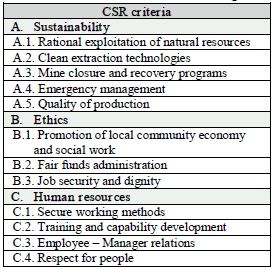
<body><![CDATA[<p><font size="2" face="Verdana, Arial, Helvetica, sans-serif">On the basis of these two facets, it is possible to create various   strategies which allow us to deal with the new demands of social, ethical and   sustainable management. One of the first strategies consists in the adoption of   instruments of self-regulation, such as good practice codes, which establish a   number of principles for environmental and social conduct. Another alternative   lies in the incorporation of social objectives into the company’s strategic   planning. These objectives improve relations with the community and are aimed   at progressively decreasing effects on the environment and on society. Finally,   it is worth drawing attention to the introduction of a CSR management system,   which is integrated into the mission and values of a company and which may   include ethics and sustainability relating to all the actions and decisions  that may be taken.</font></p>     <p><font size="2" face="Verdana, Arial, Helvetica, sans-serif">The scope of CSR practices will vary according to the strategy that is   adopted. For example, it will be more extensive if a management system is   introduced rather than solely a code of conduct. In fact, the adoption of   self-regulatory mechanisms is a first step towards CSR management as a system,   and in general a further step towards the total integration of CSR into the  corporation.</font></p>     <p><font size="2" face="Verdana, Arial, Helvetica, sans-serif">In every   case, CSR practices must be based on a number of criteria which set out the   main guidelines to be followed. For the moment there is no uniform list of   criteria. Various bodies have proposed systems for the measurement of the   results obtained, and have published CSR indicators (Domini 400 Social Index,   Dow Jones Sustainability Index, KLD-Nasdaq Social Index, FTSE4Good Index, or   the Global Reporting Initiative -GRI). These indicators are commonly used as   references for Stock Market investments &#91;40&#93;. Some of them also contain   documents that are specific to the mining sector, which is the case of GRI   Mining &amp; Metals Sector Supplement &#91;24&#93;, and UNE 22470 Sustainable mining (pilot  version).</font></p>     <p><font size="2" face="Verdana, Arial, Helvetica, sans-serif">Some   studies on the adherence of different top mining companies to the GRI guidelines   can be found in the literature &#91;18&#93;. The results reveal that, due to the size   of the company, judgements should be made regarding the extent of the input information.   And according to data from the study conducted by Price Waterhouse Coopers,   only 49% of the Spanish companies which have defined social and environmental   objectives use indicators for managing these aspects &#91;41&#93;, a fact that has led   us to take the opportunity of creating a more operative and simplified  performance chart.</font></p>     <p><font size="2" face="Verdana, Arial, Helvetica, sans-serif">After carrying out an analysis of the application guides and regulations   on CSR, we propose the establishment of a set of criteria (<a href="#tab01">Table 1</a>) for  sustainability, ethics and human capital (to be called CSR criteria). </font></p>     <p align="center"><font size="2" face="Verdana, Arial, Helvetica, sans-serif"><b><a name="tab01"></a>Table 1.</b> CSR criteria for mining</font>    <br> <img src="/img/revistas/dyna/v77n161/a03tab01.gif"></p>     <p>&nbsp;</p>     <p><font size="3" face="Verdana, Arial, Helvetica, sans-serif"><b>5. SYNERGIES WITH MANAGEMENT SYSTEMS</b></font></p>     <p><font size="2" face="Verdana, Arial, Helvetica, sans-serif">Firstly, it is important to point out that although the voluntary CSR   initiatives are varied, there is a common approach in the areas of   environmental quality, labour regulations and human rights, and competitive   practices &#91;38&#93; - areas which may in turn be related to the management systems   concerning environment, occupational safety, and product and service quality   respectively. These connections result in the existence of synergies between   CSR and management systems. Consequently, the following connections may be  highlighted:</font></p>     ]]></body>
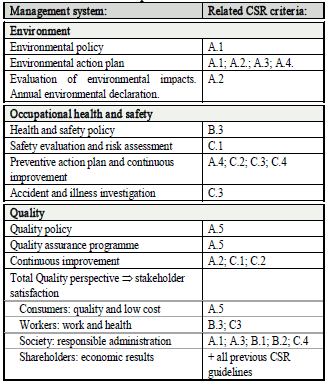
<body><![CDATA[<p><font size="2" face="Verdana, Arial, Helvetica, sans-serif">1) CSR and environmental management: respect for the environment is one   of the fundamental cornerstones of CSR. The practices that are respectful   towards the environment are related to the management of natural resources,   which constitute the raw material or energy source for industrial processes. In   this way, potential damage to the environment is reduced by decreasing resource   consumption, adapting it to requirements, and reducing waste and polluting  emissions.</font></p>     <p><font size="2" face="Verdana, Arial, Helvetica, sans-serif">2) CSR and occupational safety management: the European Union Green Book   cites safety in the workplace as one of the areas in which a company can   demonstrate its socially responsible conduct. Within the company, the socially responsible   practices primarily affect the workers and concern questions such as investment  in human resources, training, empowerment and occupational safety. </font></p>     <p><font size="2" face="Verdana, Arial, Helvetica, sans-serif">3) CSR and quality management: consumers are increasingly socially   responsible, and it is predicted that their purchasing decisions will not only   be influenced by whether the company fulfils its product and service quality   expectations, but also by the conditions in which the latter carries them out,  including the CSR practices which are adopted.</font></p>     <p><font size="2" face="Verdana, Arial, Helvetica, sans-serif">The application of the above disciplines is carried out through   environmental (ISO 14001), occupational health and safety (OHSAS 18001), and   quality (ISO 9001) management systems. The adoption of these management systems   in mining companies has grown in importance during recent decades, and it has been  studied by various authors &#91;3-42-43&#93;. </font></p>     <p><font size="2" face="Verdana, Arial, Helvetica, sans-serif">Each one of these systems has specific objectives, although they all have  a common </font><font size="2" face="Verdana, Arial, Helvetica, sans-serif">basis and as a result, it is necessary to establish a policy in addition   to action plans in the area of influence. With regard to specific objectives,   it is possible to cite the following information included therein: the   principal objective of environmental management systems is aimed at obtaining   operational control of environmental aspects, ensuring a reduction in negative   effects on the natural surroundings. On the other hand, occupational safety   management systems hope to ensure the integrity and the physical, mental and   social well-being of the workers through the adaptation of the working posts,   and the adoption of a preventive policy that takes precedence over a corrective   policy. In addition, quality management systems are aimed at satisfying all the   interested parties by guaranteeing a high level in the product and service quality  that is offered.</font></p>     <p><font size="2" face="Verdana, Arial, Helvetica, sans-serif">Having   confirmed the existence of synergies between CSR and the analysed management   systems, and by extension of the concept, we may relate the principal contents  of the management systems to the defined CSR criteria (<a href="#tab02">Table 2</a>). </font></p>     <p align="center"><font size="2" face="Verdana, Arial, Helvetica, sans-serif"><b><a name="tab02"></a>Table 2.</b> CSR criteria and management system   requirements</font>    <br>   <img src="/img/revistas/dyna/v77n161/a03tab02.gif"></p>     <p>&nbsp;</p>     <p><font size="3" face="Verdana, Arial, Helvetica, sans-serif"><b>6. PERFORMANCE CHART FOR CSR</b></font></p>     ]]></body>
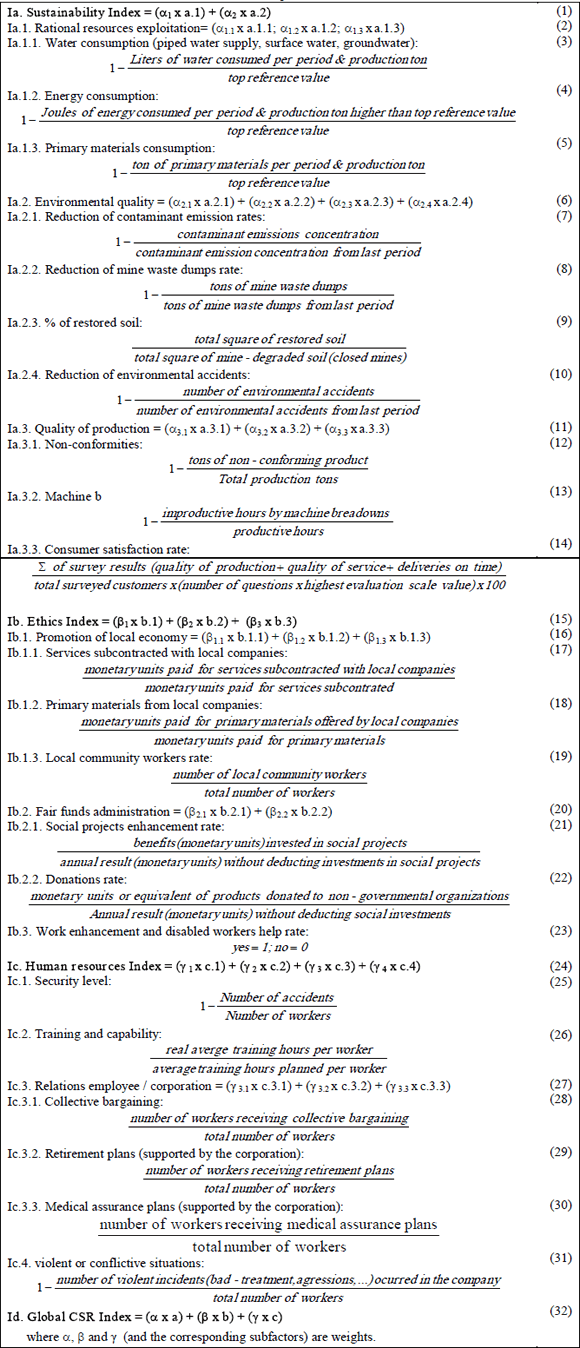
<body><![CDATA[<p><font size="2" face="Verdana, Arial, Helvetica, sans-serif">In view of   the importance of having an up-to-date and easy-to-use performance chart, we   present in this paper a three-level model composed of a set of 31 indicators   (1-31) and a global index (32) along with the associated algorithms for the   calculation (<a href="#tab03">Table 3</a>). Level 1 includes the main indicators or categories   (directly related to the defined CSR criteria). Level 2 and 3 include factors  and subfactors.</font></p>     <p align="center"><font size="2" face="Verdana, Arial, Helvetica, sans-serif"><b><a name="tab03"></a>Table   3.</b> CSR performance chart</font>    <br>   <img src="/img/revistas/dyna/v77n161/a03tab03.gif"></p>     <p><font size="2" face="Verdana, Arial, Helvetica, sans-serif">Each item evaluated receives a score (the result of the algorithm   calculation). All factors and subfactors have a predetermined weight. The total  score for a category is the combination of these data. For example:</font></p>     <p><font size="2" face="Verdana, Arial, Helvetica, sans-serif">Category “A”:</font></p>     <p><font size="2" face="Verdana, Arial, Helvetica, sans-serif">Factor 1:  score 0.8 (calculated), weight 0.4    <br> </font><font size="2" face="Verdana, Arial, Helvetica, sans-serif">Factor 2:  score (to be calculated), weight 0.6    <br>  </font><font size="2" face="Verdana, Arial, Helvetica, sans-serif">Factor 2.2:  score 0.9 (calculated), weight 0.3    <br>  </font><font size="2" face="Verdana, Arial, Helvetica, sans-serif">Factor 2.1:  score 0.7 (calculated), weight 0.7</font></p>     <p><font size="2" face="Verdana, Arial, Helvetica, sans-serif">The score for category “A” would be calculated as follows (33):</font></p>     ]]></body>
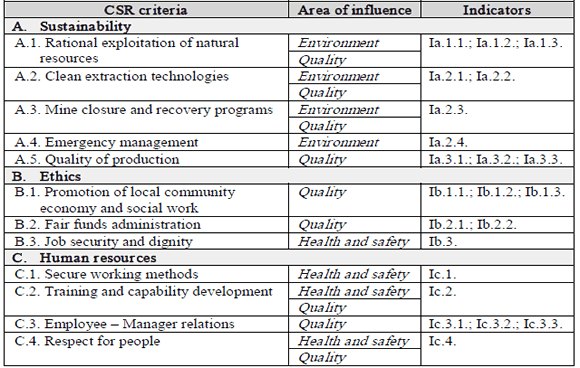
<body><![CDATA[<p><font size="2" face="Verdana, Arial, Helvetica, sans-serif">0.4 x 0.8 + 0.6 x (0.3 x 0.9 + 0.7 x 0.7)=0.776  (33)</font></p>     <p><font size="2" face="Verdana, Arial, Helvetica, sans-serif">A company’s global CSR index is the score obtained at the highest   aggregate level, and it is calculated as the aggregation of the three main   categories considering the weights of categories (32). The higher the value  obtained, the better the CSR conduct will be.</font></p>     <p><font size="2" face="Verdana, Arial, Helvetica, sans-serif">Input data can be obtained from quality, environmental and health and security   management reports and statistics. The weights represent the importance given   to each item evaluated, considering the impact that each category, factor or   subfactor has on the concept associated. The sum of all weights within a  specific concept must be 1.</font></p>     <p><font size="2" face="Verdana, Arial, Helvetica, sans-serif">All indicators   (<a href="#tab03">Table 3</a>) have been defined after a thorough revision of the published CSR   guides and after a revision of the more commonly used indicators for the measurement   of quality, environmental and security issues in organisations. They are calculated   in terms of contribution towards the sustainable conduct of a company. For   example, the “non-conformities” index is computed as the proportion of   production tons free of non-conformities, and the “reduction mine waste dumps”   rate is calculated as the decrease (or increase) from the previous period  value.</font></p>     <p><font size="2" face="Verdana, Arial, Helvetica, sans-serif">In comparison to the existing schemes of CSR indicators (i.e. Dow Jones   and GRI), the performance chart pretends to be a more simplified and therefore   operative method. The criteria included in the aforementioned guides are very   extensive and for small and medium enterprises, which is the profile of the   vast majority of companies engaged in the extraction of aggregates and other  mineral resources, it could be difficult to obtain all the input data required.</font></p>     <p><font size="2" face="Verdana, Arial, Helvetica, sans-serif">The CSR performance chart is intended as an internal measure for   companies of their continuous improvement in CSR practices. Measuring those   improvements would be a step towards more sustainable mining. In fact, the aim   of the method is not to provide a “pass” or “fail” result. It is to encourage   companies to adopt more sustainable working technologies and procedures, and to   contribute towards the promotion of local economies, through periodical   evaluation of different CSR facets. As it is commonly accepted in other   expertise areas such as occupational health and security (see for example NTP   537, a Spanish technical note on integrated risk management and human factor: a   simplified model for evaluation), the company will achieve the sufficiency   level at a score of 0.5 (50%) and the starting point on the path to Excellence   at a score of 0.75 (75%). These threshold values can be employed in the  evaluation of the global index, the main categories and the individual factors. </font></p>     <p><font size="2" face="Verdana, Arial, Helvetica, sans-serif"><a href="#tab04">Table 4</a> indicates the correspondences of the indicators with the defined CSR criteria.</font></p>     <p align="center"><font size="2" face="Verdana, Arial, Helvetica, sans-serif"><b><a name="tab04"></a>Table   4.</b> CSR indicators and criteria</font>    <br>   <img src="/img/revistas/dyna/v77n161/a03tab04.gif"></p>     <p>&nbsp;</p>     ]]></body>
<body><![CDATA[<p><font size="3" face="Verdana, Arial, Helvetica, sans-serif"><b>7. CONCLUSIONS</b></font></p>     <p><font size="2" face="Verdana, Arial, Helvetica, sans-serif">This study has proposed a set of CSR criteria   (sustainability, ethics and human capital) which are applicable to mining, and   which are principally framed by a rational exploitation of resources by using   clean technologies and safe working methods, a responsible administration of  economic funds, information transparency and the promotion of local economies. </font></p>     <p><font size="2" face="Verdana, Arial, Helvetica, sans-serif">All these criteria share a common focus on areas of   environmental quality, occupational regulations   and human rights, and competitive practices, which will be carried out   by means of the application of environmental,   occupational safety, and quality management systems. A comparative table for   the CSR criteria has been presented, together with the principal contents of  the aforementioned management systems. </font></p>     <p><font size="2" face="Verdana, Arial, Helvetica, sans-serif">Companies must have CSR, organise themselves in order that they  have it, and show the results </font><font size="2" face="Verdana, Arial, Helvetica, sans-serif">obtained. Therefore, it is essential to create a set   of criteria that sets out the guidelines to be followed, and to evaluate CSR   performance. The performance chart presented in this paper aims to fulfil these   needs and to help companies in this endowment. By comparing the global index   values recorded, companies can analyse the evolution of their own CSR conduct   over time. Hence, the global index can be considered an internal measure of  continuous improvement in CSR practices. </font></p>     <p><font size="2" face="Verdana, Arial, Helvetica, sans-serif">In future research, the indicators will be presented in more detail, outlining reference values, weights and primary data sources.</font></p>     <p>&nbsp;</p>     <p><font size="3" face="Verdana, Arial, Helvetica, sans-serif"><b>REFERENCES</b></font></p>     <!-- ref --><p><font size="2" face="Verdana, Arial, Helvetica, sans-serif"><b>&#91;1&#93;</b> L&Oacute;PEZ, M.D; MOLINA, J.F. AND CLAVER, E. An&aacute;lisis de los factores que condicionan la percepci&oacute;n del directivo sobre el medio ambiente. Un estudio Cual/Cuan. Cuadernos de Econom&iacute;a y Direcci&oacute;n de Empresa, 37, 123-172, 2008.     &nbsp;&nbsp;&nbsp;&nbsp;&nbsp;&nbsp;&nbsp;&nbsp;[&#160;<a href="javascript:void(0);" onclick="javascript: window.open('/scielo.php?script=sci_nlinks&ref=000090&pid=S0012-7353201000010000300001&lng=','','width=640,height=500,resizable=yes,scrollbars=1,menubar=yes,');">Links</a>&#160;]<!-- end-ref --><!-- ref --><br>     <b>&#91;2&#93;</b>  JENKINS, H. Corporate Social Responsibility and the Mining Industry: Conflicts and Constructs. Corporate Social Responsibility and Environmental Management, 11, 23-34, 2004.       &nbsp;&nbsp;&nbsp;&nbsp;&nbsp;&nbsp;&nbsp;&nbsp;[&#160;<a href="javascript:void(0);" onclick="javascript: window.open('/scielo.php?script=sci_nlinks&ref=000091&pid=S0012-7353201000010000300002&lng=','','width=640,height=500,resizable=yes,scrollbars=1,menubar=yes,');">Links</a>&#160;]<!-- end-ref --><!-- ref --><br>     <b>&#91;3&#93;</b>  NAVARRO, V. AND DINIS, C. Environmental, Health and Safety Management Systems for Underground Mining. 1st Int. Conf. on Sustainable Development and Management of the Subsurface, The Netherlands , 2003.        &nbsp;&nbsp;&nbsp;&nbsp;&nbsp;&nbsp;&nbsp;&nbsp;[&#160;<a href="javascript:void(0);" onclick="javascript: window.open('/scielo.php?script=sci_nlinks&ref=000092&pid=S0012-7353201000010000300003&lng=','','width=640,height=500,resizable=yes,scrollbars=1,menubar=yes,');">Links</a>&#160;]<!-- end-ref --><!-- ref --><br>     <b>&#91;4&#93;</b> ERKOREKA, J.I. Comisiones mixtas, subcomisiones y ponencias 154/000003 Informe       de la Subcomisi&oacute;n para potenciar y promover la RS de las empresas. Bolet&iacute;n Oficial Cortes Generales. Congreso Diputados 423, 3-120, 2006.     &nbsp;&nbsp;&nbsp;&nbsp;&nbsp;&nbsp;&nbsp;&nbsp;[&#160;<a href="javascript:void(0);" onclick="javascript: window.open('/scielo.php?script=sci_nlinks&ref=000093&pid=S0012-7353201000010000300004&lng=','','width=640,height=500,resizable=yes,scrollbars=1,menubar=yes,');">Links</a>&#160;]<!-- end-ref --><!-- ref --><br>   <b>&#91;5&#93;</b> BESTRAT&Eacute;N, M. AND PUJOL, L. NTP 643: Responsabilidad social de las empresas (I): conceptos generales. Instituto Nacional de Seguridad e Higiene en el Trabajo, 2004.     &nbsp;&nbsp;&nbsp;&nbsp;&nbsp;&nbsp;&nbsp;&nbsp;[&#160;<a href="javascript:void(0);" onclick="javascript: window.open('/scielo.php?script=sci_nlinks&ref=000094&pid=S0012-7353201000010000300005&lng=','','width=640,height=500,resizable=yes,scrollbars=1,menubar=yes,');">Links</a>&#160;]<!-- end-ref --><!-- ref --><br>   <b>&#91;6&#93;</b> CASTKA, P. AND BALZAROVA, M. A critical look on quality through CSR lenses. Key challenges steaming from the development of ISO 26000. International Journal of Quality & Reliability Management, 24, 738-752, 2007.     &nbsp;&nbsp;&nbsp;&nbsp;&nbsp;&nbsp;&nbsp;&nbsp;[&#160;<a href="javascript:void(0);" onclick="javascript: window.open('/scielo.php?script=sci_nlinks&ref=000095&pid=S0012-7353201000010000300006&lng=','','width=640,height=500,resizable=yes,scrollbars=1,menubar=yes,');">Links</a>&#160;]<!-- end-ref --><!-- ref --><br>   <b>&#91;7&#93;</b> NIETO, M. AND FERN&Aacute;NDEZ, R. Responsabilidad social corporativa: la &uacute;ltima innovaci&oacute;n en management. Universia Business Review, 1, 28-39, 2004.     &nbsp;&nbsp;&nbsp;&nbsp;&nbsp;&nbsp;&nbsp;&nbsp;[&#160;<a href="javascript:void(0);" onclick="javascript: window.open('/scielo.php?script=sci_nlinks&ref=000096&pid=S0012-7353201000010000300007&lng=','','width=640,height=500,resizable=yes,scrollbars=1,menubar=yes,');">Links</a>&#160;]<!-- end-ref --><!-- ref --><br>   <b>&#91;8&#93;</b> GAL&Aacute;N, J.I. Responsabilidad social corporativa, cambio institucional y gobierno: introducci&oacute;n y panor&aacute;mica. Revista Europea de Direcci&oacute;n y Econom&iacute;a de la Empresa, 17, 7, 2008.     &nbsp;&nbsp;&nbsp;&nbsp;&nbsp;&nbsp;&nbsp;&nbsp;[&#160;<a href="javascript:void(0);" onclick="javascript: window.open('/scielo.php?script=sci_nlinks&ref=000097&pid=S0012-7353201000010000300008&lng=','','width=640,height=500,resizable=yes,scrollbars=1,menubar=yes,');">Links</a>&#160;]<!-- end-ref --><!-- ref --><br>   <b>&#91;9&#93;</b>  ISO. Guidance on social responsibility. Committee Draft ISO/CD26000, 2008.        &nbsp;&nbsp;&nbsp;&nbsp;&nbsp;&nbsp;&nbsp;&nbsp;[&#160;<a href="javascript:void(0);" onclick="javascript: window.open('/scielo.php?script=sci_nlinks&ref=000098&pid=S0012-7353201000010000300009&lng=','','width=640,height=500,resizable=yes,scrollbars=1,menubar=yes,');">Links</a>&#160;]<!-- end-ref --><!-- ref --><br>   <b>&#91;10&#93;</b>  DALTON, D.R. AND DAILY, C.M. The Constituents of Corporate Responsibility: Separate, but not separable interests?. Business Horizons, July-August, 74-88, 1991.       &nbsp;&nbsp;&nbsp;&nbsp;&nbsp;&nbsp;&nbsp;&nbsp;[&#160;<a href="javascript:void(0);" onclick="javascript: window.open('/scielo.php?script=sci_nlinks&ref=000099&pid=S0012-7353201000010000300010&lng=','','width=640,height=500,resizable=yes,scrollbars=1,menubar=yes,');">Links</a>&#160;]<!-- end-ref --><!-- ref --><br>   <b>&#91;11&#93;</b>  CARROLL, A.B. A three dimensional conceptual model of corporate performance. Academy of Management Review, 4, 497-505, 1979.       &nbsp;&nbsp;&nbsp;&nbsp;&nbsp;&nbsp;&nbsp;&nbsp;[&#160;<a href="javascript:void(0);" onclick="javascript: window.open('/scielo.php?script=sci_nlinks&ref=000100&pid=S0012-7353201000010000300011&lng=','','width=640,height=500,resizable=yes,scrollbars=1,menubar=yes,');">Links</a>&#160;]<!-- end-ref --><!-- ref --><br>   <b>&#91;12&#93;</b> DEEGAN, C. AND RANKIN, M. Do Australian companies report environmental news objectively? An analysis of environmental disclosures by firms prosecuted successfully by the Environmental Protection Authority. Accounting, Auditing & Accountability Journal, 9, 50-67, 1996.     &nbsp;&nbsp;&nbsp;&nbsp;&nbsp;&nbsp;&nbsp;&nbsp;[&#160;<a href="javascript:void(0);" onclick="javascript: window.open('/scielo.php?script=sci_nlinks&ref=000101&pid=S0012-7353201000010000300012&lng=','','width=640,height=500,resizable=yes,scrollbars=1,menubar=yes,');">Links</a>&#160;]<!-- end-ref --><!-- ref --><br>   <b>&#91;13&#93;</b>  YAKOVLEVA, N. Corporate social responsibility in the mining industries. Ashgate, Aldershot, Hampshire, England; Burlington, 2005.       &nbsp;&nbsp;&nbsp;&nbsp;&nbsp;&nbsp;&nbsp;&nbsp;[&#160;<a href="javascript:void(0);" onclick="javascript: window.open('/scielo.php?script=sci_nlinks&ref=000102&pid=S0012-7353201000010000300013&lng=','','width=640,height=500,resizable=yes,scrollbars=1,menubar=yes,');">Links</a>&#160;]<!-- end-ref --><!-- ref --><br>   <b>&#91;14&#93;</b>  HAMANN, R. AND KAPELUS, P. Corporate social responsibility in mining in Southern Africa: Fair accountability or just greenwash?. Development,       47, 85-92, 2004.       &nbsp;&nbsp;&nbsp;&nbsp;&nbsp;&nbsp;&nbsp;&nbsp;[&#160;<a href="javascript:void(0);" onclick="javascript: window.open('/scielo.php?script=sci_nlinks&ref=000103&pid=S0012-7353201000010000300014&lng=','','width=640,height=500,resizable=yes,scrollbars=1,menubar=yes,');">Links</a>&#160;]<!-- end-ref --><!-- ref --><br>   <b>&#91;15&#93;</b>  HARRIS, N. Corporate engagement in processes for planetary sustainability: understanding corporate capacity in the non-renewable resources extractive sector, Australia. Business Strategy and the Environment, 16, 538-553, 2007.       &nbsp;&nbsp;&nbsp;&nbsp;&nbsp;&nbsp;&nbsp;&nbsp;[&#160;<a href="javascript:void(0);" onclick="javascript: window.open('/scielo.php?script=sci_nlinks&ref=000104&pid=S0012-7353201000010000300015&lng=','','width=640,height=500,resizable=yes,scrollbars=1,menubar=yes,');">Links</a>&#160;]<!-- end-ref --><!-- ref --><br>   <b>&#91;16&#93;</b> KAPELUS, P. Mining, corporate social responsibility and the “Community”: The Case of Rio Tinto, Richards Bay Minerals and the Mbonambi. Journal of Business Ethics, 39, 275-296, 2002.     &nbsp;&nbsp;&nbsp;&nbsp;&nbsp;&nbsp;&nbsp;&nbsp;[&#160;<a href="javascript:void(0);" onclick="javascript: window.open('/scielo.php?script=sci_nlinks&ref=000105&pid=S0012-7353201000010000300016&lng=','','width=640,height=500,resizable=yes,scrollbars=1,menubar=yes,');">Links</a>&#160;]<!-- end-ref --><!-- ref --><br>   <b>&#91;17&#93;</b>  BANKS, G. Mining, social change and corporate social responsibility: Drawing lines in the Papua New Guinea mud. Globalisation, Governance and the Pacific Islands, 259-274, 2006.       &nbsp;&nbsp;&nbsp;&nbsp;&nbsp;&nbsp;&nbsp;&nbsp;[&#160;<a href="javascript:void(0);" onclick="javascript: window.open('/scielo.php?script=sci_nlinks&ref=000106&pid=S0012-7353201000010000300017&lng=','','width=640,height=500,resizable=yes,scrollbars=1,menubar=yes,');">Links</a>&#160;]<!-- end-ref --><!-- ref --><br>   <b>&#91;18&#93;</b>  JENKINS, H. AND YAKOVLEVA, N. Corporate social responsibility in the mining industry: exploring trends in social and environmental disclosure. Journal of Cleaner Production, 14, 71-284, 2006.       &nbsp;&nbsp;&nbsp;&nbsp;&nbsp;&nbsp;&nbsp;&nbsp;[&#160;<a href="javascript:void(0);" onclick="javascript: window.open('/scielo.php?script=sci_nlinks&ref=000107&pid=S0012-7353201000010000300018&lng=','','width=640,height=500,resizable=yes,scrollbars=1,menubar=yes,');">Links</a>&#160;]<!-- end-ref --><!-- ref --><br>   <b>&#91;19&#93;</b>  HAMANN, R. Corporate social responsibility, partnerships and institutional change. Natural Resources Forum, 28, 278-290, 2004.       &nbsp;&nbsp;&nbsp;&nbsp;&nbsp;&nbsp;&nbsp;&nbsp;[&#160;<a href="javascript:void(0);" onclick="javascript: window.open('/scielo.php?script=sci_nlinks&ref=000108&pid=S0012-7353201000010000300019&lng=','','width=640,height=500,resizable=yes,scrollbars=1,menubar=yes,');">Links</a>&#160;]<!-- end-ref --><!-- ref --><br>   <b>&#91;20&#93;</b>  WALKER, J. AND HOWARD, S. Voluntary codes of conduct in the mining industry. Mining, Minerals and Sustainable Development Project (MMSD), IIED, 2002.       &nbsp;&nbsp;&nbsp;&nbsp;&nbsp;&nbsp;&nbsp;&nbsp;[&#160;<a href="javascript:void(0);" onclick="javascript: window.open('/scielo.php?script=sci_nlinks&ref=000109&pid=S0012-7353201000010000300020&lng=','','width=640,height=500,resizable=yes,scrollbars=1,menubar=yes,');">Links</a>&#160;]<!-- end-ref --><!-- ref --><br>   <b>&#91;21&#93;</b>  JENKINS, H. Corporate social responsibility and the mining industry: conflicts and constructs. Corporate Social Responsibility and Environmental Management, 11, 23-34, 2004.       &nbsp;&nbsp;&nbsp;&nbsp;&nbsp;&nbsp;&nbsp;&nbsp;[&#160;<a href="javascript:void(0);" onclick="javascript: window.open('/scielo.php?script=sci_nlinks&ref=000110&pid=S0012-7353201000010000300021&lng=','','width=640,height=500,resizable=yes,scrollbars=1,menubar=yes,');">Links</a>&#160;]<!-- end-ref --><!-- ref --><br>   <b>&#91;22&#93;</b>  WARHURST, A. Corporate Citizenship and Corporate Social Investment: Drivers of Tri-Sector Partnerships. The Journal of Corporate Citizenship, 1, 57-7, 2001.       &nbsp;&nbsp;&nbsp;&nbsp;&nbsp;&nbsp;&nbsp;&nbsp;[&#160;<a href="javascript:void(0);" onclick="javascript: window.open('/scielo.php?script=sci_nlinks&ref=000111&pid=S0012-7353201000010000300022&lng=','','width=640,height=500,resizable=yes,scrollbars=1,menubar=yes,');">Links</a>&#160;]<!-- end-ref --><!-- ref --><br>   <b>&#91;23&#93;</b> MAT&Iacute;AS, R. Or&iacute;genes de la miner&iacute;a. Cimbra, 362, 32-46, 2005.     &nbsp;&nbsp;&nbsp;&nbsp;&nbsp;&nbsp;&nbsp;&nbsp;[&#160;<a href="javascript:void(0);" onclick="javascript: window.open('/scielo.php?script=sci_nlinks&ref=000112&pid=S0012-7353201000010000300023&lng=','','width=640,height=500,resizable=yes,scrollbars=1,menubar=yes,');">Links</a>&#160;]<!-- end-ref --><!-- ref --><br>   <b>&#91;24&#93;</b> GRI. Suplemento GRI del Sector Miner&iacute;a y Metales. Versi&oacute;n piloto 1.0, 2005.     &nbsp;&nbsp;&nbsp;&nbsp;&nbsp;&nbsp;&nbsp;&nbsp;[&#160;<a href="javascript:void(0);" onclick="javascript: window.open('/scielo.php?script=sci_nlinks&ref=000113&pid=S0012-7353201000010000300024&lng=','','width=640,height=500,resizable=yes,scrollbars=1,menubar=yes,');">Links</a>&#160;]<!-- end-ref --><!-- ref --><br>   <b>&#91;25&#93;</b> TÖREY, S. La empresa minera: desde el blanco de las cr&iacute;ticas hacia la acci&oacute;n pionera. Ambiente y Desarrollo, 20, 78-81, 2004.     &nbsp;&nbsp;&nbsp;&nbsp;&nbsp;&nbsp;&nbsp;&nbsp;[&#160;<a href="javascript:void(0);" onclick="javascript: window.open('/scielo.php?script=sci_nlinks&ref=000114&pid=S0012-7353201000010000300025&lng=','','width=640,height=500,resizable=yes,scrollbars=1,menubar=yes,');">Links</a>&#160;]<!-- end-ref --><!-- ref --><br>   <b>&#91;26&#93;</b>  BLINKER, L.R. Mining and the Natural Environment. UNCTAD, series of papers on Mining, Environment and Development 6, advanced copy, &#91;online februrary 2009&#93;</b> .       &nbsp;&nbsp;&nbsp;&nbsp;&nbsp;&nbsp;&nbsp;&nbsp;[&#160;<a href="javascript:void(0);" onclick="javascript: window.open('/scielo.php?script=sci_nlinks&ref=000115&pid=S0012-7353201000010000300026&lng=','','width=640,height=500,resizable=yes,scrollbars=1,menubar=yes,');">Links</a>&#160;]<!-- end-ref --><!-- ref --><br>   <b>&#91;27&#93;</b> VILLARZ&Uacute;, J. Codelco y su aporte al desarrollo sustentable. Ambiente y desarrollo, 18, 76-78, 2002.     &nbsp;&nbsp;&nbsp;&nbsp;&nbsp;&nbsp;&nbsp;&nbsp;[&#160;<a href="javascript:void(0);" onclick="javascript: window.open('/scielo.php?script=sci_nlinks&ref=000116&pid=S0012-7353201000010000300027&lng=','','width=640,height=500,resizable=yes,scrollbars=1,menubar=yes,');">Links</a>&#160;]<!-- end-ref --><!-- ref --><br>   <b>&#91;28&#93;</b>  BRUNTLAND, G. ED. Our common future. The World Com. On Env. and Dev. Oxford, 1987.       &nbsp;&nbsp;&nbsp;&nbsp;&nbsp;&nbsp;&nbsp;&nbsp;[&#160;<a href="javascript:void(0);" onclick="javascript: window.open('/scielo.php?script=sci_nlinks&ref=000117&pid=S0012-7353201000010000300028&lng=','','width=640,height=500,resizable=yes,scrollbars=1,menubar=yes,');">Links</a>&#160;]<!-- end-ref --><!-- ref --><br>   <b>&#91;29&#93;</b> L&Aacute;ZARO, P. Transparencia en la gesti&oacute;n &eacute;tica del sector empresarial. El papel del l&iacute;der. Revista futuros, 19, 2007.     &nbsp;&nbsp;&nbsp;&nbsp;&nbsp;&nbsp;&nbsp;&nbsp;[&#160;<a href="javascript:void(0);" onclick="javascript: window.open('/scielo.php?script=sci_nlinks&ref=000118&pid=S0012-7353201000010000300029&lng=','','width=640,height=500,resizable=yes,scrollbars=1,menubar=yes,');">Links</a>&#160;]<!-- end-ref --><!-- ref --><br>   <b>&#91;30&#93;</b>  WHEELER, D.; FABIG, H. AND BOELE, R. Paradoxes and dilemmas for stakeholder responsive firms in the extractive sector: lessons from the case of Shell and the Ogoni. Journal of Business Ethics, 39, 297-31, 2002.       &nbsp;&nbsp;&nbsp;&nbsp;&nbsp;&nbsp;&nbsp;&nbsp;[&#160;<a href="javascript:void(0);" onclick="javascript: window.open('/scielo.php?script=sci_nlinks&ref=000119&pid=S0012-7353201000010000300030&lng=','','width=640,height=500,resizable=yes,scrollbars=1,menubar=yes,');">Links</a>&#160;]<!-- end-ref --><!-- ref --><br>   <b>&#91;31&#93;</b>  LABONNE, B. The Mining Industry and the Community: Joining Forces for Sustainable Social Development. Natural Resources Forum, 23, 315-322, 1999.       &nbsp;&nbsp;&nbsp;&nbsp;&nbsp;&nbsp;&nbsp;&nbsp;[&#160;<a href="javascript:void(0);" onclick="javascript: window.open('/scielo.php?script=sci_nlinks&ref=000120&pid=S0012-7353201000010000300031&lng=','','width=640,height=500,resizable=yes,scrollbars=1,menubar=yes,');">Links</a>&#160;]<!-- end-ref --><!-- ref --><br>   <b>&#91;32&#93;</b>  COWELL, S.J. ET AL. Sustainability and the primary extraction industries: theories and practice. Resource policy, 25, 277-286, 1999.       &nbsp;&nbsp;&nbsp;&nbsp;&nbsp;&nbsp;&nbsp;&nbsp;[&#160;<a href="javascript:void(0);" onclick="javascript: window.open('/scielo.php?script=sci_nlinks&ref=000121&pid=S0012-7353201000010000300032&lng=','','width=640,height=500,resizable=yes,scrollbars=1,menubar=yes,');">Links</a>&#160;]<!-- end-ref --><!-- ref --><br>   <b>&#91;33&#93;</b> MOGROVEJO, M.; PIMENTEL, R. AND Z&Uacute;&Ntilde;IGA, A. Modelos de inversi&oacute;n social para empresas mineras. Experiencias y propuestas. Cuadernos de Difusi&oacute;n, 12, 115-143, 2007.     &nbsp;&nbsp;&nbsp;&nbsp;&nbsp;&nbsp;&nbsp;&nbsp;[&#160;<a href="javascript:void(0);" onclick="javascript: window.open('/scielo.php?script=sci_nlinks&ref=000122&pid=S0012-7353201000010000300033&lng=','','width=640,height=500,resizable=yes,scrollbars=1,menubar=yes,');">Links</a>&#160;]<!-- end-ref --><!-- ref --><br>   <b>&#91;34&#93;</b>  ICMM. Reporting against the ICMM Sustainable Development Principles. International Council on Mining and Metals, London, 2005.        &nbsp;&nbsp;&nbsp;&nbsp;&nbsp;&nbsp;&nbsp;&nbsp;[&#160;<a href="javascript:void(0);" onclick="javascript: window.open('/scielo.php?script=sci_nlinks&ref=000123&pid=S0012-7353201000010000300034&lng=','','width=640,height=500,resizable=yes,scrollbars=1,menubar=yes,');">Links</a>&#160;]<!-- end-ref --><!-- ref --><br>   <b>&#91;35&#93;</b>  GUERRA, M. Community relations in mineral development projects. The CEPMLP Internet Journal, 11, 1-31, 2002.       &nbsp;&nbsp;&nbsp;&nbsp;&nbsp;&nbsp;&nbsp;&nbsp;[&#160;<a href="javascript:void(0);" onclick="javascript: window.open('/scielo.php?script=sci_nlinks&ref=000124&pid=S0012-7353201000010000300035&lng=','','width=640,height=500,resizable=yes,scrollbars=1,menubar=yes,');">Links</a>&#160;]<!-- end-ref --><!-- ref --><br>   <b>&#91;36&#93;</b> FOMBRUN, C. AND SHANLEY, M. What’s in a name? Reputation Building and Corporate Strategy. Academy of Management Journal, 33, 233-258, 1990.     &nbsp;&nbsp;&nbsp;&nbsp;&nbsp;&nbsp;&nbsp;&nbsp;[&#160;<a href="javascript:void(0);" onclick="javascript: window.open('/scielo.php?script=sci_nlinks&ref=000125&pid=S0012-7353201000010000300036&lng=','','width=640,height=500,resizable=yes,scrollbars=1,menubar=yes,');">Links</a>&#160;]<!-- end-ref --><!-- ref --><br>   <b>&#91;37&#93;</b> EUROPEAN COMMISSION. Promoting a European framework for CSR. Green Paper. Directorate for Employment & Social Affairs. Brussels, 2001.     &nbsp;&nbsp;&nbsp;&nbsp;&nbsp;&nbsp;&nbsp;&nbsp;[&#160;<a href="javascript:void(0);" onclick="javascript: window.open('/scielo.php?script=sci_nlinks&ref=000126&pid=S0012-7353201000010000300037&lng=','','width=640,height=500,resizable=yes,scrollbars=1,menubar=yes,');">Links</a>&#160;]<!-- end-ref --><!-- ref --><br>   <b>&#91;38&#93;</b> ARAYA, M. Negociaciones de inversi&oacute;n y responsabilidad social corporativa: explorando un v&iacute;nculo en las Am&eacute;ricas. Ambiente y Desarrollo, 19, 74-81, 2003.     &nbsp;&nbsp;&nbsp;&nbsp;&nbsp;&nbsp;&nbsp;&nbsp;[&#160;<a href="javascript:void(0);" onclick="javascript: window.open('/scielo.php?script=sci_nlinks&ref=000127&pid=S0012-7353201000010000300038&lng=','','width=640,height=500,resizable=yes,scrollbars=1,menubar=yes,');">Links</a>&#160;]<!-- end-ref --><!-- ref --><br>   <b>&#91;39&#93;</b> FERN&Aacute;NDEZ, D. AND MERINO, A. ¿Existe disponibilidad a pagar por responsabilidad social corporativa? Percepci&oacute;n       de los consumidores. Universia Business Review, 7, 38-53, 2005.     &nbsp;&nbsp;&nbsp;&nbsp;&nbsp;&nbsp;&nbsp;&nbsp;[&#160;<a href="javascript:void(0);" onclick="javascript: window.open('/scielo.php?script=sci_nlinks&ref=000128&pid=S0012-7353201000010000300039&lng=','','width=640,height=500,resizable=yes,scrollbars=1,menubar=yes,');">Links</a>&#160;]<!-- end-ref --><!-- ref --><br>   <b>&#91;40&#93;</b> CECU. &Eacute;tica y mercado: c&oacute;mo invertir. Proyecto ETHMA, 2004.     &nbsp;&nbsp;&nbsp;&nbsp;&nbsp;&nbsp;&nbsp;&nbsp;[&#160;<a href="javascript:void(0);" onclick="javascript: window.open('/scielo.php?script=sci_nlinks&ref=000129&pid=S0012-7353201000010000300040&lng=','','width=640,height=500,resizable=yes,scrollbars=1,menubar=yes,');">Links</a>&#160;]<!-- end-ref --><!-- ref --><br>   <b>&#91;41&#93;</b> CASTILLA, M.L. Responsabilidad social corporativa: Tendencias empresariales en Espa&ntilde;a. Pricewaterhouse Coopers, 2003.     &nbsp;&nbsp;&nbsp;&nbsp;&nbsp;&nbsp;&nbsp;&nbsp;[&#160;<a href="javascript:void(0);" onclick="javascript: window.open('/scielo.php?script=sci_nlinks&ref=000130&pid=S0012-7353201000010000300041&lng=','','width=640,height=500,resizable=yes,scrollbars=1,menubar=yes,');">Links</a>&#160;]<!-- end-ref --><!-- ref --><br>   <b>&#91;42&#93;</b>  HILSON, G. AND NAYEE, V. Environmental management system implementation in the mining industry: a key to achieving cleaner production. International Journal of Mineral Processing, 64, 19-41, 2002.       &nbsp;&nbsp;&nbsp;&nbsp;&nbsp;&nbsp;&nbsp;&nbsp;[&#160;<a href="javascript:void(0);" onclick="javascript: window.open('/scielo.php?script=sci_nlinks&ref=000131&pid=S0012-7353201000010000300042&lng=','','width=640,height=500,resizable=yes,scrollbars=1,menubar=yes,');">Links</a>&#160;]<!-- end-ref --><!-- ref --><br>   <b>&#91;43&#93;</b> ESCANCIANO, C. AND SU&Aacute;REZ, A. Los sistemas de gesti&oacute;n en el sector minero espa&ntilde;ol: estudio sobre la gesti&oacute;n de la calidad y comparaci&oacute;n con la ambiental y la de prevenci&oacute;n de riesgos. Forum Calidad, 19, 39-45, 2007. </font>&nbsp;&nbsp;&nbsp;&nbsp;&nbsp;&nbsp;&nbsp;&nbsp;[&#160;<a href="javascript:void(0);" onclick="javascript: window.open('/scielo.php?script=sci_nlinks&ref=000132&pid=S0012-7353201000010000300043&lng=','','width=640,height=500,resizable=yes,scrollbars=1,menubar=yes,');">Links</a>&#160;]<!-- end-ref --> ]]></body><back>
<ref-list>
<ref id="B1">
<label>1</label><nlm-citation citation-type="journal">
<person-group person-group-type="author">
<name>
<surname><![CDATA[LÓPEZ]]></surname>
<given-names><![CDATA[M.D]]></given-names>
</name>
<name>
<surname><![CDATA[MOLINA]]></surname>
<given-names><![CDATA[J.F.]]></given-names>
</name>
</person-group>
<article-title xml:lang="es"><![CDATA[Análisis de los factores que condicionan la percepción del directivo sobre el medio ambiente. Un estudio Cual/Cuan.]]></article-title>
<source><![CDATA[Cuadernos de Economía y Dirección de Empresa]]></source>
<year>2008</year>
<volume>37</volume>
<page-range>123-172</page-range></nlm-citation>
</ref>
<ref id="B2">
<label>2</label><nlm-citation citation-type="">
<person-group person-group-type="author">
<name>
<surname><![CDATA[JENKINS]]></surname>
<given-names><![CDATA[H.]]></given-names>
</name>
</person-group>
<source><![CDATA[Corporate Social Responsibility and the Mining Industry:: Conflicts and Constructs.]]></source>
<year>2004</year>
<volume>11</volume>
<page-range>23-34</page-range></nlm-citation>
</ref>
<ref id="B3">
<label>3</label><nlm-citation citation-type="">
<person-group person-group-type="author">
<name>
<surname><![CDATA[NAVARRO]]></surname>
<given-names><![CDATA[V.]]></given-names>
</name>
<name>
<surname><![CDATA[DINIS]]></surname>
<given-names><![CDATA[C.]]></given-names>
</name>
</person-group>
<source><![CDATA[Environmental, Health and Safety Management Systems for Underground Mining. 1st Int. Conf. on Sustainable Development and Management of the Subsurface,]]></source>
<year>2003</year>
</nlm-citation>
</ref>
<ref id="B4">
<label>4</label><nlm-citation citation-type="">
<person-group person-group-type="author">
<name>
<surname><![CDATA[ERKOREKA]]></surname>
<given-names><![CDATA[J.I.]]></given-names>
</name>
</person-group>
<source><![CDATA[Comisiones mixtas, subcomisiones y ponencias 154/000003 Informe de la Subcomisión para potenciar y promover la RS de las empresas.]]></source>
<year>2006</year>
<volume>423</volume>
<page-range>3-120</page-range></nlm-citation>
</ref>
<ref id="B5">
<label>5</label><nlm-citation citation-type="">
<person-group person-group-type="author">
<name>
<surname><![CDATA[BESTRATÉN]]></surname>
<given-names><![CDATA[M.]]></given-names>
</name>
<name>
<surname><![CDATA[PUJOL]]></surname>
<given-names><![CDATA[L.]]></given-names>
</name>
</person-group>
<source><![CDATA[NTP 643: Responsabilidad social de las empresas (I):: conceptos generales.]]></source>
<year>2004</year>
</nlm-citation>
</ref>
<ref id="B6">
<label>6</label><nlm-citation citation-type="journal">
<person-group person-group-type="author">
<name>
<surname><![CDATA[CASTKA]]></surname>
<given-names><![CDATA[P.]]></given-names>
</name>
<name>
<surname><![CDATA[BALZAROVA]]></surname>
<given-names><![CDATA[M.]]></given-names>
</name>
</person-group>
<article-title xml:lang="en"><![CDATA[A critical look on quality through CSR lenses. Key challenges steaming from the development of ISO 26000.]]></article-title>
<source><![CDATA[International Journal of Quality & Reliability Management]]></source>
<year>2007</year>
<volume>24</volume>
<page-range>738-752</page-range></nlm-citation>
</ref>
<ref id="B7">
<label>7</label><nlm-citation citation-type="journal">
<person-group person-group-type="author">
<name>
<surname><![CDATA[NIETO]]></surname>
<given-names><![CDATA[M.]]></given-names>
</name>
<name>
<surname><![CDATA[FERNÁNDEZ]]></surname>
<given-names><![CDATA[R.]]></given-names>
</name>
</person-group>
<article-title xml:lang="es"><![CDATA[Responsabilidad social corporativa:: la última innovación en management.]]></article-title>
<source><![CDATA[Universia Business Review]]></source>
<year>2004</year>
<volume>1</volume>
<page-range>28-39</page-range></nlm-citation>
</ref>
<ref id="B8">
<label>8</label><nlm-citation citation-type="journal">
<person-group person-group-type="author">
<name>
<surname><![CDATA[GALÁN]]></surname>
<given-names><![CDATA[J.I.]]></given-names>
</name>
</person-group>
<article-title xml:lang="es"><![CDATA[Responsabilidad social corporativa, cambio institucional y gobierno:: introducción y panorámica.]]></article-title>
<source><![CDATA[Revista Europea de Dirección y Economía de la Empresa]]></source>
<year>2008</year>
<volume>17</volume>
<numero>7</numero>
<issue>7</issue>
</nlm-citation>
</ref>
<ref id="B9">
<label>9</label><nlm-citation citation-type="">
<collab>ISO</collab>
<source><![CDATA[Guidance on social responsibility]]></source>
<year>2008</year>
</nlm-citation>
</ref>
<ref id="B10">
<label>10</label><nlm-citation citation-type="">
<person-group person-group-type="author">
<name>
<surname><![CDATA[DALTON]]></surname>
<given-names><![CDATA[D.R.]]></given-names>
</name>
<name>
<surname><![CDATA[DAILY]]></surname>
<given-names><![CDATA[C.M.]]></given-names>
</name>
</person-group>
<source><![CDATA[The Constituents of Corporate Responsibility:: Separate, but not separable interests?.]]></source>
<year>1991</year>
<volume>July-August</volume>
<page-range>74-88</page-range></nlm-citation>
</ref>
<ref id="B11">
<label>11</label><nlm-citation citation-type="journal">
<person-group person-group-type="author">
<name>
<surname><![CDATA[CARROLL]]></surname>
<given-names><![CDATA[A.B.]]></given-names>
</name>
</person-group>
<article-title xml:lang="en"><![CDATA[A three dimensional conceptual model of corporate performance.]]></article-title>
<source><![CDATA[Academy of Management Review]]></source>
<year>1979</year>
<volume>4</volume>
<page-range>497-505</page-range></nlm-citation>
</ref>
<ref id="B12">
<label>12</label><nlm-citation citation-type="journal">
<person-group person-group-type="author">
<name>
<surname><![CDATA[DEEGAN]]></surname>
<given-names><![CDATA[C.]]></given-names>
</name>
<name>
<surname><![CDATA[RANKIN]]></surname>
<given-names><![CDATA[M.]]></given-names>
</name>
</person-group>
<article-title xml:lang="en"><![CDATA[Do Australian companies report environmental news objectively? An analysis of environmental disclosures by firms prosecuted successfully by the Environmental Protection Authority.]]></article-title>
<source><![CDATA[Accounting, Auditing & Accountability Journal]]></source>
<year>1996</year>
<volume>9</volume>
<page-range>50-67</page-range></nlm-citation>
</ref>
<ref id="B13">
<label>13</label><nlm-citation citation-type="">
<person-group person-group-type="author">
<name>
<surname><![CDATA[YAKOVLEVA]]></surname>
<given-names><![CDATA[N.]]></given-names>
</name>
</person-group>
<source><![CDATA[Corporate social responsibility in the mining industries. Ashgate, Aldershot, Hampshire, England]]></source>
<year>2005</year>
</nlm-citation>
</ref>
<ref id="B14">
<label>14</label><nlm-citation citation-type="journal">
<person-group person-group-type="author">
<name>
<surname><![CDATA[HAMANN]]></surname>
<given-names><![CDATA[R.]]></given-names>
</name>
<name>
<surname><![CDATA[KAPELUS]]></surname>
<given-names><![CDATA[P.]]></given-names>
</name>
</person-group>
<article-title xml:lang="en"><![CDATA[Corporate social responsibility in mining in Southern Africa: Fair accountability or just greenwash?.]]></article-title>
<source><![CDATA[Development]]></source>
<year>2004</year>
<volume>47</volume>
<page-range>85-92</page-range></nlm-citation>
</ref>
<ref id="B15">
<label>15</label><nlm-citation citation-type="journal">
<person-group person-group-type="author">
<name>
<surname><![CDATA[HARRIS]]></surname>
<given-names><![CDATA[N.]]></given-names>
</name>
</person-group>
<article-title xml:lang="en"><![CDATA[Corporate engagement in processes for planetary sustainability:: understanding corporate capacity in the non-renewable resources extractive sector, Australia.]]></article-title>
<source><![CDATA[Business Strategy and the Environment,]]></source>
<year>2007</year>
<volume>16</volume>
<page-range>538-553</page-range></nlm-citation>
</ref>
<ref id="B16">
<label>16</label><nlm-citation citation-type="journal">
<person-group person-group-type="author">
<name>
<surname><![CDATA[KAPELUS]]></surname>
<given-names><![CDATA[P.]]></given-names>
</name>
</person-group>
<article-title xml:lang="en"><![CDATA[Mining, corporate social responsibility and the “Community”: The Case of Rio Tinto, Richards Bay Minerals and the Mbonambi.]]></article-title>
<source><![CDATA[Journal of Business Ethics]]></source>
<year>2002</year>
<volume>39</volume>
<page-range>275-296</page-range></nlm-citation>
</ref>
<ref id="B17">
<label>17</label><nlm-citation citation-type="">
<person-group person-group-type="author">
<name>
<surname><![CDATA[BANKS]]></surname>
<given-names><![CDATA[G.]]></given-names>
</name>
</person-group>
<source><![CDATA[Mining, social change and corporate social responsibility:: Drawing lines in the Papua New Guinea mud. Globalisation,]]></source>
<year>2006</year>
<page-range>259-274</page-range></nlm-citation>
</ref>
<ref id="B18">
<label>18</label><nlm-citation citation-type="journal">
<person-group person-group-type="author">
<name>
<surname><![CDATA[JENKINS]]></surname>
<given-names><![CDATA[H.]]></given-names>
</name>
<name>
<surname><![CDATA[YAKOVLEVA]]></surname>
<given-names><![CDATA[N.]]></given-names>
</name>
</person-group>
<article-title xml:lang="en"><![CDATA[Corporate social responsibility in the mining industry:: exploring trends in social and environmental disclosure.]]></article-title>
<source><![CDATA[Journal of Cleaner Production]]></source>
<year>2006</year>
<volume>14</volume>
<page-range>71-284</page-range></nlm-citation>
</ref>
<ref id="B19">
<label>19</label><nlm-citation citation-type="journal">
<person-group person-group-type="author">
<name>
<surname><![CDATA[HAMANN]]></surname>
<given-names><![CDATA[R.]]></given-names>
</name>
</person-group>
<article-title xml:lang="en"><![CDATA[Corporate social responsibility, partnerships and institutional change.]]></article-title>
<source><![CDATA[Natural Resources Forum]]></source>
<year>2004</year>
<volume>28</volume>
<page-range>278-290</page-range></nlm-citation>
</ref>
<ref id="B20">
<label>20</label><nlm-citation citation-type="">
<person-group person-group-type="author">
<name>
<surname><![CDATA[WALKER]]></surname>
<given-names><![CDATA[J.]]></given-names>
</name>
<name>
<surname><![CDATA[HOWARD]]></surname>
<given-names><![CDATA[S.]]></given-names>
</name>
</person-group>
<source><![CDATA[Voluntary codes of conduct in the mining industry. Mining, Minerals and Sustainable Development Project (MMSD)]]></source>
<year>2002</year>
</nlm-citation>
</ref>
<ref id="B21">
<label>21</label><nlm-citation citation-type="journal">
<person-group person-group-type="author">
<name>
<surname><![CDATA[JENKINS]]></surname>
<given-names><![CDATA[H.]]></given-names>
</name>
</person-group>
<article-title xml:lang="en"><![CDATA[Corporate social responsibility and the mining industry:: conflicts and constructs.]]></article-title>
<source><![CDATA[Corporate Social Responsibility and Environmental Management]]></source>
<year>2004</year>
<volume>11</volume>
<page-range>23-34</page-range></nlm-citation>
</ref>
<ref id="B22">
<label>22</label><nlm-citation citation-type="journal">
<person-group person-group-type="author">
<name>
<surname><![CDATA[WARHURST]]></surname>
<given-names><![CDATA[A.]]></given-names>
</name>
</person-group>
<article-title xml:lang="en"><![CDATA[Corporate Citizenship and Corporate Social Investment:: Drivers of Tri-Sector Partnerships.]]></article-title>
<source><![CDATA[The Journal of Corporate Citizenship]]></source>
<year>2001</year>
<volume>1</volume>
<page-range>57-7</page-range></nlm-citation>
</ref>
<ref id="B23">
<label>23</label><nlm-citation citation-type="journal">
<person-group person-group-type="author">
<name>
<surname><![CDATA[MATÍAS]]></surname>
<given-names><![CDATA[R.]]></given-names>
</name>
</person-group>
<article-title xml:lang="es"><![CDATA[Orígenes de la minería.]]></article-title>
<source><![CDATA[Cimbra]]></source>
<year>2005</year>
<volume>362</volume>
<page-range>32-46</page-range></nlm-citation>
</ref>
<ref id="B24">
<label>24</label><nlm-citation citation-type="">
<collab>GRI</collab>
<source><![CDATA[Suplemento GRI del Sector Minería y Metales]]></source>
<year>2005</year>
</nlm-citation>
</ref>
<ref id="B25">
<label>25</label><nlm-citation citation-type="journal">
<person-group person-group-type="author">
<name>
<surname><![CDATA[TÖREY]]></surname>
<given-names><![CDATA[S.]]></given-names>
</name>
</person-group>
<article-title xml:lang="es"><![CDATA[La empresa minera:: desde el blanco de las críticas hacia la acción pionera.]]></article-title>
<source><![CDATA[Ambiente y Desarrollo]]></source>
<year>2004</year>
<volume>20</volume>
<page-range>78-81</page-range></nlm-citation>
</ref>
<ref id="B26">
<label>26</label><nlm-citation citation-type="">
<person-group person-group-type="author">
<name>
<surname><![CDATA[BLINKER]]></surname>
<given-names><![CDATA[L.R.]]></given-names>
</name>
</person-group>
<source><![CDATA[Mining and the Natural Environment. UNCTAD]]></source>
<year>2009</year>
<volume>6</volume>
</nlm-citation>
</ref>
<ref id="B27">
<label>27</label><nlm-citation citation-type="journal">
<person-group person-group-type="author">
<name>
<surname><![CDATA[VILLARZÚ]]></surname>
<given-names><![CDATA[J.]]></given-names>
</name>
</person-group>
<article-title xml:lang="es"><![CDATA[Codelco y su aporte al desarrollo sustentable.]]></article-title>
<source><![CDATA[Ambiente y desarrollo]]></source>
<year>2002</year>
<volume>18</volume>
<page-range>76-78</page-range></nlm-citation>
</ref>
<ref id="B28">
<label>28</label><nlm-citation citation-type="">
<person-group person-group-type="author">
<name>
<surname><![CDATA[BRUNTLAND]]></surname>
<given-names><![CDATA[G.]]></given-names>
</name>
</person-group>
<source><![CDATA[ED. Our common future. The World Com. On Env. and Dev. Oxford]]></source>
<year>1987</year>
</nlm-citation>
</ref>
<ref id="B29">
<label>29</label><nlm-citation citation-type="">
<person-group person-group-type="author">
<name>
<surname><![CDATA[LÁZARO]]></surname>
<given-names><![CDATA[P.]]></given-names>
</name>
</person-group>
<source><![CDATA[Transparencia en la gestión ética del sector empresarial. El papel del líder.]]></source>
<year>2007</year>
<volume>19</volume>
</nlm-citation>
</ref>
<ref id="B30">
<label>30</label><nlm-citation citation-type="journal">
<person-group person-group-type="author">
<name>
<surname><![CDATA[WHEELER]]></surname>
<given-names><![CDATA[D.]]></given-names>
</name>
<name>
<surname><![CDATA[FABIG]]></surname>
<given-names><![CDATA[H.]]></given-names>
</name>
<name>
<surname><![CDATA[BOELE]]></surname>
<given-names><![CDATA[R.]]></given-names>
</name>
</person-group>
<article-title xml:lang="en"><![CDATA[Paradoxes and dilemmas for stakeholder responsive firms in the extractive sector:: lessons from the case of Shell and the Ogoni.]]></article-title>
<source><![CDATA[Journal of Business Ethics]]></source>
<year>2002</year>
<volume>39</volume>
<page-range>297-31</page-range></nlm-citation>
</ref>
<ref id="B31">
<label>31</label><nlm-citation citation-type="journal">
<person-group person-group-type="author">
<name>
<surname><![CDATA[LABONNE]]></surname>
<given-names><![CDATA[B.]]></given-names>
</name>
</person-group>
<article-title xml:lang="en"><![CDATA[The Mining Industry and the Community:: Joining Forces for Sustainable Social Development.]]></article-title>
<source><![CDATA[Natural Resources Forum]]></source>
<year>1999</year>
<volume>23</volume>
<page-range>315-322</page-range></nlm-citation>
</ref>
<ref id="B32">
<label>32</label><nlm-citation citation-type="journal">
<person-group person-group-type="author">
<name>
<surname><![CDATA[COWELL]]></surname>
<given-names><![CDATA[S.J.]]></given-names>
</name>
</person-group>
<article-title xml:lang="en"><![CDATA[Sustainability and the primary extraction industries:: theories and practice.]]></article-title>
<source><![CDATA[Resource policy]]></source>
<year>1999</year>
<volume>25</volume>
<page-range>277-286</page-range></nlm-citation>
</ref>
<ref id="B33">
<label>33</label><nlm-citation citation-type="journal">
<person-group person-group-type="author">
<name>
<surname><![CDATA[MOGROVEJO]]></surname>
<given-names><![CDATA[M.]]></given-names>
</name>
<name>
<surname><![CDATA[PIMENTEL]]></surname>
<given-names><![CDATA[R.]]></given-names>
</name>
</person-group>
<article-title xml:lang="es"><![CDATA[Modelos de inversión social para empresas mineras. Experiencias y propuestas.]]></article-title>
<source><![CDATA[Cuadernos de Difusión]]></source>
<year>2007</year>
<volume>12</volume>
<page-range>115-143</page-range></nlm-citation>
</ref>
<ref id="B34">
<label>34</label><nlm-citation citation-type="">
<collab>ICMM</collab>
<source><![CDATA[Reporting against the ICMM Sustainable Development Principles.]]></source>
<year>2005</year>
<publisher-loc><![CDATA[London ]]></publisher-loc>
</nlm-citation>
</ref>
<ref id="B35">
<label>35</label><nlm-citation citation-type="journal">
<person-group person-group-type="author">
<name>
<surname><![CDATA[GUERRA]]></surname>
<given-names><![CDATA[M.]]></given-names>
</name>
</person-group>
<article-title xml:lang="en"><![CDATA[Community relations in mineral development projects.]]></article-title>
<source><![CDATA[The CEPMLP Internet Journal]]></source>
<year>2002</year>
<volume>11</volume>
<page-range>1-31</page-range></nlm-citation>
</ref>
<ref id="B36">
<label>36</label><nlm-citation citation-type="journal">
<person-group person-group-type="author">
<name>
<surname><![CDATA[FOMBRUN]]></surname>
<given-names><![CDATA[C.]]></given-names>
</name>
<name>
<surname><![CDATA[SHANLEY]]></surname>
<given-names><![CDATA[M.]]></given-names>
</name>
</person-group>
<article-title xml:lang="en"><![CDATA[What’s in a name? Reputation Building and Corporate Strategy.]]></article-title>
<source><![CDATA[Academy of Management Journal]]></source>
<year>1990</year>
<volume>33</volume>
<page-range>233-258</page-range></nlm-citation>
</ref>
<ref id="B37">
<label>37</label><nlm-citation citation-type="">
<collab>EUROPEAN COMMISSION</collab>
<source><![CDATA[Promoting a European framework for CSR. Green Paper.]]></source>
<year>2001</year>
<publisher-loc><![CDATA[Brussels ]]></publisher-loc>
</nlm-citation>
</ref>
<ref id="B38">
<label>38</label><nlm-citation citation-type="journal">
<person-group person-group-type="author">
<name>
<surname><![CDATA[ARAYA]]></surname>
<given-names><![CDATA[M.]]></given-names>
</name>
</person-group>
<article-title xml:lang="es"><![CDATA[Negociaciones de inversión y responsabilidad social corporativa:: explorando un vínculo en las Américas]]></article-title>
<source><![CDATA[Ambiente y Desarrollo]]></source>
<year>2003</year>
<volume>19</volume>
<page-range>74-81</page-range></nlm-citation>
</ref>
<ref id="B39">
<label>39</label><nlm-citation citation-type="journal">
<person-group person-group-type="author">
<name>
<surname><![CDATA[FERNÁNDEZ]]></surname>
<given-names><![CDATA[D]]></given-names>
</name>
<name>
<surname><![CDATA[MERINO]]></surname>
<given-names><![CDATA[A.]]></given-names>
</name>
</person-group>
<article-title xml:lang="es"><![CDATA[¿Existe disponibilidad a pagar por responsabilidad social corporativa? Percepción de los consumidores.]]></article-title>
<source><![CDATA[Universia Business Review]]></source>
<year>2005</year>
<volume>7</volume>
<page-range>38-53</page-range></nlm-citation>
</ref>
<ref id="B40">
<label>40</label><nlm-citation citation-type="">
<collab>CECU</collab>
<source><![CDATA[Ética y mercado: cómo invertir.]]></source>
<year>2004</year>
</nlm-citation>
</ref>
<ref id="B41">
<label>41</label><nlm-citation citation-type="">
<person-group person-group-type="author">
<name>
<surname><![CDATA[CASTILLA]]></surname>
<given-names><![CDATA[M.L.]]></given-names>
</name>
</person-group>
<source><![CDATA[Responsabilidad social corporativa:: Tendencias empresariales en España.]]></source>
<year>2003</year>
</nlm-citation>
</ref>
<ref id="B42">
<label>42</label><nlm-citation citation-type="journal">
<person-group person-group-type="author">
<name>
<surname><![CDATA[HILSON]]></surname>
<given-names><![CDATA[G.]]></given-names>
</name>
<name>
<surname><![CDATA[NAYEE]]></surname>
<given-names><![CDATA[V.]]></given-names>
</name>
</person-group>
<article-title xml:lang="en"><![CDATA[Environmental management system implementation in the mining industry:: a key to achieving cleaner production]]></article-title>
<source><![CDATA[International Journal of Mineral Processing]]></source>
<year>2002</year>
<volume>64</volume>
<page-range>19-41</page-range></nlm-citation>
</ref>
<ref id="B43">
<label>43</label><nlm-citation citation-type="journal">
<person-group person-group-type="author">
<name>
<surname><![CDATA[ESCANCIANO]]></surname>
<given-names><![CDATA[C.]]></given-names>
</name>
<name>
<surname><![CDATA[SUÁREZ]]></surname>
<given-names><![CDATA[A.]]></given-names>
</name>
</person-group>
<article-title xml:lang="es"><![CDATA[Los sistemas de gestión en el sector minero español: estudio sobre la gestión de la calidad y comparación con la ambiental y la de prevención de riesgos.]]></article-title>
<source><![CDATA[Forum Calidad]]></source>
<year>2007</year>
<volume>19</volume>
<page-range>39-45</page-range></nlm-citation>
</ref>
</ref-list>
</back>
</article>