<?xml version="1.0" encoding="ISO-8859-1"?><article xmlns:mml="http://www.w3.org/1998/Math/MathML" xmlns:xlink="http://www.w3.org/1999/xlink" xmlns:xsi="http://www.w3.org/2001/XMLSchema-instance">
<front>
<journal-meta>
<journal-id>0012-7353</journal-id>
<journal-title><![CDATA[DYNA]]></journal-title>
<abbrev-journal-title><![CDATA[Dyna rev.fac.nac.minas]]></abbrev-journal-title>
<issn>0012-7353</issn>
<publisher>
<publisher-name><![CDATA[Universidad Nacional de Colombia]]></publisher-name>
</publisher>
</journal-meta>
<article-meta>
<article-id>S0012-73532010000100004</article-id>
<title-group>
<article-title xml:lang="en"><![CDATA[INTEGRATING SUSTAINABILITY DOWN TO THE OPERATIONAL LEVELS OF A MINING COMPANY]]></article-title>
<article-title xml:lang="es"><![CDATA[INTEGRACION DE LA SOSTENIBILIDAD EN LOS NIVELES OPERACIONALES DE LA EMPRESA MINERA]]></article-title>
</title-group>
<contrib-group>
<contrib contrib-type="author">
<name>
<surname><![CDATA[BOTIN]]></surname>
<given-names><![CDATA[JOSE A.]]></given-names>
</name>
<xref ref-type="aff" rid="A01"/>
</contrib>
</contrib-group>
<aff id="A01">
<institution><![CDATA[,Universidad Politécnica de Madrid  ]]></institution>
<addr-line><![CDATA[ ]]></addr-line>
</aff>
<pub-date pub-type="pub">
<day>00</day>
<month>03</month>
<year>2010</year>
</pub-date>
<pub-date pub-type="epub">
<day>00</day>
<month>03</month>
<year>2010</year>
</pub-date>
<volume>77</volume>
<numero>161</numero>
<fpage>43</fpage>
<lpage>49</lpage>
<copyright-statement/>
<copyright-year/>
<self-uri xlink:href="http://www.scielo.org.co/scielo.php?script=sci_arttext&amp;pid=S0012-73532010000100004&amp;lng=en&amp;nrm=iso"></self-uri><self-uri xlink:href="http://www.scielo.org.co/scielo.php?script=sci_abstract&amp;pid=S0012-73532010000100004&amp;lng=en&amp;nrm=iso"></self-uri><self-uri xlink:href="http://www.scielo.org.co/scielo.php?script=sci_pdf&amp;pid=S0012-73532010000100004&amp;lng=en&amp;nrm=iso"></self-uri><abstract abstract-type="short" xml:lang="en"><p><![CDATA[Today, most mining companies declare their commitment to the values of sustainability in their Vision, declarations and policies, but not many achieve an efficient integration of those values down into the operational levels of the organization. Corporate commitment is an essential condition for integrating sustainability, but is not sufficient. Another key condition is a business culture where sustainability is a high professional and business value and sustainability objectives are implemented through commitment rather than compliance. Furthermore, the integration process requires of an organizational structure specific roles and integration mechanisms and adequate management systems. In this paper, I would like to focus on the very complex management task for the integration of sustainability down to the operational levels of mining companies, the organizational structures and the management roles and systems required for integration.]]></p></abstract>
<abstract abstract-type="short" xml:lang="es"><p><![CDATA[Hoy, la mayor parte de las empresas mineras declaran su compromiso con los valores de la sostenibilidad en sus declaraciones de Visión de negocio y políticas de empresa. Sin embargo, no muchas logran una integración eficiente de esos valores en los niveles operacionales de la organización. El compromiso corporativo es condición esencial, pero no suficiente, para la integración de la sostenibilidad. Otra condición esencial es una cultura empresarial en la que la sostenibilidad sea un valor profesional y empresarial, de modo que el objetivo de sostenibilidad sea implementado por compromiso personal más que por cumplir una norma. Además, el proceso requiere de una estructura organizativa dotada de mecanismos, roles integradores y sistemas de gestión adecuados. En esta conferencia, pretendo centrarme en la exposición de la compleja tarea de gestión de la integración de sostenibilidad en los niveles operacionales de la empresa minera, la estructura organizativa y los roles y sistemas necesarios para dicha integración.]]></p></abstract>
<kwd-group>
<kwd lng="en"><![CDATA[Mining]]></kwd>
<kwd lng="en"><![CDATA[Sustainability]]></kwd>
<kwd lng="en"><![CDATA[Management]]></kwd>
<kwd lng="es"><![CDATA[Mineria]]></kwd>
<kwd lng="es"><![CDATA[Sostenibilidad]]></kwd>
<kwd lng="es"><![CDATA[Gestión]]></kwd>
</kwd-group>
</article-meta>
</front><body><![CDATA[ <p align="center"><font size="4" face="Verdana, Arial, Helvetica, sans-serif"><b>INTEGRATING SUSTAINABILITY DOWN TO THE OPERATIONAL LEVELS OF A MINING COMPANY </b></font></p>     <p align="center"><font size="3"><b><font face="Verdana, Arial, Helvetica, sans-serif"><i>INTEGRACION DE LA SOSTENIBILIDAD EN LOS NIVELES OPERACIONALES DE LA EMPRESA MINERA</i></font></b></font></p>     <p align="center">&nbsp;</p>     <p align="center"><b><font size="2" face="Verdana, Arial, Helvetica, sans-serif">JOSE A. BOTIN</font></b><font size="2" face="Verdana, Arial, Helvetica, sans-serif">    <br>   <i>Catedr&aacute;tico de        la Universidad   Polit&eacute;cnica de Madrid (ETS de Ingenieros de Minas de Madrid)</i> <i>Visiting Professor,          Colorado School of Mines (Division of Economics&amp;Business),         <a href="mailto:jabotin@iies.es">jabotin@iies.es</a></i></font></p>     <p align="center">&nbsp;</p>     <p align="center"><font size="2" face="Verdana, Arial, Helvetica, sans-serif"><b>Received for review June 16 <sup>th</sup>,   2009, accepted December 6 <sup>th</sup>, 2009, final version December 21<sup>th</sup>,   2009</b></font></p>     <p>&nbsp;</p> <hr>     <p><font size="2" face="Verdana, Arial, Helvetica, sans-serif"><b>ABSTRACT: </b>Today, most mining   companies declare their commitment to the values of sustainability in their   Vision, declarations and policies, but not many achieve an efficient integration of those values down into the   operational levels of the organization. Corporate commitment is an essential condition for   integrating sustainability, but is not sufficient. Another key condition is a   business culture where sustainability is a high professional and business value   and sustainability objectives are implemented through commitment rather than   compliance. Furthermore, the integration process requires of an organizational   structure specific roles and integration mechanisms and adequate management   systems. In this paper, I would like to focus on the very complex management   task for the integration of sustainability down to the operational levels of   mining companies, the organizational structures and the management roles and   systems required for integration.</font></p>     <p><font size="2" face="Verdana, Arial, Helvetica, sans-serif"><b>KEYWORDS:</b> Mining, Sustainability, Management.</font></p>     ]]></body>
<body><![CDATA[<p><font size="2" face="Verdana, Arial, Helvetica, sans-serif"><b>RESUMEN: </b>Hoy, la mayor parte de  las empresas mineras declaran su compromiso con los valores de la  sostenibilidad en sus declaraciones de  Visi&oacute;n de negocio y pol&iacute;ticas de empresa. Sin embargo, no muchas logran una  integraci&oacute;n eficiente de esos valores en los niveles operacionales de   la organizaci&oacute;n. El  compromiso corporativo es condici&oacute;n esencial, pero no suficiente, para la  integraci&oacute;n de la  sostenibilidad. Otra condici&oacute;n esencial es una cultura  empresarial en la que la sostenibilidad sea un valor profesional y empresarial,  de modo que el objetivo de sostenibilidad sea implementado por compromiso  personal m&aacute;s que por cumplir una norma. Adem&aacute;s, el proceso requiere de  una estructura organizativa dotada de mecanismos, roles integradores y  sistemas de gesti&oacute;n adecuados. En esta  conferencia, pretendo centrarme en la exposici&oacute;n de la compleja tarea de  gesti&oacute;n de la integraci&oacute;n de sostenibilidad en los niveles operacionales de la  empresa minera, la estructura organizativa y los roles y sistemas necesarios  para dicha integraci&oacute;n.</font></p>     <p><font size="2" face="Verdana, Arial, Helvetica, sans-serif"><b>PALABRAS CLAVE:</b> Mineria, Sostenibilidad, Gesti&oacute;n.</font></p>   <hr>     <p>&nbsp;</p>     <p><font size="3" face="Verdana, Arial, Helvetica, sans-serif"><b>1. INTRODUCTION</b></font></p>     <p><font size="2" face="Verdana, Arial, Helvetica, sans-serif">The minerals industry is essential to economic prosperity and a better  quality of life but, as important as these benefits are, mining activity causes  social and environmental impacts on communities that require a responsible mining  practice. Many mining companies have acknowledged this challenge and have  stated their commitment to the values of sustainability. However, the public  perception of the environmental and social performance of the minerals industry  remains poor. </font></p>     <p>&nbsp;</p>     <p><font size="3" face="Verdana, Arial, Helvetica, sans-serif"><b>2. THE CHALLENGE OF SUSTAINABLE MANAGEMENT IN THE MINERALS INDUSTRY</b></font></p>     <p><font size="2" face="Verdana, Arial, Helvetica, sans-serif">In 2002, the United Nations Environment  Programme (UNEP) published a document title &#8220;Berlin II Guidelines for  Mining and Sustainable Development&#8221;, where it was stated that: <i>&#8220;If  sustainable development is defined as the integration of social, economic and  environmental considerations , then a mining </i></font><font size="2" face="Verdana, Arial, Helvetica, sans-serif"><i>project that is developed, operated  and closed in an environmentally and socially acceptable manner could be seen  as contributing to sustainable development&#8221;.</i></font></p>     <p><font size="2" face="Verdana, Arial, Helvetica, sans-serif">In this  vision, the concept of sustainable management&#91;1&#93; refers  to: <i>&#8220;The management approach which  efficiently integrates economic, environmental and social issues into  operations, aiming to create long-term benefits to stakeholders, including  shareholders, and to secure the support, cooperation, and trust of the local  community in which the company operates. </i></font></p>     <p><font size="2" face="Verdana, Arial, Helvetica, sans-serif">In  practice, sustainable management refers to the process for implementing in  day-to-day operations the sustainability principles expressed in the  company&#8217;s charter. Essential to  this aim is i) adapting the company structure to fully integrate sustainability  in the decision making processes and ii) Manage for a business culture where  sustainability is a high professional and business value. </font></p>     ]]></body>
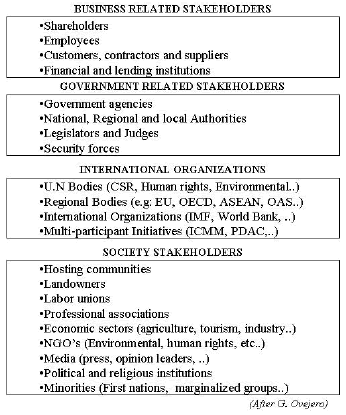
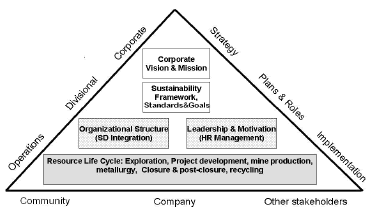
<body><![CDATA[<p><font size="2" face="Verdana, Arial, Helvetica, sans-serif">Therefore,  sustainable management implies a real challenge for the minerals industry. This  is exemplified by the &#8220;Sustainable Development Frameworks&#8221; proposed  by multi-participant initiatives offering guidance to the minerals industry  (ICMM, Global Compact and other). As an example, the International Council of  Mining and Metals &#91;2&#93;, proposes the &#8220;10  Principles of Sustainable Development&#8221;, all of them focusing on the  issues of strategy implementation, structural integration, continual improvement  and other challenging management tasks. </font></p>     <p><font size="2" face="Verdana, Arial, Helvetica, sans-serif">The  author&#8217;s vision of sustainable management is represented in the graphical  model of <a href="#fig01">Figure 1</a>, In this model, sustainability must be vertically  integrated at three organizational levels (corporate, divisional and  operations) and three functional levels (strategy, planning and implementation)  and three social levels (Company, community and other stakeholders). Besides,  the implementation of sustainability goals at the different stages of the  resource life cycle requires an organizational structure with adequate  integration mechanisms and a business culture where sustainability is a high  professional and business value. </font></p>     <p align="center"><font size="2" face="Verdana, Arial, Helvetica, sans-serif"><b><a name="fig01"></a><img src="/img/revistas/dyna/v77n161/a04fig01.gif">    <br>   Figure 1.</b> Sustainable Management of Mineral Resource Companies: An integrated   model</font></p>     <p><font size="2" face="Verdana, Arial, Helvetica, sans-serif">From the  shareholder&#8217;s perspective, there is ample evidence of the link between  environmental and social performance and company financial performance&#91;3&#93;, this  is a &#8220;Business case for sustainability&#8221;. Ultimately, any efficient  integration of sustainability must be driven by business considerations, this  is, sustainable management practice must lead to improved profitability and  added value to shareholders and hence, the potential benefits and costs of  sustainability need to be quantified. </font></p>     <p><font size="2" face="Verdana, Arial, Helvetica, sans-serif">The quantitative  evaluation of the potential benefits of sustainable management is a complex  subject that goes well beyond the scope of this paper but at the conceptual  level, these benefits are summarized below: </font></p> <ul>       <li><font size="2" face="Verdana, Arial, Helvetica, sans-serif">Corporate     reputation and lower risk profile</font></li>       <li><font size="2" face="Verdana, Arial, Helvetica, sans-serif"> Higher     operational efficiency from the implementation of SD management systems (e.g.,     ISO 14001, ISO 9001), and the continuous improvement philosophy associated with     sustainable management. </font></li>       <li><font size="2" face="Verdana, Arial, Helvetica, sans-serif">Competitive     advantage from the access to new mineral resources at lower acquisition cost     and reduced project failure rates.</font></li>       <li><font size="2" face="Verdana, Arial, Helvetica, sans-serif">Advantage     in recruiting and retaining human resources resulting in improved leadership     and motivation, initiative and decision making at lower levels. </font></li>       ]]></body>
<body><![CDATA[<li><font size="2" face="Verdana, Arial, Helvetica, sans-serif">Easier     and more economical project financing derived from the perception by investors     of the positive financial consequences of Social License in financing new     mining projects. </font></li>       <li><font size="2" face="Verdana, Arial, Helvetica, sans-serif">Lower     project development costs through improved stakeholder&#8217;s relation and     faster permitting process. </font></li>     </ul>     <p><font size="2" face="Verdana, Arial, Helvetica, sans-serif">Achieving these benefits has associated costs related to an increased  company structure, partnership in community development projects and, in  general, the costs of earning and  maintaining the social license. </font></p>     <p>&nbsp;</p>     <p><font size="3" face="Verdana, Arial, Helvetica, sans-serif"><b>3. CORPORATE STRATEGY AND SUSTAINABILITY</b></font></p>     <p><font size="2" face="Verdana, Arial, Helvetica, sans-serif">Some of the key strategy issues for   sustainability in the mineral industry described by Rebollo&#91;4&#93; are  highlighted below.</font></p>     <p><font size="2" face="Verdana, Arial, Helvetica, sans-serif">Contrary to most other businesses, once the ore body  has been discovered, the geographical location and other business parameters  such as political environment, availability of energy and water, transportation  conditions, climate, etc. are locked and little can be done to change them.</font></p>     <p><font size="2" face="Verdana, Arial, Helvetica, sans-serif">Mining and metallurgical activities are still regarded  as socially threatening and hazardous. Therefore, sustainable management of  these activities requires a &#8220;social license to operate&#8221;. Because  of this fact, a strategic plan for developing such an activity may not be  limited to the operational, market and financial considerations but must  address social, political and environmental implications that could be crucial for  feasibility. </font></p>     <p><font size="2" face="Verdana, Arial, Helvetica, sans-serif">Reputation is an important intangible asset in mining  companies. It can be improved in the frame of an intelligent strategy or  degraded by wrong policies and poor communication. A good reputation allows the companies to be  accepted by its social environment and, as a consequence, increase its capacity  to compete in other strategic aspects.</font></p>     ]]></body>
<body><![CDATA[<p><font size="2" face="Verdana, Arial, Helvetica, sans-serif">Another important strategic particularity of the  minerals industry is the relatively small number of actors and the  international &#8211; sometimes global &#8211; projection of many of them. This  fact makes sustainability and corporate social responsibility aspects often  become extremely important for the strategy of the company. </font></p>     <p><font size="2" face="Verdana, Arial, Helvetica, sans-serif">At the operational levels, probably the key strategic issue for sustainable  management is the relation with the &#8220;stakeholders&#8221;. In this context,  a &#8220;stakeholder&#8221;&#91;5&#93; is a party which affects, or can be affected  negatively or positively by the activities of the company. Although the concept  is applicable to any business activity, it is in the minerals industry where it  becomes of greatest strategic interest, due to the great diversity and  magnitude of its potential (positive and negative) impacts and the  controversial legacy of mining around the world throughout history. </font></p>     <p><font size="2" face="Verdana, Arial, Helvetica, sans-serif">Interaction  with each stakeholder requires a specific strategy but any efficient  interaction with the shareholders of a mining project requires clear  objectives, mutual trust and transparency. The Social  License is a covenant drawn up between the company and the affected communities  and stakeholders. Furthermore, it is dynamic in its nature and must be  preserved over time through adapting it to the changes and new circumstances affecting  the company and the community. </font></p>     <p><font size="2" face="Verdana, Arial, Helvetica, sans-serif"><a href="#tab01">Table 1</a> shows a list of some typical mine  project stakeholders&#91;6&#93;. Identifying and interacting with the relevant  stakeholders is essential to sustainable management. No hard rules exist to identify  them but it is of interest the recommendation of the World Bank&#91;7&#93; suggesting  that a good way to start the identification process is by asking questions such  as: </font></p> <ul>       <li><font size="2" face="Verdana, Arial, Helvetica, sans-serif">Who are the     &#8220;voiceless&#8221; for whom special efforts may have to be made? </font></li>       <li><font size="2" face="Verdana, Arial, Helvetica, sans-serif">Who are the representatives of     those likely to be affected? </font></li>       <li><font size="2" face="Verdana, Arial, Helvetica, sans-serif">Who is likely to mobilize for     or against what is intended? </font></li>       <li><font size="2" face="Verdana, Arial, Helvetica, sans-serif">Who can make what is intended     more effective through their participation or less effective by their     non-participation or outright opposition? </font></li>       <li><font size="2" face="Verdana, Arial, Helvetica, sans-serif">Who can contribute financial     and technical resources?</font></li>       <li><font size="2" face="Verdana, Arial, Helvetica, sans-serif"> Whose behavior has to change     for the effort to succeed? </font></li>     ]]></body>
<body><![CDATA[</ul>     <p align="center"><font size="2" face="Verdana, Arial, Helvetica, sans-serif"><b><a name="tab01"></a>Table 1.</b> Typical stakeholders in mining projects</font>    <br> <img src="/img/revistas/dyna/v77n161/a04tab01.gif"></p>     <p>&nbsp;</p>     <p><font size="3" face="Verdana, Arial, Helvetica, sans-serif"><b>4. CORPORATE SOCIAL RESPONSIBILITY</b></font></p>     <p><font size="2" face="Verdana, Arial, Helvetica, sans-serif">The World Business Council for Sustainable Development states:  &#8220;Corporate social responsibility is the continuing commitment by business  to behave ethically and contribute to economic development while improving the  quality of life of the workforce and their families as well as the local  community and society at large&#8221; &#91;8&#93; . As a business value, CSR can help  safeguard license to operate; facilitate access to capital; contribute to  reputation, and enhance stakeholder engagement, including employees and  overall, it contributes to sustainable management and the reduction of business  risk. </font></p>     <p><font size="2" face="Verdana, Arial, Helvetica, sans-serif">It is also understood that CSR implies the  voluntary acceptance by the companies of social responsibilities,  sustainability standards and codes of ethics above and beyond legal  requirements. To this end, mining companies may align their codes of conduct  and sustainable development frameworks, such as :</font></p> <ul>       <li><font size="2" face="Verdana, Arial, Helvetica, sans-serif">The International Council of     Mining and Metals (ICMM) </font></li>       <li><font size="2" face="Verdana, Arial, Helvetica, sans-serif">The United Nations Global     Compact (www.unglobalcompact.org)</font></li>       <li><font size="2" face="Verdana, Arial, Helvetica, sans-serif">The Prospectors and Developers     Association of Canada - PDAC (http://www.pdac.ca/)</font></li>       ]]></body>
<body><![CDATA[<li><font size="2" face="Verdana, Arial, Helvetica, sans-serif">Global Reporting Initiative- GRI     (http://www.globalreporting.org/)</font></li>     </ul>     <p><font size="2" face="Verdana, Arial, Helvetica, sans-serif">In most cases, these corporate values include considerations towards  ethics, social license, and safety and clearly represent a commitment to  upholding standards and codes of conduct relative to company employees, local  communities, the environment, and stockholders/investors. </font></p>     <p>&nbsp;</p>     <p><font size="3" face="Verdana, Arial, Helvetica, sans-serif"><b>5. HUMAN RESOURCES MANAGEMENT AND THE SOCIAL LICENSE</b></font></p>     <p><font size="2" face="Verdana, Arial, Helvetica, sans-serif">Probably, one of the most prominent risks now  facing mining and resource companies involves their ability to develop and  maintain a social license to operate&#91;9&#93;. While the  legal authority to mine a specific property is embodied in the regulatory  consent granted by governmental agencies, this &#8220;right to mine&#8221; is  only as valid as the explicit or implicit social license granted by the potentially  affected communities and stakeholders. In exchange for this social license, mining companies make a commitment  to local communities to provide tangible benefits and improve the quality of  life of residents during and after mining. </font></p>     <p><font size="2" face="Verdana, Arial, Helvetica, sans-serif">The Social License is a covenant drawn up between the company and the  affected communities and stakeholders. Furthermore, it is dynamic in its nature  and must be preserved over time through adapting it to the changes and new circumstances  affecting the company and the community. </font></p>     <p><font size="2" face="Verdana, Arial, Helvetica, sans-serif">Employees  play a critical role, often overlooked, in facilitating this social license. Freeman, 2009&#91;9&#93; stated that employees serve as an important conduit  for disseminating information about the company and its practices to the  general public and hence, everything associated with human resources  management, directly or indirectly impacts a company&#8217;s reputation and how  they are perceived by local communities. In addition, employees are key in conveying important information back  to the company about social and community issues, a feedback which is critical  for assessing the outcomes of specific social programs and identifying key  factors that might indicate community needs or potential conflicts.</font></p>     <p><font size="2" face="Verdana, Arial, Helvetica, sans-serif">Company  culture and ethics are perhaps the two most critical HR management issues for  sustainability. Company&#8217;s ethics are inherently defined by the behaviour  of its employees. Ethics is a complex subject  beyond the scope of this paper. Suffice to say that although companies often have  well-defined codes of ethics, standards and policies that precisely define the limits  of ethical conduct of employees, a company&#8217;s ethics are usually defined  by the behavior of its employees with respect to &#8220;grey areas&#8221;, that  is, when in the absence of prescriptive policy or standards, employees behavior  is based upon their own interpretation of the situation. For example breeches  of ethics such as theft and lying are easy to define but, Is it ethical to exaggerate for personal  gain?. How about corporate intelligence?. A Company&#8217;s ethics are often  characterized through these grey areas.</font></p>     <p><font size="2" face="Verdana, Arial, Helvetica, sans-serif">Regarding company culture, sustainable management requires a culture  where sustainability is a motivating corporate and professional value so that sustainability  objectives may rely on personal commitment rather than compliance with policy  and regulations, thus allowing for maximum degree of decentralization of  decision making in sustainability issues. </font></p>     ]]></body>
<body><![CDATA[<p>&nbsp;</p>     <p><font size="3" face="Verdana, Arial, Helvetica, sans-serif"><b>6. INTEGRATING SUSTAINABILITY INTO COMPANY STRUCTURE</b></font></p>     <p><font size="2" face="Verdana, Arial, Helvetica, sans-serif">As an important area of corporate strategy, sustainability must be  integrated within the corporate decision-making process at all management  levels. This integration process, often difficult and challenging, requires an  organizational structure with integration mechanisms, management roles, plans  and systems ensuring proper communication, coordination and control. Integration roles are individual positions or  ad-hoc committees with accountability for the integration of sustainable  development values and objectives. Integration plans and systems are the  policies, standards and the management tools which are required to carry out  sustainable management at operations level.</font></p>     <p><font size="2" face="Verdana, Arial, Helvetica, sans-serif">As an  example (<a href="#fig02">Figure 2</a>), exemplifies the sustainable management structure  for a large minerals corporation and highlights the integration mechanisms for  sustainable management. The model would also be conceptually valid for medium  size or small companies, where the divisional level would not exist. </font></p>     <p align="center"><font size="2" face="Verdana, Arial, Helvetica, sans-serif"><b><a name="fig02"></a><img src="/img/revistas/dyna/v77n161/a04fig02.gif">    <br>   Figure 2.</b> The process of integration of sustainability in   the company structure</font></p>     <p><font size="2" face="Verdana, Arial, Helvetica, sans-serif">At  corporate level, three roles are key to sustainable management:</font></p> <ul>       <li><font size="2" face="Verdana, Arial, Helvetica, sans-serif">The CEO role, developing a business vision,     formulating challenging goals and reinforcing motivation toward the values of     ethics and sustainability. </font></li>       <li><font size="2" face="Verdana, Arial, Helvetica, sans-serif">The SD Committee, assisting the     Board in overseeing SD framework and standards, evaluating performance, public reporting and external auditing.</font></li>       <li><font size="2" face="Verdana, Arial, Helvetica, sans-serif">The VP Sustainability, a key     leadership role, normally a staff to the CEO, who is accountable for setting     strategy, establishing goals and integrating sustainability down and across the     organization. Among other tasks, the VP Sustainability should assist divisional     heads on sustainability matters, cooperation with HR in developing sustainability values in employees. </font></li>     ]]></body>
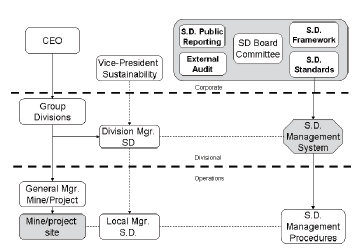
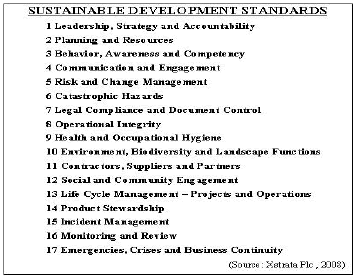
<body><![CDATA[</ul>     <p><font size="2" face="Verdana, Arial, Helvetica, sans-serif">At the  divisional level, the Divisional Managers, Sustainability are accountable to  the VP, Sustainability and coordinate sustainability issues with the Division  heads. Here, the key roles are related to the efficient integration of  sustainability standards, the implementation of management systems for  evaluation and control of SD goals and the management of the sustainable  development reporting.</font></p>     <p><font size="2" face="Verdana, Arial, Helvetica, sans-serif">At  operational levels, the site Manager, Sustainability report to the operations  general managers with overall accountability for the implementation of  sustainability procedures at operational level.</font></p>     <p><font size="2" face="Verdana, Arial, Helvetica, sans-serif"><u>Sustainable  Development Standards</u> are a set of management standards issued to interpret and support the Sustainable  Development framework and policy on sustainability at all management levels in  the company. Also, the SD Standards act to formalise the conceptual base for the  design and implementation of management systems. In many cases, SD Frameworks  and Standards are designed in full alignment with international SD frameworks  (ICMM, Global Compact, etc.). As an example, XSTRATA PLC has a SD developed System based on the Standards  listed in <a href="#tab02">Table 2</a>. </font></p>     <p align="center"><font size="2" face="Verdana, Arial, Helvetica, sans-serif"><b><a name="tab02"></a>Table 2</b>. Typical Sustainability Management   Standards of Mining Company</font>    <br>   <img src="/img/revistas/dyna/v77n161/a04tab02.gif"></p>     <p><font size="2" face="Verdana, Arial, Helvetica, sans-serif"><u>The SD  Management Systems</u> are tools supporting the implementation of SD objectives (planning and control)  and to manage for a hierarchical performance reporting system to allow for  analysis and decision taking at all levels.</font></p>     <p><font size="2" face="Verdana, Arial, Helvetica, sans-serif"><u>Sustainability  Reports</u> are often  designed in alignment with global reporting standards. Probably the most widely  used minerals industry reporting  standard is the Global Reporting Initiative (GRI). GRI has published a public  reporting guide specifically designed for the Minerals Industry, which was  developed in cooperation with the International Council on Mining and Metals  (ICMM). </font></p>     <p><font size="2" face="Verdana, Arial, Helvetica, sans-serif">Only  publicly listed Companies are required to issue an independently assured annual  report on sustainability. However, many non listed mining companies issue  independently assured reports seeking the very positive effect on reputation  and credibility with respect to sustainability and Corporate Social  Responsibility.</font></p>     <p><font size="2" face="Verdana, Arial, Helvetica, sans-serif">Audits are  normally performed on an annual basis by the internal audit team under the  direction of an independent auditor. The objective is to provide independent  assurance that the management practice and performance are in compliance with  the SD standards and public reporting of the Company.</font></p>     ]]></body>
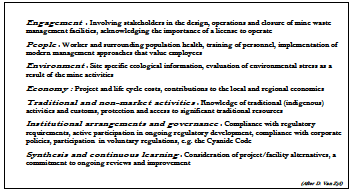
<body><![CDATA[<p><font size="2" face="Verdana, Arial, Helvetica, sans-serif">Assurance practices of mining companies vary widely but there is  increasing use of standards such as AA1000.</font></p>     <p>&nbsp;</p>     <p><b><font size="3" face="Verdana, Arial, Helvetica, sans-serif">7. MANAGING PROJECT   DEVELOPMENT AND OPERATIONS </font></b></p>     <p><font size="2" face="Verdana, Arial, Helvetica, sans-serif">Implementing sustainable management in day to  day operations is difficult to accomplish and describing the systems and  procedures required is very complex and well beyond the scope of this paper.  However, we will highlight that any approach to sustainable operations management  relies on the identification of expectations expressed by local stakeholders  and its integration with those identified in corporate sustainability  standards. </font></p>     <p><font size="2" face="Verdana, Arial, Helvetica, sans-serif">In this regard, Van  Zyl et al &#91;10&#93; describes a powerful  methodology - &#8220;Seven Themes of Sustainability&#8221;  &#8211; which may be used to develop broad  management guidelines. The methodology consists in analyzing management  decisions from the perspective of the &#8220;Seven Themes&#8221;, as described  in <a href="#tab03">Table  3</a>, to identify some sustainable management  considerations. </font></p>     <p align="center"><font size="2" face="Verdana, Arial, Helvetica, sans-serif"><b><a name="tab03"></a>Table 3</b>. Management Considerations and the Seven Themes to Sustainability </font>    <br> <img src="/img/revistas/dyna/v77n161/a04tab03.gif"></p>     <p>&nbsp;</p>     <p><font size="3" face="Verdana, Arial, Helvetica, sans-serif"><b>8. CONCLUSIONS</b></font></p> <ul>      <li><font size="2" face="Verdana, Arial, Helvetica, sans-serif">In the context of the minerals  industry, sustainable management refers to a management approach that  integrates sustainability across the organization: i) At all organizational  levels (corporate, divisional and operations), ii) At all functional levels  (strategy, planning and implementation) and iii) In all stages of the resource  life cycle (Exploration, project development, mining and metallurgical  operations, closure &amp; post-closure). </font></li>      ]]></body>
<body><![CDATA[<li><font size="2" face="Verdana, Arial, Helvetica, sans-serif">Sustainable Management deals with seeking for long term competitive advantages through  responsible management of economic, environmental and social issues. Achieving these advantages has associated  costs related to the development of a sustainability driven business culture,  the partnership in community development projects and, in general, the costs of  earning and maintaining the social license. </font></li>      <li><font size="2" face="Verdana, Arial, Helvetica, sans-serif">The social license to operate relies  on individual ethical conduct and trust to foster participation of stakeholders  and encourage commitment among them. Therefore, sustainable management requires  a business culture where sustainability is a self-motivation professional value  and decisions are driven by commitment rather than compliance with policies and  regulations. </font></li>     </ul>     <p>&nbsp;</p>     <p><font size="3" face="Verdana, Arial, Helvetica, sans-serif"><b>REFERENCES</b></font></p>     <!-- ref --><p><font size="2" face="Verdana, Arial, Helvetica, sans-serif"><b>&#91;1&#93;</b> BOTIN, J.A. ed. Sustainable Management of Mining Operations. Society for Mining, Metallurgy and Exploration (SME). Littleton, Co., USA . 2009.       &nbsp;&nbsp;&nbsp;&nbsp;&nbsp;&nbsp;&nbsp;&nbsp;[&#160;<a href="javascript:void(0);" onclick="javascript: window.open('/scielo.php?script=sci_nlinks&ref=000108&pid=S0012-7353201000010000400001&lng=','','width=640,height=500,resizable=yes,scrollbars=1,menubar=yes,');">Links</a>&#160;]<!-- end-ref --><!-- ref --><br>     <b>&#91;2&#93;</b> INTERNATIONAL COUNCIL OF MINING AND METALS. Sustainable Development Framework. May 2003.       &nbsp;&nbsp;&nbsp;&nbsp;&nbsp;&nbsp;&nbsp;&nbsp;[&#160;<a href="javascript:void(0);" onclick="javascript: window.open('/scielo.php?script=sci_nlinks&ref=000109&pid=S0012-7353201000010000400002&lng=','','width=640,height=500,resizable=yes,scrollbars=1,menubar=yes,');">Links</a>&#160;]<!-- end-ref --><!-- ref --><br>     <b>&#91;3&#93;</b> GRIEG-GRAN, M. Financial Incentives for Improved Sustainability Performance: The Business Case and the Sustainability Dividend. MMSD project of IIED and WBCSD. 2001.       &nbsp;&nbsp;&nbsp;&nbsp;&nbsp;&nbsp;&nbsp;&nbsp;[&#160;<a href="javascript:void(0);" onclick="javascript: window.open('/scielo.php?script=sci_nlinks&ref=000110&pid=S0012-7353201000010000400003&lng=','','width=640,height=500,resizable=yes,scrollbars=1,menubar=yes,');">Links</a>&#160;]<!-- end-ref --><!-- ref --><br>     <b>&#91;4&#93;</b> REBOLLO, J.L. Strategy issues in the Mineral Industry. Sustainable Management of Mining Operations, Botin Ed. Chapter 4. Society for Mining, Metallurgy and Exploration (SME). Littleton, Co., USA . 2009.       &nbsp;&nbsp;&nbsp;&nbsp;&nbsp;&nbsp;&nbsp;&nbsp;[&#160;<a href="javascript:void(0);" onclick="javascript: window.open('/scielo.php?script=sci_nlinks&ref=000111&pid=S0012-7353201000010000400004&lng=','','width=640,height=500,resizable=yes,scrollbars=1,menubar=yes,');">Links</a>&#160;]<!-- end-ref --><!-- ref --><br>     <b>&#91;5&#93;</b> EDWARD FREEMAN, R. Strategic Management: A Stakeholder Approach. ISBN: 0273019139. 1986.       &nbsp;&nbsp;&nbsp;&nbsp;&nbsp;&nbsp;&nbsp;&nbsp;[&#160;<a href="javascript:void(0);" onclick="javascript: window.open('/scielo.php?script=sci_nlinks&ref=000112&pid=S0012-7353201000010000400005&lng=','','width=640,height=500,resizable=yes,scrollbars=1,menubar=yes,');">Links</a>&#160;]<!-- end-ref --><!-- ref --><br>     <b>&#91;6&#93;</b> OVEJERO, G. Project Management and Stakeholders. Sustainable Management of Mining Operations, Botin Ed. Chapter 8. Society for Mining, Metallurgy and Exploration (SME). Littleton, Co., USA . 2009.       &nbsp;&nbsp;&nbsp;&nbsp;&nbsp;&nbsp;&nbsp;&nbsp;[&#160;<a href="javascript:void(0);" onclick="javascript: window.open('/scielo.php?script=sci_nlinks&ref=000113&pid=S0012-7353201000010000400006&lng=','','width=640,height=500,resizable=yes,scrollbars=1,menubar=yes,');">Links</a>&#160;]<!-- end-ref --><!-- ref --><br>     <b>&#91;7&#93;</b> WORLD BANK. IBRD. “Participation sourcebook”. ISBN 0-8213-3558-8. Washington D.C. 1996.     &nbsp;&nbsp;&nbsp;&nbsp;&nbsp;&nbsp;&nbsp;&nbsp;[&#160;<a href="javascript:void(0);" onclick="javascript: window.open('/scielo.php?script=sci_nlinks&ref=000114&pid=S0012-7353201000010000400007&lng=','','width=640,height=500,resizable=yes,scrollbars=1,menubar=yes,');">Links</a>&#160;]<!-- end-ref --><!-- ref --><br>     <b>&#91;8&#93;</b> WBCSD ( Mike Wright), “Corporate Social Responsibility: What stakeholders in emerging economies had to say”, presentation at the Corporate Citizenship Conference, The Royal Institute of International Affairs, Chatham House, London, November 8, 1999.     &nbsp;&nbsp;&nbsp;&nbsp;&nbsp;&nbsp;&nbsp;&nbsp;[&#160;<a href="javascript:void(0);" onclick="javascript: window.open('/scielo.php?script=sci_nlinks&ref=000115&pid=S0012-7353201000010000400008&lng=','','width=640,height=500,resizable=yes,scrollbars=1,menubar=yes,');">Links</a>&#160;]<!-- end-ref --><!-- ref --><br>     <b>&#91;9&#93;</b> FREEMAN, L. and MILLER, H. Human Resources Management. SME Annual Meeting. Technical Session on Managing for Sustainability in the Minerals Industry. Denver, Co. USA . Society for Mining, Metallurgy and Exploration (SME). Littleton, Co., USA . 2009.       &nbsp;&nbsp;&nbsp;&nbsp;&nbsp;&nbsp;&nbsp;&nbsp;[&#160;<a href="javascript:void(0);" onclick="javascript: window.open('/scielo.php?script=sci_nlinks&ref=000116&pid=S0012-7353201000010000400009&lng=','','width=640,height=500,resizable=yes,scrollbars=1,menubar=yes,');">Links</a>&#160;]<!-- end-ref --><!-- ref --><br>     <b>&#91;10&#93;</b> VAN ZYL, D., LOHRY, J. and REID, R. Evaluation of Resource Management Plans in Nevada Using Seven Questions to Sustainability, In: Proceedings of the 3rd International Conference on Sustainable Development Indicators in the Mineral Industries, Z. Agioutantis (ed), Milos Conference Center, pp 403-410. 2007.  </font>&nbsp;&nbsp;&nbsp;&nbsp;&nbsp;&nbsp;&nbsp;&nbsp;[&#160;<a href="javascript:void(0);" onclick="javascript: window.open('/scielo.php?script=sci_nlinks&ref=000117&pid=S0012-7353201000010000400010&lng=','','width=640,height=500,resizable=yes,scrollbars=1,menubar=yes,');">Links</a>&#160;]<!-- end-ref --> ]]></body><back>
<ref-list>
<ref id="B1">
<label>1</label><nlm-citation citation-type="book">
<person-group person-group-type="author">
<name>
<surname><![CDATA[BOTIN]]></surname>
<given-names><![CDATA[J.A.]]></given-names>
</name>
</person-group>
<source><![CDATA[Sustainable Management of Mining Operations]]></source>
<year></year>
<publisher-loc><![CDATA[Littleton ]]></publisher-loc>
<publisher-name><![CDATA[Society for Mining, Metallurgy and Exploration (SME)]]></publisher-name>
</nlm-citation>
</ref>
<ref id="B2">
<label>2</label><nlm-citation citation-type="">
<collab>INTERNATIONAL COUNCIL OF MINING AND METALS</collab>
<source><![CDATA[Sustainable Development Framework]]></source>
<year>May </year>
<month>20</month>
<day>03</day>
</nlm-citation>
</ref>
<ref id="B3">
<label>3</label><nlm-citation citation-type="book">
<person-group person-group-type="author">
<name>
<surname><![CDATA[GRIEG-GRAN]]></surname>
<given-names><![CDATA[M.]]></given-names>
</name>
</person-group>
<source><![CDATA[Financial Incentives for Improved Sustainability Performance: The Business Case and the Sustainability Dividend]]></source>
<year>2001</year>
<publisher-name><![CDATA[MMSD project of IIED and WBCSD]]></publisher-name>
</nlm-citation>
</ref>
<ref id="B4">
<label>4</label><nlm-citation citation-type="book">
<person-group person-group-type="author">
<name>
<surname><![CDATA[REBOLLO]]></surname>
<given-names><![CDATA[J.L.]]></given-names>
</name>
</person-group>
<source><![CDATA[Strategy issues in the Mineral Industry: Sustainable Management of Mining Operations]]></source>
<year>2009</year>
<publisher-loc><![CDATA[Littleton ]]></publisher-loc>
<publisher-name><![CDATA[Society for Mining, Metallurgy and Exploration (SME)]]></publisher-name>
</nlm-citation>
</ref>
<ref id="B5">
<label>5</label><nlm-citation citation-type="">
<person-group person-group-type="author">
<name>
<surname><![CDATA[EDWARD FREEMAN]]></surname>
<given-names><![CDATA[R.]]></given-names>
</name>
</person-group>
<source><![CDATA[Strategic Management: A Stakeholder Approach]]></source>
<year>1986</year>
</nlm-citation>
</ref>
<ref id="B6">
<label>6</label><nlm-citation citation-type="book">
<person-group person-group-type="author">
<name>
<surname><![CDATA[OVEJERO]]></surname>
<given-names><![CDATA[G.]]></given-names>
</name>
</person-group>
<source><![CDATA[Project Management and Stakeholders: Sustainable Management of Mining Operations]]></source>
<year>2009</year>
<publisher-loc><![CDATA[Littleton^eCo Co]]></publisher-loc>
<publisher-name><![CDATA[Society for Mining, Metallurgy and Exploration (SME)]]></publisher-name>
</nlm-citation>
</ref>
<ref id="B7">
<label>7</label><nlm-citation citation-type="">
<collab>WORLD BANK</collab>
<source><![CDATA[IBRD: Participation sourcebook]]></source>
<year>1996</year>
<publisher-loc><![CDATA[Washington D.C. ]]></publisher-loc>
</nlm-citation>
</ref>
<ref id="B8">
<label>8</label><nlm-citation citation-type="confpro">
<person-group person-group-type="author">
<name>
<surname><![CDATA[Wright]]></surname>
<given-names><![CDATA[Mike]]></given-names>
</name>
</person-group>
<source><![CDATA[Corporate Social Responsibility: What stakeholders in emerging economies had to say]]></source>
<year></year>
<conf-name><![CDATA[ Corporate Citizenship Conference]]></conf-name>
<conf-date>November 8, 1999</conf-date>
<conf-loc>London </conf-loc>
</nlm-citation>
</ref>
<ref id="B9">
<label>9</label><nlm-citation citation-type="confpro">
<person-group person-group-type="author">
<name>
<surname><![CDATA[FREEMAN]]></surname>
<given-names><![CDATA[L.]]></given-names>
</name>
<name>
<surname><![CDATA[MILLER]]></surname>
<given-names><![CDATA[H.]]></given-names>
</name>
</person-group>
<source><![CDATA[Human Resources Management]]></source>
<year>2009</year>
<conf-name><![CDATA[ SME Annual Meeting]]></conf-name>
<conf-loc>Denver Co</conf-loc>
<publisher-loc><![CDATA[Littleton^eCo Co]]></publisher-loc>
</nlm-citation>
</ref>
<ref id="B10">
<label>10</label><nlm-citation citation-type="confpro">
<person-group person-group-type="author">
<name>
<surname><![CDATA[VAN ZYL]]></surname>
<given-names><![CDATA[D.]]></given-names>
</name>
<name>
<surname><![CDATA[LOHRY]]></surname>
<given-names><![CDATA[J.]]></given-names>
</name>
<name>
<surname><![CDATA[REID]]></surname>
<given-names><![CDATA[R.]]></given-names>
</name>
</person-group>
<article-title xml:lang="en"><![CDATA[Evaluation of Resource Management Plans in Nevada Using Seven Questions to Sustainability]]></article-title>
<person-group person-group-type="editor">
<name>
<surname><![CDATA[Agioutantis]]></surname>
<given-names><![CDATA[Z.]]></given-names>
</name>
</person-group>
<source><![CDATA[Proceedings]]></source>
<year>2007</year>
<conf-name><![CDATA[3rd International Conference on Sustainable Development Indicators in the Mineral Industries]]></conf-name>
<conf-loc> </conf-loc>
<page-range>403-410</page-range></nlm-citation>
</ref>
</ref-list>
</back>
</article>