<?xml version="1.0" encoding="ISO-8859-1"?><article xmlns:mml="http://www.w3.org/1998/Math/MathML" xmlns:xlink="http://www.w3.org/1999/xlink" xmlns:xsi="http://www.w3.org/2001/XMLSchema-instance">
<front>
<journal-meta>
<journal-id>0012-7353</journal-id>
<journal-title><![CDATA[DYNA]]></journal-title>
<abbrev-journal-title><![CDATA[Dyna rev.fac.nac.minas]]></abbrev-journal-title>
<issn>0012-7353</issn>
<publisher>
<publisher-name><![CDATA[Universidad Nacional de Colombia]]></publisher-name>
</publisher>
</journal-meta>
<article-meta>
<article-id>S0012-73532010000100005</article-id>
<title-group>
<article-title xml:lang="en"><![CDATA[COMPOSITIONAL KRIGING APPLIED TO THE RESERVE ESTIMATION OF A GRANITE DEPOSIT]]></article-title>
<article-title xml:lang="es"><![CDATA[TÉCNICAS DE KRIGEADO COMPOSICIONAL PARA LA ESTIMACIÓN DE RESERVAS EN UN DEPÓSITO DE GRANITO]]></article-title>
</title-group>
<contrib-group>
<contrib contrib-type="author">
<name>
<surname><![CDATA[SAAVEDRA]]></surname>
<given-names><![CDATA[ÁNGELES]]></given-names>
</name>
<xref ref-type="aff" rid="A01"/>
</contrib>
<contrib contrib-type="author">
<name>
<surname><![CDATA[ORDÓÑEZ]]></surname>
<given-names><![CDATA[CELESTINO]]></given-names>
</name>
<xref ref-type="aff" rid="A02"/>
</contrib>
<contrib contrib-type="author">
<name>
<surname><![CDATA[TABOADA]]></surname>
<given-names><![CDATA[JAVIER]]></given-names>
</name>
<xref ref-type="aff" rid="A03"/>
</contrib>
<contrib contrib-type="author">
<name>
<surname><![CDATA[ARMESTO]]></surname>
<given-names><![CDATA[JULIA]]></given-names>
</name>
<xref ref-type="aff" rid="A04"/>
</contrib>
</contrib-group>
<aff id="A01">
<institution><![CDATA[,Universidad de Vigo  ]]></institution>
<addr-line><![CDATA[Vigo ]]></addr-line>
<country>Spain</country>
</aff>
<aff id="A02">
<institution><![CDATA[,Universidad de Vigo  ]]></institution>
<addr-line><![CDATA[Vigo ]]></addr-line>
<country>Spain</country>
</aff>
<aff id="A03">
<institution><![CDATA[,Universidad de Vigo  ]]></institution>
<addr-line><![CDATA[Vigo ]]></addr-line>
<country>Spain</country>
</aff>
<aff id="A04">
<institution><![CDATA[,Universidad de Vigo  ]]></institution>
<addr-line><![CDATA[Vigo ]]></addr-line>
<country>Spain</country>
</aff>
<pub-date pub-type="pub">
<day>00</day>
<month>03</month>
<year>2010</year>
</pub-date>
<pub-date pub-type="epub">
<day>00</day>
<month>03</month>
<year>2010</year>
</pub-date>
<volume>77</volume>
<numero>161</numero>
<fpage>53</fpage>
<lpage>60</lpage>
<copyright-statement/>
<copyright-year/>
<self-uri xlink:href="http://www.scielo.org.co/scielo.php?script=sci_arttext&amp;pid=S0012-73532010000100005&amp;lng=en&amp;nrm=iso"></self-uri><self-uri xlink:href="http://www.scielo.org.co/scielo.php?script=sci_abstract&amp;pid=S0012-73532010000100005&amp;lng=en&amp;nrm=iso"></self-uri><self-uri xlink:href="http://www.scielo.org.co/scielo.php?script=sci_pdf&amp;pid=S0012-73532010000100005&amp;lng=en&amp;nrm=iso"></self-uri><abstract abstract-type="short" xml:lang="en"><p><![CDATA[Making an accurate estimate of quality distribution in a granite deposit is essential, both from a financial point of view, to determine the profitability of the site, and from an environmental perspective, to focus operations on the most profitable areas thereby reducing the extent of land affected by such work. Granite is extracted in blocks whose profitability and value depend on the final size of the slabs, which is an important factor in defining quality. This article uses a variant of disjunctive kriging in order to determine the quality of granite in one of the largest reserves in the world-the Porriño deposit located in northwest Spain. This method, unlike classical disjunctive kriging, considers random variables that are not necessarily binary. The advantage of using this technique compared to the classical statistical cokriging technique is that all the qualities are considered as variables with the same importance and that the sum of quality percentages in a block is one hundred percent. The validity of the method was tested in a cross-validation process. The results compared favourably with those obtained using ordinary cokriging and fuzzy kriging.]]></p></abstract>
<abstract abstract-type="short" xml:lang="es"><p><![CDATA[Realizar una estimación precisa de la distribución del granito por calidades en un yacimiento es fundamental, tanto desde el punto de vista económico, para determinar la rentabilidad del yacimiento, como ambiental, para dirigir las labores de extracción exclusivamente a las zonas más rentables, reduciendo así la extensión de los terrenos afectados por dichas labores. El granito es extraído en bloques cuya utilidad y precio dependen del tamaño final de roca que se puede extraer de los mismos, que es el factor que define la calidad. En este artículo se utiliza una variante del krigeado disyuntivo para determinar las reservas de granito por calidades en el yacimiento de Porriño, uno de los más importantes del mundo, situado en el Noroeste de España. El método utilizado, a diferencia del krigeado disyuntivo clásico, considera variables aleatorias que no son necesariamente binarias. La ventaja de utilizar esta técnica estadística frente a las técnicas clásicas de cokriging es que todas las calidades son consideradas variables de la misma importancia y que se asegura que la suma del porcentaje de las calidades en un bloque es del cien por cien. La validez del método se ha chequeado mediante un proceso de validación cruzada. La comparación con los resultados obtenidos utilizando cokrigeado ordinario y krigeado difuso ha sido favorable para el krigeado composicional.]]></p></abstract>
<kwd-group>
<kwd lng="en"><![CDATA[compositional kriging]]></kwd>
<kwd lng="en"><![CDATA[cokriging]]></kwd>
<kwd lng="en"><![CDATA[fuzzy kriging]]></kwd>
<kwd lng="en"><![CDATA[granite]]></kwd>
<kwd lng="en"><![CDATA[quality estimation]]></kwd>
<kwd lng="es"><![CDATA[krigeado composicional]]></kwd>
<kwd lng="es"><![CDATA[cokriging]]></kwd>
<kwd lng="es"><![CDATA[krigieado difuso]]></kwd>
<kwd lng="es"><![CDATA[granito]]></kwd>
<kwd lng="es"><![CDATA[estimación de calidad]]></kwd>
</kwd-group>
</article-meta>
</front><body><![CDATA[ <p align="center"><font size="4" face="Verdana, Arial, Helvetica, sans-serif"><b>COMPOSITIONAL KRIGING APPLIED TO THE RESERVE ESTIMATION OF A GRANITE  DEPOSIT</b></font></p>     <p align="center"><i><font size="3"><b><font face="Verdana, Arial, Helvetica, sans-serif"> T&Eacute;CNICAS DE KRIGEADO  COMPOSICIONAL PARA   LA  ESTIMACI&Oacute;N DE RESERVAS EN UN DEP&Oacute;SITO DE GRANITO </font></b></font></i></p>     <p align="center">&nbsp;</p>     <p align="center"><font size="2" face="Verdana, Arial, Helvetica, sans-serif"><b>&Aacute;NGELES SAAVEDRA</b>    <br>     <i>Universidad de Vigo, Campus   Lagoas-Marcosende, Vigo-Spain, <a href="mailto:saavedra@uvigo.es">saavedra@uvigo.es</a></i></font></p>     <p align="center"><font size="2" face="Verdana, Arial, Helvetica, sans-serif"><b>CELESTINO ORD&Oacute;&Ntilde;EZ</b>    <br>     <i>Universidad de Vigo, Campus Lagoas-Marcosende, Vigo-Spain, <a href="mailto:cgalan@uvigo.es">cgalan@uvigo.es</a></i></font></p>     <p align="center"><font size="2" face="Verdana, Arial, Helvetica, sans-serif"><b>JAVIER TABOADA</b>    <br>     <i>Universidad de Vigo, Campus Lagoas-Marcosende, Vigo-Spain, <a href="mailto:jtaboada@uvigo.es">jtaboada@uvigo.es</a></i></font></p>     <p align="center"><font size="2" face="Verdana, Arial, Helvetica, sans-serif"><b>JULIA ARMESTO</b>    ]]></body>
<body><![CDATA[<br>     <i>Universidad de Vigo, Campus Lagoas-Marcosende, Vigo-Spain, <a href="mailto:julia@uvigo.es">julia@uvigo.es</a></i></font></p>     <p align="center">&nbsp;</p>     <p align="center"><font size="2" face="Verdana, Arial, Helvetica, sans-serif"><b>Received for review May 26<sup> th</sup>, 2009, accepted December 6<sup> th</sup>, 2009, final version December   21<sup>th</sup>, 2009</b></font></p>     <p>&nbsp;</p> <hr>      <p><font size="2" face="Verdana, Arial, Helvetica, sans-serif"><b>ABSTRACT</b>: Making an accurate estimate of quality  distribution in a granite deposit is essential, both from a financial point of  view, to determine the profitability of the site, and from an environmental  perspective, to focus operations on the most profitable areas thereby reducing  the extent of land affected by such work. Granite is extracted in blocks whose  profitability and value depend on the final size of the slabs, which is an  important factor in defining quality. This article uses a variant of  disjunctive kriging in order to determine the quality of granite in one of the  largest reserves in the world—the Porri&ntilde;o deposit located in northwest Spain.  This method, unlike classical disjunctive kriging, considers random variables  that are not necessarily binary. The advantage of using this technique compared  to the classical statistical cokriging technique is that all the qualities are  considered as variables with the same importance and that the sum of quality  percentages in a block is one hundred percent. The validity of the method was  tested in a cross-validation process. The results compared favourably with  those obtained using ordinary cokriging and fuzzy kriging.</font></p>     <p><font size="2" face="Verdana, Arial, Helvetica, sans-serif"><b>KEYWORDS</b>: compositional kriging, cokriging, fuzzy kriging, granite, quality  estimation.</font></p>      <p><font size="2" face="Verdana, Arial, Helvetica, sans-serif"><b>RESUMEN: </b>Realizar una estimaci&oacute;n precisa de la  distribuci&oacute;n del granito por calidades en un yacimiento es fundamental, tanto  desde el punto de vista econ&oacute;mico, para determinar la rentabilidad del  yacimiento, como ambiental, para dirigir las labores de extracci&oacute;n  exclusivamente a las zonas m&aacute;s rentables, reduciendo as&iacute; la extensi&oacute;n de los  terrenos afectados por dichas labores. El granito es extra&iacute;do en bloques cuya  utilidad y precio dependen del tama&ntilde;o final de roca que se puede extraer de los  mismos, que es el factor que define la calidad. En este art&iacute;culo se utiliza una  variante del krigeado disyuntivo para determinar las reservas de granito por  calidades en el yacimiento de Porri&ntilde;o, uno de los m&aacute;s importantes del mundo,  situado en el Noroeste de Espa&ntilde;a. El m&eacute;todo utilizado, a diferencia del  krigeado disyuntivo cl&aacute;sico, considera variables aleatorias que no son necesariamente  binarias. La ventaja de utilizar esta t&eacute;cnica estad&iacute;stica frente a las t&eacute;cnicas  cl&aacute;sicas de cokriging es que todas las calidades son consideradas variables de  la misma importancia y que se asegura que la suma del porcentaje de las  calidades en un bloque es del cien por cien. La validez del m&eacute;todo se ha  chequeado mediante un proceso de validaci&oacute;n cruzada. La comparaci&oacute;n con los  resultados obtenidos utilizando cokrigeado ordinario y krigeado difuso ha sido  favorable para el krigeado composicional.</font></p>      <p><font size="2" face="Verdana, Arial, Helvetica, sans-serif"><b>PALABRAS CLAVE</b>: krigeado composicional, cokriging, krigieado  difuso, granito, estimaci&oacute;n de calidad.</font></p>  <hr>      <p>&nbsp;</p>      <p><font size="3" face="Verdana, Arial, Helvetica, sans-serif"><b>1. INTRODUCTION</b></font></p>        ]]></body>
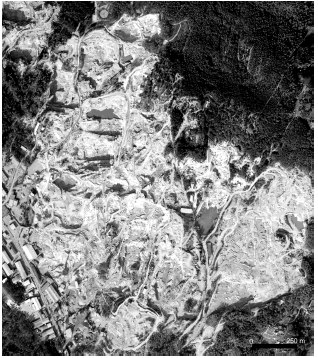
<body><![CDATA[<p><font size="2" face="Verdana, Arial, Helvetica, sans-serif">Granite is  an ornamental rock that is widely used in roofing and for interiors (flooring,  worktops, etc), given its physical, chemical and aesthetic properties. It is  generally quarried from opencast pits in the form of blocks that are  subsequently sawn and cut into slabs of different sizes and thicknesses  according to end use. </font></p>      <p><font size="2" face="Verdana, Arial, Helvetica, sans-serif">Granite  deposit reserves from data collected in the field can be evaluated using the  kriging methods traditionally used in the metals mining sector &#91;1&#93; &#91;2&#93; in which  the variable to be estimated is continuous. The estimation method is based on  traditional research methods based on geological maps, a description of fracturing  in quarry fronts and vertical information provided by borehole sampling &#91;3&#93;.  Fracturing is the parameter that ultimately defines the commercial quality of  granite. Four qualities are usually defined, depending on fracturing intensity:  top quality, secondary quality (both suitable for the ornamental rock market),  construction quality and aggregate quality &#91;4&#93; &#91;5&#93;.</font></p>      <p><font size="2" face="Verdana, Arial, Helvetica, sans-serif">Topographical  and geological maps and a characterization of the structural and textural  parameters of the deposit at various levels are used to define rock quality and  plan exploitation methods &#91;6&#93;. The fact that each block of granite extracted  from the quarry may have different qualities conditions the choice of which  kriging technique to use. This same problem occurs with other materials. For  example, Tercan and Özcelik &#91;7&#93; estimated the reserves in a Turkish andesite  mine, from which the rock would also be extracted in blocks that could have  different qualities. These authors, however, distinguished between commercially  valid and other rock using indicator kriging. Recently, fuzzy kriging has been  proposed as a suitable method for evaluating reserves, as it can account for  the fact that a block may contain different qualities and that the definition  of qualities in the field is subject to uncertainty &#91;8&#93;. Nonetheless, this  method has the problem of having to define membership functions that adequately  represent the uncertainty in determining qualities, which are assessed in the  field by geologists. </font></p>      <p><font size="2" face="Verdana, Arial, Helvetica, sans-serif">Fuzzy  kriging is a generalization of traditional methods of kriging in which  imprecise information is typically incorporated to accompany all the sets of  sample data. These generalisations can be obtained if the spatial function is  considered to be a fuzzy random function, and, applying the extension principle  of Zadeh &#91;9&#93;, kriging equations are obtained that satisfy non-bias conditions  and minimum prediction variance. See &#91;10&#93; and &#91;11&#93; for a discussion on fuzzy  kriging fundamentals.</font></p>      <p><font size="2" face="Verdana, Arial, Helvetica, sans-serif">In this  research, the problem of determining the quantities of each quality in granite  blocks is tackled differently, using a kriging technique called compositional  kriging.</font></p>     <p>&nbsp;</p>     <p><font size="3" face="Verdana, Arial, Helvetica, sans-serif"><b>2. MATERIALS AND METHODS</b></font></p> <font size="2" face="Verdana, Arial, Helvetica, sans-serif"><b>2.1 The Porri&ntilde;o Batholit    <br>  </b></font><font size="2" face="Verdana, Arial, Helvetica, sans-serif">The    reserves estimated in this research are located in Spain’s most important and    one of the world’s most important granite deposits—the Rosa Porri&ntilde;o batholith    situated in the province of Pontevedra (northwest Spain). Supplying technically    and aesthetically high-quality ornamental rock, the licensed area measures 6.8 km<sup>2</sup> and a total of 39 companies operate there. A    detailed description of this batholith can be found in &#91;8&#93;. An aerial  photograph of the Porri&ntilde;o batholith is provided in <a href="#fig01">Figure 1</a>.</font>      <p align="center"><font size="2" face="Verdana, Arial, Helvetica, sans-serif"><b><a name="fig01"></a><img src="/img/revistas/dyna/v77n161/a05fig01.gif">    <br>   Figure   1.</b> Aerial photograph of the Porri&ntilde;o batholith clearly    showing, in the lower left part, some of the warehouses used to store and    transform the granite</font></p>     ]]></body>
<body><![CDATA[<p><font size="2" face="Verdana, Arial, Helvetica, sans-serif">Given the    size of the batholith and the textural homogeneity of the rock, this deposit is    expected to be profitable for a considerable period of time (over 30 years).    Nonetheless, it is clear that as greater depths are reached in the deposit, its    capacity for supporting all the companies operating there will be diminished    and mergers are therefore likely. It is thus important to make an accurate    estimate of the reserves to enable medium-term decision making by the  companies.</font></p>     <p><font size="2" face="Verdana, Arial, Helvetica, sans-serif">The rock is    cut using diamond wire, which conditions the size of the primary block (10 m×10    m×10 m, i.e., 1000 m<sup>3</sup>). The block is then further cut,        using diamond wire, perforation and shape blasting, to obtain commercially sized  slabs.</font></p>     <p><font size="2" face="Verdana, Arial, Helvetica, sans-serif">Depending    on the degree of fracturing, qualities are assigned, with each 1000- m<sup>3</sup> block capable of representing different    qualities. Four granite  qualities are defined as follows:</font></p> <ul>       <li><font size="2" face="Verdana, Arial, Helvetica, sans-serif">Quality 1: Rock that can be extracted in     volumes that are sufficiently large to be able to obtain slabs for cutting with     disk saws, in other words, rock with few fissures and yielding blocks of 6 to     12 m<sup>3</sup>.</font></li>       <li><font size="2" face="Verdana, Arial, Helvetica, sans-serif">Quality 2: Rock that produces blocks of less     than 6 m3 but still suitable for sawing, with discontinuity spacing of over 2     m.</font></li>       <li><font size="2" face="Verdana, Arial, Helvetica, sans-serif">Quality 3: Fractured rock that produces     semi-blocks (less than 4 m<sup>3</sup>), with discontinuity spacing of     less than 2 m.</font></li>       <li><font size="2" face="Verdana, Arial, Helvetica, sans-serif">Quality 4: Fractured rock with market value     only as aggregate. </font></li>     </ul>     <p><font size="2" face="Verdana, Arial, Helvetica, sans-serif">Knowing the    quality of each block prior to cutting is clearly important, as it enables more    realistic financial forecasting and more rational exploitation in the  medium-to-long term.</font></p>      <p><font size="2" face="Verdana, Arial, Helvetica, sans-serif"><b>2.2 Reserve evaluation </b></font></p>      ]]></body>
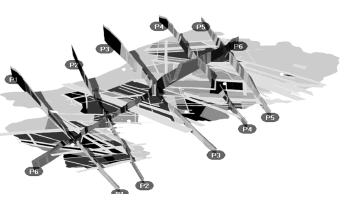
<body><![CDATA[<p><font size="2" face="Verdana, Arial, Helvetica, sans-serif"><b>2.2.1 Data collection    <br>    </b></font><font size="2" face="Verdana, Arial, Helvetica, sans-serif">For the      documentation and field data-collection phase, the mining parameter of interest      for defining rock quality (and therefore for estimating reserves) was the level      of rock mass fracturing, given that textural features—such as grain      heterogeneity and the presence of phenocrystals, weathering bands or black      knots—have little bearing on the quality of a granite as homogeneous as that of      the studied deposit. The fractures in the exploitable area were assessed on the      basis of the following: </font> </p>  <ol>       <li><font size="2" face="Verdana, Arial, Helvetica, sans-serif">A map to scale 1:3,500 that included     topographical and geological details and information on fractures. Fractures     were directly observed at outcrops and represented on the map.</font></li>       <li><font size="2" face="Verdana, Arial, Helvetica, sans-serif"> A description of seven continuous core     boreholes (total perforation 304.35 m) furnishing vertical information on the     non-accessible parts of the deposit. </font></li>       <li><font size="2" face="Verdana, Arial, Helvetica, sans-serif">A description of the fractures obtained from     profiles of the areas being exploited. </font></li>     </ol>     <p><font size="2" face="Verdana, Arial, Helvetica, sans-serif">The fractures were characterized according to    direction, dip, spacing, opening, filling and roughness, for a total of 312  diaclases and 41 faults.</font></p>     <p><font size="2" face="Verdana, Arial, Helvetica, sans-serif"><a href="#fig02">Figure 2</a>  depicts the map of granite qualities and a number of profiles obtained at   outcrops (P1 to P6). Along with the borehole data, this information was the basic input to the study.</font></p>     <p align="center"><font size="2" face="Verdana, Arial, Helvetica, sans-serif"><b><a name="fig02" id="fig02"></a><img src="/img/revistas/dyna/v77n161/a05fig02.gif">    <br>   Figure 2.</b> Map of granite qualities constructed from outcrops. Darker tones    correspond to higher qualities of granite. White circles represent the location  of the boreholes</font></p>  <font size="2" face="Verdana, Arial, Helvetica, sans-serif"><b>2.2.2 Compositional kriging    ]]></body>
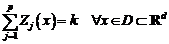
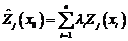
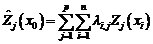
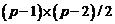
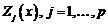
<body><![CDATA[<br>  </b></font><font size="2" face="Verdana, Arial, Helvetica, sans-serif">Composite    data are a set of non-negative vectors such that the sum of their components is    a constant <i>k</i>. This constant is    normally <i>k</i> = 100 when working with    percentages, or <i>k</i> = 1 when the data    is given as proportions. Denoting as <sub><img src="/img/revistas/dyna/v77n161/a05eq002.gif"></sub> the centroid of a    primary block in domain <i>D</i> of the real space <sub><img src="/img/revistas/dyna/v77n161/a05eq004.gif"></sub>, <i>d</i> =1,2,3, we can define the composite random function as <sub><img src="/img/revistas/dyna/v77n161/a05eq006.gif"></sub>, in such a way that the one-dimensional variables <sub><img src="/img/revistas/dyna/v77n161/a05eq008.gif"></sub> reflect the <sub><img src="/img/revistas/dyna/v77n161/a05eq010.gif"></sub>th component of the composition. Note that <sub><img src="/img/revistas/dyna/v77n161/a05eq012.gif"></sub> and <sub><img src="/img/revistas/dyna/v77n161/a05eq014.gif"></sub>.</font>     <p><font size="2" face="Verdana, Arial, Helvetica, sans-serif"> Given a sampling realization <sub><img src="/img/revistas/dyna/v77n161/a05eq016.gif"></sub> for the composite    random function <sub><img src="/img/revistas/dyna/v77n161/a05eq018.gif"></sub>, where each <sub><img src="/img/revistas/dyna/v77n161/a05eq020.gif"></sub> is a composite datum, the aim is to infer the value of <sub><img src="/img/revistas/dyna/v77n161/a05eq022.gif"></sub>for a new location of interest <sub><img src="/img/revistas/dyna/v77n161/a05eq024.gif"></sub>.</font></p>     <p><font size="2" face="Verdana, Arial, Helvetica, sans-serif">Classical    spatial statistical methods enable forecasting using kriging and the variables <sub><img src="/img/revistas/dyna/v77n161/a05eq026.gif"></sub>, according to <sub><img src="/img/revistas/dyna/v77n161/a05eq028.gif"></sub>, or using cokriging and the entire set of variables <sub><img src="/img/revistas/dyna/v77n161/a05eq030.gif"></sub>, in accordance with the expression <sub><img src="/img/revistas/dyna/v77n161/a05eq032.gif"></sub>. However, it is a demonstrated fact that neither of these    prediction methods is guaranteed to preserve the particularities of the    composite data. See &#91;12&#93; and &#91;13&#93; for a more detailed explanation of these classical prediction methods.</font></p>     <p><font size="2" face="Verdana, Arial, Helvetica, sans-serif">Walvoort    and de Gruijter &#91;14&#93; proposed a prediction method based on classical    approaches. These authors included in the matrix system the constraints    necessary for the predictions to take values that would be admissible in the    composite random function. Other authors &#91;15&#93; proposed a transformation of the    sample data <sub><img src="/img/revistas/dyna/v77n161/a05eq034.gif"></sub> before applying any of    the spatial prediction methods in order to obtain<sub><img src="/img/revistas/dyna/v77n161/a05eq036.gif"></sub>. If the function <i>f</i> has been correctly selected, admissible composite data can be obtained by inverting the transformation: <sub><img src="/img/revistas/dyna/v77n161/a05eq038.gif"></sub>. </font></p>     <p><font size="2" face="Verdana, Arial, Helvetica, sans-serif">For this    research we implemented a compositional kriging method based on the methodology    developed by Tolosana-Delgado &#91;16&#93; and    Tolosana-Delgado et al. &#91;17&#93;. This procedure can be viewed as a generalization of the log-normal and normal kriging techniques in <sub><img src="/img/revistas/dyna/v77n161/a05eq040.gif"></sub>. </font></p>     <p><font size="2" face="Verdana, Arial, Helvetica, sans-serif">The subset <sub><img src="/img/revistas/dyna/v77n161/a05eq042.gif"></sub>of <sub><img src="/img/revistas/dyna/v77n161/a05eq044.gif"></sub> formed of non-negative    vectors and verifying that the sum of their components is one, can be equipped    with the inner sum, external product and scalar product operations: <sub><img src="/img/revistas/dyna/v77n161/a05eq046.gif"></sub>. The space, called a Simplex, is a Euclidean <sub><img src="/img/revistas/dyna/v77n161/a05eq048.gif"></sub>-dimensional space. Tolosana-Delgado &#91;16&#93; demonstrated that    the kriging techniques can be generalized to the Euclidean simplex space and    that optimal predictors can be obtained for random functions whose sample    spaces are contained in a simplex. Another interesting fact is that a Euclidean    space allows the selection of an orthonormal base, the calculation of the real    coordinates of the elements in the simplex space with respect to this base, and    the application of classical prediction methods. Changing the coordinates, the    predictions can be expressed as elements in the original Euclidean space (i.e.,    the simplex). Furthermore, the equivalence between obtaining the predictors in    the simplex space and calculating predictors based on changing the variable    using an orthonormal base has been demonstrated. It can also be demonstrated    that compositional kriging is the optimal predictor since it minimizes the expected Aitchinson distance between the true composition <sub><img src="/img/revistas/dyna/v77n161/a05eq050.gif"></sub> and its prediction <sub><img src="/img/revistas/dyna/v77n161/a05eq052.gif"></sub> &#91;16&#93;.</font></p>     <p><font size="2" face="Verdana, Arial, Helvetica, sans-serif">The procedure can be briefly summarized as follows:</font></p>     <p><font size="2" face="Verdana, Arial, Helvetica, sans-serif">a) The    sample space of the composite data, contained in <sub><img src="/img/revistas/dyna/v77n161/a05eq054.gif"></sub>, is transformed by means of a change of coordinates in a new dimension space <sub><img src="/img/revistas/dyna/v77n161/a05eq056.gif"></sub>: </font></p>     <p><font size="2" face="Verdana, Arial, Helvetica, sans-serif"><sub><img src="/img/revistas/dyna/v77n161/a05eq058.gif"></sub> </font></p>     <p><font size="2" face="Verdana, Arial, Helvetica, sans-serif">where <sub><img src="/img/revistas/dyna/v77n161/a05eq060.gif"></sub> is the    coordinate-change matrix, of dimension <sub><img src="/img/revistas/dyna/v77n161/a05eq062.gif"></sub>, formed of the vectors of the orthonormal base arranged in columns, <sub><img src="/img/revistas/dyna/v77n161/a05eq064.gif"></sub>, <sub><img src="/img/revistas/dyna/v77n161/a05eq066.gif"></sub>, and where the superscript <sub><img src="/img/revistas/dyna/v77n161/a05eq068.gif"></sub> means transposed.</font></p>     ]]></body>






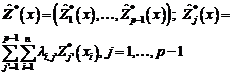
<body><![CDATA[<p><font size="2" face="Verdana, Arial, Helvetica, sans-serif">(b) Obtained    in the Euclidean space <sub><img src="/img/revistas/dyna/v77n161/a05eq070.gif"></sub> using traditional cokriging techniques is the prediction <sub><img src="/img/revistas/dyna/v77n161/a05eq036.gif"></sub>.</font></p>     <p><font size="2" face="Verdana, Arial, Helvetica, sans-serif">c) The value of the prediction,<sub><img src="/img/revistas/dyna/v77n161/a05eq073.gif"></sub>is given by:</font></p>     <p><font size="2" face="Verdana, Arial, Helvetica, sans-serif"><sub><img src="/img/revistas/dyna/v77n161/a05eq075.gif"></sub> </font></p>     <p><font size="2" face="Verdana, Arial, Helvetica, sans-serif">with </font></p>     <p><font size="2" face="Verdana, Arial, Helvetica, sans-serif"><sub><img src="/img/revistas/dyna/v77n161/a05eq077.gif"></sub> </font></p>     <p><font size="2" face="Verdana, Arial, Helvetica, sans-serif">a    normalization operator. This methodology ensures admissible composite predictions. </font></p>     <p><font size="2" face="Verdana, Arial, Helvetica, sans-serif"> For point (b) above, semivariograms, <sub><img src="/img/revistas/dyna/v77n161/a05eq079.gif"></sub> and <sub><img src="/img/revistas/dyna/v77n161/a05eq081.gif"></sub> cross-semivariograms, <sub><img src="/img/revistas/dyna/v77n161/a05eq083.gif"></sub>, have to be calculated and fitted. The theoretical models    selected to model the experimental semivariograms should verify that the    variance of any linear combination of these variables is always non-negative.    Put another way, it should be ensured that the prediction variance is always    non-negative. To resolve this problem of model selection, the linear    co-regionalization model is usually used. To ensure that the variance of any linear    combination of the variables <sub><img src="/img/revistas/dyna/v77n161/a05eq085.gif"></sub> is always    non-negative, the coefficients of the semivariograms cannot be chosen randomly    but must have certain conditions verified, and this affects the process of    fitting the theoretical models. See &#91;17&#93;, &#91;18&#93; and &#91;19&#93; for a more detailed discussion on the linear co-regionalization model.</font></p>     <p><font size="2" face="Verdana, Arial, Helvetica, sans-serif">Following    the structural analysis stage, in which the experimental semivariograms are suitably estimated, cokriging systems are used to estimate the random function <sub><img src="/img/revistas/dyna/v77n161/a05eq087.gif"></sub> </font></p>     <p><font size="2" face="Verdana, Arial, Helvetica, sans-serif"><sub><img src="/img/revistas/dyna/v77n161/a05eq089.gif"></sub> </font></p>     <p><font size="2" face="Verdana, Arial, Helvetica, sans-serif">A detailed description of the compositional kriging algorithm can be found in &#91;20&#93;.</font></p>     ]]></body>
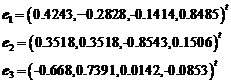
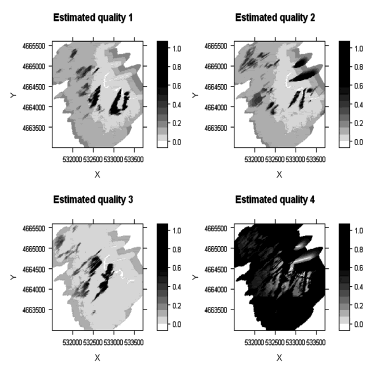
<body><![CDATA[<p>&nbsp;</p>     <p><b><font size="3" face="Verdana, Arial, Helvetica, sans-serif">3. RESULTS</font></b></p>     <p><font size="2" face="Verdana, Arial, Helvetica, sans-serif">The composite    data used in this study consists of a set of <i>n</i> = 35,543 values such that its <i>p</i> = 4 components added up to one. Given an orthonormal base for a vector space of    dimension <i>p -1</i> = 3, <sub><img src="/img/revistas/dyna/v77n161/a05eq091.gif"></sub>, the coordinate-change matrix was constructed by arranging    the base elements in columns: <sub><img src="/img/revistas/dyna/v77n161/a05eq093.gif"></sub>. Following a study of the principal components of the sample    data, we obtained the orthogonal base that determined the main directions of    variability in the observations. This base, previously normalized, constituted    the orthonormal base that would give rise to the matrix <sub><img src="/img/revistas/dyna/v77n161/a05eq060.gif"></sub>. As can be confirmed in &#91;16&#93;, the choice of the orthonormal    base has no great bearing on the final results. However, choosing directions    close to maximum variability aims to reflect as best as possible underlying    behaviour in terms of granite quality proportions. The orthonormal base was thus formed of the following vectors:</font></p>     <p><font size="2" face="Verdana, Arial, Helvetica, sans-serif"><sub><img src="/img/revistas/dyna/v77n161/a05eq096.gif"></sub> </font></p>     <p><font size="2" face="Verdana, Arial, Helvetica, sans-serif">Given that    several components with zero value were recorded in the sample data, a positive    constant was added in prior to changing the coordinates <sub><img src="/img/revistas/dyna/v77n161/a05eq098.gif"></sub>. It should be borne in mind that adding a constant to the    data to avoid zero values might introduce some subjectivity in the results    since any error in the kriging or variance estimations is exponentially magnified. </font></p>     <p><font size="2" face="Verdana, Arial, Helvetica, sans-serif">In order to    fit the linear co-regionalization model, used were <sub><img src="/img/revistas/dyna/v77n161/a05eq100.gif"></sub> incorrelated variables    with the following characteristics: <sub><img src="/img/revistas/dyna/v77n161/a05eq102.gif"></sub> pure nugget effect    semivariogram with partial sill 1 and <sub><img src="/img/revistas/dyna/v77n161/a05eq104.gif"></sub>spherical semivariogram with range = 280 m and partial sill    1. The coefficients <sub><img src="/img/revistas/dyna/v77n161/a05eq106.gif"></sub> that complete the models were fitted using the R freeware &#91;21&#93;. </font></p>     <p><font size="2" face="Verdana, Arial, Helvetica, sans-serif">Finally,    using cokriging techniques we obtained the predictions <sub><img src="/img/revistas/dyna/v77n161/a05eq036.gif"></sub> and, after suitable transformation, the composite predictions <sub><img src="/img/revistas/dyna/v77n161/a05eq109.gif"></sub>.</font></p>     <p><font size="2" face="Verdana, Arial, Helvetica, sans-serif"><a href="#fig03">Figure 3</a>  shows a map of the granite qualities estimated using composite kriging. The map   corresponds to a height above sea level of 205 meters. It can be seen that quality 4 is the predominant.</font></p>     <p align="center"><font size="2" face="Verdana, Arial, Helvetica, sans-serif"><b><a name="fig03"></a><img src="/img/revistas/dyna/v77n161/a05fig03.gif">    <br>   Figure    3</b>. Maps showing the granite quality obtained using    compositional kriging for a height above sea level of 205 meters. Each map    corresponds to one of the qualities. Darker tones represent a higher quantity of granite for that quality</font></p>     ]]></body>


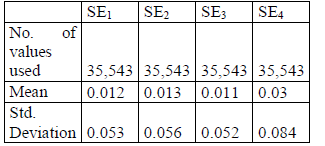
<body><![CDATA[<p><font size="2" face="Verdana, Arial, Helvetica, sans-serif">The    compositional kriging described earlier was validated using a cross-validation    procedure. An element was removed from the sample,<sub><img src="/img/revistas/dyna/v77n161/a05eq111.gif"></sub>, and the prediction <sub><img src="/img/revistas/dyna/v77n161/a05eq113.gif"></sub> was calculated using    the remaining data. The squared errors of the prediction were obtained for each    quality proportion as <sub><img src="/img/revistas/dyna/v77n161/a05eq115.gif"></sub>. These values are a good indicator of the efficacy of the    prediction method. <a href="#tab01">Table 1</a> shows descriptive coefficients calculated for the    squared prediction errors and obtained by means of cross-validation. Note that <sub><img src="/img/revistas/dyna/v77n161/a05eq117.gif"></sub>, given that the composite data reflect the proportions for the different qualities observed in each block. </font></p>     <p align="center"><font size="2" face="Verdana, Arial, Helvetica, sans-serif"><b><a name="tab01"></a>Table   1. </b> Mean squared   errors and corresponding standard deviations calculated for each granite   quality by means of cross-validation</font>    <br>   <img src="/img/revistas/dyna/v77n161/a05tab01.gif"></p>     <p><font size="2" face="Verdana, Arial, Helvetica, sans-serif">These    results were somewhat improved in comparison with those obtained using ordinary    cokriging and adjusting the results to obtain non negative and constant sum    constraints of compositional data. The mean squared errors were 0.014, 0.025,    0.021 and 0.036 for quality 1 to quality 4, respectively. The standard deviations were 0.051, 0.055, 0.052 and 0.089, respectively. </font></p>     <p><font size="2" face="Verdana, Arial, Helvetica, sans-serif">Taboada et    al. &#91;8&#93; described a fuzzy kriging study performed using the same database. In    their study, the mean squared errors obtained in a cross-validation procedure    were 0.021, 0.039, 0.053 and 0.037 for quality 1 (top quality) to quality 4    (aggregate quality), respectively. The improvement in our research is evident,    as the means have been reduced by values between 18.9% (quality 3) and 79.2% (quality 3).</font></p>     <p>&nbsp;</p> <font size="3" face="Verdana, Arial, Helvetica, sans-serif"><b>4. CONCLUSIONES  </b> </font>     <p><font size="2" face="Verdana, Arial, Helvetica, sans-serif">In this research    we estimated the reserves in one of the world’s most important granite    deposits, which sustains a large number of companies and provides employment    for a significant number of people. Knowledge of the volume of reserves and    distribution in terms of different quality grades is crucial to be able to    implement rational exploitation over time and ensure the quarry’s viability in    the medium and long term. The estimation method used in this    research—compositional kriging—takes account of the fact that each block    extracted from the quarry is likely to contain granite of different qualities,    and, unlike other prediction methods—such as classical cokriging—ensures that    the sum of the different qualities is 100% for each block. Although at first    sight the method may appear to be complex, it is easily implemented in  high-level language programs like R.</font></p>     <p><font size="2" face="Verdana, Arial, Helvetica, sans-serif">The results    obtained indicate that the method is an improvement over other geostatistical    methods, specifically, ordinary cokriging and fuzzy kriging. Any improvement in    techniques to estimate qualities in granite blocks is of relevance for the    companies quarrying the granite, as there are significant differences in price for the different quality grades. </font></p>     <p>&nbsp;</p>      <p><font size="3" face="Verdana, Arial, Helvetica, sans-serif"><b>REFERENCIAS  </b></font></p>      ]]></body>


<body><![CDATA[<!-- ref --><p><font size="2" face="Verdana, Arial, Helvetica, sans-serif"><b>&#91;1&#93;</b>  ARMSTRONG, M. AND BOUFASSA, A. Comparing the robustness of ordinary kriging and lognormal kriging: Outlier resistance, Mathematical Geology, 20, 447-457, 1988.       &nbsp;&nbsp;&nbsp;&nbsp;&nbsp;&nbsp;&nbsp;&nbsp;[&#160;<a href="javascript:void(0);" onclick="javascript: window.open('/scielo.php?script=sci_nlinks&ref=000093&pid=S0012-7353201000010000500001&lng=','','width=640,height=500,resizable=yes,scrollbars=1,menubar=yes,');">Links</a>&#160;]<!-- end-ref --><!-- ref --><br>      <b>&#91;2&#93;</b>  TABOADA, J., VAAMONDE, A. AND SAAVEDRA A. Evaluation of the quality of a granite quarry, Engineering Geology, 53, 1-11, 1999.       &nbsp;&nbsp;&nbsp;&nbsp;&nbsp;&nbsp;&nbsp;&nbsp;[&#160;<a href="javascript:void(0);" onclick="javascript: window.open('/scielo.php?script=sci_nlinks&ref=000094&pid=S0012-7353201000010000500002&lng=','','width=640,height=500,resizable=yes,scrollbars=1,menubar=yes,');">Links</a>&#160;]<!-- end-ref --><!-- ref --><br>      <b>&#91;3&#93;</b> TOYOS, J.M., TABOADA, J., LOMBARDERO, M., ROMERO, J.A AND MEN&Eacute;NDEZ, A. Estudio de las discontinuidades en yacimientos de roca ornamental. Bolet&iacute;n Geol&oacute;gico y Minero, 105, 110-118, 1994.     &nbsp;&nbsp;&nbsp;&nbsp;&nbsp;&nbsp;&nbsp;&nbsp;[&#160;<a href="javascript:void(0);" onclick="javascript: window.open('/scielo.php?script=sci_nlinks&ref=000095&pid=S0012-7353201000010000500003&lng=','','width=640,height=500,resizable=yes,scrollbars=1,menubar=yes,');">Links</a>&#160;]<!-- end-ref --><!-- ref --><br>      <b>&#91;4&#93;</b> TABOADA, J., ALEJANO, L., BASTANTE, F.G. AND ORD&Oacute;&Ntilde;EZ, C. Total exploitation of an ornamental granite quarry. Materiales de Construcci&oacute;n 55, 67-78, 2004.     &nbsp;&nbsp;&nbsp;&nbsp;&nbsp;&nbsp;&nbsp;&nbsp;[&#160;<a href="javascript:void(0);" onclick="javascript: window.open('/scielo.php?script=sci_nlinks&ref=000096&pid=S0012-7353201000010000500004&lng=','','width=640,height=500,resizable=yes,scrollbars=1,menubar=yes,');">Links</a>&#160;]<!-- end-ref --><!-- ref --><br>      <b>&#91;5&#93;</b>  SOUSA, L.M. Granite fracture index to check suitability of granite outcrops for quarrying. Engineering Geology 92, 146-159, 2007.       &nbsp;&nbsp;&nbsp;&nbsp;&nbsp;&nbsp;&nbsp;&nbsp;[&#160;<a href="javascript:void(0);" onclick="javascript: window.open('/scielo.php?script=sci_nlinks&ref=000097&pid=S0012-7353201000010000500005&lng=','','width=640,height=500,resizable=yes,scrollbars=1,menubar=yes,');">Links</a>&#160;]<!-- end-ref --><!-- ref --><br>      <b>&#91;6&#93;</b> MU&Ntilde;OZ DE LA NAVA, P, ROMERO ESCUDERO, J.A., RODR&Iacute;GUEZ SU&Aacute;REZ, I., GARC&Iacute;A ROMERO, ET., CRESPO ROSA, A., CARRI&Oacute;N MOLES, F. AND GARBAYO, M.P. Metodolog&iacute;a de investigaci&oacute;n de rocas ornamentales: granitos. Bolet&iacute;n Geol&oacute;gico y Minero, 100, 433-453, 1989.     &nbsp;&nbsp;&nbsp;&nbsp;&nbsp;&nbsp;&nbsp;&nbsp;[&#160;<a href="javascript:void(0);" onclick="javascript: window.open('/scielo.php?script=sci_nlinks&ref=000098&pid=S0012-7353201000010000500006&lng=','','width=640,height=500,resizable=yes,scrollbars=1,menubar=yes,');">Links</a>&#160;]<!-- end-ref --><!-- ref --><br>      <b>&#91;7&#93;</b> TERCAN, A.E. AND ÖZÇELIK, Y. Geostatistical Evaluation of Dimension-Stone Quarries. Engineering Geology, 58, 25-33, 2000.     &nbsp;&nbsp;&nbsp;&nbsp;&nbsp;&nbsp;&nbsp;&nbsp;[&#160;<a href="javascript:void(0);" onclick="javascript: window.open('/scielo.php?script=sci_nlinks&ref=000099&pid=S0012-7353201000010000500007&lng=','','width=640,height=500,resizable=yes,scrollbars=1,menubar=yes,');">Links</a>&#160;]<!-- end-ref --><!-- ref --><br>      <b>&#91;8&#93;</b> TABOADA, J., RIVAS, T., SAAVEDRA, A., ORD&Oacute;&Ntilde;EZ, C., BASTANTE, F.G. AND GIR&Aacute;LDEZ, E. Evaluation of the reserve of a granite deposit by fuzzy kriging. Engineering Geology, 99, 23-30, 2008.     &nbsp;&nbsp;&nbsp;&nbsp;&nbsp;&nbsp;&nbsp;&nbsp;[&#160;<a href="javascript:void(0);" onclick="javascript: window.open('/scielo.php?script=sci_nlinks&ref=000100&pid=S0012-7353201000010000500008&lng=','','width=640,height=500,resizable=yes,scrollbars=1,menubar=yes,');">Links</a>&#160;]<!-- end-ref --><!-- ref --><br>      <b>&#91;9&#93;</b>  KLIR, G., AND YUAN, B. Fuzzy sets and fuzzy logic. Prentice-Hall, New York, 1995.       &nbsp;&nbsp;&nbsp;&nbsp;&nbsp;&nbsp;&nbsp;&nbsp;[&#160;<a href="javascript:void(0);" onclick="javascript: window.open('/scielo.php?script=sci_nlinks&ref=000101&pid=S0012-7353201000010000500009&lng=','','width=640,height=500,resizable=yes,scrollbars=1,menubar=yes,');">Links</a>&#160;]<!-- end-ref --><!-- ref --><br>      <b>&#91;10&#93;</b>  DIAMOND, P.. Fuzzy kriging. Fuzzy Sets and Systems, 33, 315-332, 1989.       &nbsp;&nbsp;&nbsp;&nbsp;&nbsp;&nbsp;&nbsp;&nbsp;[&#160;<a href="javascript:void(0);" onclick="javascript: window.open('/scielo.php?script=sci_nlinks&ref=000102&pid=S0012-7353201000010000500010&lng=','','width=640,height=500,resizable=yes,scrollbars=1,menubar=yes,');">Links</a>&#160;]<!-- end-ref --><!-- ref --><br>      <b>&#91;11&#93;</b>  BARDOSSY, A., BOGARDI, I., AND KELLY, W. Geostatistics utilizing imprecise (fuzzy) information. Fuzzy Sets and Systems, 31, 311-327, 1989.       &nbsp;&nbsp;&nbsp;&nbsp;&nbsp;&nbsp;&nbsp;&nbsp;[&#160;<a href="javascript:void(0);" onclick="javascript: window.open('/scielo.php?script=sci_nlinks&ref=000103&pid=S0012-7353201000010000500011&lng=','','width=640,height=500,resizable=yes,scrollbars=1,menubar=yes,');">Links</a>&#160;]<!-- end-ref --><!-- ref --><br>      <b>&#91;12&#93;</b> CHIL&Eacute;S, J.P., AND DELFINER, P. Geostatistics: modeling spatial uncertainty, John Wiley and Sons, New York, 1999.     &nbsp;&nbsp;&nbsp;&nbsp;&nbsp;&nbsp;&nbsp;&nbsp;[&#160;<a href="javascript:void(0);" onclick="javascript: window.open('/scielo.php?script=sci_nlinks&ref=000104&pid=S0012-7353201000010000500012&lng=','','width=640,height=500,resizable=yes,scrollbars=1,menubar=yes,');">Links</a>&#160;]<!-- end-ref --><!-- ref --><br>      <b>&#91;13&#93;</b>  RIVOIRDAD, J. Introduction to disjunctive kriging and nonlinear geostatistics, Clarendom Press, Oxford, 1999.       &nbsp;&nbsp;&nbsp;&nbsp;&nbsp;&nbsp;&nbsp;&nbsp;[&#160;<a href="javascript:void(0);" onclick="javascript: window.open('/scielo.php?script=sci_nlinks&ref=000105&pid=S0012-7353201000010000500013&lng=','','width=640,height=500,resizable=yes,scrollbars=1,menubar=yes,');">Links</a>&#160;]<!-- end-ref --><!-- ref --><br>      <b>&#91;14&#93;</b>  WALVOORT, D.J.J. AND DE GRUIJTER, J.J. Compositional Kriging: A Spatial Interpolation Method for Compositional Data. Mathematical Geology, 33, 951-966, 2001.       &nbsp;&nbsp;&nbsp;&nbsp;&nbsp;&nbsp;&nbsp;&nbsp;[&#160;<a href="javascript:void(0);" onclick="javascript: window.open('/scielo.php?script=sci_nlinks&ref=000106&pid=S0012-7353201000010000500014&lng=','','width=640,height=500,resizable=yes,scrollbars=1,menubar=yes,');">Links</a>&#160;]<!-- end-ref --><!-- ref --><br>      <b>&#91;15&#93;</b> PAWLOWSKY-GLAHN, V. AND OLEA, R.A. Geostatistical Analysis of Compositional Data. Studies in Mathematical Geology, Nº 7. Oxford University Press, 2004.     &nbsp;&nbsp;&nbsp;&nbsp;&nbsp;&nbsp;&nbsp;&nbsp;[&#160;<a href="javascript:void(0);" onclick="javascript: window.open('/scielo.php?script=sci_nlinks&ref=000107&pid=S0012-7353201000010000500015&lng=','','width=640,height=500,resizable=yes,scrollbars=1,menubar=yes,');">Links</a>&#160;]<!-- end-ref --><!-- ref --><br>      <b>&#91;16&#93;</b>  TOLOSANA-DELGADO, R. Geostatistics for constrained variables: positive data, compositions and probabilites. Application to environmental hazard monitoring &#91;PhD thesis&#93;</b> , Universidad de Gerona, 2006.       &nbsp;&nbsp;&nbsp;&nbsp;&nbsp;&nbsp;&nbsp;&nbsp;[&#160;<a href="javascript:void(0);" onclick="javascript: window.open('/scielo.php?script=sci_nlinks&ref=000108&pid=S0012-7353201000010000500016&lng=','','width=640,height=500,resizable=yes,scrollbars=1,menubar=yes,');">Links</a>&#160;]<!-- end-ref --><!-- ref --><br>      <b>&#91;17&#93;</b> TOLOSANA-DELGADO, R, PAWLOWSKY-GLAHN, V, EGOZCUE, J.J. AND VAN DEN BOOGAART, K.G. A Compositional Approach to Indicator Kriging. Proceedings of IAMG’05: GIS and Spatial Analysis, Vol.1, 651-656, 2005.     &nbsp;&nbsp;&nbsp;&nbsp;&nbsp;&nbsp;&nbsp;&nbsp;[&#160;<a href="javascript:void(0);" onclick="javascript: window.open('/scielo.php?script=sci_nlinks&ref=000109&pid=S0012-7353201000010000500017&lng=','','width=640,height=500,resizable=yes,scrollbars=1,menubar=yes,');">Links</a>&#160;]<!-- end-ref --><!-- ref --><br>      <b>&#91;18&#93;</b>  CRESIE, N. AC. Statistics for spatial data. John Wiley and Sons, New York, 1999.       &nbsp;&nbsp;&nbsp;&nbsp;&nbsp;&nbsp;&nbsp;&nbsp;[&#160;<a href="javascript:void(0);" onclick="javascript: window.open('/scielo.php?script=sci_nlinks&ref=000110&pid=S0012-7353201000010000500018&lng=','','width=640,height=500,resizable=yes,scrollbars=1,menubar=yes,');">Links</a>&#160;]<!-- end-ref --><!-- ref --><br>      <b>&#91;19&#93;</b>  GOULARD, M. AND VOLTZ, M. Linear coregionalization model: Tools for estimation and choice of cross-variogram matrix, Mathematical Geology, 24, 269-286, 1992.       &nbsp;&nbsp;&nbsp;&nbsp;&nbsp;&nbsp;&nbsp;&nbsp;[&#160;<a href="javascript:void(0);" onclick="javascript: window.open('/scielo.php?script=sci_nlinks&ref=000111&pid=S0012-7353201000010000500019&lng=','','width=640,height=500,resizable=yes,scrollbars=1,menubar=yes,');">Links</a>&#160;]<!-- end-ref --><!-- ref --><br>      <b>&#91;20&#93;</b> VAN DEN BOOGAARTA, K.G. AND TOLOSANA-DELGADO. R. “Compositions”: A unified R package to analyze compositional data. Computers and Geosciences, 34, 320-338, 2008.     &nbsp;&nbsp;&nbsp;&nbsp;&nbsp;&nbsp;&nbsp;&nbsp;[&#160;<a href="javascript:void(0);" onclick="javascript: window.open('/scielo.php?script=sci_nlinks&ref=000112&pid=S0012-7353201000010000500020&lng=','','width=640,height=500,resizable=yes,scrollbars=1,menubar=yes,');">Links</a>&#160;]<!-- end-ref --><!-- ref --><br>      <b>&#91;21&#93;</b>  R DEVELOPMENT CORE TEAM. R: A language and environment for statistical computing. R Foundation for Statistical Computing, Vienna, Austria . Available: <a href="http://www.R-project.org">http://www.R-project.org</a> &#91;cited December 25, 2009&#93;</b> . </font>&nbsp;&nbsp;&nbsp;&nbsp;&nbsp;&nbsp;&nbsp;&nbsp;[&#160;<a href="javascript:void(0);" onclick="javascript: window.open('/scielo.php?script=sci_nlinks&ref=000113&pid=S0012-7353201000010000500021&lng=','','width=640,height=500,resizable=yes,scrollbars=1,menubar=yes,');">Links</a>&#160;]<!-- end-ref --> ]]></body><back>
<ref-list>
<ref id="B1">
<label>1</label><nlm-citation citation-type="journal">
<person-group person-group-type="author">
<name>
<surname><![CDATA[ARMSTRONG]]></surname>
<given-names><![CDATA[M.]]></given-names>
</name>
<name>
<surname><![CDATA[BOUFASSA]]></surname>
<given-names><![CDATA[A.]]></given-names>
</name>
</person-group>
<article-title xml:lang="en"><![CDATA[Comparing the robustness of ordinary kriging and lognormal kriging]]></article-title>
<source><![CDATA[Mathematical Geology]]></source>
<year>1988</year>
<volume>20</volume>
<page-range>447-457</page-range></nlm-citation>
</ref>
<ref id="B2">
<label>2</label><nlm-citation citation-type="journal">
<person-group person-group-type="author">
<name>
<surname><![CDATA[TABOADA]]></surname>
<given-names><![CDATA[J.]]></given-names>
</name>
<name>
<surname><![CDATA[VAAMONDE]]></surname>
<given-names><![CDATA[A.]]></given-names>
</name>
<name>
<surname><![CDATA[SAAVEDRA]]></surname>
<given-names><![CDATA[A.]]></given-names>
</name>
</person-group>
<article-title xml:lang="en"><![CDATA[Evaluation of the quality of a granite quarry]]></article-title>
<source><![CDATA[Engineering Geology]]></source>
<year>1999</year>
<numero>53</numero>
<issue>53</issue>
<page-range>1-11</page-range></nlm-citation>
</ref>
<ref id="B3">
<label>3</label><nlm-citation citation-type="journal">
<person-group person-group-type="author">
<name>
<surname><![CDATA[TOYOS]]></surname>
<given-names><![CDATA[J.M.]]></given-names>
</name>
<name>
<surname><![CDATA[TABOADA]]></surname>
<given-names><![CDATA[J.]]></given-names>
</name>
<name>
<surname><![CDATA[LOMBARDERO]]></surname>
<given-names><![CDATA[M.]]></given-names>
</name>
<name>
<surname><![CDATA[ROMERO]]></surname>
<given-names><![CDATA[J.A]]></given-names>
</name>
<name>
<surname><![CDATA[MENÉNDEZ]]></surname>
<given-names><![CDATA[A.]]></given-names>
</name>
</person-group>
<article-title xml:lang="es"><![CDATA[Estudio de las discontinuidades en yacimientos de roca ornamental]]></article-title>
<source><![CDATA[Boletín Geológico y Minero]]></source>
<year>1994</year>
<volume>105</volume>
<page-range>110-118</page-range></nlm-citation>
</ref>
<ref id="B4">
<label>4</label><nlm-citation citation-type="journal">
<person-group person-group-type="author">
<name>
<surname><![CDATA[TABOADA]]></surname>
<given-names><![CDATA[J.]]></given-names>
</name>
<name>
<surname><![CDATA[ALEJANO]]></surname>
<given-names><![CDATA[L.]]></given-names>
</name>
<name>
<surname><![CDATA[BASTANTE]]></surname>
<given-names><![CDATA[F.G.]]></given-names>
</name>
<name>
<surname><![CDATA[ORDÓÑEZ]]></surname>
<given-names><![CDATA[C.]]></given-names>
</name>
</person-group>
<article-title xml:lang="en"><![CDATA[Total exploitation of an ornamental granite quarry]]></article-title>
<source><![CDATA[Materiales de Construcción]]></source>
<year>2004</year>
<volume>55</volume>
<page-range>67-78</page-range></nlm-citation>
</ref>
<ref id="B5">
<label>5</label><nlm-citation citation-type="journal">
<person-group person-group-type="author">
<name>
<surname><![CDATA[SOUSA]]></surname>
<given-names><![CDATA[L.M.]]></given-names>
</name>
</person-group>
<article-title xml:lang="en"><![CDATA[Granite fracture index to check suitability of granite outcrops for quarrying]]></article-title>
<source><![CDATA[Engineering Geology]]></source>
<year>2007</year>
<volume>92</volume>
<page-range>146-159</page-range></nlm-citation>
</ref>
<ref id="B6">
<label>6</label><nlm-citation citation-type="journal">
<person-group person-group-type="author">
<name>
<surname><![CDATA[MUÑOZ DE LA NAVA]]></surname>
<given-names><![CDATA[P]]></given-names>
</name>
<name>
<surname><![CDATA[ROMERO ESCUDERO]]></surname>
<given-names><![CDATA[J.A.]]></given-names>
</name>
<name>
<surname><![CDATA[RODRÍGUEZ SUÁREZ]]></surname>
<given-names><![CDATA[I.]]></given-names>
</name>
<name>
<surname><![CDATA[GARCÍA ROMERO]]></surname>
<given-names><![CDATA[ET]]></given-names>
</name>
<name>
<surname><![CDATA[CRESPO ROSA]]></surname>
<given-names><![CDATA[A.]]></given-names>
</name>
<name>
<surname><![CDATA[CARRIÓN MOLES]]></surname>
<given-names><![CDATA[F.]]></given-names>
</name>
<name>
<surname><![CDATA[GARBAYO]]></surname>
<given-names><![CDATA[M.P.]]></given-names>
</name>
</person-group>
<article-title xml:lang="es"><![CDATA[Metodología de investigación de rocas ornamentales: granitos]]></article-title>
<source><![CDATA[Boletín Geológico y Minero]]></source>
<year>1989</year>
<volume>100</volume>
<page-range>433-453</page-range></nlm-citation>
</ref>
<ref id="B7">
<label>7</label><nlm-citation citation-type="journal">
<person-group person-group-type="author">
<name>
<surname><![CDATA[TERCAN]]></surname>
<given-names><![CDATA[A.E.]]></given-names>
</name>
<name>
<surname><![CDATA[ÖZÇELIK]]></surname>
<given-names><![CDATA[Y.]]></given-names>
</name>
</person-group>
<article-title xml:lang="en"><![CDATA[Geostatistical Evaluation of Dimension-Stone Quarries]]></article-title>
<source><![CDATA[Engineering Geology]]></source>
<year>2000</year>
<volume>58</volume>
<page-range>25-33</page-range></nlm-citation>
</ref>
<ref id="B8">
<label>8</label><nlm-citation citation-type="journal">
<person-group person-group-type="author">
<name>
<surname><![CDATA[TABOADA]]></surname>
<given-names><![CDATA[J.]]></given-names>
</name>
<name>
<surname><![CDATA[RIVAS]]></surname>
<given-names><![CDATA[T.]]></given-names>
</name>
<name>
<surname><![CDATA[SAAVEDRA]]></surname>
<given-names><![CDATA[A.]]></given-names>
</name>
<name>
<surname><![CDATA[ORDÓÑEZ]]></surname>
<given-names><![CDATA[C.]]></given-names>
</name>
<name>
<surname><![CDATA[BASTANTE]]></surname>
<given-names><![CDATA[F.G.]]></given-names>
</name>
<name>
<surname><![CDATA[GIRÁLDEZ]]></surname>
<given-names><![CDATA[E.]]></given-names>
</name>
</person-group>
<article-title xml:lang="en"><![CDATA[Evaluation of the reserve of a granite deposit by fuzzy kriging]]></article-title>
<source><![CDATA[Engineering Geology]]></source>
<year>2008</year>
<volume>99</volume>
<page-range>23-30</page-range></nlm-citation>
</ref>
<ref id="B9">
<label>9</label><nlm-citation citation-type="book">
<person-group person-group-type="author">
<name>
<surname><![CDATA[KLIR]]></surname>
<given-names><![CDATA[G.]]></given-names>
</name>
<name>
<surname><![CDATA[YUAN]]></surname>
<given-names><![CDATA[B.]]></given-names>
</name>
</person-group>
<source><![CDATA[Fuzzy sets and fuzzy logic]]></source>
<year>1995</year>
<publisher-loc><![CDATA[New York ]]></publisher-loc>
<publisher-name><![CDATA[Prentice-Hall]]></publisher-name>
</nlm-citation>
</ref>
<ref id="B10">
<label>10</label><nlm-citation citation-type="journal">
<person-group person-group-type="author">
<name>
<surname><![CDATA[DIAMOND]]></surname>
<given-names><![CDATA[P.]]></given-names>
</name>
</person-group>
<article-title xml:lang="en"><![CDATA[Fuzzy kriging]]></article-title>
<source><![CDATA[Fuzzy Sets and Systems]]></source>
<year>1989</year>
<volume>33</volume>
<page-range>315-332</page-range></nlm-citation>
</ref>
<ref id="B11">
<label>11</label><nlm-citation citation-type="journal">
<person-group person-group-type="author">
<name>
<surname><![CDATA[BARDOSSY]]></surname>
<given-names><![CDATA[A.]]></given-names>
</name>
<name>
<surname><![CDATA[BOGARDI]]></surname>
<given-names><![CDATA[I.]]></given-names>
</name>
<name>
<surname><![CDATA[KELLY]]></surname>
<given-names><![CDATA[W.]]></given-names>
</name>
</person-group>
<article-title xml:lang="en"><![CDATA[Geostatistics utilizing imprecise (fuzzy) information]]></article-title>
<source><![CDATA[Fuzzy Sets and Systems]]></source>
<year>1989</year>
<volume>31</volume>
<page-range>311-327</page-range></nlm-citation>
</ref>
<ref id="B12">
<label>12</label><nlm-citation citation-type="book">
<person-group person-group-type="author">
<name>
<surname><![CDATA[CHILÉS]]></surname>
<given-names><![CDATA[J.P.]]></given-names>
</name>
<name>
<surname><![CDATA[DELFINER]]></surname>
<given-names><![CDATA[P.]]></given-names>
</name>
</person-group>
<source><![CDATA[Geostatistics: modeling spatial uncertainty]]></source>
<year>1999</year>
<publisher-loc><![CDATA[New York ]]></publisher-loc>
<publisher-name><![CDATA[John Wiley and Sons]]></publisher-name>
</nlm-citation>
</ref>
<ref id="B13">
<label>13</label><nlm-citation citation-type="book">
<person-group person-group-type="author">
<name>
<surname><![CDATA[RIVOIRDAD]]></surname>
<given-names><![CDATA[J.]]></given-names>
</name>
</person-group>
<source><![CDATA[Introduction to disjunctive kriging and nonlinear geostatistics]]></source>
<year>1999</year>
<publisher-loc><![CDATA[Oxford ]]></publisher-loc>
<publisher-name><![CDATA[Clarendom Press]]></publisher-name>
</nlm-citation>
</ref>
<ref id="B14">
<label>14</label><nlm-citation citation-type="journal">
<person-group person-group-type="author">
<name>
<surname><![CDATA[WALVOORT]]></surname>
<given-names><![CDATA[D.J.J.]]></given-names>
</name>
<name>
<surname><![CDATA[DE GRUIJTER]]></surname>
<given-names><![CDATA[J.J.]]></given-names>
</name>
</person-group>
<article-title xml:lang="en"><![CDATA[Compositional Kriging: A Spatial Interpolation Method for Compositional Data]]></article-title>
<source><![CDATA[Mathematical Geology]]></source>
<year>2001</year>
<volume>33</volume>
<page-range>951-966</page-range></nlm-citation>
</ref>
<ref id="B15">
<label>15</label><nlm-citation citation-type="book">
<person-group person-group-type="author">
<name>
<surname><![CDATA[PAWLOWSKY-GLAHN]]></surname>
<given-names><![CDATA[V.]]></given-names>
</name>
<name>
<surname><![CDATA[OLEA]]></surname>
<given-names><![CDATA[R.A.]]></given-names>
</name>
</person-group>
<article-title xml:lang="en"><![CDATA[Geostatistical Analysis of Compositional Data]]></article-title>
<source><![CDATA[Studies in Mathematical Geology, Nº 7]]></source>
<year>2004</year>
<publisher-name><![CDATA[Oxford University Press]]></publisher-name>
</nlm-citation>
</ref>
<ref id="B16">
<label>16</label><nlm-citation citation-type="">
<person-group person-group-type="author">
<name>
<surname><![CDATA[TOLOSANA-DELGADO]]></surname>
<given-names><![CDATA[R.]]></given-names>
</name>
</person-group>
<source><![CDATA[Geostatistics for constrained variables: positive data, compositions and probabilites. Application to environmental hazard monitoring]]></source>
<year></year>
</nlm-citation>
</ref>
<ref id="B17">
<label>17</label><nlm-citation citation-type="">
<person-group person-group-type="author">
<name>
<surname><![CDATA[TOLOSANA-DELGADO]]></surname>
<given-names><![CDATA[R]]></given-names>
</name>
<name>
<surname><![CDATA[PAWLOWSKY-GLAHN]]></surname>
<given-names><![CDATA[V]]></given-names>
</name>
<name>
<surname><![CDATA[EGOZCUE]]></surname>
<given-names><![CDATA[J.J.]]></given-names>
</name>
<name>
<surname><![CDATA[VAN DEN BOOGAART]]></surname>
<given-names><![CDATA[K.G.]]></given-names>
</name>
</person-group>
<article-title xml:lang="en"><![CDATA[A Compositional Approach to Indicator Kriging]]></article-title>
<source><![CDATA[Proceedings of IAMG’05: GIS and Spatial Analysis]]></source>
<year>2005</year>
<volume>1</volume>
<page-range>651-656</page-range></nlm-citation>
</ref>
<ref id="B18">
<label>18</label><nlm-citation citation-type="">
<person-group person-group-type="author">
<name>
<surname><![CDATA[CRESIE]]></surname>
<given-names><![CDATA[N. AC.]]></given-names>
</name>
</person-group>
<source><![CDATA[Statistics for spatial data: John Wiley and Sons]]></source>
<year>1999</year>
<publisher-loc><![CDATA[New York ]]></publisher-loc>
</nlm-citation>
</ref>
<ref id="B19">
<label>19</label><nlm-citation citation-type="journal">
<person-group person-group-type="author">
<name>
<surname><![CDATA[GOULARD]]></surname>
<given-names><![CDATA[M.]]></given-names>
</name>
<name>
<surname><![CDATA[VOLTZ]]></surname>
<given-names><![CDATA[M.]]></given-names>
</name>
</person-group>
<article-title xml:lang="en"><![CDATA[Linear coregionalization model: Tools for estimation and choice of cross-variogram matrix]]></article-title>
<source><![CDATA[Mathematical Geology]]></source>
<year>1992</year>
<volume>24</volume>
<page-range>269-286</page-range></nlm-citation>
</ref>
<ref id="B20">
<label>20</label><nlm-citation citation-type="journal">
<person-group person-group-type="author">
<name>
<surname><![CDATA[VAN DEN BOOGAARTA]]></surname>
<given-names><![CDATA[K.G.]]></given-names>
</name>
<name>
<surname><![CDATA[TOLOSANA-DELGADO]]></surname>
<given-names><![CDATA[R.]]></given-names>
</name>
</person-group>
<article-title xml:lang="en"><![CDATA[Compositions: A unified R package to analyze compositional data]]></article-title>
<source><![CDATA[Computers and Geosciences]]></source>
<year>2008</year>
<volume>34</volume>
<page-range>320-338</page-range></nlm-citation>
</ref>
<ref id="B21">
<label>21</label><nlm-citation citation-type="book">
<collab>R DEVELOPMENT CORE TEAM</collab>
<source><![CDATA[R: A language and environment for statistical computing]]></source>
<year></year>
<publisher-loc><![CDATA[Vienna ]]></publisher-loc>
<publisher-name><![CDATA[R Foundation for Statistical Computing]]></publisher-name>
</nlm-citation>
</ref>
</ref-list>
</back>
</article>